
Development What are the different definitions of development







- Slides: 34
Development What are the different definitions of development? Development in geography can be defined as the rate at which a country progresses/advances. Development can be classified in many ways: Social development-Improving people's quality of lives. It includes improving healthcare and quality of education. Economic development- Improving a country’s level of wealth. It can often mean that employment structures move away from traditional primary industries such as farming and into tertiary services or high –tech quaternary industry. Environmental development-. The improvement made to the natural world. This should include the recognition of the need to reduce greenhouse gases. Sustainable development-Meeting the needs of the present while protecting the needs of the future. Resources can not be exhausted and environments need to be protected. Do it now! 1. Define the term ‘development’. [2] 2. How do social and economic development differ?
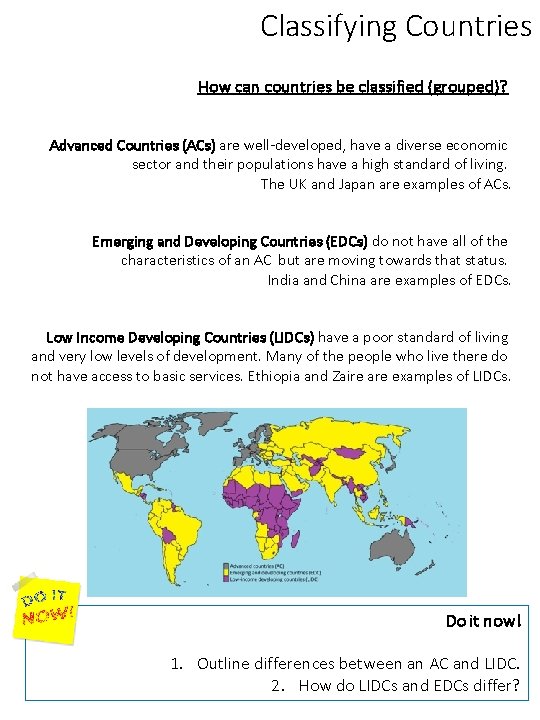
Classifying Countries How can countries be classified (grouped)? Advanced Countries (ACs) are well-developed, have a diverse economic sector and their populations have a high standard of living. The UK and Japan are examples of ACs. Emerging and Developing Countries (EDCs) do not have all of the characteristics of an AC but are moving towards that status. India and China are examples of EDCs. Low Income Developing Countries (LIDCs) have a poor standard of living and very low levels of development. Many of the people who live there do not have access to basic services. Ethiopia and Zaire are examples of LIDCs. Do it now! 1. Outline differences between an AC and LIDC. 2. How do LIDCs and EDCs differ?
Development Indicators What are development indicators? An indicator of development is something which can be used to measure the level of development within a country. These indicators become more reliable when used in conjunction with one another. Social development indicators Social indicators of development are related to people and quality of life: Life expectancy - The higher the life expectancy the more developed the healthcare within a country is. Literacy rate- The higher the literacy rate (the percentage of people who can read and write) the more developed the quality of education. The UK has a literacy rate of 99% amongst people over the age of 15. Number of doctors per 1000 people-The more doctors there are per 1000 people the better the quality of healthcare which increases life expectancy. The UK has 2. 8 doctors per 1000 people whereas Zaire has 1 doctor for every 50, 000 people. Infant mortality – The higher the infant mortality the poorer the quality of healthcare. Do it now! 1. Explain how social indicators are able to measure a country’s level of development. [4]
Development Indicators What are development indicators? An indicator of development is something which can be used to measure the level of development within a country. These indicators become more reliable when used in conjunction with one another. Economic development indicators Economic indicators of development are related to income. Employment type – the higher the number of people employed in the primary industry the lower the levels of development. Primary products are of low value and so exporting these products brings little income. Manufactured goods need to be imported at a cost and this leads to a trade deficit (where value of imports is greater than exports). GNI person – average income person per year – higher GNI links to tertiary and quaternary jobs and shows higher levels of development. Human Development Index (HDI) Using one stand alone indicator is regarded as unreliable and so using a series of indicators improves the reliability of the judgement. The Human Development Index (HDI) uses three indicators (a combination of social and economic indicators) and so is a composite indicator. It measures life expectancy, education and income per capita to give countries a ranking and a score from 0 to 1 (with 1 being the highest). Norway has the highest HDI score of 0. 95 and Zaire has the lowest HDI score of 0. 37. Do it now! 1. Explain how economic indicators are able to measure a country’s level of development. [4]
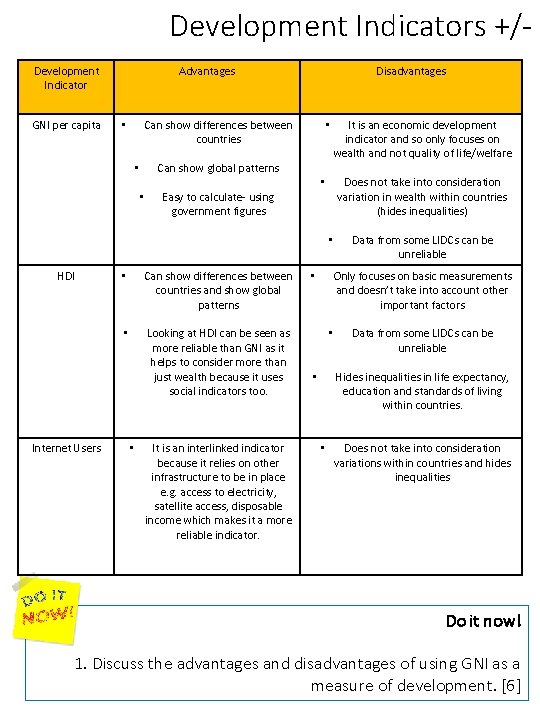
Development Indicators +/Development Indicator GNI per capita Advantages Disadvantages Can show differences between countries • • Can show global patterns • • It is an economic development indicator and so only focuses on wealth and not quality of life/welfare Does not take into consideration variation in wealth within countries (hides inequalities) • Easy to calculate- using government figures • HDI Internet Users • Can show differences between countries and show global patterns • Looking at HDI can be seen as more reliable than GNI as it helps to consider more than just wealth because it uses social indicators too. • It is an interlinked indicator because it relies on other infrastructure to be in place e. g. access to electricity, satellite access, disposable income which makes it a more reliable indicator. Data from some LIDCs can be unreliable Only focuses on basic measurements and doesn’t take into account other important factors • • Data from some LIDCs can be unreliable Hides inequalities in life expectancy, education and standards of living within countries. • • Does not take into consideration variations within countries and hides inequalities Do it now! 1. Discuss the advantages and disadvantages of using GNI as a measure of development. [6]
The Development Gap Development can be influenced by a number of physical (natural) and human factors. Some factors hinder and some increase development which explains why we have ACs and LIDCs which demonstrate a development gap. Physical causes of uneven development Climate • Reliability of rainfall influences agriculture and can create risks e. g. droughts/monsoons • Some climates will attract tourists (tropical beaches) and bring income to aid development • Extreme climates (such as hot/cold deserts) will limit industry and affect health Location and terrain • Landlocked countries may find trade with more distant countries difficult due to absence of ports • Steep mountainous terrain is difficult to build on and limits farming Natural resources • Access to safe water for health benefits • Availability of timber for fuel and construction • Fuel sources such as coal, oil and natural gas Natural hazards • Risk of earthquakes, tropical storms, volcanic activity and floods can limit development because the damage is costly to repair reducing investment in development • Benefits from volcanic ash- minerals and fertile soils Do it now! 1. Create a spider diagram that highlights how physical factors promote or hinder development.
The Development Gap Human causes of uneven development Colonialism is where one country goes to another and claims that they are in power. This happened from the sixteenth century to the mid-twentieth century where European powers colonised most of Africa in order to exploit raw materials using force. Raw materials were taken from Africa and transported to countries in Europe and so African countries (such as Gambia, Egypt and Kenya) could not use their resources to their own advantage to aid development. Exploitation of natural resources Humans manipulate natural environments in order to extract the resources we need for fuel, construction and industry. In the nineteenth century, the UK discovered large quantities of coal which generated wealth. This money was invested in education creating a skilled workforce. It was also spent on exploring other countries and colonising them and therefore finding new raw materials and making use of them. Politics Many countries which are LIDCS often have corrupt governments who use the countries money and resources for their own benefit instead of for the people. Do it now! 1. Physical factors are more important than human factors on promoting development in a country. Do you agree? [8]
Consequences of Uneven Development Health: Many LIDCs have high levels of infant mortality, high birth rates, low life expectancy levels and low numbers of doctors. These indicators can show levels of investment in health care, sanitation, food and water supply and education. Education: Literacy rates indicate how many people can read and write. Low literacy levels and low numbers of people attending school suggest investment in education is low. The UK’s literacy rate is 99% whereas Ethiopia's is 36%. How will this affect the Ethiopia's ability to develop? Standard of living: In LIDCs, a large number of people live in areas where there is poor infrastructure such as lack of running water and sanitation and a lack of adequate housing. In AC’s people live in houses with fresh water supplies and sanitation. How will this affect the development of those in an LIDC? Do it now! 1. Describe the consequences of uneven development. [4] 2. How can education affect a country develop?
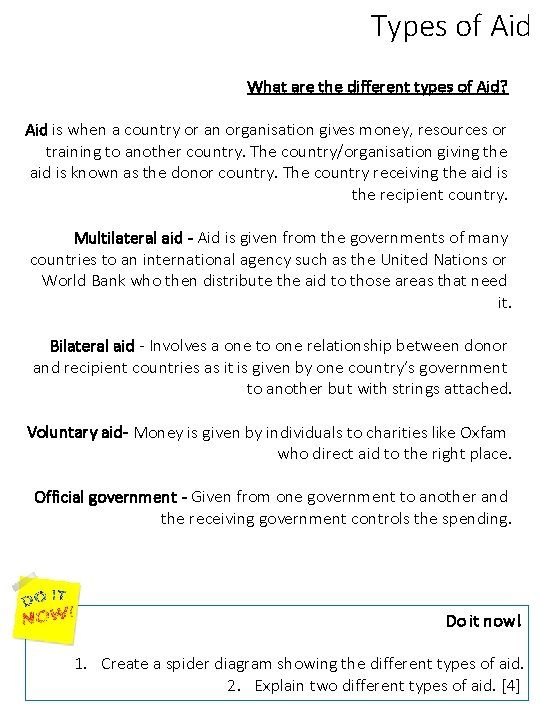
Types of Aid What are the different types of Aid? Aid is when a country or an organisation gives money, resources or training to another country. The country/organisation giving the aid is known as the donor country. The country receiving the aid is the recipient country. Multilateral aid - Aid is given from the governments of many countries to an international agency such as the United Nations or World Bank who then distribute the aid to those areas that need it. Bilateral aid - Involves a one to one relationship between donor and recipient countries as it is given by one country’s government to another but with strings attached. Voluntary aid- Money is given by individuals to charities like Oxfam who direct aid to the right place. Official government - Given from one government to another and the receiving government controls the spending. Do it now! 1. Create a spider diagram showing the different types of aid. 2. Explain two different types of aid. [4]
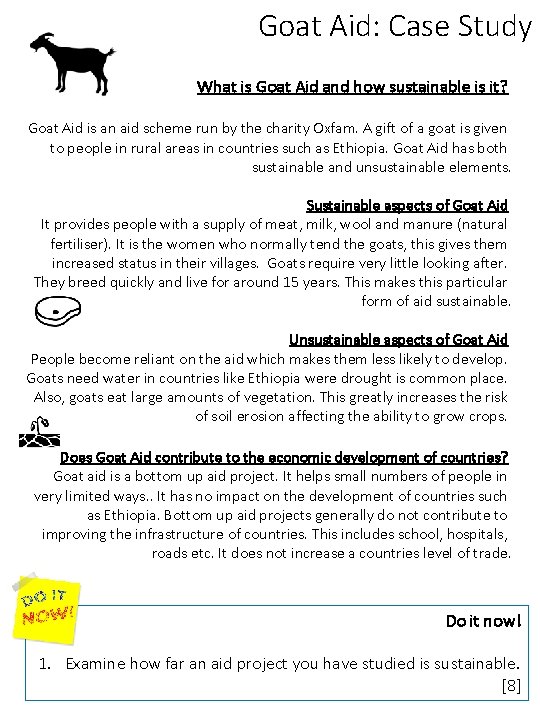
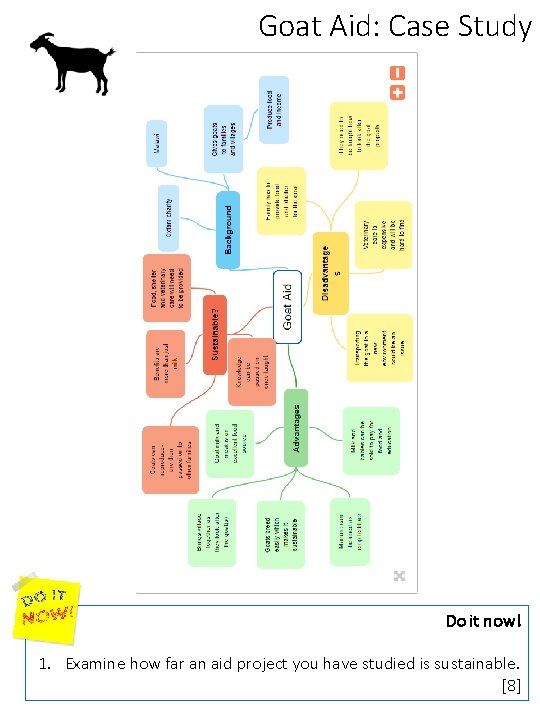
Goat Aid: Case Study What is Goat Aid and how sustainable is it? Goat Aid is an aid scheme run by the charity Oxfam. A gift of a goat is given to people in rural areas in countries such as Ethiopia. Goat Aid has both sustainable and unsustainable elements. Sustainable aspects of Goat Aid It provides people with a supply of meat, milk, wool and manure (natural fertiliser). It is the women who normally tend the goats, this gives them increased status in their villages. Goats require very little looking after. They breed quickly and live for around 15 years. This makes this particular form of aid sustainable. Unsustainable aspects of Goat Aid People become reliant on the aid which makes them less likely to develop. Goats need water in countries like Ethiopia were drought is common place. Also, goats eat large amounts of vegetation. This greatly increases the risk of soil erosion affecting the ability to grow crops. Does Goat Aid contribute to the economic development of countries? Goat aid is a bottom up aid project. It helps small numbers of people in very limited ways. . It has no impact on the development of countries such as Ethiopia. Bottom up aid projects generally do not contribute to improving the infrastructure of countries. This includes school, hospitals, roads etc. It does not increase a countries level of trade. Do it now! 1. Examine how far an aid project you have studied is sustainable. [8]
Goat Aid: Case Study Do it now! 1. Examine how far an aid project you have studied is sustainable. [8]
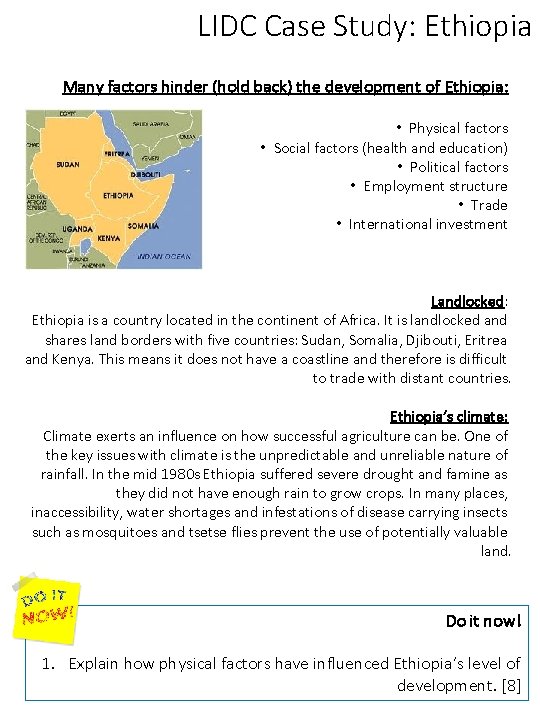
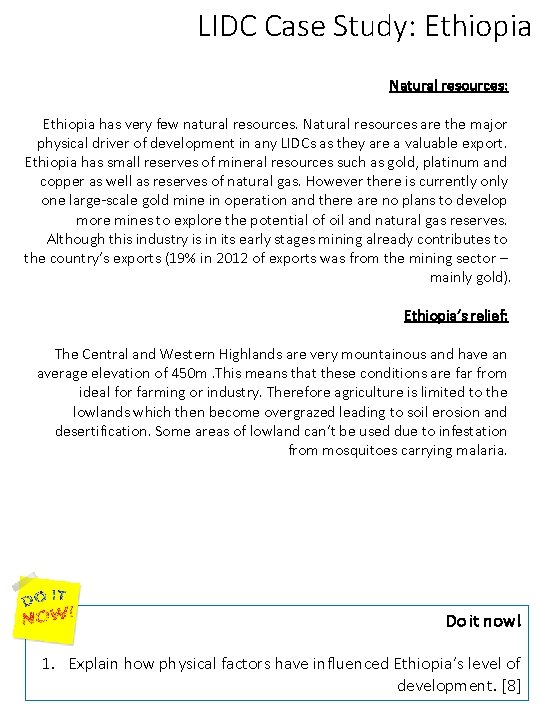
LIDC Case Study: Ethiopia Many factors hinder (hold back) the development of Ethiopia: • Physical factors • Social factors (health and education) • Political factors • Employment structure • Trade • International investment Landlocked: Ethiopia is a country located in the continent of Africa. It is landlocked and shares land borders with five countries: Sudan, Somalia, Djibouti, Eritrea and Kenya. This means it does not have a coastline and therefore is difficult to trade with distant countries. Ethiopia’s climate: Climate exerts an influence on how successful agriculture can be. One of the key issues with climate is the unpredictable and unreliable nature of rainfall. In the mid 1980 s Ethiopia suffered severe drought and famine as they did not have enough rain to grow crops. In many places, inaccessibility, water shortages and infestations of disease carrying insects such as mosquitoes and tsetse flies prevent the use of potentially valuable land. Do it now! 1. Explain how physical factors have influenced Ethiopia’s level of development. [8]
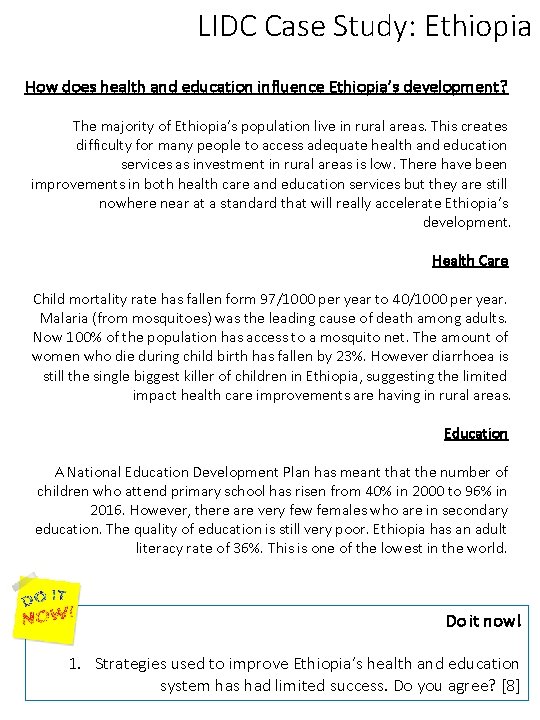
LIDC Case Study: Ethiopia Natural resources: Ethiopia has very few natural resources. Natural resources are the major physical driver of development in any LIDCs as they are a valuable export. Ethiopia has small reserves of mineral resources such as gold, platinum and copper as well as reserves of natural gas. However there is currently one large-scale gold mine in operation and there are no plans to develop more mines to explore the potential of oil and natural gas reserves. Although this industry is in its early stages mining already contributes to the country’s exports (19% in 2012 of exports was from the mining sector – mainly gold). Ethiopia’s relief: The Central and Western Highlands are very mountainous and have an average elevation of 450 m. This means that these conditions are far from ideal for farming or industry. Therefore agriculture is limited to the lowlands which then become overgrazed leading to soil erosion and desertification. Some areas of lowland can’t be used due to infestation from mosquitoes carrying malaria. Do it now! 1. Explain how physical factors have influenced Ethiopia’s level of development. [8]
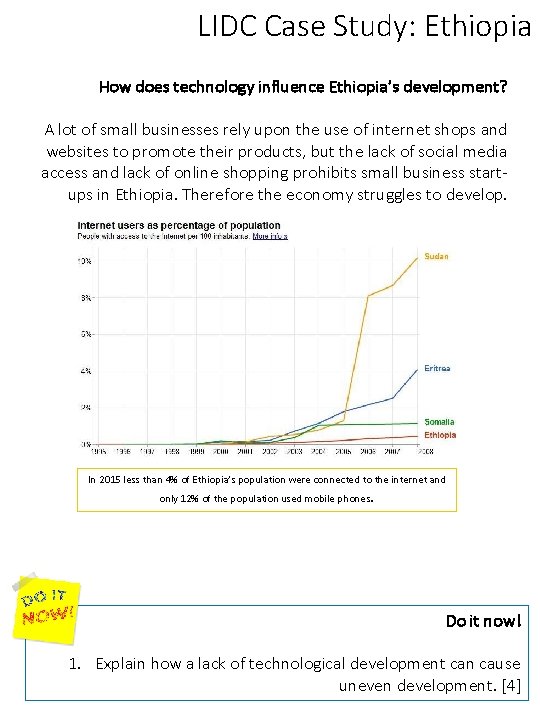
LIDC Case Study: Ethiopia How does health and education influence Ethiopia’s development? The majority of Ethiopia’s population live in rural areas. This creates difficulty for many people to access adequate health and education services as investment in rural areas is low. There have been improvements in both health care and education services but they are still nowhere near at a standard that will really accelerate Ethiopia’s development. Health Care Child mortality rate has fallen form 97/1000 per year to 40/1000 per year. Malaria (from mosquitoes) was the leading cause of death among adults. Now 100% of the population has access to a mosquito net. The amount of women who die during child birth has fallen by 23%. However diarrhoea is still the single biggest killer of children in Ethiopia, suggesting the limited impact health care improvements are having in rural areas. Education A National Education Development Plan has meant that the number of children who attend primary school has risen from 40% in 2000 to 96% in 2016. However, there are very few females who are in secondary education. The quality of education is still very poor. Ethiopia has an adult literacy rate of 36%. This is one of the lowest in the world. Do it now! 1. Strategies used to improve Ethiopia’s health and education system has had limited success. Do you agree? [8]
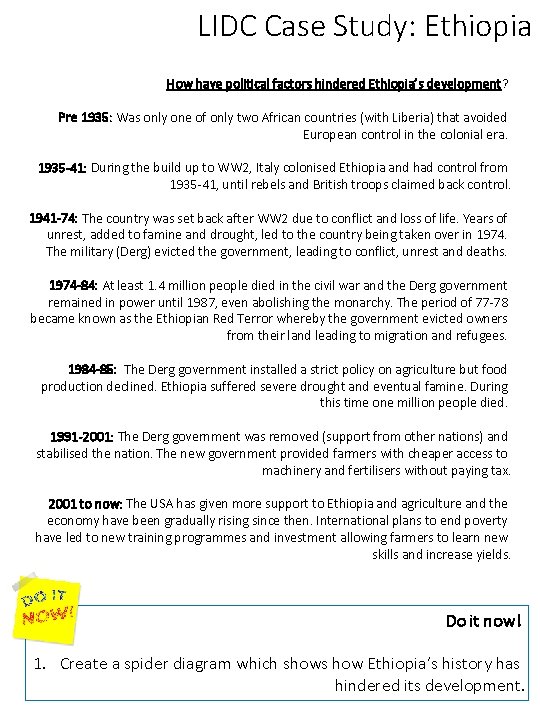
LIDC Case Study: Ethiopia How does technology influence Ethiopia’s development? A lot of small businesses rely upon the use of internet shops and websites to promote their products, but the lack of social media access and lack of online shopping prohibits small business startups in Ethiopia. Therefore the economy struggles to develop. In 2015 less than 4% of Ethiopia’s population were connected to the internet and only 12% of the population used mobile phones . Do it now! 1. Explain how a lack of technological development can cause uneven development. [4]
LIDC Case Study: Ethiopia How have political factors hindered Ethiopia’s development? Pre 1935: Was only one of only two African countries (with Liberia) that avoided European control in the colonial era. 1935 -41: During the build up to WW 2, Italy colonised Ethiopia and had control from 1935 -41, until rebels and British troops claimed back control. 1941 -74: The country was set back after WW 2 due to conflict and loss of life. Years of unrest, added to famine and drought, led to the country being taken over in 1974. The military (Derg) evicted the government, leading to conflict, unrest and deaths. 1974 -84: At least 1. 4 million people died in the civil war and the Derg government remained in power until 1987, even abolishing the monarchy. The period of 77 -78 became known as the Ethiopian Red Terror whereby the government evicted owners from their land leading to migration and refugees. 1984 -85: The Derg government installed a strict policy on agriculture but food production declined. Ethiopia suffered severe drought and eventual famine. During this time one million people died. 1991 -2001: The Derg government was removed (support from other nations) and stabilised the nation. The new government provided farmers with cheaper access to machinery and fertilisers without paying tax. 2001 to now: The USA has given more support to Ethiopia and agriculture and the economy have been gradually rising since then. International plans to end poverty have led to new training programmes and investment allowing farmers to learn new skills and increase yields. Do it now! 1. Create a spider diagram which shows how Ethiopia’s history has hindered its development.
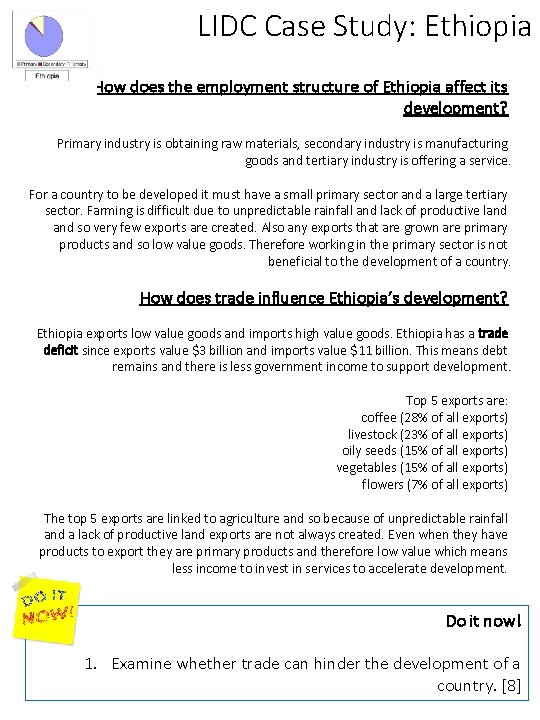
LIDC Case Study: Ethiopia How does the employment structure of Ethiopia affect its development? Primary industry is obtaining raw materials, secondary industry is manufacturing goods and tertiary industry is offering a service. For a country to be developed it must have a small primary sector and a large tertiary sector. Farming is difficult due to unpredictable rainfall and lack of productive land so very few exports are created. Also any exports that are grown are primary products and so low value goods. Therefore working in the primary sector is not beneficial to the development of a country. How does trade influence Ethiopia’s development? Ethiopia exports low value goods and imports high value goods. Ethiopia has a trade deficit since exports value $3 billion and imports value $11 billion. This means debt remains and there is less government income to support development. Top 5 exports are: coffee (28% of all exports) livestock (23% of all exports) oily seeds (15% of all exports) vegetables (15% of all exports) flowers (7% of all exports) The top 5 exports are linked to agriculture and so because of unpredictable rainfall and a lack of productive land exports are not always created. Even when they have products to export they are primary products and therefore low value which means less income to invest in services to accelerate development. Do it now! 1. Examine whether trade can hinder the development of a country. [8]
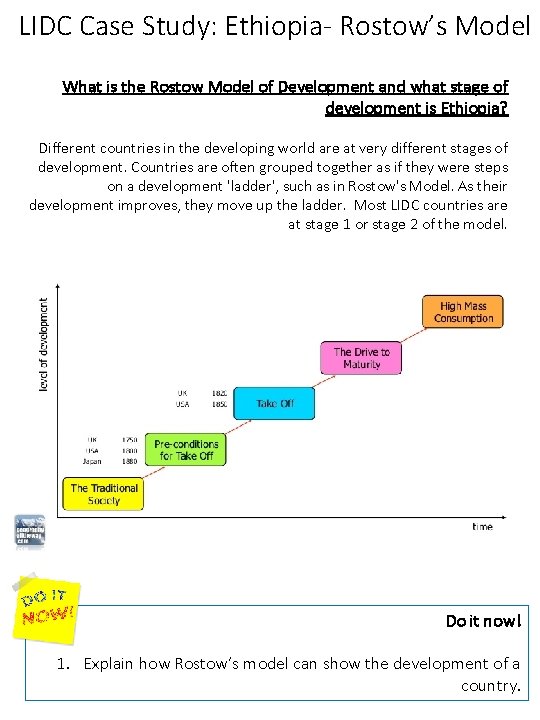
LIDC Case Study: Ethiopia- Rostow’s Model What is the Rostow Model of Development and what stage of development is Ethiopia? Different countries in the developing world are at very different stages of development. Countries are often grouped together as if they were steps on a development 'ladder', such as in Rostow's Model. As their development improves, they move up the ladder. Most LIDC countries are at stage 1 or stage 2 of the model. Do it now! 1. Explain how Rostow’s model can show the development of a country.
LIDC Case Study: Ethiopia- Rostow’s Model Traditional Society: Natural resources are collected to meet an individual’s basic need for survival (subsistence) and very little extra for trade. Primary industries such as farming dominate. The economy is very vulnerable to factors such as climate. Preconditions to Take-off: People are beginning to have surplus products they can trade and infrastructure to support trade (roads) is being developed. Agriculture still dominates but now becomes more commercial (producing goods to sell) which creates profit which can be invested into improving development. Secondary industries such as manufacturing start to take off and governments encourage investment from TNCs. Take-off: Secondary manufacturing dominates which increases wealth and the government invests in welfare services such as education and healthcare. Rural to urban migration occurs as workers move away from primary jobs and into secondary jobs (factories) which are located in cities. TNCs often dominate the economy which causes the country to depend on them for investment and jobs and as a result exploitation of workers may occur. However TNCs also brings wealth and investment in infrastructure which attracts more industry and in turn more wealth. Drive to Maturity: Due to investment in education the quality of education improves and aspirations rise and so employment changes and more people become involved in tertiary industry. Very few people work in primary industries as resources can often be imported cheaply from elsewhere. Age of High Mass Consumption: Tertiary and quaternary jobs now dominate the economy due to improved education. As the population becomes wealthier there is more consumption (buying of goods) which leads to the multiplier effect (spread of wealth). Do it now! 1. Explain how Rostow’s model can show the development of a country.
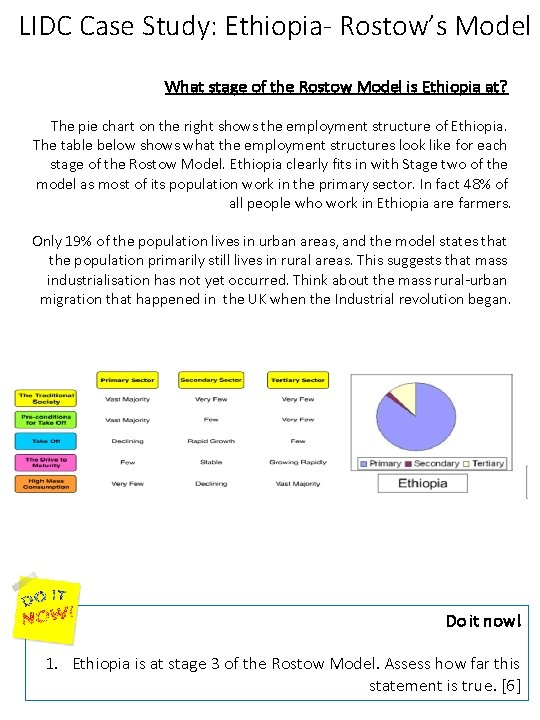
LIDC Case Study: Ethiopia- Rostow’s Model What stage of the Rostow Model is Ethiopia at? The pie chart on the right shows the employment structure of Ethiopia. The table below shows what the employment structures look like for each stage of the Rostow Model. Ethiopia clearly fits in with Stage two of the model as most of its population work in the primary sector. In fact 48% of all people who work in Ethiopia are farmers. Only 19% of the population lives in urban areas, and the model states that the population primarily still lives in rural areas. This suggests that mass industrialisation has not yet occurred. Think about the mass rural-urban migration that happened in the UK when the Industrial revolution began. Do it now! 1. Ethiopia is at stage 3 of the Rostow Model. Assess how far this statement is true. [6]
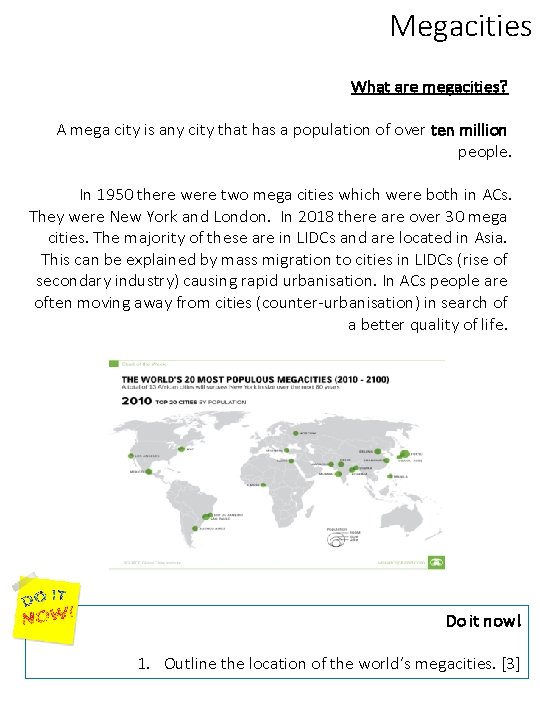
Megacities What are megacities? A mega city is any city that has a population of over ten million people. In 1950 there were two mega cities which were both in ACs. They were New York and London. In 2018 there are over 30 mega cities. The majority of these are in LIDCs and are located in Asia. This can be explained by mass migration to cities in LIDCs (rise of secondary industry) causing rapid urbanisation. In ACs people are often moving away from cities (counter-urbanisation) in search of a better quality of life. Do it now! 1. Outline the location of the world’s megacities. [3]
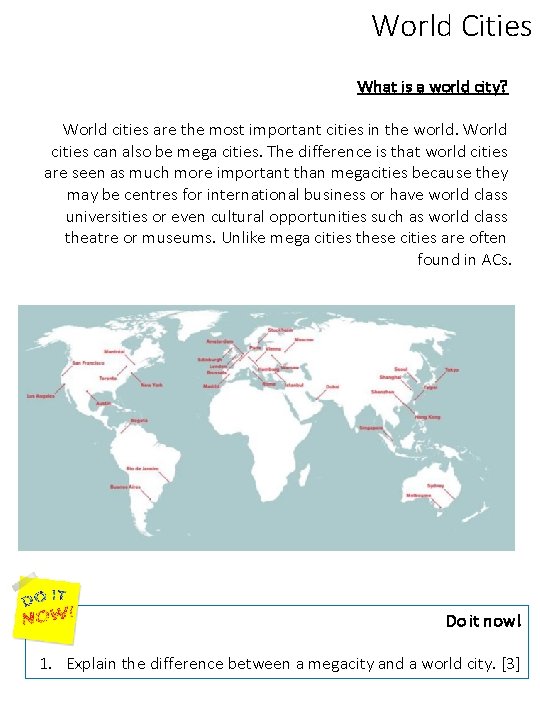
World Cities What is a world city? World cities are the most important cities in the world. World cities can also be mega cities. The difference is that world cities are seen as much more important than megacities because they may be centres for international business or have world class universities or even cultural opportunities such as world class theatre or museums. Unlike mega cities these cities are often found in ACs. Do it now! 1. Explain the difference between a megacity and a world city. [3]
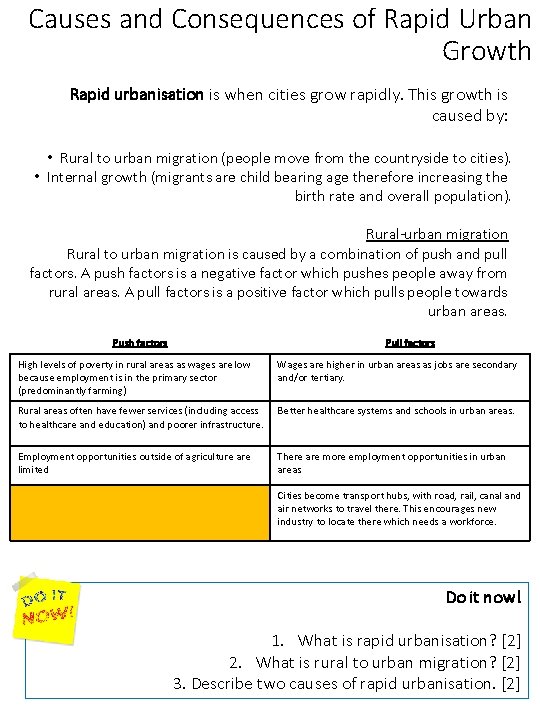
Causes and Consequences of Rapid Urban Growth Rapid urbanisation is when cities grow rapidly. This growth is caused by: • Rural to urban migration (people move from the countryside to cities). • Internal growth (migrants are child bearing age therefore increasing the birth rate and overall population). Rural-urban migration Rural to urban migration is caused by a combination of push and pull factors. A push factors is a negative factor which pushes people away from rural areas. A pull factors is a positive factor which pulls people towards urban areas. Push factors Pull factors High levels of poverty in rural areas as wages are low because employment is in the primary sector (predominantly farming) Wages are higher in urban areas as jobs are secondary and/or tertiary. Rural areas often have fewer services (including access to healthcare and education) and poorer infrastructure. Better healthcare systems and schools in urban areas. Employment opportunities outside of agriculture are limited There are more employment opportunities in urban areas Cities become transport hubs, with road, rail, canal and air networks to travel there. This encourages new industry to locate there which needs a workforce. Do it now! 1. What is rapid urbanisation? [2] 2. What is rural to urban migration? [2] 3. Describe two causes of rapid urbanisation. [2]
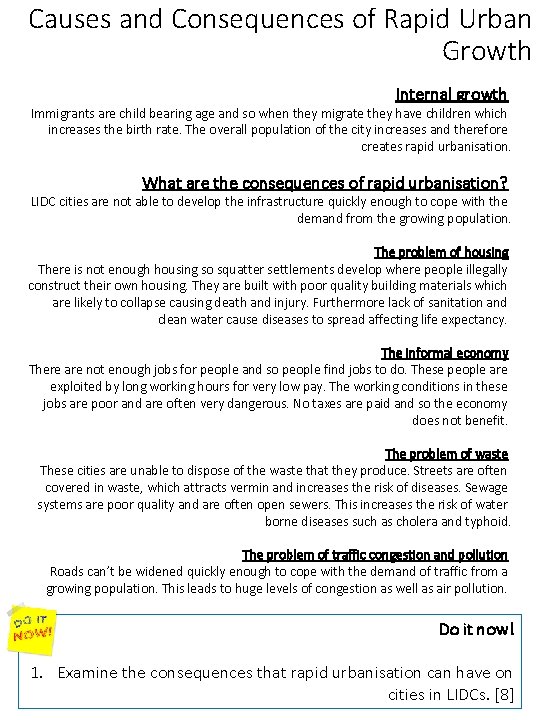
Causes and Consequences of Rapid Urban Growth Internal growth Immigrants are child bearing age and so when they migrate they have children which increases the birth rate. The overall population of the city increases and therefore creates rapid urbanisation. What are the consequences of rapid urbanisation? LIDC cities are not able to develop the infrastructure quickly enough to cope with the demand from the growing population. The problem of housing There is not enough housing so squatter settlements develop where people illegally construct their own housing. They are built with poor quality building materials which are likely to collapse causing death and injury. Furthermore lack of sanitation and clean water cause diseases to spread affecting life expectancy. The informal economy There are not enough jobs for people and so people find jobs to do. These people are exploited by long working hours for very low pay. The working conditions in these jobs are poor and are often very dangerous. No taxes are paid and so the economy does not benefit. The problem of waste These cities are unable to dispose of the waste that they produce. Streets are often covered in waste, which attracts vermin and increases the risk of diseases. Sewage systems are poor quality and are often open sewers. This increases the risk of water borne diseases such as cholera and typhoid. The problem of traffic congestion and pollution Roads can’t be widened quickly enough to cope with the demand of traffic from a growing population. This leads to huge levels of congestion as well as air pollution. Do it now! 1. Examine the consequences that rapid urbanisation can have on cities in LIDCs. [8]
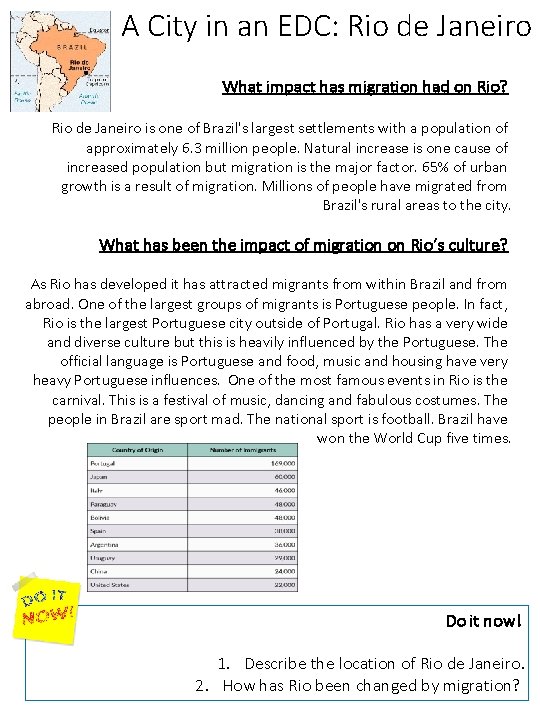
A City in an EDC: Rio de Janeiro What impact has migration had on Rio? Rio de Janeiro is one of Brazil's largest settlements with a population of approximately 6. 3 million people. Natural increase is one cause of increased population but migration is the major factor. 65% of urban growth is a result of migration. Millions of people have migrated from Brazil's rural areas to the city. What has been the impact of migration on Rio’s culture? As Rio has developed it has attracted migrants from within Brazil and from abroad. One of the largest groups of migrants is Portuguese people. In fact, Rio is the largest Portuguese city outside of Portugal. Rio has a very wide and diverse culture but this is heavily influenced by the Portuguese. The official language is Portuguese and food, music and housing have very heavy Portuguese influences. One of the most famous events in Rio is the carnival. This is a festival of music, dancing and fabulous costumes. The people in Brazil are sport mad. The national sport is football. Brazil have won the World Cup five times. Do it now! 1. Describe the location of Rio de Janeiro. 2. How has Rio been changed by migration?
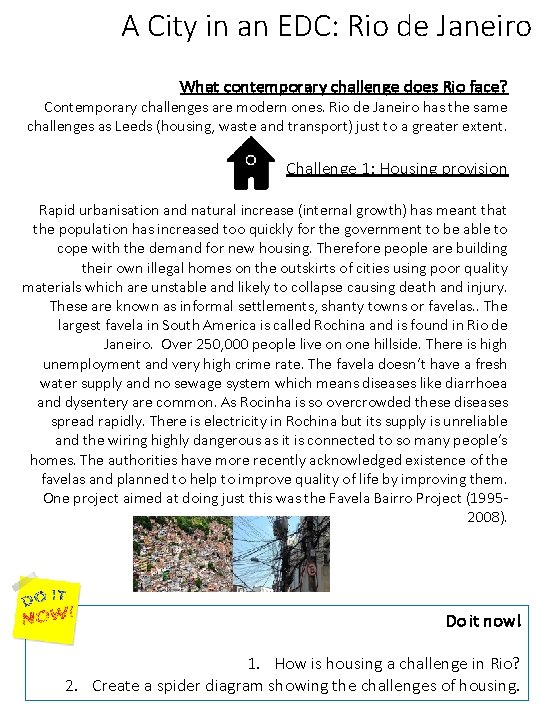
A City in an EDC: Rio de Janeiro What contemporary challenge does Rio face? Contemporary challenges are modern ones. Rio de Janeiro has the same challenges as Leeds (housing, waste and transport) just to a greater extent. Challenge 1: Housing provision Rapid urbanisation and natural increase (internal growth) has meant that the population has increased too quickly for the government to be able to cope with the demand for new housing. Therefore people are building their own illegal homes on the outskirts of cities using poor quality materials which are unstable and likely to collapse causing death and injury. These are known as informal settlements, shanty towns or favelas. . The largest favela in South America is called Rochina and is found in Rio de Janeiro. Over 250, 000 people live on one hillside. There is high unemployment and very high crime rate. The favela doesn’t have a fresh water supply and no sewage system which means diseases like diarrhoea and dysentery are common. As Rocinha is so overcrowded these diseases spread rapidly. There is electricity in Rochina but its supply is unreliable and the wiring highly dangerous as it is connected to so many people’s homes. The authorities have more recently acknowledged existence of the favelas and planned to help to improve quality of life by improving them. One project aimed at doing just this was the Favela Bairro Project (19952008). Do it now! 1. How is housing a challenge in Rio? 2. Create a spider diagram showing the challenges of housing.
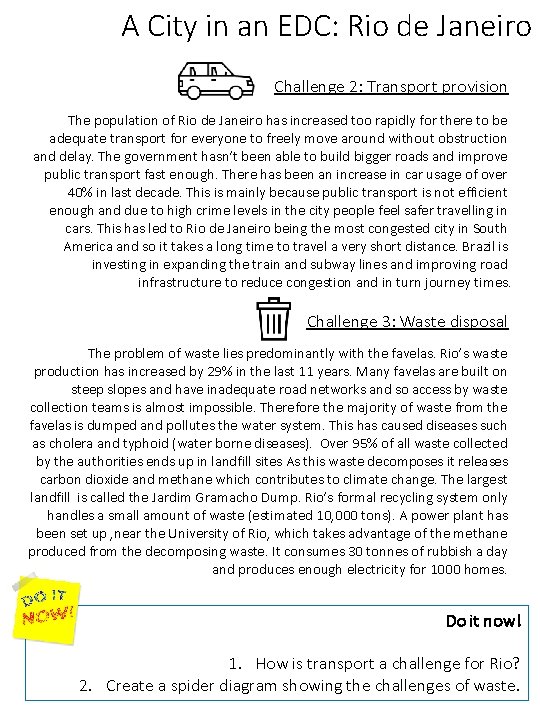
A City in an EDC: Rio de Janeiro Challenge 2: Transport provision The population of Rio de Janeiro has increased too rapidly for there to be adequate transport for everyone to freely move around without obstruction and delay. The government hasn’t been able to build bigger roads and improve public transport fast enough. There has been an increase in car usage of over 40% in last decade. This is mainly because public transport is not efficient enough and due to high crime levels in the city people feel safer travelling in cars. This has led to Rio de Janeiro being the most congested city in South America and so it takes a long time to travel a very short distance. Brazil is investing in expanding the train and subway lines and improving road infrastructure to reduce congestion and in turn journey times. Challenge 3: Waste disposal The problem of waste lies predominantly with the favelas. Rio’s waste production has increased by 29% in the last 11 years. Many favelas are built on steep slopes and have inadequate road networks and so access by waste collection teams is almost impossible. Therefore the majority of waste from the favelas is dumped and pollutes the water system. This has caused diseases such as cholera and typhoid (water borne diseases). Over 95% of all waste collected by the authorities ends up in landfill sites As this waste decomposes it releases carbon dioxide and methane which contributes to climate change. The largest landfill is called the Jardim Gramacho Dump. Rio’s formal recycling system only handles a small amount of waste (estimated 10, 000 tons). A power plant has been set up , near the University of Rio, which takes advantage of the methane produced from the decomposing waste. It consumes 30 tonnes of rubbish a day and produces enough electricity for 1000 homes. Do it now! 1. How is transport a challenge for Rio? 2. Create a spider diagram showing the challenges of waste.
A City in an EDC: Rio de Janeiro Case Study – a city in an EDC/LIDC Name of EDC/LIDC city: . . . . . Housing provision is the greatest contemporary challenge facing a city in an EDC/LIDC. To what extent do you agree? [8]
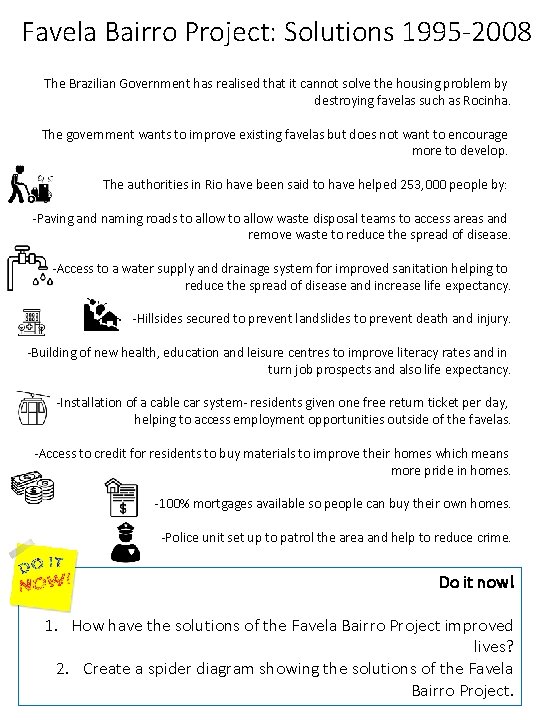
Favela Bairro Project: Solutions 1995 -2008 The Brazilian Government has realised that it cannot solve the housing problem by destroying favelas such as Rocinha. The government wants to improve existing favelas but does not want to encourage more to develop. The authorities in Rio have been said to have helped 253, 000 people by: -Paving and naming roads to allow waste disposal teams to access areas and remove waste to reduce the spread of disease. -Access to a water supply and drainage system for improved sanitation helping to reduce the spread of disease and increase life expectancy. -Hillsides secured to prevent landslides to prevent death and injury. -Building of new health, education and leisure centres to improve literacy rates and in turn job prospects and also life expectancy. -Installation of a cable car system- residents given one free return ticket per day, helping to access employment opportunities outside of the favelas. -Access to credit for residents to buy materials to improve their homes which means more pride in homes. -100% mortgages available so people can buy their own homes. -Police unit set up to patrol the area and help to reduce crime. Do it now! 1. How have the solutions of the Favela Bairro Project improved lives? 2. Create a spider diagram showing the solutions of the Favela Bairro Project.
Favela Bairro Project: Solutions 1995 -2008 The project is said to have both successes and failures. § The quality of life, mobility and employment prospects of the residents have been improved due to the development of the favela. • It has been recognised by the UN as a useful model. However, it has not been a complete success because there are still problems: • The newly built infrastructure is not being maintained. • The quality of work and materials used has been questioned- one home in Acari has received new concrete walls on 4 occasions. • Residents lack skills and resources to make repairs. • More training is needed to improve literacy and employment. • Rents rise in improved favelas, leaving the poorest people worse off. • Total cost over the two phases of R$1. 2 billion. Do it now! 1. Is the Favela Bairro Project successful? Why? 2. Create flash cards to show the advantages and disadvantages.
A City in an EDC: Rio de Janeiro Case Study – a city in an EDC/LIDC Name of EDC/LIDC city: . . . . . Examine how far strategies used to overcome housing, traffic and/or waste issues, in cities in LIDCs or EDCs are sustainable. [12]