
Development Through the Lifespan Insert new cover art


- Slides: 41
Development Through the Lifespan (Insert new cover art) Chapter 11 Physical and Cognitive Development in Adolescence This multimedia product and its contents are protected under copyright law. The following are prohibited by law: n Any public performance or display, including transmission of any image over a network; n Preparation of any derivative work, including the extraction, in whole or in part, of any images; n Any rental, lease, or lending of the program. Copyright © 2010 Pearson Education, Inc. All Rights Reserved.
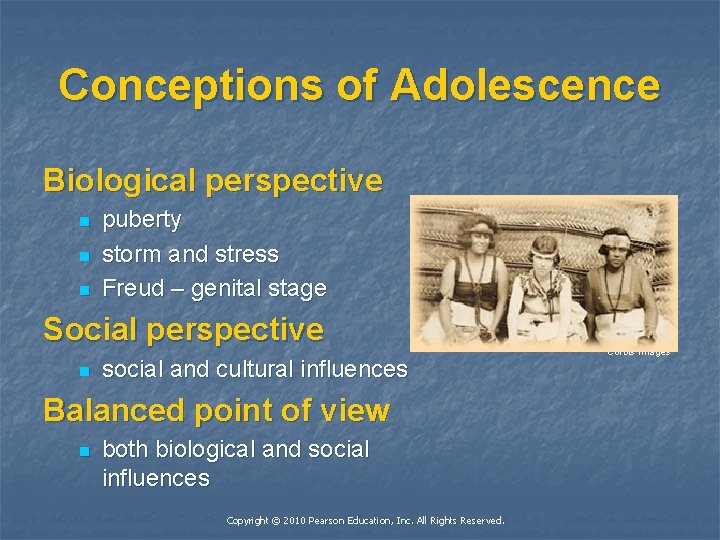
Conceptions of Adolescence Biological perspective n n n puberty storm and stress Freud – genital stage Social perspective n social and cultural influences Balanced point of view n both biological and social influences Copyright © 2010 Pearson Education, Inc. All Rights Reserved. Corbis Images
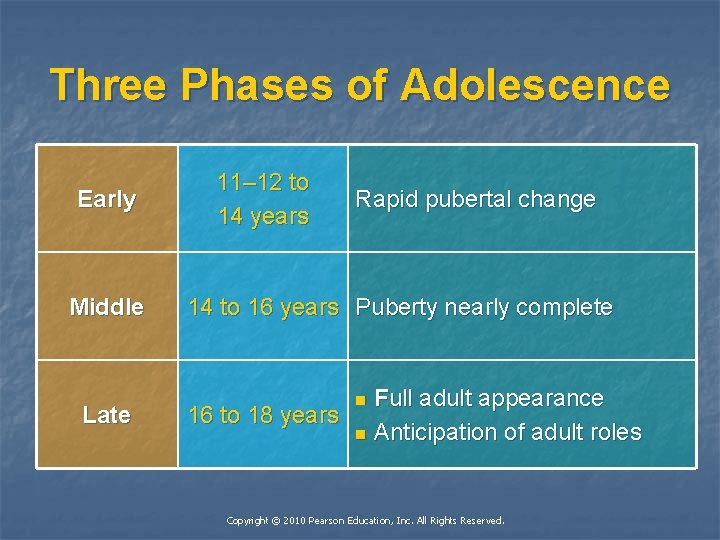
Three Phases of Adolescence Early Middle Late 11– 12 to 14 years Rapid pubertal change 14 to 16 years Puberty nearly complete Full adult appearance 16 to 18 years n Anticipation of adult roles n Copyright © 2010 Pearson Education, Inc. All Rights Reserved.
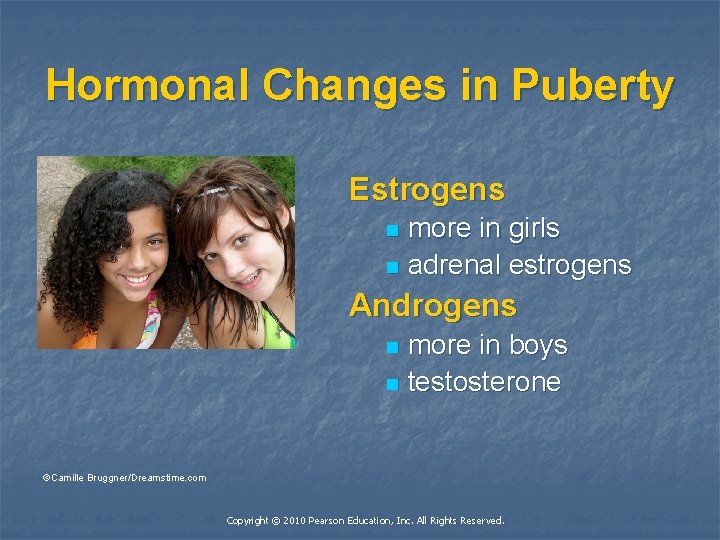
Hormonal Changes in Puberty Estrogens more in girls n adrenal estrogens n Androgens more in boys n testosterone n ©Camille Bruggner/Dreamstime. com Copyright © 2010 Pearson Education, Inc. All Rights Reserved.
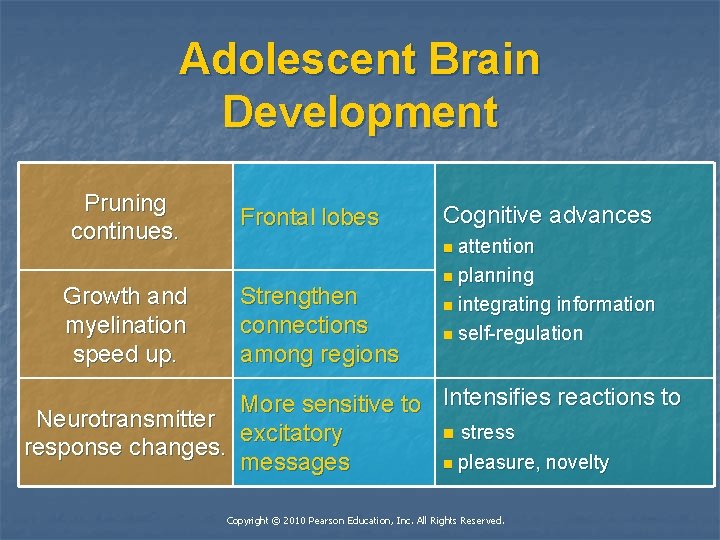
Adolescent Brain Development Pruning continues. Growth and myelination speed up. Frontal lobes Cognitive advances attention n planning n integrating information n self-regulation n Strengthen connections among regions More sensitive to Intensifies reactions to Neurotransmitter n stress excitatory response changes. n pleasure, novelty messages Copyright © 2010 Pearson Education, Inc. All Rights Reserved.
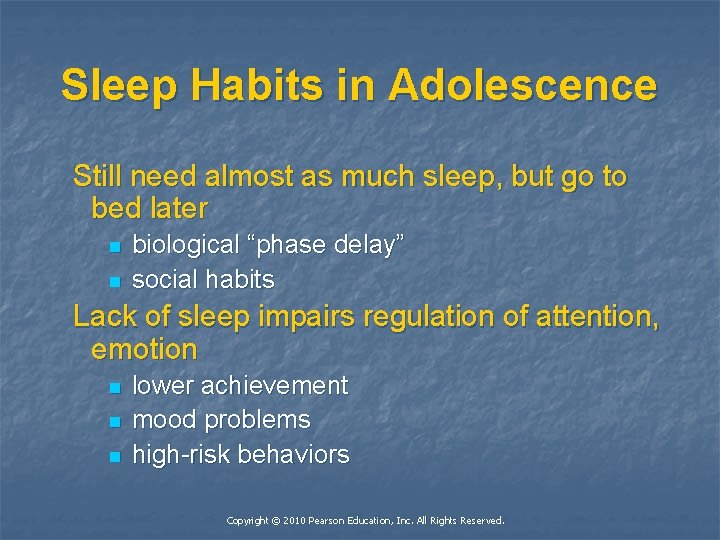
Sleep Habits in Adolescence Still need almost as much sleep, but go to bed later n n biological “phase delay” social habits Lack of sleep impairs regulation of attention, emotion n lower achievement mood problems high-risk behaviors Copyright © 2010 Pearson Education, Inc. All Rights Reserved.
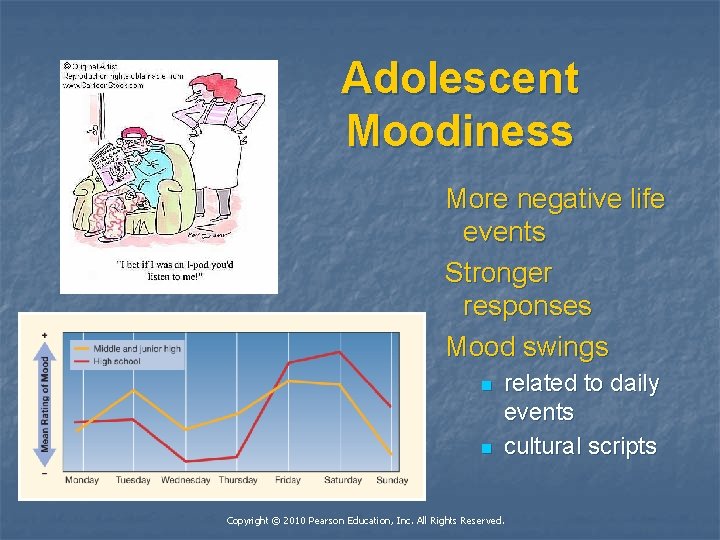
Adolescent Moodiness More negative life events Stronger responses Mood swings n ©Joe Mercier/Dreamstime. com n related to daily events cultural scripts Copyright © 2010 Pearson Education, Inc. All Rights Reserved.
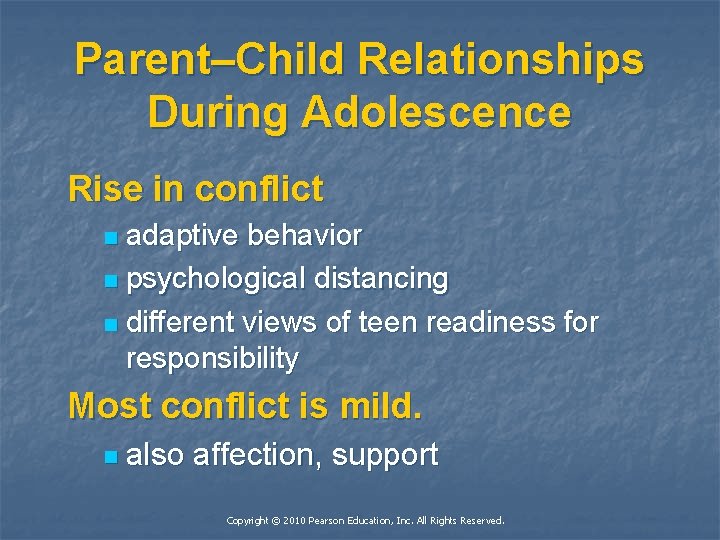
Parent–Child Relationships During Adolescence Rise in conflict adaptive behavior n psychological distancing n different views of teen readiness for responsibility n Most conflict is mild. n also affection, support Copyright © 2010 Pearson Education, Inc. All Rights Reserved.
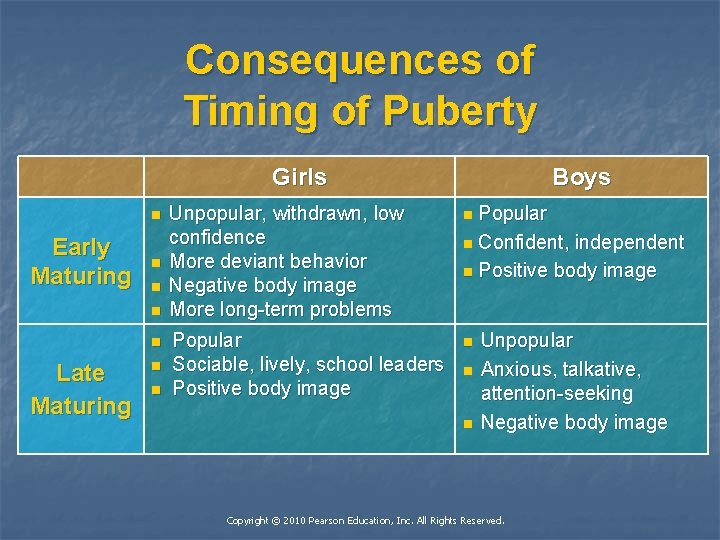
Consequences of Timing of Puberty Girls n Early Maturing n n Late Maturing n n Boys Unpopular, withdrawn, low confidence More deviant behavior Negative body image More long-term problems n Popular n Confident, independent n Positive body image Popular Sociable, lively, school leaders Positive body image n n n Unpopular Anxious, talkative, attention-seeking Negative body image Copyright © 2010 Pearson Education, Inc. All Rights Reserved.
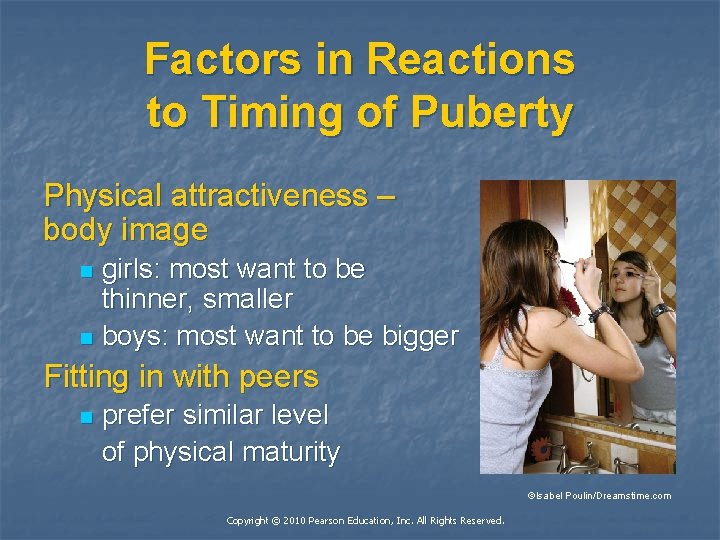
Factors in Reactions to Timing of Puberty Physical attractiveness – body image girls: most want to be thinner, smaller n boys: most want to be bigger n Fitting in with peers n prefer similar level of physical maturity ©Isabel Poulin/Dreamstime. com Copyright © 2010 Pearson Education, Inc. All Rights Reserved.
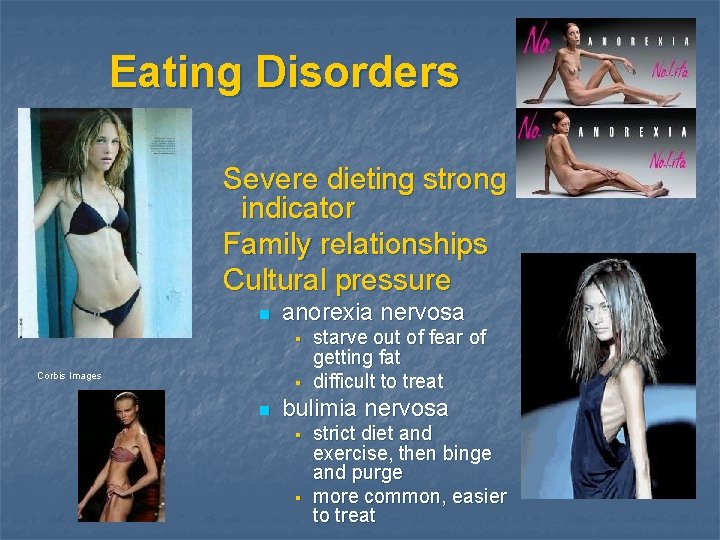
Eating Disorders Severe dieting strong indicator Family relationships Cultural pressure n anorexia nervosa § Corbis Images § n starve out of fear of getting fat difficult to treat bulimia nervosa § § strict diet and exercise, then binge and purge more common, easier to treat
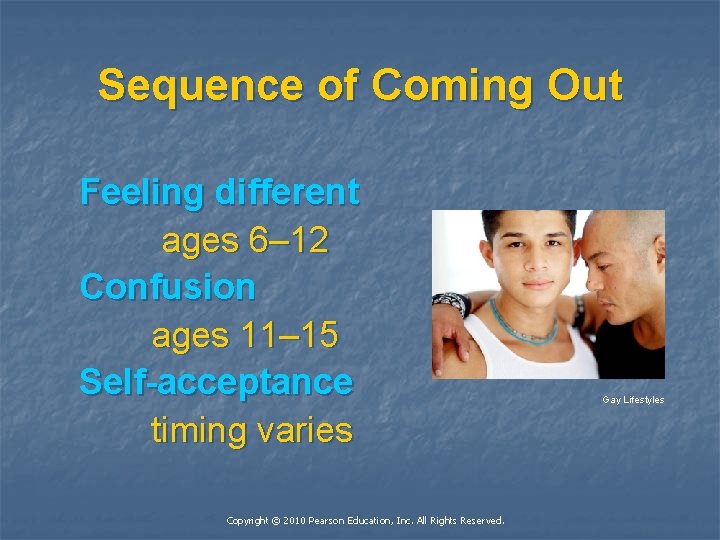
Sequence of Coming Out Feeling different ages 6– 12 Confusion ages 11– 15 Self-acceptance timing varies Copyright © 2010 Pearson Education, Inc. All Rights Reserved. Gay Lifestyles
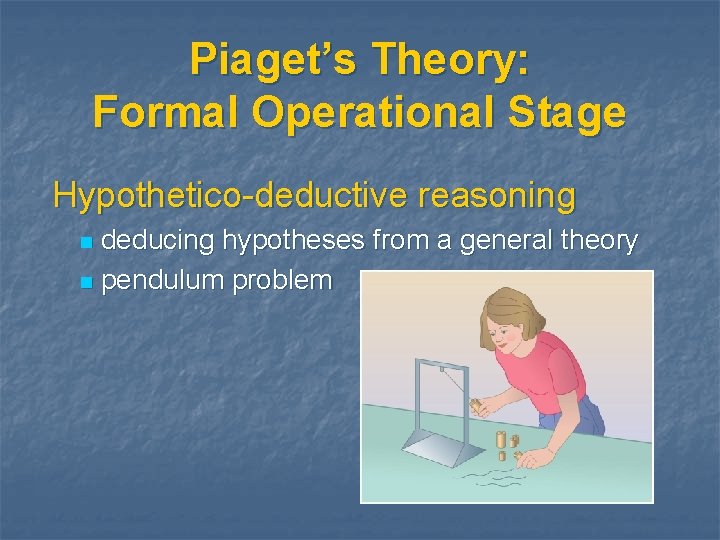
Piaget’s Theory: Formal Operational Stage Hypothetico-deductive reasoning deducing hypotheses from a general theory n pendulum problem n
Formal Operational Stage Propositional thought evaluating the logic of verbal propositions n Either the chip in my hand is green or it is not green n The chip in my hand is green and it is not green n Chip hidden – n Chip visible – if green? If red? n n True or false?
Follow-Up Research on Formal Operational Thought School-age children start developing abstract thinking skills. n problems with propositional thinking n logical necessity If dogs are bigger than elephants and elephants are bigger than mice, then dogs are bigger than mice Logic of propositions irrespective of contents Copyright © 2010 Pearson Education, Inc. All Rights Reserved.
Follow-Up Research on Formal Operational Thought Formal operations may not be universal. n training, context contribute n often fall back on easier thinking n schooling essential factor Copyright © 2010 Pearson Education, Inc. All Rights Reserved.
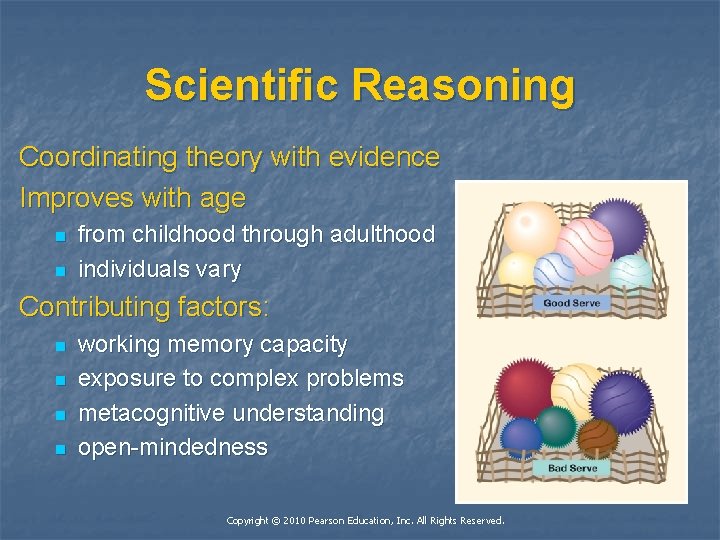
Scientific Reasoning Coordinating theory with evidence Improves with age n n from childhood through adulthood individuals vary Contributing factors: n n working memory capacity exposure to complex problems metacognitive understanding open-mindedness Photodisc Copyright © 2010 Pearson Education, Inc. All Rights Reserved.
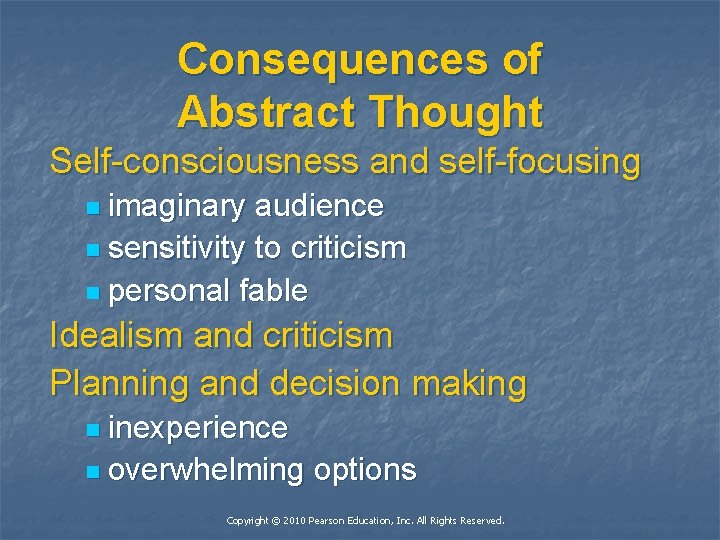
Consequences of Abstract Thought Self-consciousness and self-focusing n imaginary audience n sensitivity to criticism n personal fable Idealism and criticism Planning and decision making n inexperience n overwhelming options Copyright © 2010 Pearson Education, Inc. All Rights Reserved.
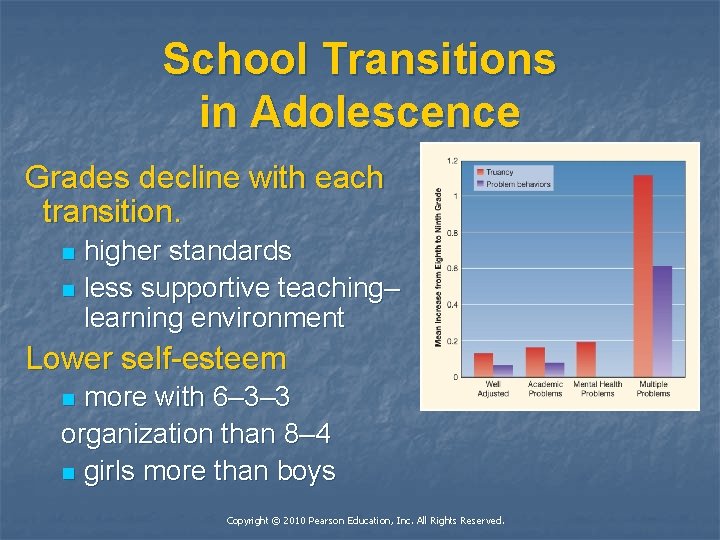
School Transitions in Adolescence Grades decline with each transition. higher standards n less supportive teaching– learning environment n Lower self-esteem more with 6– 3– 3 organization than 8– 4 n girls more than boys n Copyright © 2010 Pearson Education, Inc. All Rights Reserved. Corbis Images
Development Through the Lifespan (Insert new cover art) Chapter 12 Emotional and Social Development in Adolescence This multimedia product and its contents are protected under copyright law. The following are prohibited by law: n Any public performance or display, including transmission of any image over a network; n Preparation of any derivative work, including the extraction, in whole or in part, of any images; n Any rental, lease, or lending of the program. Copyright © 2010 Pearson Education, Inc. All Rights Reserved.
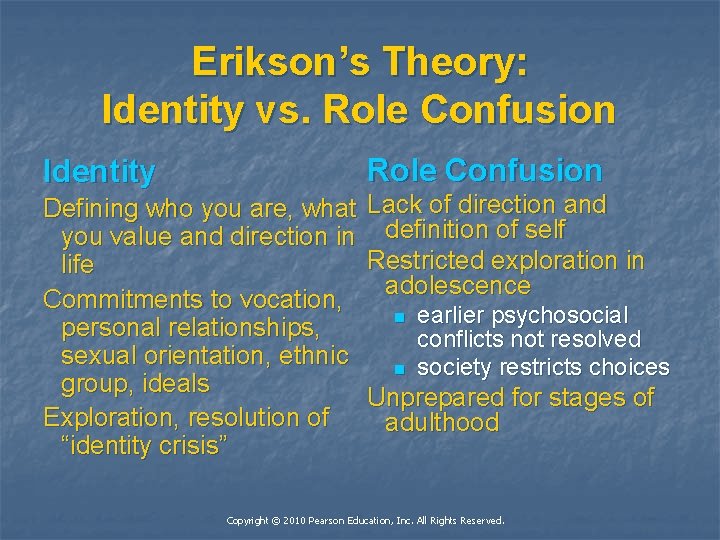
Erikson’s Theory: Identity vs. Role Confusion Identity Role Confusion Defining who you are, what Lack of direction and you value and direction in definition of self Restricted exploration in life adolescence Commitments to vocation, n earlier psychosocial personal relationships, conflicts not resolved sexual orientation, ethnic n society restricts choices group, ideals Unprepared for stages of Exploration, resolution of adulthood “identity crisis” Copyright © 2010 Pearson Education, Inc. All Rights Reserved.
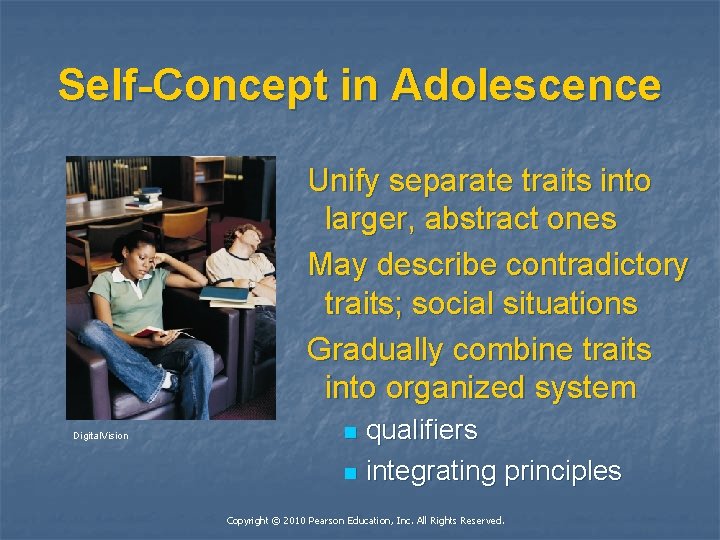
Self-Concept in Adolescence Unify separate traits into larger, abstract ones May describe contradictory traits; social situations Gradually combine traits into organized system Digital. Vision qualifiers n integrating principles n Copyright © 2010 Pearson Education, Inc. All Rights Reserved.
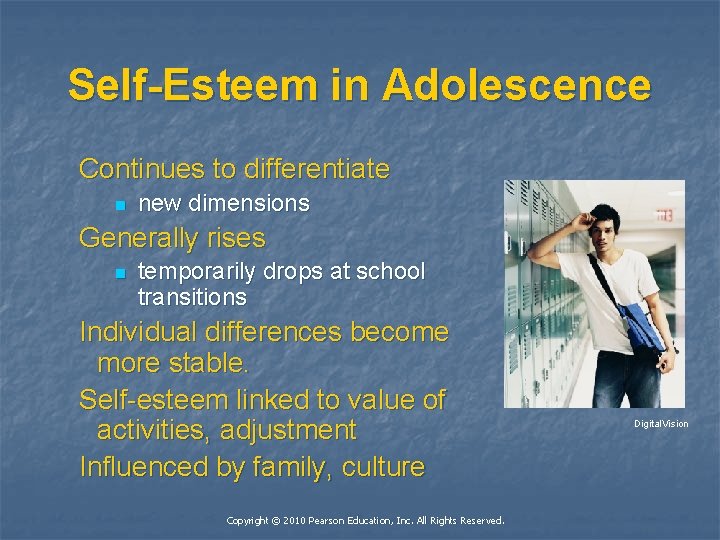
Self-Esteem in Adolescence Continues to differentiate n new dimensions Generally rises n temporarily drops at school transitions Individual differences become more stable. Self-esteem linked to value of activities, adjustment Influenced by family, culture Copyright © 2010 Pearson Education, Inc. All Rights Reserved. Digital. Vision
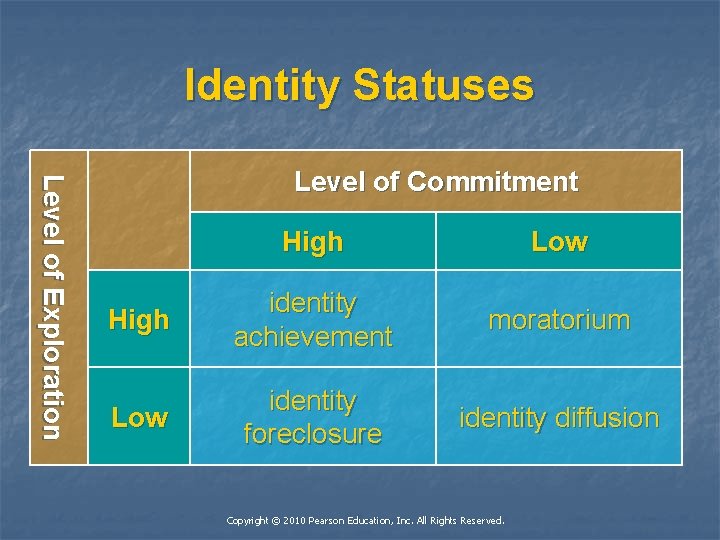
Identity Statuses L e v e l o f E x p l o r a ti o n Level of Commitment High Low High identity achievement moratorium Low identity foreclosure identity diffusion Copyright © 2010 Pearson Education, Inc. All Rights Reserved.
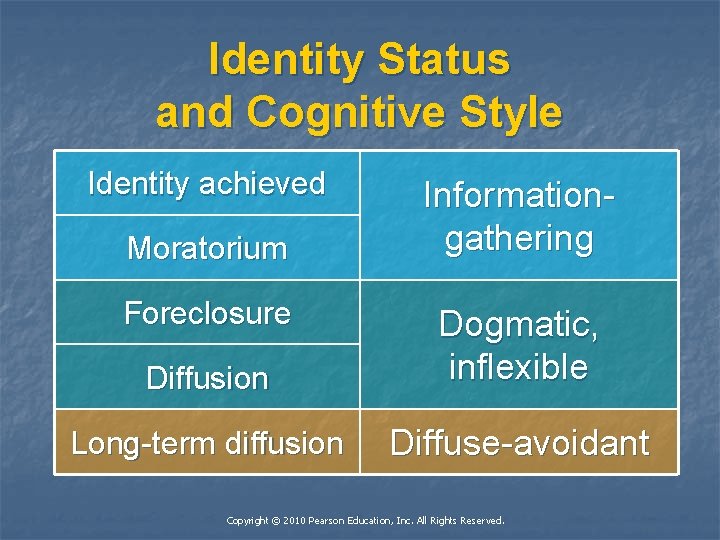
Identity Status and Cognitive Style Identity achieved Moratorium Foreclosure Informationgathering Diffusion Dogmatic, inflexible Long-term diffusion Diffuse-avoidant Copyright © 2010 Pearson Education, Inc. All Rights Reserved.
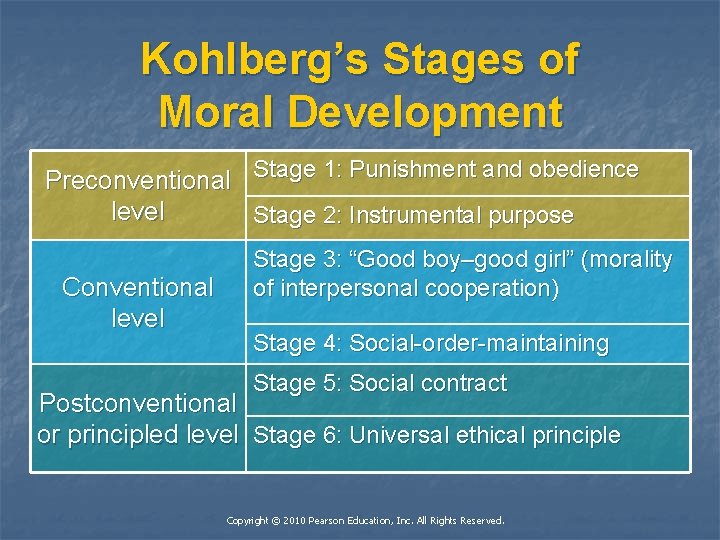
Kohlberg’s Stages of Moral Development Preconventional Stage 1: Punishment and obedience level Stage 2: Instrumental purpose Conventional level Stage 3: “Good boy–good girl” (morality of interpersonal cooperation) Stage 4: Social-order-maintaining Stage 5: Social contract Postconventional or principled level Stage 6: Universal ethical principle Copyright © 2010 Pearson Education, Inc. All Rights Reserved.
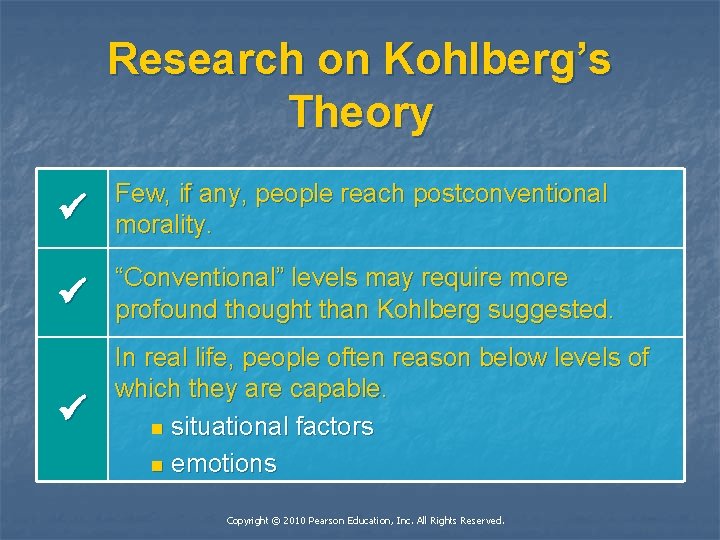
Research on Kohlberg’s Theory Few, if any, people reach postconventional morality. “Conventional” levels may require more profound thought than Kohlberg suggested. In real life, people often reason below levels of which they are capable. n situational factors n emotions Copyright © 2010 Pearson Education, Inc. All Rights Reserved.
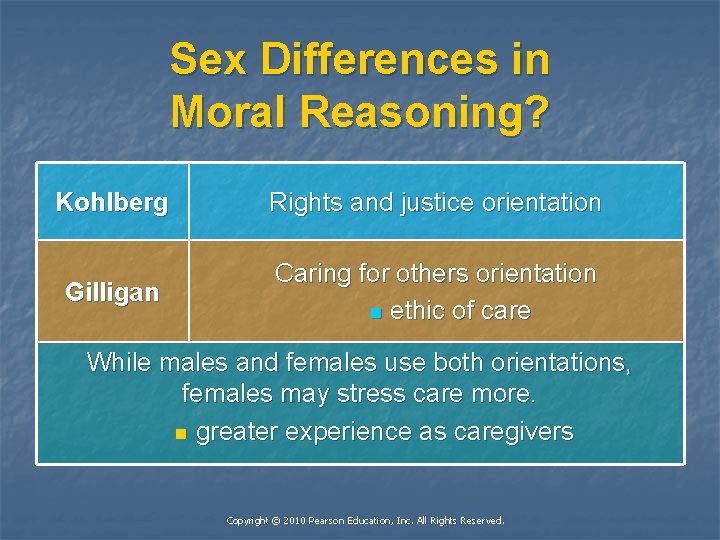
Sex Differences in Moral Reasoning? Kohlberg Rights and justice orientation Gilligan Caring for others orientation n ethic of care While males and females use both orientations, females may stress care more. n greater experience as caregivers Copyright © 2010 Pearson Education, Inc. All Rights Reserved.
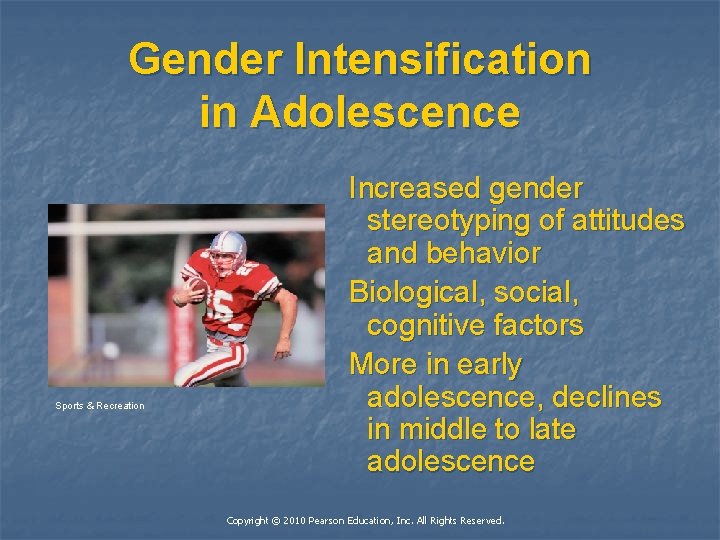
Gender Intensification in Adolescence Sports & Recreation Increased gender stereotyping of attitudes and behavior Biological, social, cognitive factors More in early adolescence, declines in middle to late adolescence Copyright © 2010 Pearson Education, Inc. All Rights Reserved.
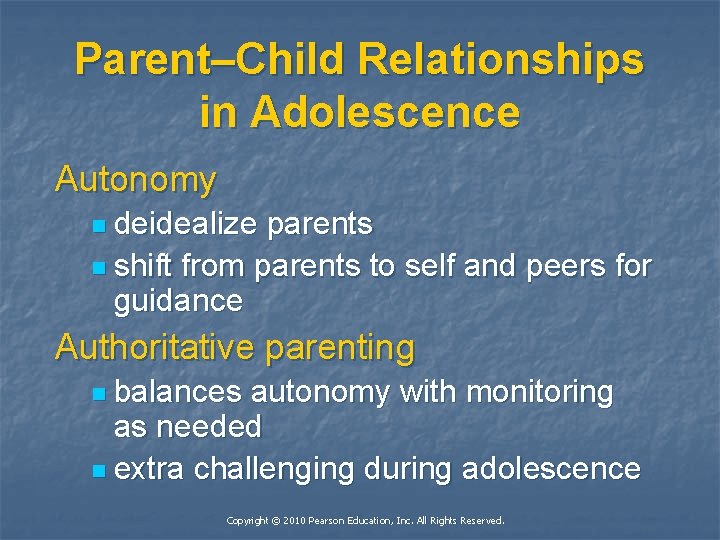
Parent–Child Relationships in Adolescence Autonomy n deidealize parents n shift from parents to self and peers for guidance Authoritative parenting n balances autonomy with monitoring as needed n extra challenging during adolescence Copyright © 2010 Pearson Education, Inc. All Rights Reserved.
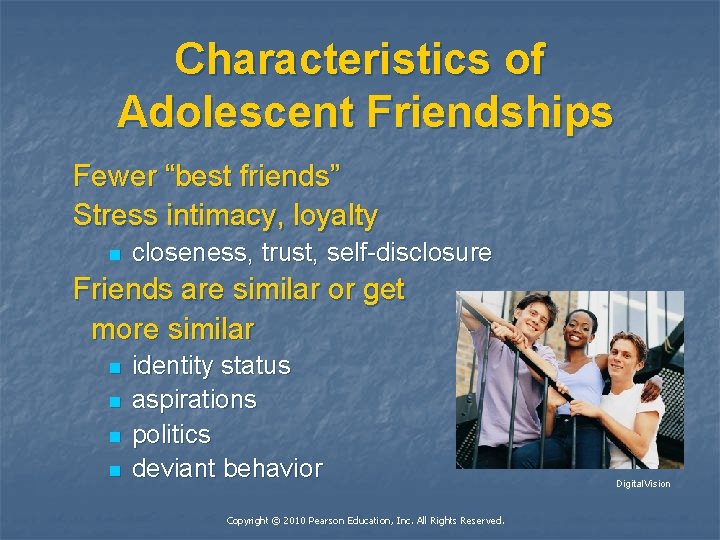
Characteristics of Adolescent Friendships Fewer “best friends” Stress intimacy, loyalty n closeness, trust, self-disclosure Friends are similar or get more similar n n identity status aspirations politics deviant behavior Copyright © 2010 Pearson Education, Inc. All Rights Reserved. Digital. Vision
Gender Differences in Adolescent Friendships Girls Boys Emotional closeness, communal concerns Get together to “just talk” Achievement, status Get together for activities Intimacy related to gender identity n self-disclosure n androgynous: more likely to be intimate friends Copyright © 2010 Pearson Education, Inc. All Rights Reserved.
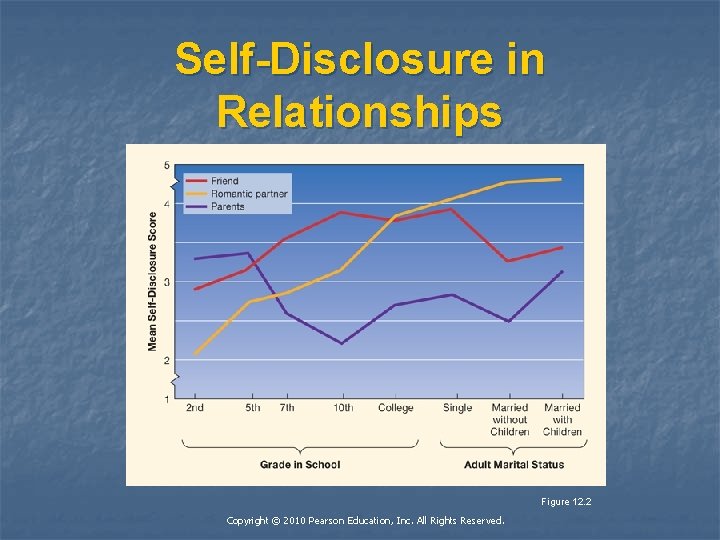
Self-Disclosure in Relationships Figure 12. 2 Copyright © 2010 Pearson Education, Inc. All Rights Reserved.
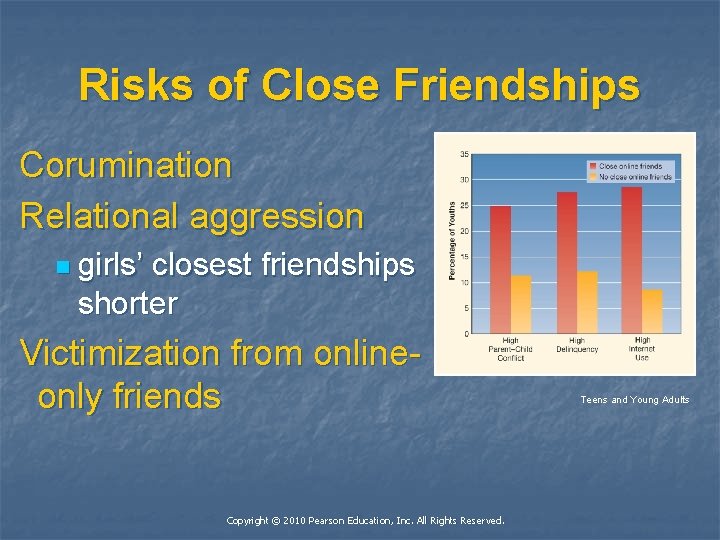
Risks of Close Friendships Corumination Relational aggression n girls’ closest friendships shorter Victimization from onlineonly friends Copyright © 2010 Pearson Education, Inc. All Rights Reserved. Teens and Young Adults
Benefits of Adolescent Friendships ü Opportunities to explore self ü Form deep understanding of another ü Foundation for future intimate relationships ü Help deal with life stress ü Can improve attitude toward and involvement in school Copyright © 2010 Pearson Education, Inc. All Rights Reserved.
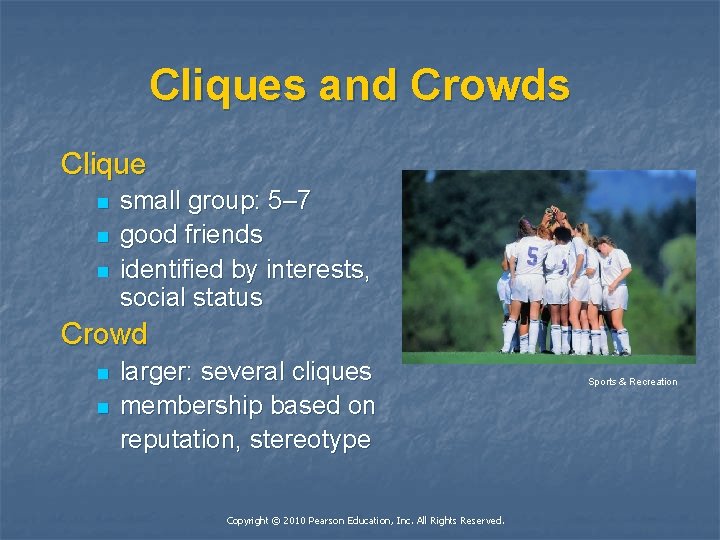
Cliques and Crowds Clique n n n small group: 5– 7 good friends identified by interests, social status Crowd n n larger: several cliques membership based on reputation, stereotype Copyright © 2010 Pearson Education, Inc. All Rights Reserved. Sports & Recreation
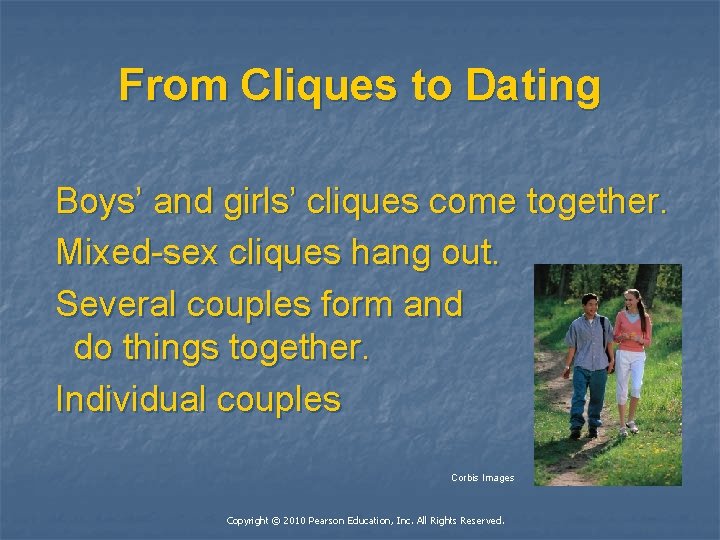
From Cliques to Dating Boys’ and girls’ cliques come together. Mixed-sex cliques hang out. Several couples form and do things together. Individual couples Corbis Images Copyright © 2010 Pearson Education, Inc. All Rights Reserved.
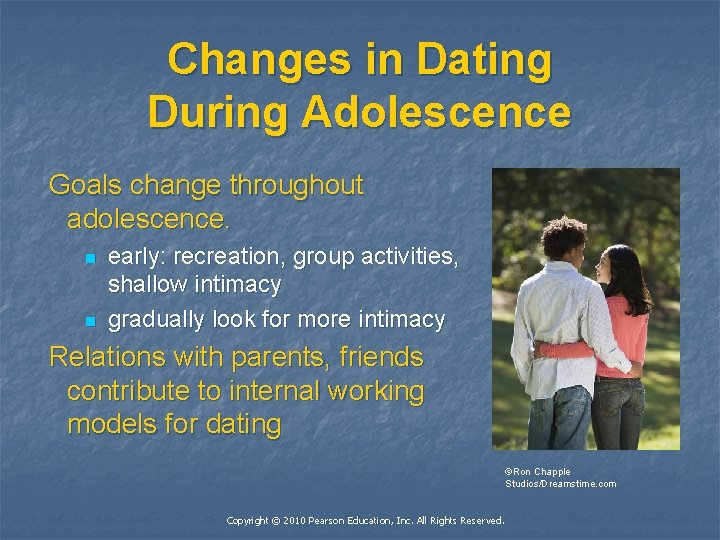
Changes in Dating During Adolescence Goals change throughout adolescence. n n early: recreation, group activities, shallow intimacy gradually look for more intimacy Relations with parents, friends contribute to internal working models for dating ©Ron Chapple Studios/Dreamstime. com Copyright © 2010 Pearson Education, Inc. All Rights Reserved.
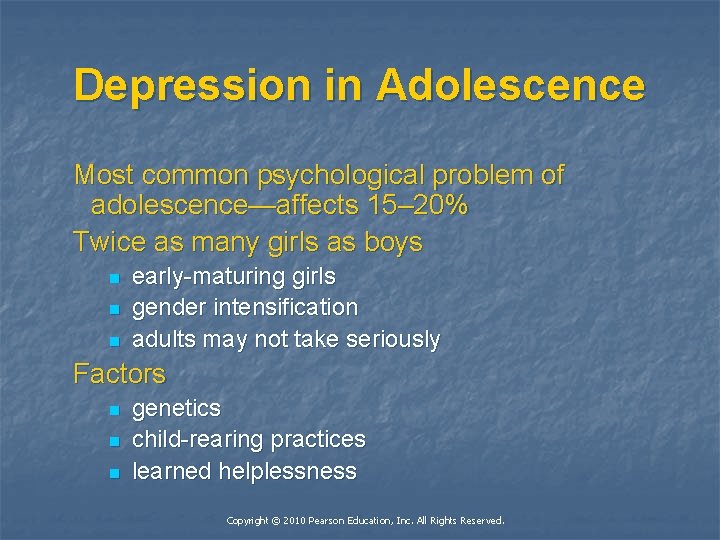
Depression in Adolescence Most common psychological problem of adolescence—affects 15– 20% Twice as many girls as boys n n n early-maturing girls gender intensification adults may not take seriously Factors n n n genetics child-rearing practices learned helplessness Copyright © 2010 Pearson Education, Inc. All Rights Reserved.
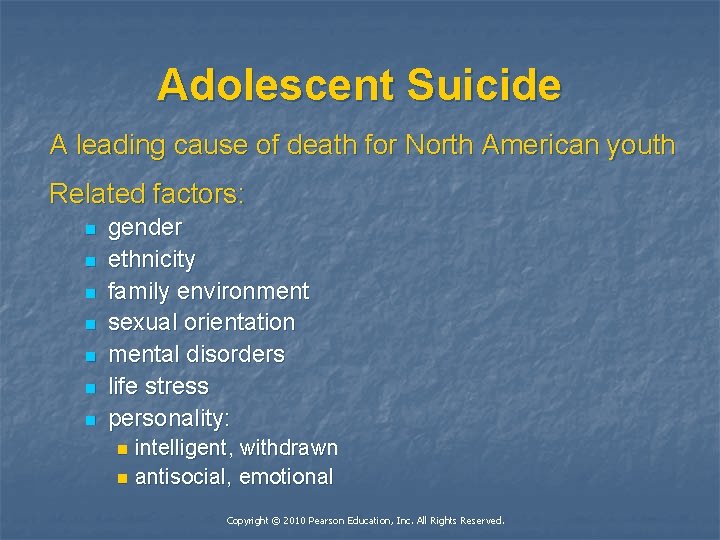
Adolescent Suicide A leading cause of death for North American youth Related factors: n n n n gender ethnicity family environment sexual orientation mental disorders life stress personality: intelligent, withdrawn n antisocial, emotional n Copyright © 2010 Pearson Education, Inc. All Rights Reserved.
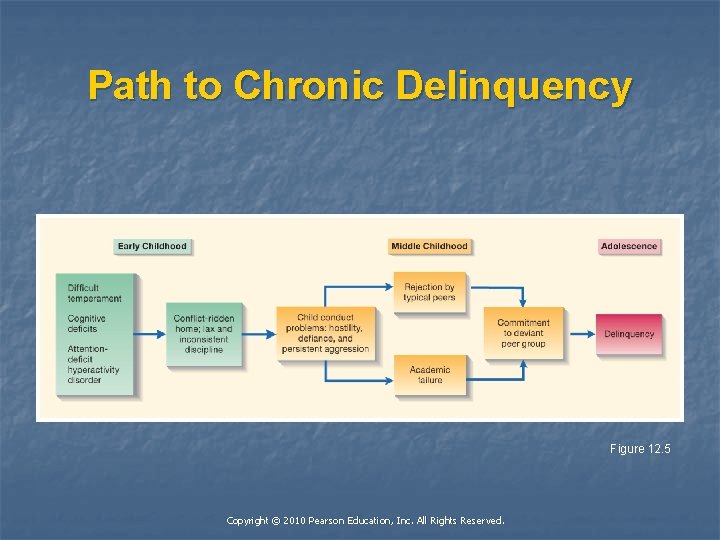
Path to Chronic Delinquency Figure 12. 5 Copyright © 2010 Pearson Education, Inc. All Rights Reserved.