
DEVELOPMENT THE MOVE FROM TRADITIONAL TO MODERN CONCEPTS
- Slides: 47
DEVELOPMENT THE MOVE FROM TRADITIONAL TO MODERN CONCEPTS OF DEVELOPMENT avalonsimon. weebly. com
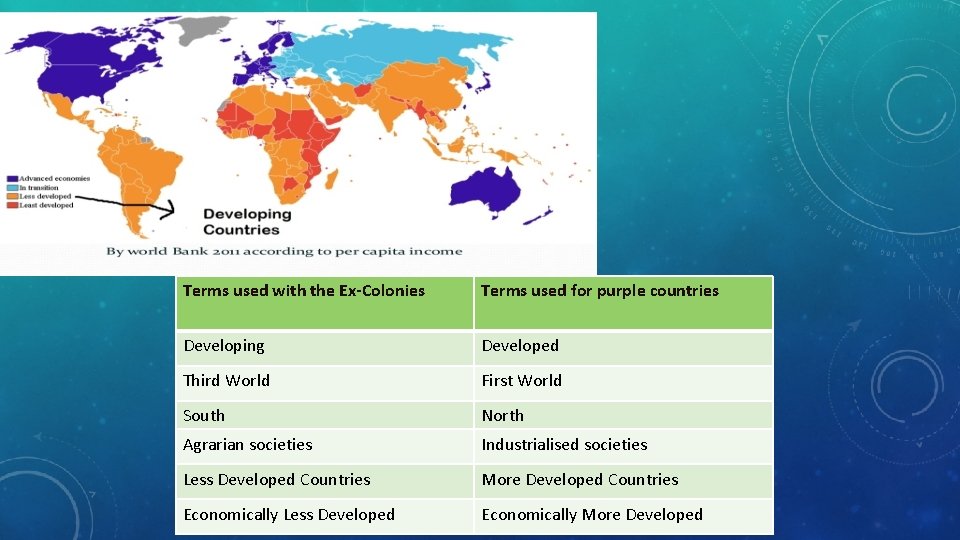
Terms used with the Ex-Colonies Terms used for purple countries Developing Developed Third World First World South North Agrarian societies Industrialised societies Less Developed Countries More Developed Countries Economically Less Developed Economically More Developed
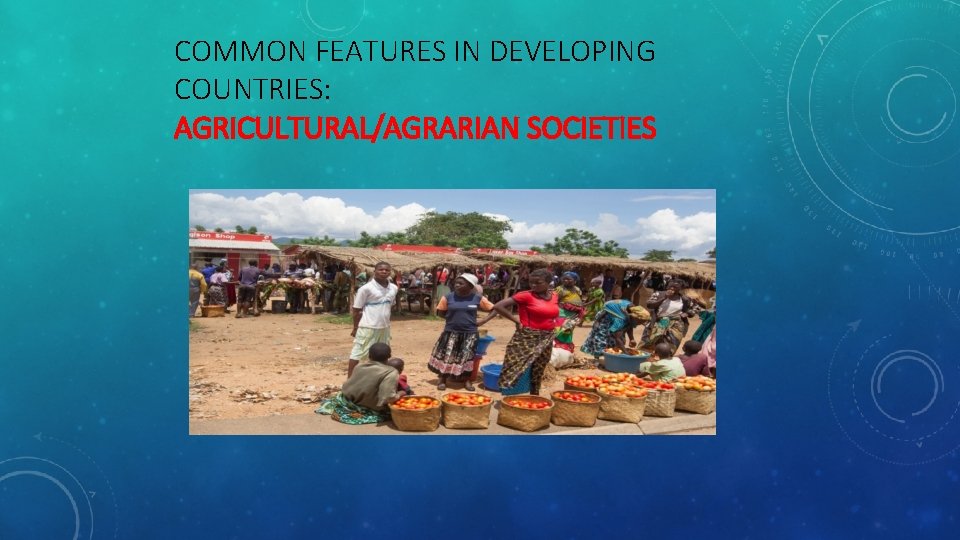
COMMON FEATURES IN DEVELOPING COUNTRIES: AGRICULTURAL/AGRARIAN SOCIETIES
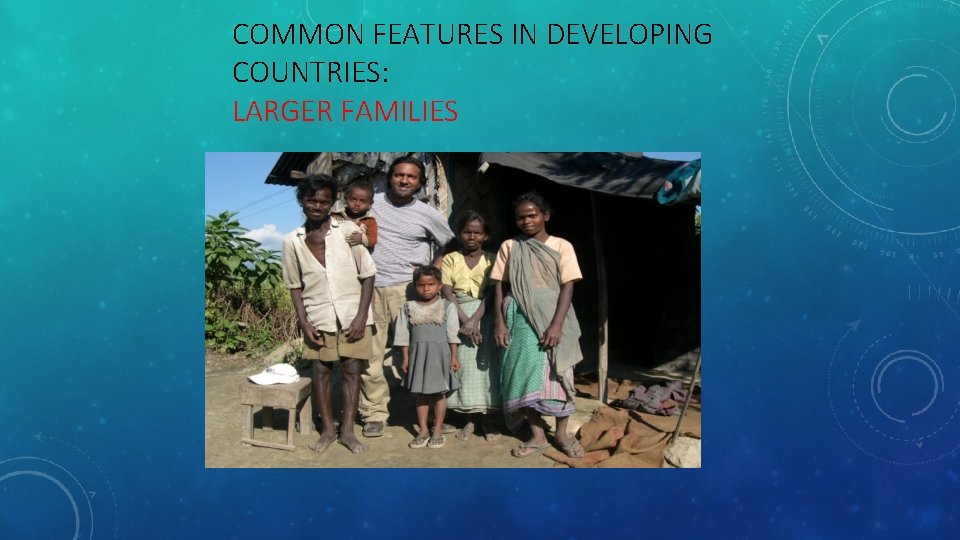
COMMON FEATURES IN DEVELOPING COUNTRIES: LARGER FAMILIES
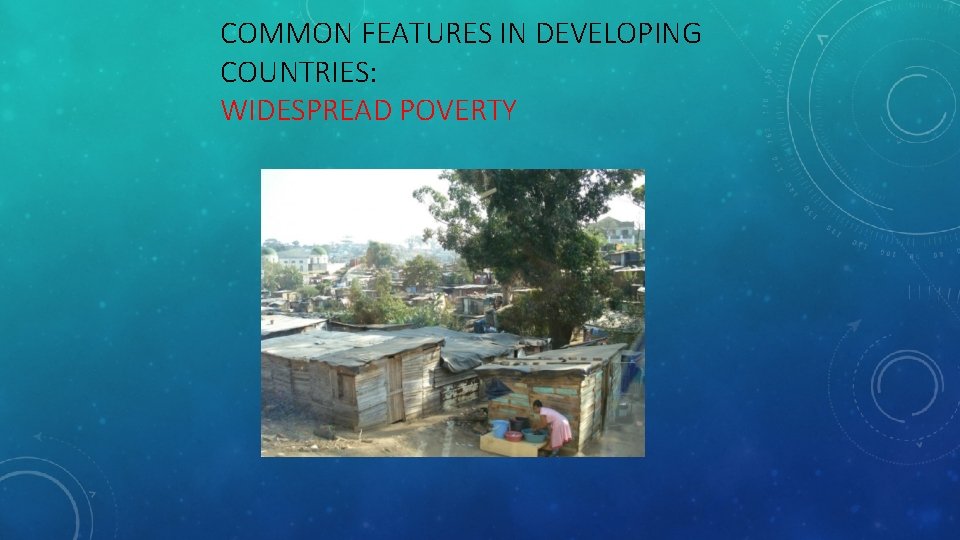
COMMON FEATURES IN DEVELOPING COUNTRIES: WIDESPREAD POVERTY
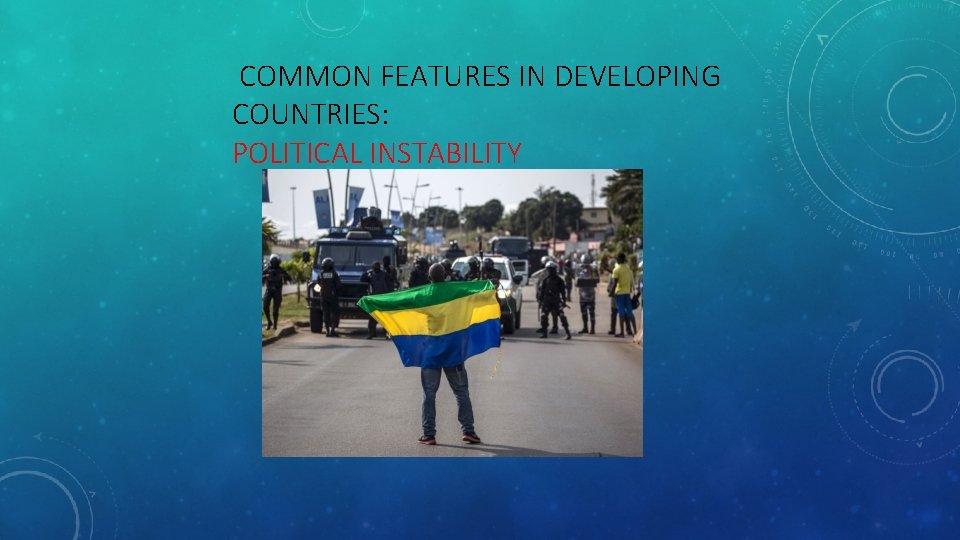
COMMON FEATURES IN DEVELOPING COUNTRIES: POLITICAL INSTABILITY
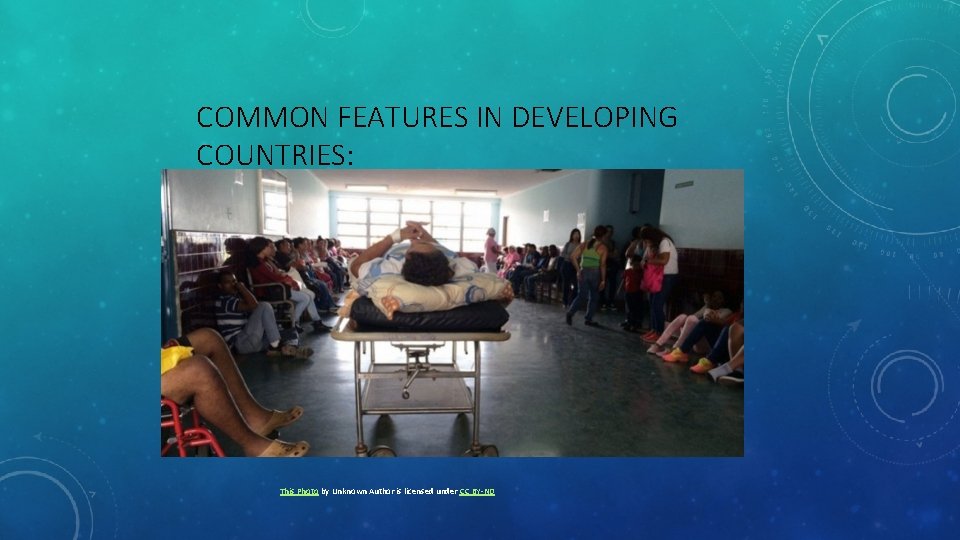
COMMON FEATURES IN DEVELOPING COUNTRIES: LIMITED ACCESS HEALTH CARE This Photo by Unknown Author is licensed under CC BY-ND
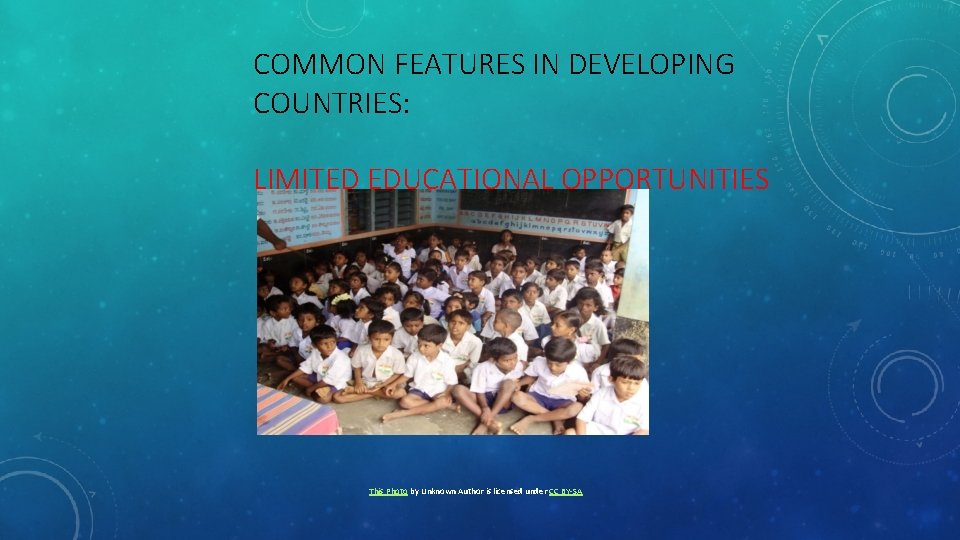
COMMON FEATURES IN DEVELOPING COUNTRIES: LIMITED EDUCATIONAL OPPORTUNITIES This Photo by Unknown Author is licensed under CC BY-SA
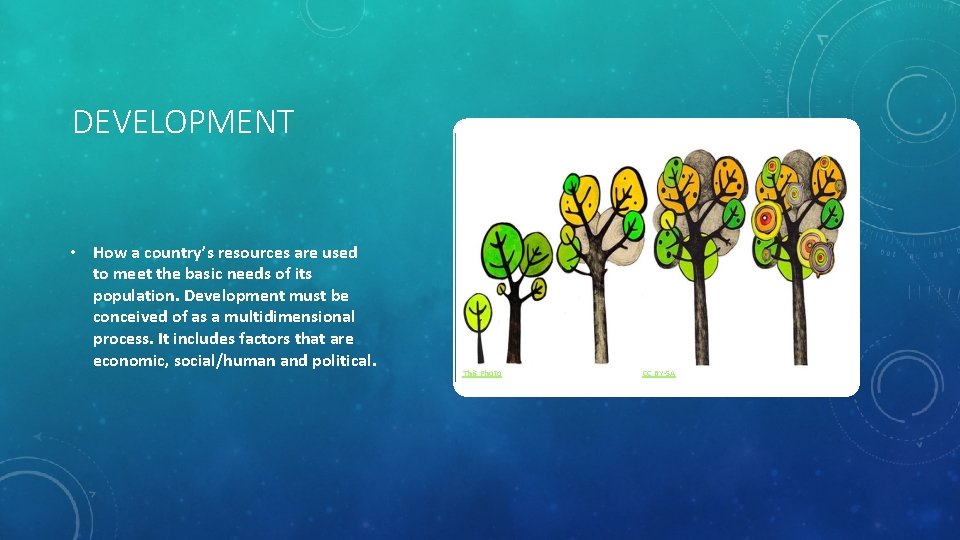
DEVELOPMENT • How a country’s resources are used to meet the basic needs of its population. Development must be conceived of as a multidimensional process. It includes factors that are economic, social/human and political. This Photo by Unknown Author is licensed under CC BY-SA
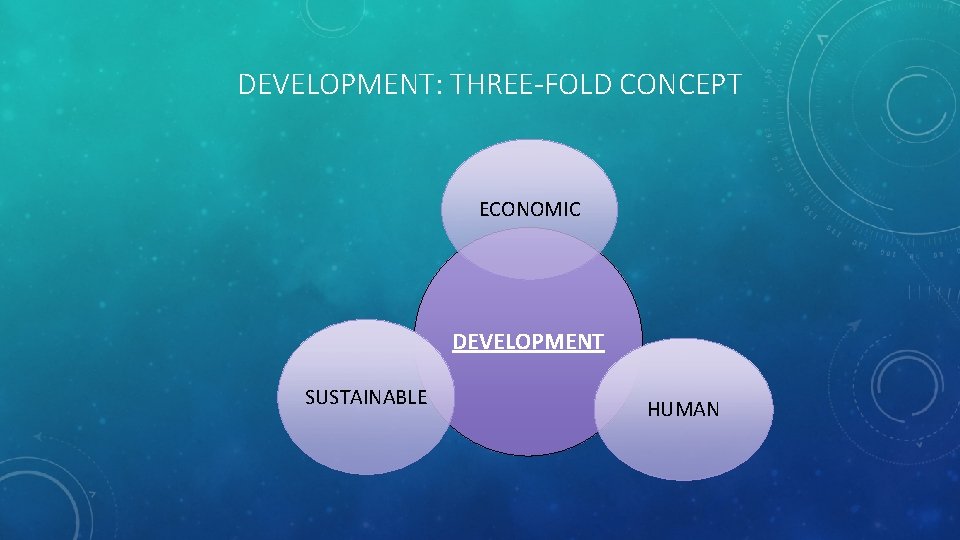
DEVELOPMENT: THREE-FOLD CONCEPT ECONOMIC DEVELOPMENT SUSTAINABLE HUMAN
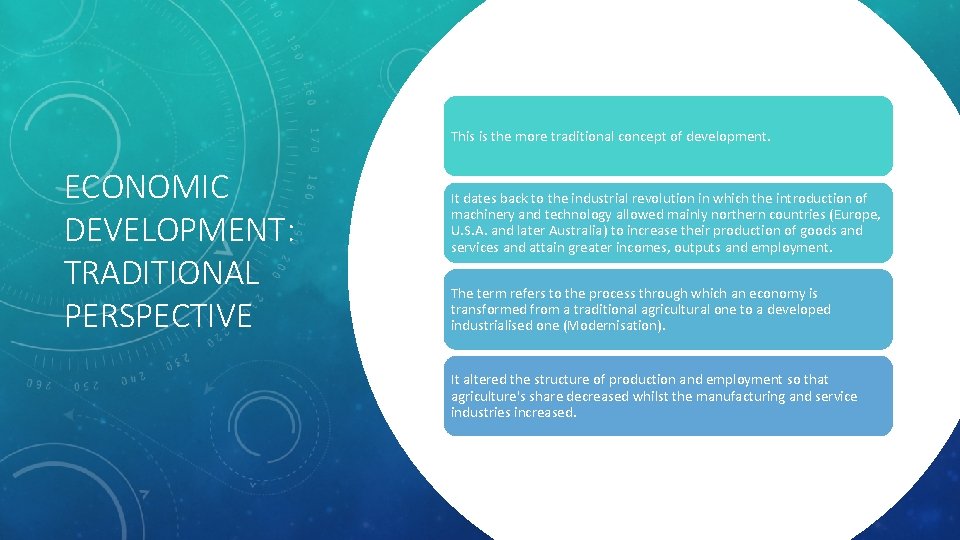
This is the more traditional concept of development. ECONOMIC DEVELOPMENT: TRADITIONAL PERSPECTIVE It dates back to the industrial revolution in which the introduction of machinery and technology allowed mainly northern countries (Europe, U. S. A. and later Australia) to increase their production of goods and services and attain greater incomes, outputs and employment. The term refers to the process through which an economy is transformed from a traditional agricultural one to a developed industrialised one (Modernisation). It altered the structure of production and employment so that agriculture's share decreased whilst the manufacturing and service industries increased.
ECONOMIC DEVELOPMENT: TRADITIONAL PERSPECTIVE It is often aligned with economic growth since the aim of both is to increase the production of material goods and services. However economic growth is limited to quantitative factors. In the 1970's economic development came to be redefined in terms of the reduction or elimination of poverty, inequality and unemployment within the context of the production and acquisition of goods and services. Therefore, “Economic Development” now includes not only economic growth but also social, cultural, political, moral and economic factors which contribute to material progress (the production and acquisition of goods and services)
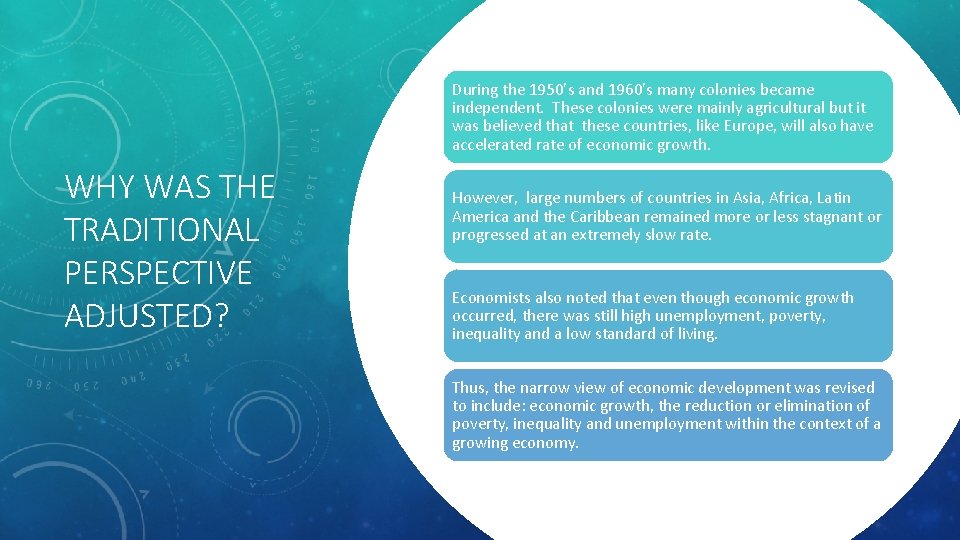
During the 1950’s and 1960’s many colonies became independent. These colonies were mainly agricultural but it was believed that these countries, like Europe, will also have accelerated rate of economic growth. WHY WAS THE TRADITIONAL PERSPECTIVE ADJUSTED? However, large numbers of countries in Asia, Africa, Latin America and the Caribbean remained more or less stagnant or progressed at an extremely slow rate. Economists also noted that even though economic growth occurred, there was still high unemployment, poverty, inequality and a low standard of living. Thus, the narrow view of economic development was revised to include: economic growth, the reduction or elimination of poverty, inequality and unemployment within the context of a growing economy.
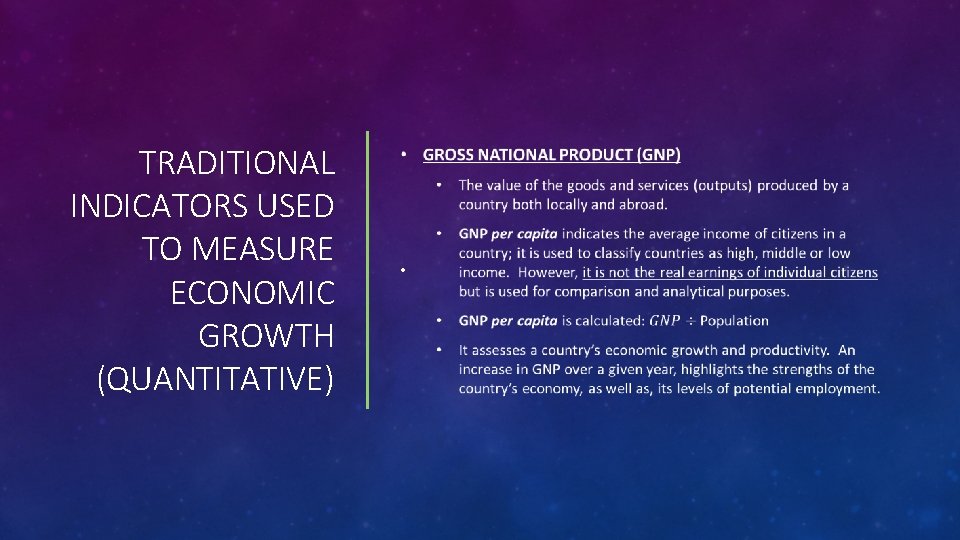
TRADITIONAL INDICATORS USED TO MEASURE ECONOMIC GROWTH (QUANTITATIVE) •
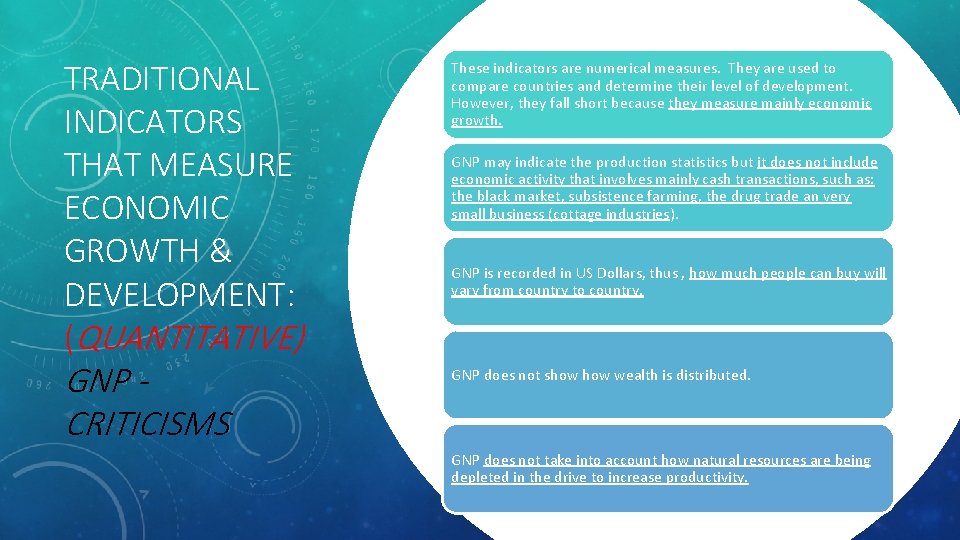
TRADITIONAL INDICATORS THAT MEASURE ECONOMIC GROWTH & DEVELOPMENT: (QUANTITATIVE) GNP CRITICISMS These indicators are numerical measures. They are used to compare countries and determine their level of development. However, they fall short because they measure mainly economic growth. GNP may indicate the production statistics but it does not include economic activity that involves mainly cash transactions, such as: the black market, subsistence farming, the drug trade an very small business (cottage industries). GNP is recorded in US Dollars, thus , how much people can buy will vary from country to country. GNP does not show wealth is distributed. GNP does not take into account how natural resources are being depleted in the drive to increase productivity.
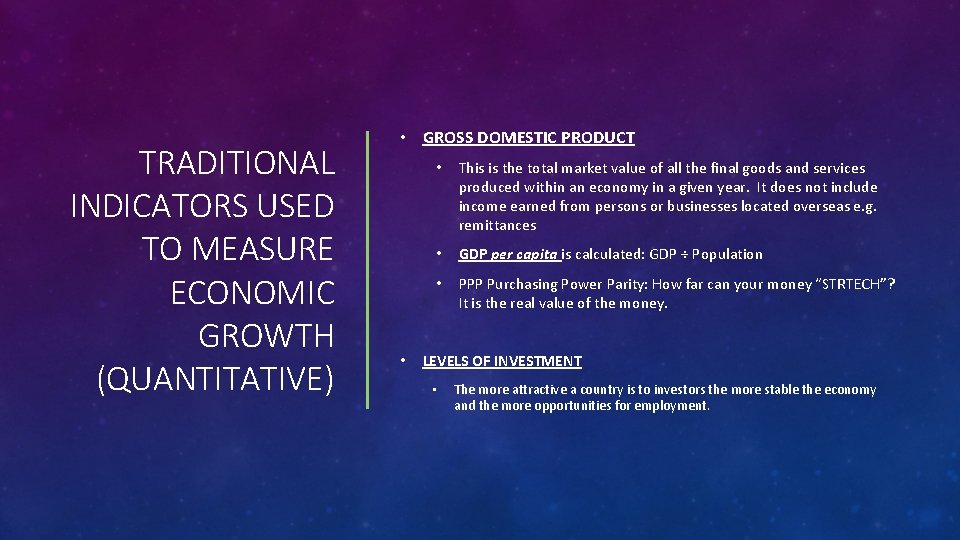
TRADITIONAL INDICATORS USED TO MEASURE ECONOMIC GROWTH (QUANTITATIVE) • GROSS DOMESTIC PRODUCT • • This is the total market value of all the final goods and services produced within an economy in a given year. It does not include income earned from persons or businesses located overseas e. g. remittances • GDP per capita is calculated: GDP ÷ Population • PPP Purchasing Power Parity: How far can your money “STRTECH”? It is the real value of the money. LEVELS OF INVESTMENT • The more attractive a country is to investors the more stable the economy and the more opportunities for employment.
TRADITIONAL INDICATORS USED TO MEASURE ECONOMIC GROWTH (QUANTITATIVE) • POPULATION GROWTH RATE • Examines indicators such as a country’s birth rate, death rate and migration patterns in and out of the country. A country will aim to manage its growth rate in order to maintain a high per capita income. • AGE-DEPENDENCY RATIO • This statistic examines the number of dependents, younger than 15 yrs. and older than 65 yrs. to the working population. • This implies that a larger working population would be better able to provide for their dependents and would rely less on the government. • Thus, the government can then divert its resources to infrastructure and other forms of development that would enable production and greater productivity.
These ideas formed the basis of the policies used by Caribbean countries from the 1960’s- 1980’s. TRADITIONAL ECONOMIC INDICATORS & THE CARIBBEAN Although production increased in the Caribbean, wealth did not trickle down to the average citizen. There were still issues of unemployment, poverty, inequality etc. It was a very Eurocentric approach, since these approaches to development were applied in Europe and was expected to produce the same result in the Caribbean. It did not take into account the unique challenges that Caribbean countries face. Caribbean countries have come to understand that economic development must ALSO take into account the welfare of the people, as well as, poverty reduction.
MODERN ECONOMIC INDICATORS OF DEVELOPMENT Economists REVISED the concept of development to personal and community welfare. Welfare would include the basic necessities of life, education, health employment and equity in the distribution of income and wealth. Most economists agree that an index of development based on a good number of socio-economic indicators provides a more relevant measure of social and personal welfare than per capita national income.
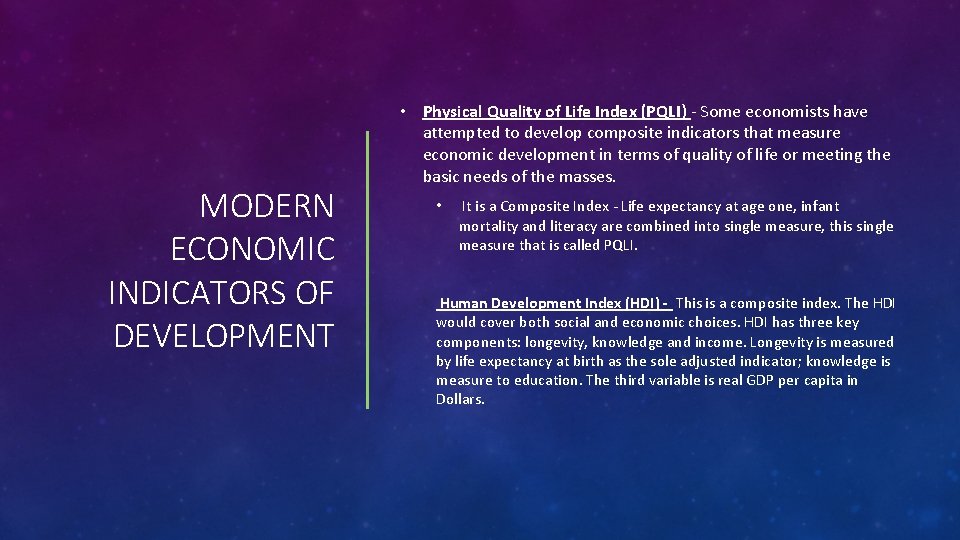
MODERN ECONOMIC INDICATORS OF DEVELOPMENT • Physical Quality of Life Index (PQLI) - Some economists have attempted to develop composite indicators that measure economic development in terms of quality of life or meeting the basic needs of the masses. • It is a Composite Index - Life expectancy at age one, infant mortality and literacy are combined into single measure, this single measure that is called PQLI. Human Development Index (HDI) - This is a composite index. The HDI would cover both social and economic choices. HDI has three key components: longevity, knowledge and income. Longevity is measured by life expectancy at birth as the sole adjusted indicator; knowledge is measure to education. The third variable is real GDP per capita in Dollars.
MODERN ECONOMIC INDICATORS OF DEVELOPMENT • Physical Quality of Life Index (PQLI) - Some economists have attempted to develop composite indicators that measure economic development in terms of quality of life or meeting the basic needs of the masses. • It is a Composite Index - Life expectancy at age one, infant mortality and literacy are combined into single measure, this single measure that is called PQLI. Human Development Index (HDI) - This is a composite index. The HDI would cover both social and economic choices. HDI has three key components: longevity, knowledge and income. Longevity is measured by life expectancy at birth as the sole adjusted indicator; knowledge is measure to education. The third variable is real GDP per capita in Dollars.
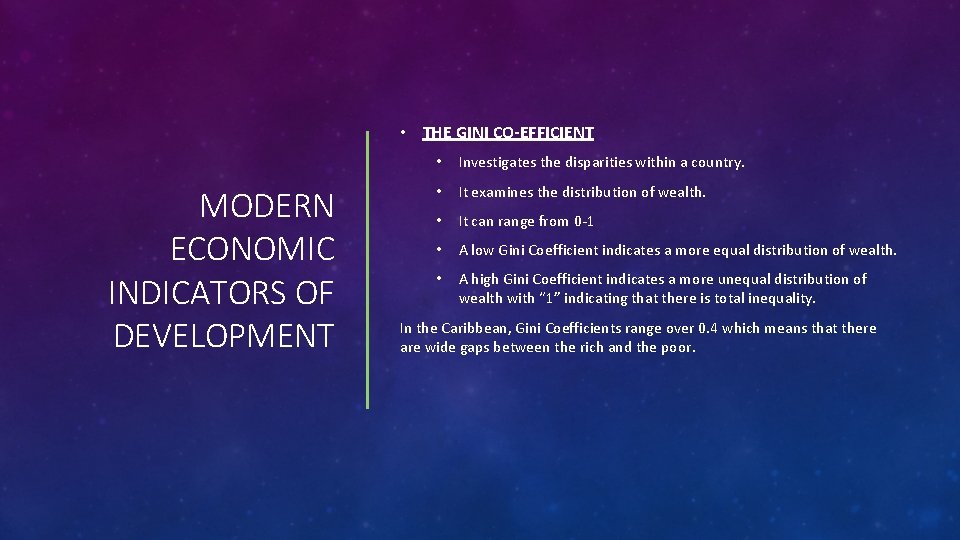
• THE GINI CO-EFFICIENT MODERN ECONOMIC INDICATORS OF DEVELOPMENT • Investigates the disparities within a country. • It examines the distribution of wealth. • It can range from 0 -1 • A low Gini Coefficient indicates a more equal distribution of wealth. • A high Gini Coefficient indicates a more unequal distribution of wealth with “ 1” indicating that there is total inequality. In the Caribbean, Gini Coefficients range over 0. 4 which means that there are wide gaps between the rich and the poor.
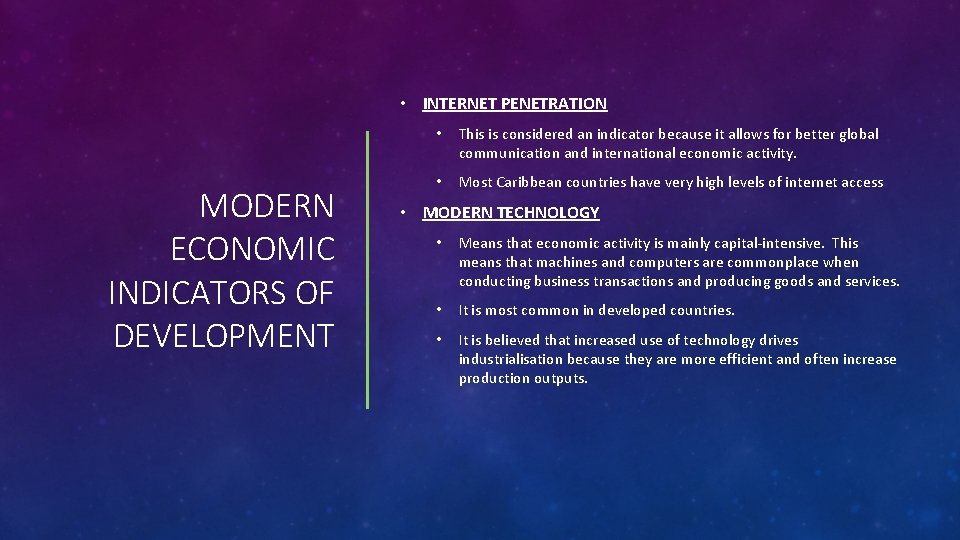
• INTERNET PENETRATION MODERN ECONOMIC INDICATORS OF DEVELOPMENT • This is considered an indicator because it allows for better global communication and international economic activity. • Most Caribbean countries have very high levels of internet access • MODERN TECHNOLOGY • Means that economic activity is mainly capital-intensive. This means that machines and computers are commonplace when conducting business transactions and producing goods and services. • It is most common in developed countries. • It is believed that increased use of technology drives industrialisation because they are more efficient and often increase production outputs.
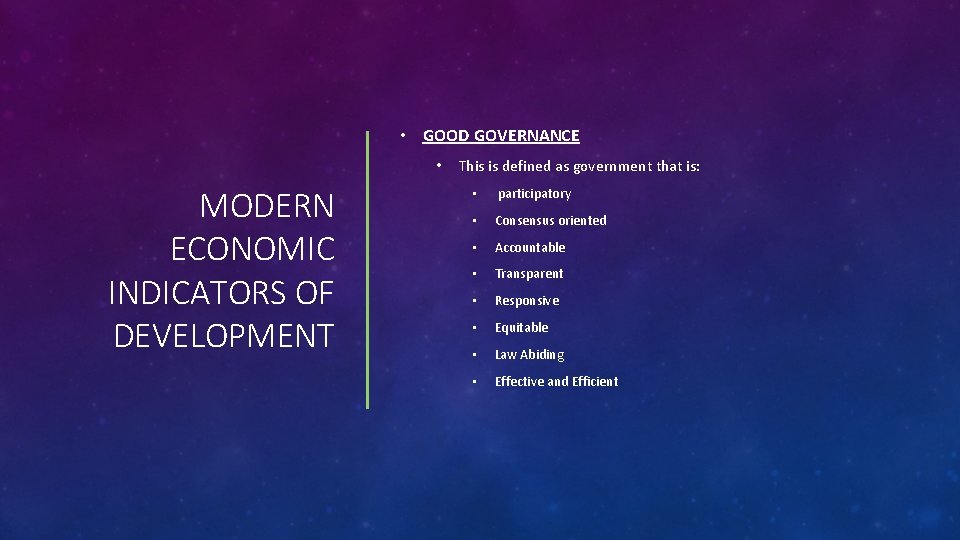
• GOOD GOVERNANCE • MODERN ECONOMIC INDICATORS OF DEVELOPMENT This is defined as government that is: • participatory • Consensus oriented • Accountable • Transparent • Responsive • Equitable • Law Abiding • Effective and Efficient
• RESPONSIBLE ENVIRONMENTAL FACTORS MODERN ECONOMIC INDICATORS OF DEVELOPMENT • Both the Government and the people are responsible for protecting and managing the environment. • It is important to protect and conserve the land, sea and the entire ecology. Therefore responsible environmental governance will include the following: • Measure to restrict pollution of the air, land water e. g. legislation and agencies that will ensure the safe disposal of waste, penalties for pollution in its various forms ( noise, air, land, water) • Education in the agricultural sector e. g. educating farmers of safe practices on land use, chemical and fertilizers; the dangers of overcropping and over-grazing etc.
MODERN ECONOMIC INDICATORS OF DEVELOPMENT • It is possible to have economic growth without economic development? • This is possible because the factors needed for economic development is both quantitative and qualitative. This means that economic development has evolved to assess the entire welfare of the people in a country and their opportunities for economic security. • READ ARTICLE ON TRADITIONAL VS MODERN
ASSIGNMENT • BASED ON READINGS : • Traditional vs. Modern measures of Economic Development: www. academia. edu/6533261/Traditional_vs. _Modern_measures_of_Econo mic_Development_a_Theoretical_Analysis. ARTICLES • QUESTION: Examine whether or not Caribbean countries are better served by the modern perspective of economic development. (500 -700 words) In your essay, be sure to highlight: Aspects of both the traditional and modern perspective; the criticisms and its relevance to the Caribbean.
HUMAN DEVELOPMENT UNDERSTANDING THE CONCEPT OF HUMAN DEVELOPMENT • https: //www. youtube. com/watch? v=Hwg. ZQ 1 Dq. G 3 w&t=25 s • https: //www. youtube. com/watch? v=s. Hkpbg. QVumo
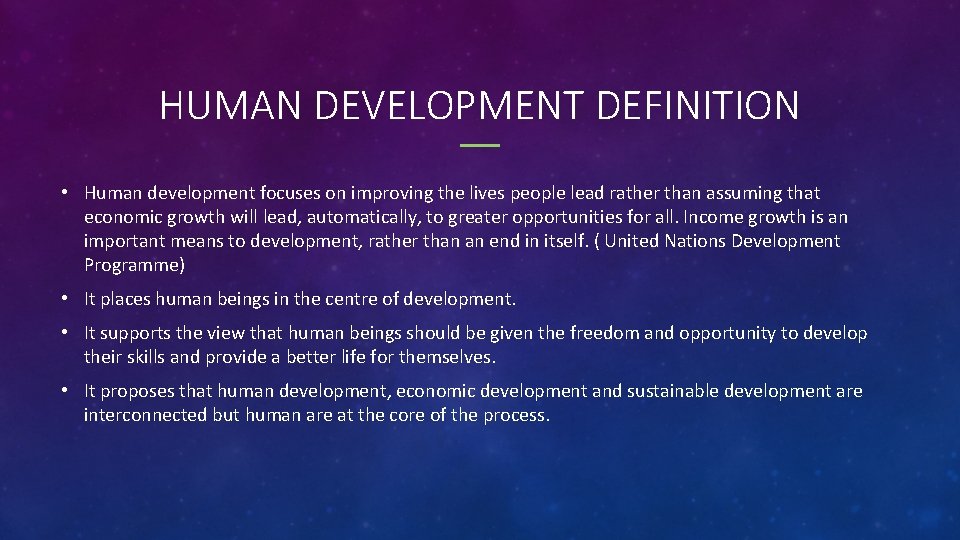
HUMAN DEVELOPMENT DEFINITION • Human development focuses on improving the lives people lead rather than assuming that economic growth will lead, automatically, to greater opportunities for all. Income growth is an important means to development, rather than an end in itself. ( United Nations Development Programme) • It places human beings in the centre of development. • It supports the view that human beings should be given the freedom and opportunity to develop their skills and provide a better life for themselves. • It proposes that human development, economic development and sustainable development are interconnected but human are at the core of the process.
HOW DID HUMAN DEVELOPMENT THEORIES EMERGE? • In the 1960’s Social Scientists sought to re-examine the concept of development. They found that economic growth did not necessarily improve the human condition. • Industrialisation and the development of social and educational instructions did not solve problems of inequity, unemployment, poverty and other social ills.
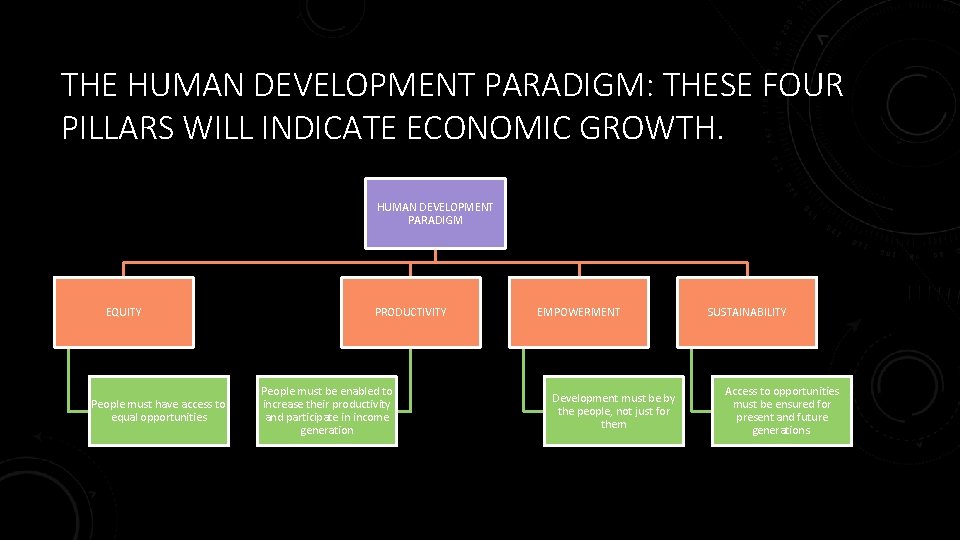
THE HUMAN DEVELOPMENT PARADIGM: THESE FOUR PILLARS WILL INDICATE ECONOMIC GROWTH. HUMAN DEVELOPMENT PARADIGM EQUITY People must have access to equal opportunities PRODUCTIVITY People must be enabled to increase their productivity and participate in income generation EMPOWERMENT Development must be by the people, not just for them SUSTAINABILITY Access to opportunities must be ensured for present and future generations.
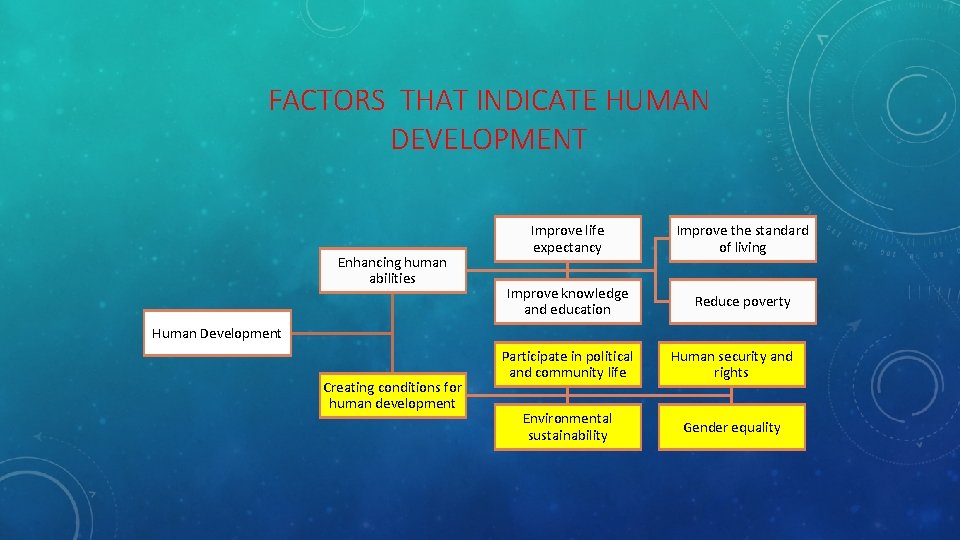
FACTORS THAT INDICATE HUMAN DEVELOPMENT Enhancing human abilities Improve life expectancy Improve the standard of living Improve knowledge and education Reduce poverty Human Development Creating conditions for human development Participate in political and community life Human security and rights Environmental sustainability Gender equality
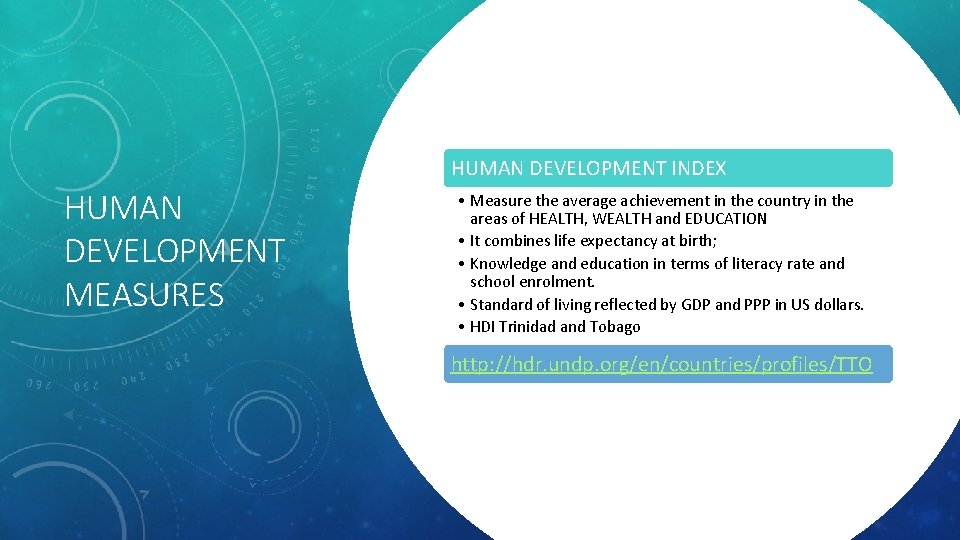
HUMAN DEVELOPMENT INDEX HUMAN DEVELOPMENT MEASURES • Measure the average achievement in the country in the areas of HEALTH, WEALTH and EDUCATION • It combines life expectancy at birth; • Knowledge and education in terms of literacy rate and school enrolment. • Standard of living reflected by GDP and PPP in US dollars. • HDI Trinidad and Tobago http: //hdr. undp. org/en/countries/profiles/TTO
POVERTY HUMAN DEVELOPMENT MEASURES EDUCATION MODERN TECHNOLOGY GENDER EQUALITY
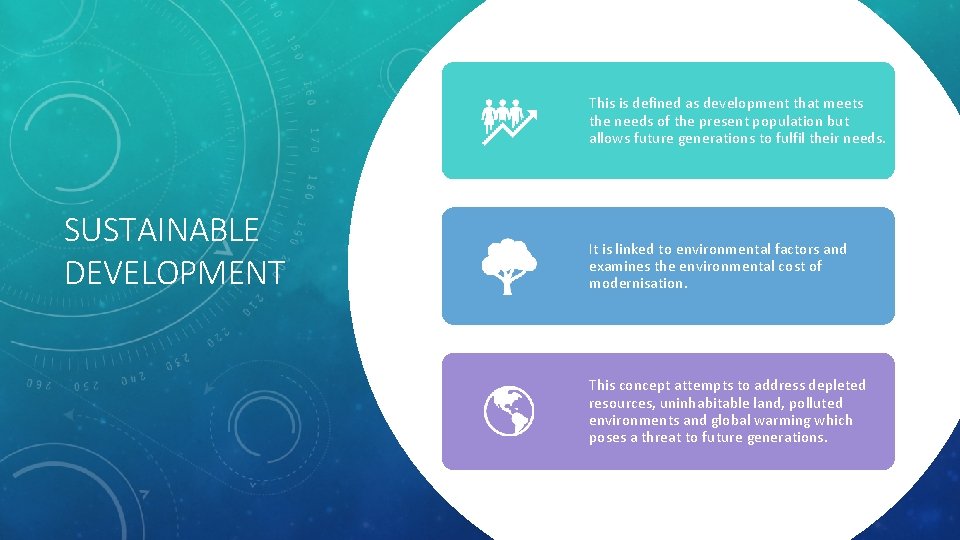
This is defined as development that meets the needs of the present population but allows future generations to fulfil their needs. SUSTAINABLE DEVELOPMENT It is linked to environmental factors and examines the environmental cost of modernisation. This concept attempts to address depleted resources, uninhabitable land, polluted environments and global warming which poses a threat to future generations.
CHINA’S ECONOMIC GROWTH • https: //tradingeconomics. com/china/gdp-growth-annual
SUSTAINABLE DEVELOPMENT: HAITI • https: //www. youtube. com/watch? v=R 84 E 6 K 7 Wm. JI&t=10 s
• SOCIAL FACTORS BACKGROUND • Some argue that social factors are the most important in promoting or hindering a country’s development. It examines the social conditions of the people such as: the distribution of wealth, poverty and other social inequalities. 1. SOCIAL STRATIFICATION/ CLASS BOUNDARIES FACTORS THAT INFLUENCE DEVELOPMENT • In the Caribbean, many are negatively affected by social stratification which affects how the resources are distributed. These are patterns of wealth distribution are remnants of our colonial past. • The elites are the owners of land capital. They are often descendants of the Europeans. However, in Trinidad and Tobago, the descendants of the Europeans have been surpassed by the descendants of the Syrian community. • The Middle Class. These are usually the descendants of the African and East Indians. They own property and provide much of the human capital. • The Poor. They provide mainly labour
1. SOCIAL STRATIFICATION/ CHANGING CLASS BOUNDARIES SOCIAL FACTORS THAT HINDER DEVELOPMENT • In countries where the population has access to a good education and opportunities to earn wealth, there is upward social mobility. This means that the poor can move from a state of poverty and enjoy a better standard of living. • Likewise, if certain groups are denied access to a good education and financial gain, then they are limited in their ability to improve their social and economic condition.
2. GENDER INEQUALITY SOCIAL FACTORS THAT INFLUENCE DEVELOPMENT The Gender inequality Index (GII) is a measure used to assess the place of women in society. It attempts to measure: • The role of women in the labour force • The role and empowerment of women in political life • The reproductive health of women Discussion Point: Why is the assessment of gender inequalities important to development?
3. EDUCATION SOCIAL FACTORS THAT INFLUENCE DEVELOPMENT • Education must be relevant to the lives of the people in order to promote development • Access to a quality education can be influenced by social status, neighbourhood etc. Social prejudices can hinder development. • The structure of the education system can empower the elite class and restrict the lower classes to subservient roles in society. • Creativity and entrepreneurship may not be nurtured in the current system • It can create a culture of dependency
SOCIAL FACTORS THAT INFLUENCE DEVELOPMENT 4. MIGRATION • Many Caribbean countries experience a brain drain. This is the loss of the skills and talents needed in the local labour force to another country.
• POLITICAL IDEOLOGIES AND POPULAR MOVEMENTS POLITICAL FACTORS THAT INFLUENCE DEVELOPMENT • Is the electorate empowered to participate in the political process or is there a history of repression or reluctance? • Government policies are important to all aspects of development in a country. Government policies will influence: How resources are utilised, the distribution of wealth, gender inequalities, racial inequalities etc. • Are there radical ideologies that can destabilise the government? • A country’s adoption of capitalism/ free market policies • A country’s adoption of Marxism / planned economies • Grassroots movements: Black Power Movement, Garveyism • Jamaat Muslimeen attempted Coup 1990
ECONOMIC FACTORS THAT HINDER DEVELOPMENT • THE DISTRIBUTION OF WEALTH AND RESOURCES • Causes of the unequal distribution of wealth: • The class structure inherited from our colonial past. • Social stratification where the poorer groups have limited access to opportunities that would improve their social condition. They are often marginalised and face many prejudices. The lower classes are often stuck in a cycle of poverty. • Land ownership generates wealth. Land ownership is also influenced by our colonial past, slavery and indentureship.
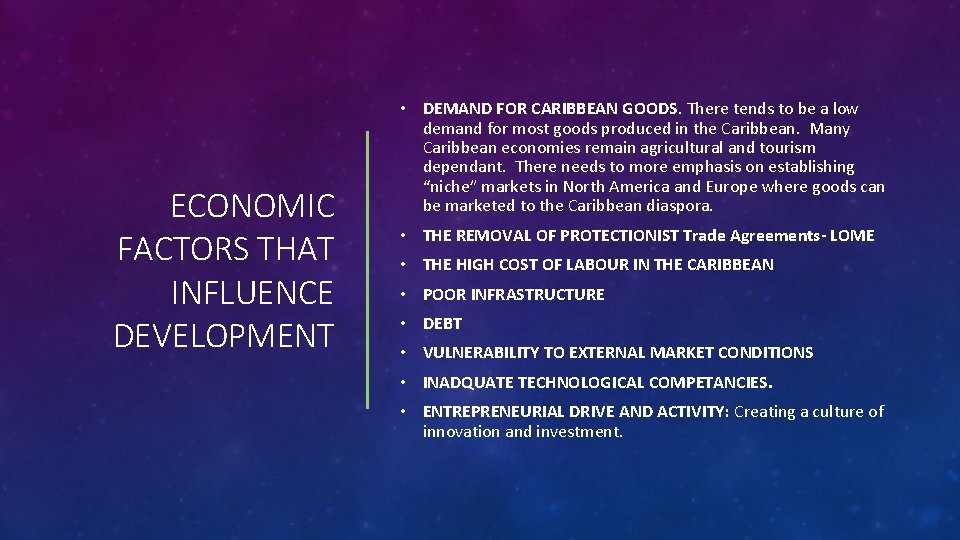
ECONOMIC FACTORS THAT INFLUENCE DEVELOPMENT • DEMAND FOR CARIBBEAN GOODS. There tends to be a low demand for most goods produced in the Caribbean. Many Caribbean economies remain agricultural and tourism dependant. There needs to more emphasis on establishing “niche” markets in North America and Europe where goods can be marketed to the Caribbean diaspora. • THE REMOVAL OF PROTECTIONIST Trade Agreements- LOME • THE HIGH COST OF LABOUR IN THE CARIBBEAN • POOR INFRASTRUCTURE • DEBT • VULNERABILITY TO EXTERNAL MARKET CONDITIONS • INADQUATE TECHNOLOGICAL COMPETANCIES. • ENTREPRENEURIAL DRIVE AND ACTIVITY: Creating a culture of innovation and investment.
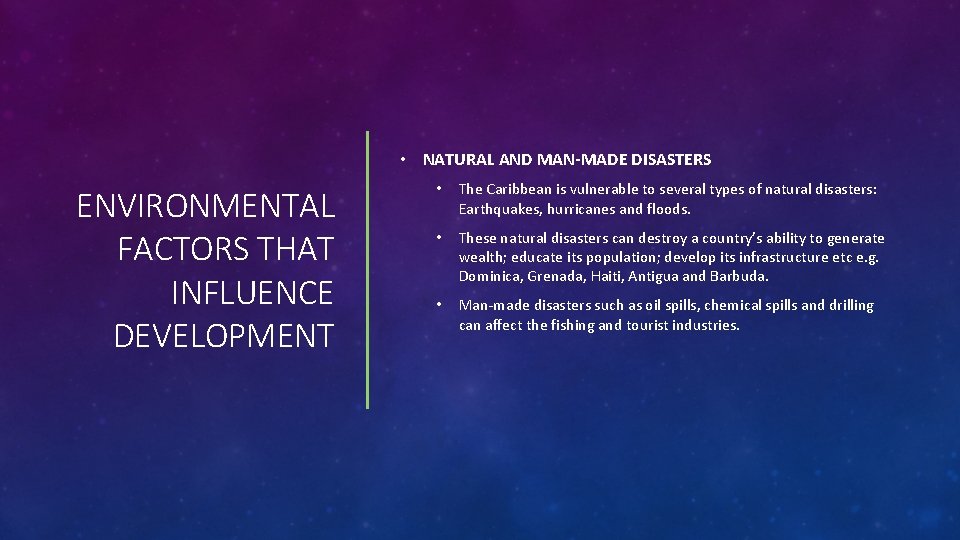
• NATURAL AND MAN-MADE DISASTERS ENVIRONMENTAL FACTORS THAT INFLUENCE DEVELOPMENT • The Caribbean is vulnerable to several types of natural disasters: Earthquakes, hurricanes and floods. • These natural disasters can destroy a country’s ability to generate wealth; educate its population; develop its infrastructure etc e. g. Dominica, Grenada, Haiti, Antigua and Barbuda. • Man-made disasters such as oil spills, chemical spills and drilling can affect the fishing and tourist industries.
DEVELOPMENT AND COVID: PRIME MINISTER MIA MOTTLEY • https: //blogs. iadb. org/caribbean-dev-trends/en/time-to-pivot-the-caribbean-as-a-world-leader/ • https: //www. youtube. com/watch? v=Dxb 6 t. H 4 slq. I&feature=emb_logo