
DEVELOPMENT RESULTS The Case of the Spanish Cooperation
- Slides: 29
DEVELOPMENT RESULTS The Case of the Spanish Cooperation Eva del Hoyo - SGCID 29/10/2021 1
Topics • JP of course YES; however……. • The Spanish Cooperation Development Results model • The CPF/MAP of the Spanish Aid • Country Programs of AECID • Study for development results of the Spanish Cooperation • Conclusions
JP OF COURSE yes; however……. • Bilateral programming offers: – International Relations mechanisms – Sound process with a dregree of quality ensured: • Im going to explain why……
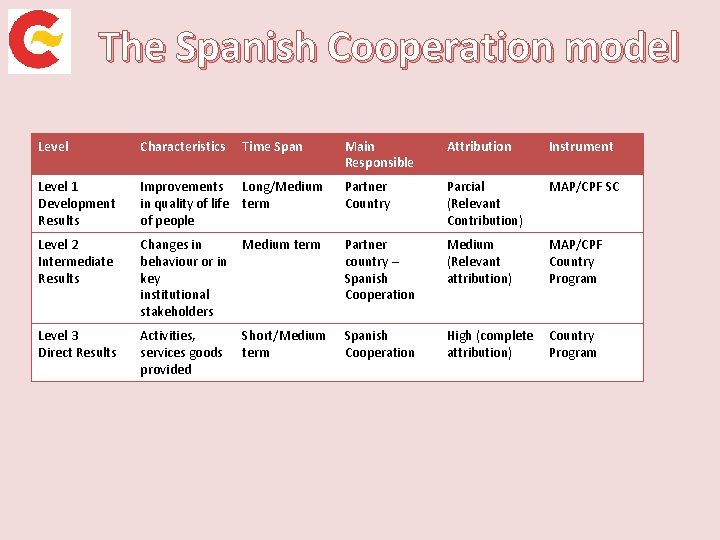
The Spanish Cooperation model Level Characteristics Level 1 Development Results Time Span Main Responsible Attribution Instrument Improvements Long/Medium in quality of life term of people Partner Country Parcial (Relevant Contribution) MAP/CPF SC Level 2 Intermediate Results Changes in behaviour or in key institutional stakeholders Medium term Partner country – Spanish Cooperation Medium (Relevant attribution) MAP/CPF Country Program Level 3 Direct Results Activities, services goods provided Short/Medium term Spanish Cooperation High (complete attribution) Country Program
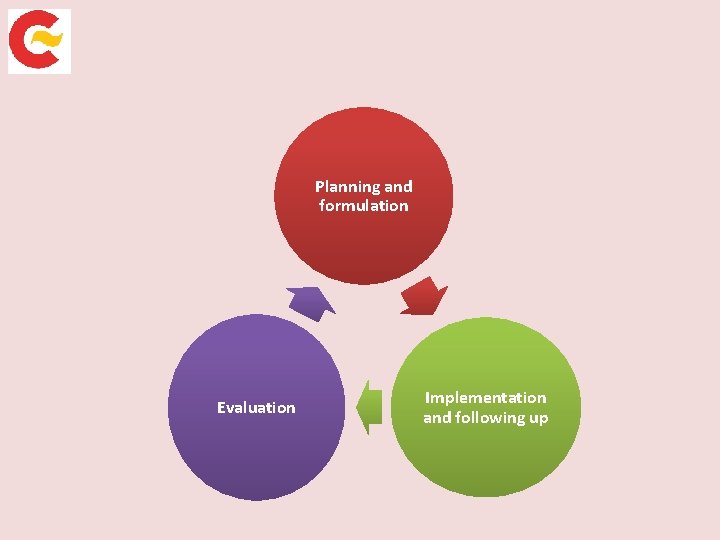
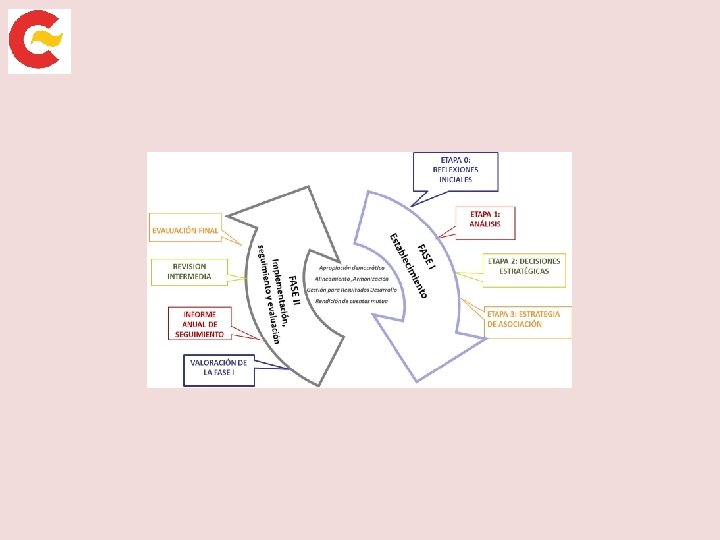
Planning and formulation Evaluation Implementation and following up
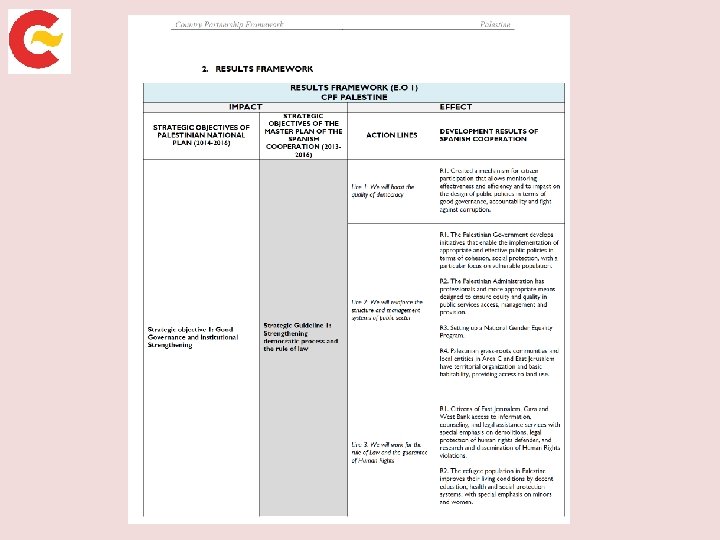
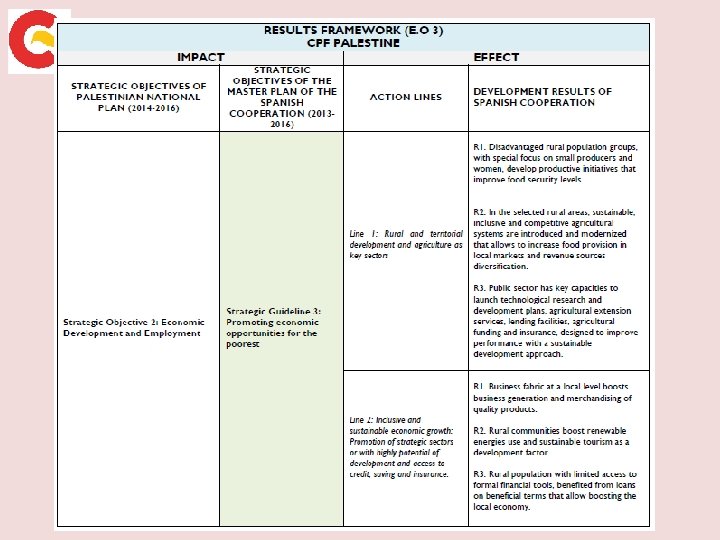
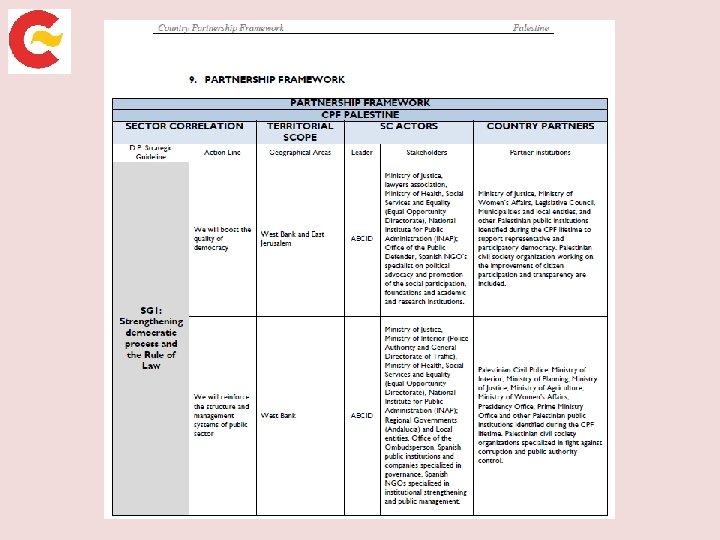
So…. what are the CPF/MAP • Shared partnership strategy at country level that aims towards common goals and visions of human development and poverty eradication. • Main bilateral instrument of the Spanish Cooperation to ensure effectiveness development cooperation and strategic implementation of policy guidelines.
Main Characteristics • Agrees on a Common Development Results framework with the partner country based on National Development Plan. • Aligned to the partner’s political cycle. • It is inclusive and incorporates as many stakeholders as possible with potential impact on development. • Close dialogue and joint work with partner countries (government, institutions, parliaments and civil society) as well as with the donor community. • Coordination among the different actors (Spanish Cooperation) – – Other Ministries Regions Civil society Private sector • Estimation of budget
Main Characteristics • 100% of partner countries CPF signed http: //www. exteriores. gob. es/Portal/es/Sala. De. Prensa/Multimedia/Publicaciones/Paginas/Cooperacion/Planificacion. aspx http: //www. cooperacionespanola. es/en/geographic-priorities • It is field driven and capital coordinated (Mo. FAC, AECID) – In order to provide homogeneity – While respecting our partner development goals. – Establishes a triangular cooperation • Follows a methodology that ensures common aid effectiveness standards and vision of the Spanish Cooperation. http: //www. cooperacionespanola. es/sites/default/files/map-metodologia_2013_sgcid. pdf – Follows an equivalent work schema for all processes • Coordination in the field is during implementation and follow-up in close relation with our counterparts – Working committee throughout the whole process (GEC – Stable Coordination Group)
Effectiveness in the CPF/MAP • The main effectiveness for development values that Spanish Cooperation is trying to promote through the CPF are: – – – – Strategic association Predictability Alignment Ownership Harmonization Results-based approach Mutual accountability (via follow-up and evaluation). • These agreements are based on partner’s needs, requirements, and development results as defined in national and/or sector plans and linked with one or more of Spain’s strategic guidelines • Revised mid-term and evaluated jointly upon completion.
Spain DAC OECD Peer Review • Spain clearly applies the principles of aid effectiveness. • The Country Partnership Frameworks (CPFs) are: – – developed in-country in close consultation with partners aligned with the planning cycles of Spain’s partner countries and territories. CPFs include a four-year indicative budget which, together with flexibility in budgeting and programming in countries and in headquarters, helps Spain to be more predictable and responsive to the needs of its partners. • Each CPF includes the development results to which Spain aims to contribute. It also includes operational and results indicators, targets and baselines that draw on country results frameworks and national statistics. • This capacity to adapt to the specific needs of a country also helps Spain develop and implement programmes in fragile contexts in a pragmatic manner – without requiring specific approaches or tools. • Synthesis report of mid-term reviews/evaluations published in 2015: http: //www. cooperacionespañola. es/sites/default/files/sintesis_evaluacio nes_map. pdf
Spanish Cooperation CPF • The intention of making Country Partnership Frameworks whole-of-country strategies, supported by in-country co-ordination mechanisms, is positive. • The Ambassador of Spain in each country leads co -ordination efforts by, for example, chairing the permanent co-ordination groups that oversee Spanish development co-operation actors in partner countries and territories.
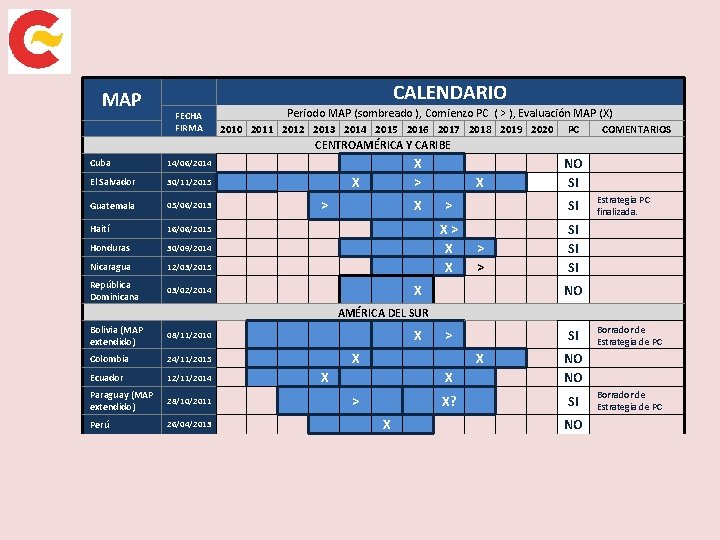
MAP CALENDARIO FECHA FIRMA Periodo MAP (sombreado ), Comienzo PC ( > ), Evaluación MAP (X) 2010 2011 2012 2013 2014 2015 2016 2017 2018 2019 2020 PC COMENTARIOS CENTROAMÉRICA Y CARIBE Cuba 14/06/2014 El Salvador 30/11/2015 Guatemala 05/06/2013 Haití 16/06/2015 Honduras 30/09/2014 Nicaragua 12/03/2015 República Dominicana 03/02/2014 X > X X NO SI > SI X> X X SI SI SI > > X Estrategia PC finalizada. NO AMÉRICA DEL SUR Bolivia (MAP extendido) 08/11/2010 Colombia 24/11/2015 Ecuador 12/11/2014 Paraguay (MAP extendido) 28/10/2011 Perú 26/04/2013 X > X SI X X > X X NO NO X? SI NO Borrador de Estrategia de PC
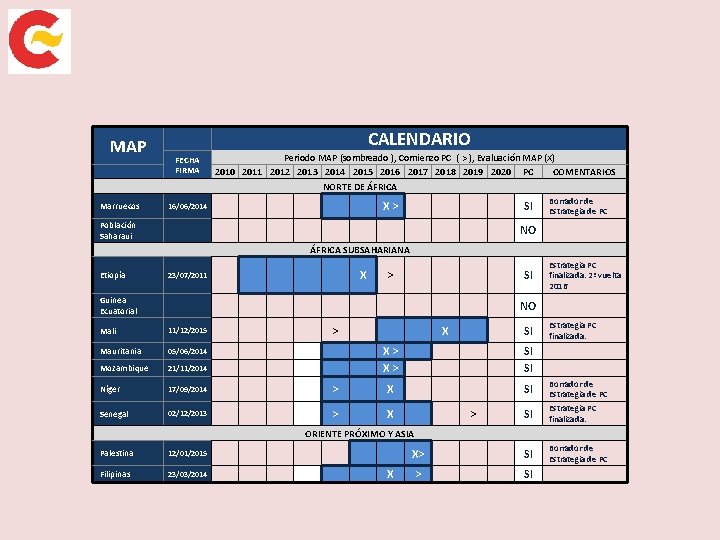
MAP Marruecos CALENDARIO FECHA FIRMA Periodo MAP (sombreado ), Comienzo PC ( > ), Evaluación MAP (X) 2010 2011 2012 2013 2014 2015 2016 2017 2018 2019 2020 PC COMENTARIOS NORTE DE ÁFRICA X> 16/06/2014 SI Población Saharaui Borrador de Estrategia de PC NO ÁFRICA SUBSAHARIANA Etiopía X 23/07/2011 > SI Guinea Ecuatorial Estrategia PC finalizada. 2ª vuelta 2016 NO Mali 11/12/2015 Mauritania 05/06/2014 Mozambique 21/11/2014 Níger 17/09/2014 Senegal 02/12/2013 > X SI Estrategia PC finalizada. X> X> SI SI > X SI Borrador de Estrategia de PC > X SI Estrategia PC finalizada. X> SI Borrador de Estrategia de PC > SI > ORIENTE PRÓXIMO Y ASIA Palestina 12/01/2015 Filipinas 23/03/2014 X
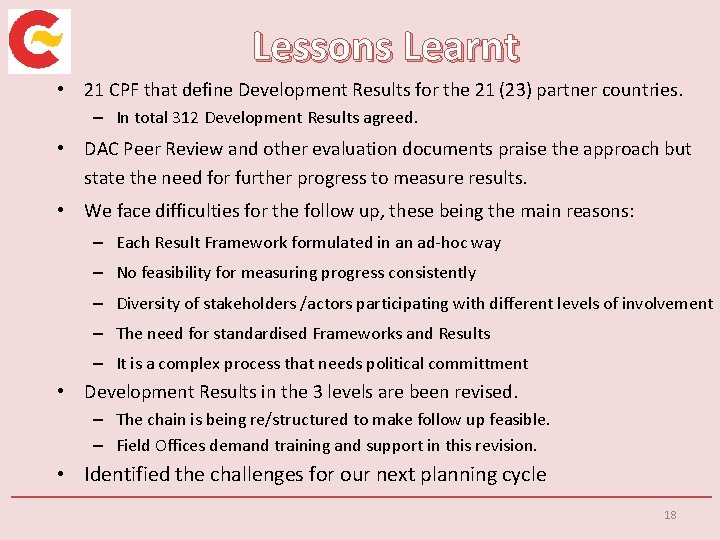
Lessons Learnt • 21 CPF that define Development Results for the 21 (23) partner countries. – In total 312 Development Results agreed. • DAC Peer Review and other evaluation documents praise the approach but state the need for further progress to measure results. • We face difficulties for the follow up, these being the main reasons: – Each Result Framework formulated in an ad-hoc way – No feasibility for measuring progress consistently – Diversity of stakeholders /actors participating with different levels of involvement – The need for standardised Frameworks and Results – It is a complex process that needs political committment • Development Results in the 3 levels are been revised. – The chain is being re/structured to make follow up feasible. – Field Offices demand training and support in this revision. • Identified the challenges for our next planning cycle 18
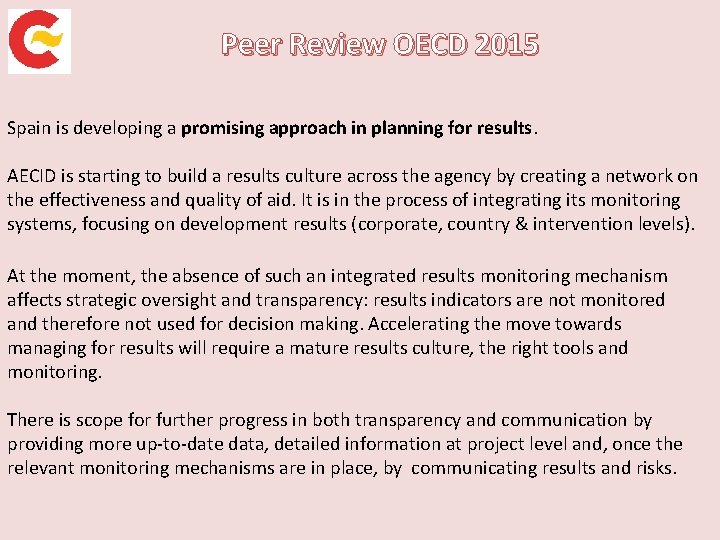
Peer Review OECD 2015 Spain is developing a promising approach in planning for results. AECID is starting to build a results culture across the agency by creating a network on the effectiveness and quality of aid. It is in the process of integrating its monitoring systems, focusing on development results (corporate, country & intervention levels). At the moment, the absence of such an integrated results monitoring mechanism affects strategic oversight and transparency: results indicators are not monitored and therefore not used for decision making. Accelerating the move towards managing for results will require a mature results culture, the right tools and monitoring. There is scope for further progress in both transparency and communication by providing more up-to-date data, detailed information at project level and, once the relevant monitoring mechanisms are in place, by communicating results and risks.
So……what are we doing to progress? Developed further the model in a twofold manner: – The AECID country program: • Operative results (level 2 and 3) • Based on MAP/CPF – A complete study for standardised Frameworks and Results for the Spanish Cooperation
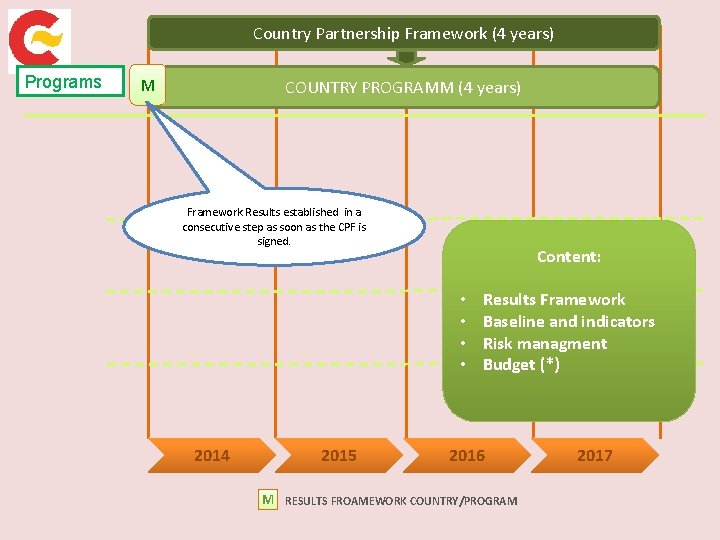
Country Partnership Framework (4 years) Programs M COUNTRY PROGRAMM (4 years) Framework Results established in a consecutive step as soon as the CPF is signed. Content: • • 2014 2015 Results Framework Baseline and indicators Risk managment Budget (*) 2016 M RESULTS FROAMEWORK COUNTRY/PROGRAM 2017
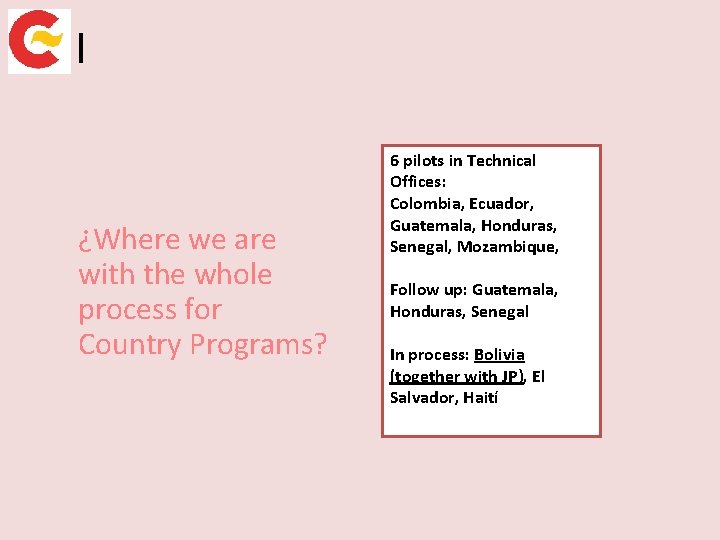
¿Where we are with the whole process for Country Programs? 6 pilots in Technical Offices: Colombia, Ecuador, Guatemala, Honduras, Senegal, Mozambique, Follow up: Guatemala, Honduras, Senegal In process: Bolivia (together with JP), El Salvador, Haití
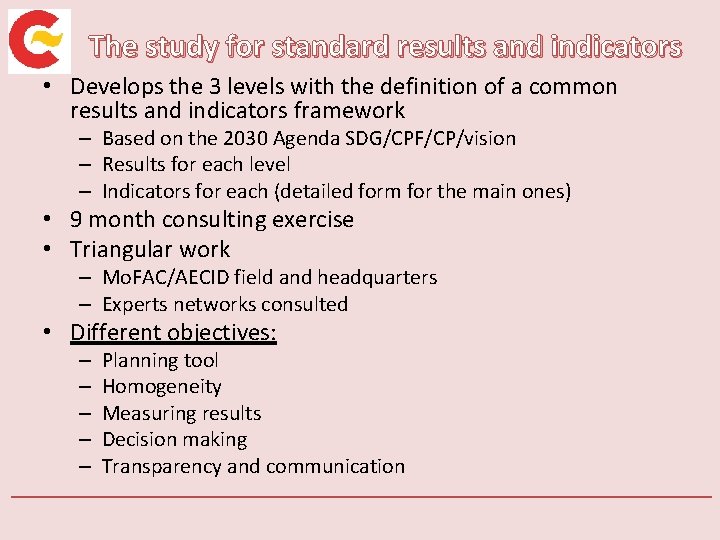
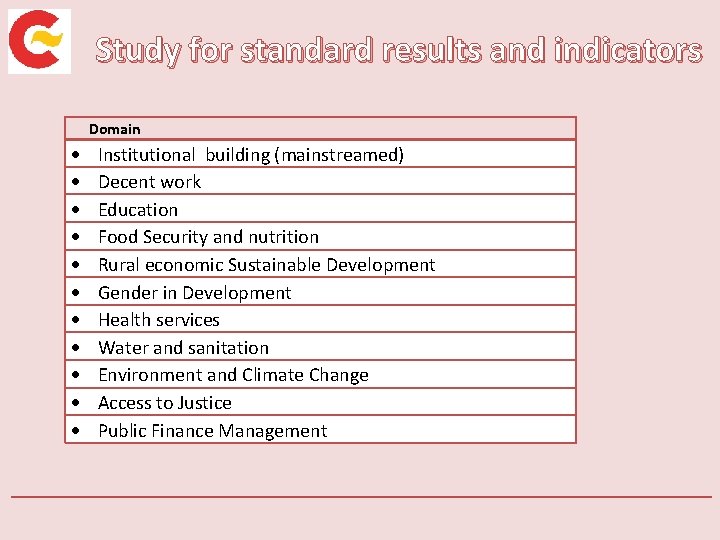
The study for standard results and indicators • Develops the 3 levels with the definition of a common results and indicators framework – Based on the 2030 Agenda SDG/CPF/CP/vision – Results for each level – Indicators for each (detailed form for the main ones) • 9 month consulting exercise • Triangular work – Mo. FAC/AECID field and headquarters – Experts networks consulted • Different objectives: – – – Planning tool Homogeneity Measuring results Decision making Transparency and communication
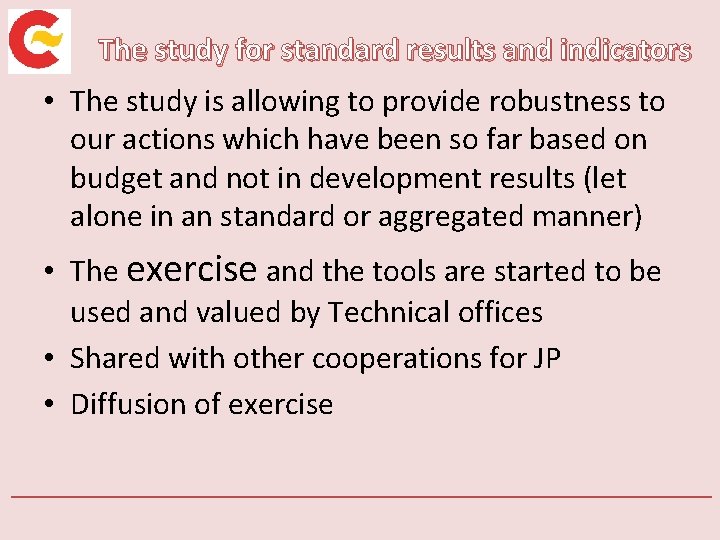
The study for standard results and indicators • The study is allowing to provide robustness to our actions which have been so far based on budget and not in development results (let alone in an standard or aggregated manner) • The exercise and the tools are started to be used and valued by Technical offices • Shared with other cooperations for JP • Diffusion of exercise
Study for standard results and indicators Domain Institutional building (mainstreamed) Decent work Education Food Security and nutrition Rural economic Sustainable Development Gender in Development Health services Water and sanitation Environment and Climate Change Access to Justice Public Finance Management
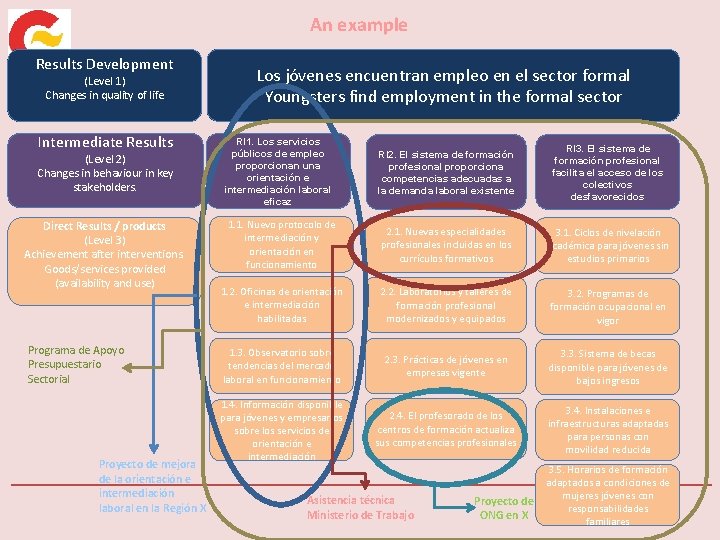
An example Results Development (Level 1) Changes in quality of life Intermediate Results (Level 2) Changes in behaviour in key stakeholders. Direct Results / products (Level 3) Achievement after interventions. Goods/services provided (availability and use) Programa de Apoyo Presupuestario Sectorial Proyecto de mejora de la orientación e intermediación laboral en la Región X Los jóvenes encuentran empleo en el sector formal Youngsters find employment in the formal sector RI 1. Los servicios públicos de empleo proporcionan una orientación e intermediación laboral eficaz RI 2. El sistema de formación profesional proporciona competencias adecuadas a la demanda laboral existente RI 3. El sistema de formación profesional facilita el acceso de los colectivos desfavorecidos 1. 1. Nuevo protocolo de intermediación y orientación en funcionamiento 2. 1. Nuevas especialidades profesionales incluidas en los currículos formativos 3. 1. Ciclos de nivelación académica para jóvenes sin estudios primarios 1. 2. Oficinas de orientación e intermediación habilitadas 2. 2. Laboratorios y talleres de formación profesional modernizados y equipados 3. 2. Programas de formación ocupacional en vigor 1. 3. Observatorio sobre tendencias del mercado laboral en funcionamiento 2. 3. Prácticas de jóvenes en empresas vigente 3. 3. Sistema de becas disponible para jóvenes de bajos ingresos 1. 4. Información disponible para jóvenes y empresarios sobre los servicios de orientación e intermediación 2. 4. El profesorado de los centros de formación actualiza sus competencias profesionales 3. 4. Instalaciones e infraestructuras adaptadas para personas con movilidad reducida Asistencia técnica Ministerio de Trabajo Proyecto de ONG en X 3. 5. Horarios de formación adaptados a condiciones de mujeres jóvenes con responsabilidades familiares
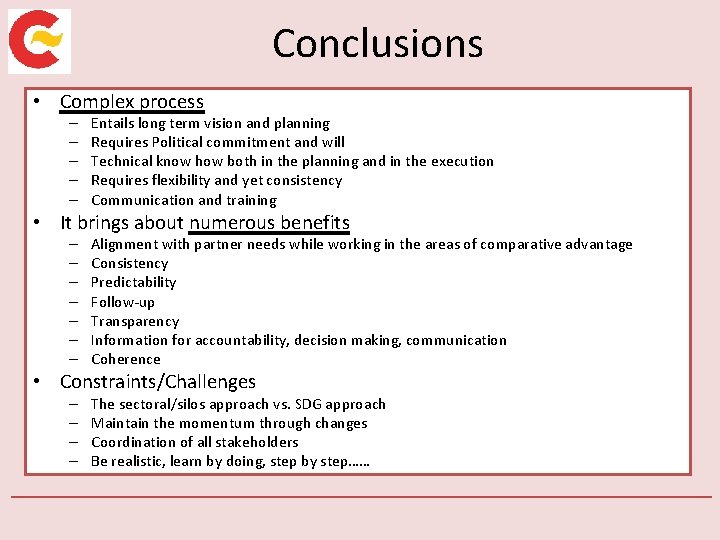
Conclusions • Complex process – – – Entails long term vision and planning Requires Political commitment and will Technical know how both in the planning and in the execution Requires flexibility and yet consistency Communication and training • It brings about numerous benefits – – – – Alignment with partner needs while working in the areas of comparative advantage Consistency Predictability Follow-up Transparency Information for accountability, decision making, communication Coherence • Constraints/Challenges – – The sectoral/silos approach vs. SDG approach Maintain the momentum through changes Coordination of all stakeholders Be realistic, learn by doing, step by step……
Questions? eva. delhoyo@maec. es
MUCHAS GRACIAS