
Development Policy Making and The Roles of Market






- Slides: 45
Development Policy Making and The Roles of Market, State, and Civil Society Presented by: Agustian Singgih Herna O. S Juanita Fathul Amani Nadya Aufa 11/317478/EK/18640 11/319841/EK/18645 11/315980/EK/18633 11/315829/EK/18591
Nadya Aufa 11/315829/EK/18591
Review Chapter 10
A Question of Balance Three important trends in governance and reform: �Tackling the problem of corruption, implementing �Decentralization �Encouraging broad-based development participation.
Development Planning: Concept and Rationale � The Planning Mystique � The Nature of Development Planning � Planning in Mixed Developing Economies � The Rationale for Development Planning
The Planning Mystique National planning was widely believed to offer the essential and perhaps the only institutional and organizational mechanism for overcoming the major obstacles to development and for ensuring a sustained high rate of economic growth.
The Nature of Development Planning � Economic plan � Comprehensive plan � Partial plan � Planning process
Planning in Mixed Developing Economies The private sector in developing countries typically comprises four traditional forms of private ownership and a more recent emerging one: ◦ The subsistence sector, ◦ Small-scale individual or family-owned commercial business and service activities in the formal and informal urban sectors ◦ Medium-size commercial enterprises ◦ Large jointly owned or completely foreign-owned manufacturing enterprises, mining companies, and plantations, catering primarily to foreign ◦ A growing number of relatively large
The Rationale for Development Planning � Market Failure � Resource Mobilization and Allocation � Attitudinal or Psychological Impact � Foreign Aid
Juanita Fathul Amani 11/315980/EK/18633
Government Failure and Preferences for Markets over Planning
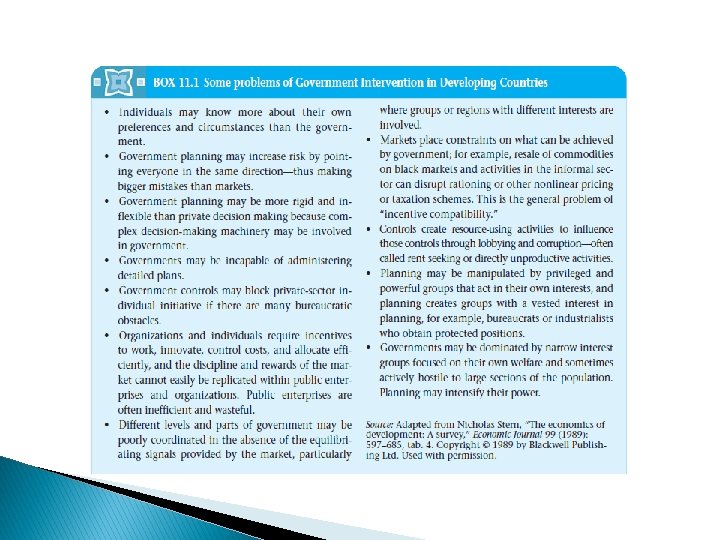
Problems of plan implementation and plan failure What went wrong? Why has the early euphoria about planning gradually been transformed into disillusionment and dejection? o Theory vs Practice - In theory, planning is made in the presence of: market failure, divergences between private and social valuations, resource mobilization, investment coordination, etc. - Government policy in many developing countries has been one of often exacerbating rather than reconciling the divergencies. - Government failure > market failure. - Failure in planning process
Problems of plan implementation and plan failure o o - Deficiencies in Plans and Their Implementation Ambitious plans Insufficient and Unreliable Data Diminishing the accuracy and internal consistency of economywide quantitative plans Unanticipated Economic Disturbances, External and Internal - Difficult to engage in short-term forecasting o
Problems of plan implementation and plan failure o - Institutional weaknesses Incompetent and inqualified civil servants Cumbersome bureaucratic procedures Excessive caution and resistance to innovation and change Interministerial personal and departemental rivalries Lack of commitment to national goals Burreaucratic corruption
Problems of plan implementation and plan failure o - o Lack of political will A will to develop on the part of politicians is likely to meet with staunch resistance, frustration, and internal conflict Conflict, Postconflict, and Fragile States - The large-scale failure of a state to otherwise function meaningfully has resulted in catastrophic failure of even the most basic development objectives
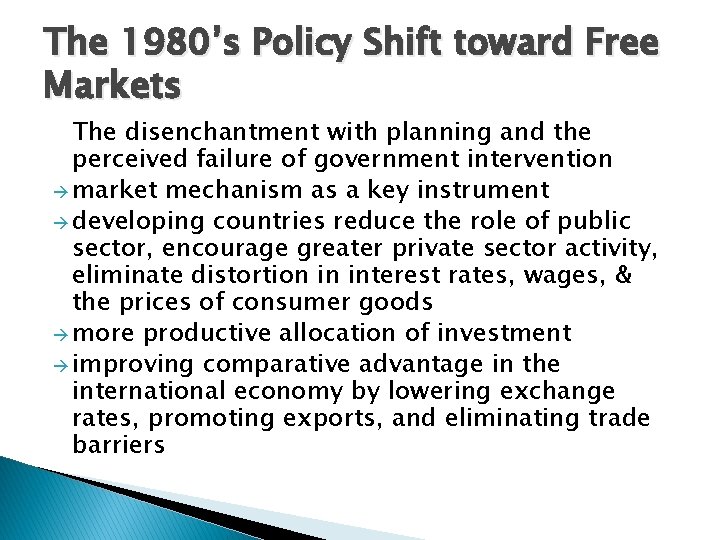
The 1980’s Policy Shift toward Free Markets The disenchantment with planning and the perceived failure of government intervention market mechanism as a key instrument developing countries reduce the role of public sector, encourage greater private sector activity, eliminate distortion in interest rates, wages, & the prices of consumer goods more productive allocation of investment improving comparative advantage in the international economy by lowering exchange rates, promoting exports, and eliminating trade barriers
The Market Economy
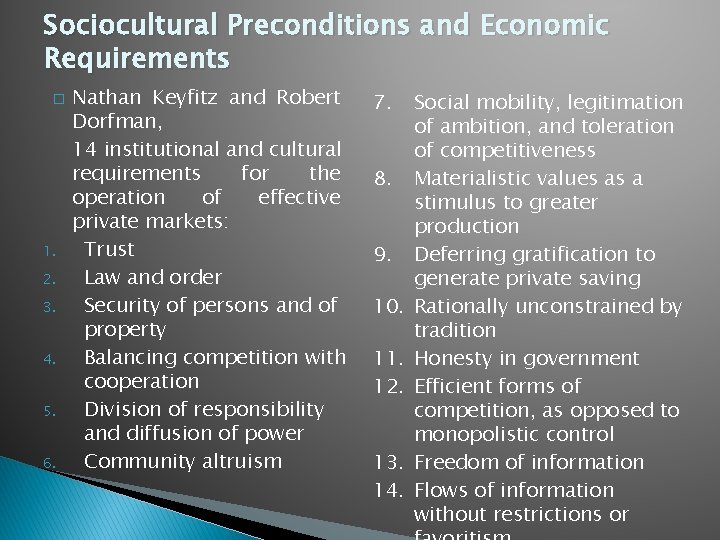
Sociocultural Preconditions and Economic Requirements � 1. 2. 3. 4. 5. 6. Nathan Keyfitz and Robert Dorfman, 14 institutional and cultural requirements for the operation of effective private markets: Trust Law and order Security of persons and of property Balancing competition with cooperation Division of responsibility and diffusion of power Community altruism 7. 8. 9. 10. 11. 12. 13. 14. Social mobility, legitimation of ambition, and toleration of competitiveness Materialistic values as a stimulus to greater production Deferring gratification to generate private saving Rationally unconstrained by tradition Honesty in government Efficient forms of competition, as opposed to monopolistic control Freedom of information Flows of information without restrictions or
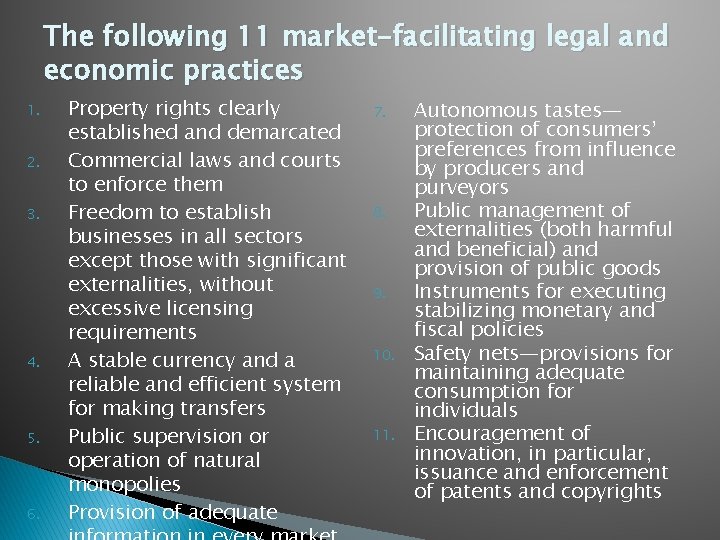
The following 11 market-facilitating legal and economic practices 1. 2. 3. 4. 5. 6. Property rights clearly established and demarcated Commercial laws and courts to enforce them Freedom to establish businesses in all sectors except those with significant externalities, without excessive licensing requirements A stable currency and a reliable and efficient system for making transfers Public supervision or operation of natural monopolies Provision of adequate 7. 8. 9. 10. 11. Autonomous tastes— protection of consumers’ preferences from influence by producers and purveyors Public management of externalities (both harmful and beneficial) and provision of public goods Instruments for executing stabilizing monetary and fiscal policies Safety nets—provisions for maintaining adequate consumption for individuals Encouragement of innovation, in particular, issuance and enforcement of patents and copyrights
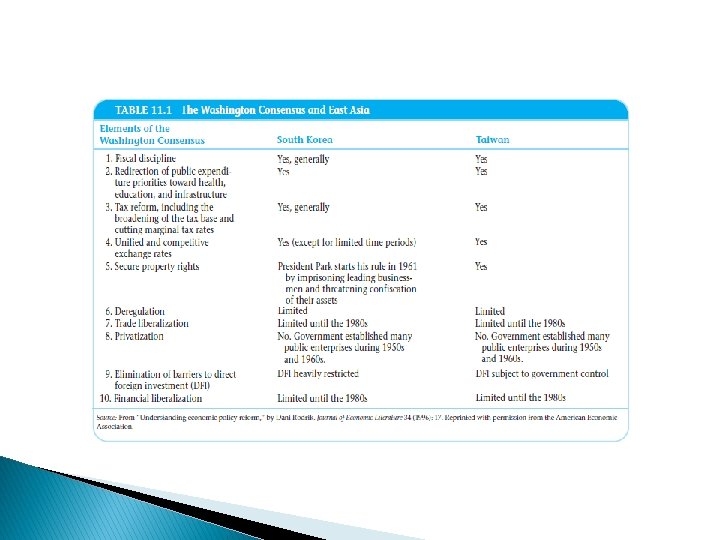
The Wahington Consensus on The Role of The State in Development and Its Subsequent Evolution
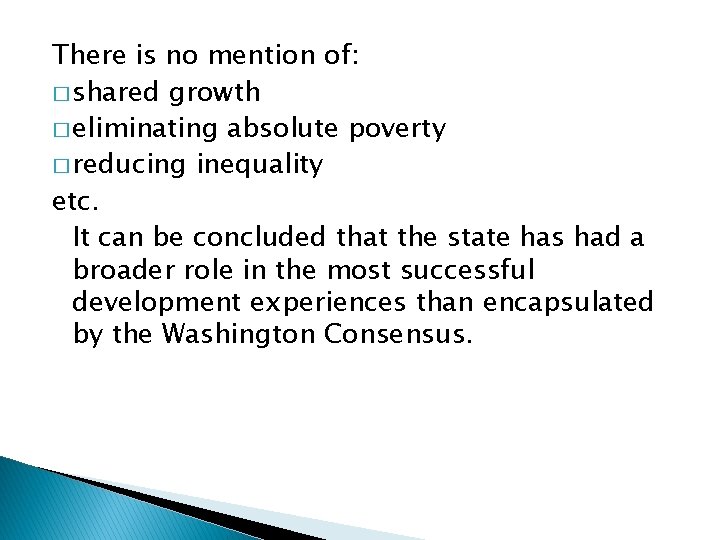
There is no mention of: � shared growth � eliminating absolute poverty � reducing inequality etc. It can be concluded that the state has had a broader role in the most successful development experiences than encapsulated by the Washington Consensus.
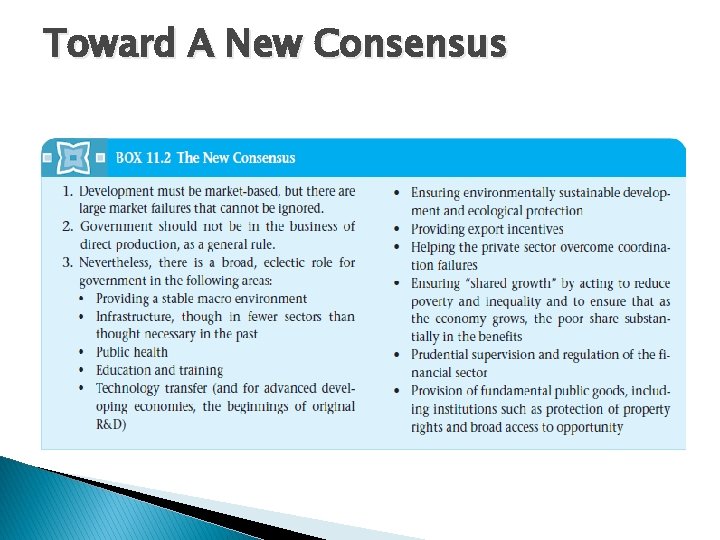
Toward A New Consensus
An important dimension of the New Consensus is the emphasis on government’s responsibility to focus on poverty alleviation. � Free-market policies of the 1980 s and early 1990 s were viewed as inadequately helping the poor. � The New Consensus also appears to reflect a growing sentiment that the goal of poverty eradication is finally achievable, especially given recent progress in health, education, and other areas. � The stress on market-based development and limiting government’s role in direct production continues to be the consensus view. � The new elements emphasize: - the importance of building state capacity - responsiveness by reacting to government failure with judiciously designed reforms - seeking feasible improvements in economic institution - encouraging a deepened civil society role. �
� The New Consensus does not include some features that have considered significant to East Asian success: an active or at least a highly targeted industrial policy—picking winners—to overcome coordination failures, because these remain controversial. � Industrial policy is generally ineffective when government is less capable or more constrained.
a key part of government’s role is to help secure the foundations for economic development by ensuring that the requirements for an effective market-based economy are met.
Agustian Singgih 11/317478/EK/18640
Voting Patterns on Policy Reform Raquel Fernandez dan Dani Rodrik mengemukakan contoh yang terkenal dari suatu situasi di mana risiko pemilih netral dapat memilih terhadap kebijakan dari mayoritas.
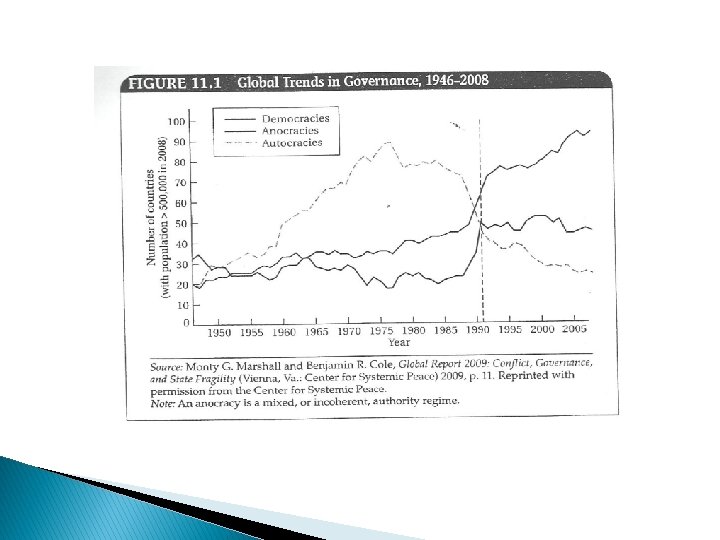
Demokrasi VS Otokrasi, mana yang memberikan fasilitas pertumbuhan ekonomi lebih cepat? Demokrasi: � Banyak politisi korupsi � Tujuan pembangunan strategis jangka pendek � Pertumbuhan ekonomi lambat tapi stabil � Peran penguasa lemah
Demokrasi VS Otokrasi, mana yang memberikan fasilitas pertumbuhan ekonomi lebih cepat? Otokrasi: � Pertumbuhan ekonomi cepat tapi tidak stabil � Tujuan pembangunan strategis jangka panjang � Tingkat korupsi tapi sedikit � peran penguasa pemerintah yang kuat
NGOs World Bank, mendefenisikan NGOs sebagai “organisasi swasta yang menjalankan kegiatan untuk meringankan penderitaan, mengentaskan kemiskinan, memelihara lingkungan hidup, menyediakan layanan sosial dasar atau melakukan kegiatan pengembangan masyarakat”.
NGOs Dalam konteks yang lebih luas, istilah NGOs dapat diartikan sebagai semua organisasi nirlaba yang tidak terkait dengan pemerintahan dan pada umumnya organisasi berbasis nilai (value-based organizations) yang bergantung kepada, baik sebagian atau keseluruhan, bantuan amal (charitable donations) dan pelayanan sukarela (voluntary service).
NGOs Tujuan: Pengembangan dan Pembangunan Infrastruktur, Mendukung inovasi, ujicoba dan proyek percontohan, Memfasilitasi komunikasi, Bantuan teknis dan pelatihan, Penelitian, Monitoring dan Evaluasi, dan Advokasi untuk dan dengan masyarakat miskin.
NGOs Peran: � Inovasi memprogram desain dan keefektifan kebijakan pemerintah � Program flexibility Melihat seberapa pentingnya program pemerintah terhadap masyarakat � Specialized technical knowledge Memberikan pengetahuan khusus atau spesialisasi pada program pemerintah
NGOs Peran: � Targeted local public goods Mengawasi kinerja pemerintah terhadap barang publik atau fasilitas sosial � Common property resource management design and implementation Mengawasi kinerja pemerintah terhadap sumber daya, biasanya sumber daya alam
NGOs Peran: � Representation and advocacy Memrepresentasikan apa yang masyarakat butuhkan
Herna O. S. 11/319841/EK/18645
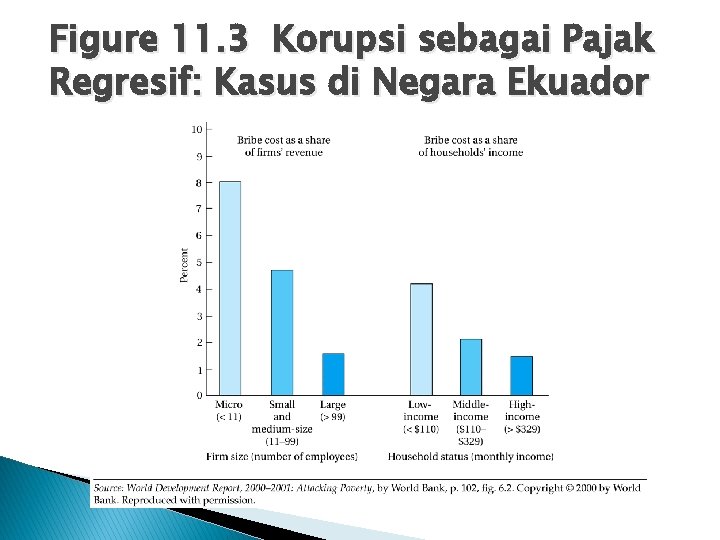
11. 9 Trends Dalam Pemerintahan dan Pembentukannya � Pengurangan masalah korupsi ◦ Menyalahgunakan kepercayaan publik untuk kepentingan pribadi ◦ Pentingnya pembersihan korupsi 1. Pemerintahan yang jujur bisa mempromosikan pertumbuhan dan mempertahankan pendapatan yang tinggi secara berkelanjutan.
2. Secara langsung, pemerintahan yang bersih juga merupakan tujuan dari pembangunan termasuk pada maksimisasi pemberdayaan fasilitator. 3. Korupsi menjadi masalah bagi masyarakat miskin karena mengakibatkan pembatasan pada kesempatan/kemampuan mereka untuk keluar dari garis kemiskinan.
- Pembersihan masalah korupsi menjadi bagian dalam strategi memerangi kemiskinan, korupsi muncul seperti “pajak progresif” bagi si miskin.
Figure 11. 3 Korupsi sebagai Pajak Regresif: Kasus di Negara Ekuador
� Desentralisasi Karakter desentralisasi di Asia sangat erat kaitannya dengan fenomena demokrasi. � Partisipasi dalam Pembangunan Tujuan pertumbuhan ekonomi Pembangunan manusia tanpa partisipasi? ? ? ◦ Partisipasi membuat suatu pekerjaan/ proyek berjalan lebih baik. ◦ Peran NGOs
Kesimpulan Kebijakan pembangunan dalam rasionalitasnya memperhatikan fenomena kegagalan pasar, mengusahakan supaya sumber daya termobolisasi dan teralokasi dengan baik dan adil, mempertimbangkan pengaruh sikap/psikologi dalam proses perencanaan pembangunan, yang akhirnya juga mempertimbangkan syarat penerimaan bantuan luar negeri (khususnya bagi negara berkembang). Kebijakan pembangunan sangat ideal dengan partisipasi masyarakat secara keseluruhan, baik dalam pemerintahan maupun masyarakat sipil/biasa.