
DEVELOPMENT PLANNING FROM CENTRALIZATION TO DECENTRALIZATION A CASE

- Slides: 24
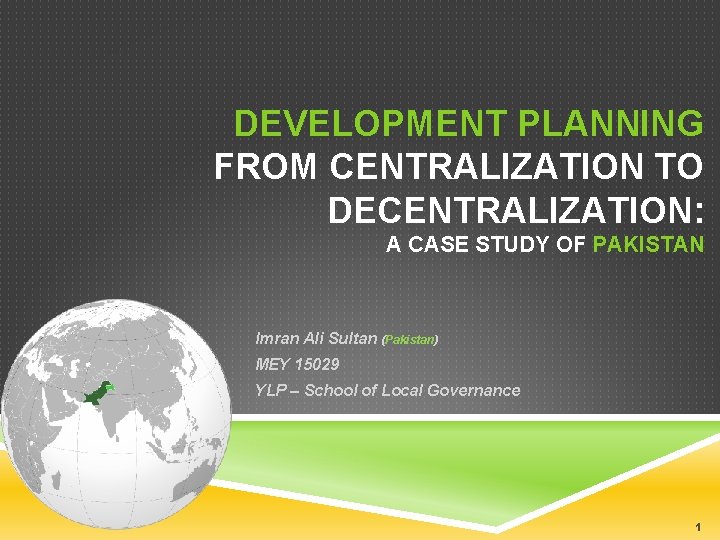
DEVELOPMENT PLANNING FROM CENTRALIZATION TO DECENTRALIZATION: A CASE STUDY OF PAKISTAN Imran Ali Sultan (Pakistan) MEY 15029 YLP – School of Local Governance 1
OUTLINE Pakistan – an overview Centralized Development Planning Key Features Results Analysis Decentralized Development Planning 18 th Constitutional Amendment – Empowering Provinces 7 th National Finance Commission Award Local Governments Devolution Plan 2000 Conclusion 2
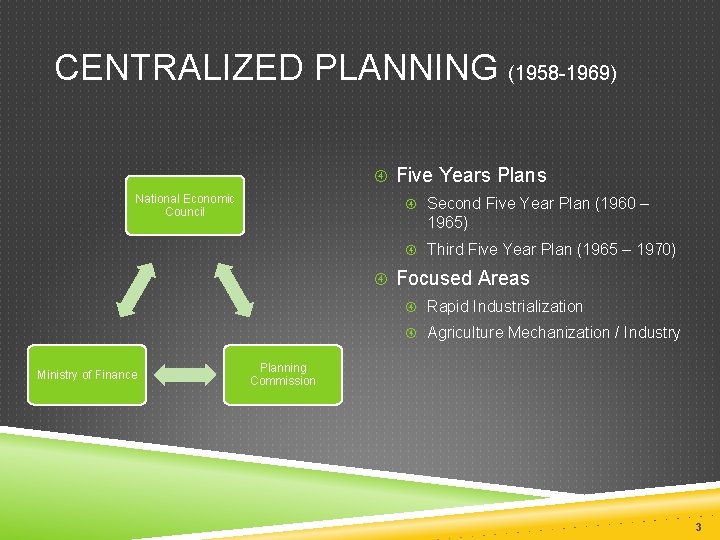
CENTRALIZED PLANNING (1958 -1969) Five Years Plans National Economic Council Second Five Year Plan (1960 – 1965) Third Five Year Plan (1965 – 1970) Focused Areas Rapid Industrialization Agriculture Mechanization / Industry Ministry of Finance Planning Commission 3
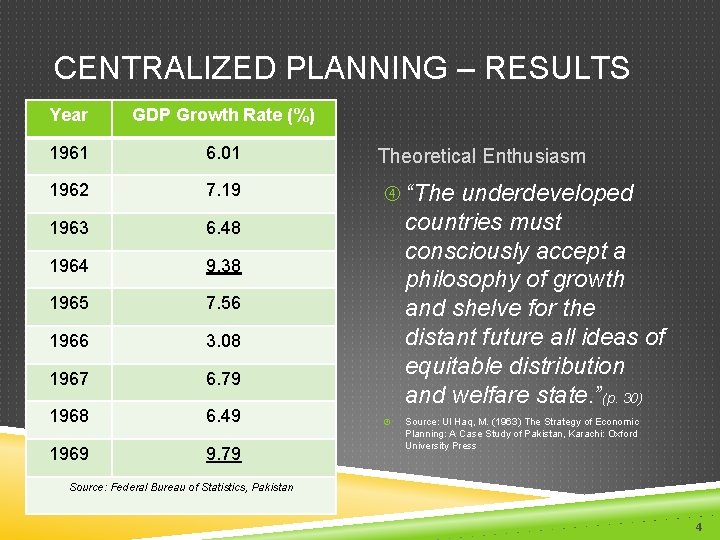
CENTRALIZED PLANNING – RESULTS Year GDP Growth Rate (%) 1961 6. 01 Theoretical Enthusiasm 1962 7. 19 “The underdeveloped 1963 6. 48 1964 9. 38 1965 7. 56 1966 3. 08 1967 6. 79 1968 6. 49 1969 9. 79 countries must consciously accept a philosophy of growth and shelve for the distant future all ideas of equitable distribution and welfare state. ”(p. 30) Source: Ul Haq, M. (1963) The Strategy of Economic Planning: A Case Study of Pakistan, Karachi: Oxford University Press Source: Federal Bureau of Statistics, Pakistan 4
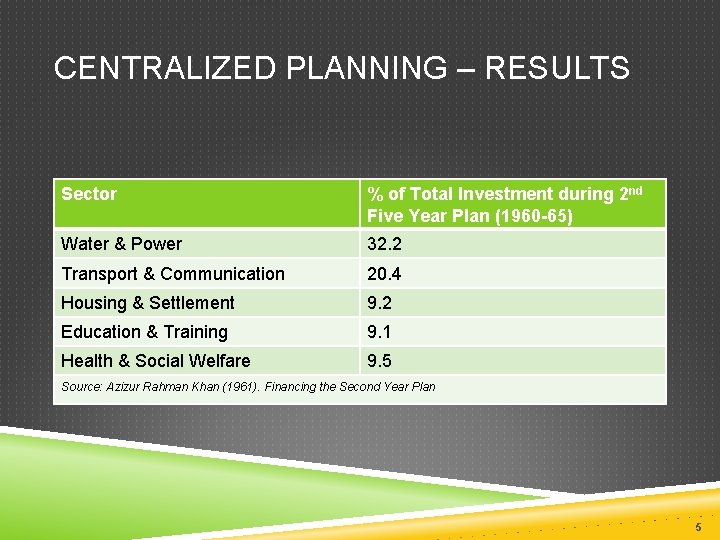
CENTRALIZED PLANNING – RESULTS Sector % of Total Investment during 2 nd Five Year Plan (1960 -65) Water & Power 32. 2 Transport & Communication 20. 4 Housing & Settlement 9. 2 Education & Training 9. 1 Health & Social Welfare 9. 5 Source: Azizur Rahman Khan (1961). Financing the Second Year Plan 5
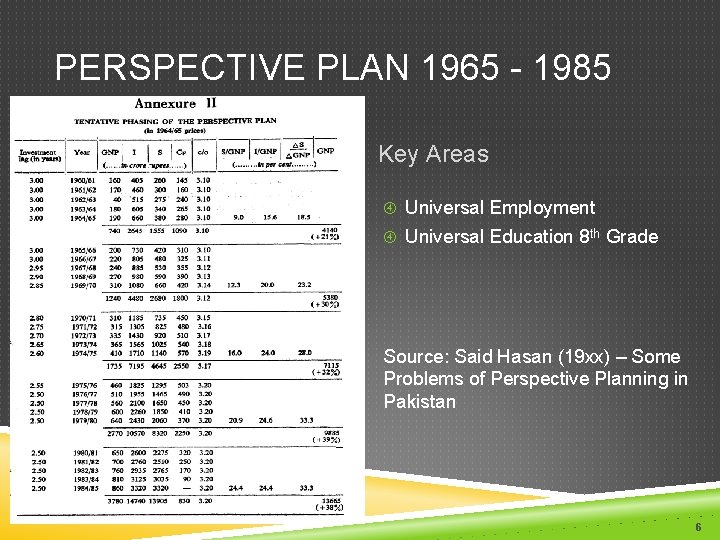
PERSPECTIVE PLAN 1965 - 1985 Key Areas Universal Employment Universal Education 8 th Grade Source: Said Hasan (19 xx) – Some Problems of Perspective Planning in Pakistan 6
CENTRALIZED PLANNING – ANALYSIS Subsidies and tariff protection to exports Export Bonus Vouchers Elite Farming Strategy Land Reforms, Consolidation of Land Holdings Concentrating income in upper income groups Target savings rate set at 25% of GDP 7
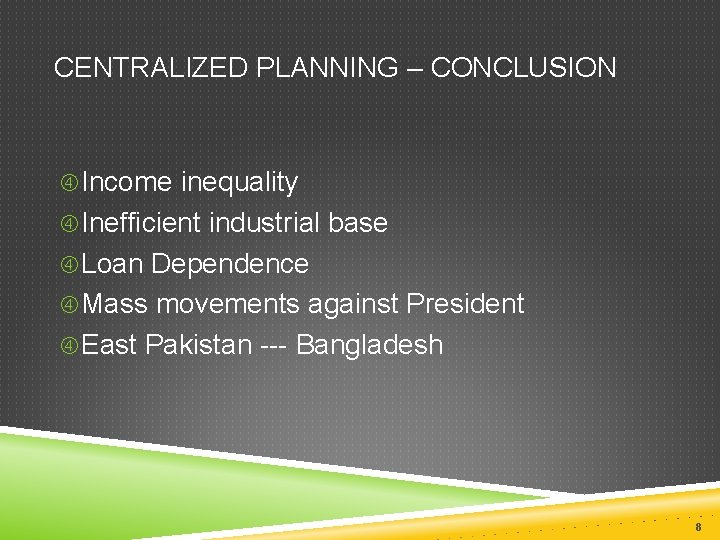
CENTRALIZED PLANNING – CONCLUSION Income inequality Inefficient industrial base Loan Dependence Mass movements against President East Pakistan --- Bangladesh 8
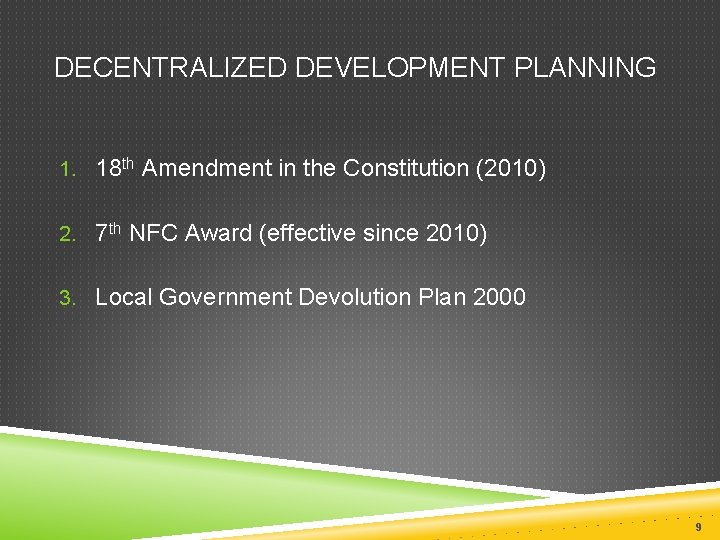
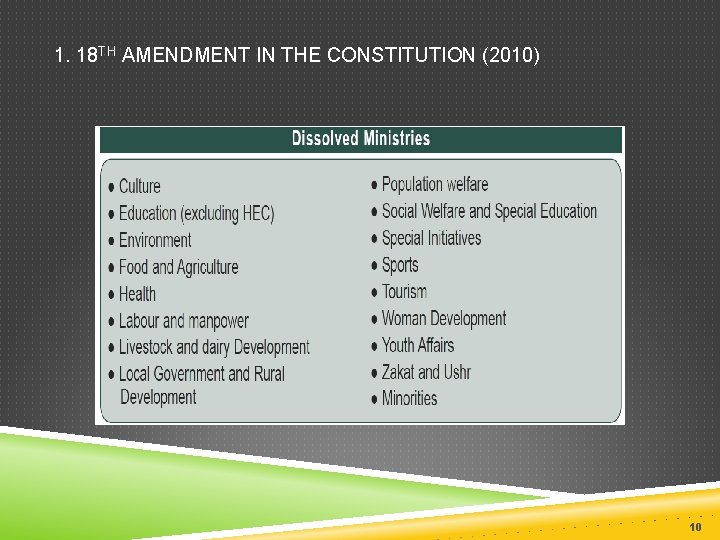
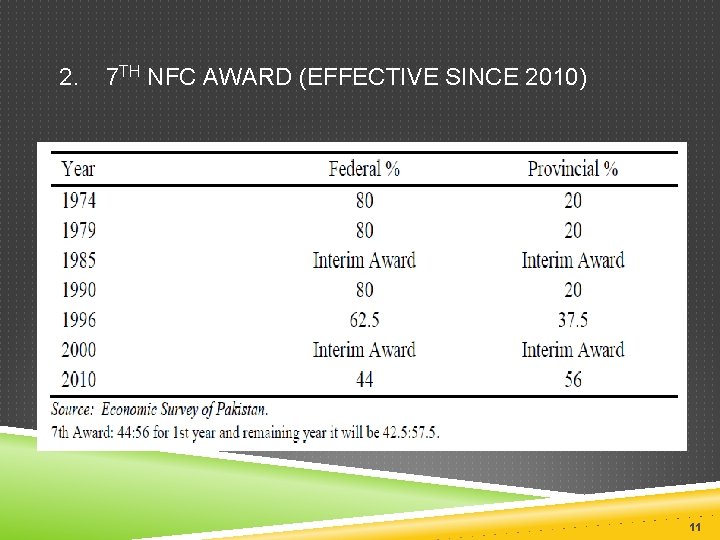
DECENTRALIZED DEVELOPMENT PLANNING 1. 18 th Amendment in the Constitution (2010) 2. 7 th NFC Award (effective since 2010) 3. Local Government Devolution Plan 2000 9
1. 18 TH AMENDMENT IN THE CONSTITUTION (2010) 10
2. 7 TH NFC AWARD (EFFECTIVE SINCE 2010) 11
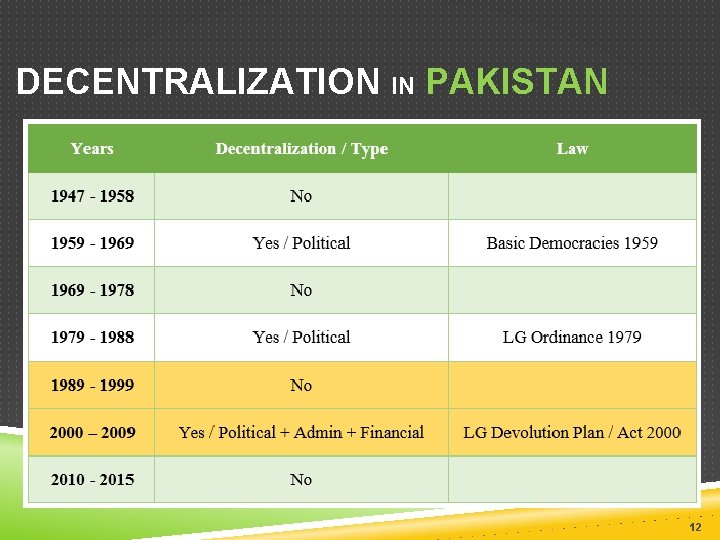
DECENTRALIZATION IN PAKISTAN 12
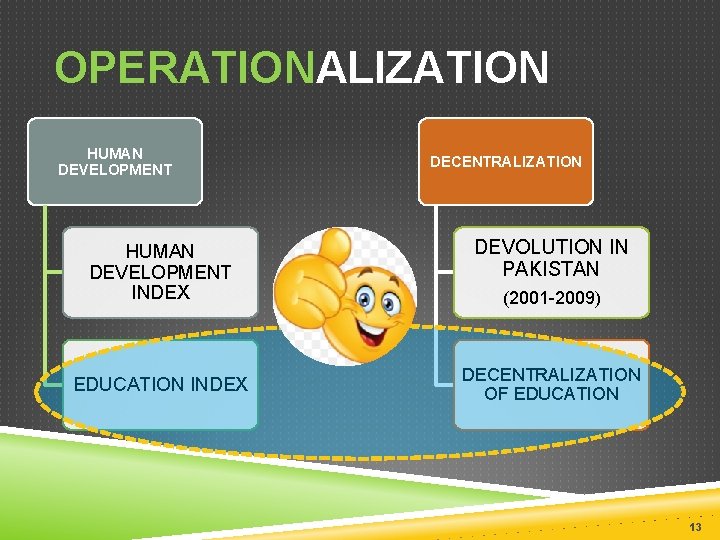
OPERATIONALIZATION HUMAN DEVELOPMENT INDEX EDUCATION INDEX DECENTRALIZATION DEVOLUTION IN PAKISTAN (2001 -2009) DECENTRALIZATION OF EDUCATION 13
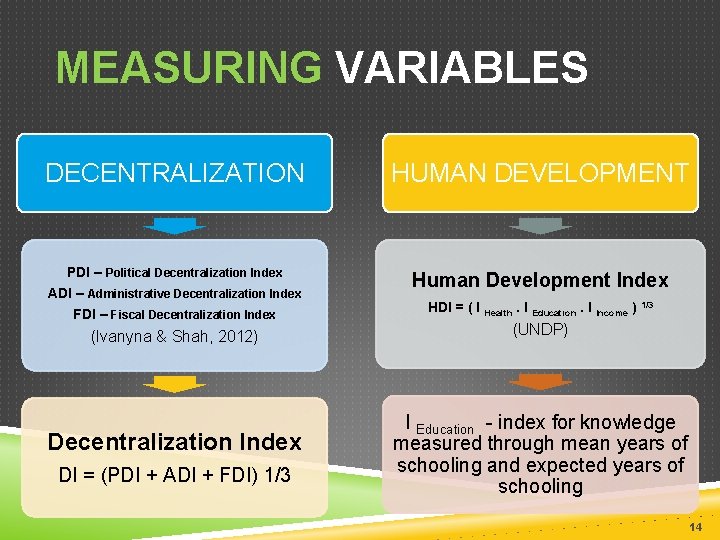
MEASURING VARIABLES DECENTRALIZATION HUMAN DEVELOPMENT PDI – Political Decentralization Index Human Development Index ADI – Administrative Decentralization Index FDI – Fiscal Decentralization Index (Ivanyna & Shah, 2012) Decentralization Index DI = (PDI + ADI + FDI) 1/3 HDI = ( I Health. I Education. I Income ) 1/3 (UNDP) I Education - index for knowledge measured through mean years of schooling and expected years of schooling 14
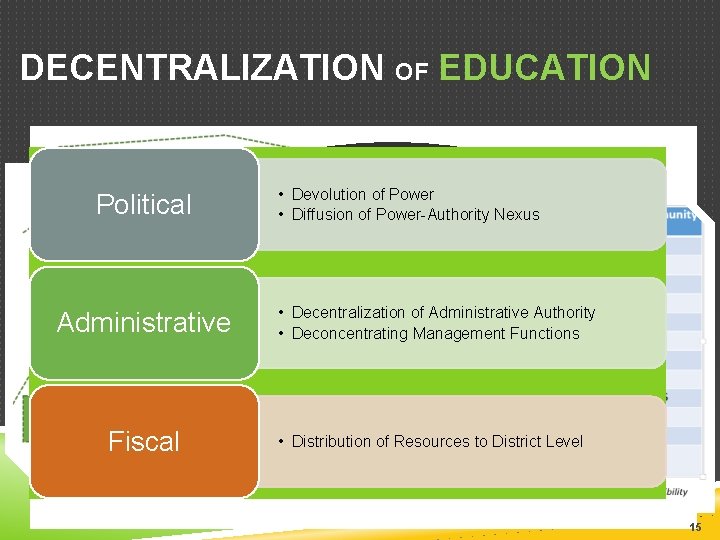
DECENTRALIZATION OF EDUCATION Political Administrative Fiscal • Devolution of Power • Diffusion of Power-Authority Nexus • Decentralization of Administrative Authority • Deconcentrating Management Functions • Distribution of Resources to District Level 15
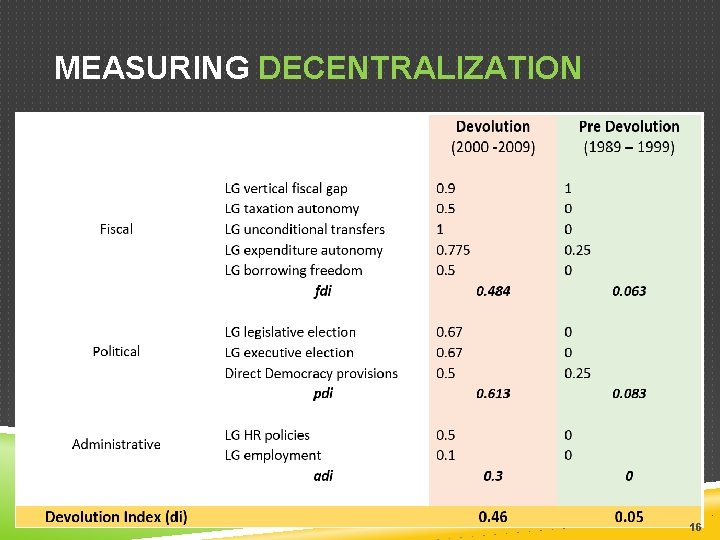
MEASURING DECENTRALIZATION 16
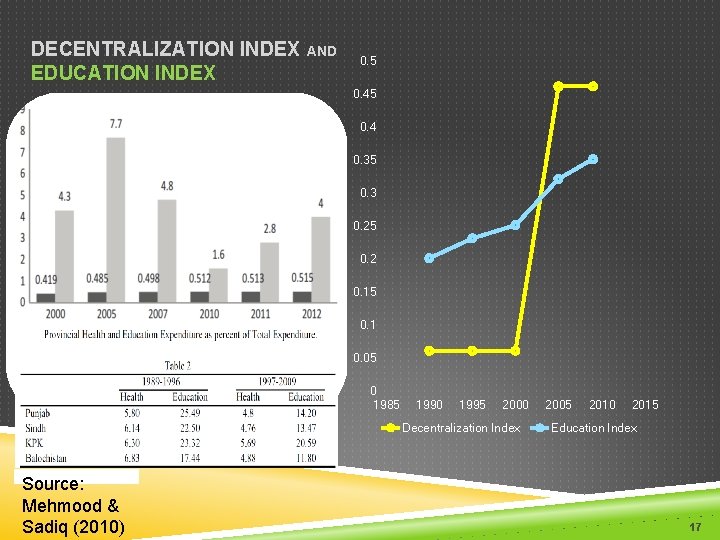
DECENTRALIZATION INDEX AND EDUCATION INDEX 0. 5 0. 45 Research Question: Does decentralization of education contribute in attaining higher education index? . Projection: Longitudinal (time horizon) 0. 4 0. 35 0. 3 0. 25 0. 2 0. 15 Sources: UNDP – HDR (various), Author’s calculation and projection 0. 1 0. 05 0 1985 1990 1995 2000 Decentralization Index Source: Mehmood & Sadiq (2010) 2005 2010 2015 Education Index 17
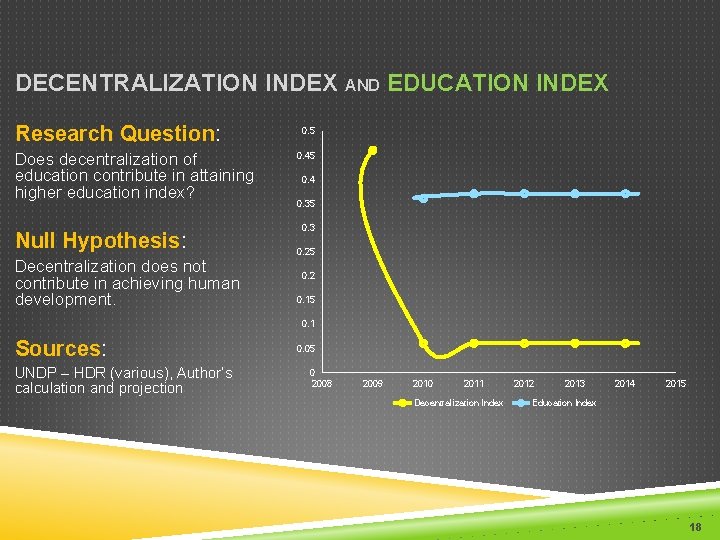
DECENTRALIZATION INDEX AND EDUCATION INDEX Research Question: Does decentralization of education contribute in attaining higher education index? Null Hypothesis: Decentralization does not contribute in achieving human development. 0. 5 0. 4 0. 35 0. 3 0. 25 0. 2 0. 15 0. 1 Sources: UNDP – HDR (various), Author’s calculation and projection 0. 05 0 2008 2009 2010 2011 Decentralization Index 2012 2013 2014 2015 Education Index 18
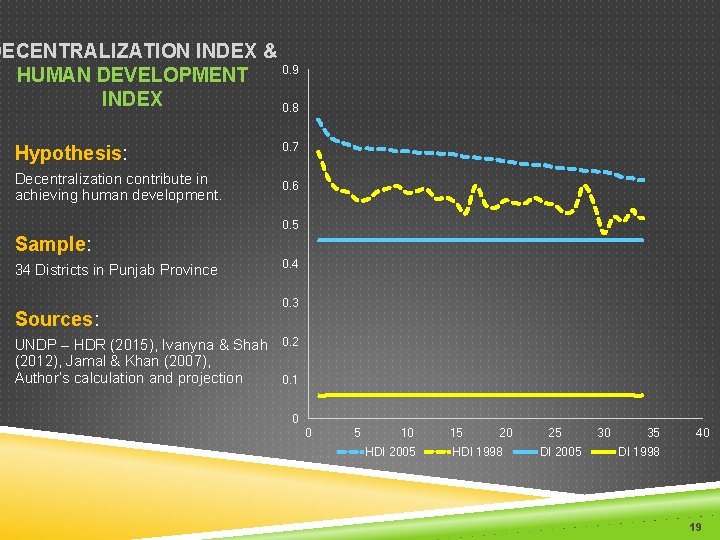
DECENTRALIZATION INDEX & HUMAN DEVELOPMENT 0. 9 INDEX 0. 8 Hypothesis: 0. 7 Decentralization contribute in achieving human development. 0. 6 0. 5 Sample: 34 Districts in Punjab Province Sources: UNDP – HDR (2015), Ivanyna & Shah (2012), Jamal & Khan (2007), Author’s calculation and projection 0. 4 0. 3 0. 2 0. 1 0 0 5 10 HDI 2005 15 20 HDI 1998 25 DI 2005 30 35 40 DI 1998 19
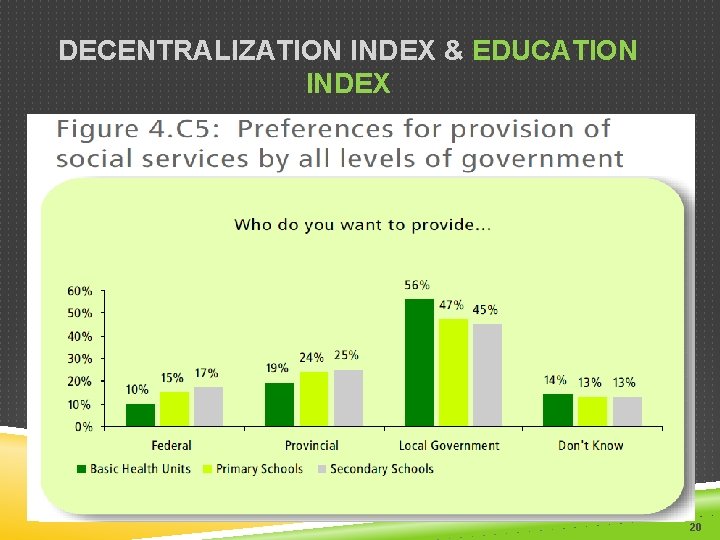
DECENTRALIZATION INDEX & EDUCATION INDEX Source: USAID (2008) – National Survey “The Local Government System: Citizens Perceptions and Preferences” 20
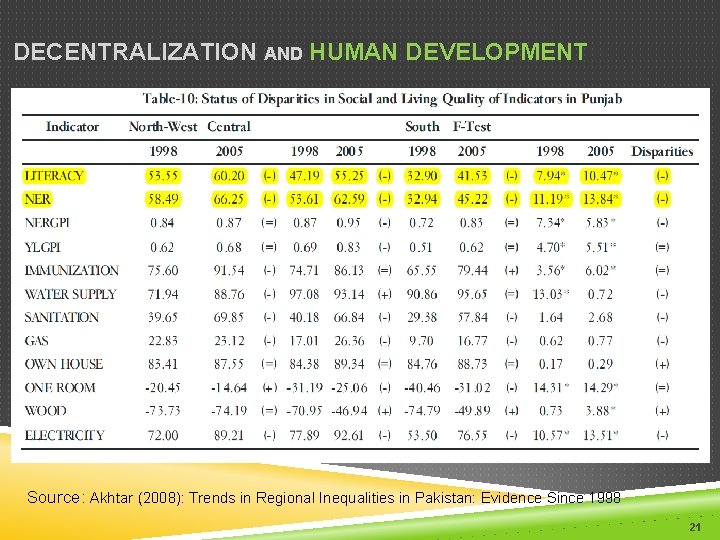
DECENTRALIZATION AND HUMAN DEVELOPMENT Source: Akhtar (2008): Trends in Regional Inequalities in Pakistan: Evidence Since 1998 21
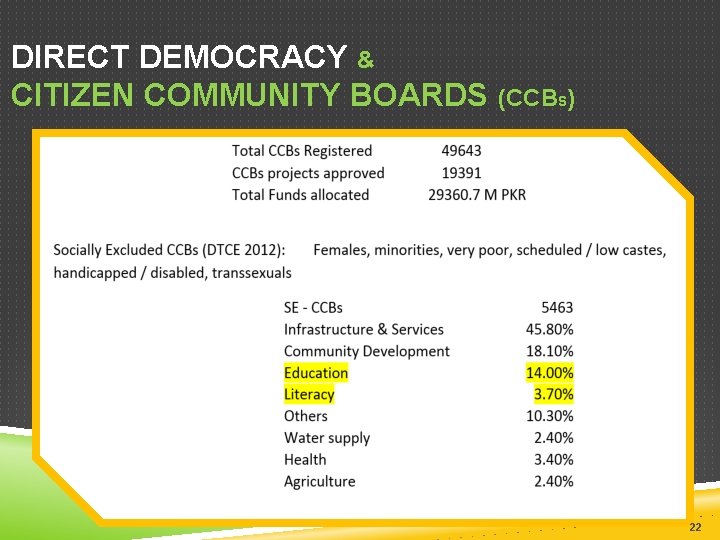
DIRECT DEMOCRACY & CITIZEN COMMUNITY BOARDS (CCBS) 22
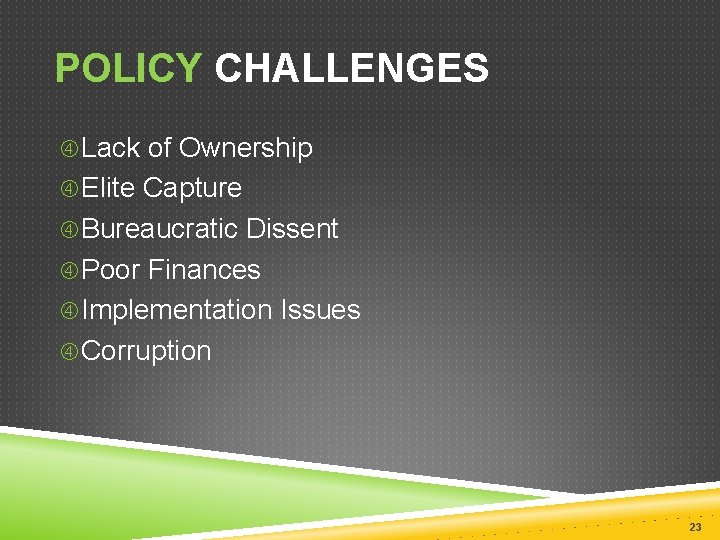
POLICY CHALLENGES Lack of Ownership Elite Capture Bureaucratic Dissent Poor Finances Implementation Issues Corruption 23
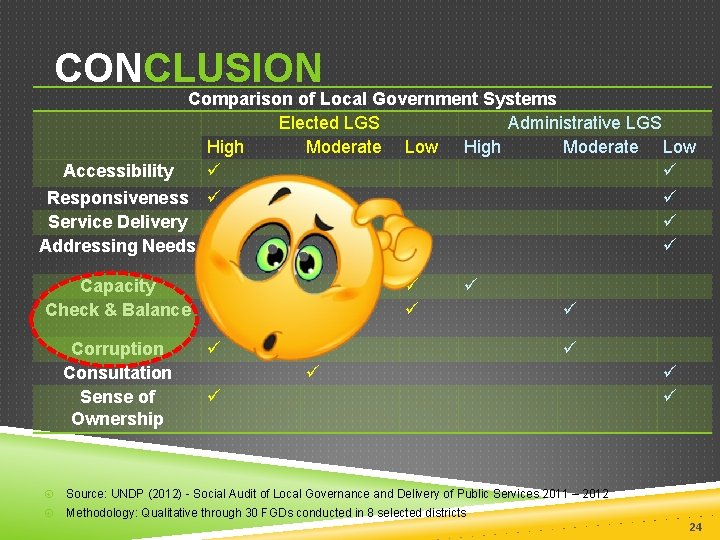
CONCLUSION Comparison of Local Government Systems Elected LGS Administrative LGS High Moderate Low Accessibility Responsiveness Service Delivery Addressing Needs Capacity Check & Balance Corruption Consultation Sense of Ownership Source: UNDP (2012) - Social Audit of Local Governance and Delivery of Public Services 2011 – 2012 Methodology: Qualitative through 30 FGDs conducted in 8 selected districts 24