
Development of the skull metopic Frontal suture bregma

Development of the skull

metopic Frontal suture bregma Anterior fontanelle lambda Posterior fontanelle 1 - Flat skull bones (Neuro-cranium) - It develops from the mesoderm around the developing brain. - These bones included the frontal, parietal, and occipital - These bones ossified in membranes.
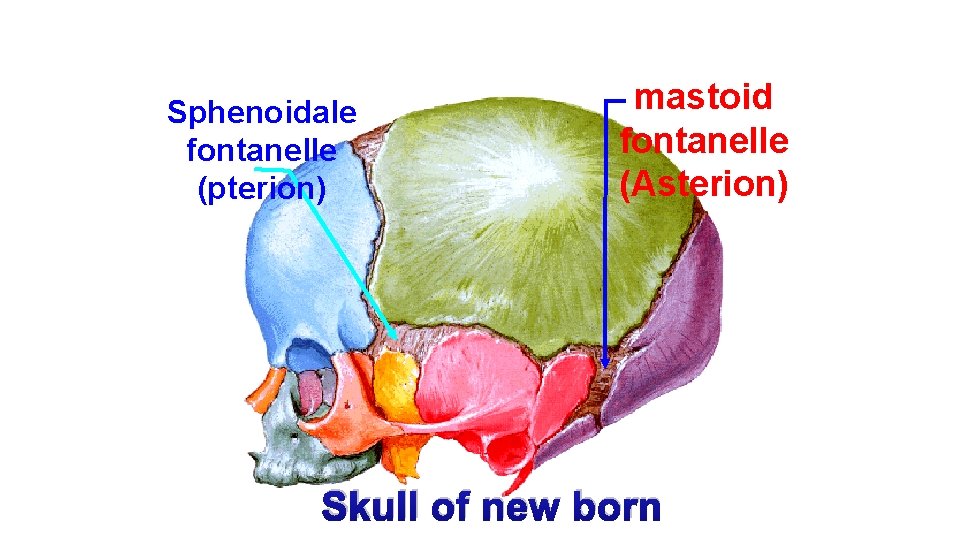
Sphenoidale fontanelle (pterion) mastoid fontanelle (Asterion) Skull of new born

2 Cribriform plate of ethmoid Body of sphenoid Basilar part of occipital bone Lesser wing of the sphenoid Greater wing of the sphenoid Petros part of temporal bone
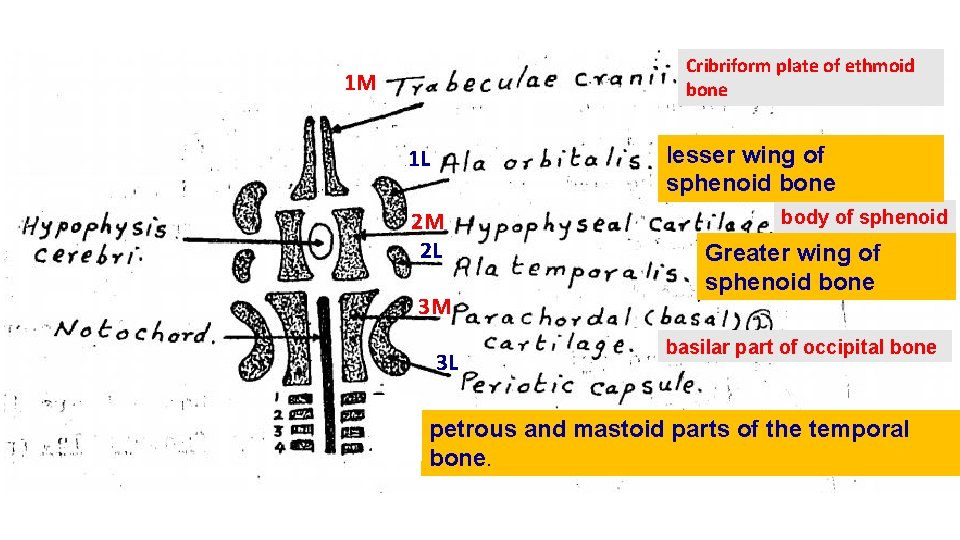
Cribriform plate of ethmoid bone 1 M lesser wing of sphenoid bone 1 L 2 M 2 L 3 M 3 L body of sphenoid Greater wing of sphenoid bone basilar part of occipital bone petrous and mastoid parts of the temporal bone.
** Congenital anomalies of the skull: 1 - Microcephally: small size of the skull. 2 - Macrocephally: large size of the skull. 3 - Scaphocephally: the skull is elongated anteroposteriorly due to early closure of the sagittal sutures. 4 - Acrocephally: short, high skull due to early closure of the coronal sutures. 5 - Anencephaly (cranioschisis): failure of development of the Vault of the skull.
Development of the face & palate
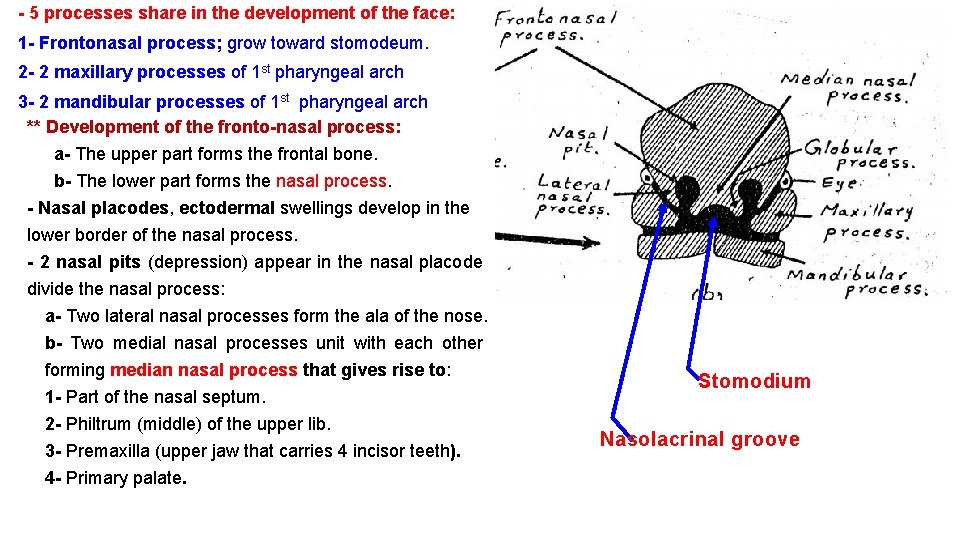
- 5 processes share in the development of the face: 1 - Frontonasal process; grow toward stomodeum. 2 - 2 maxillary processes of 1 st pharyngeal arch 3 - 2 mandibular processes of 1 st pharyngeal arch ** Development of the fronto-nasal process: a- The upper part forms the frontal bone. b- The lower part forms the nasal process. - Nasal placodes, ectodermal swellings develop in the lower border of the nasal process. - 2 nasal pits (depression) appear in the nasal placode divide the nasal process: a- Two lateral nasal processes form the ala of the nose. b- Two medial nasal processes unit with each other forming median nasal process that gives rise to: 1 - Part of the nasal septum. 2 - Philtrum (middle) of the upper lib. 3 - Premaxilla (upper jaw that carries 4 incisor teeth). 4 - Primary palate. Stomodium Nasolacrinal groove
** Development of the maxillary process; - The 2 maxillary processes develop above and lateral to the stomodium. - They grow medially above the stomodium towards the lateral nasal processes but separated from them by a well developed ectodermal groove called nasolacrimal groove, Later on forms the nasolacrimal canal. - The maxillary processes continue to grow medially and fused with the lateral nasal processes. Later on; they fused with the margins of the median nasal process to form the upper jaw. ** Development of the mandibular process - The 2 mandibular processes grow medially below the stomodium and fused with each other in the midline forming the primitive lower jaw.
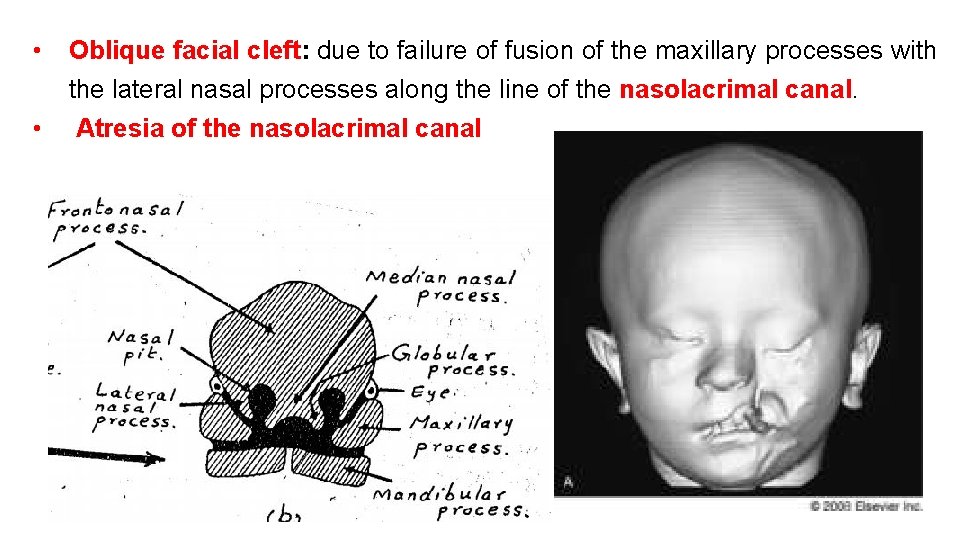
• • Oblique facial cleft: due to failure of fusion of the maxillary processes with the lateral nasal processes along the line of the nasolacrimal canal. Atresia of the nasolacrimal canal
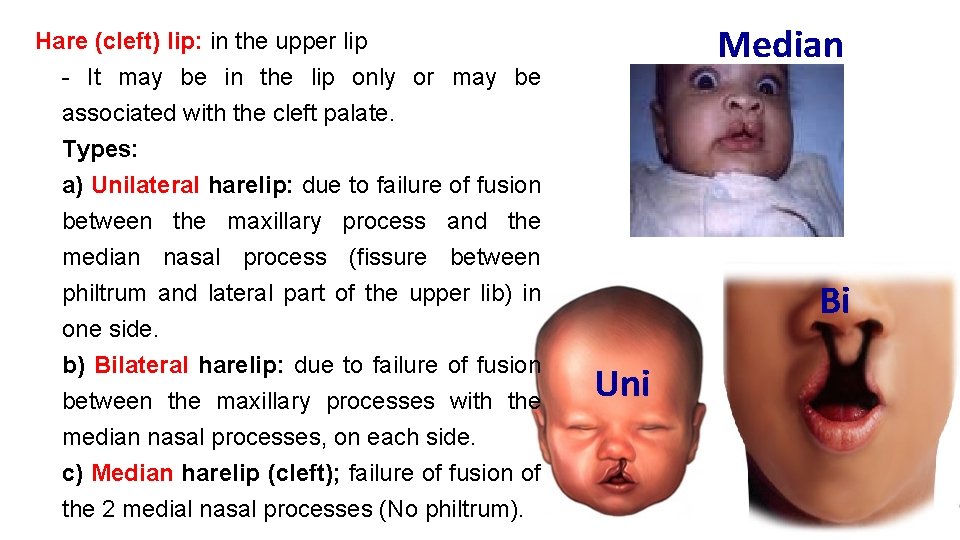
Hare (cleft) lip: in the upper lip - It may be in the lip only or may be associated with the cleft palate. Types: a) Unilateral harelip: due to failure of fusion between the maxillary process and the median nasal process (fissure between philtrum and lateral part of the upper lib) in one side. b) Bilateral harelip: due to failure of fusion between the maxillary processes with the median nasal processes, on each side. c) Median harelip (cleft); failure of fusion of the 2 medial nasal processes (No philtrum). Median Bi Uni
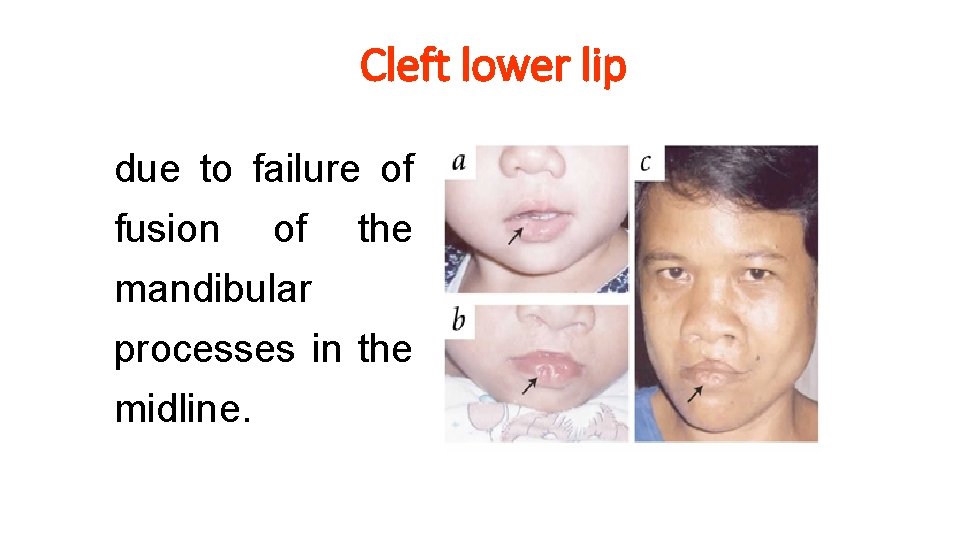
Cleft lower lip due to failure of fusion of the mandibular processes in the midline.
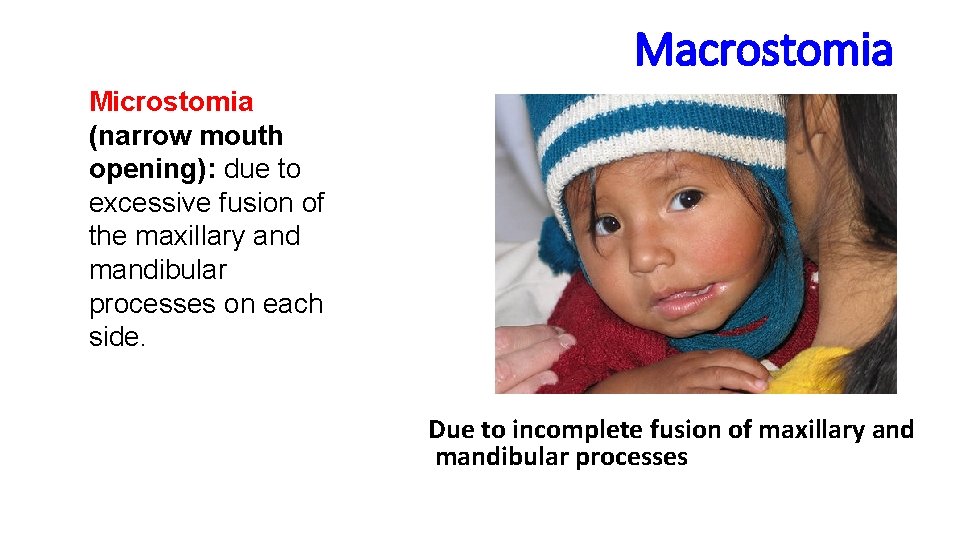
Macrostomia Microstomia (narrow mouth opening): due to excessive fusion of the maxillary and mandibular processes on each side. Due to incomplete fusion of maxillary and mandibular processes
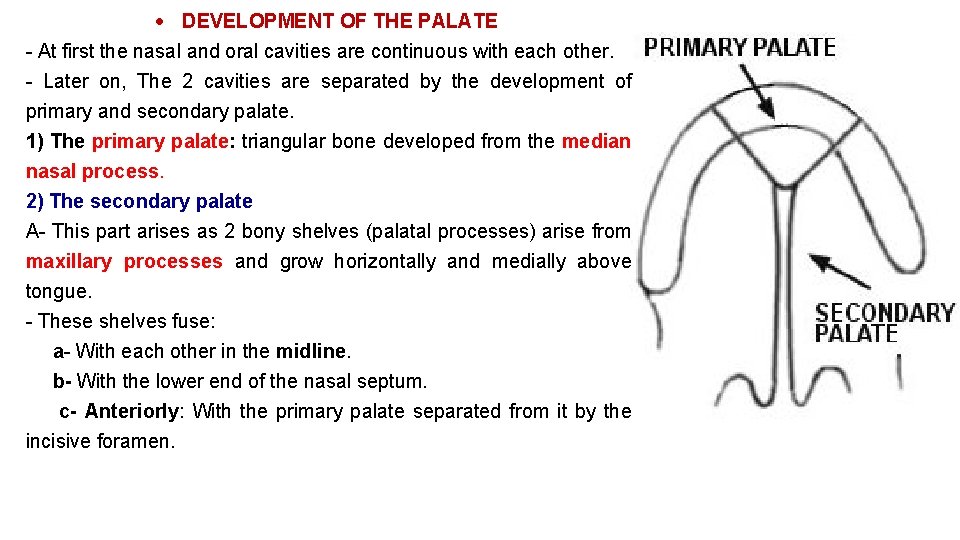
DEVELOPMENT OF THE PALATE - At first the nasal and oral cavities are continuous with each other. - Later on, The 2 cavities are separated by the development of primary and secondary palate. 1) The primary palate: triangular bone developed from the median nasal process. 2) The secondary palate A- This part arises as 2 bony shelves (palatal processes) arise from maxillary processes and grow horizontally and medially above tongue. - These shelves fuse: a- With each other in the midline. b- With the lower end of the nasal septum. c- Anteriorly: With the primary palate separated from it by the incisive foramen.
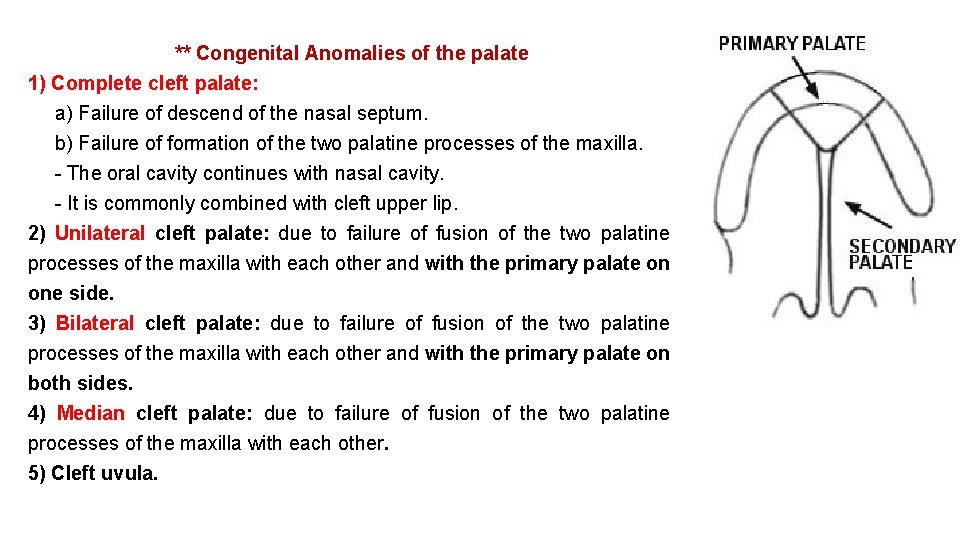
** Congenital Anomalies of the palate 1) Complete cleft palate: a) Failure of descend of the nasal septum. b) Failure of formation of the two palatine processes of the maxilla. - The oral cavity continues with nasal cavity. - It is commonly combined with cleft upper lip. 2) Unilateral cleft palate: due to failure of fusion of the two palatine processes of the maxilla with each other and with the primary palate on one side. 3) Bilateral cleft palate: due to failure of fusion of the two palatine processes of the maxilla with each other and with the primary palate on both sides. 4) Median cleft palate: due to failure of fusion of the two palatine processes of the maxilla with each other. 5) Cleft uvula.

- Slides: 17