
DEVELOPMENT OF THE SELF IN SOCIETY Page 128









- Slides: 27
DEVELOPMENT OF THE SELF IN SOCIETY Page 128 - 146
HUMAN FACTORS THAT CAUSE ILLHEALTH, ACCIDENTS, CRISES & DISASTER • Natural disasters are: • • • Floods Lightning strikes Earthquakes Tornadoes These occur naturally and there is nothing anyone can do to prevent them. • Then there are other types of diseases, accidents and disasters that we often hear about that are caused by human factors.
HUMAN FACTORS • Human factors can be: • Psychological • Social • Religious • Cultural practices • Different knowledge perspectives • Let’s look at each of these Human Factors to see how they could play a role in making people cause a range of different accidents, crises or disasters.
PSYCHOLOGICAL FACTORS • Mental and emotional state of a person. Eg: depression, schizophrenia & psychopathy. • These mental illnesses can cause sufferers to do irrational things that a normal person would never do.
RELIGIOUS FACTORS • These factors arise from religious beliefs and practices. • The Holocaust. • 9/11 terrorist attacks by Muslim extremists. • Religious cult called Heaven’s Cult, all the members committed mass suicide. • ISIS
SOCIAL FACTORS • These factors arise when a group of people are living or socializing together. • When people live in overcrowded informal settlements that don’t have proper buildings, roads or sanitation. • These conditions are very unhealthy, as there is a lot of pollution and the danger of fires spreading very quickly. • Social factors include things like: • • Drunkenness Anger Aggression These lead to violence
CULTURAL PRACTICES • Various cultural practices lead to ill-health, accidents, crises and disasters. • Examples of some extreme cultural practices: • Honour killings – where the father/brother of a Muslim daughter/sister has the right to kill her if she brings shame to the family. • Bull fighting – The matador (bullfighter) can be severely injured by the bull. • Female Genital Mutilation – The external female genitalia are removed and sewn closed to signify purity. • Placentophagy – Women eat the placenta after giving birth, they believe it helps prevent post-partum depression.
DIFFERENT KNOWLEDGE PERSPECTIVES • This refers to the strange ideas that some people have that can cause serious damage to themselves and also other people. • The myth that if you have sex with a virgin you will be cured from HIV/AIDS. • The myth that rhino horn cures a fever, arthritis and gout. • The myth that spraying a person with Doom would ward off evil spirits.
Activity 1 Part A No. 1 – 2 Part B No. 1 – 5 Page 131
LIFESTYLE DISEASES AS A RESULT OF POVERTY AND GENDER IMBALANCES • Poverty: • Refers to the condition of not being able to afford basic human needs such as clean water, food, health care, clothing and shelter. • Poverty leads to fewer opportunities and empowerment, and poor quality of life. • Poor people are usually unhappy with their lives, they are often sick and die sooner than people who are not so poor. • The most common effects of poverty include hunger, homelessness, diseases and illness, together with lack of basic hygiene.
LIFESTYLE DISEASES AS A RESULT OF POVERTY AND GENDER IMBALANCES cont… • Gender Imbalances: • The term gender imbalances describes how women are still at a disadvantage when compared to men. • Even though our constitution guarantees equal rights for all, women are still being discriminated against. • There are still parents who don’t want to spend money on educating a girl child because they feel she will marry and her husband will take care of her. • In rural areas, women are poorer than men and they are dependent on men to take care of them.
LIFESTYLE DISEASES AS A RESULT OF POVERTY AND GENDER IMBALANCES cont… • Lifestyle Diseases: • Lifestyle diseases are caused by the way we live our lives. • In SA major lifestyle diseases include hypertension, heart disease and diabetes • STD’s, such as syphilis, gonorrhoea and AIDS, are also spread as a result of lifestyle choices. • Lifestyle factors can also be involved in diseases such as cancer. Eg: Lung cancer (smoking) and skin cancer (too much sun).
LIFESTYLE DISEASES • Cancer: • Cancer is a disease caused by an uncontrolled growth of abnormal cells. This growth can also be called a tumour. • Poor people often smoke tobacco rolled up in newspaper which increases the risk of getting lung cancer. • Ovarian cancer often goes undetected as poor women cannot afford to go for regular screening and it is often picked up too late. • Skin cancer is a big problem among people who cannot afford expensive sunscreen and those who work outside, unprotected for extended periods of time.
LIFESTYLE DISEASES • Hypertension: • High Blood Pressure is an illness that can lead to a stroke, if it is not controlled. • Research has shown that high blood pressure is more common in poorer people than in richer people. • Poorer people tend to eat an unhealthier diet. Too much salt, as well as cheap starchy and oily foods, which makes them pick up weight. • This poor diet and being overweight can lead to high blood pressure. • More women than men suffer from high blood pressure.
LIFESTYLE DISEASES • Disease of the heart and circulatory system • Cholesterol affects the circulatory system, fatty deposits collect on the inside of the veins and arteries, narrowing them. If a piece breaks off this can cause a heart attack. • More men suffer from heart and circulatory diseases than women. • This is mostly linked to poor lifestyle choices and stress. • Research shows that up to 80% of heart disease and strokes can be prevented by better lifestyle choices.
Activity 2 No. 1 – 3 Page 135
LIFESTYLE DISEASES • Tuberculosis • TB is a contagious but curable disease that kills 2 million people every year. • TB mostly attacks the lungs. • TB occurs mainly in poor socio-economic environments where people live in over-crowded conditions, and don’t eat a healthy diet. • Poor ventilation, unhygienic circumstances and exposure to an infected person, cause the spread of TB.
CONTRIBUTING FACTORS TO LIFESTYLE DISEASES • Eating habits • A healthy diet contributes to the health of your entire body. • Your body requires fuel and the healthier and more nutritious the foods you eat, the better use your body can make them. • Unhealthy foods (junk food) can actually lead to health problems. • A healthy diet contains enough vitamins and minerals for the body to function at peak efficiency.
CONTRIBUTING FACTORS TO LIFESTYLE DISEASES • Smoking causes emphysema, lung cancer and heart disease. • The government has outlawed smoking in public places, like shopping centers, restaurants and places of work. • New laws were introduced that make it illegal to sell cigarettes to children under the age of 18.
Activity 3 No. 1 – 8 Page 138
CONTRIBUTING FACTORS TO LIFESTYLE DISEASES • Lack of exercise • People often feel they don’t have enough time to exercise. • Lack of exercise can lead to many health problems like heart disease, hypertension, diabetes and high cholesterol. • Participating in 30 minutes of exercise, 3 times a week improves your general well-being. • Exercise reduces stress, strengthens the heart and lungs, increases energy levels, maintains a healthy body weight and improves your outlook on life: “A healthy body contains a healthy spirit. ”
CONTRIBUTING FACTORS TO LIFESTYLE DISEASES • Long term effects of participating in physical activities: • Studies show that people who exercise regularly have half the medical expenses of people who don’t exercise. • Your heart and lungs will work more effectively. • Regular training lowers blood pressure and reduces the risk of coronary disease. • Exercise increases muscular strength. • People are able to deal with stress and depression more effectively. • People have a higher self-esteem if they look fit and healthy.
CONTRIBUTING FACTORS TO LIFESTYLE DISEASES • Value-added benefits and diseases of lifestyle: • The value-added benefits of a healthy lifestyle are: • Sense of achievement. • Improved self-confidence. • Feeling a part of a group of positive, healthy people. • Drastically reduce your chances of getting a lifestyle disease.
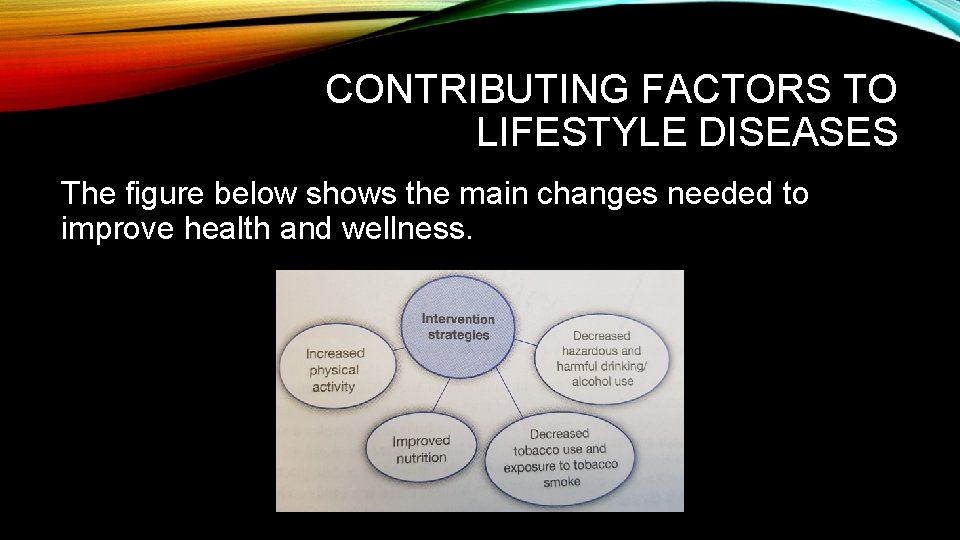
CONTRIBUTING FACTORS TO LIFESTYLE DISEASES • Intervention strategies: • The worldwide epidemic of lifestyle disease has forced the health departments to research possible ways of dealing with them. • Various interventions have been identified that are low cost and very effective. • The only factor that is needed to ensure the success of any health intervention is the commitment of the participants and good planning. • If these interventions can be implemented, the major risk factors can be managed and reduced.
CONTRIBUTING FACTORS TO LIFESTYLE DISEASES The figure below shows the main changes needed to improve health and wellness.
Activity 6 No. 1 – 2 Page 146
RECAP: Complete the following activities in this chapter. Activity 1 Part A No. 1 – 2 Part B No. 1 – 5 Page 131 Activity 2 No. 1 – 3 Page 135 Activity 3 No. 1 – 8 Page 138 Activity 6 No. 1 – 2 Page 146