
Development of the regions of the world economy
- Slides: 13
Development of the regions of the world economy dr. Jeney László Senior lecturer jeney@elte. hu Economic Geography I. International Business bachelor study programme (BA) Spring term 2015/2016. CUB Centre of Economic Geography and Futures Studies
Definition and characteristics of world economy
Evolution and actors of world economy n n Modern world economy developed by a long historical evolution The appearance of world market: 15 th– 16 th century (at the Age of Discovery): the appearance of only the world market 18 th– 19 th century (at the age of classical capitalism): the appearance world economy – At the same time with the apprearance of national economy – The essence is derived from the capitalist social formations n A system with more actors 1. 2. 3. National economies: oldiest actors Transnational companies (tnc) International organizations: newest actors 3
Similar concepts n World economy > aggregate of national economies – – – Internationalization of forces of production More effective allocation of resources Global problems can be solved only on this level (more and more questions arises what should be internationally dealt) – Processes of world economy determines the ones of national economies n n World economy > world market ( only the interactions among the national economies) World economy < world system ( system of ethnical, cultural, military relations as well) 4
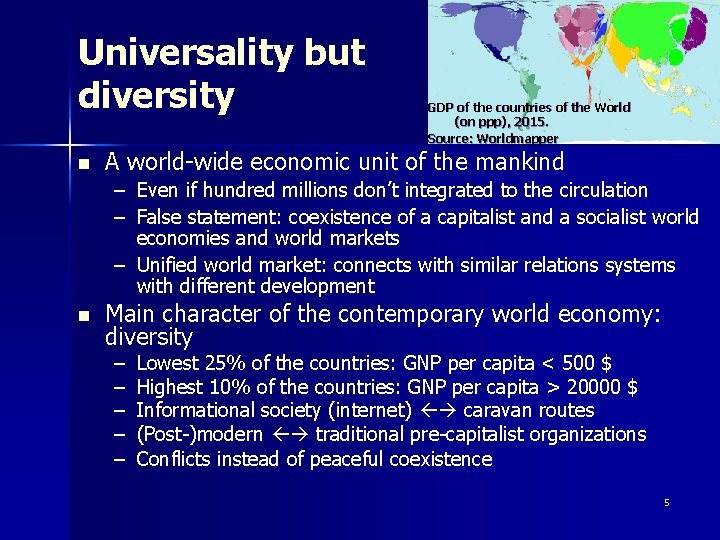
Universality but diversity n GDP of the countries of the World (on ppp), 2015. Source: Worldmapper A world-wide economic unit of the mankind – Even if hundred millions don’t integrated to the circulation – False statement: coexistence of a capitalist and a socialist world economies and world markets – Unified world market: connects with similar relations systems with different development n Main character of the contemporary world economy: diversity – – – Lowest 25% of the countries: GNP per capita < 500 $ Highest 10% of the countries: GNP per capita > 20000 $ Informational society (internet) caravan routes (Post-)modern traditional pre-capitalist organizations Conflicts instead of peaceful coexistence 5
Main characteristics of the global core–periphery relationship
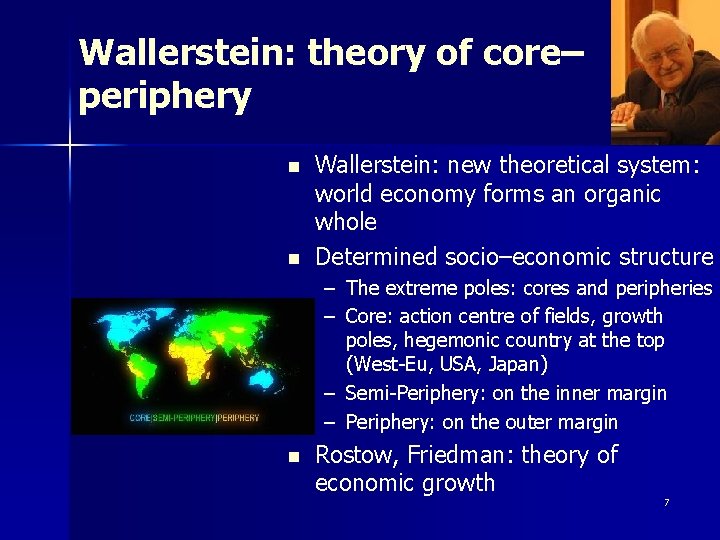
Wallerstein: theory of core– periphery n n Wallerstein: new theoretical system: world economy forms an organic whole Determined socio–economic structure – The extreme poles: cores and peripheries – Core: action centre of fields, growth poles, hegemonic country at the top (West-Eu, USA, Japan) – Semi-Periphery: on the inner margin – Periphery: on the outer margin n Rostow, Friedman: theory of economic growth 7
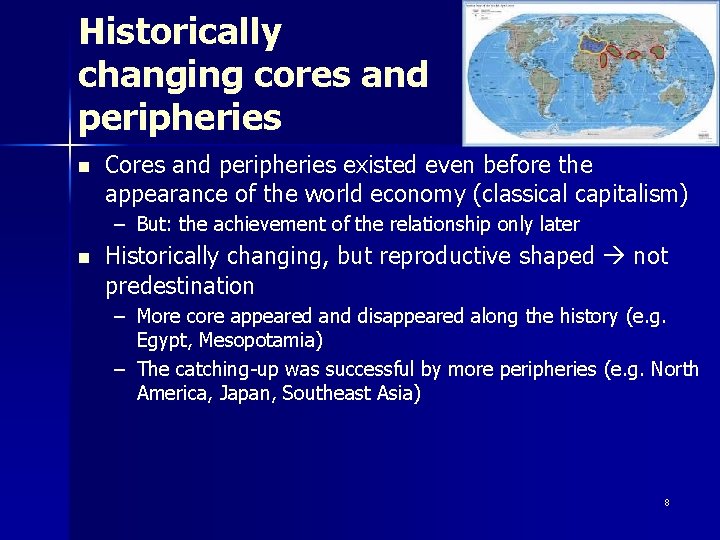
Historically changing cores and peripheries n Cores and peripheries existed even before the appearance of the world economy (classical capitalism) – But: the achievement of the relationship only later n Historically changing, but reproductive shaped not predestination – More core appeared and disappeared along the history (e. g. Egypt, Mesopotamia) – The catching-up was successful by more peripheries (e. g. North America, Japan, Southeast Asia) 8
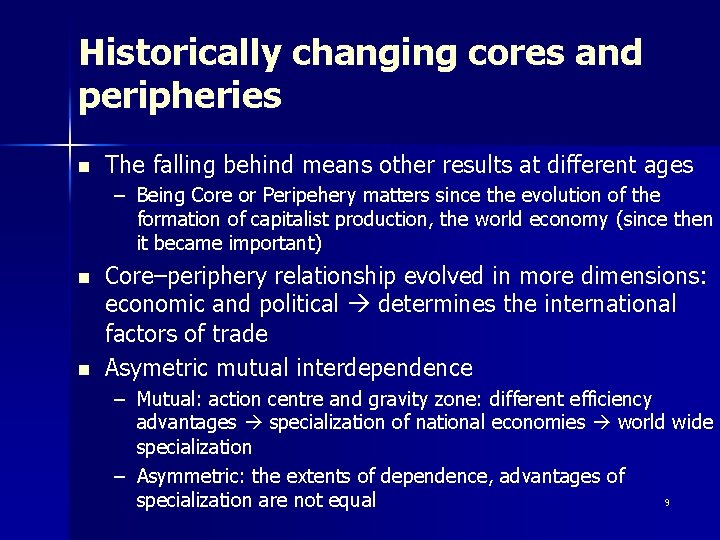
Historically changing cores and peripheries n The falling behind means other results at different ages – Being Core or Peripehery matters since the evolution of the formation of capitalist production, the world economy (since then it became important) n n Core–periphery relationship evolved in more dimensions: economic and political determines the international factors of trade Asymetric mutual interdependence – Mutual: action centre and gravity zone: different efficiency advantages specialization of national economies world wide specialization – Asymmetric: the extents of dependence, advantages of 9 specialization are not equal
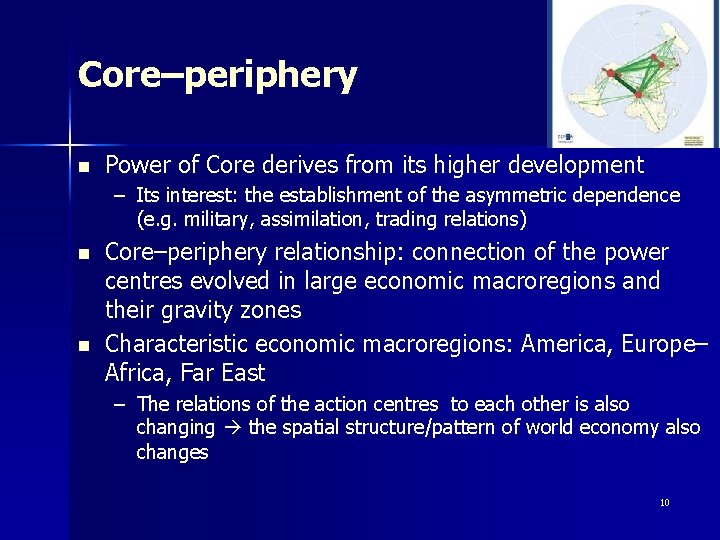
Core–periphery n Power of Core derives from its higher development – Its interest: the establishment of the asymmetric dependence (e. g. military, assimilation, trading relations) n n Core–periphery relationship: connection of the power centres evolved in large economic macroregions and their gravity zones Characteristic economic macroregions: America, Europe– Africa, Far East – The relations of the action centres to each other is also changing the spatial structure/pattern of world economy also changes 10
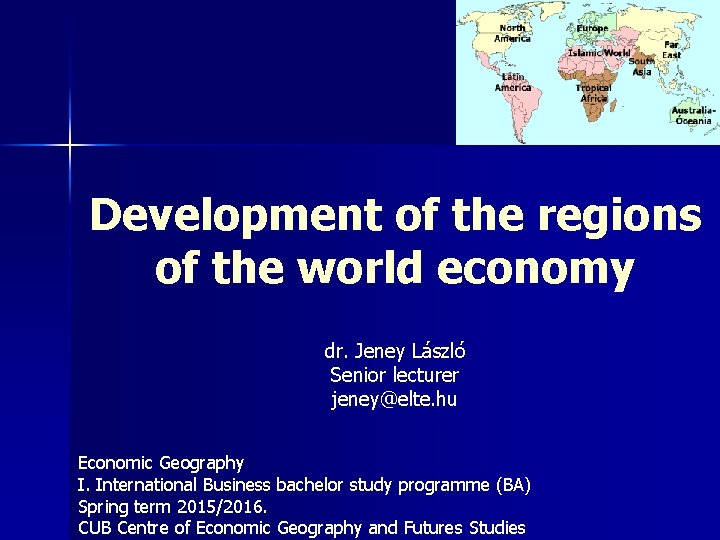
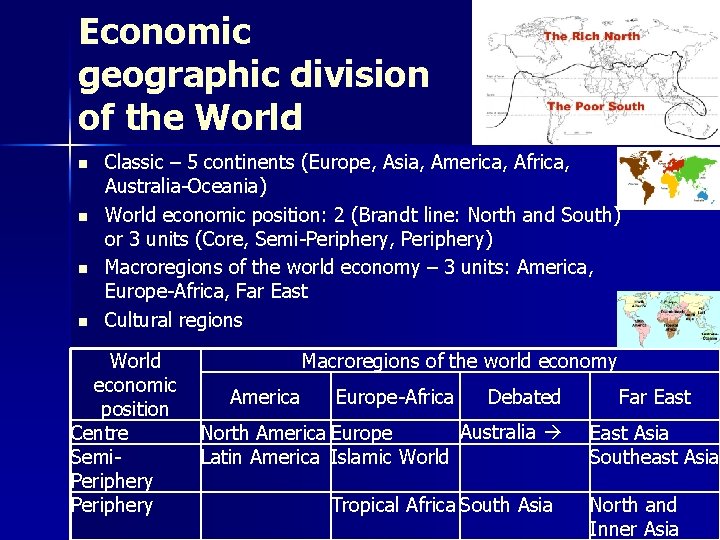
Economic geographic division of the World n n Classic – 5 continents (Europe, Asia, America, Africa, Australia-Oceania) World economic position: 2 (Brandt line: North and South) or 3 units (Core, Semi-Periphery, Periphery) Macroregions of the world economy – 3 units: America, Europe-Africa, Far East Cultural regions World economic position Centre Semi. Periphery Macroregions of the world economy America Europe-Africa Debated Australia North America Europe Latin America Islamic World Tropical Africa South Asia Far East Asia Southeast Asia North and Inner Asia
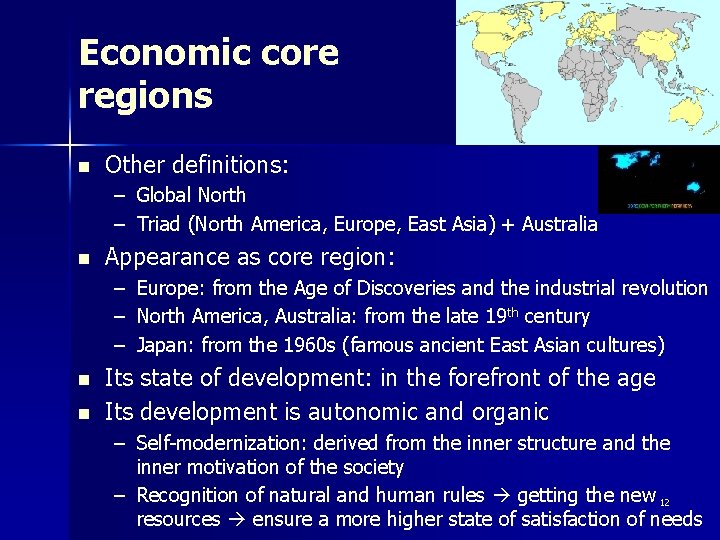
Economic core regions n Other definitions: – Global North – Triad (North America, Europe, East Asia) + Australia n Appearance as core region: – – – n n Europe: from the Age of Discoveries and the industrial revolution North America, Australia: from the late 19 th century Japan: from the 1960 s (famous ancient East Asian cultures) Its state of development: in the forefront of the age Its development is autonomic and organic – Self-modernization: derived from the inner structure and the inner motivation of the society – Recognition of natural and human rules getting the new 12 resources ensure a more higher state of satisfaction of needs
Economic peripheries n n n Falls behind the state of development of Core Does not move on an organic and autonomic pathway Periphery: lagging structure dependent position, acceptance of asymmetric relations – Delinking from the world is not alternative – Its development based on copy of more developed systems evolved under other circumstances copied following samples n Question: are the copied samples able to be organic, to dynamize the whole structure? 13