
Development of the Pennsylvania Statewide CommodityBased Freight Model
Development of the Pennsylvania Statewide Commodity-Based Freight Model 11 th TRB National Transportation Planning Applications Conference May 7, 2007 Wade White, AICP, Citilabs Brian Wall, Pennsylvania Dept. of Transportation Patrick Anater, Gannett Fleming Pennsylvania Statewide Freight Model
Penn. DOT and Analytical Tools—A Historic Perspective § Penn. DOT’s Credibility & Funding Crises— 1970 s § Penn. DOT & State Transportation Advisory Committee – New Directions for Penn. DOT – Program and Budgetary Control – Strategic Planning & Management § This “Model” was successful for a generation § Resource Constraint Renews True Planning Focus § PA Mobility Plan as the catalyst for improving analytical capabilities Pennsylvania Statewide Freight Model
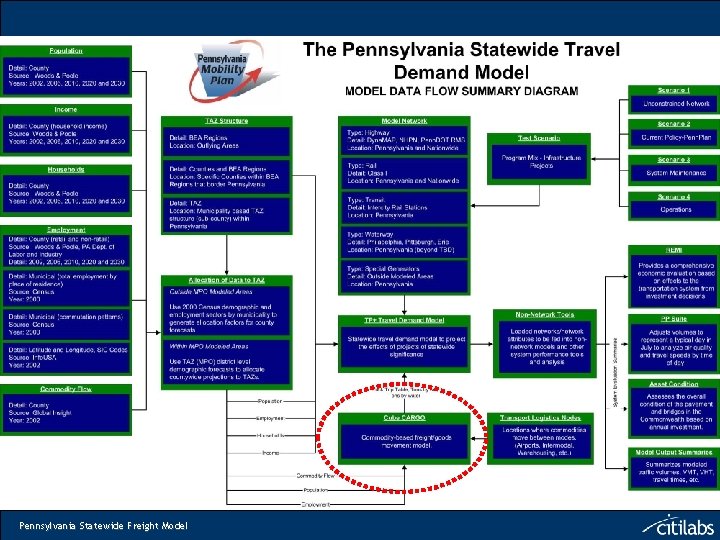
Pennsylvania Statewide Freight Model
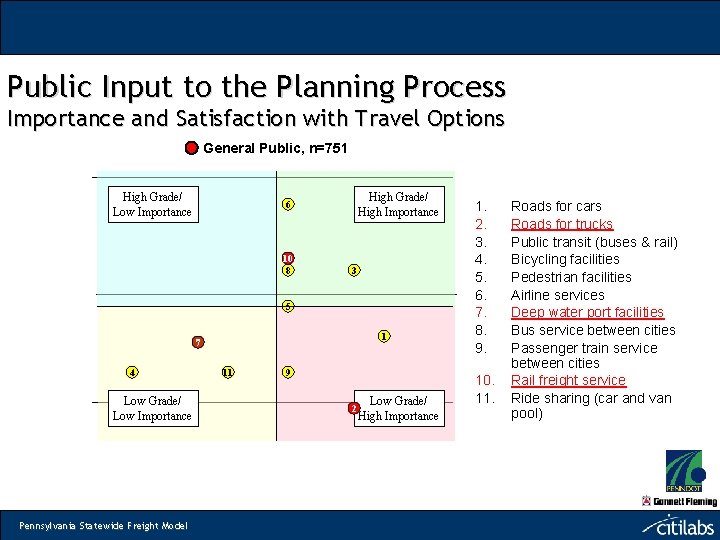
Public Input to the Planning Process Importance and Satisfaction with Travel Options General Public, n=751 B- Travel Options (1 -11) High Grade/ Low Importance High Grade/ High Importance 6 10 8 C+ 3 5 1 7 4 C 11 9 Low Grade/ Low Importance Somewhat Important Pennsylvania Statewide Freight Model 2 IMPORTANCE (Scale of 1 - 4) Low Grade/ High Importance Very Important 1. 2. 3. 4. 5. 6. 7. 8. 9. 10. 11. Roads for cars Roads for trucks Public transit (buses & rail) Bicycling facilities Pedestrian facilities Airline services Deep water port facilities Bus service between cities Passenger train service between cities Rail freight service Ride sharing (car and van pool)
Overview of the Model Development § Identification of data needs § Analysis of the freight and GIS databases (Global Insight, CFS, Freight Analysis Framework) § Identification of commodity groupings and development of zone systems, base year matrices and networks § Development of model structure within Cube Cargo § Linkage of data and model adjustment Pennsylvania Statewide Freight Model
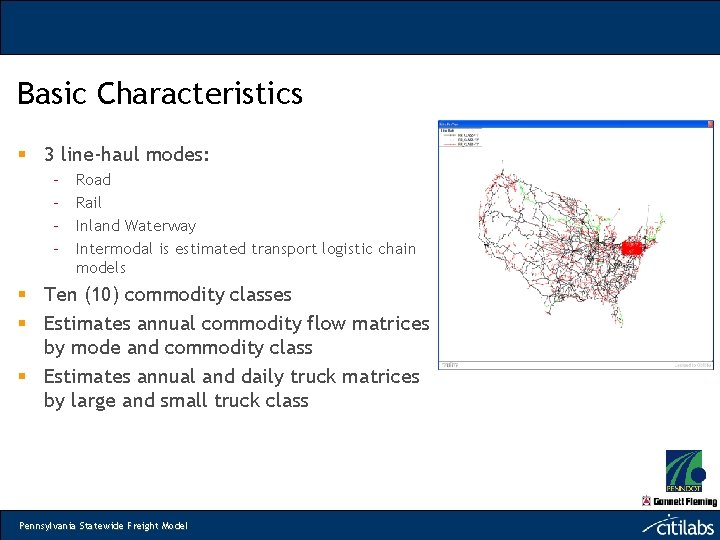
Basic Characteristics § 3 line-haul modes: – – Road Rail Inland Waterway Intermodal is estimated transport logistic chain models § Ten (10) commodity classes § Estimates annual commodity flow matrices by mode and commodity class § Estimates annual and daily truck matrices by large and small truck class Pennsylvania Statewide Freight Model
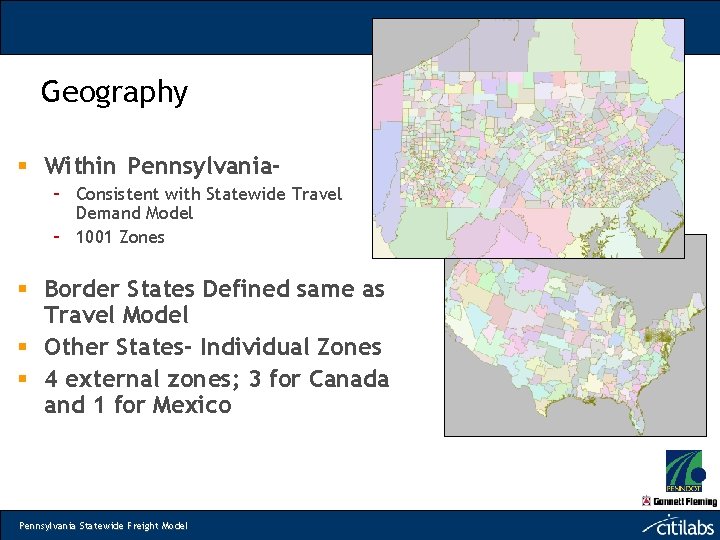
Geography § Within Pennsylvania– Consistent with Statewide Travel Demand Model – 1001 Zones § Border States Defined same as Travel Model § Other States- Individual Zones § 4 external zones; 3 for Canada and 1 for Mexico Pennsylvania Statewide Freight Model
Logistics Nodes § Ports – – Port PA – Port § Rail Yards of of Wilmington, DE Baltimore, MD NY/NJ Philadelphia, of Pittsburgh, PA of Erie, PA of Cleveland, OH – – – NS Rutherford Yard- Harrisburg, PA NS Trafford PA Intermodal Yard Newark/Elizabeth NJ Intermodal Yards NS Bethlehem PA Yards NS Taylor, PA NS Yard Conrail, CSX, NS Philadelphia, PA Rail Yards – NS Harrisburg Yard § Distribution Centers – Clearfield, PA Walmart Distribution Center – Bedford, PA Walmart Distribution Center Pennsylvania Statewide Freight Model
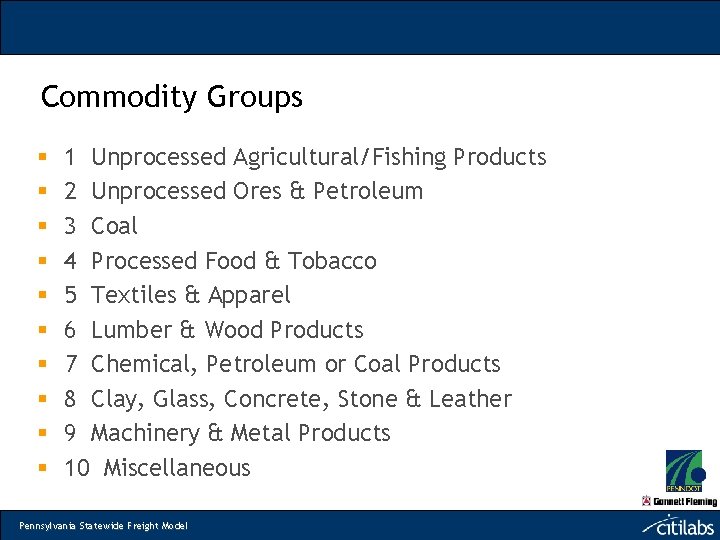
Commodity Groups § § § § § 1 Unprocessed Agricultural/Fishing Products 2 Unprocessed Ores & Petroleum 3 Coal 4 Processed Food & Tobacco 5 Textiles & Apparel 6 Lumber & Wood Products 7 Chemical, Petroleum or Coal Products 8 Clay, Glass, Concrete, Stone & Leather 9 Machinery & Metal Products 10 Miscellaneous Pennsylvania Statewide Freight Model
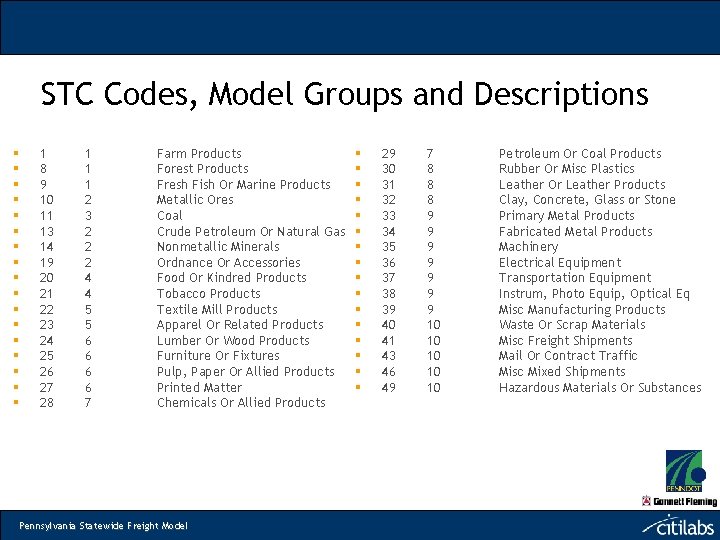
STC Codes, Model Groups and Descriptions § § § § § 1 8 9 10 11 13 14 19 20 21 22 23 24 25 26 27 28 1 1 1 2 3 2 2 2 4 4 5 5 6 6 7 Farm Products Forest Products Fresh Fish Or Marine Products Metallic Ores Coal Crude Petroleum Or Natural Gas Nonmetallic Minerals Ordnance Or Accessories Food Or Kindred Products Tobacco Products Textile Mill Products Apparel Or Related Products Lumber Or Wood Products Furniture Or Fixtures Pulp, Paper Or Allied Products Printed Matter Chemicals Or Allied Products Pennsylvania Statewide Freight Model § § § § 29 30 31 32 33 34 35 36 37 38 39 40 41 43 46 49 7 8 8 8 9 9 9 9 10 10 10 Petroleum Or Coal Products Rubber Or Misc Plastics Leather Or Leather Products Clay, Concrete, Glass or Stone Primary Metal Products Fabricated Metal Products Machinery Electrical Equipment Transportation Equipment Instrum, Photo Equip, Optical Eq Misc Manufacturing Products Waste Or Scrap Materials Misc Freight Shipments Mail Or Contract Traffic Misc Mixed Shipments Hazardous Materials Or Substances
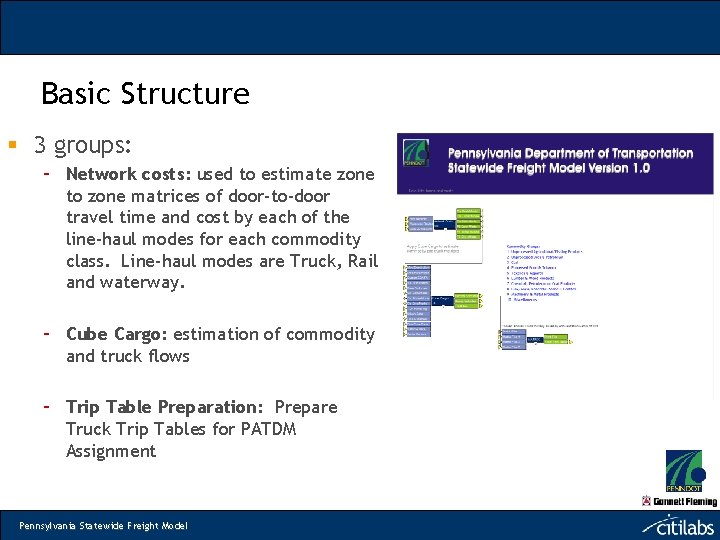
Basic Structure § 3 groups: – Network costs: used to estimate zone to zone matrices of door-to-door travel time and cost by each of the line-haul modes for each commodity class. Line-haul modes are Truck, Rail and waterway. – Cube Cargo: estimation of commodity and truck flows – Trip Table Preparation: Prepare Truck Trip Tables for PATDM Assignment Pennsylvania Statewide Freight Model
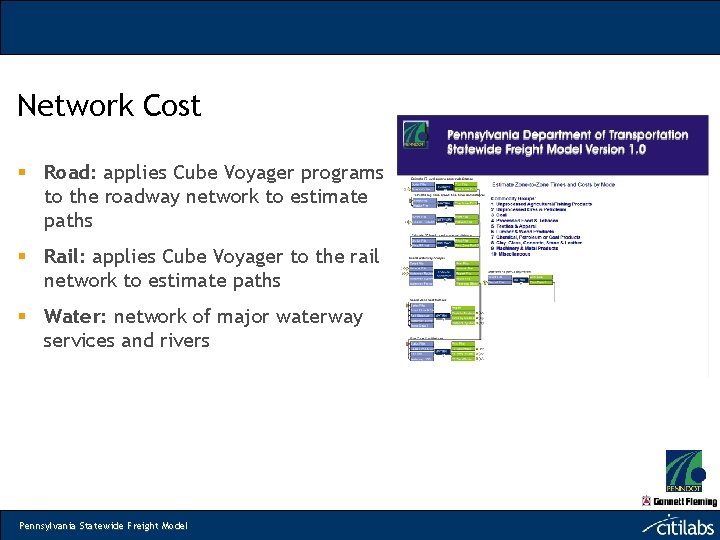
Network Cost § Road: applies Cube Voyager programs to the roadway network to estimate paths § Rail: applies Cube Voyager to the rail network to estimate paths § Water: network of major waterway services and rivers Pennsylvania Statewide Freight Model
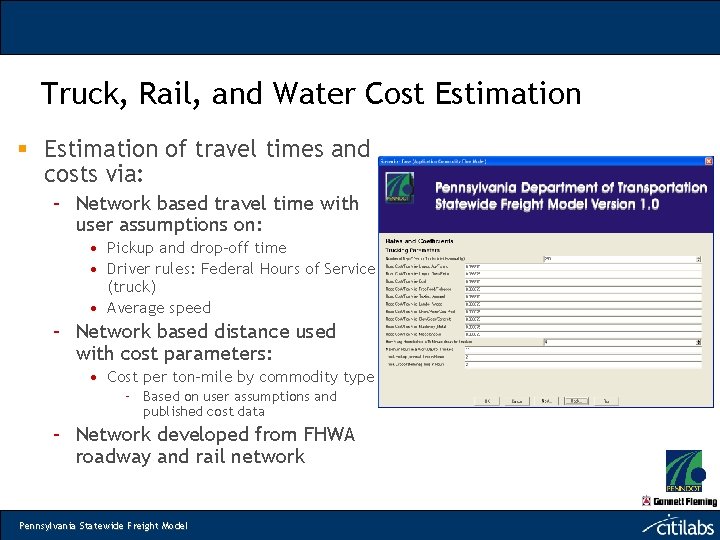
Truck, Rail, and Water Cost Estimation § Estimation of travel times and costs via: – Network based travel time with user assumptions on: • Pickup and drop-off time • Driver rules: Federal Hours of Service (truck) • Average speed – Network based distance used with cost parameters: • Cost per ton-mile by commodity type – Based on user assumptions and published cost data – Network developed from FHWA roadway and rail network Pennsylvania Statewide Freight Model
Network Costs § The network cost group provides: – Zone to zone door-to-door cost per ton by mode and commodity group – Zone to zone door-to-door travel time by mode and commodity group – Zone to zone travel distance by mode § Data are important elements in the estimation of the distribution, mode choice and transport-logistics nodes models Pennsylvania Statewide Freight Model
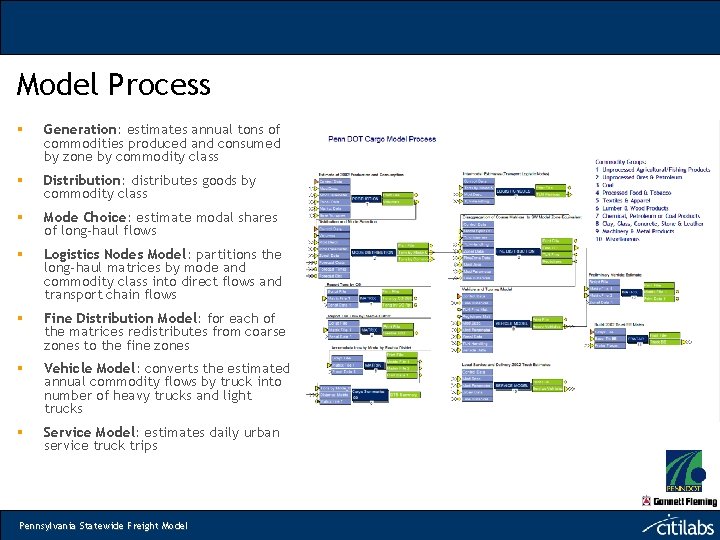
Model Process § Generation: estimates annual tons of commodities produced and consumed by zone by commodity class § Distribution: distributes goods by commodity class § Mode Choice: estimate modal shares of long-haul flows § Logistics Nodes Model: partitions the long-haul matrices by mode and commodity class into direct flows and transport chain flows § Fine Distribution Model: for each of the matrices redistributes from coarse zones to the fine zones § Vehicle Model: converts the estimated annual commodity flows by truck into number of heavy trucks and light trucks § Service Model: estimates daily urban service truck trips Pennsylvania Statewide Freight Model
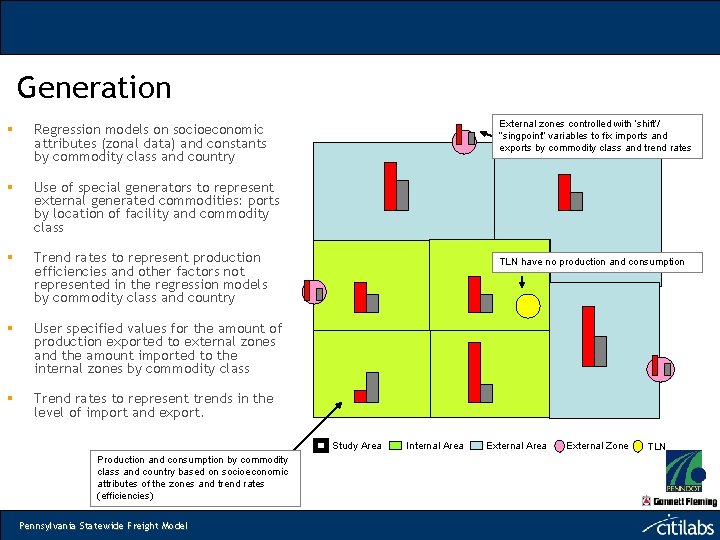
Generation § Regression models on socioeconomic attributes (zonal data) and constants by commodity class and country § Use of special generators to represent external generated commodities: ports by location of facility and commodity class § Trend rates to represent production efficiencies and other factors not represented in the regression models by commodity class and country § User specified values for the amount of production exported to external zones and the amount imported to the internal zones by commodity class § Trend rates to represent trends in the level of import and export. External zones controlled with ‘shift’/ “singpoint” variables to fix imports and exports by commodity class and trend rates TLN have no production and consumption Study Area Production and consumption by commodity class and country based on socioeconomic attributes of the zones and trend rates (efficiencies) Pennsylvania Statewide Freight Model Internal Area External Zone TLN
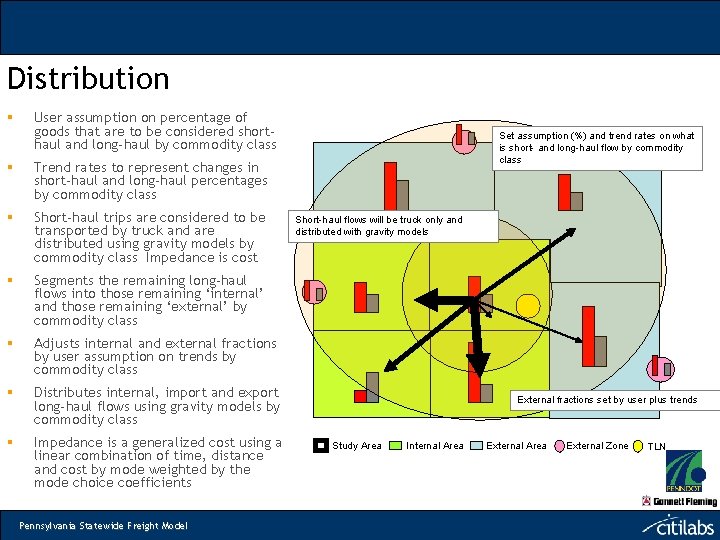
Distribution § User assumption on percentage of goods that are to be considered shorthaul and long-haul by commodity class § Trend rates to represent changes in short-haul and long-haul percentages by commodity class § Short-haul trips are considered to be transported by truck and are distributed using gravity models by commodity class Impedance is cost § Segments the remaining long-haul flows into those remaining ‘internal’ and those remaining ‘external’ by commodity class § Adjusts internal and external fractions by user assumption on trends by commodity class § Distributes internal, import and export long-haul flows using gravity models by commodity class § Impedance is a generalized cost using a linear combination of time, distance and cost by mode weighted by the mode choice coefficients Pennsylvania Statewide Freight Model Set assumption (%) and trend rates on what is short- and long-haul flow by commodity class Short-haul flows will be truck only and distributed with gravity models External fractions set by user plus trends Study Area Internal Area External Zone TLN
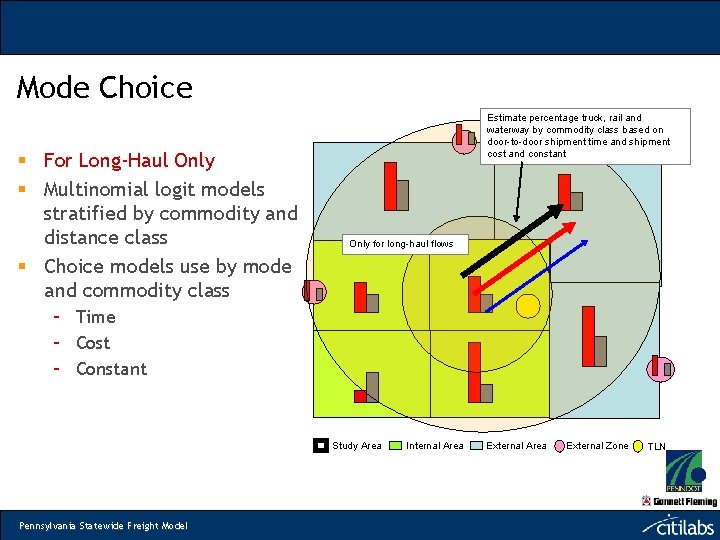
Mode Choice § For Long-Haul Only § Multinomial logit models stratified by commodity and distance class § Choice models use by mode and commodity class Estimate percentage truck, rail and waterway by commodity class based on door-to-door shipment time and shipment cost and constant Only for long-haul flows – Time – Cost – Constant Study Area Pennsylvania Statewide Freight Model Internal Area External Zone TLN
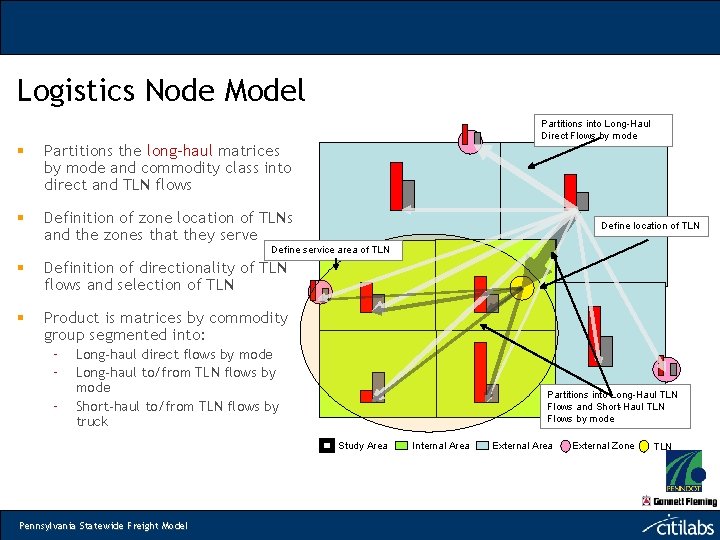
Logistics Node Model § Partitions the long-haul matrices by mode and commodity class into direct and TLN flows § Definition of zone location of TLNs and the zones that they serve Partitions into Long-Haul Direct Flows by mode Define location of TLN Define service area of TLN § Definition of directionality of TLN flows and selection of TLN § Product is matrices by commodity group segmented into: – – – Long-haul direct flows by mode Long-haul to/from TLN flows by mode Short-haul to/from TLN flows by truck Partitions into Long-Haul TLN Flows and Short-Haul TLN Flows by mode Study Area Pennsylvania Statewide Freight Model Internal Area External Zone TLN
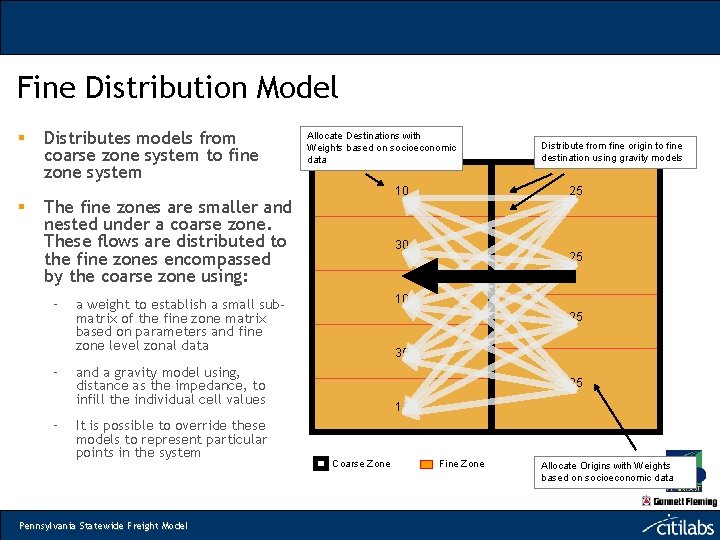
Fine Distribution Model § § Distributes models from coarse zone system to fine zone system Allocate Destinations with Weights based on socioeconomic data 10 The fine zones are smaller and nested under a coarse zone. These flows are distributed to the fine zones encompassed by the coarse zone using: – – – 25 10 25 35 and a gravity model using, distance as the impedance, to infill the individual cell values Pennsylvania Statewide Freight Model 25 30 a weight to establish a small submatrix of the fine zone matrix based on parameters and fine zone level zonal data It is possible to override these models to represent particular points in the system Distribute from fine origin to fine destination using gravity models 25 15 Coarse Zone Fine Zone Allocate Origins with Weights based on socioeconomic data
Review: bringing the flows to the vehicle model § Generation gives P & C by zone and commodity class § Distribution distributes two sets of matrices: – short-haul flows by commodity class which are assumed to be truck flows; and – long-haul flows by commodity class which go to mode choice § Mode Choice splits the long-haul flows into long-haul flow matrices by mode and commodity class § The long-haul modal matrices from Mode Choice are segmented into flows that: – travel directly from zone of production to zone of consumption (Direct long haul flows by commodity class) and, – flows that will use a TLN. The flows that go via TLNs are segmented into: • short haul segment by mode and commodity class • long-haul segment by mode and commodity class Pennsylvania Statewide Freight Model
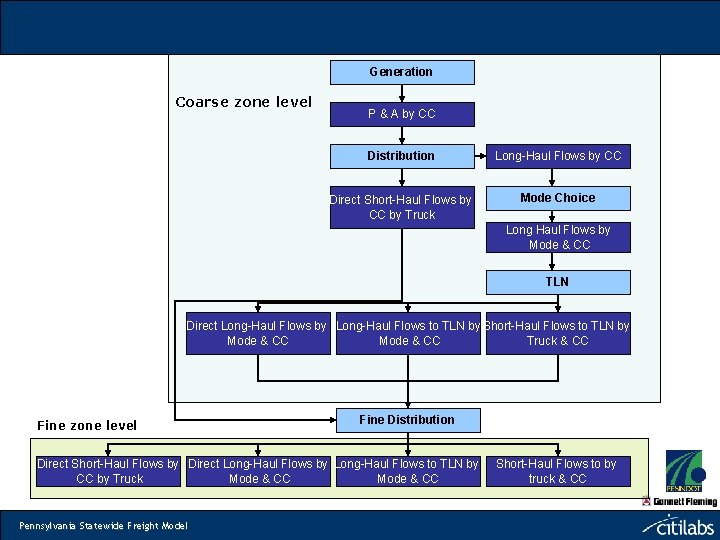
Generation Coarse zone level P & A by CC Distribution Long-Haul Flows by CC Direct Short-Haul Flows by CC by Truck Mode Choice Long Haul Flows by Mode & CC TLN Direct Long-Haul Flows by Long-Haul Flows to TLN by Short-Haul Flows to TLN by Mode & CC Truck & CC Fine zone level Fine Distribution Direct Short-Haul Flows by Direct Long-Haul Flows by Long-Haul Flows to TLN by CC by Truck Mode & CC Pennsylvania Statewide Freight Model Short-Haul Flows to by truck & CC
Vehicle Models § The vehicle models estimate matrices of light and heavy truck trips by using vehicle models and load factors. § Two vehicle models: – Touring Vehicle Model • Used for flows where the origin is a TLN • And, where the user selects specific zones – Standard Vehicle Model • Used in all other cases § Results are combined to provide a truck trip matrix for assignment – – – § Heavy long-haul trucks Heavy short-haul trucks Light short-haul trucks By default, these matrices are annual truck flows (resulting from the annual commodity flows). Matrix manipulation can be used to estimate daily and hourly flows by season if so desired. Pennsylvania Statewide Freight Model
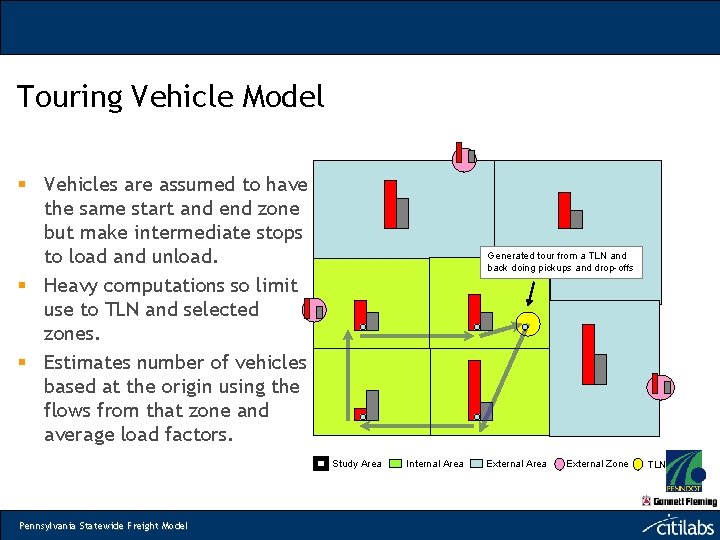
Touring Vehicle Model § Vehicles are assumed to have the same start and end zone but make intermediate stops to load and unload. § Heavy computations so limit use to TLN and selected zones. § Estimates number of vehicles based at the origin using the flows from that zone and average load factors. Generated tour from a TLN and back doing pickups and drop-offs Study Area Pennsylvania Statewide Freight Model Internal Area External Zone TLN
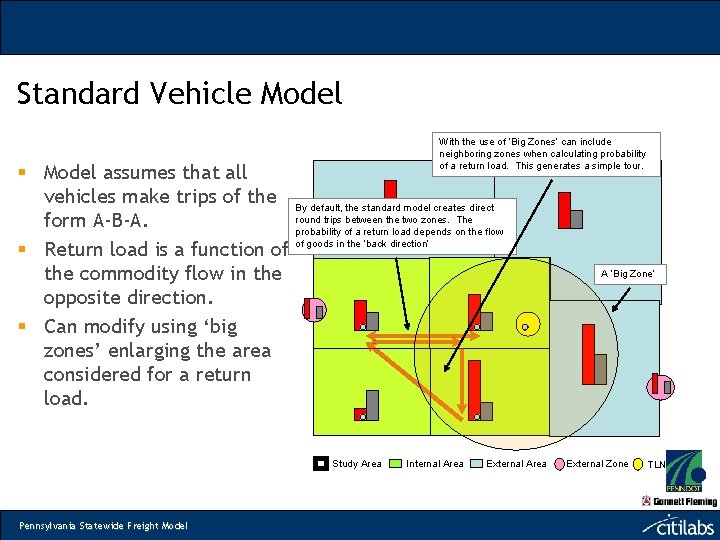
Standard Vehicle Model With the use of ‘Big Zones’ can include neighboring zones when calculating probability of a return load. This generates a simple tour. § Model assumes that all vehicles make trips of the By default, the standard model creates direct round trips between the two zones. The form A-B-A. probability of a return load depends on the flow § Return load is a function of of goods in the ‘back direction’ the commodity flow in the opposite direction. § Can modify using ‘big zones’ enlarging the area considered for a return load. Study Area Pennsylvania Statewide Freight Model Internal Area External Area A ‘Big Zone’ External Zone TLN
Service Trips § All modeling to this point concerns the movement of goods. § The service model is used to estimate urban service truck trips such as: – Repair men (e. g. elevator repair) – Small shopkeeper taking goods from a wholesaler to a local restaurant, etc. § Used directly on the fine zone system § Estimates generation using regression models based on zone type and socioeconomic data § Trips are distributed using gravity models. Pennsylvania Statewide Freight Model
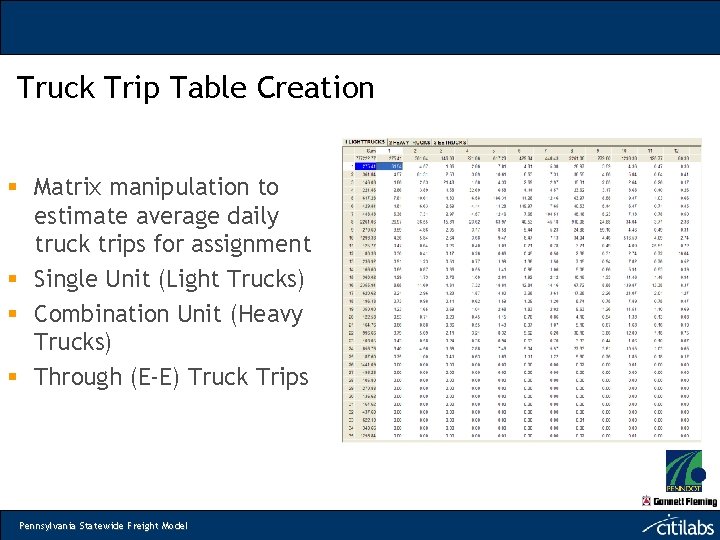
Truck Trip Table Creation § Matrix manipulation to estimate average daily truck trips for assignment § Single Unit (Light Trucks) § Combination Unit (Heavy Trucks) § Through (E-E) Truck Trips Pennsylvania Statewide Freight Model
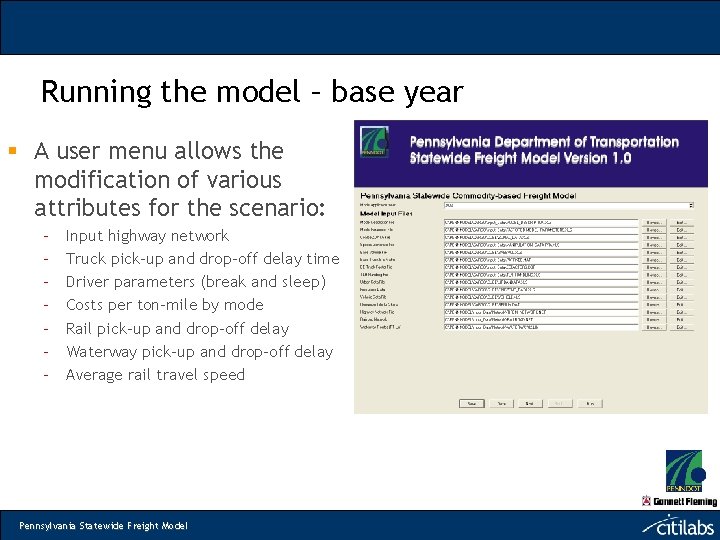
Running the model – base year § A user menu allows the modification of various attributes for the scenario: – – – – Input highway network Truck pick-up and drop-off delay time Driver parameters (break and sleep) Costs per ton-mile by mode Rail pick-up and drop-off delay Waterway pick-up and drop-off delay Average rail travel speed Pennsylvania Statewide Freight Model
Potential Use for the PA Statewide Freight Model § To Answer Policy Questions – Effects of alternative growth scenarios on freight movement • What if regional development patterns change? • What if major freight facilities are developed? – Effects of alternative policies on freight movement • What if tolls were increased? • What if the price of fuel continues to increase? – Impacts of major projects on freight movement • What if a two-lane US highway was widened to four lanes? • What if major access improvements to a region were advanced? Pennsylvania Statewide Freight Model
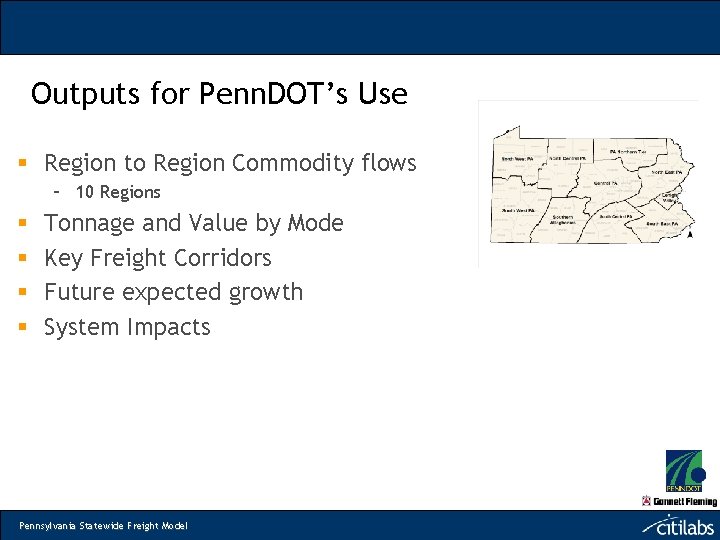
Outputs for Penn. DOT’s Use § Region to Region Commodity flows – 10 Regions § § Tonnage and Value by Mode Key Freight Corridors Future expected growth System Impacts Pennsylvania Statewide Freight Model
Changes in Organizational Thinking § Current LRTP serves as a change agent § Major awareness raising challenges § Creating a culture valuing analytically based planning § TDM in an emerging Multi-Modal Agency § Leveraging strong Penn. DOT—MPO and RPO Partnership § Paradigm shifts for evaluation—Core System, State of the System, Performance Based Pennsylvania Statewide Freight Model
Changes in Penn. DOT Capabilities § Leadership Support § Analytical Skill Building from the ground up § Applied Training—Learning through implementation § Capacity Building Bridging Agency & Consultant § Marketing capabilities to Penn. DOT staff and leadership § Continuing to Expand Horizons—Applying and expanding the tools as warranted Pennsylvania Statewide Freight Model
Implications § TDM and freight modeling can’t be in a vacuum § Strategic Integration of T-O-P Thinking – Technical, Organizational, and People § Building bridges among a wide range of organizations (internal & external) § Communicating Progress & Raising Awareness § Fostering Experimentation, Innovation, and Risk Taking Pennsylvania Statewide Freight Model
Questions? Pennsylvania Statewide Freight Model
- Slides: 34