
Development of the Modern Periodic Table Chapter 6
Development of the Modern Periodic Table Chapter 6 Section 1
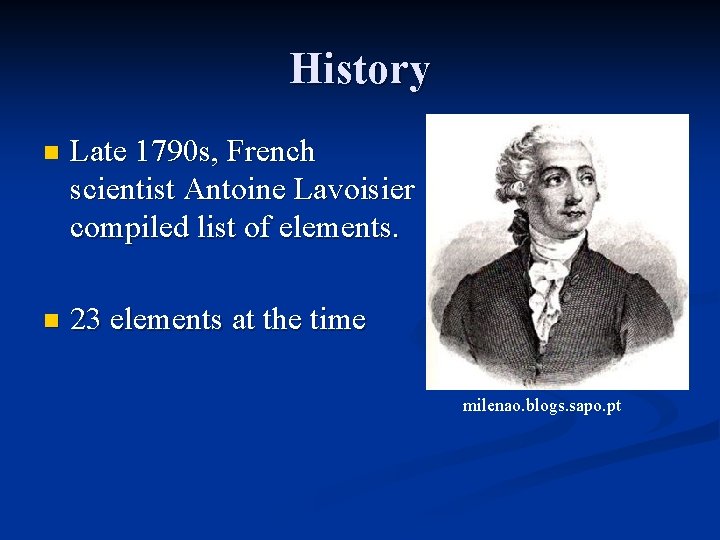
History n Late 1790 s, French scientist Antoine Lavoisier compiled list of elements. n 23 elements at the time milenao. blogs. sapo. pt
History (cont. ) During 1800 s, electricity, development of a spectrometer and the industrial revolution helped to discover new elements. n 1860 – They agreed on a method to determine atomic masses. n Chemists needed a tool to organize facts about elements. n 1870 – 70 elements n
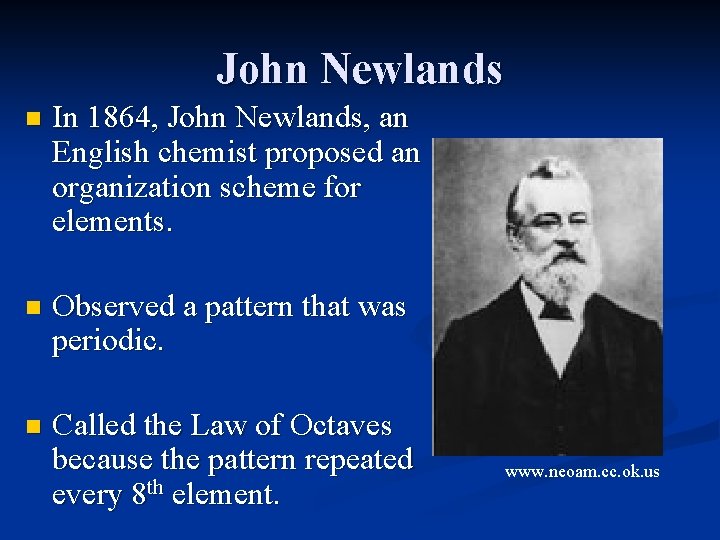
John Newlands n In 1864, John Newlands, an English chemist proposed an organization scheme for elements. n Observed a pattern that was periodic. n Called the Law of Octaves because the pattern repeated every 8 th element. www. neoam. cc. ok. us
John Newlands (cont. ) n Harshly criticized for using musical analogy n Law did not work for every element n Elements were arranged by atomic mass
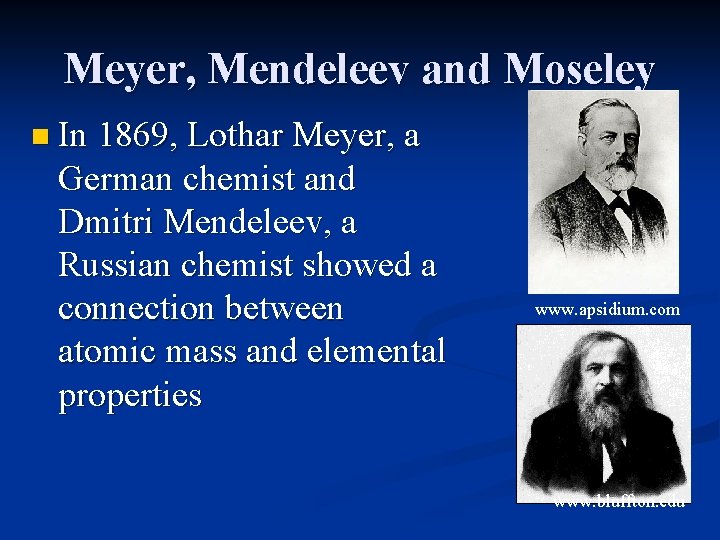
Meyer, Mendeleev and Moseley n In 1869, Lothar Meyer, a German chemist and Dmitri Mendeleev, a Russian chemist showed a connection between atomic mass and elemental properties www. apsidium. com www. bluffton. edu
Meyer, Mendeleev and Moseley n Mendeleev published first so he’s given more credit than Meyer and he better demonstrated its usefulness. n Arranged by increasing atomic mass had periodic properties. n Table had blank spaces for undiscovered elements.
Meyer, Mendeleev and Moseley n Mendeleev’s table was not completely accurate. n In 1913, Henry Moseley, an English chemist arranged atoms by increasing atomic number. n This arrangement showed a clear periodic pattern of properties (periodic law).
- Slides: 8