
Development of the heart part I Mark Kozsurek


- Slides: 52
Development of the heart, part I Mark Kozsurek, M. D. , Ph. D. EM I. , groups 1 -9, 11/03/2019
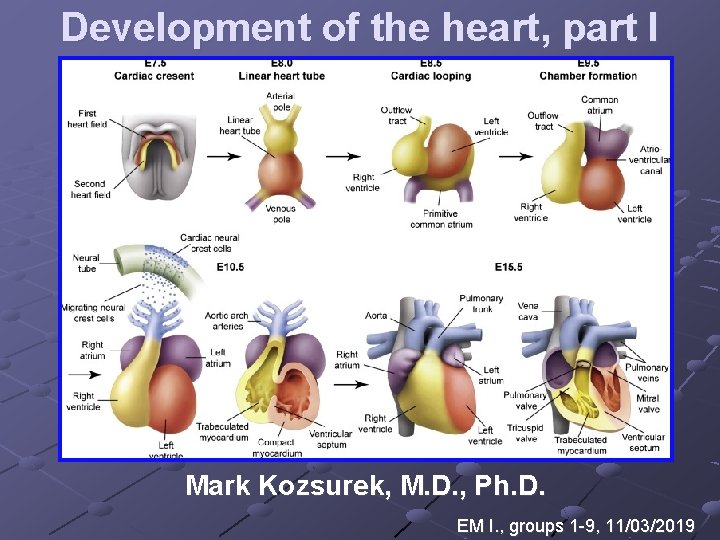
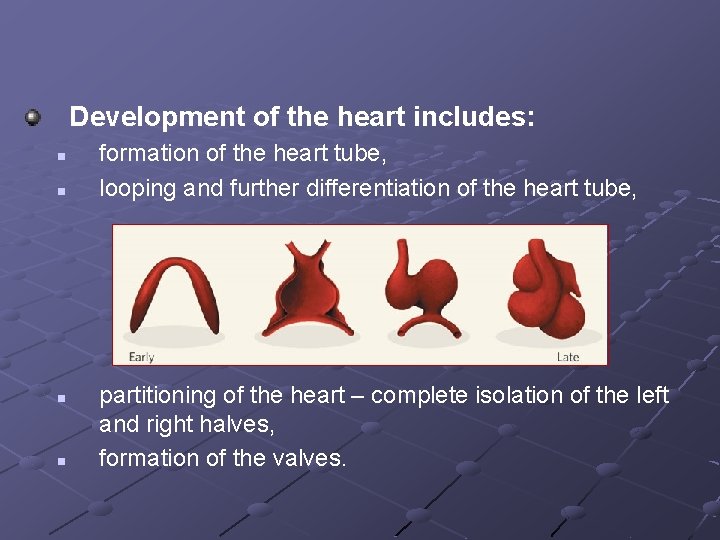
Development of the heart includes: n n formation of the heart tube, looping and further differentiation of the heart tube, partitioning of the heart – complete isolation of the left and right halves, formation of the valves.
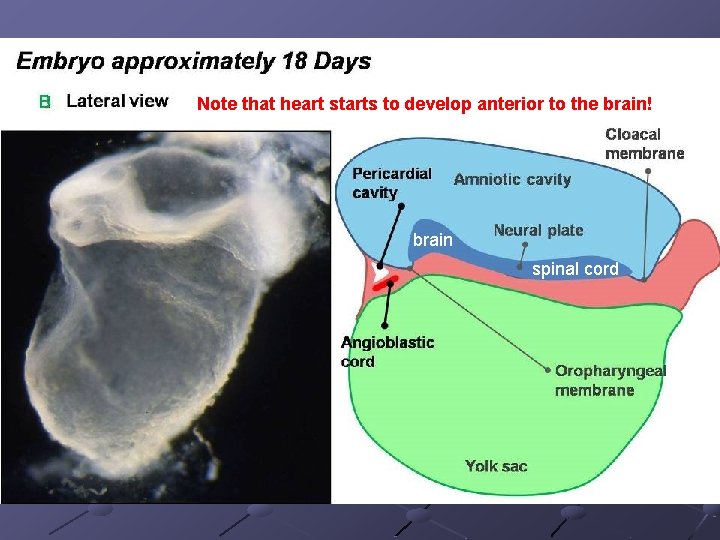
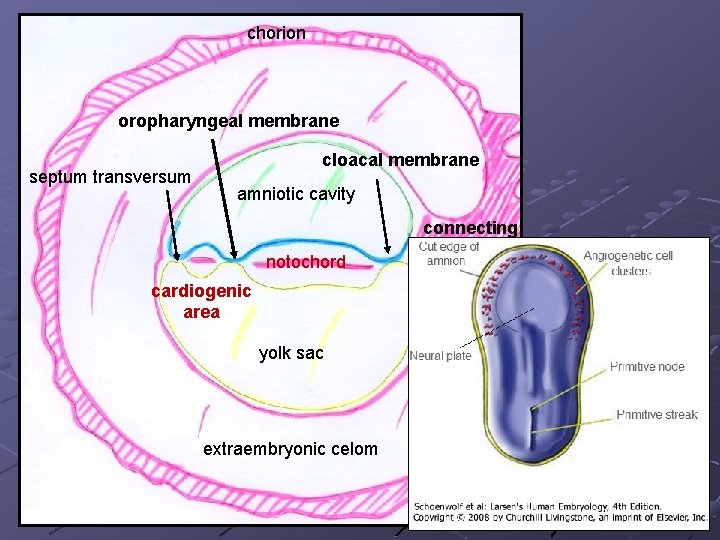
I. Early development of the heart: appearance of the heart tube Heart primordium appears on the 18 th-19 th days (the end of the third week). At this stage the embryo is a flat, trilaminar disc and the differentiation of the three germ layers has just begun. Heart develops from the cardiogenic area, a part of the intraembryonic mesoderm anterior to the oropharyngeal membrane.
Note that heart starts to develop anterior to the brain! brain spinal cord
chorion oropharyngeal membrane septum transversum cloacal membrane amniotic cavity notochord cardiogenic area yolk sac extraembryonic celom connecting stalk
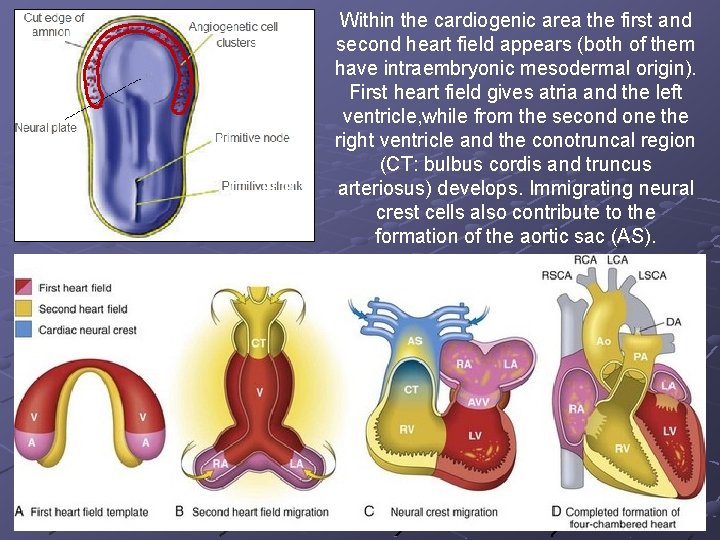
Within the cardiogenic area the first and second heart field appears (both of them have intraembryonic mesodermal origin). First heart field gives atria and the left ventricle, while from the second one the right ventricle and the conotruncal region (CT: bulbus cordis and truncus arteriosus) develops. Immigrating neural crest cells also contribute to the formation of the aortic sac (AS).
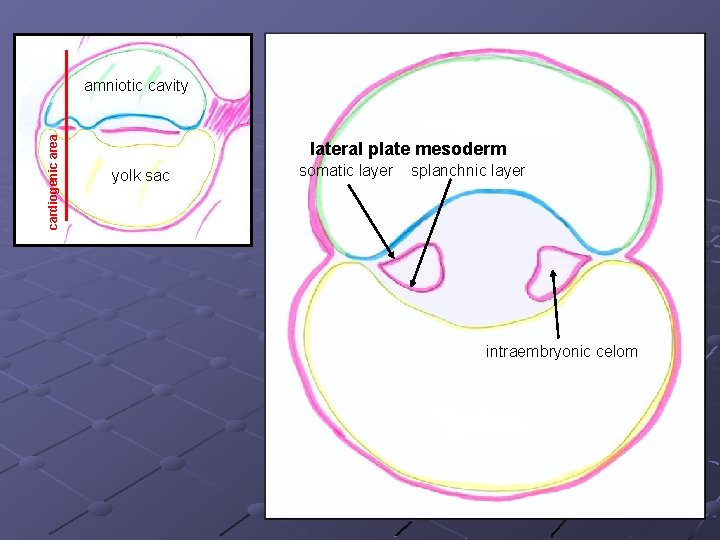
cardiogenic area amniotic cavity lateral plate mesoderm yolk sac somatic layer splanchnic layer intraembryonic celom
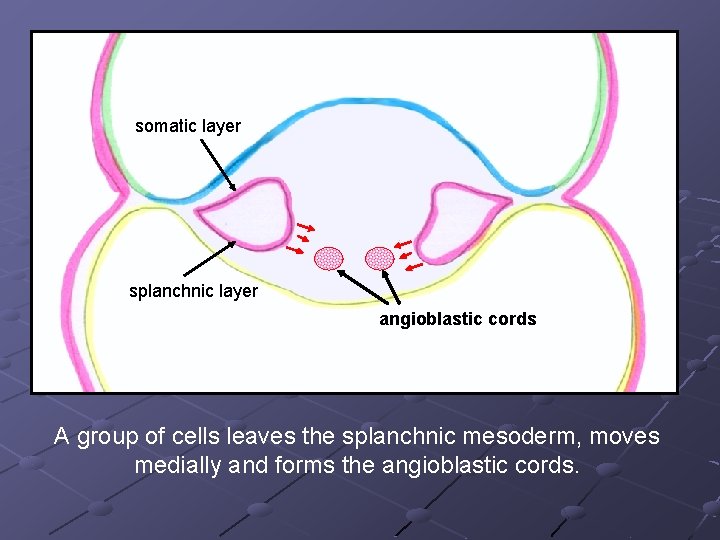
somatic layer splanchnic layer angioblastic cords A group of cells leaves the splanchnic mesoderm, moves medially and forms the angioblastic cords.
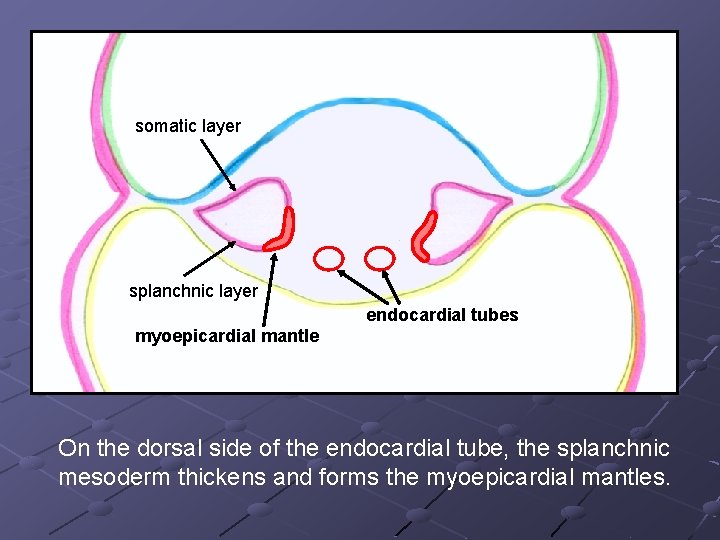
somatic layer splanchnic layer endocardial tubes myoepicardial mantle On the dorsal side of the endocardial tube, the splanchnic mesoderm thickens and forms the myoepicardial mantles.
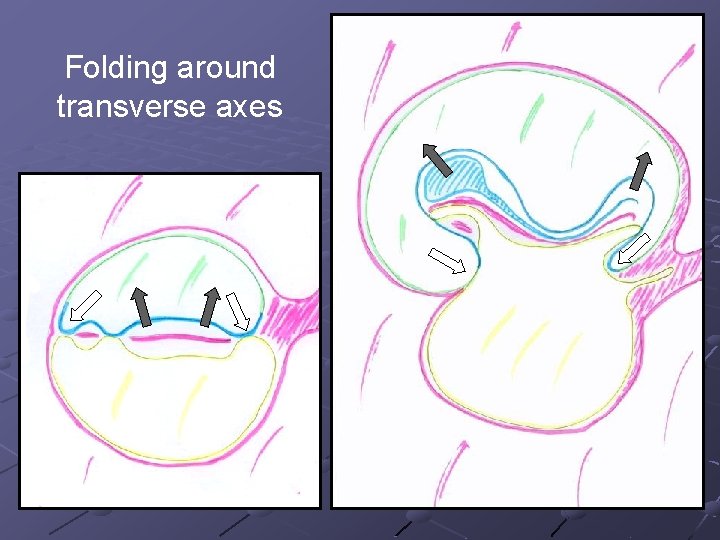
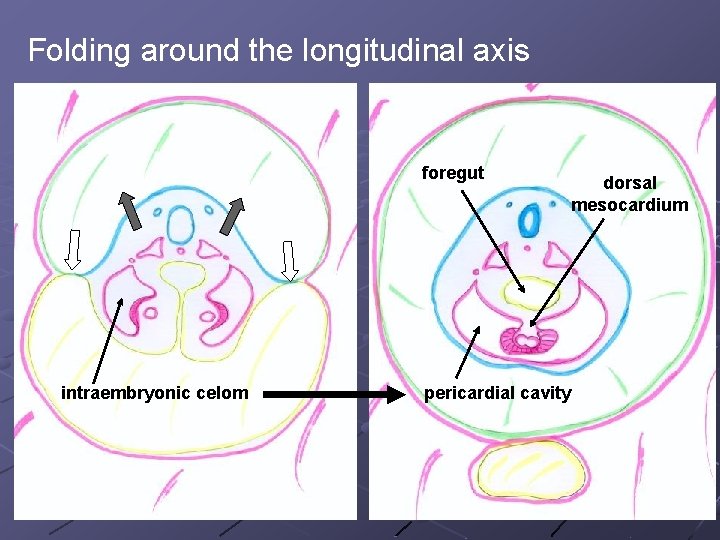
Further development of the heart is mainly determined by the folding of the embryo (4 th week). The folding includes: 1) folding around transverse axes – this will explain, how the heart primordium moves from „above the head” into the chest occupying its final position. 2) folding around the longitudinal axis – this will mainly explain the fusion of the structures originally developing on the two sides of the embryo.
Folding around transverse axes
Folding around the longitudinal axis foregut intraembryonic celom pericardial cavity dorsal mesocardium
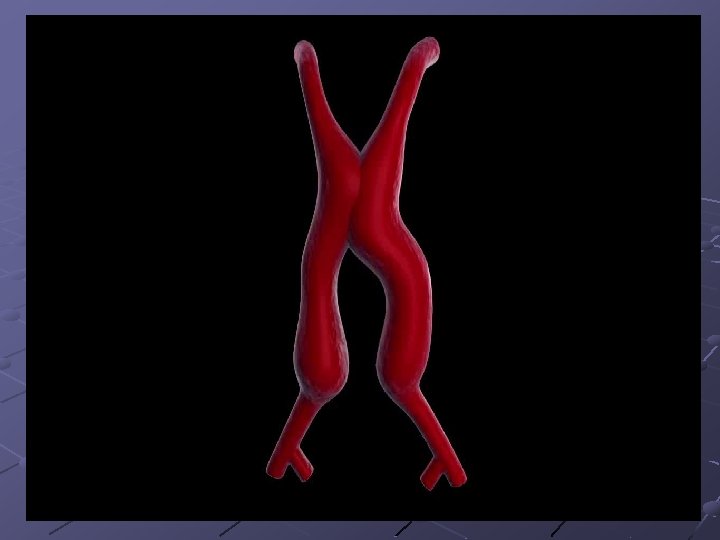
Folding of the embryo results in the fusion of the two endocardial tubes in the midline. Somewhat later the myoepicardial mantles also unite and surround the endocardial tube. The intraembryonic celoms fuse ventrally, and finally, the dorsal mesocardium disappears.
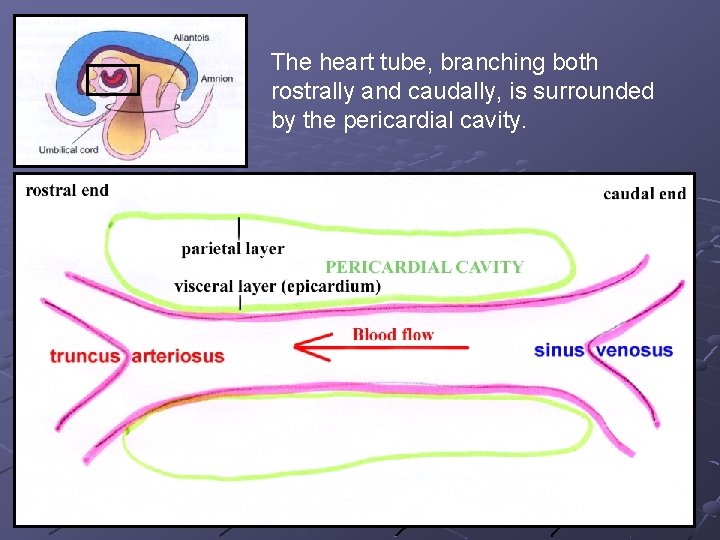
The heart tube, branching both rostrally and caudally, is surrounded by the pericardial cavity.
Summary Cells emigrating from the splanchnic mesoderm form the endocardial tubes, this gives later the ENDOCARDIUM. Thickening of the splanchnic mesoderm gives the myoepicardial mantles from which the MYOCARDIUM, and the VISCERAL LAYER OF THE PERICARDIUM (EPICARDIUM) develop. Intraembryonic celom, originally bounded by the lateral plates, transforms into the PERICARDIAL CAVITY. Somatic layer of the mesoderm differenciates into the PARIETAL LAYER OF THE PERICARDIUM.
II. Looping and further differentiation of the heart tube
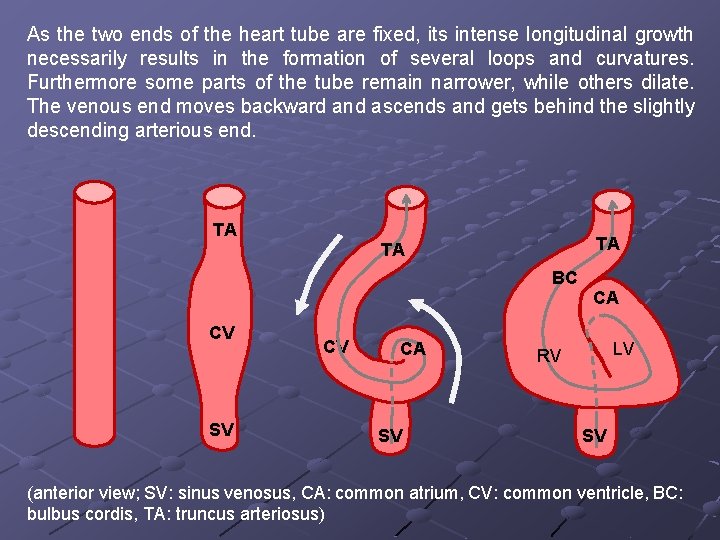
As the two ends of the heart tube are fixed, its intense longitudinal growth necessarily results in the formation of several loops and curvatures. Furthermore some parts of the tube remain narrower, while others dilate. The venous end moves backward and ascends and gets behind the slightly descending arterious end. TA TA TA BC CV SV CV CA SV CA LV RV SV (anterior view; SV: sinus venosus, CA: common atrium, CV: common ventricle, BC: bulbus cordis, TA: truncus arteriosus)
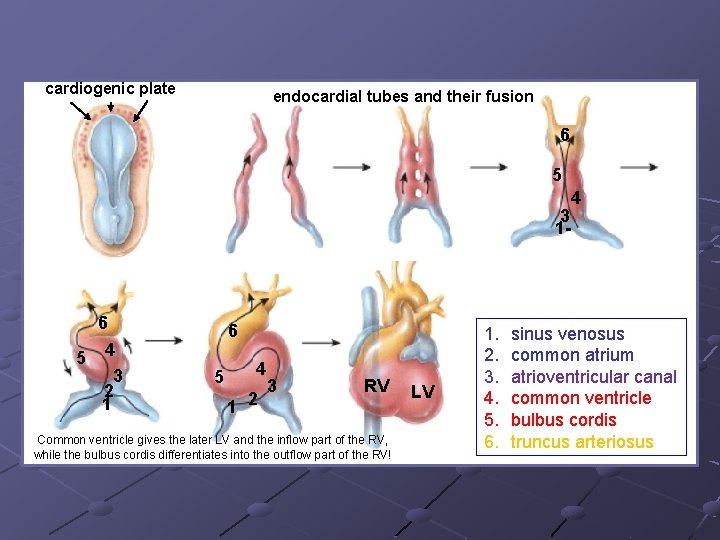
cardiogenic plate endocardial tubes and their fusion 6 5 3 1 - 6 5 4 3 2 1 6 5 4 1 2 3 RV Common ventricle gives the later LV and the inflow part of the RV, while the bulbus cordis differentiates into the outflow part of the RV! LV 1. 2. 3. 4. 5. 6. 4 sinus venosus common atrium atrioventricular canal common ventricle bulbus cordis truncus arteriosus
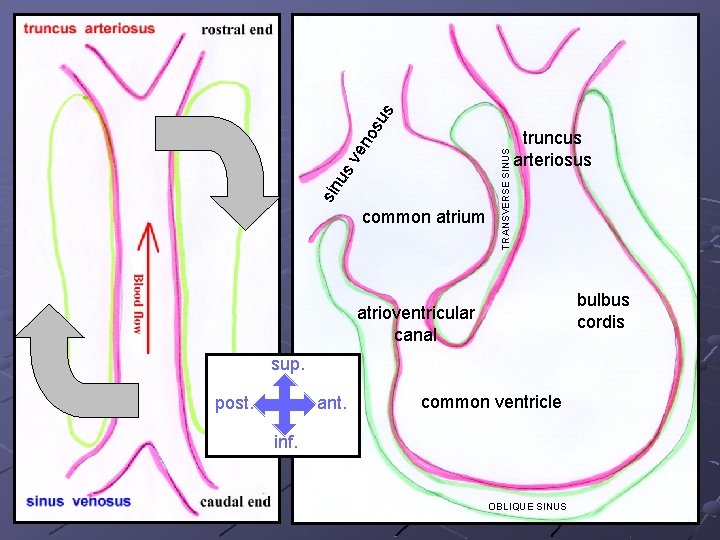
TRANSVERSE SINUS su s ve no us sin common atrium truncus arteriosus bulbus cordis atrioventricular canal sup. post. ant. common ventricle inf. OBLIQUE SINUS
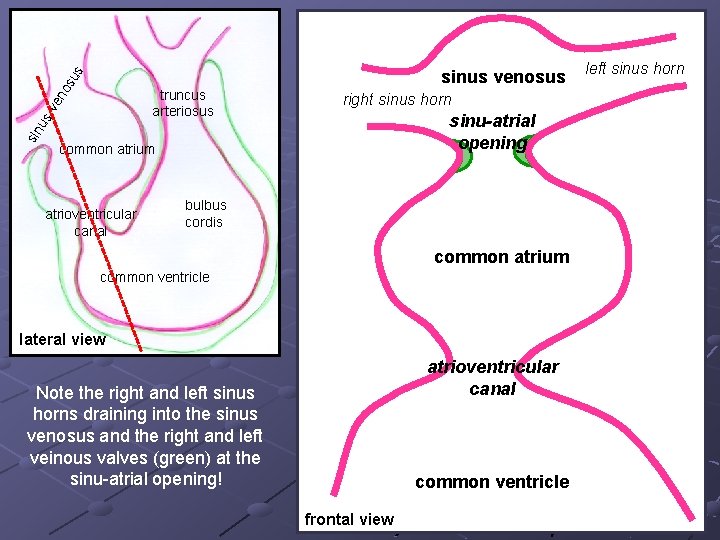
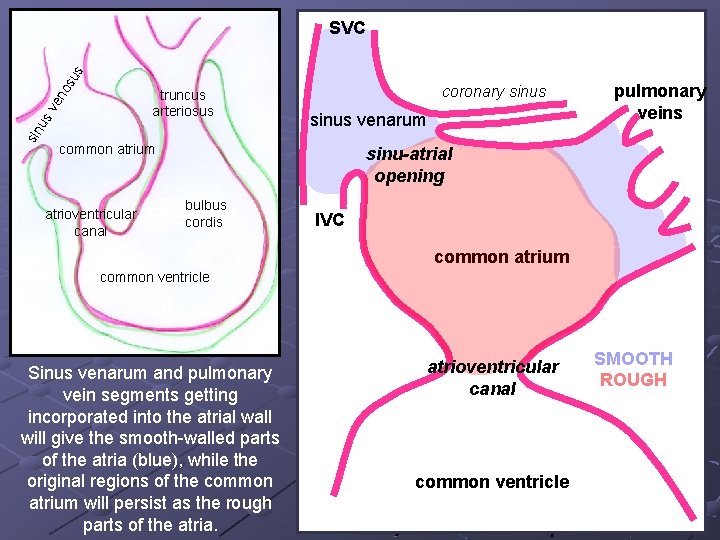
os us sinus venosus sin u sv en truncus arteriosus right sinus horn sinu-atrial opening common atrium atrioventricular canal bulbus cordis common atrium common ventricle lateral view atrioventricular canal Note the right and left sinus horns draining into the sinus venosus and the right and left veinous valves (green) at the sinu-atrial opening! common ventricle frontal view left sinus horn
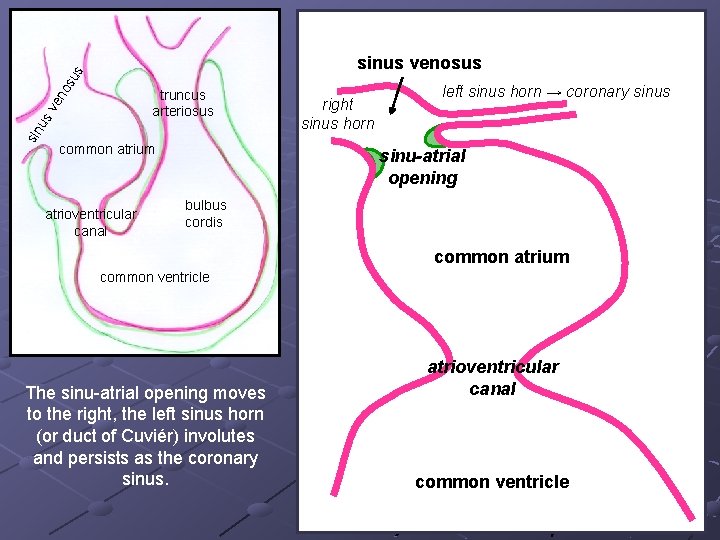
os us sinus venosus sin u sv en truncus arteriosus common atrium atrioventricular canal right sinus horn left sinus horn → coronary sinus sinu-atrial opening bulbus cordis common atrium common ventricle The sinu-atrial opening moves to the right, the left sinus horn (or duct of Cuviér) involutes and persists as the coronary sinus. atrioventricular canal common ventricle
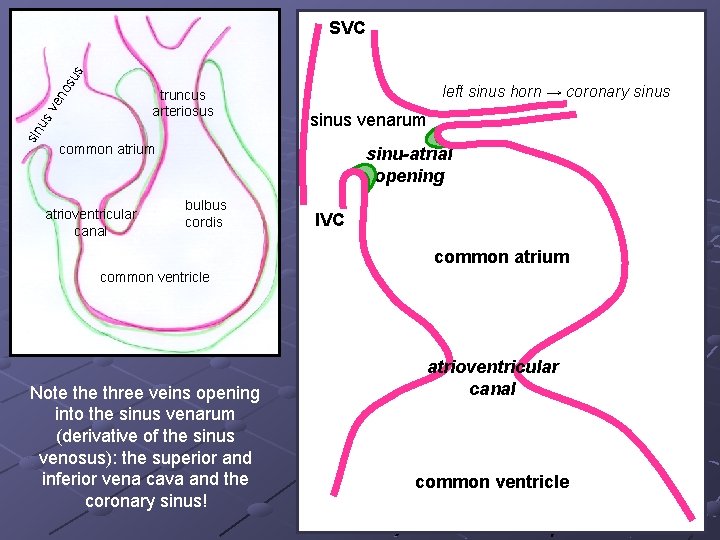
os us SVC sin u sv en truncus arteriosus left sinus horn → coronary sinus venarum common atrium atrioventricular canal sinu-atrial opening bulbus cordis IVC common atrium common ventricle Note three veins opening into the sinus venarum (derivative of the sinus venosus): the superior and inferior vena cava and the coronary sinus! atrioventricular canal common ventricle
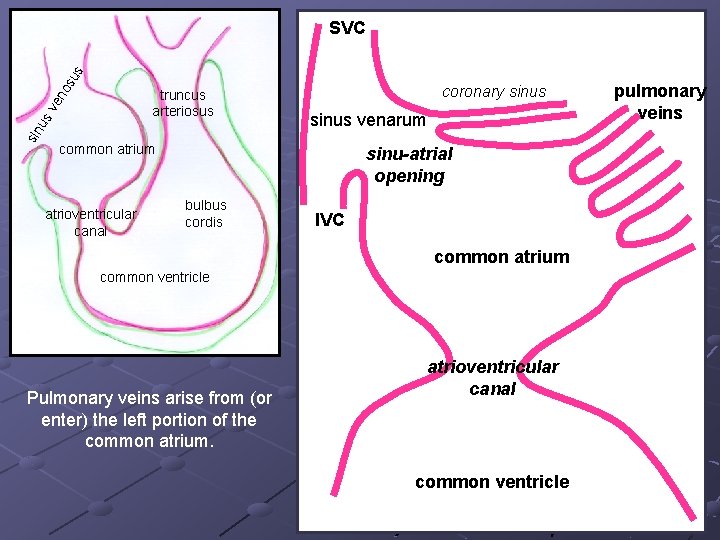
os us SVC sin u sv en truncus arteriosus coronary sinus venarum common atrium atrioventricular canal sinu-atrial opening bulbus cordis IVC common atrium common ventricle Pulmonary veins arise from (or enter) the left portion of the common atrium. atrioventricular canal common ventricle pulmonary veins
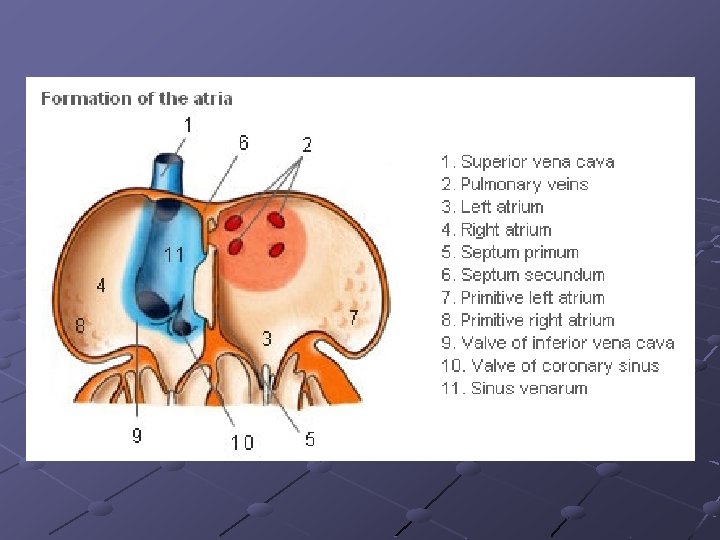
os us SVC sin u sv en truncus arteriosus coronary sinus venarum common atrium atrioventricular canal pulmonary veins sinu-atrial opening bulbus cordis IVC common atrium common ventricle Sinus venarum and pulmonary vein segments getting incorporated into the atrial wall will give the smooth-walled parts of the atria (blue), while the original regions of the common atrium will persist as the rough parts of the atria. atrioventricular canal common ventricle SMOOTH ROUGH
III. Partitioning of the heart
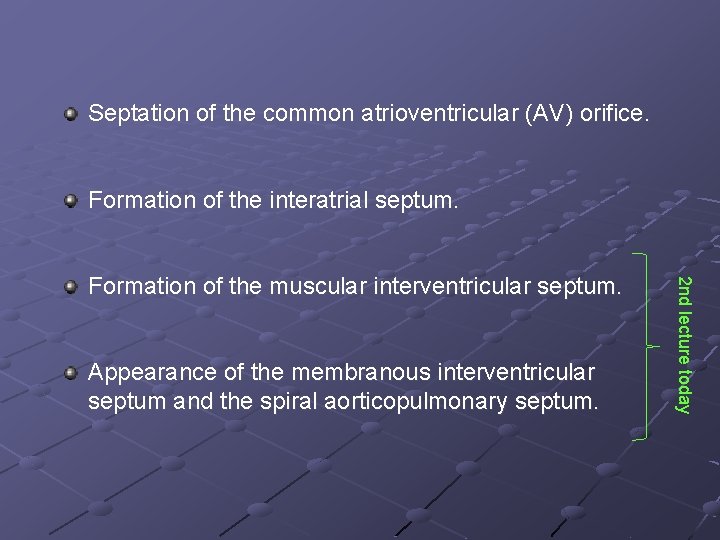
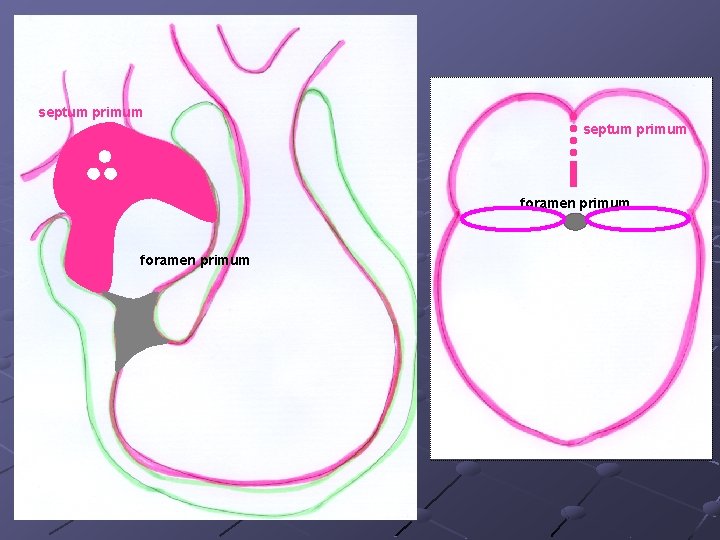
Septation of the common atrioventricular (AV) orifice. Formation of the interatrial septum. Appearance of the membranous interventricular septum and the spiral aorticopulmonary septum. 2 nd lecture today Formation of the muscular interventricular septum.
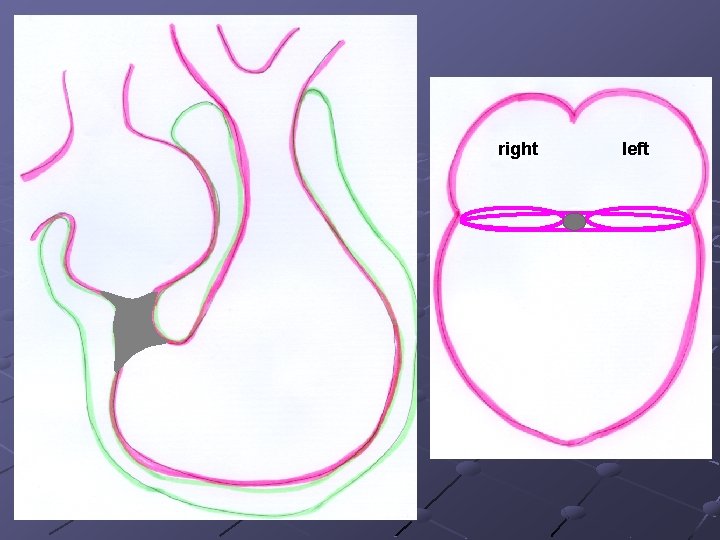
right left
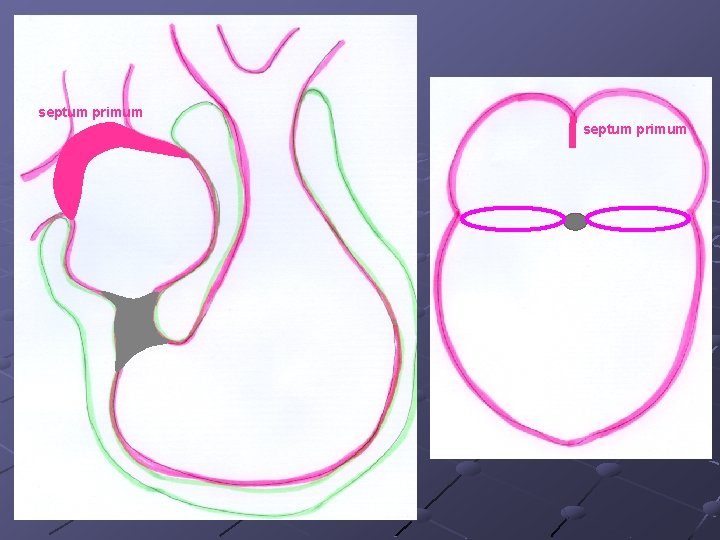
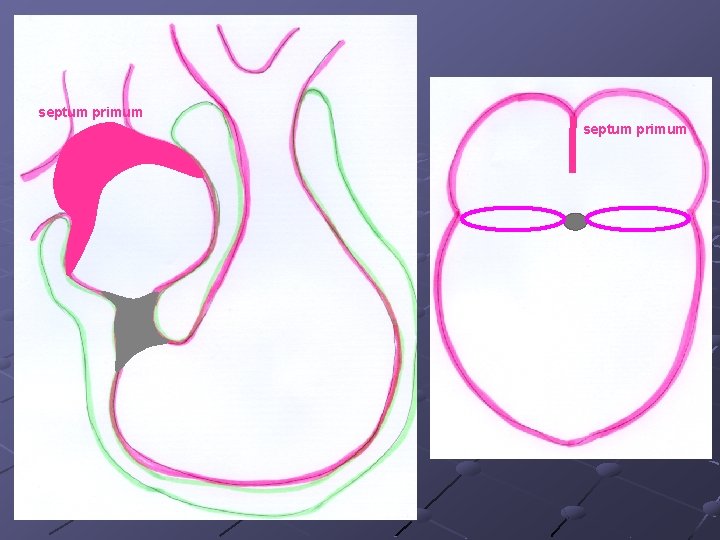
septum primum
septum primum
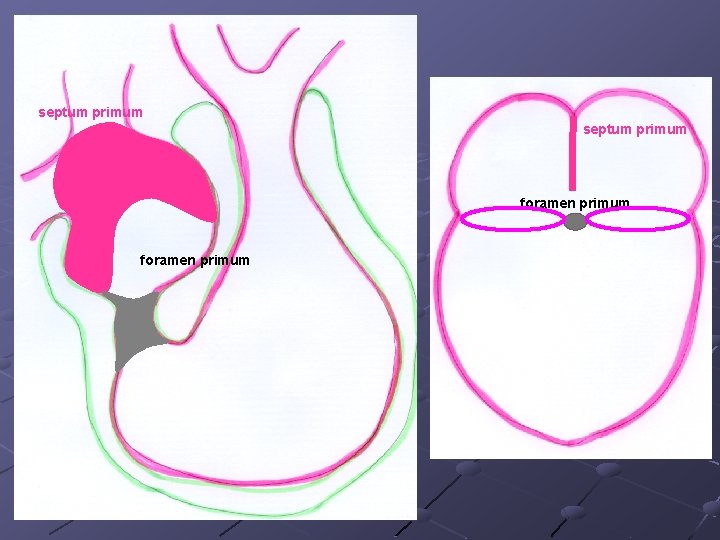
septum primum foramen primum
septum primum foramen primum
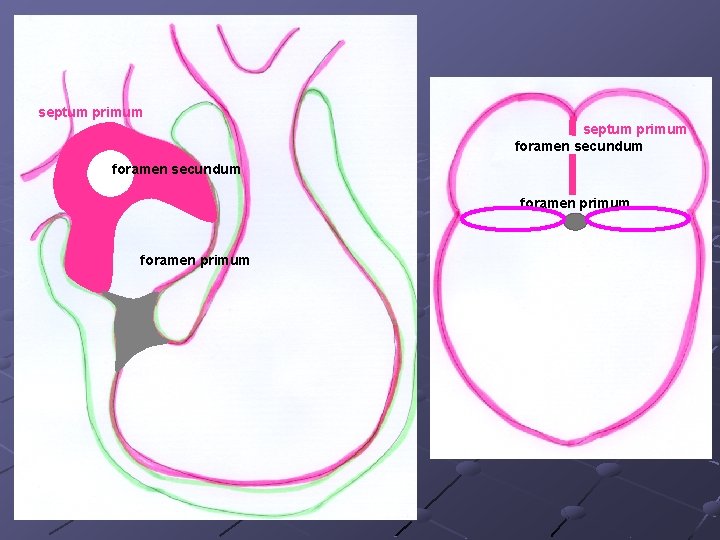
septum primum foramen secundum foramen primum
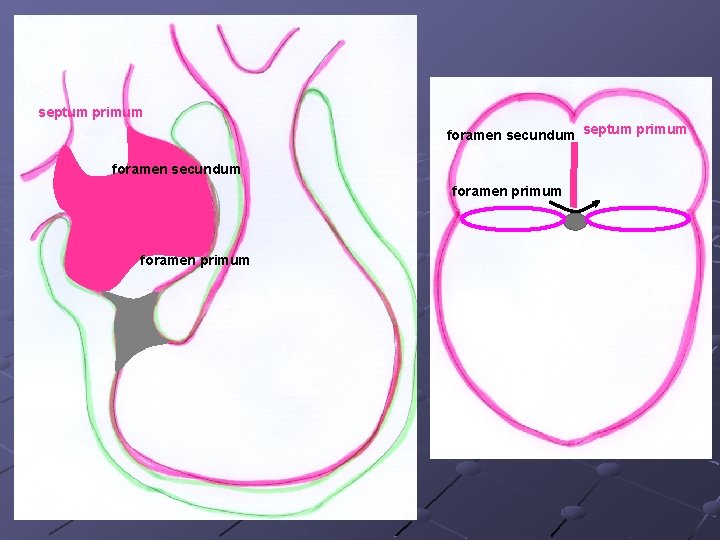
septum primum foramen secundum foramen primum
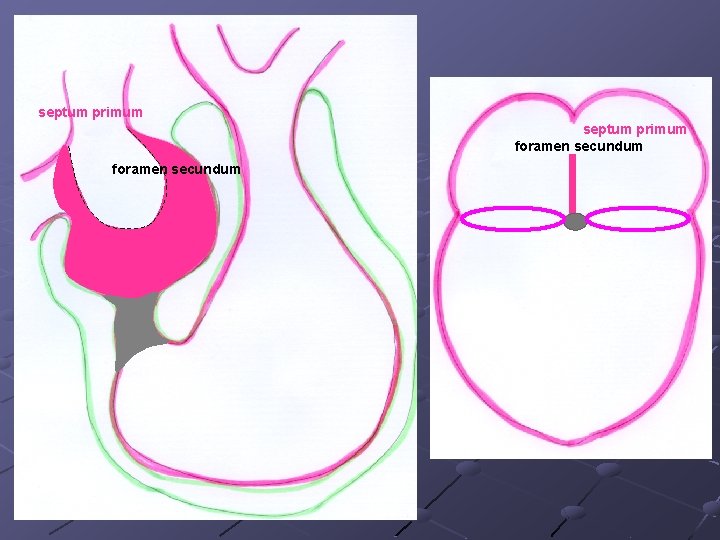
septum primum foramen secundum
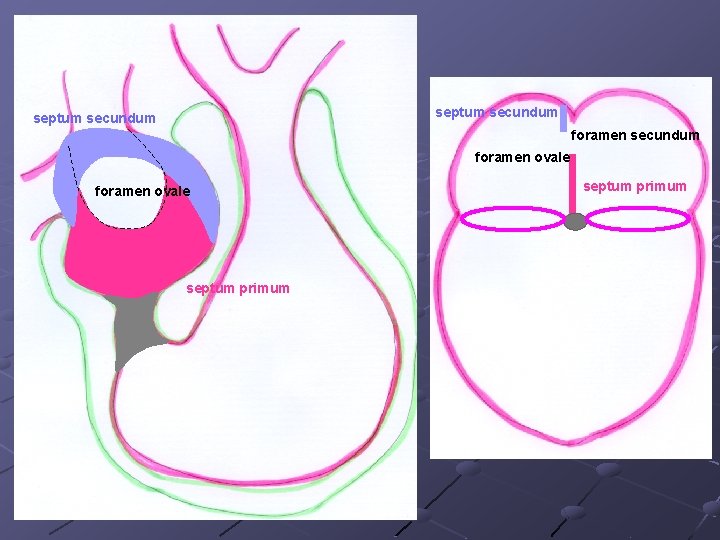
septum secundum foramen ovale septum primum
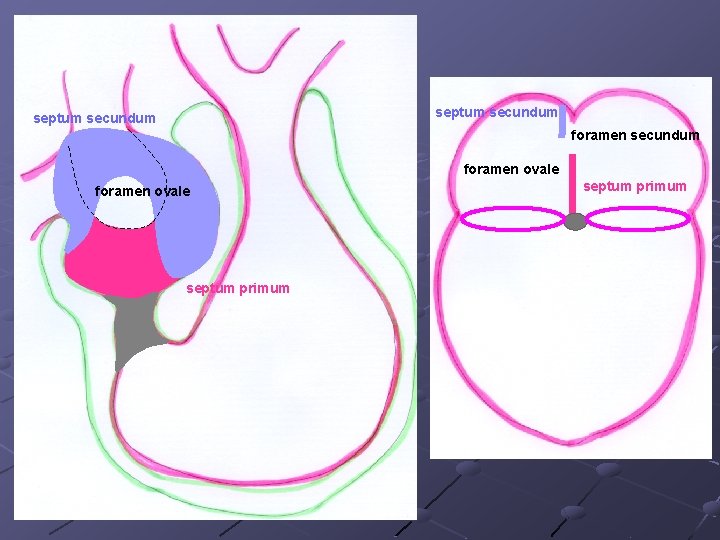
septum secundum foramen ovale septum primum
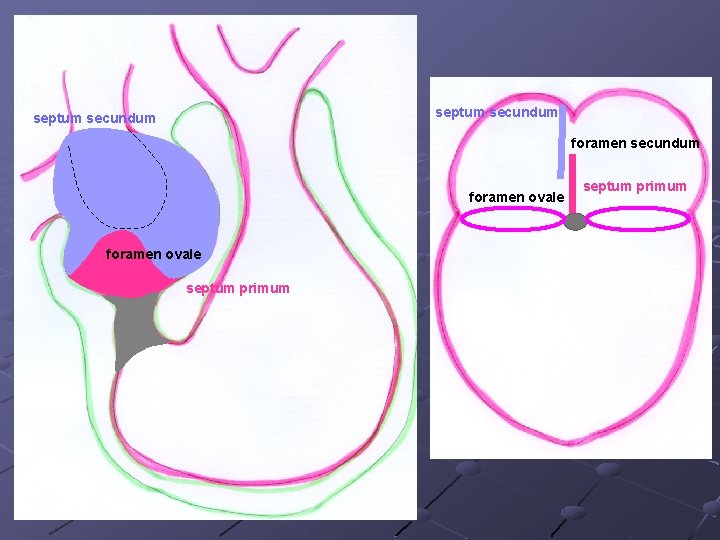
septum secundum foramen ovale septum primum
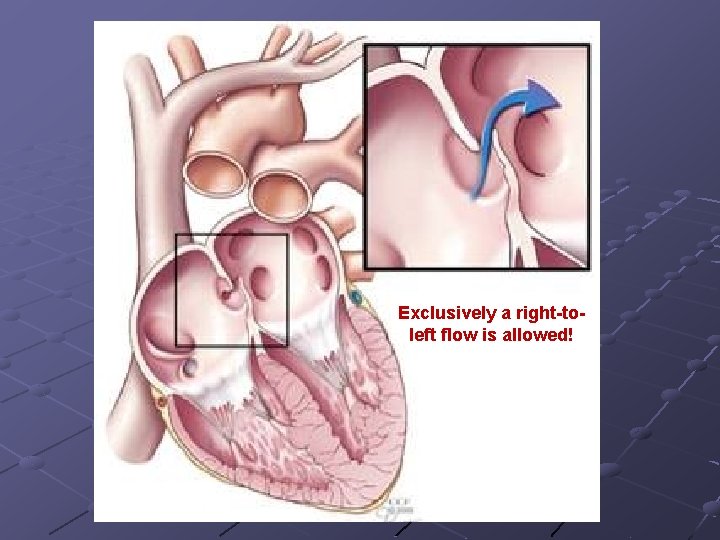
Exclusively a right-toleft flow is allowed!
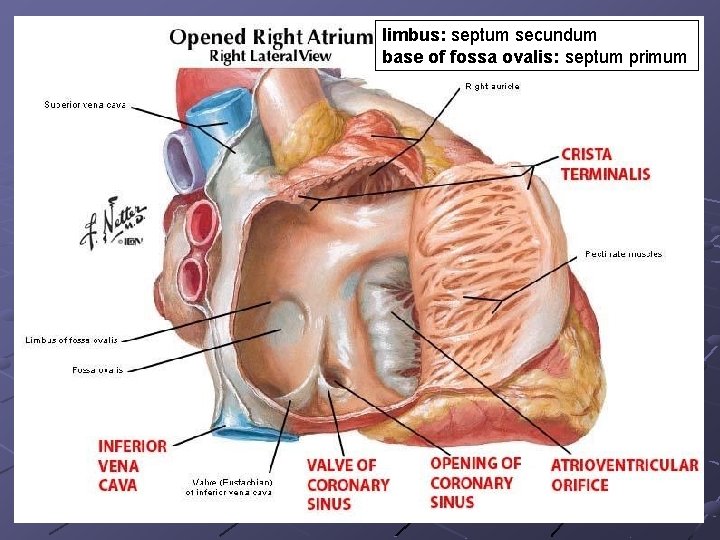
limbus: septum secundum base of fossa ovalis: septum primum
Summary The septation of the common atrium starts with the appearance of the crescent-shaped septum primum. The opening of this septum, the foramen primum, becomes progressively smaller. Before the foramen primum completly closes, postero-superiorly several small openings appear on the septum primum. These perforations coalesce later and form the foramen secundum. On the right side of the septum primum a new septum, the septum secundum, starts to grow. The orifice of the septum secundum is the foramen ovale. Finally two crescent-like, incomplete, partially overlapping septa exist with one hole on each. Septum secundum is more rigid and the septum primum on its left side acts as a valve letting the blood flow exclusively from the right to the left. Its importance will become obvious when the fetal circulation is discussed.
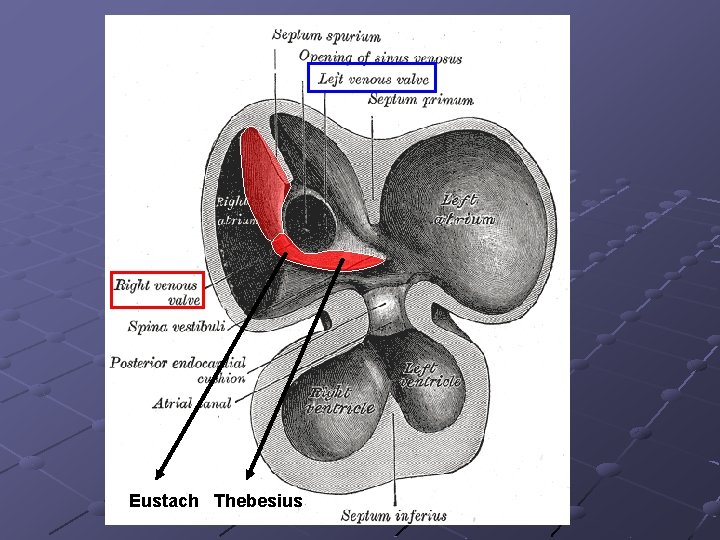
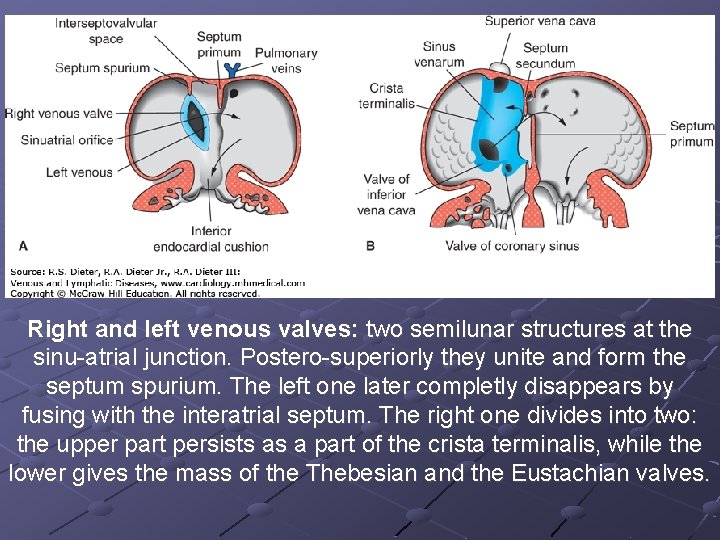
The fate of SA valves (right and left venous valves)
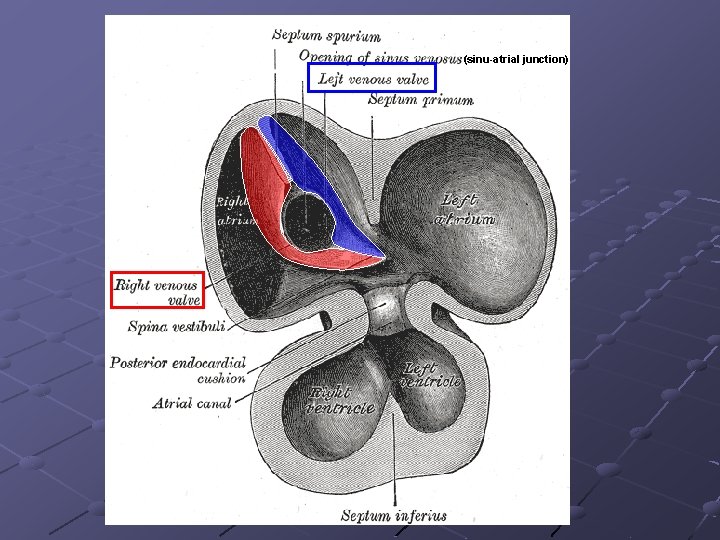
(sinu-atrial junction)
Eustach Thebesius
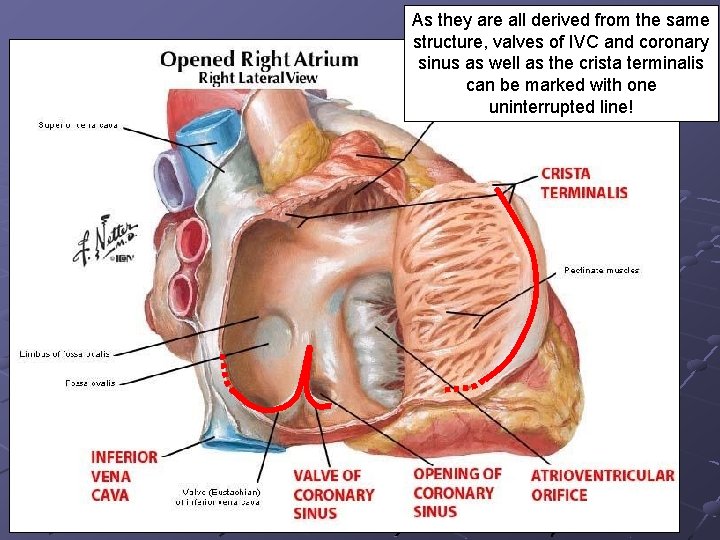
Right and left venous valves: two semilunar structures at the sinu-atrial junction. Postero-superiorly they unite and form the septum spurium. The left one later completly disappears by fusing with the interatrial septum. The right one divides into two: the upper part persists as a part of the crista terminalis, while the lower gives the mass of the Thebesian and the Eustachian valves.
As they are all derived from the same structure, valves of IVC and coronary sinus as well as the crista terminalis can be marked with one uninterrupted line!
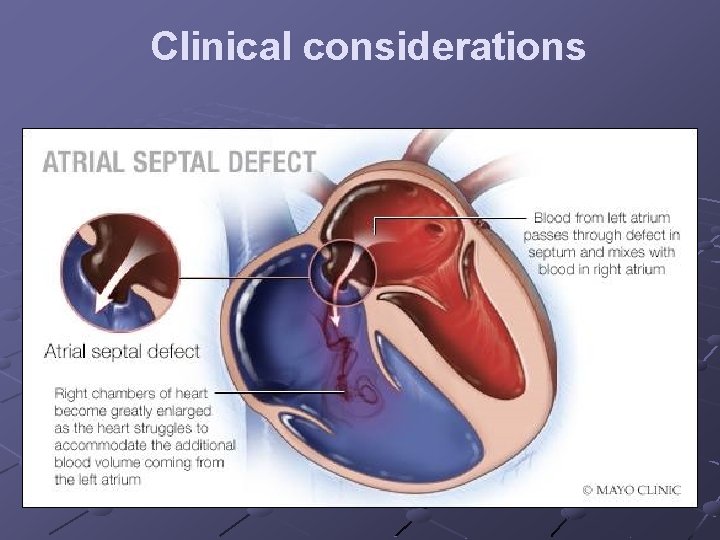
Clinical considerations
Thank you for your attention!