
Development of the Central Nervous System an ongoing
- Slides: 39
Development of the Central Nervous System an ongoing process, through adolescence and maybe even adult hood ? the nervous system is “plastic” Experience plays a key role Dire consequences when something goes wrong - “teratogens” - Drugs of abuse, industrial chemicals, caffeine? , household chemicals
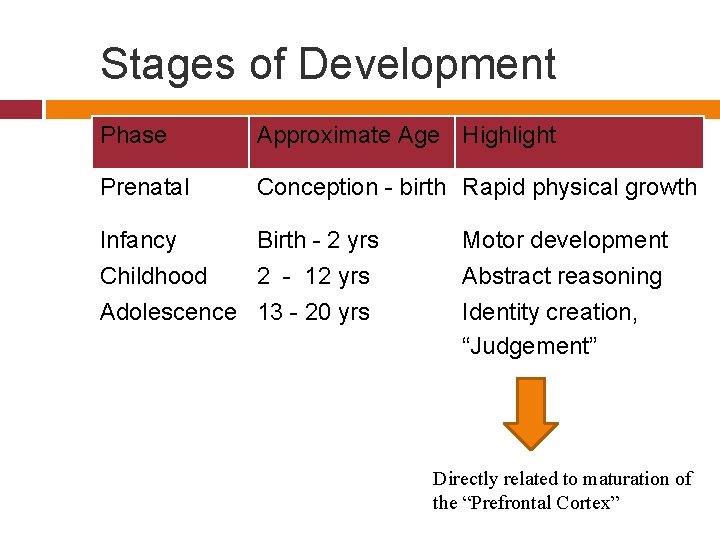
Stages of Development Phase Approximate Age Highlight Prenatal Conception - birth Rapid physical growth Infancy Birth - 2 yrs Childhood 2 - 12 yrs Adolescence 13 - 20 yrs Motor development Abstract reasoning Identity creation, “Judgement” Directly related to maturation of the “Prefrontal Cortex”
Phases of Prenatal Development Ovum + sperm Once zygote implants in uterus zygote embryo Week 8 until birth fetus
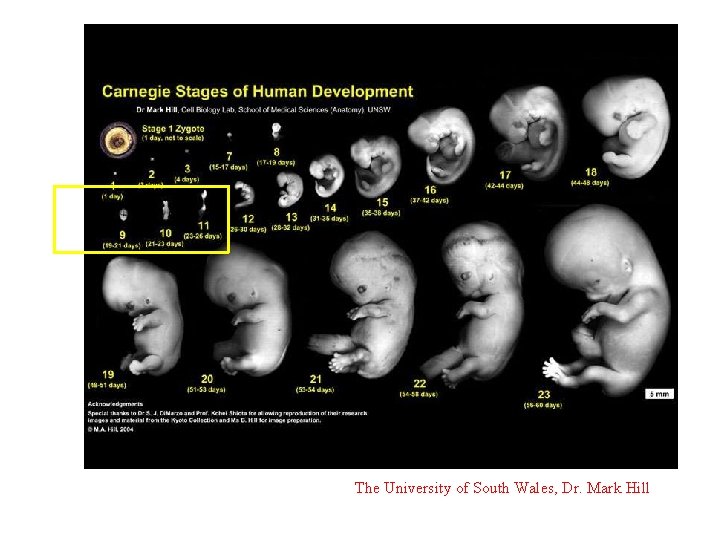
The University of South Wales, Dr. Mark Hill
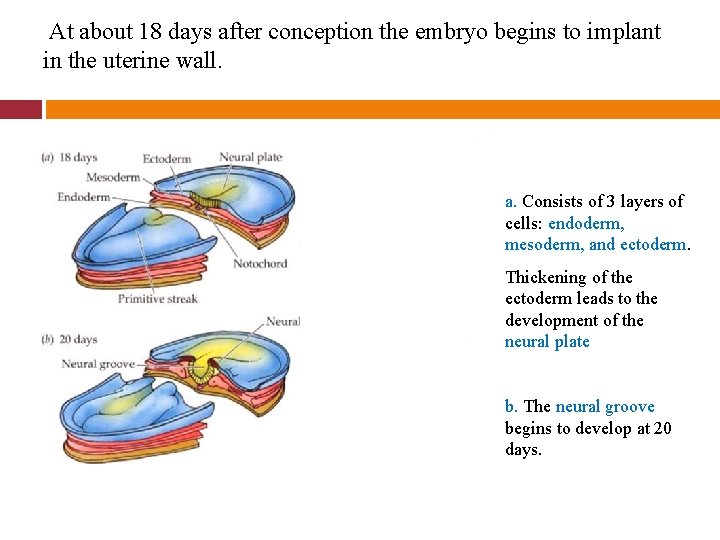
At about 18 days after conception the embryo begins to implant in the uterine wall. a. Consists of 3 layers of cells: endoderm, mesoderm, and ectoderm. Thickening of the ectoderm leads to the development of the neural plate b. The neural groove begins to develop at 20 days.
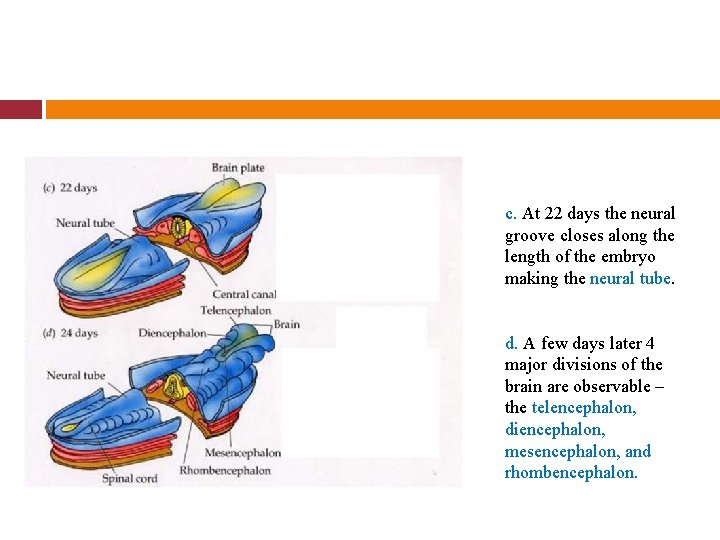
c. At 22 days the neural groove closes along the length of the embryo making the neural tube. d. A few days later 4 major divisions of the brain are observable – the telencephalon, diencephalon, mesencephalon, and rhombencephalon.
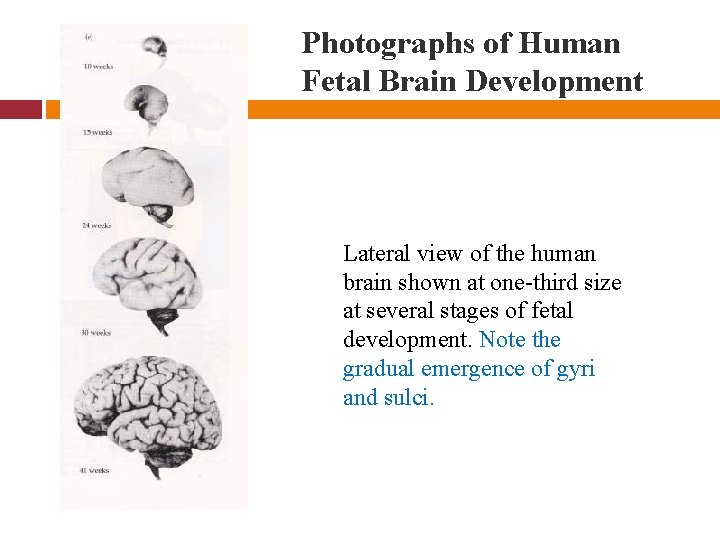
Photographs of Human Fetal Brain Development Lateral view of the human brain shown at one-third size at several stages of fetal development. Note the gradual emergence of gyri and sulci.
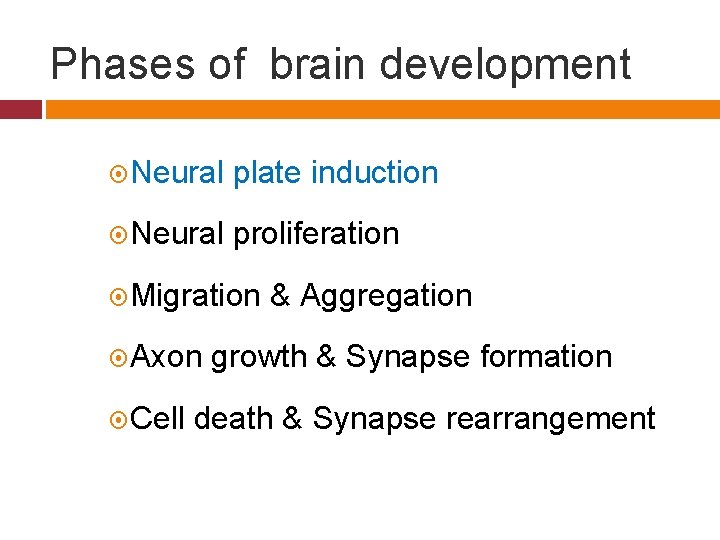
Phases of brain development Neural plate induction Neural proliferation Migration Axon Cell & Aggregation growth & Synapse formation death & Synapse rearrangement
Induction of the Neural Plate 2 -3 weeks after conception A patch of tissue on the dorsal surface of the embryo that will become the nervous system Development induced by chemical signals “growth factors”: several chemicals produced in developing and mature brain that stimulate neuron development and help neurons respond to injury
Neural Plate Totipotent (zygote) – Fertilized ovum has ability to divide and produce all cells of the body (brain, kidney, liver, skin, bone etc. ) Can produce a whole animal Pluripotent: 5 days after fertilization = blastocyst forms, With the development of the neural tube, cells become multipotent – some of these cells are embryonic“stem cells”. Can be taken and differentiated into any organ ? able to develop into any type of mature nervous system cell
Phases of brain development Neural plate induction Neural proliferation Migration Axon Cell & Aggregation growth & Synapse formation death & Synapse rearrangement
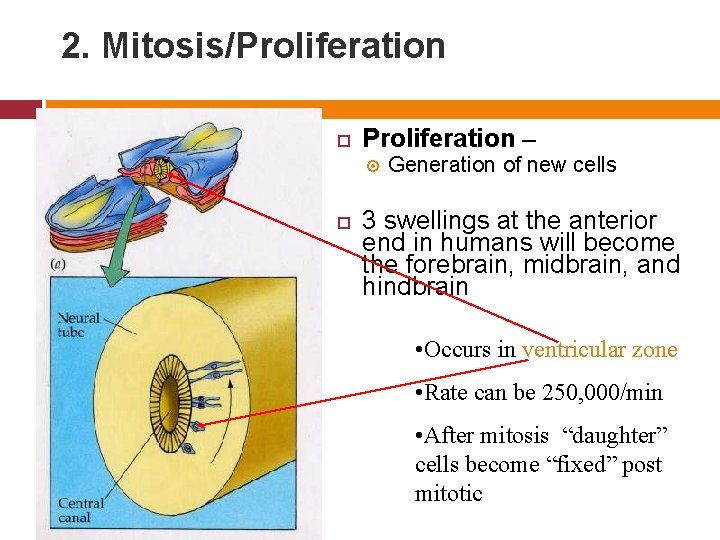
2. Mitosis/Proliferation – Generation of new cells 3 swellings at the anterior end in humans will become the forebrain, midbrain, and hindbrain • Occurs in ventricular zone • Rate can be 250, 000/min • After mitosis “daughter” cells become “fixed” post mitotic
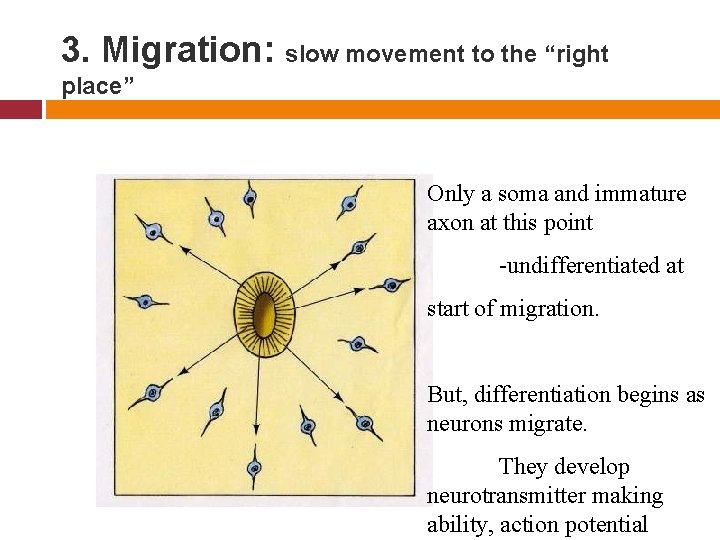
3. Migration: slow movement to the “right place” Only a soma and immature axon at this point -undifferentiated at start of migration. But, differentiation begins as neurons migrate. They develop neurotransmitter making ability, action potential
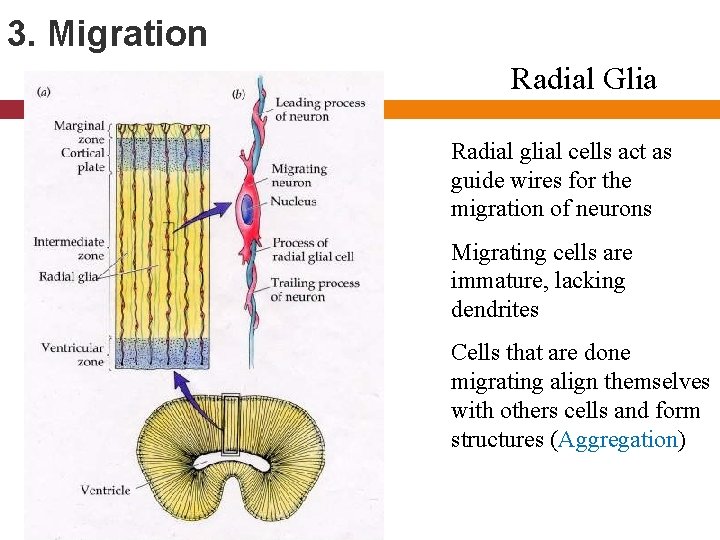
3. Migration Radial Glia Radial glial cells act as guide wires for the migration of neurons Migrating cells are immature, lacking dendrites Cells that are done migrating align themselves with others cells and form structures (Aggregation)
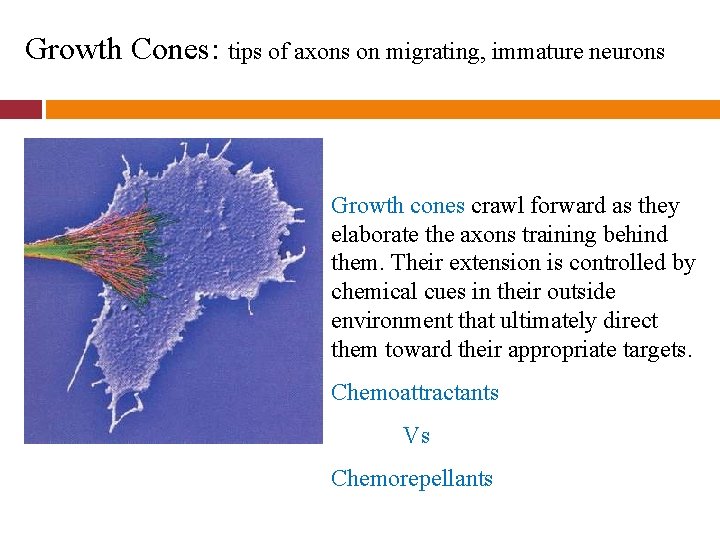
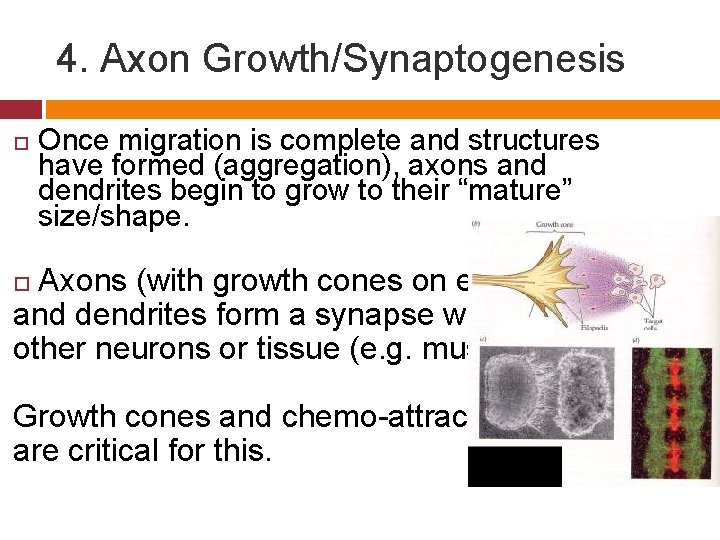
Growth Cones: tips of axons on migrating, immature neurons Growth cones crawl forward as they elaborate the axons training behind them. Their extension is controlled by chemical cues in their outside environment that ultimately direct them toward their appropriate targets. Chemoattractants Vs Chemorepellants
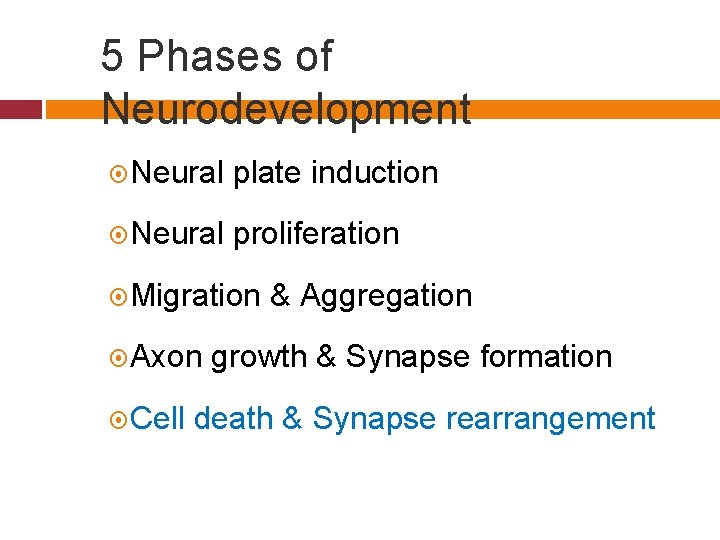
5 Phases of Neurodevelopment Neural plate induction Neural proliferation Migration Axon Cell & Aggregation growth & Synapse formation death & Synapse rearrangement
4. Axon Growth/Synaptogenesis Once migration is complete and structures have formed (aggregation), axons and dendrites begin to grow to their “mature” size/shape. Axons (with growth cones on end) and dendrites form a synapse with other neurons or tissue (e. g. muscle) Growth cones and chemo-attractants are critical for this.
Synaptogenesis Formation of new synapses Depends on the presence of glial cells – especially astrocytes Chemical signal exchange between pre- and postsynaptic neurons is needed
5 Phases of Neurodevelopment Neural plate induction Neural proliferation Migration Axon Cell & Aggregation growth & Synapse formation death & Synapse rearrangement
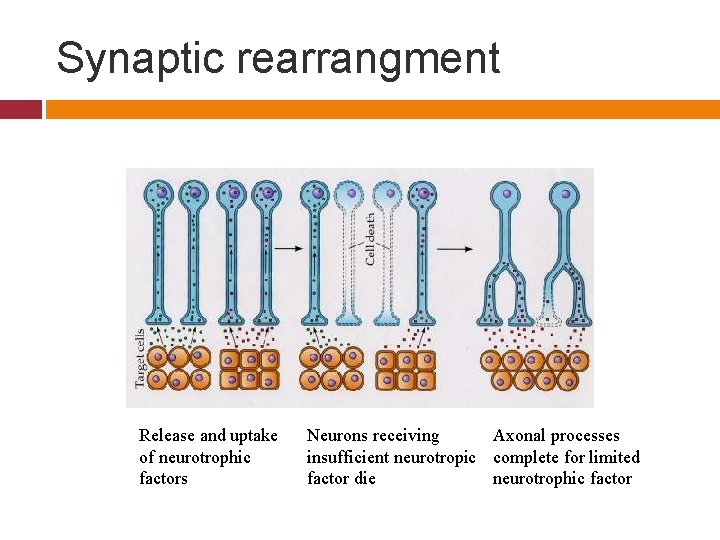
5. Neuronal Death Between 40 -75% neurons made, will die after migration – death is normal and necessary !! Neurons die due to failure to compete for chemicals provided by targets Neurotrophins – promote growth and survival guide axons stimulate synaptogenesis
Synaptic rearrangment Release and uptake of neurotrophic factors Neurons receiving Axonal processes insufficient neurotropic complete for limited factor die neurotrophic factor
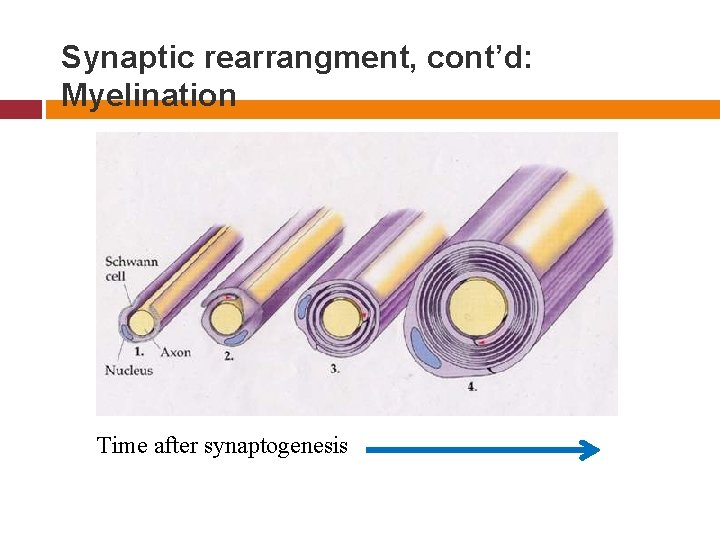
Synaptic rearrangment, cont’d: Myelination Time after synaptogenesis
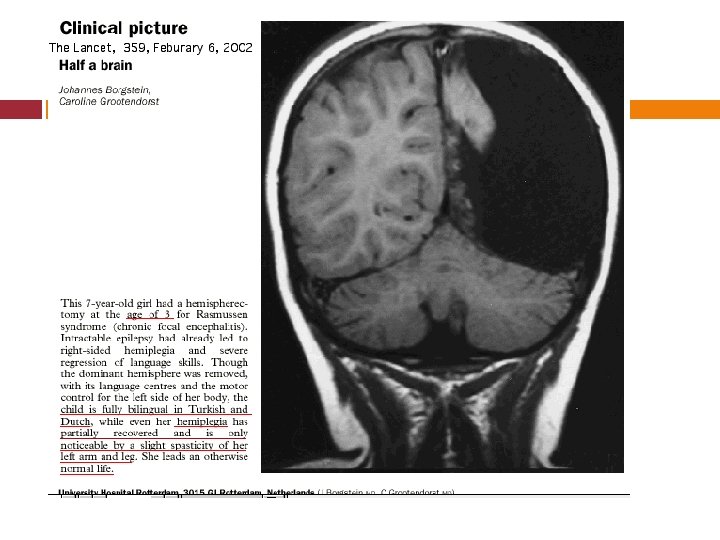
Postnatal Cerebral Development Human Infants Postnatal growth is a consequence of Synaptogenesis Increased dendritic branches Myelination (prefrontal cortex continues into adolescence) Overproduction of synapses may underlie the greater “plasticity” of the young brain Young brain more able to recover function after injury, as compared to older brain
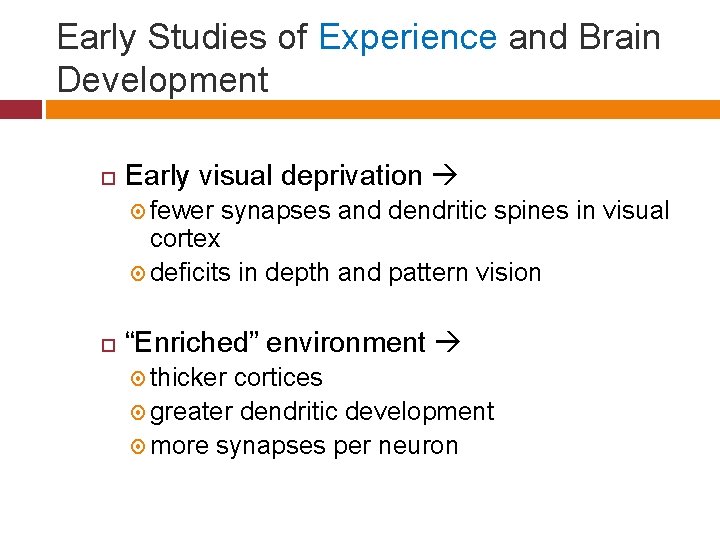
Early Studies of Experience and Brain Development Early visual deprivation fewer synapses and dendritic spines in visual cortex deficits in depth and pattern vision “Enriched” environment thicker cortices greater dendritic development more synapses per neuron
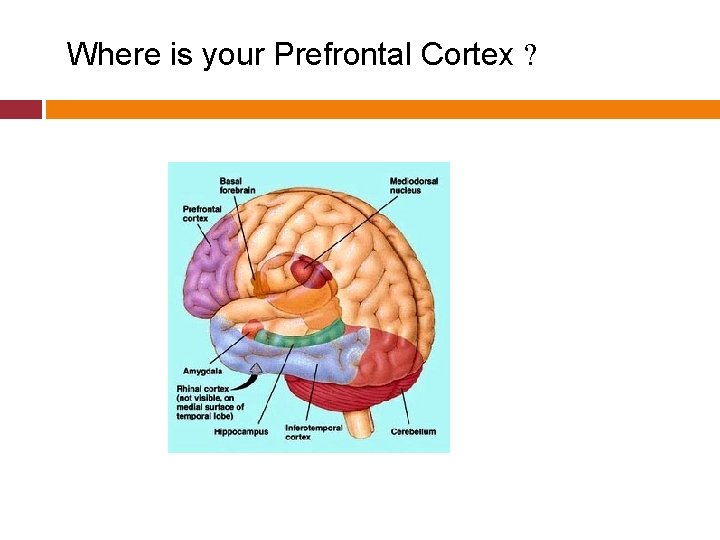
Development of the Prefrontal Cortex Believed to underlie age-related changes in cognitive function, judgement, decisionmaking No single theory explains the function of this area Prefrontal cortex plays a role in working memory, planning and carrying out sequences of actions, and inhibiting inappropriate responses
Where is your Prefrontal Cortex ?
Postnatal Cerebral Development: Adolescence The prefrontal lobe is the last to fully develop http: //www. youtube. com/watch? v=4 -9 sjvit. KWA
Neuroplasticity in Adults ? Mature brain changes and adapts Neurogenesis (birth of new neurons) seen only in olfactory bulb and hippocampus of adult mammals Not clear if this is critical for “normal” adult behavior
Effects of Experience on the Reorganization of the Adult Cortex Skill training leads to reorganization of motor cortex Adult musicians who play instruments have an enlarged representation of the hand in somatosensory cortex Reorganization is synaptogenesis or pruning of unused synapses…
Neurodevelopmental Disorders Autism Spectrum Disorders 1/91 live births in U. S. ) Fetal Alcohol Spectrum Disorders (1/100 live births in North America ? )
Autism http: //health. yahoo. com/nervous-videos/what-is-autism/healthination-HNB 10051_autism_1. html 3 core symptoms: Reduced ability to communicate Reduced capacity for social interaction Preoccupation with a single subject or activity Heterogenous – level of brain damage and dysfunction varies (Autism Spectrum Disorder) Probably no single cause
Autism Most have some abilities preserved § Savants – intellectually handicapped individuals who display specific cognitive or artistic abilities ~1/10 autistic individuals display savant abilities
Neural Basis of Autism Genetic basis Siblings of the autistic have a 5% chance of being autistic 60% concordance rate for monozygotic twins Several genes interacting with the environment
Fetal Alcohol Spectrum Disorders 50+% of women who could become pregnant are drinking 2% of women drink significantly during pregnancy, 10% drink some Glass of wine, bottle of beer, shot of liquor are equal approximately 0. 5 oz absolute alcohol Fetal brain damage occurs at regular doses of 1 -2 oz/day (24 drinks) Source: National Institute on Alcohol Abuse and Alcoholism
Symptoms of FASD Infant: Problems with sleep, feeding, milestones, muscle tone, sensory information processing Child: Hyperactive, poorly coordinated, learning delays Adolescent/Adult: poor judgment, attention, problems with arithmetic, memory, abstraction, frustration/anger
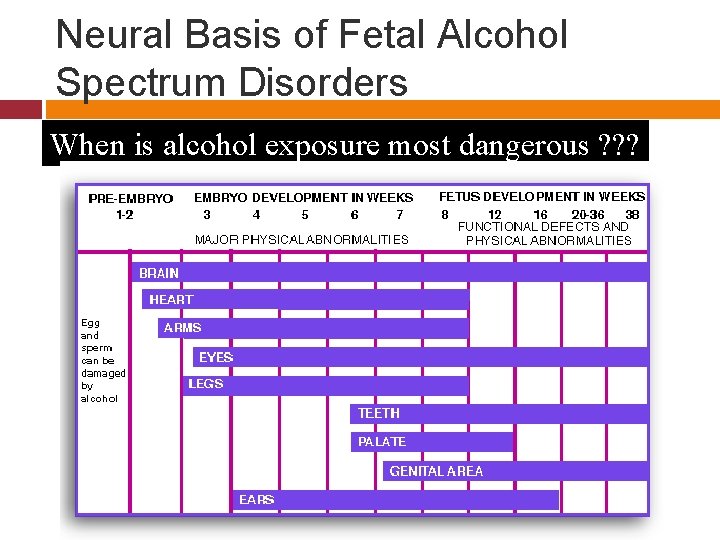
Neural Basis of Fetal Alcohol Spectrum Disorders When is alcohol exposure most dangerous ? ? ?
Neural Basis of Fetal Alcohol Spectrum Disorders Alcohol inhibits all stages of brain development, except neuronal death, which it promotes.
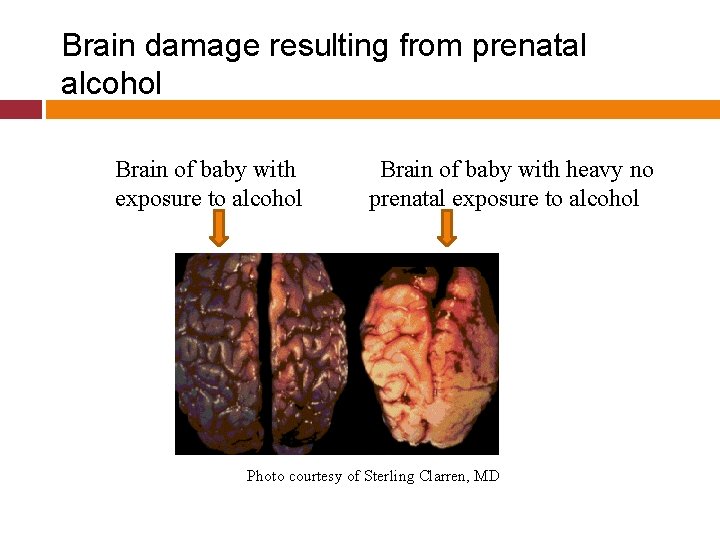
Brain damage resulting from prenatal alcohol Brain of baby with heavy no exposure to alcohol prenatal exposure to alcohol Photo courtesy of Sterling Clarren, MD