
Development of Superconducting Magnets for Particle Accelerators and
- Slides: 17
Development of Superconducting Magnets for Particle Accelerators and Detectors in High Energy Physics Takakazu Shintomi and Akira Yamamoto On behalf of US-Japan collaboration carried out with KEK, University of Tsukuba (Japan) and FNAL, BNL, LBNL (USA) US-Japan HEP Collaboration 30 th Anniversary Symposium 1
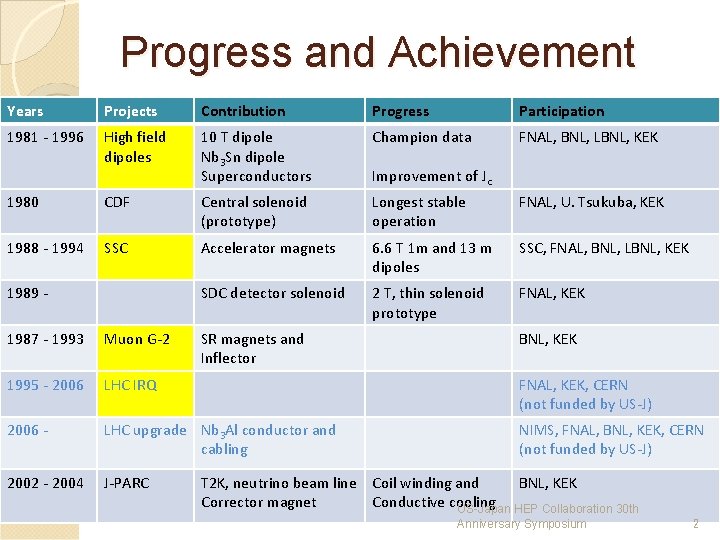
Progress and Achievement Years Projects Contribution Progress Participation 1981 - 1996 High field dipoles 10 T dipole Nb 3 Sn dipole Superconductors Champion data FNAL, BNL, LBNL, KEK 1980 CDF Central solenoid (prototype) Longest stable operation FNAL, U. Tsukuba, KEK 1988 - 1994 SSC Accelerator magnets 6. 6 T 1 m and 13 m dipoles SSC, FNAL, BNL, LBNL, KEK SDC detector solenoid 2 T, thin solenoid prototype FNAL, KEK 1989 - SR magnets and Inflector Improvement of Jc 1987 - 1993 Muon G-2 BNL, KEK 1995 - 2006 LHC IRQ FNAL, KEK, CERN (not funded by US-J) 2006 - LHC upgrade Nb 3 Al conductor and cabling NIMS, FNAL, BNL, KEK, CERN (not funded by US-J) 2002 - 2004 J-PARC T 2 K, neutrino beam line Coil winding and BNL, KEK Corrector magnet Conductive cooling US-Japan HEP Collaboration 30 th Anniversary Symposium 2
Objective To develop superconducting magnets for high energy accelerators and particle detectors The program was performed between KEK and BNL, FNAL and LBNL since 1981 to present ◦ Development of superconducting accelerator and detector magnets ◦ Development of superconducting wires And succeeded to further programs US-Japan HEP Collaboration 30 th Anniversary Symposium 3
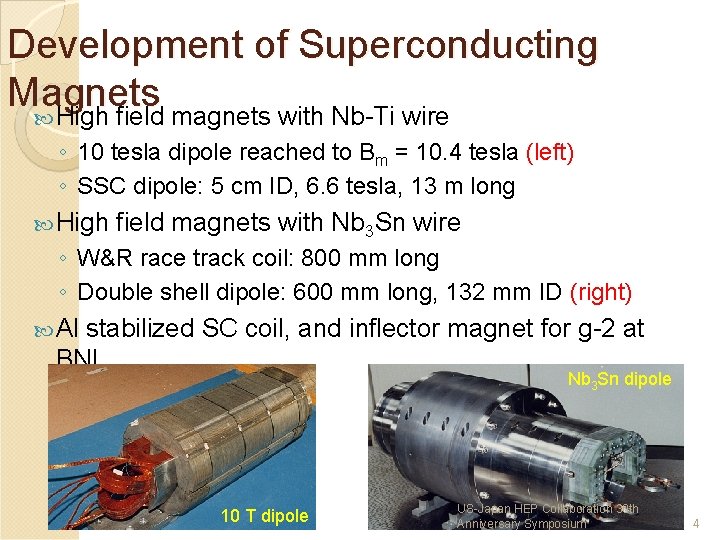
Development of Superconducting Magnets High field magnets with Nb-Ti wire ◦ 10 tesla dipole reached to Bm = 10. 4 tesla (left) ◦ SSC dipole: 5 cm ID, 6. 6 tesla, 13 m long High field magnets with Nb 3 Sn wire ◦ W&R race track coil: 800 mm long ◦ Double shell dipole: 600 mm long, 132 mm ID (right) Al stabilized SC coil, and inflector magnet for g-2 at BNL Nb 3 Sn dipole 10 T dipole US-Japan HEP Collaboration 30 th Anniversary Symposium 4
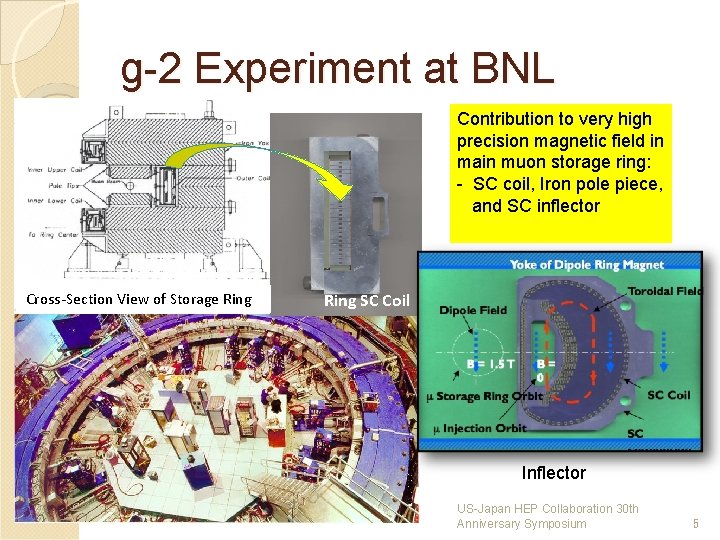
g-2 Experiment at BNL Contribution to very high precision magnetic field in main muon storage ring: - SC coil, Iron pole piece, and SC inflector Cross-Section View of Storage Ring SC Coil Inflector US-Japan HEP Collaboration 30 th Anniversary Symposium 5
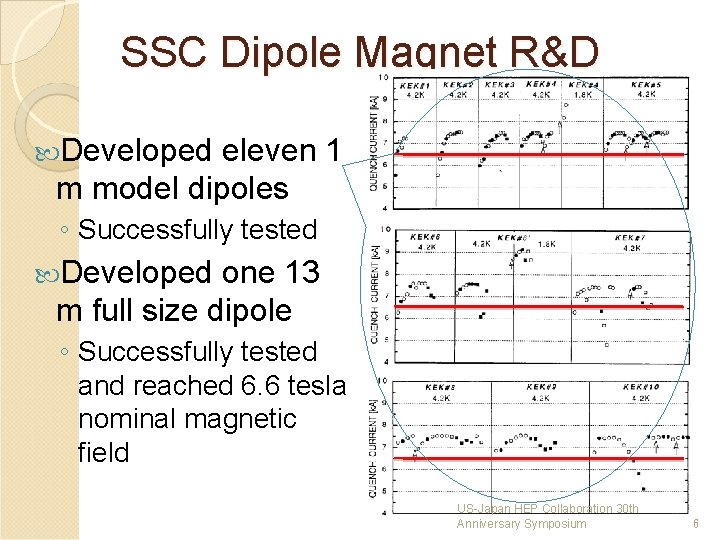
SSC Dipole Magnet R&D Developed eleven 1 m model dipoles ◦ Successfully tested Developed one 13 m full size dipole ◦ Successfully tested and reached 6. 6 tesla nominal magnetic field US-Japan HEP Collaboration 30 th Anniversary Symposium 6
Successive Programs in Stage nd 2 The program for the LHC insertion region quadrupole (IRQ) magnet started in 1995, and was completed successfully in 2006 The technologies achieved were succeeded to superconducting magnets for KEK-B IRQ, and the J-PARC neutrino beam line Also, these technologies have been succeeded to magnet development for the US-Japan HEP Collaboration 30 th Anniversary Symposium 7
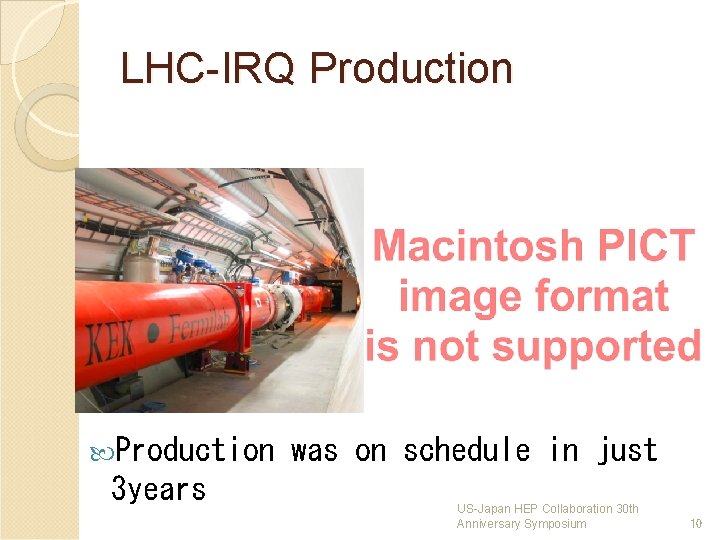
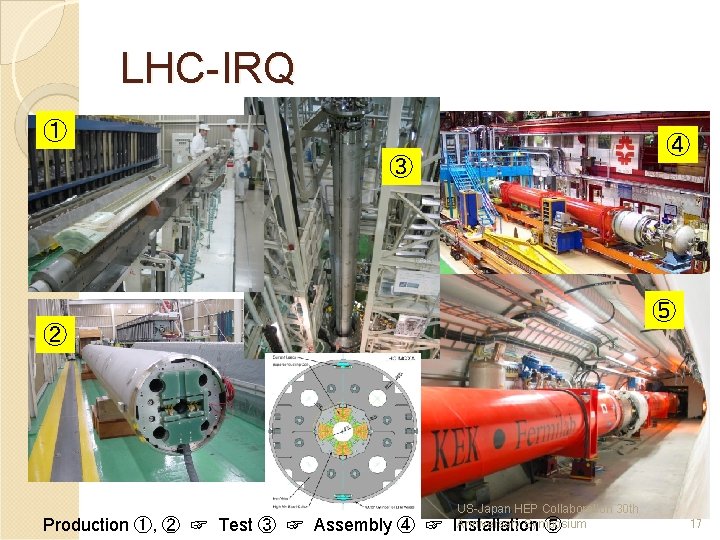
Collaboration with CERN for LHCIRQ The collaboration for LHC Insertion Region Quadrupole (IRQ) magnets started in 1995 and was successfully completed in 2006 by collaboration with KEK, FNAL and CERN Sixteen IRQ magnets plus four spares were fabricated KEK designed and developed technologies which were transferred to an industry KEK tested all the quads and they satisfied the LHC-IRQ requirements The magnets were assembled into cryostat at FNAL and delivered to CERN on schedule US-Japan HEP Collaboration 30 th Anniversary Symposium 8
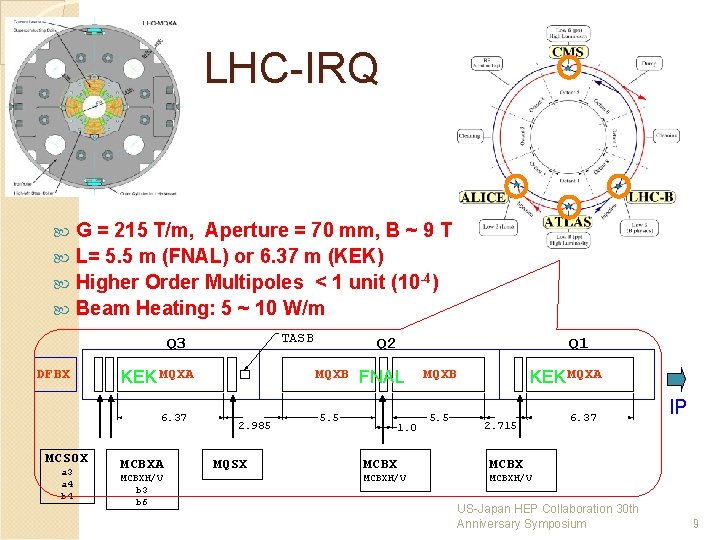
LHC-IRQ G = 215 T/m, Aperture = 70 mm, B ~ 9 T L= 5. 5 m (FNAL) or 6. 37 m (KEK) Higher Order Multipoles < 1 unit (10 -4) Beam Heating: 5 ~ 10 W/m TASB Q 3 DFBX KEK MQXA 6. 37 MCSOX a 3 a 4 b 4 MCBXA MCBXH/V b 3 b 6 Q 2 MQXB 2. 985 MQSX 5. 5 Q 1 FNAL 1. 0 MQXB 5. 5 KEK MQXA 2. 715 MCBXH/V 6. 37 US-Japan HEP Collaboration 30 th Anniversary Symposium IP 9
LHC-IRQ Production 3 years was on schedule in just US-Japan HEP Collaboration 30 th Anniversary Symposium 10
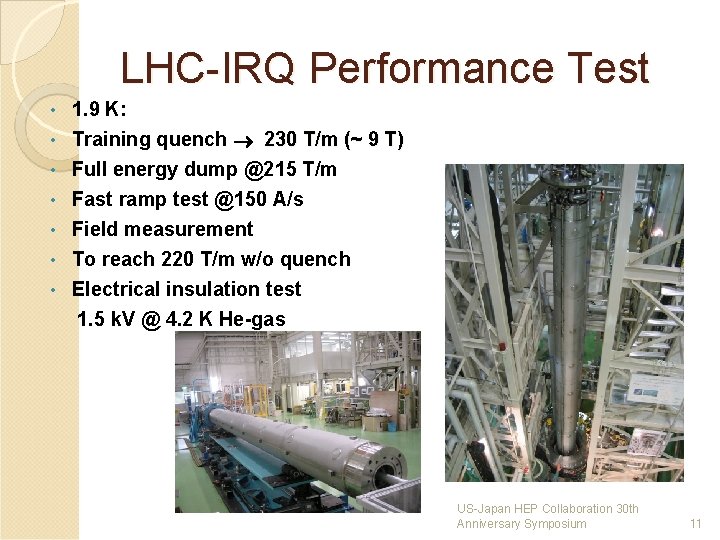
LHC-IRQ Performance Test 1. 9 K: • Training quench 230 T/m (~ 9 T) • Full energy dump @215 T/m • Fast ramp test @150 A/s • Field measurement • To reach 220 T/m w/o quench • Electrical insulation test 1. 5 k. V @ 4. 2 K He-gas • US-Japan HEP Collaboration 30 th Anniversary Symposium 11
LHC-IRQ Quench History Quench history is one of the most important characteristics with field quality Warm bore tube for field measurement attached to the coil and coil temperature increased US-Japan HEP Collaboration 30 th Anniversary Symposium 12
Summary The program for development of superconducting magnets for high energy accelerators and particle detectors was successful and various technologies have been achieved The technologies developed by the Japan-US Collaboration Program were succeeded to the Japan-CERN collaboration for LHC-IRQ The successive programs such as the J-PARC neutrino beam line magnet stand on these technologies The future programs for superconducting magnet development such as the LHC upgrade are important for high energy physics The successful development of these programs is owing to the collaboration with industries US-Japan HEP Collaboration 30 th Anniversary Symposium 13
Appendices US-Japan HEP Collaboration 30 th Anniversary Symposium 14
Development of Superconducting Wires Development of Nb-Ti wire Ni-Ti wire with industry Development of Nb-Ti (Ta) wire Development of Nb 3 Sn wire for high field magnet beyond 10 tesla The effort has been succeeded to develop Nb 3 Al wire for higher field magnet US-Japan HEP Collaboration 30 th Anniversary Symposium 15
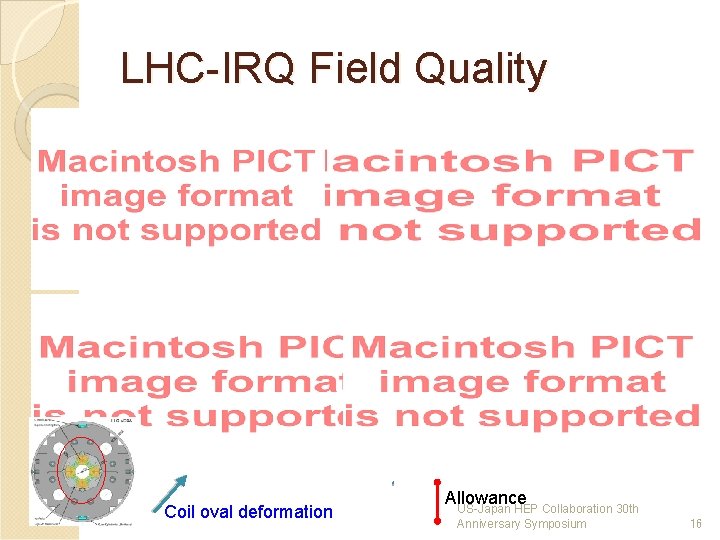
LHC-IRQ Field Quality Coil oval deformation Allowance US-Japan HEP Collaboration 30 th Anniversary Symposium 16
LHC-IRQ ① ④ ③ ⑤ ② Production ①, ② ☞ Test ③ ☞ Assembly ④ ☞ US-Japan HEP Collaboration 30 th Anniversary Symposium Installation ⑤ 17