
Development of space weather in Japan Hiroaki Isobe
Development of space weather in Japan Hiroaki Isobe Center for the Promotion of Interdisciplinary Education and Research Kyoto University
Significant changes in Japanese space policy • “Basic space law” enacted in 2008 • The Office of National Space Policy is established in the Cabinet Office as the headquarters to coordinate Japan’s overall space policy • From R&D to “Expansion of Space Utilization” • First “Basic Plan on Space Policy” under the new organization established in January, 2013, in which space weather is mentioned in the context of Space Situational Awareness (SAA).
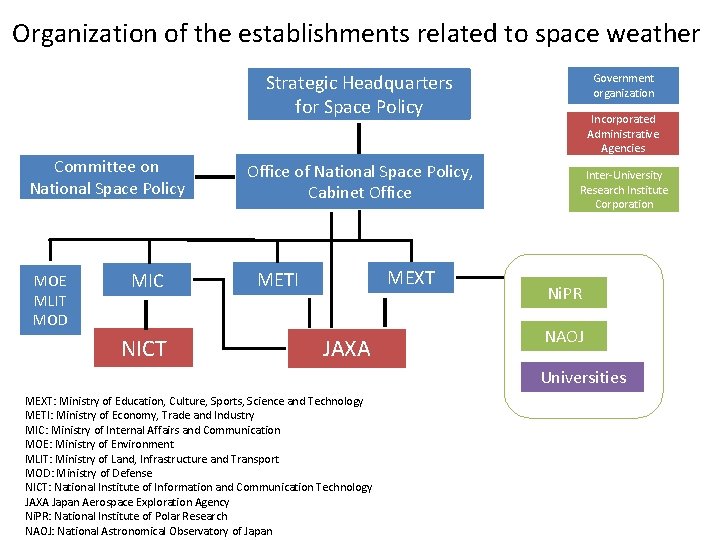
Organization of the establishments related to space weather Strategic Headquarters for Space Policy Committee on National Space Policy MOE MLIT MOD MIC NICT Office of National Space Policy, Cabinet Office MEXT METI JAXA Government organization Incorporated Administrative Agencies Inter-University Research Institute Corporation Ni. PR NAOJ Universities MEXT: Ministry of Education, Culture, Sports, Science and Technology METI: Ministry of Economy, Trade and Industry MIC: Ministry of Internal Affairs and Communication MOE: Ministry of Environment MLIT: Ministry of Land, Infrastructure and Transport MOD: Ministry of Defense NICT: National Institute of Information and Communication Technology JAXA Japan Aerospace Exploration Agency Ni. PR: National Institute of Polar Research NAOJ: National Astronomical Observatory of Japan
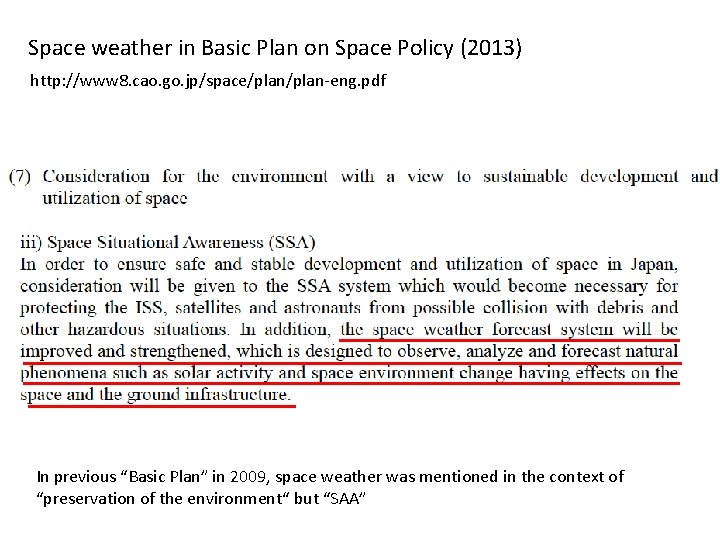
Space weather in Basic Plan on Space Policy (2013) http: //www 8. cao. go. jp/space/plan-eng. pdf In previous “Basic Plan” in 2009, space weather was mentioned in the context of “preservation of the environment“ but “SAA”
Japanese Institutes working on space weather
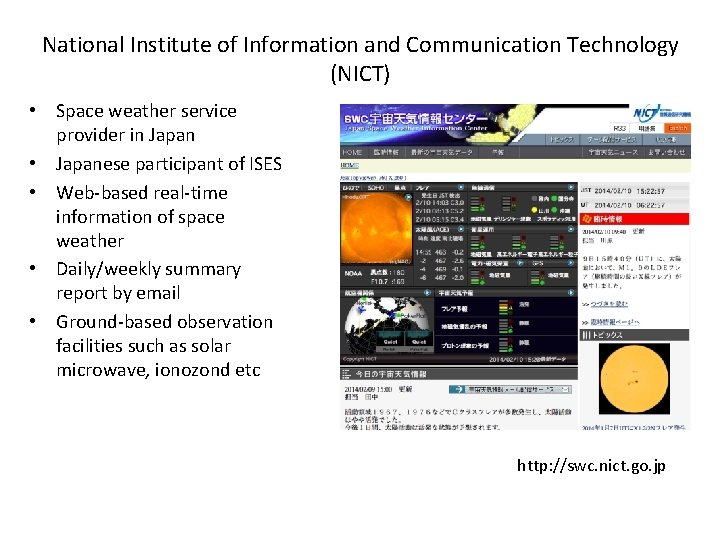
National Institute of Information and Communication Technology (NICT) • Space weather service provider in Japan • Japanese participant of ISES • Web-based real-time information of space weather • Daily/weekly summary report by email • Ground-based observation facilities such as solar microwave, ionozond etc http: //swc. nict. go. jp
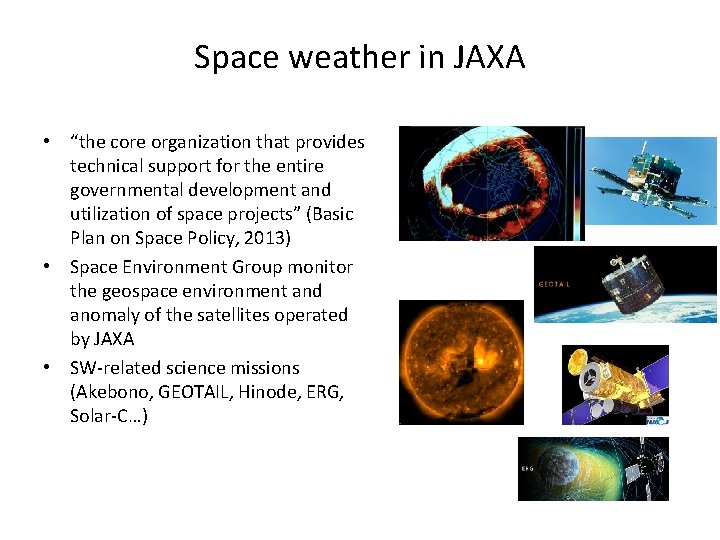
Space weather in JAXA • “the core organization that provides technical support for the entire governmental development and utilization of space projects” (Basic Plan on Space Policy, 2013) • Space Environment Group monitor the geospace environment and anomaly of the satellites operated by JAXA • SW-related science missions (Akebono, GEOTAIL, Hinode, ERG, Solar-C…)
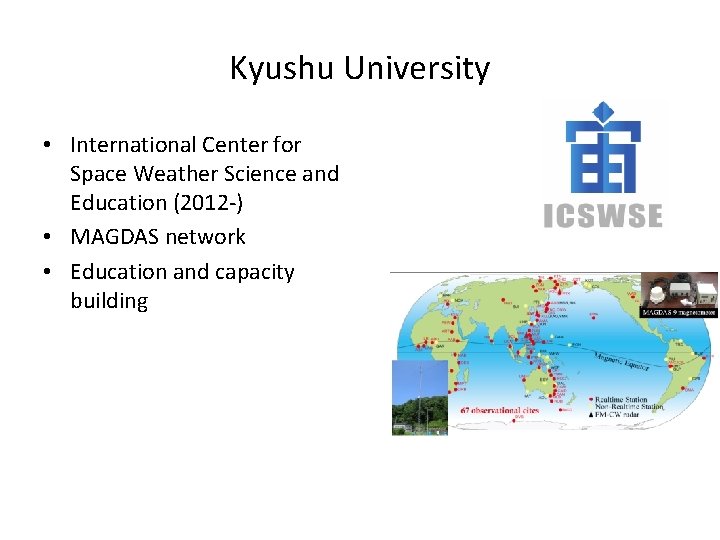
Kyushu University • International Center for Space Weather Science and Education (2012 -) • MAGDAS network • Education and capacity building
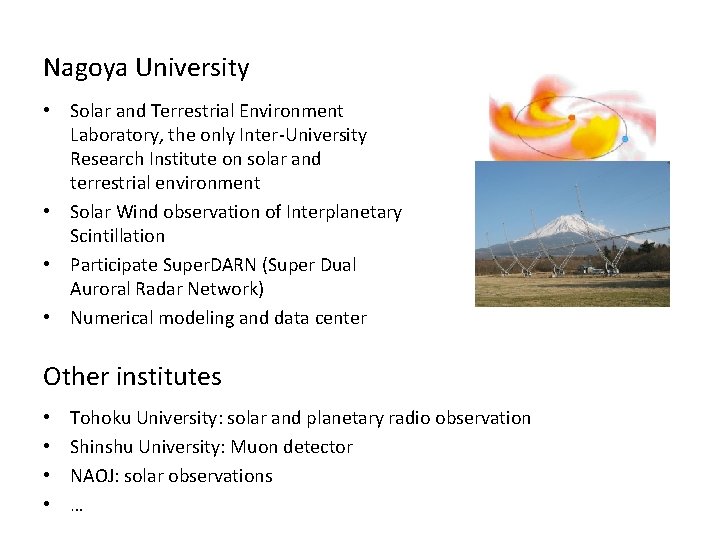
Nagoya University • Solar and Terrestrial Environment Laboratory, the only Inter-University Research Institute on solar and terrestrial environment • Solar Wind observation of Interplanetary Scintillation • Participate Super. DARN (Super Dual Auroral Radar Network) • Numerical modeling and data center Other institutes • • Tohoku University: solar and planetary radio observation Shinshu University: Muon detector NAOJ: solar observations …
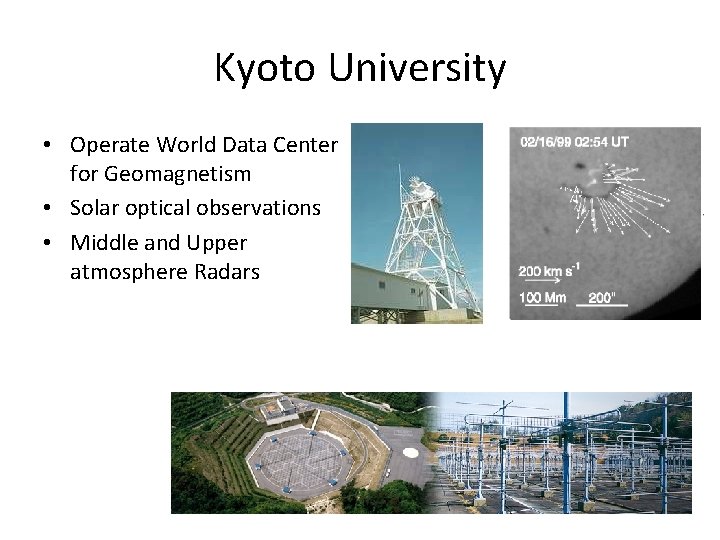
Kyoto University • Operate World Data Center for Geomagnetism • Solar optical observations • Middle and Upper atmosphere Radars
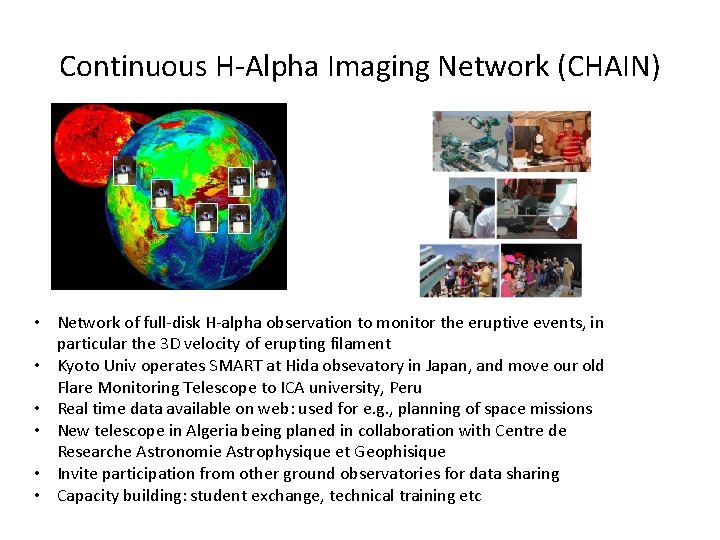
Continuous H-Alpha Imaging Network (CHAIN) • Network of full-disk H-alpha observation to monitor the eruptive events, in particular the 3 D velocity of erupting filament • Kyoto Univ operates SMART at Hida obsevatory in Japan, and move our old Flare Monitoring Telescope to ICA university, Peru • Real time data available on web: used for e. g. , planning of space missions • New telescope in Algeria being planed in collaboration with Centre de Researche Astronomie Astrophysique et Geophisique • Invite participation from other ground observatories for data sharing • Capacity building: student exchange, technical training etc
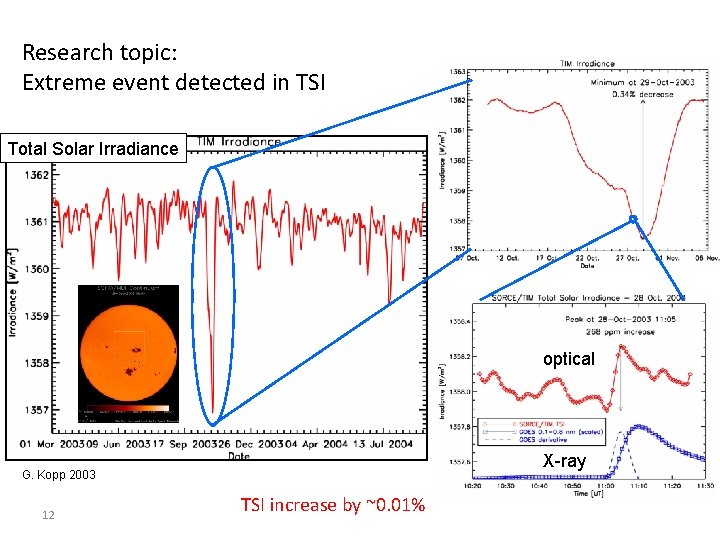
Research topic: Extreme event detected in TSI Total Solar Irradiance optical X-ray G. Kopp 2003 12 TSI increase by ~0. 01%
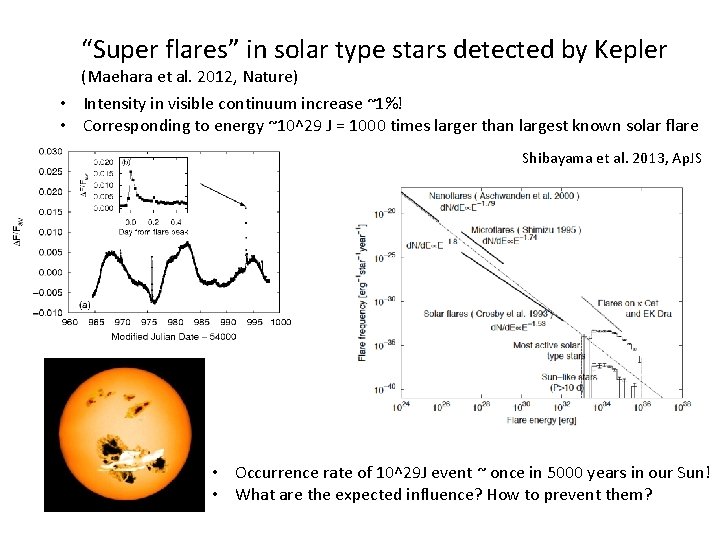
“Super flares” in solar type stars detected by Kepler (Maehara et al. 2012, Nature) • Intensity in visible continuum increase ~1%! • Corresponding to energy ~10^29 J = 1000 times larger than largest known solar flare Shibayama et al. 2013, Ap. JS • Occurrence rate of 10^29 J event ~ once in 5000 years in our Sun! • What are the expected influence? How to prevent them?
Summary • Major changes in Japanese space policy. From R&D-oriented to utilization-oriented. • In the “Basic Plan on Space Policy”, space weather is mentioned as a part of SSA. • Many space and ground-based assets in Japan, but operated more-or-less independently by individual institutes • Mostly science-driven. Need more coordinated, serviceoriented and continuous observation (<= also good for science) • International cooperation is important
- Slides: 14