
Development of Six Sigma l l Motorola launched
- Slides: 18
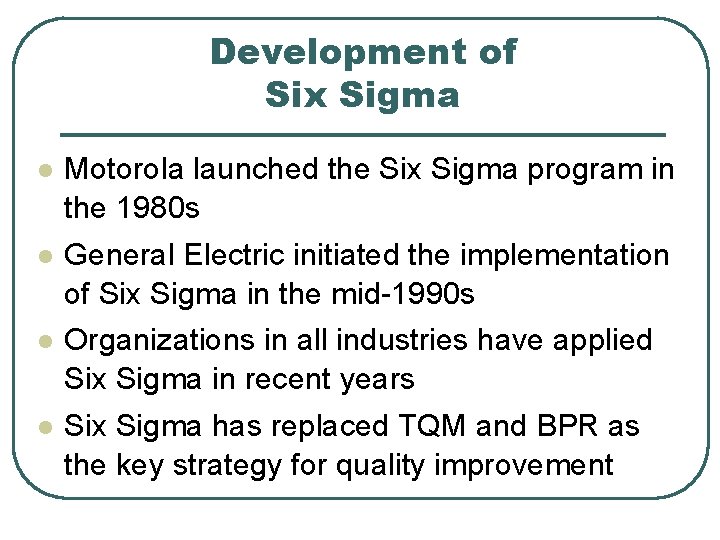
Development of Six Sigma l l Motorola launched the Six Sigma program in the 1980 s General Electric initiated the implementation of Six Sigma in the mid-1990 s Organizations in all industries have applied Six Sigma in recent years Six Sigma has replaced TQM and BPR as the key strategy for quality improvement
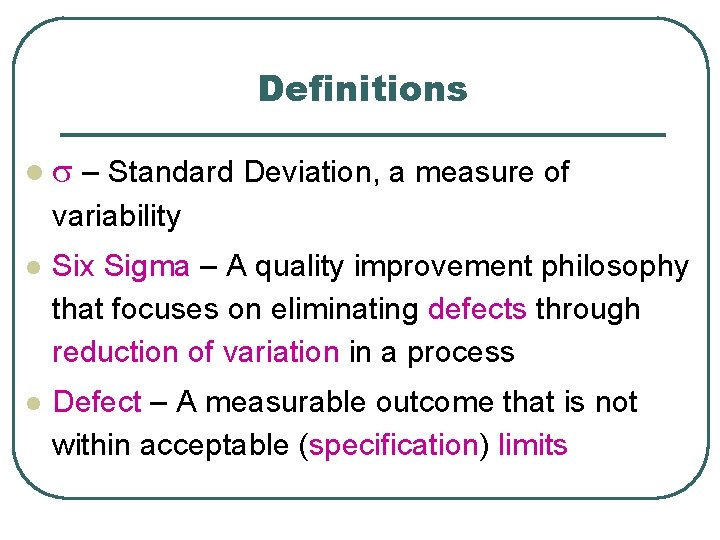
Definitions l s – Standard Deviation, a measure of variability l Six Sigma – A quality improvement philosophy that focuses on eliminating defects through reduction of variation in a process l Defect – A measurable outcome that is not within acceptable (specification) limits
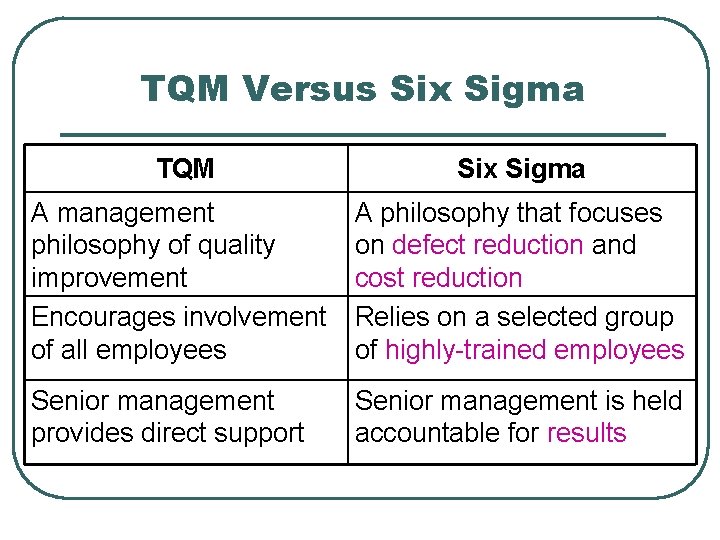
TQM Versus Six Sigma TQM Six Sigma A management philosophy of quality improvement Encourages involvement of all employees A philosophy that focuses on defect reduction and cost reduction Relies on a selected group of highly-trained employees Senior management provides direct support Senior management is held accountable for results
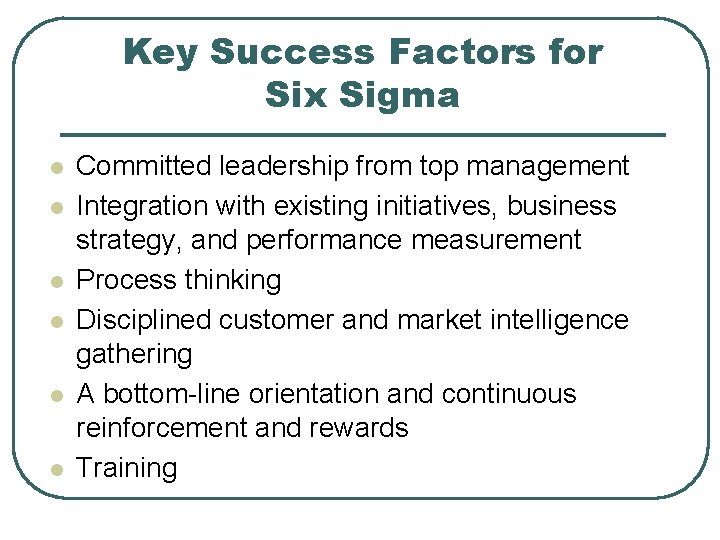
Key Success Factors for Six Sigma l l l Committed leadership from top management Integration with existing initiatives, business strategy, and performance measurement Process thinking Disciplined customer and market intelligence gathering A bottom-line orientation and continuous reinforcement and rewards Training
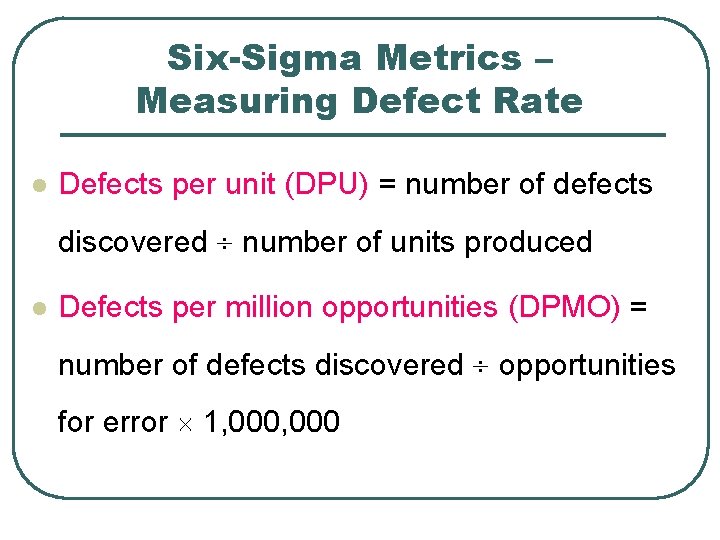
Six-Sigma Metrics – Measuring Defect Rate l Defects per unit (DPU) = number of defects discovered number of units produced l Defects per million opportunities (DPMO) = number of defects discovered opportunities for error 1, 000
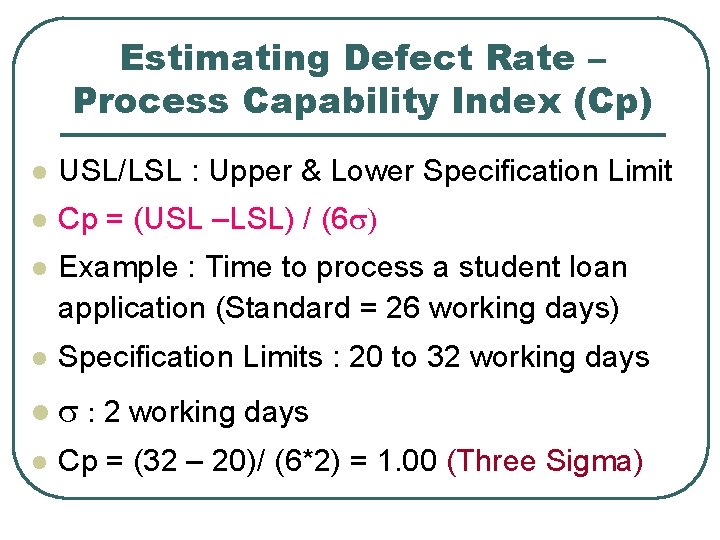
Estimating Defect Rate – Process Capability Index (Cp) l USL/LSL : Upper & Lower Specification Limit l Cp = (USL –LSL) / (6 s) l Example : Time to process a student loan application (Standard = 26 working days) l Specification Limits : 20 to 32 working days l s : 2 working days l Cp = (32 – 20)/ (6*2) = 1. 00 (Three Sigma)
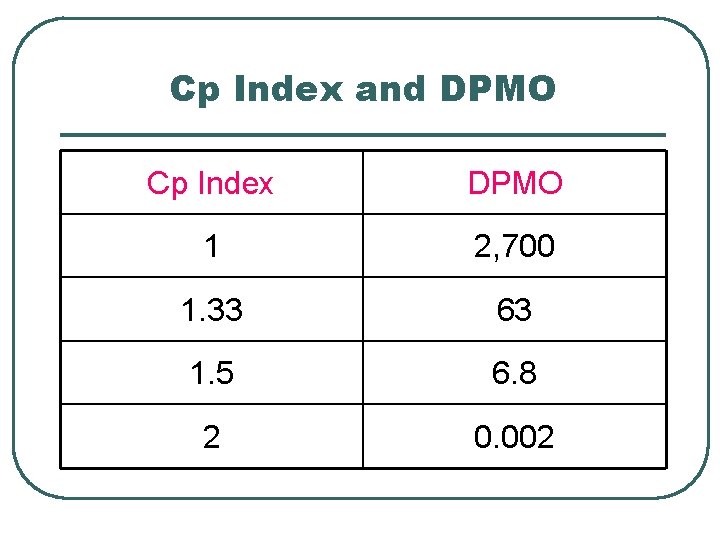
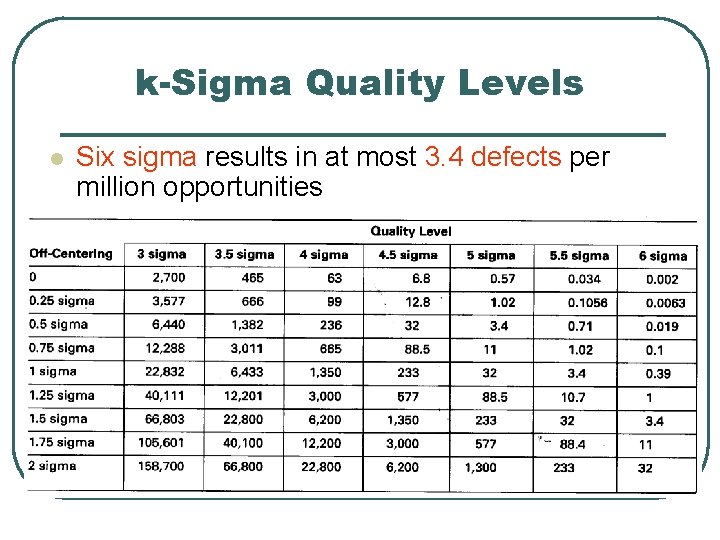
Cp Index and DPMO Cp Index DPMO 1 2, 700 1. 33 63 1. 5 6. 8 2 0. 002
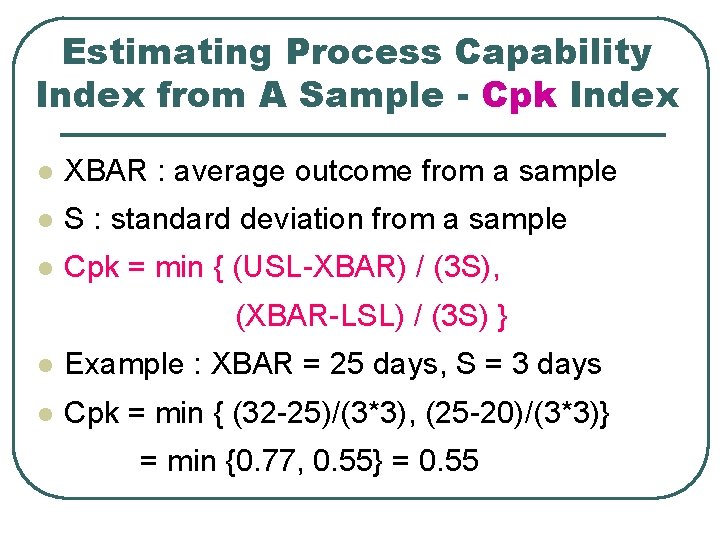
Estimating Process Capability Index from A Sample - Cpk Index l XBAR : average outcome from a sample l S : standard deviation from a sample l Cpk = min { (USL-XBAR) / (3 S), (XBAR-LSL) / (3 S) } l Example : XBAR = 25 days, S = 3 days l Cpk = min { (32 -25)/(3*3), (25 -20)/(3*3)} = min {0. 77, 0. 55} = 0. 55
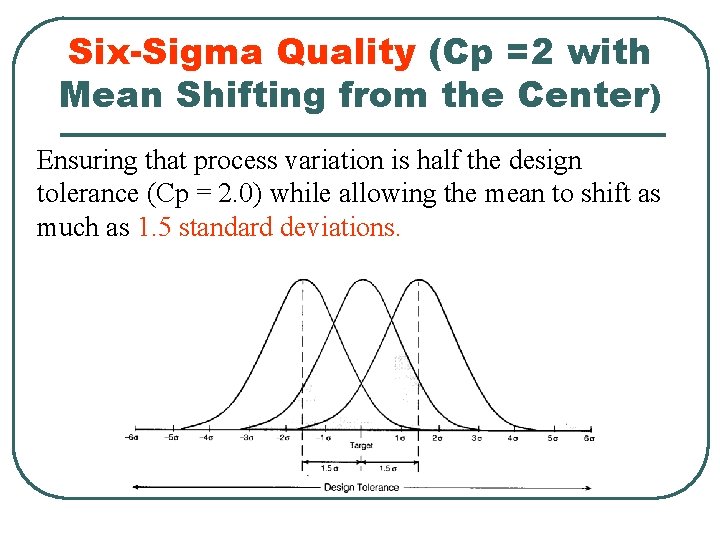
Six-Sigma Quality (Cp =2 with Mean Shifting from the Center) Ensuring that process variation is half the design tolerance (Cp = 2. 0) while allowing the mean to shift as much as 1. 5 standard deviations.
k-Sigma Quality Levels l Six sigma results in at most 3. 4 defects per million opportunities
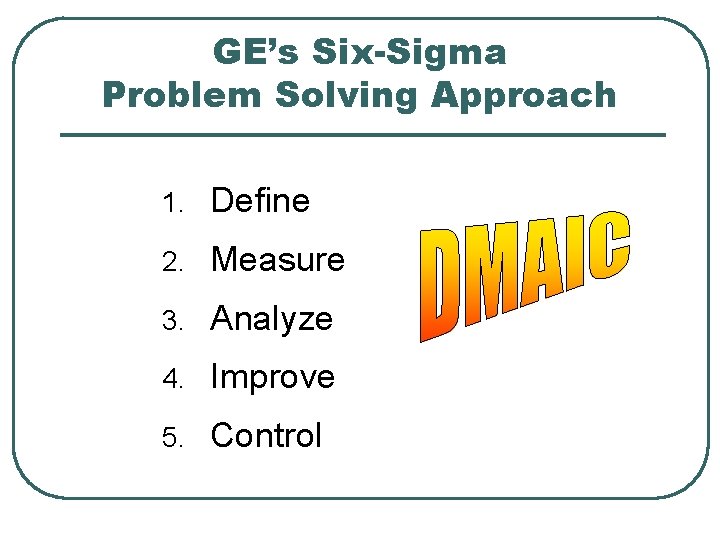
GE’s Six-Sigma Problem Solving Approach 1. Define 2. Measure 3. Analyze 4. Improve 5. Control
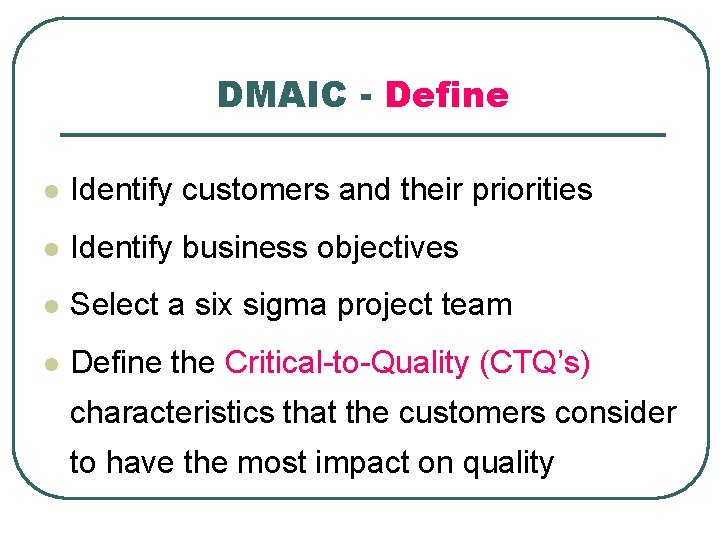
DMAIC - Define l Identify customers and their priorities l Identify business objectives l Select a six sigma project team l Define the Critical-to-Quality (CTQ’s) characteristics that the customers consider to have the most impact on quality
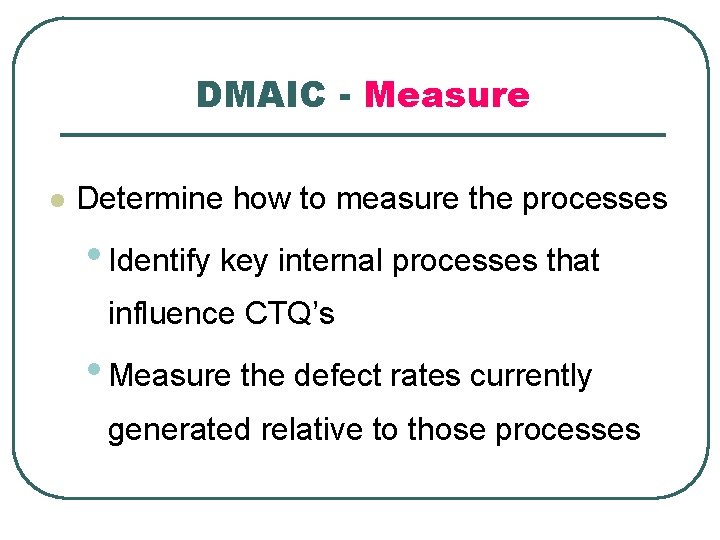
DMAIC - Measure l Determine how to measure the processes • Identify key internal processes that influence CTQ’s • Measure the defect rates currently generated relative to those processes
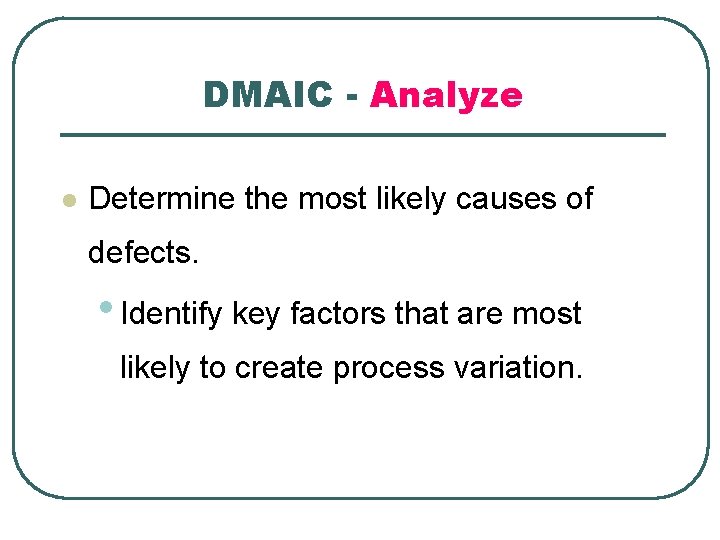
DMAIC - Analyze l Determine the most likely causes of defects. • Identify key factors that are most likely to create process variation.
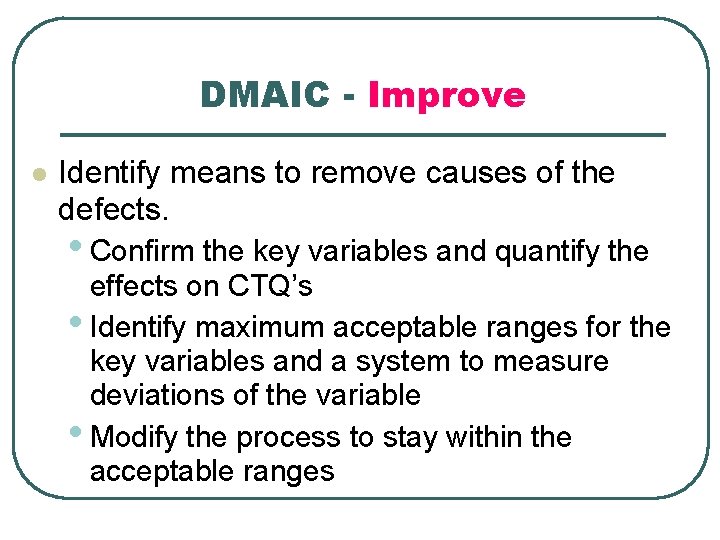
DMAIC - Improve l Identify means to remove causes of the defects. • Confirm the key variables and quantify the effects on CTQ’s • Identify maximum acceptable ranges for the key variables and a system to measure deviations of the variable • Modify the process to stay within the acceptable ranges
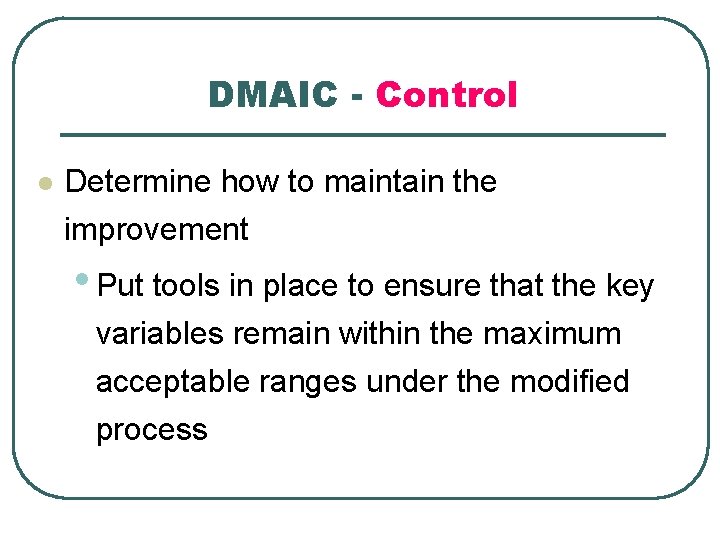
DMAIC - Control l Determine how to maintain the improvement • Put tools in place to ensure that the key variables remain within the maximum acceptable ranges under the modified process
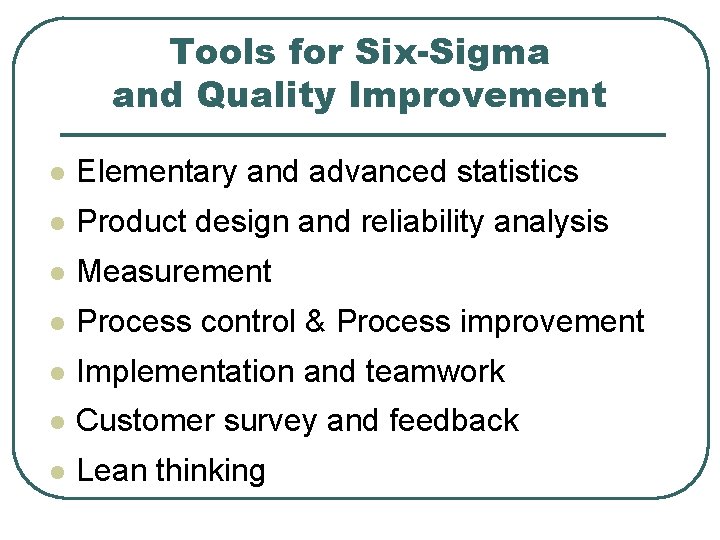
Tools for Six-Sigma and Quality Improvement l Elementary and advanced statistics l Product design and reliability analysis l Measurement l Process control & Process improvement l Implementation and teamwork l Customer survey and feedback l Lean thinking
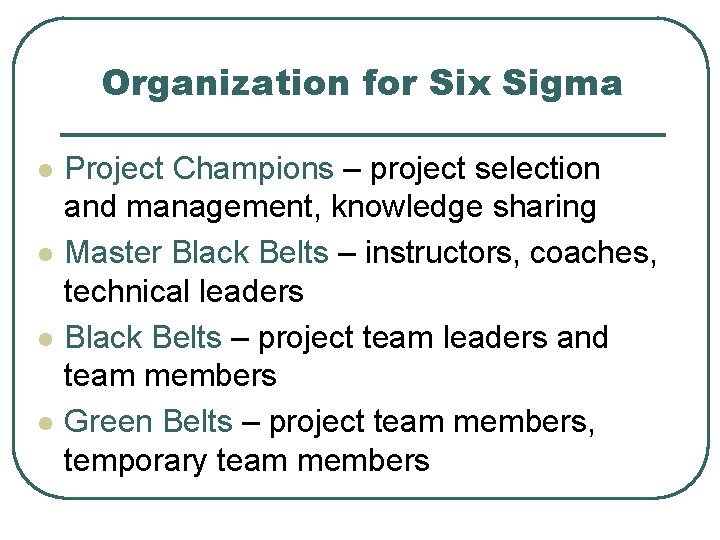
Organization for Six Sigma l l Project Champions – project selection and management, knowledge sharing Master Black Belts – instructors, coaches, technical leaders Black Belts – project team leaders and team members Green Belts – project team members, temporary team members