
Development of single photon counting pixel detectors for
- Slides: 30
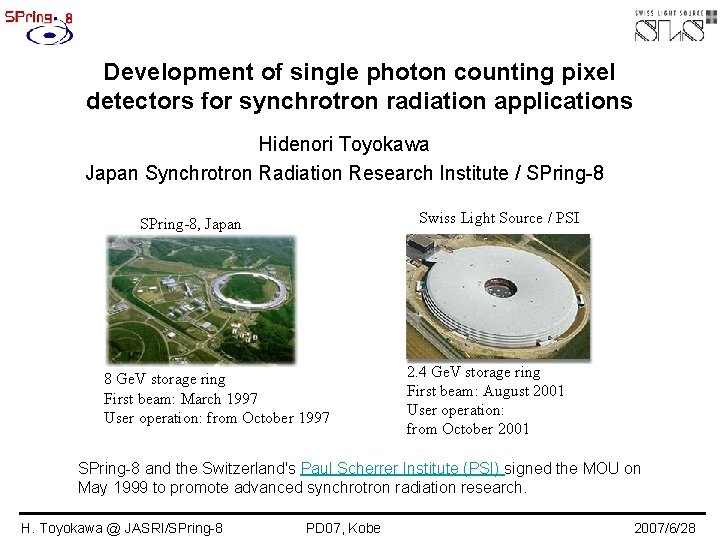
Development of single photon counting pixel detectors for synchrotron radiation applications Hidenori Toyokawa Japan Synchrotron Radiation Research Institute / SPring-8 Swiss Light Source / PSI SPring-8, Japan 8 Ge. V storage ring First beam: March 1997 User operation: from October 1997 2. 4 Ge. V storage ring First beam: August 2001 User operation: from October 2001 SPring-8 and the Switzerland's Paul Scherrer Institute (PSI) signed the MOU on May 1999 to promote advanced synchrotron radiation research. H. Toyokawa @ JASRI/SPring-8 PD 07, Kobe 2007/6/28
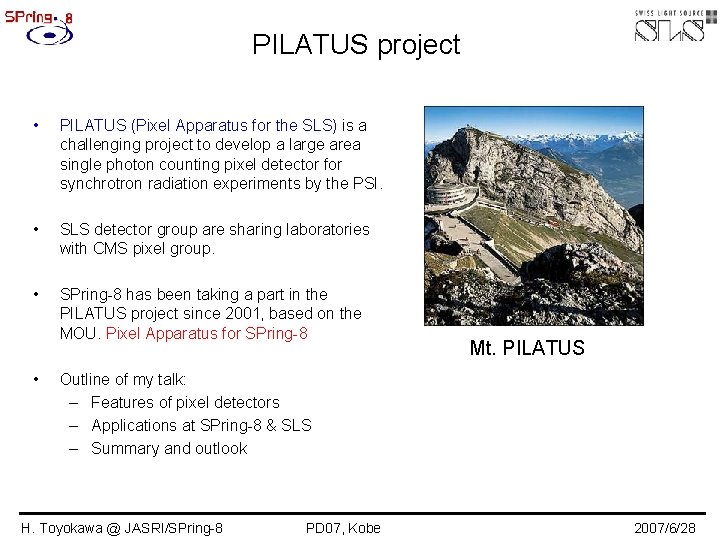
PILATUS project • PILATUS (Pixel Apparatus for the SLS) is a challenging project to develop a large area single photon counting pixel detector for synchrotron radiation experiments by the PSI. • SLS detector group are sharing laboratories with CMS pixel group. • SPring-8 has been taking a part in the PILATUS project since 2001, based on the MOU. Pixel Apparatus for SPring-8 • Mt. PILATUS Outline of my talk: – Features of pixel detectors – Applications at SPring-8 & SLS – Summary and outlook H. Toyokawa @ JASRI/SPring-8 PD 07, Kobe 2007/6/28
Existed 2 D detectors for Synchrotron Radiation Applications • Position sensitive 2 D detectors are powerful devices for use in synchrotron radiation experiments. Imaging plates are representative of them, and CCD-based detectors have become a major tool for protein crystallography recently. • These detectors, however, record X-ray intensity by integrating the energy deposited by X-ray photons. • Conventional Si, Ge, and Na. I detectors are still essential instruments, when fluorescence background has to be rejected by energy discrimination, for example. • The readout time of CCD is in the second range, and that for imaging plate is minutes. It is often so inefficient and so time consuming. H. Toyokawa @ JASRI/SPring-8 PD 07, Kobe 2007/6/28
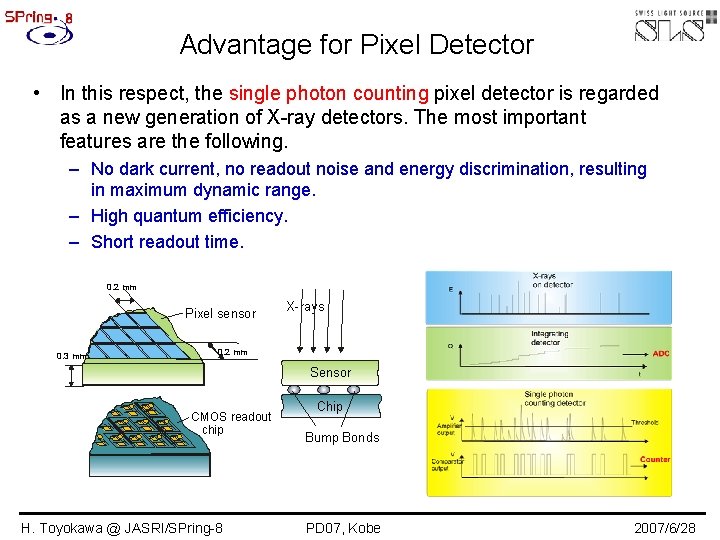
Advantage for Pixel Detector • In this respect, the single photon counting pixel detector is regarded as a new generation of X-ray detectors. The most important features are the following. – No dark current, no readout noise and energy discrimination, resulting in maximum dynamic range. – High quantum efficiency. – Short readout time. 0. 2 mm Pixel sensor 0. 3 mm X-rays 0. 2 mm Sensor CMOS readout chip H. Toyokawa @ JASRI/SPring-8 Chip Bump Bonds PD 07, Kobe 2007/6/28
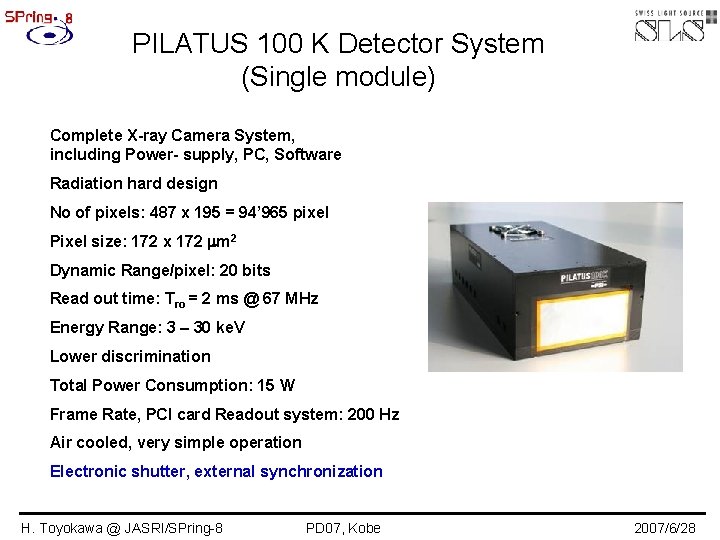
PILATUS 100 K Detector System (Single module) Complete X-ray Camera System, including Power- supply, PC, Software Radiation hard design No of pixels: 487 x 195 = 94’ 965 pixel Pixel size: 172 x 172 mm 2 Dynamic Range/pixel: 20 bits Read out time: Tro = 2 ms @ 67 MHz Energy Range: 3 – 30 ke. V Lower discrimination Total Power Consumption: 15 W Frame Rate, PCI card Readout system: 200 Hz Air cooled, very simple operation Electronic shutter, external synchronization H. Toyokawa @ JASRI/SPring-8 PD 07, Kobe 2007/6/28
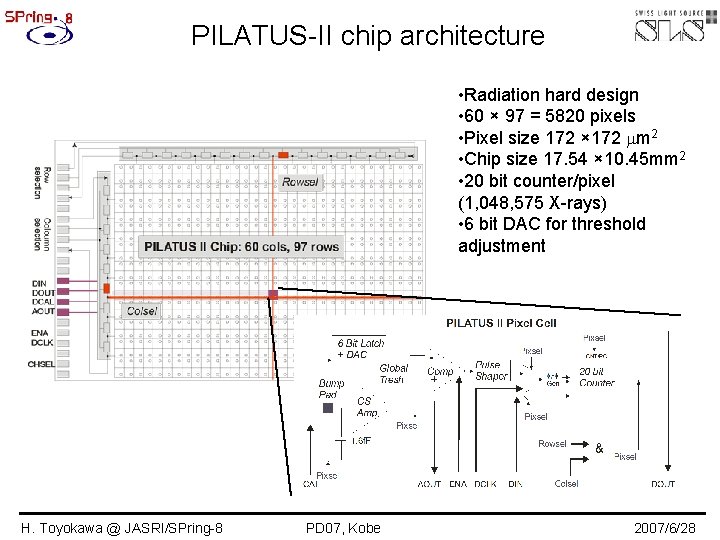
PILATUS-II chip architecture • Radiation hard design • 60 × 97 = 5820 pixels • Pixel size 172 × 172 mm 2 • Chip size 17. 54 × 10. 45 mm 2 • 20 bit counter/pixel (1, 048, 575 X-rays) • 6 bit DAC for threshold adjustment H. Toyokawa @ JASRI/SPring-8 PD 07, Kobe 2007/6/28
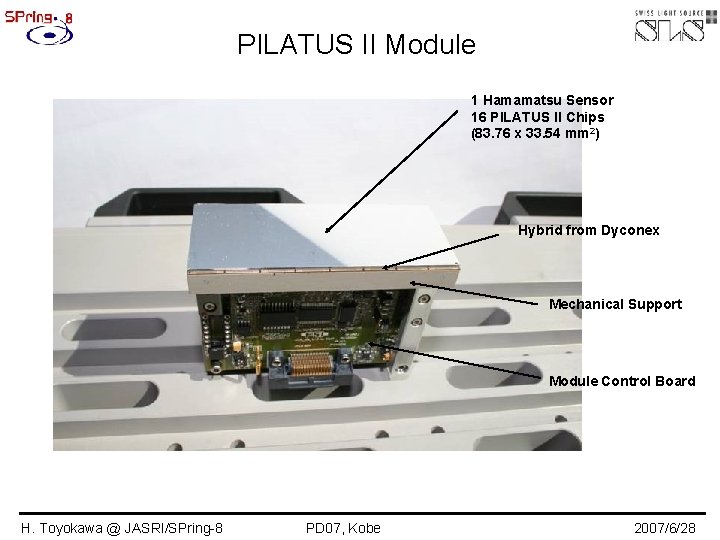
PILATUS II Module 1 Hamamatsu Sensor 16 PILATUS II Chips (83. 76 x 33. 54 mm 2) Hybrid from Dyconex Mechanical Support Module Control Board H. Toyokawa @ JASRI/SPring-8 PD 07, Kobe 2007/6/28
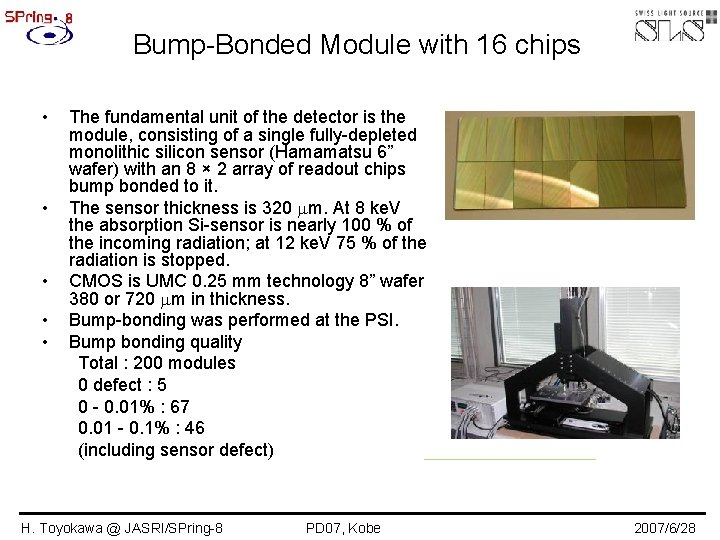
Bump-Bonded Module with 16 chips • • • The fundamental unit of the detector is the module, consisting of a single fully-depleted monolithic silicon sensor (Hamamatsu 6” wafer) with an 8 × 2 array of readout chips bump bonded to it. The sensor thickness is 320 mm. At 8 ke. V the absorption Si-sensor is nearly 100 % of the incoming radiation; at 12 ke. V 75 % of the radiation is stopped. CMOS is UMC 0. 25 mm technology 8” wafer 380 or 720 mm in thickness. Bump-bonding was performed at the PSI. Bump bonding quality Total : 200 modules 0 defect : 5 0 - 0. 01% : 67 0. 01 - 0. 1% : 46 (including sensor defect) H. Toyokawa @ JASRI/SPring-8 PD 07, Kobe 2007/6/28
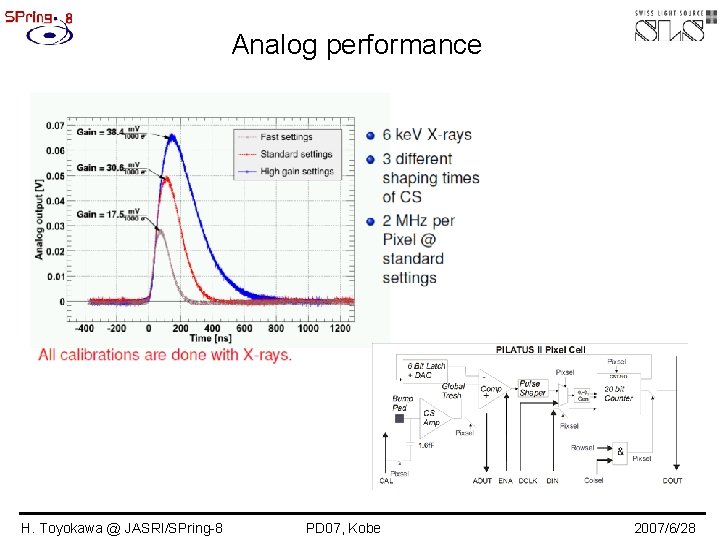
Analog performance H. Toyokawa @ JASRI/SPring-8 PD 07, Kobe 2007/6/28
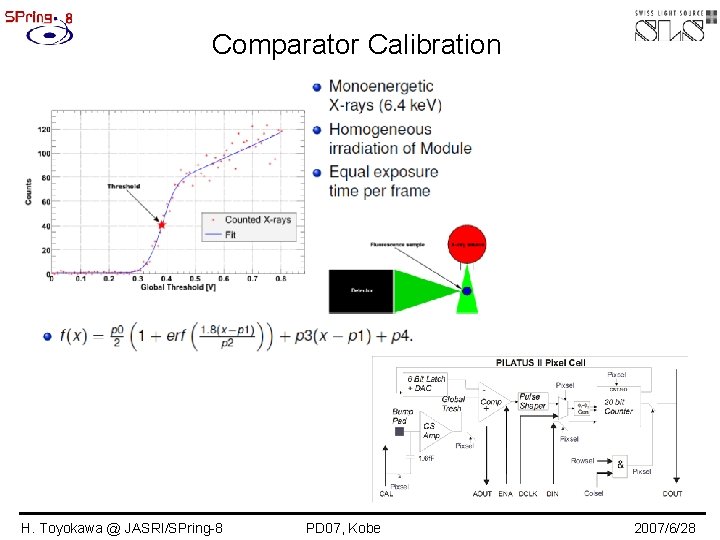
Comparator Calibration H. Toyokawa @ JASRI/SPring-8 PD 07, Kobe 2007/6/28
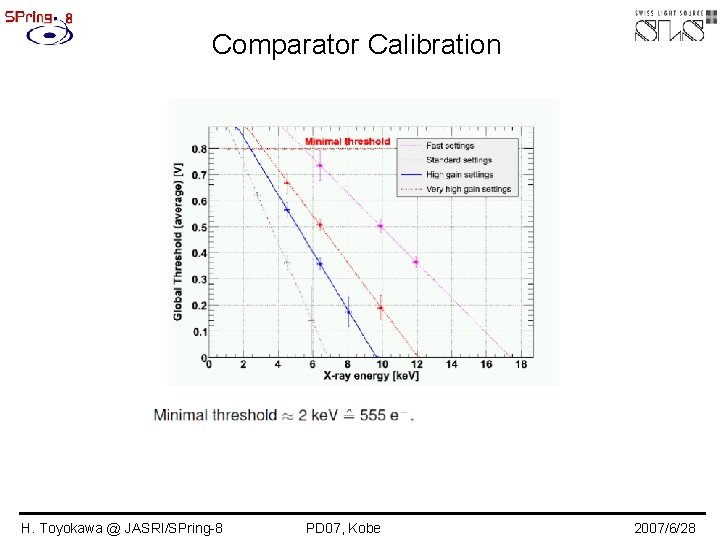
Comparator Calibration H. Toyokawa @ JASRI/SPring-8 PD 07, Kobe 2007/6/28
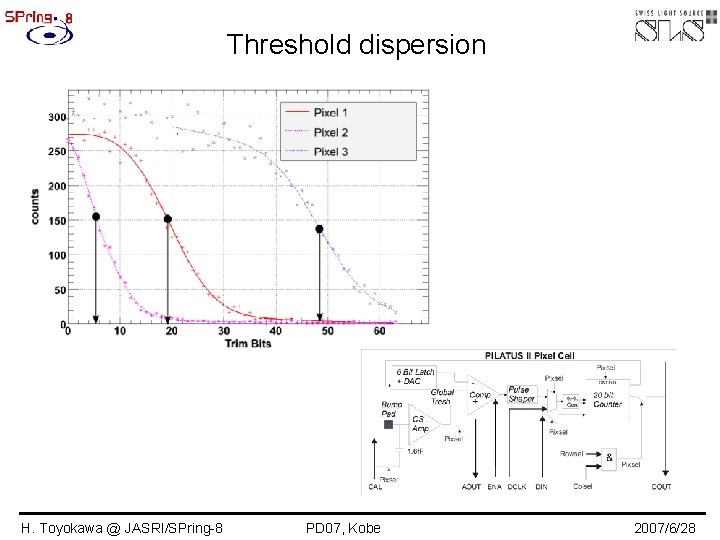
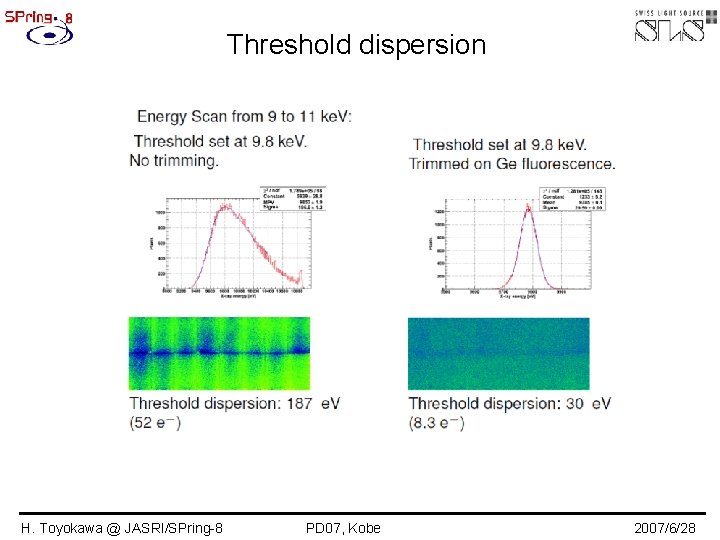
Threshold dispersion H. Toyokawa @ JASRI/SPring-8 PD 07, Kobe 2007/6/28
Threshold dispersion H. Toyokawa @ JASRI/SPring-8 PD 07, Kobe 2007/6/28
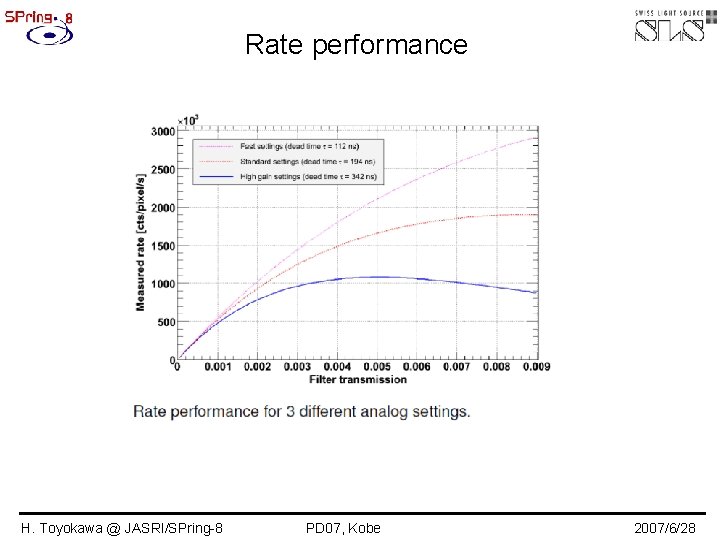
Rate performance H. Toyokawa @ JASRI/SPring-8 PD 07, Kobe 2007/6/28
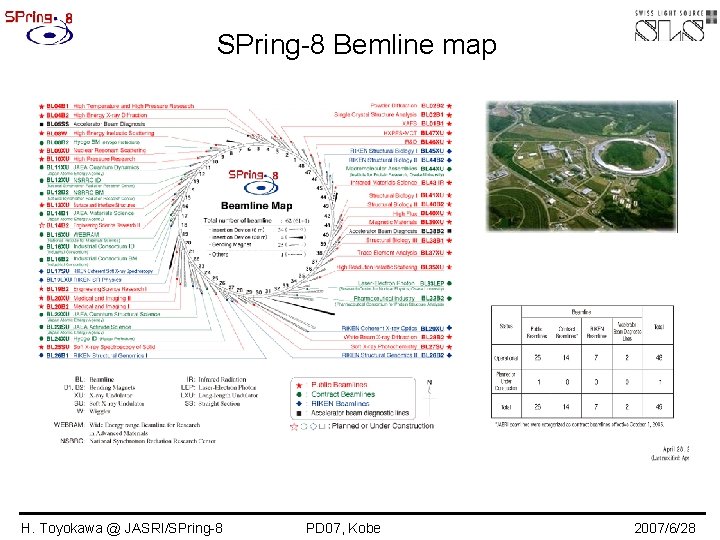
SPring-8 Bemline map H. Toyokawa @ JASRI/SPring-8 PD 07, Kobe 2007/6/28
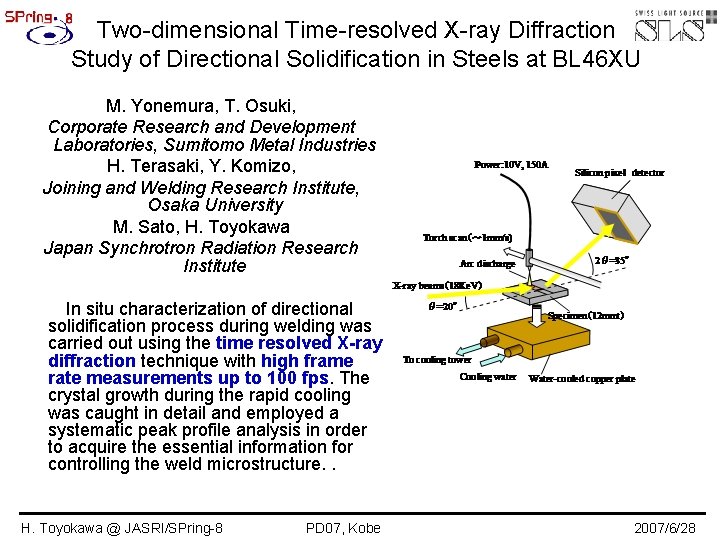
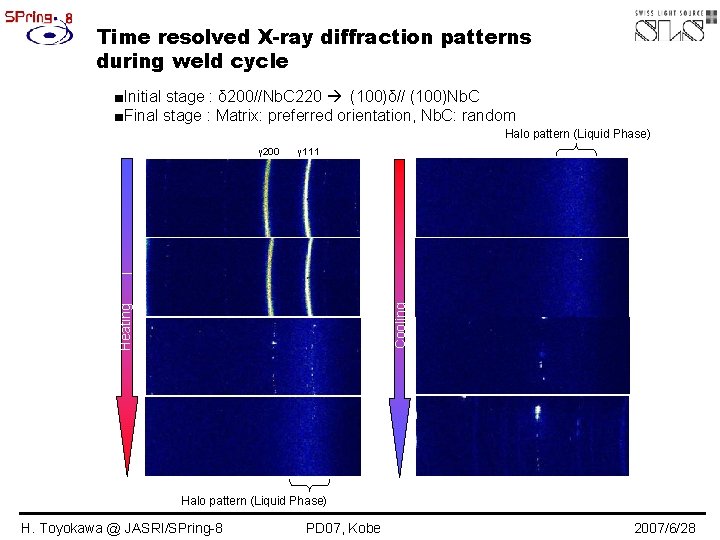
Two-dimensional Time-resolved X-ray Diffraction Study of Directional Solidification in Steels at BL 46 XU M. Yonemura, T. Osuki, Corporate Research and Development Laboratories, Sumitomo Metal Industries H. Terasaki, Y. Komizo, Joining and Welding Research Institute, Osaka University M. Sato, H. Toyokawa Japan Synchrotron Radiation Research Institute In situ characterization of directional solidification process during welding was carried out using the time resolved X-ray diffraction technique with high frame rate measurements up to 100 fps. The crystal growth during the rapid cooling was caught in detail and employed a systematic peak profile analysis in order to acquire the essential information for controlling the weld microstructure. . H. Toyokawa @ JASRI/SPring-8 PD 07, Kobe 2007/6/28
Time resolved X-ray diffraction patterns during weld cycle ■Initial stage : δ 200//Nb. C 220 (100)δ// (100)Nb. C ■Final stage : Matrix: preferred orientation, Nb. C: random Halo pattern (Liquid Phase) γ 200 γ 111 (e)1420℃ (a)200℃ Nb. C 311 δ 110 Nb. C 200 Nb. C 220 Nb. C 111 (b)500℃ (f)1370℃ Cooling Heating γ 111 γ 220 (c)1400℃ δ 110 γ 111 γ 200 δ 200 γ 111 Nb. C 220 (g)1150℃ (d)1660℃ Nb. C 200 δ 200 γ 200 (h)300℃ δ 110 Nb. C 111 Halo pattern (Liquid Phase) H. Toyokawa @ JASRI/SPring-8 PD 07, Kobe 2007/6/28
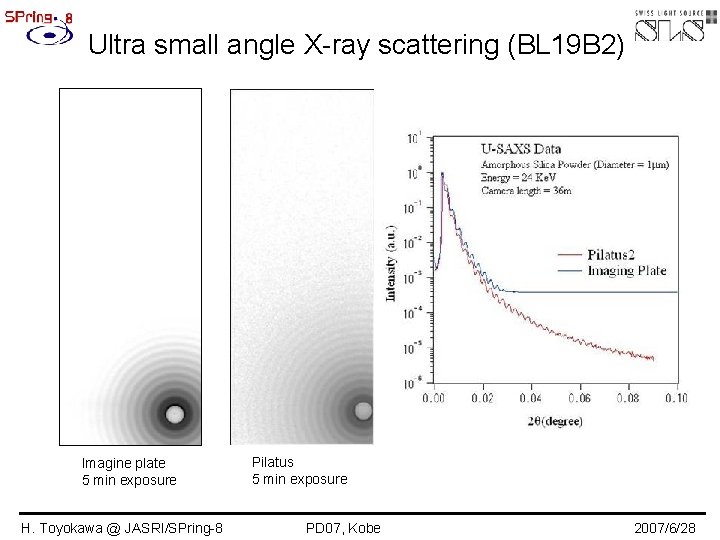
Ultra small angle X-ray scattering (BL 19 B 2) Imagine plate 5 min exposure H. Toyokawa @ JASRI/SPring-8 Pilatus 5 min exposure PD 07, Kobe 2007/6/28
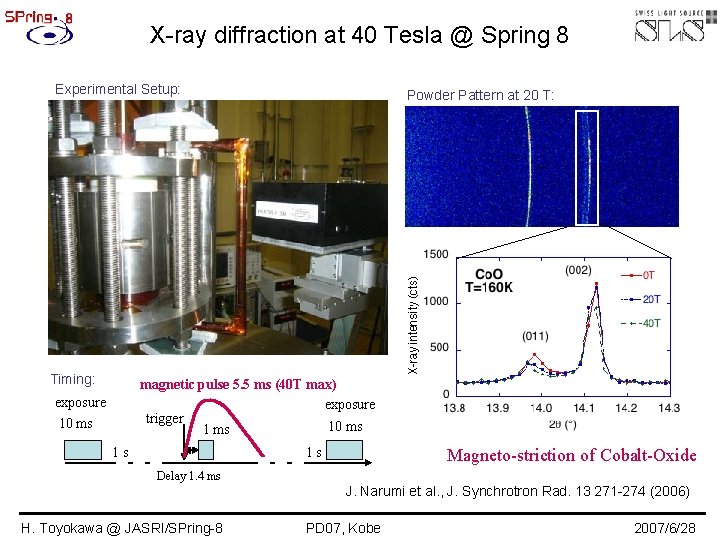
X-ray diffractometer combining synchrotron radiation and pulsed magnetic fields up to 40 T at BL 19 LXU Y. Narumi, a K. Kindo, a K. Katsumata, b M. Kawauchi, c Ch. Broennimann, d U. Staub, d H. Toyokawa, e Y. Tanaka, b A. Kikkawa, b T. Yamamoto, c M. Hagiwara, c T. Ishikawa, b and H. Kitamura, b a. ISSP, University of Tokyo b. RIKEN SPring-8 Center, Harima Institute c. KYOKUGEN, Osaka University d. Swiss Light Source, Paul Scherrer Institut e. Japan Synchrotron Radiation Research Institute A synchrotron X-ray diffractometer incorporating a pulsed field magnet for high fields up to 40 T has been developed. The PILATUS-II SMD was used to store the diffracted X-rays. As a test of this instrument, X-ray diffraction by a powder sample of the antiferromagnet Co. O is measured below the Neel temperature. A field-dependent lattice distortion of Co. O due to magnetostriction is observed up to 38 T. H. Toyokawa @ JASRI/SPring-8 PD 07, Kobe 2007/6/28
X-ray diffraction at 40 Tesla @ Spring 8 Experimental Setup: Timing: Powder Pattern at 20 T: magnetic pulse 5. 5 ms (40 T max) exposure trigger 10 ms 1 ms exposure 10 ms 1 s 1 s Magneto-striction of Cobalt-Oxide Delay 1. 4 ms J. Narumi et al. , J. Synchrotron Rad. 13 271 -274 (2006) H. Toyokawa @ JASRI/SPring-8 PD 07, Kobe 2007/6/28
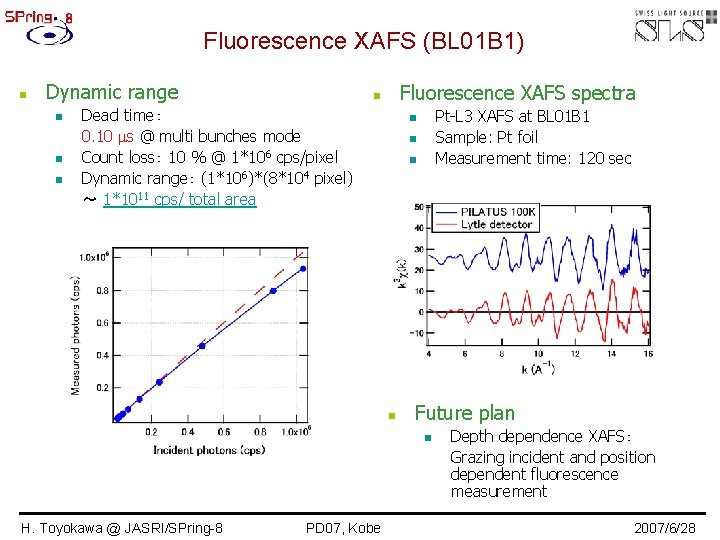
Fluorescence XAFS (BL 01 B 1) n Dynamic range n n n Fluorescence XAFS spectra n Dead time: 0. 10 ms @ multi bunches mode Count loss: 10 % @ 1*106 cps/pixel Dynamic range: (1*106)*(8*104 pixel) ~ 1*1011 cps/ total area Pt-L 3 XAFS at BL 01 B 1 Sample: Pt foil Measurement time: 120 sec n n Future plan n H. Toyokawa @ JASRI/SPring-8 PD 07, Kobe Depth dependence XAFS: Grazing incident and position dependent fluorescence measurement 2007/6/28
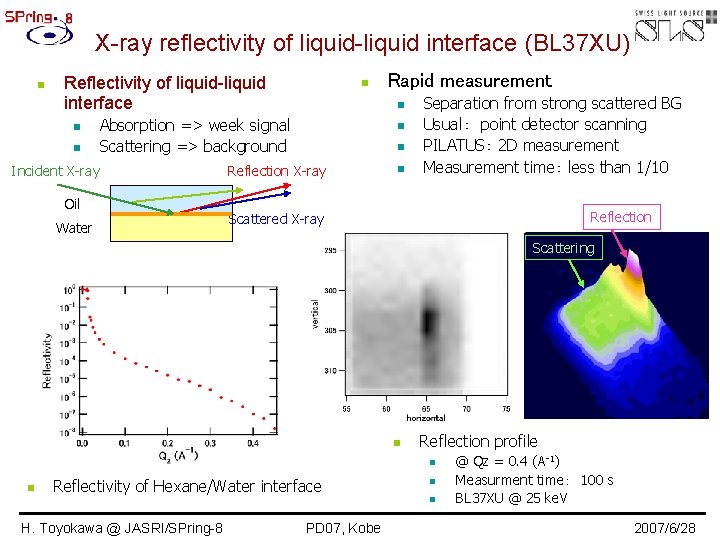
X-ray reflectivity of liquid-liquid interface (BL 37 XU) n Reflectivity of liquid-liquid interface n n Absorption => week signal Scattering => background Incident X-ray Oil Water Rapid measurement n n Reflection X-ray n Separation from strong scattered BG Usual: point detector scanning PILATUS: 2 D measurement Measurement time: less than 1/10 Reflection Scattered X-ray Scattering n Reflection profile n n Reflectivity of Hexane/Water interface n n H. Toyokawa @ JASRI/SPring-8 PD 07, Kobe @ Qz = 0. 4 (A-1) Measurment time: 100 s BL 37 XU @ 25 ke. V 2007/6/28
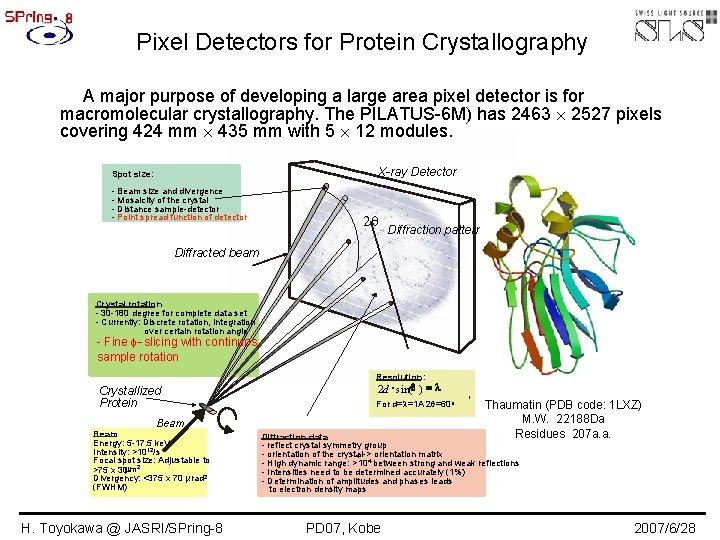
Pixel Detectors for Protein Crystallography A major purpose of developing a large area pixel detector is for macromolecular crystallography. The PILATUS-6 M) has 2463 2527 pixels covering 424 mm 435 mm with 5 12 modules. X-ray Detector Spot size: - Beam size and divergence - Mosaicity of the crystal - Distance sample-detector - Point spread function of detector 2 q Diffraction pattern Diffracted beam Crystal rotation - 30 -180 degree for complete data set - Currently: Discrete rotation, integration over certain rotation angle - Fine f-slicing with continuos sample rotation Resolution: Crystallized Protein 2 d × sin(q ) = l For d=l=1 A 2 q=60 o Beam Energy: 5 -17. 5 ke. V Intensity: >1012/s Focal spot size: Adjustable to >75 x 30 mm 2 Divergency: <375 x 70 µrad 2 (FWHM) H. Toyokawa @ JASRI/SPring-8 o Thaumatin (PDB code: 1 LXZ) M. W. 22188 Da Residues 207 a. a. Diffraction data - reflect crystal symmetry group - orientation of the crystal-> orientation matrix 4 - High dynamic range: >104 between strong and weak reflections - Intensities need to be determined accurately (1%) - Determination of amplitudes and phases leads to electron density maps PD 07, Kobe 2007/6/28
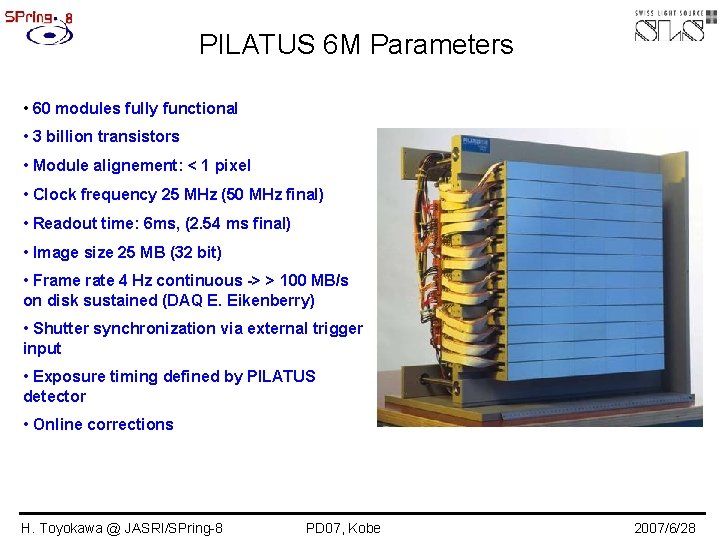
PILATUS 6 M Parameters • 60 modules fully functional • 3 billion transistors • Module alignement: < 1 pixel • Clock frequency 25 MHz (50 MHz final) • Readout time: 6 ms, (2. 54 ms final) • Image size 25 MB (32 bit) • Frame rate 4 Hz continuous -> > 100 MB/s on disk sustained (DAQ E. Eikenberry) • Shutter synchronization via external trigger input • Exposure timing defined by PILATUS detector • Online corrections H. Toyokawa @ JASRI/SPring-8 PD 07, Kobe 2007/6/28
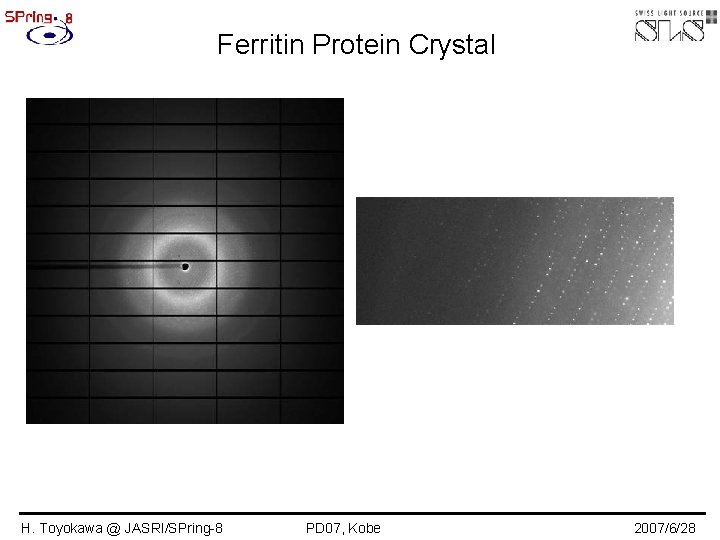
Ferritin Protein Crystal H. Toyokawa @ JASRI/SPring-8 PD 07, Kobe 2007/6/28
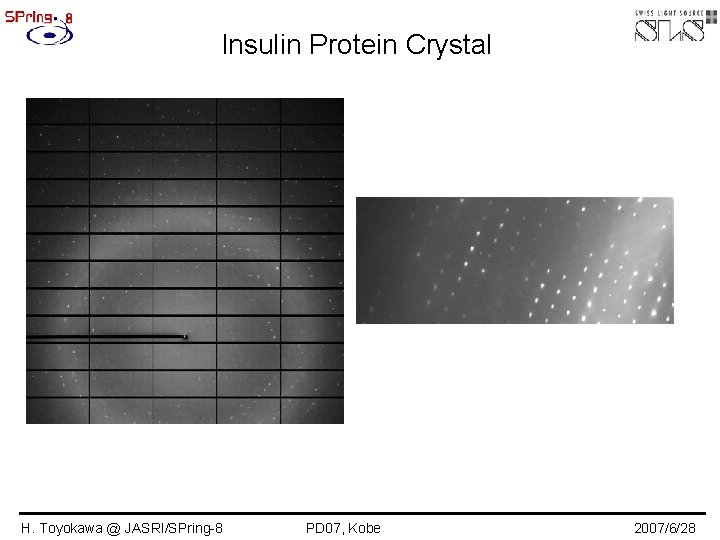
Insulin Protein Crystal H. Toyokawa @ JASRI/SPring-8 PD 07, Kobe 2007/6/28
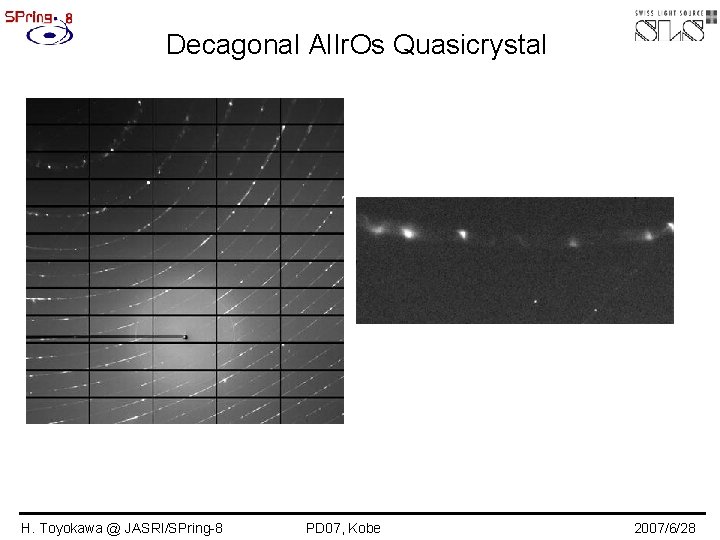
Decagonal Al. Ir. Os Quasicrystal H. Toyokawa @ JASRI/SPring-8 PD 07, Kobe 2007/6/28
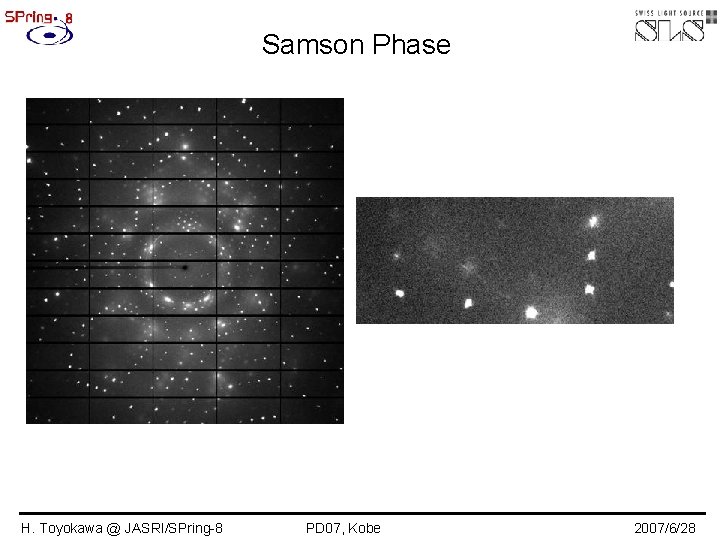
Samson Phase H. Toyokawa @ JASRI/SPring-8 PD 07, Kobe 2007/6/28
Summary and outlook • We have been developing the large area single photon counting pixel detectors. • PILATUS-II 100 K realizes a desired performance with a fast frame rate up to 200 Hz. It has wide application ranges, and several systems are already distributed to other synchrotron radiation facilities. • PILATUS-6 M detector with the 5 12 modules for protein crystallography has been completed at SLS. • PILATUS-2 M detector with the 3 8 modules for small angle scattering and other applications is under development. • PILATUS-XFS project starts this yser. Ø 75 mm × 75 mm pixel, > 10, 000 fps H. Toyokawa @ JASRI/SPring-8 PD 07, Kobe 2007/6/28
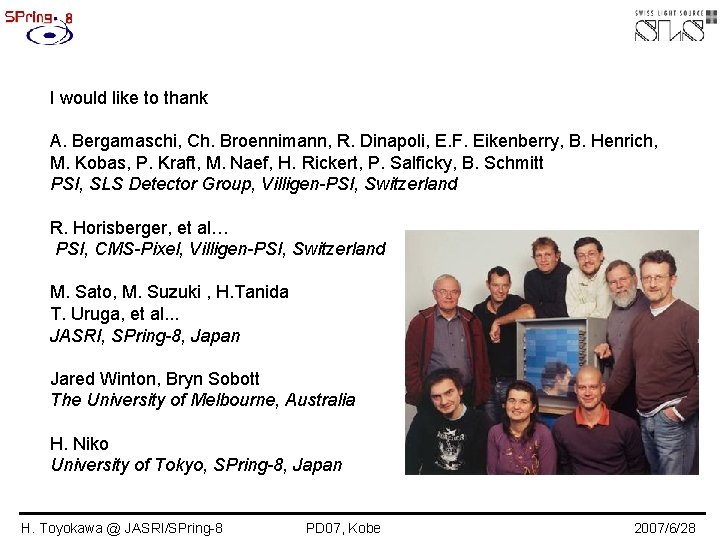
I would like to thank A. Bergamaschi, Ch. Broennimann, R. Dinapoli, E. F. Eikenberry, B. Henrich, M. Kobas, P. Kraft, M. Naef, H. Rickert, P. Salficky, B. Schmitt PSI, SLS Detector Group, Villigen-PSI, Switzerland R. Horisberger, et al… PSI, CMS-Pixel, Villigen-PSI, Switzerland M. Sato, M. Suzuki , H. Tanida T. Uruga, et al. . . JASRI, SPring-8, Japan Jared Winton, Bryn Sobott The University of Melbourne, Australia H. Niko University of Tokyo, SPring-8, Japan H. Toyokawa @ JASRI/SPring-8 PD 07, Kobe 2007/6/28