
Development of Science and Technology for Prosperity HUMAN
- Slides: 23
Development of Science and Technology for Prosperity HUMAN RESOURCES TRAINING AND EDUCATION The Trinidad & Tobago Experience… 17 th November 2011 Presenter: Mr. Chandar Gupta Supersad, Chairman of Youth Training and Employment Partnership Programme
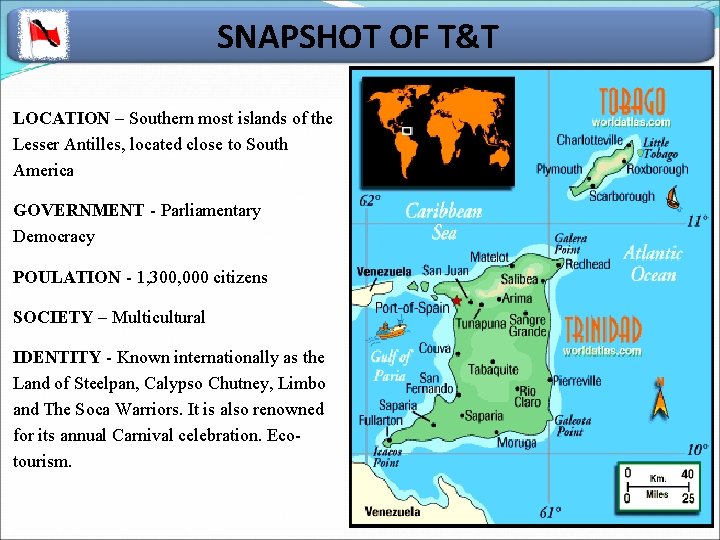
SNAPSHOT OF T&T LOCATION – Southern most islands of the Lesser Antilles, located close to South America GOVERNMENT - Parliamentary Democracy POULATION - 1, 300, 000 citizens SOCIETY – Multicultural IDENTITY - Known internationally as the Land of Steelpan, Calypso Chutney, Limbo and The Soca Warriors. It is also renowned for its annual Carnival celebration. Ecotourism.
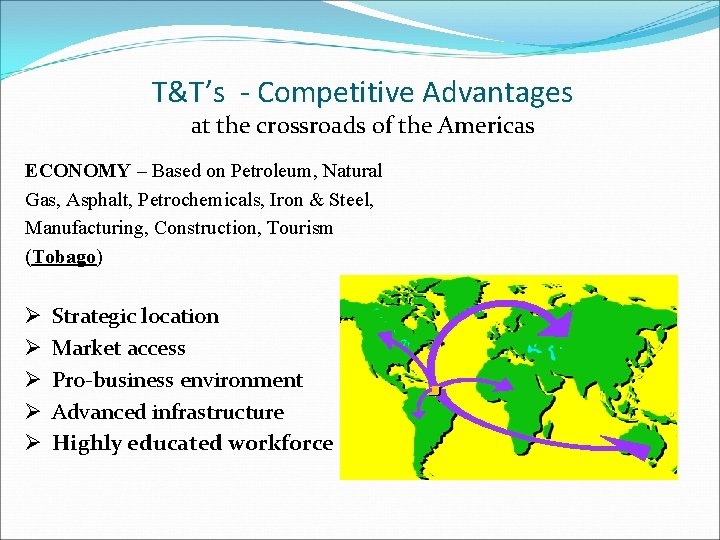
T&T’s - Competitive Advantages at the crossroads of the Americas ECONOMY – Based on Petroleum, Natural Gas, Asphalt, Petrochemicals, Iron & Steel, Manufacturing, Construction, Tourism (Tobago) Ø Ø Ø Strategic location Market access Pro-business environment Advanced infrastructure Highly educated workforce
Trinidad & Tobago Govt’s 7 Pillars for Sustainable Development 1. 2. 3. 4. 5. 6. 7. People-Centred Development Poverty Eradication and Social Justice National and Personal Security Information and Communication Technologies A more Diversified, Knowledge Intensive Economy Good Governance Foreign Policy
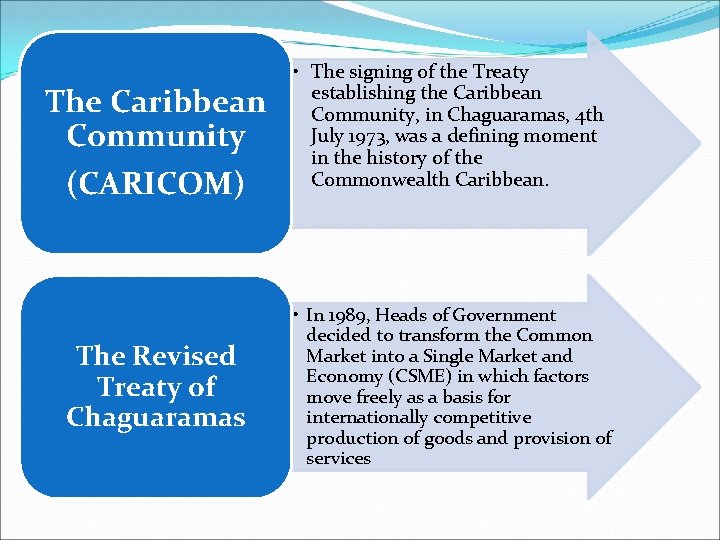
The Caribbean Community (CARICOM) The Revised Treaty of Chaguaramas • The signing of the Treaty establishing the Caribbean Community, in Chaguaramas, 4 th July 1973, was a defining moment in the history of the Commonwealth Caribbean. • In 1989, Heads of Government decided to transform the Common Market into a Single Market and Economy (CSME) in which factors move freely as a basis for internationally competitive production of goods and provision of services
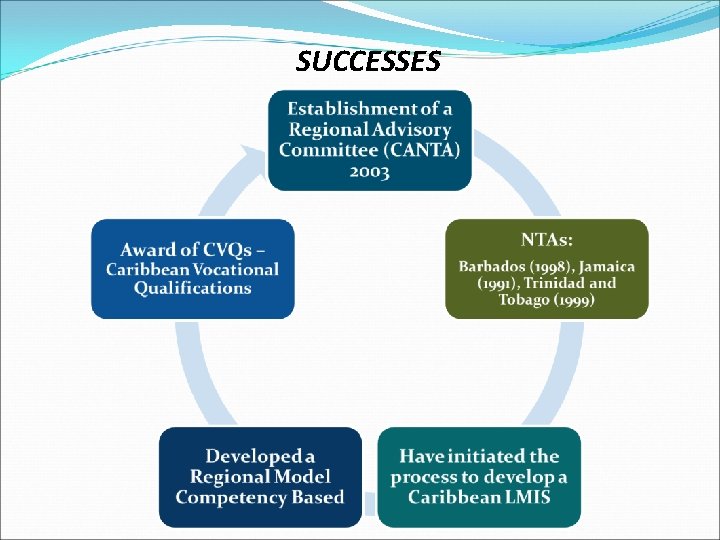
SUCCESSES
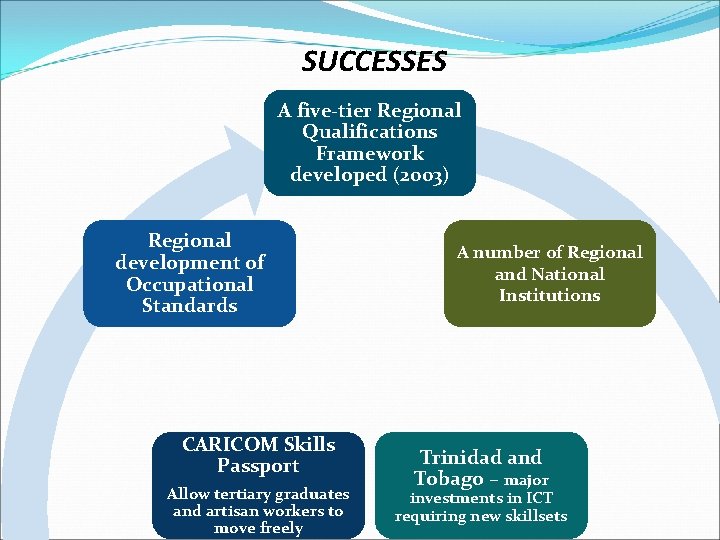
SUCCESSES A five-tier Regional Qualifications Framework developed (2003) Regional development of Occupational Standards CARICOM Skills Passport Allow tertiary graduates and artisan workers to move freely A number of Regional and National Institutions Trinidad and Tobago – major investments in ICT requiring new skillsets
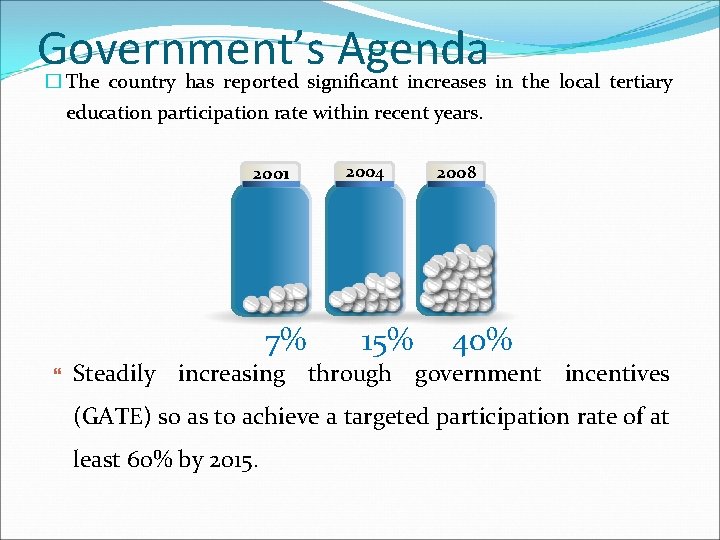
Government’s Agenda � The country has reported significant increases in the local tertiary education participation rate within recent years. 2001 7% 2004 15% 2008 40% Steadily increasing through government incentives (GATE) so as to achieve a targeted participation rate of at least 60% by 2015.
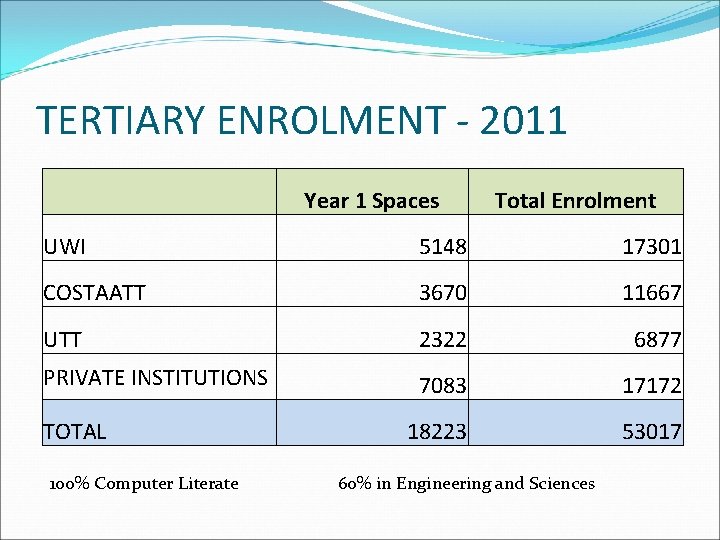
TERTIARY ENROLMENT - 2011 Year 1 Spaces Total Enrolment UWI 5148 17301 COSTAATT 3670 11667 UTT 2322 6877 PRIVATE INSTITUTIONS 7083 17172 18223 53017 TOTAL 100% Computer Literate 60% in Engineering and Sciences
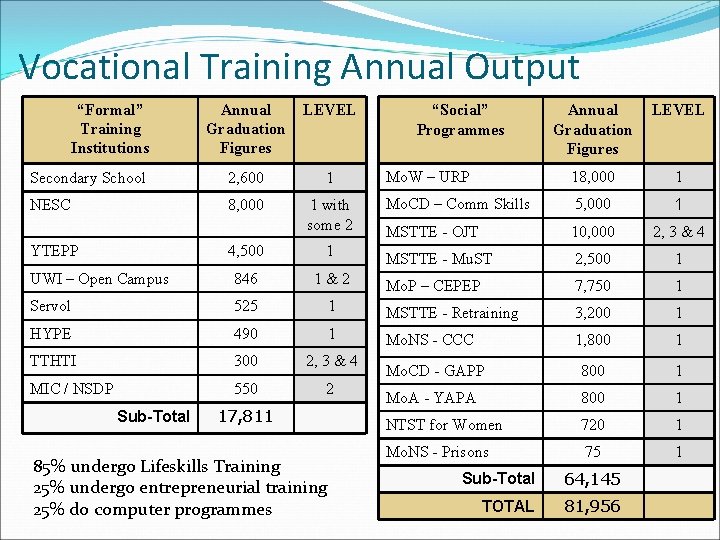
Vocational Training Annual Output “Formal” Training Institutions Annual Graduation Figures LEVEL Secondary School 2, 600 1 NESC 8, 000 1 with some 2 YTEPP “Social” Programmes Annual Graduation Figures LEVEL Mo. W – URP 18, 000 1 Mo. CD – Comm Skills 5, 000 1 MSTTE - OJT 10, 000 2, 3 & 4 MSTTE - Mu. ST 2, 500 1 Mo. P – CEPEP 7, 750 1 4, 500 1 UWI – Open Campus 846 1&2 Servol 525 1 MSTTE - Retraining 3, 200 1 HYPE 490 1 Mo. NS - CCC 1, 800 1 TTHTI 300 2, 3 & 4 Mo. CD - GAPP 800 1 MIC / NSDP 550 2 Mo. A - YAPA 800 1 NTST for Women 720 1 Mo. NS - Prisons 75 1 Sub-Total 17, 811 85% undergo Lifeskills Training 25% undergo entrepreneurial training 25% do computer programmes Sub-Total 64, 145 TOTAL 81, 956
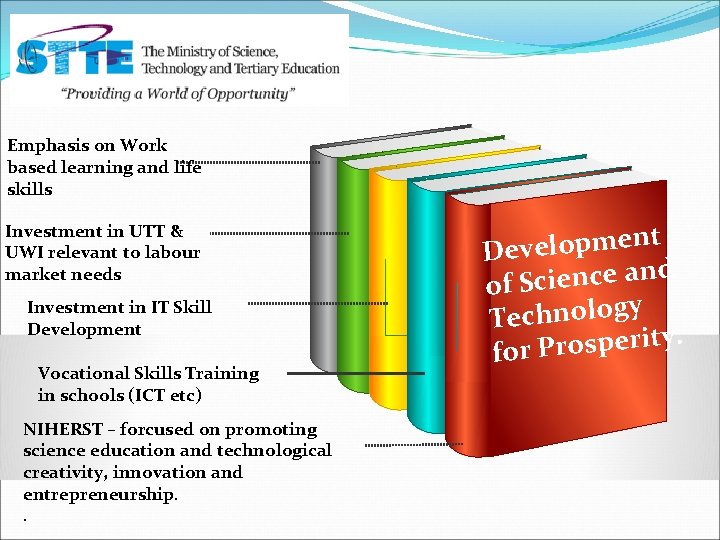
Emphasis on Work based learning and life skills Investment in UTT & UWI relevant to labour market needs Investment in IT Skill Development Vocational Skills Training in schools (ICT etc) NIHERST – forcused on promoting science education and technological creativity, innovation and entrepreneurship. . nt e m p o l e v e D d n a e c n e i c S of y g o l o n h c e T. y t i r e p s o r for P
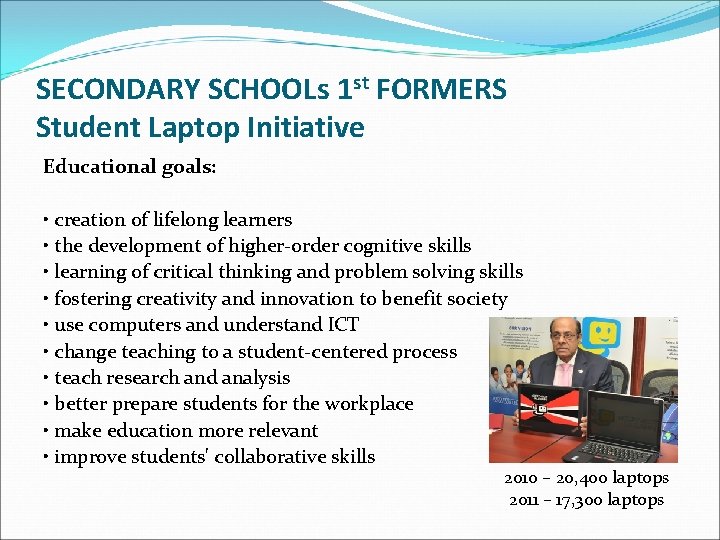
SECONDARY SCHOOLs 1 st FORMERS Student Laptop Initiative Educational goals: • creation of lifelong learners • the development of higher-order cognitive skills • learning of critical thinking and problem solving skills • fostering creativity and innovation to benefit society • use computers and understand ICT • change teaching to a student-centered process • teach research and analysis • better prepare students for the workplace • make education more relevant • improve students' collaborative skills 2010 – 20, 400 laptops 2011 – 17, 300 laptops
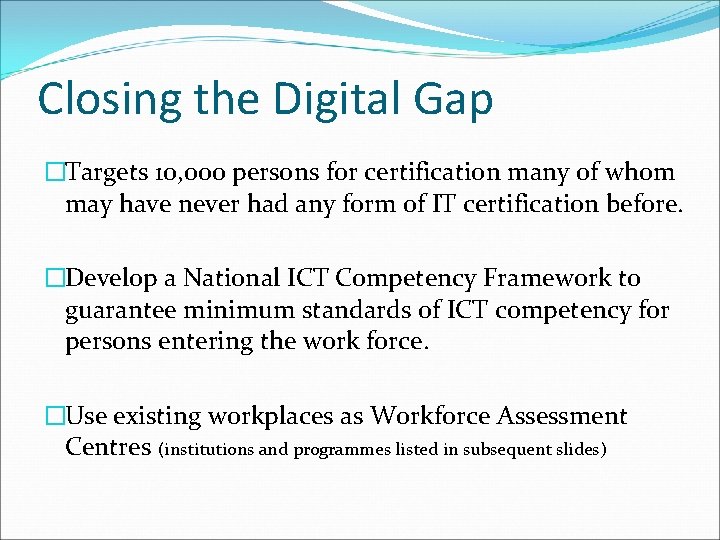
Closing the Digital Gap �Targets 10, 000 persons for certification many of whom may have never had any form of IT certification before. �Develop a National ICT Competency Framework to guarantee minimum standards of ICT competency for persons entering the work force. �Use existing workplaces as Workforce Assessment Centres (institutions and programmes listed in subsequent slides)
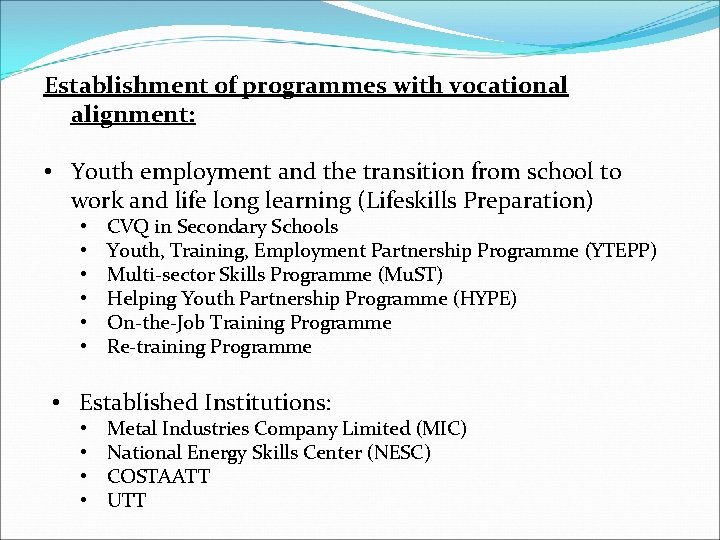
Establishment of programmes with vocational alignment: • Youth employment and the transition from school to work and life long learning (Lifeskills Preparation) • • • CVQ in Secondary Schools Youth, Training, Employment Partnership Programme (YTEPP) Multi-sector Skills Programme (Mu. ST) Helping Youth Partnership Programme (HYPE) On-the-Job Training Programme Re-training Programme • Established Institutions: • • Metal Industries Company Limited (MIC) National Energy Skills Center (NESC) COSTAATT UTT
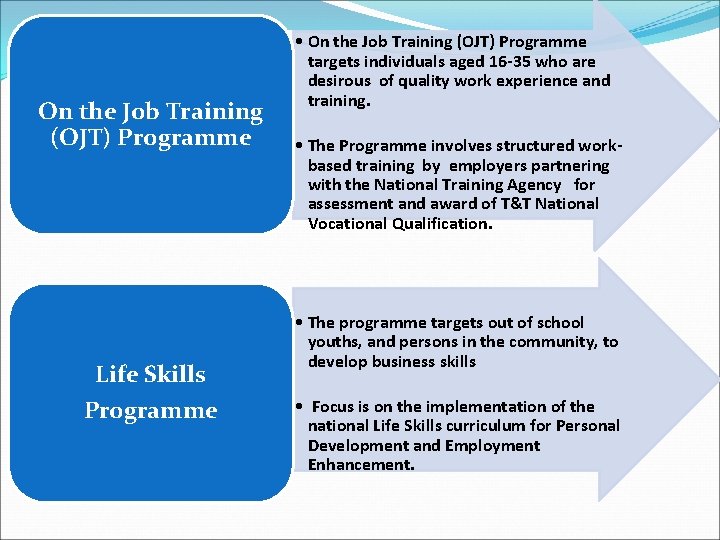
On the Job Training (OJT) Programme Life Skills Programme • On the Job Training (OJT) Programme targets individuals aged 16 -35 who are desirous of quality work experience and training. • The Programme involves structured workbased training by employers partnering with the National Training Agency for assessment and award of T&T National Vocational Qualification. • The programme targets out of school youths, and persons in the community, to develop business skills • Focus is on the implementation of the national Life Skills curriculum for Personal Development and Employment Enhancement.
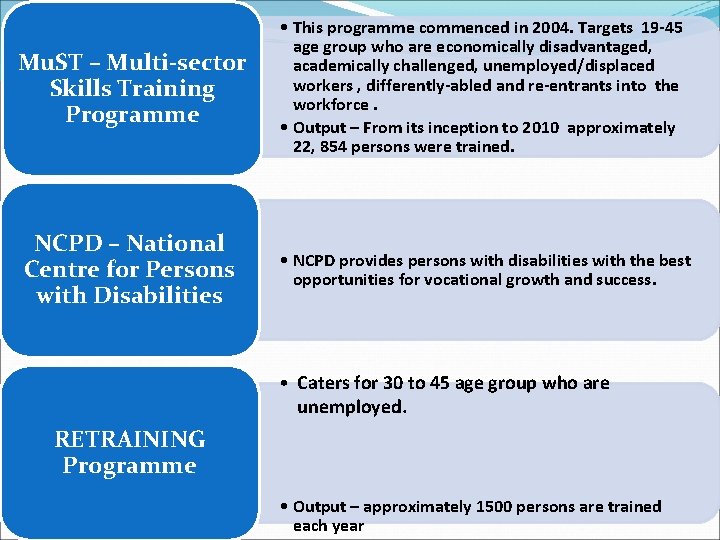
Mu. ST – Multi-sector Skills Training Programme • This programme commenced in 2004. Targets 19 -45 age group who are economically disadvantaged, academically challenged, unemployed/displaced workers , differently-abled and re-entrants into the workforce. • Output – From its inception to 2010 approximately 22, 854 persons were trained. NCPD – National Centre for Persons with Disabilities • NCPD provides persons with disabilities with the best opportunities for vocational growth and success. • Caters for 30 to 45 age group who are unemployed. RETRAINING Programme • Output – approximately 1500 persons are trained each year
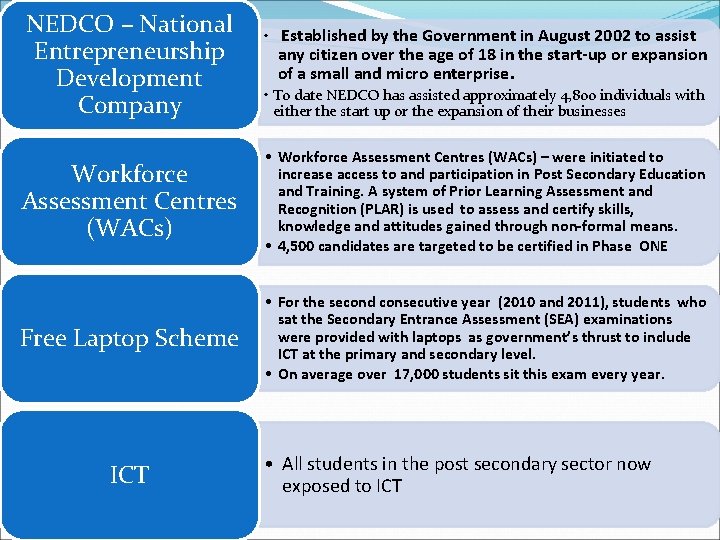
NEDCO – National Entrepreneurship Development Company • Established by the Government in August 2002 to assist any citizen over the age of 18 in the start-up or expansion of a small and micro enterprise. • To date NEDCO has assisted approximately 4, 800 individuals with either the start up or the expansion of their businesses Workforce Assessment Centres (WACs) • Workforce Assessment Centres (WACs) – were initiated to increase access to and participation in Post Secondary Education and Training. A system of Prior Learning Assessment and Recognition (PLAR) is used to assess and certify skills, knowledge and attitudes gained through non-formal means. • 4, 500 candidates are targeted to be certified in Phase ONE Free Laptop Scheme • For the second consecutive year (2010 and 2011), students who sat the Secondary Entrance Assessment (SEA) examinations were provided with laptops as government’s thrust to include ICT at the primary and secondary level. • On average over 17, 000 students sit this exam every year. ICT • All students in the post secondary sector now exposed to ICT
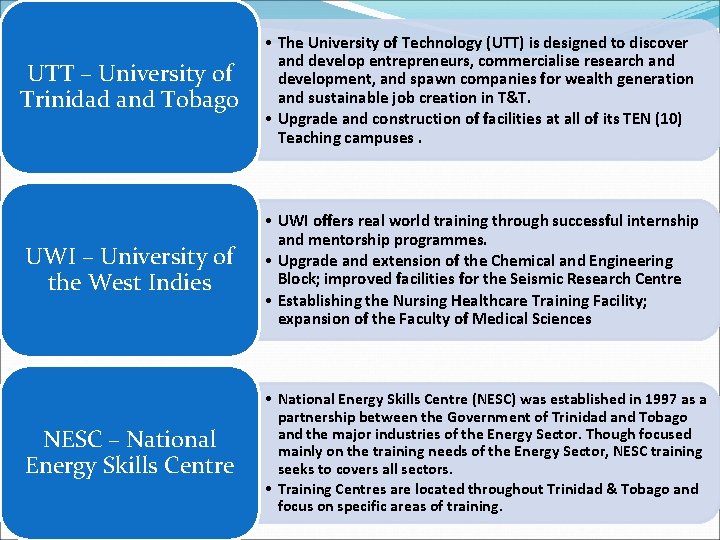
UTT – University of Trinidad and Tobago • The University of Technology (UTT) is designed to discover and develop entrepreneurs, commercialise research and development, and spawn companies for wealth generation and sustainable job creation in T&T. • Upgrade and construction of facilities at all of its TEN (10) Teaching campuses. UWI – University of the West Indies • UWI offers real world training through successful internship and mentorship programmes. • Upgrade and extension of the Chemical and Engineering Block; improved facilities for the Seismic Research Centre • Establishing the Nursing Healthcare Training Facility; expansion of the Faculty of Medical Sciences NESC – National Energy Skills Centre • National Energy Skills Centre (NESC) was established in 1997 as a partnership between the Government of Trinidad and Tobago and the major industries of the Energy Sector. Though focused mainly on the training needs of the Energy Sector, NESC training seeks to covers all sectors. • Training Centres are located throughout Trinidad & Tobago and focus on specific areas of training.
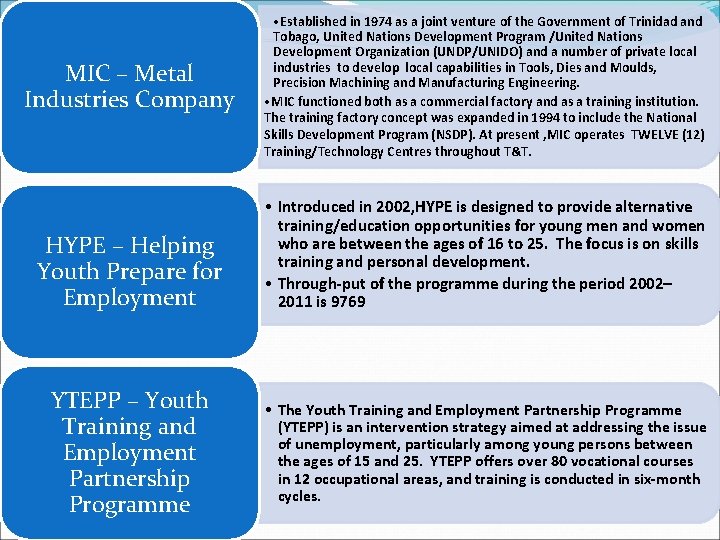
MIC – Metal Industries Company HYPE – Helping Youth Prepare for Employment YTEPP – Youth Training and Employment Partnership Programme • Established in 1974 as a joint venture of the Government of Trinidad and Tobago, United Nations Development Program /United Nations Development Organization (UNDP/UNIDO) and a number of private local industries to develop local capabilities in Tools, Dies and Moulds, Precision Machining and Manufacturing Engineering. • MIC functioned both as a commercial factory and as a training institution. The training factory concept was expanded in 1994 to include the National Skills Development Program (NSDP). At present , MIC operates TWELVE (12) Training/Technology Centres throughout T&T. • Introduced in 2002, HYPE is designed to provide alternative training/education opportunities for young men and women who are between the ages of 16 to 25. The focus is on skills training and personal development. • Through-put of the programme during the period 2002– 2011 is 9769 • The Youth Training and Employment Partnership Programme (YTEPP) is an intervention strategy aimed at addressing the issue of unemployment, particularly among young persons between the ages of 15 and 25. YTEPP offers over 80 vocational courses in 12 occupational areas, and training is conducted in six-month cycles.
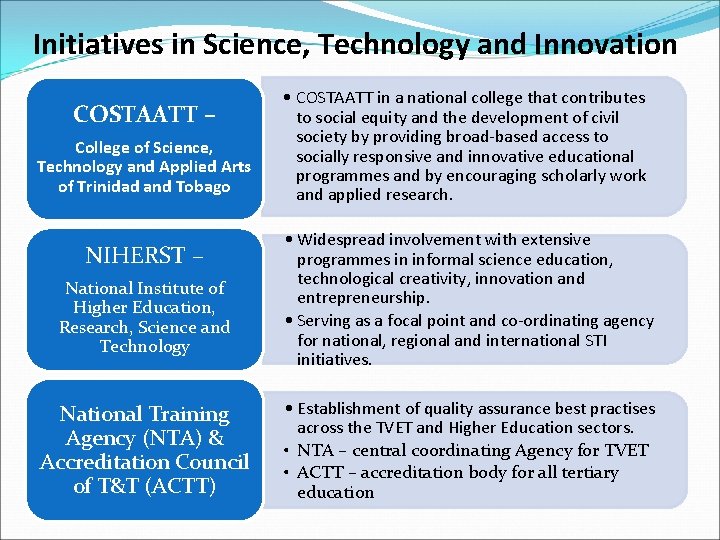
Initiatives in Science, Technology and Innovation COSTAATT – College of Science, Technology and Applied Arts of Trinidad and Tobago NIHERST – National Institute of Higher Education, Research, Science and Technology National Training Agency (NTA) & Accreditation Council of T&T (ACTT) • COSTAATT in a national college that contributes to social equity and the development of civil society by providing broad-based access to socially responsive and innovative educational programmes and by encouraging scholarly work and applied research. • Widespread involvement with extensive programmes in informal science education, technological creativity, innovation and entrepreneurship. • Serving as a focal point and co-ordinating agency for national, regional and international STI initiatives. • Establishment of quality assurance best practises across the TVET and Higher Education sectors. • NTA – central coordinating Agency for TVET • ACTT – accreditation body for all tertiary education
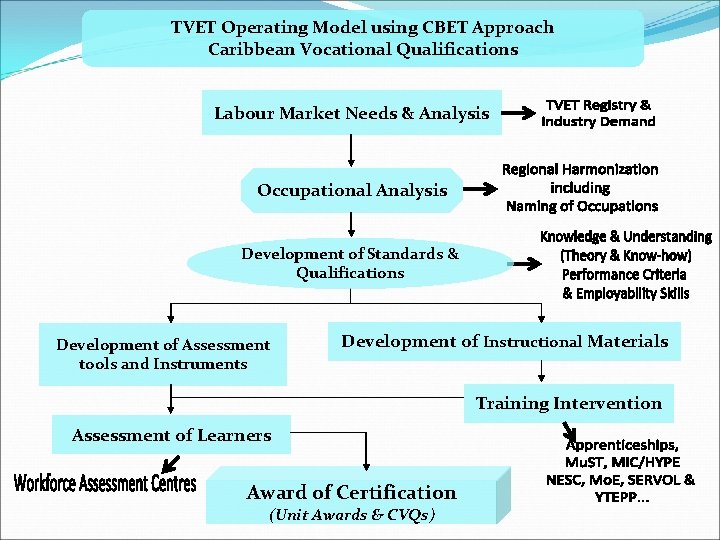
TVET Operating Model using CBET Approach Caribbean Vocational Qualifications Labour Market Needs & Analysis Occupational Analysis Development of Standards & Qualifications Development of Assessment tools and Instruments Development of Instructional Materials Training Intervention Assessment of Learners Award of Certification (Unit Awards & CVQs)
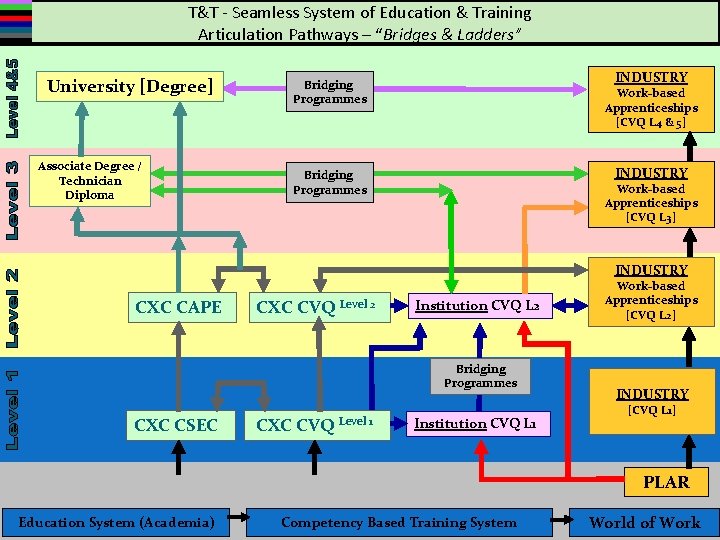
T&T - Seamless System of Education & Training Articulation Pathways – “Bridges & Ladders” University [Degree] Associate Degree / Technician Diploma INDUSTRY Bridging Programmes Work-based Apprenticeships [CVQ L 4 & 5] INDUSTRY Bridging Programmes Work-based Apprenticeships [CVQ L 3] INDUSTRY CXC CAPE CXC CVQ Level 2 Institution CVQ L 2 Bridging Programmes CXC CSEC CXC CVQ Level 1 Institution CVQ L 1 Work-based Apprenticeships [CVQ L 2] INDUSTRY [CVQ L 1] PLAR Education System (Academia) Competency Based Training System 22 World of Work
Thank you… Contact us: Level 16 -18, Tower C, International Waterfront Complex 1 a Wrightson Road Port-of-Spain Republic of Trinidad and Tobago Telephone: (868)627 -9508 Fax: (868)627 -5437 Email: Chandar. Supersad@sta. uwi. edu