
Development of regional value chains WTOs Made in

- Slides: 26
Development of regional value chains – WTO’s Made in the World Initiative andreas. maurer@wto. org http: //www. wto. org/english/res_e/statis_e/miwi_e. htm Disclaimer: Nothing in this presentation should be interpreted as implying an official position of the WTO Secretariat or WTO Members.
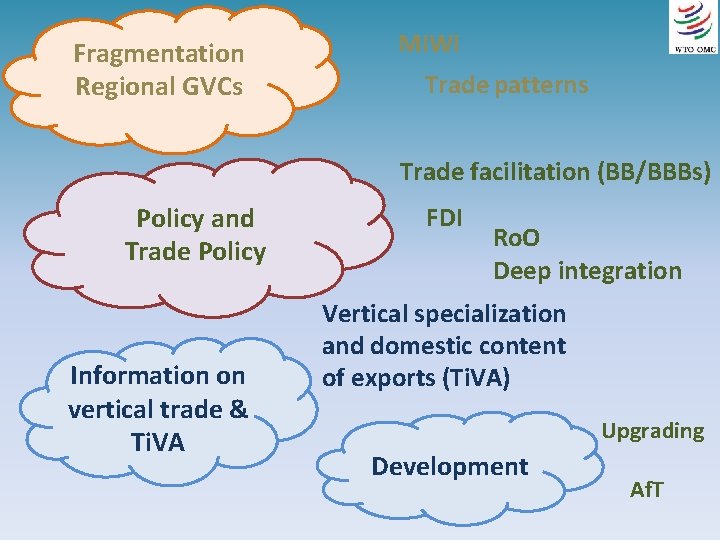
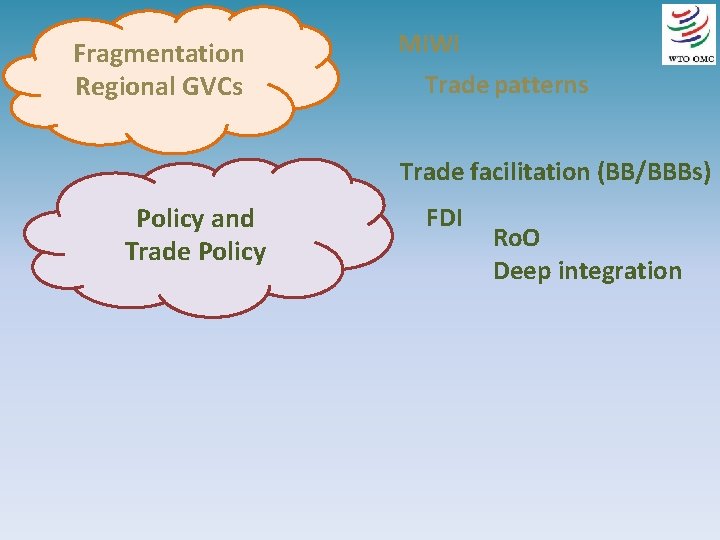
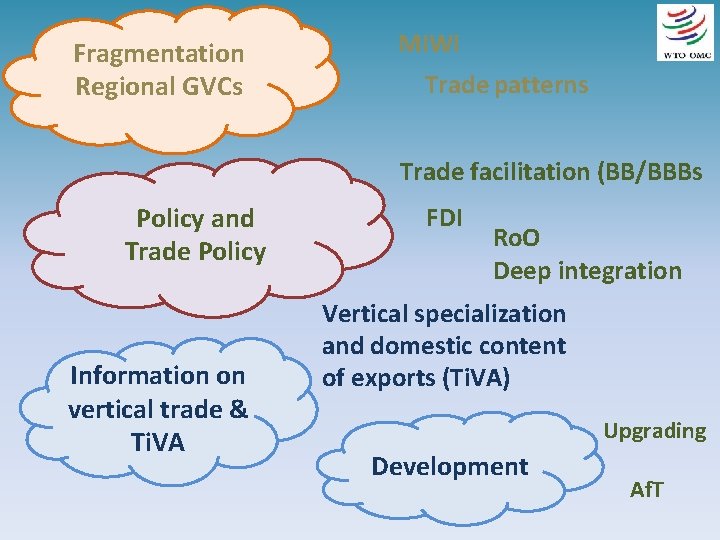
Fragmentation Regional GVCs MIWI Trade patterns Trade facilitation (BB/BBBs) Policy and Trade Policy Information on vertical trade & Ti. VA FDI Ro. O Deep integration Vertical specialization and domestic content of exports (Ti. VA) Upgrading Development Af. T
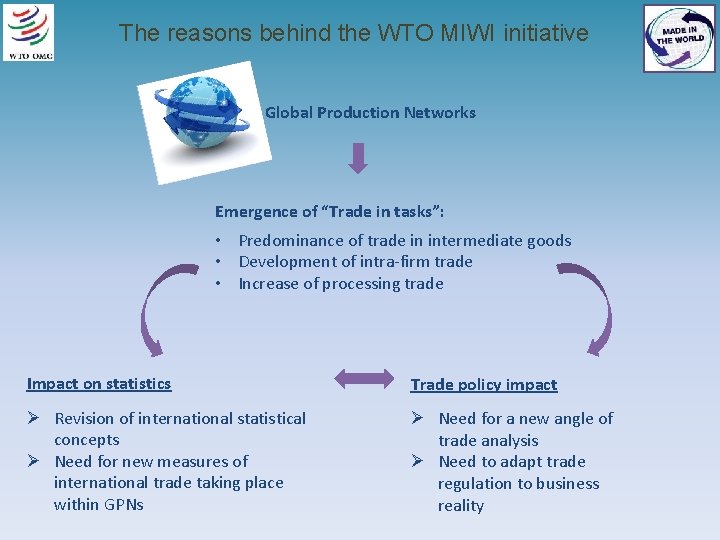
The reasons behind the WTO MIWI initiative Global Production Networks Emergence of “Trade in tasks”: • Predominance of trade in intermediate goods • Development of intra-firm trade • Increase of processing trade Impact on statistics Trade policy impact Ø Revision of international statistical concepts Ø Need for new measures of international trade taking place within GPNs Ø Need for a new angle of trade analysis Ø Need to adapt trade regulation to business reality
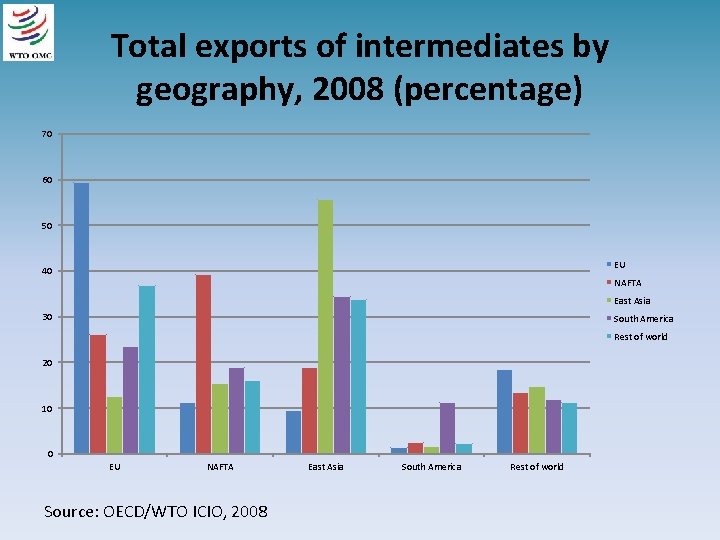
Total exports of intermediates by geography, 2008 (percentage) 70 60 50 EU 40 NAFTA East Asia 30 South America Rest of world 20 10 0 EU NAFTA Source: OECD/WTO ICIO, 2008 East Asia South America Rest of world
Fragmentation Regional GVCs MIWI Trade patterns Trade facilitation (BB/BBBs) Policy and Trade Policy FDI Ro. O Deep integration
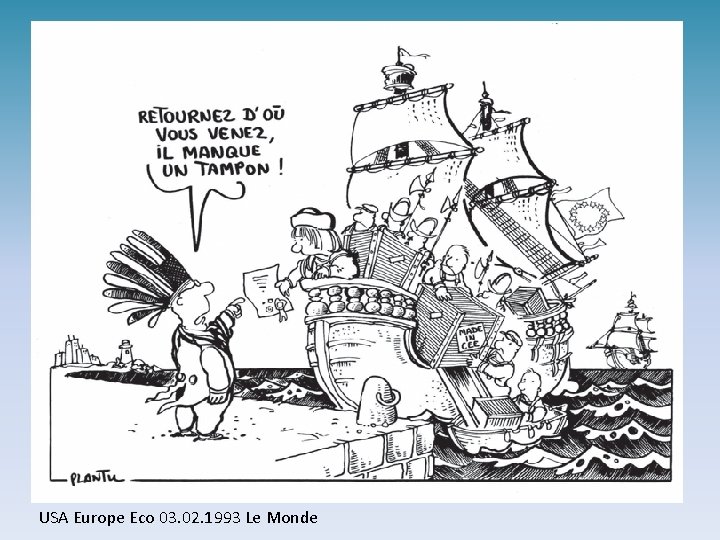
USA Europe Eco 03. 02. 1993 Le Monde
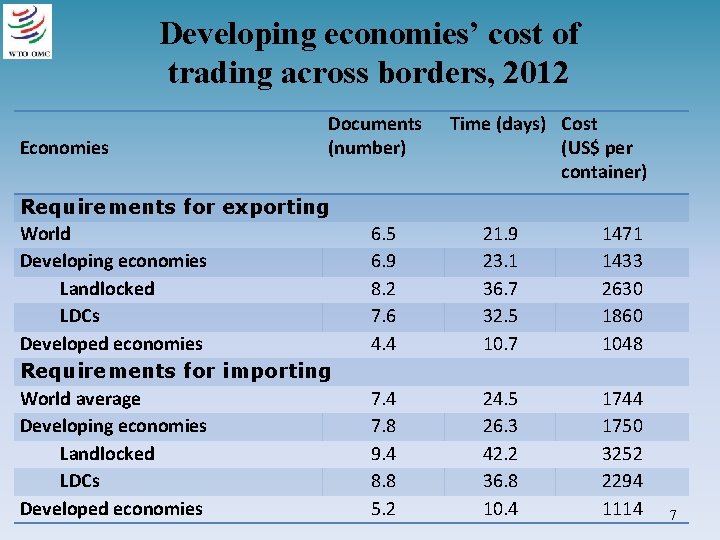
Developing economies’ cost of trading across borders, 2012 Economies Documents (number) Requirements for exporting World Developing economies Landlocked LDCs Developed economies Requirements for importing World average Developing economies Landlocked LDCs Developed economies Time (days) Cost (US$ per container) 6. 5 6. 9 8. 2 7. 6 4. 4 21. 9 23. 1 36. 7 32. 5 10. 7 1471 1433 2630 1860 1048 7. 4 7. 8 9. 4 8. 8 5. 2 24. 5 26. 3 42. 2 36. 8 10. 4 1744 1750 3252 2294 1114 7
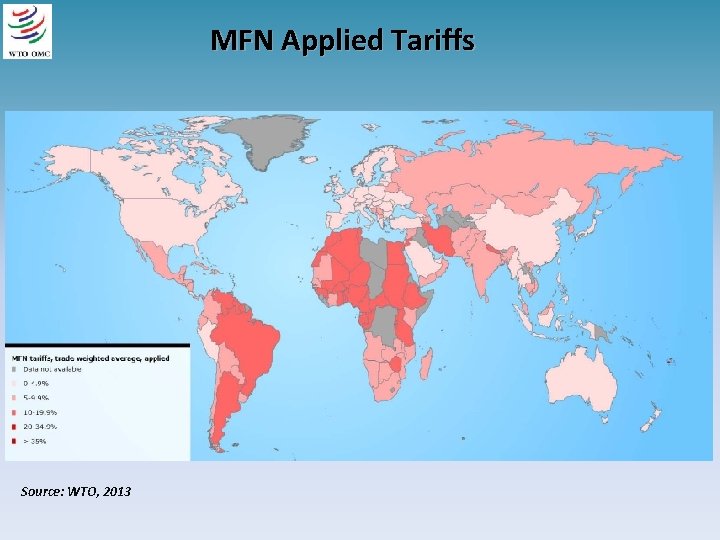
MFN Applied Tariffs Source: WTO, 2013
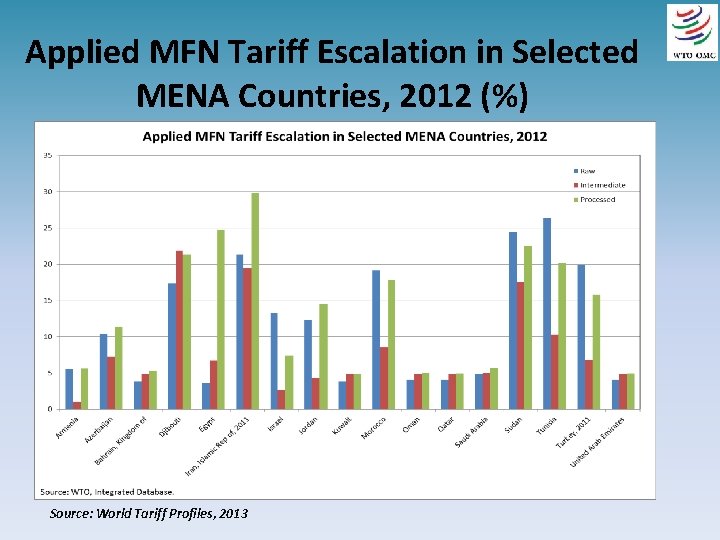
Applied MFN Tariff Escalation in Selected MENA Countries, 2012 (%) Source: World Tariff Profiles, 2013
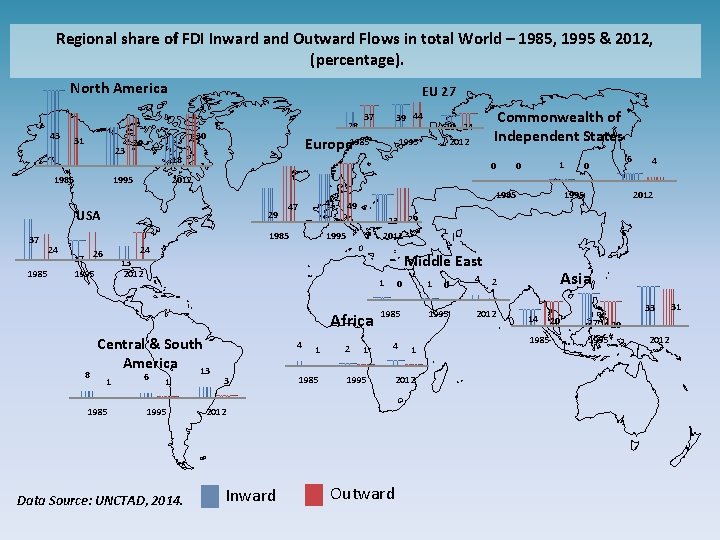
Regional share of FDI Inward and Outward Flows in total World – 1985, 1995 & 2012, (percentage). North America 43 31 23 1985 EU 27 28 30 29 Europe 1985 1995 1985 41 47 1985 49 1995 24 13 2012 1985 6 1995 Middle East 1 Central & South America 13 1 6 0 4 1 1995 Data Source: UNCTAD, 2014. 4 3 1 1985 2 1 1995 0 1 1985 4 Outward 0 1995 1 2012 Inward 2012 23 29 2012 Africa 8 1 0 2012 29 17 26 1995 0 1985 24 Commonwealth of Independent States 20 24 2012 18 USA 37 39 44 37 4 Asia 2 2012 14 33 20 1985 27 1995 20 2012 31
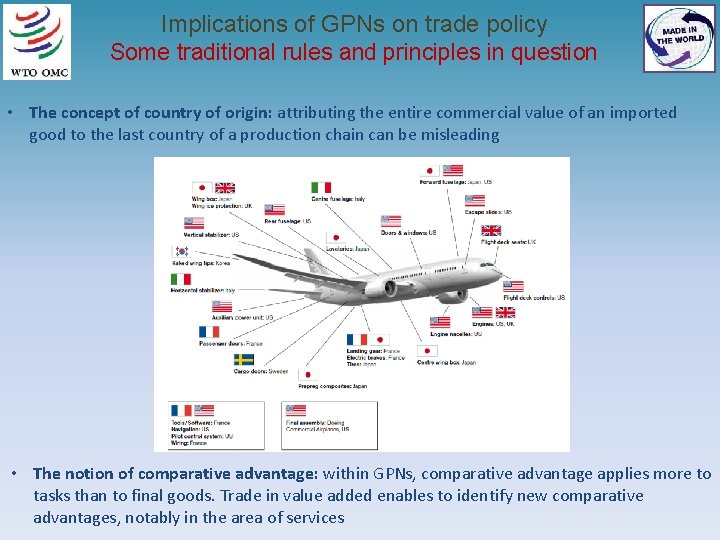
Implications of GPNs on trade policy Some traditional rules and principles in question • The concept of country of origin: attributing the entire commercial value of an imported good to the last country of a production chain can be misleading • The notion of comparative advantage: within GPNs, comparative advantage applies more to tasks than to final goods. Trade in value added enables to identify new comparative advantages, notably in the area of services
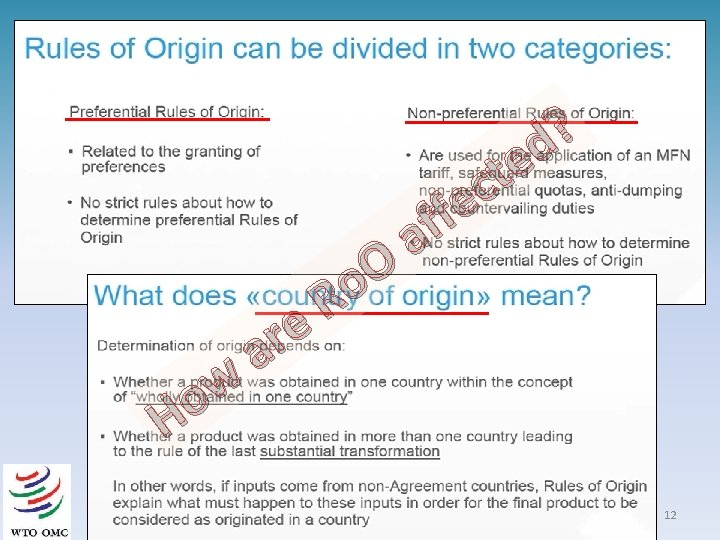
? d e t c e f f a O o R e r a w o H 12
Global Value Chains and Trade Policy Regional vs. Multilateral Trade Agreement Why is deep integration through RTAs gaining momentum? Ø International production networks call for deeper integration • Complementarity between: – Trade (shallow, border measures) and – Investment (deep, regulatory frameworks) policies • Complementarity between trade and business governance which is at the root of the flourishing of deep agreements.
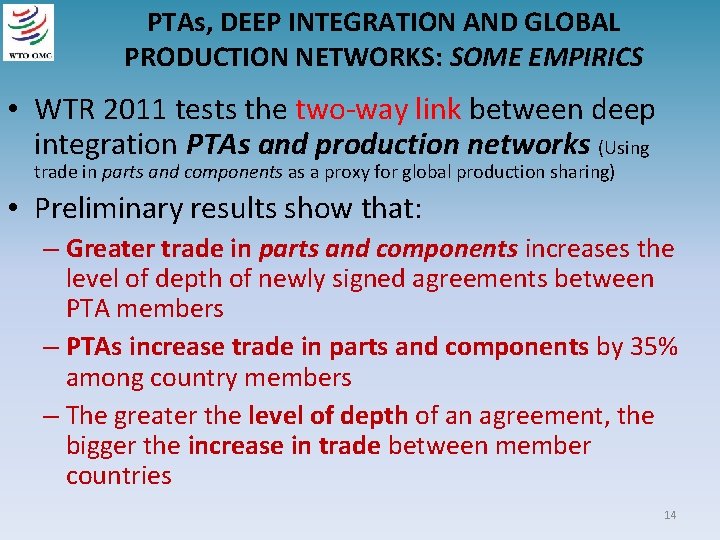
PTAs, DEEP INTEGRATION AND GLOBAL PRODUCTION NETWORKS: SOME EMPIRICS • WTR 2011 tests the two-way link between deep integration PTAs and production networks (Using trade in parts and components as a proxy for global production sharing) • Preliminary results show that: – Greater trade in parts and components increases the level of depth of newly signed agreements between PTA members – PTAs increase trade in parts and components by 35% among country members – The greater the level of depth of an agreement, the bigger the increase in trade between member countries 14
Fragmentation Regional GVCs Policy and Trade Policy Information on vertical trade & Ti. VA MIWI Trade patterns Infrastructure BB/BBBs FDI Ro. O Deep integration Vertical specialization and domestic content of exports (Ti. VA)
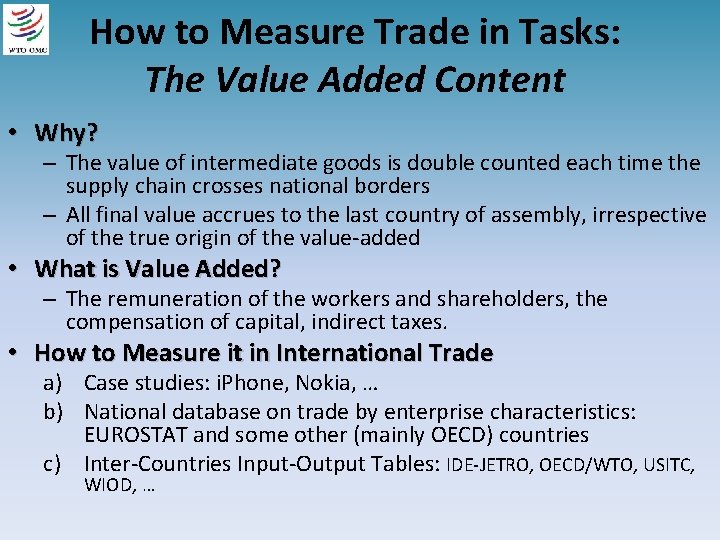
How to Measure Trade in Tasks: The Value Added Content • Why? – The value of intermediate goods is double counted each time the supply chain crosses national borders – All final value accrues to the last country of assembly, irrespective of the true origin of the value-added • What is Value Added? – The remuneration of the workers and shareholders, the compensation of capital, indirect taxes. • How to Measure it in International Trade a) Case studies: i. Phone, Nokia, … b) National database on trade by enterprise characteristics: EUROSTAT and some other (mainly OECD) countries c) Inter-Countries Input-Output Tables: IDE-JETRO, OECD/WTO, USITC, WIOD, …
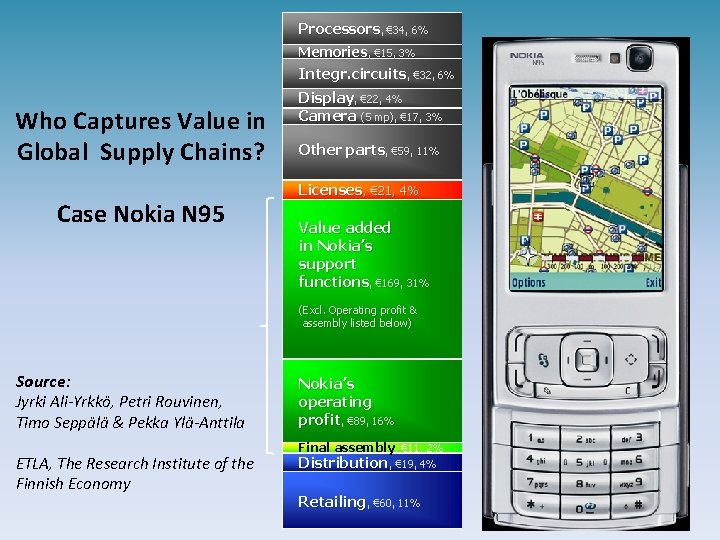
Processors, € 34, 6% Memories, € 15, 3% Integr. circuits, € 32, 6% Who Captures Value in Global Supply Chains? Case Nokia N 95 Display, € 22, 4% Camera (5 mp), € 17, 3% Other parts, € 59, 11% Licenses, € 21, 4% Value added in Nokia’s support functions, € 169, 31% (Excl. Operating profit & assembly listed below) Source: Jyrki Ali-Yrkkö, Petri Rouvinen, Timo Seppälä & Pekka Ylä-Anttila ETLA, The Research Institute of the Finnish Economy Nokia’s operating profit, € 89, 16% Final assembly, € 11, 2% Distribution, € 19, 4% Retailing, € 60, 11%
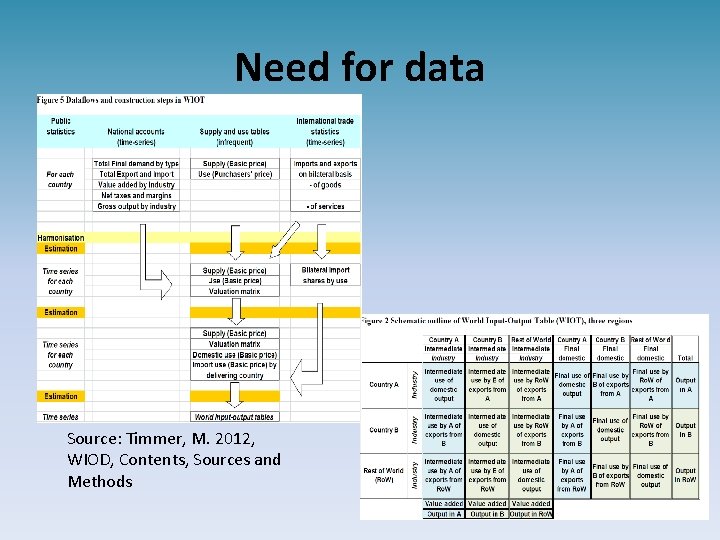
Need for data Source: Timmer, M. 2012, WIOD, Contents, Sources and Methods
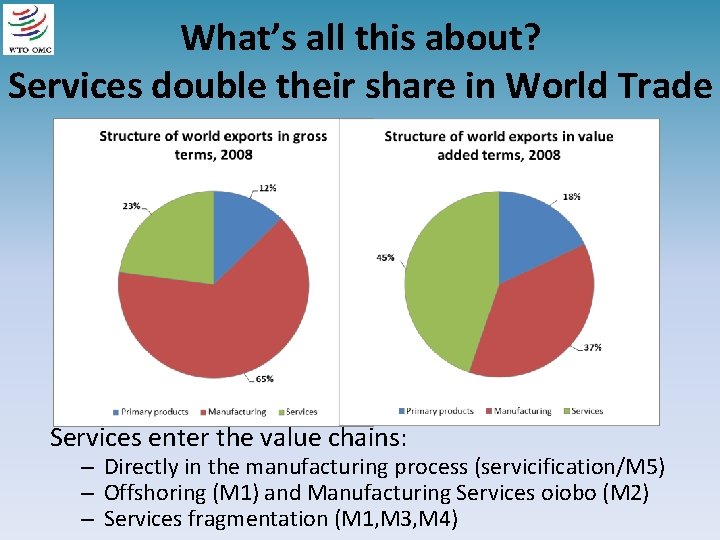
What’s all this about? Services double their share in World Trade Services enter the value chains: – Directly in the manufacturing process (servicification/M 5) – Offshoring (M 1) and Manufacturing Services oiobo (M 2) – Services fragmentation (M 1, M 3, M 4)
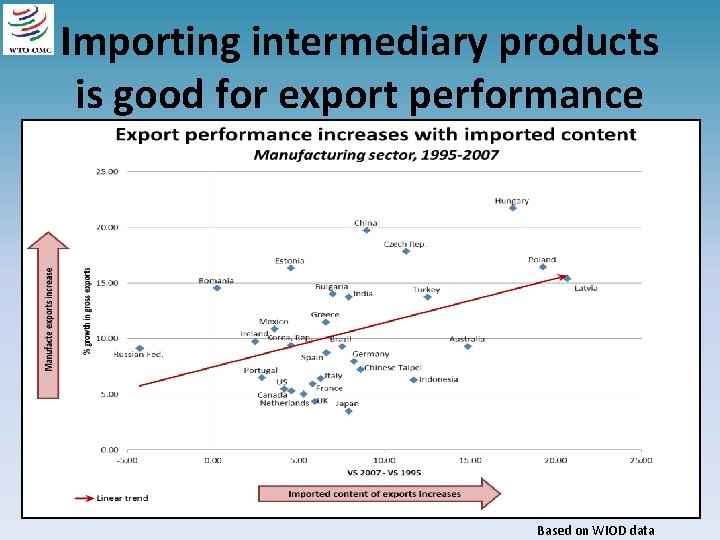
Importing intermediary products is good for export performance Based on WIOD data
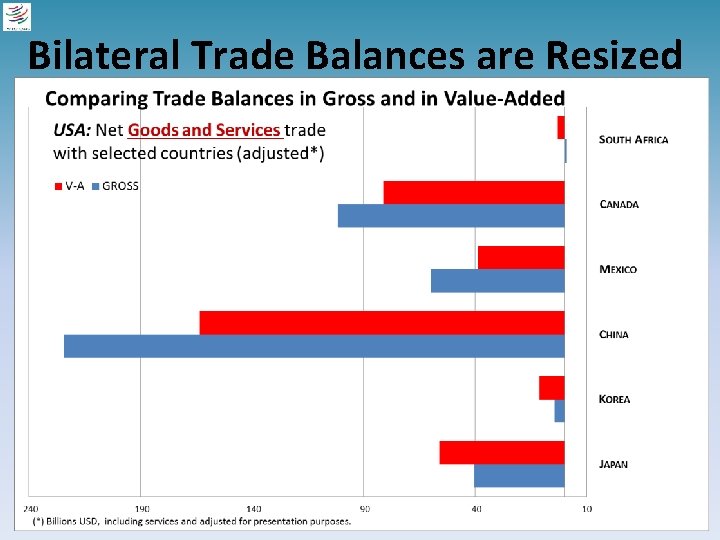
Bilateral Trade Balances are Resized
Fragmentation Regional GVCs MIWI Trade patterns Trade facilitation (BB/BBBs Policy and Trade Policy Information on vertical trade & Ti. VA FDI Ro. O Deep integration Vertical specialization and domestic content of exports (Ti. VA) Upgrading Development Af. T
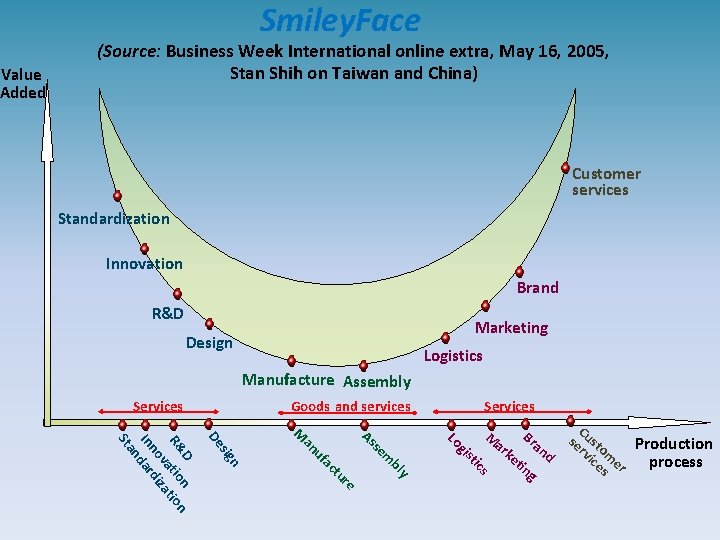
Value Added Smiley. Face (Source: Business Week International online extra, May 16, 2005, Stan Shih on Taiwan and China) Customer services Standardization Innovation Brand R&D Marketing Design Logistics Manufacture Assembly Services Goods and services y s bl M tic gis m Lo re tu ac uf an M n sig De D n R& atio tion v za no di In dar an St As se Services ar ke Br tin an g d C se ust Production rv om ice e process s r
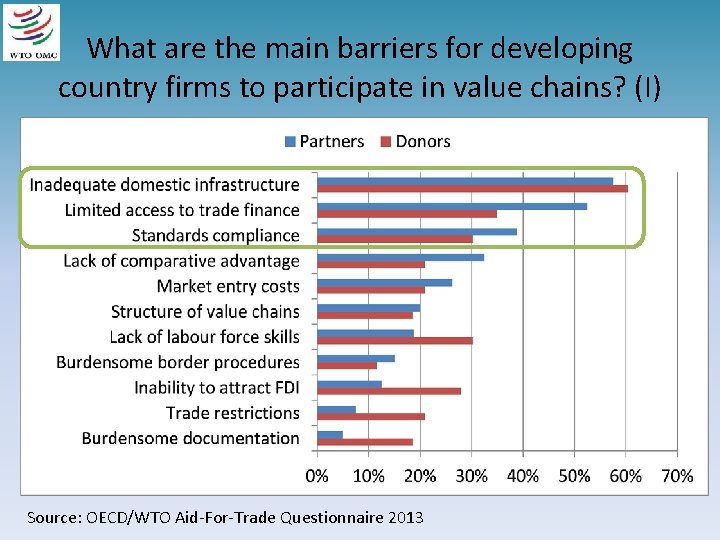
What are the main barriers for developing country firms to participate in value chains? (I) Source: OECD/WTO Aid-For-Trade Questionnaire 2013
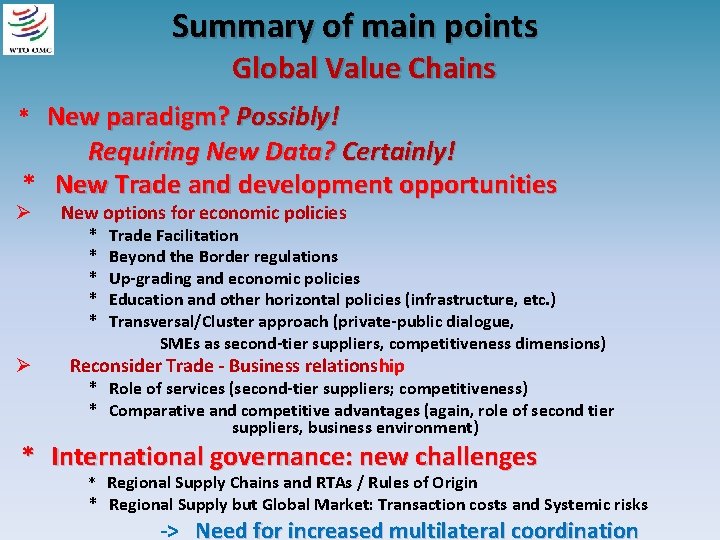
Summary of main points Global Value Chains * New paradigm? Possibly! Requiring New Data? Certainly! * New Trade and development opportunities Ø New options for economic policies * Trade Facilitation * Beyond the Border regulations * Up-grading and economic policies * Education and other horizontal policies (infrastructure, etc. ) * Transversal/Cluster approach (private-public dialogue, SMEs as second-tier suppliers, competitiveness dimensions) Ø Reconsider Trade - Business relationship * Role of services (second-tier suppliers; competitiveness) * Comparative and competitive advantages (again, role of second tier suppliers, business environment) * International governance: new challenges * Regional Supply Chains and RTAs / Rules of Origin * Regional Supply but Global Market: Transaction costs and Systemic risks -> Need for increased multilateral coordination
Need for increased information base • • • Supply-use tables? Bilateral trade statistics (goods and services) National Accounts needs Where not available, why? How to improve availability?