
Development of pixel detectors with integrated signal processing


- Slides: 50
Development of pixel detectors with integrated signal processing for the Vertex Detector in the STAR experiment at the RHIC collider Ph. D Thesis defense Michal Szelezniak ULP, Strasbourg 25 February 2008
Michal Szelezniak - Ph. D thesis defense - 25 February 2008 Outline Development of pixel detectors with integrated signal processing for the Vertex Detector in the STAR experiment at the RHIC collider l l l 2 2 The new vertex detector for the STAR experiment Development of Monolithic Active Pixel Sensors (MAPS) at IPHC MAPS prototype for PIXEL detector 3 -sensor telescope system with prototype readout for PIXEL detector Future development plans Summary and Conclusions
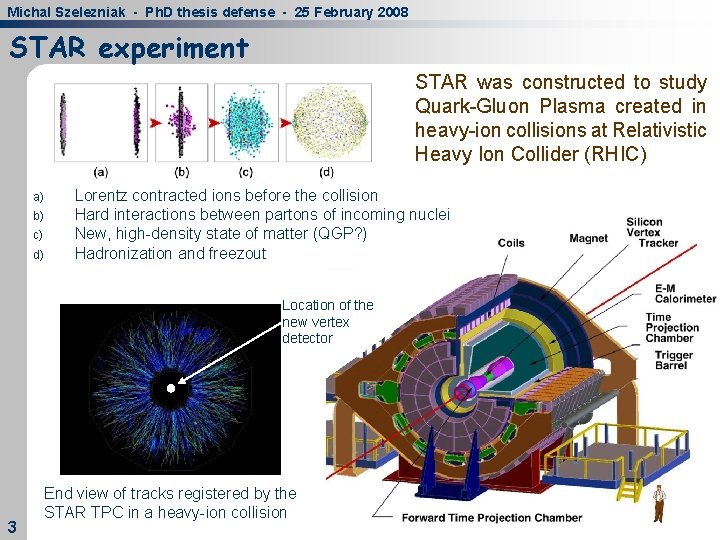
Michal Szelezniak - Ph. D thesis defense - 25 February 2008 STAR experiment STAR was constructed to study Quark-Gluon Plasma created in heavy-ion collisions at Relativistic Heavy Ion Collider (RHIC) a) b) c) d) Lorentz contracted ions before the collision Hard interactions between partons of incoming nuclei New, high-density state of matter (QGP? ) Hadronization and freezout Location of the new vertex detector 3 End view of tracks registered by the STAR TPC in a heavy-ion collision 3
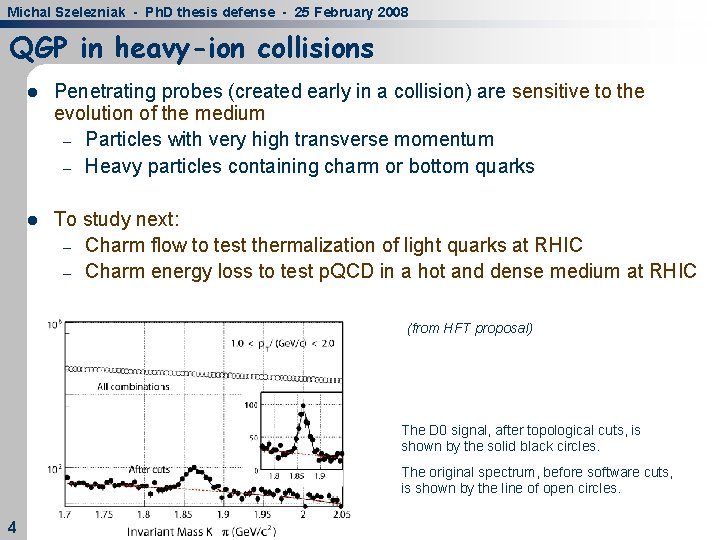
Michal Szelezniak - Ph. D thesis defense - 25 February 2008 QGP in heavy-ion collisions l Penetrating probes (created early in a collision) are sensitive to the evolution of the medium – Particles with very high transverse momentum – Heavy particles containing charm or bottom quarks l To study next: – Charm flow to test thermalization of light quarks at RHIC – Charm energy loss to test p. QCD in a hot and dense medium at RHIC (from HFT proposal) The D 0 signal, after topological cuts, is shown by the solid black circles. The original spectrum, before software cuts, is shown by the line of open circles. 4 4
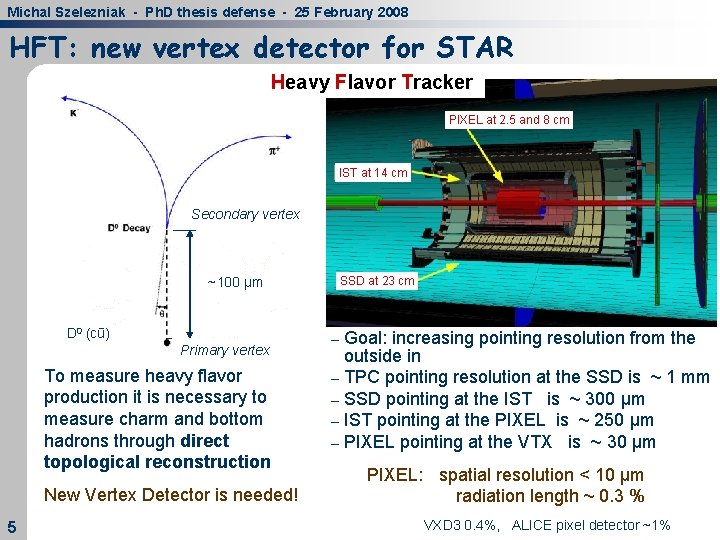
Michal Szelezniak - Ph. D thesis defense - 25 February 2008 HFT: new vertex detector for STAR Heavy Flavor Tracker PIXEL at 2. 5 and 8 cm IST at 14 cm Secondary vertex SSD at 23 cm ~100 µm D 0 (cū) Primary vertex To measure heavy flavor production it is necessary to measure charm and bottom hadrons through direct topological reconstruction New Vertex Detector is needed! 5 5 Goal: increasing pointing resolution from the outside in – TPC pointing resolution at the SSD is ~ 1 mm – SSD pointing at the IST is ~ 300 µm – IST pointing at the PIXEL is ~ 250 µm – PIXEL pointing at the VTX is ~ 30 µm – PIXEL: spatial resolution < 10 μm radiation length ~ 0. 3 % VXD 3 0. 4%, ALICE pixel detector ~1%
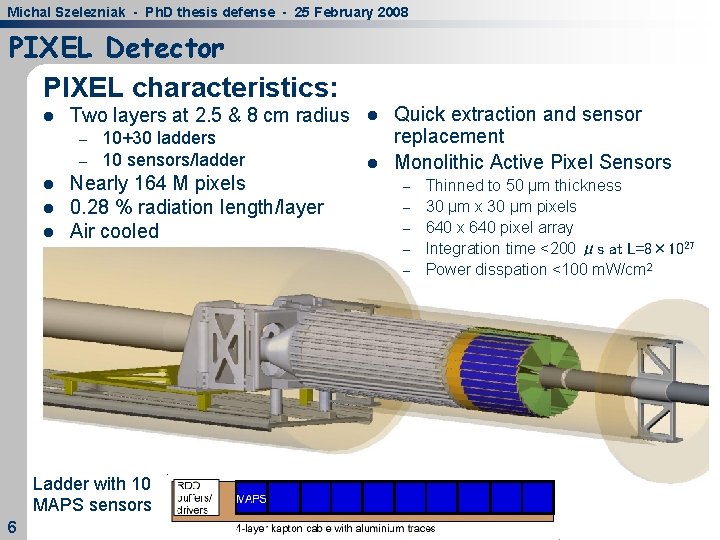
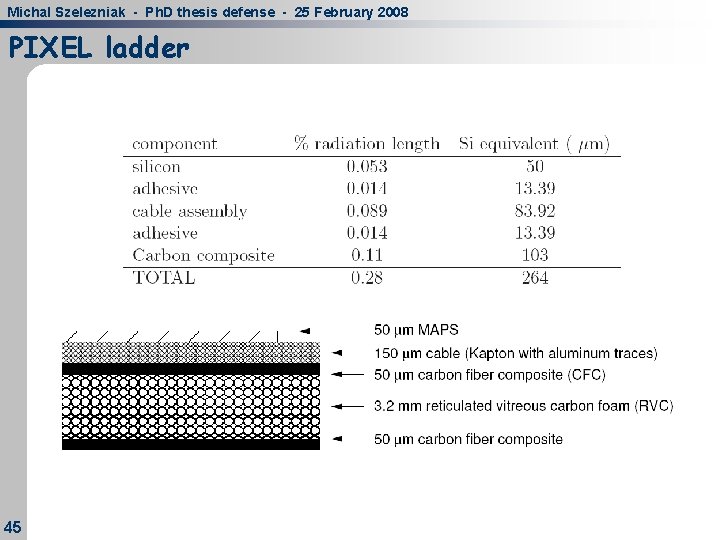
Michal Szelezniak - Ph. D thesis defense - 25 February 2008 PIXEL Detector PIXEL characteristics: Two layers at 2. 5 & 8 cm radius l – – 10+30 ladders 10 sensors/ladder Nearly 164 M pixels 0. 28 % radiation length/layer Air cooled l l l Quick extraction and sensor replacement Monolithic Active Pixel Sensors – – – Ladder with 10 MAPS sensors 6 6 Thinned to 50 μm thickness 30 μm x 30 μm pixels 640 x 640 pixel array Integration time <200 μs at L=8× 1027 Power disspation <100 m. W/cm 2
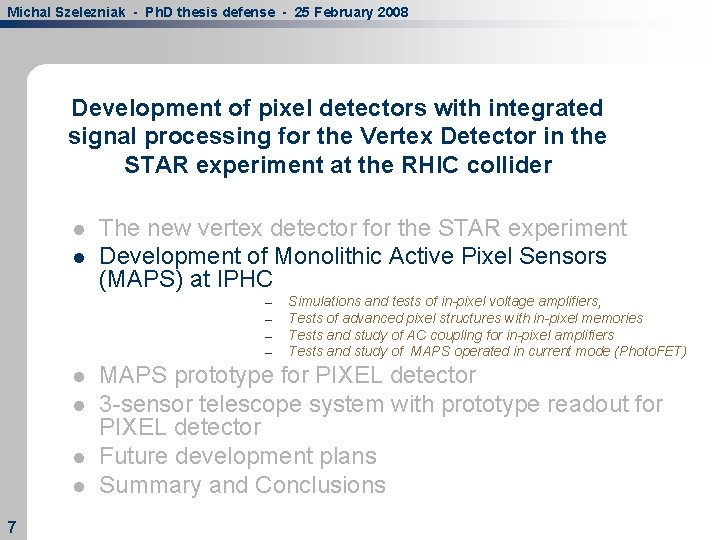
Michal Szelezniak - Ph. D thesis defense - 25 February 2008 Development of pixel detectors with integrated signal processing for the Vertex Detector in the STAR experiment at the RHIC collider l l The new vertex detector for the STAR experiment Development of Monolithic Active Pixel Sensors (MAPS) at IPHC – – l l 7 7 Simulations and tests of in-pixel voltage amplifiers, Tests of advanced pixel structures with in-pixel memories Tests and study of AC coupling for in-pixel amplifiers Tests and study of MAPS operated in current mode (Photo. FET) MAPS prototype for PIXEL detector 3 -sensor telescope system with prototype readout for PIXEL detector Future development plans Summary and Conclusions
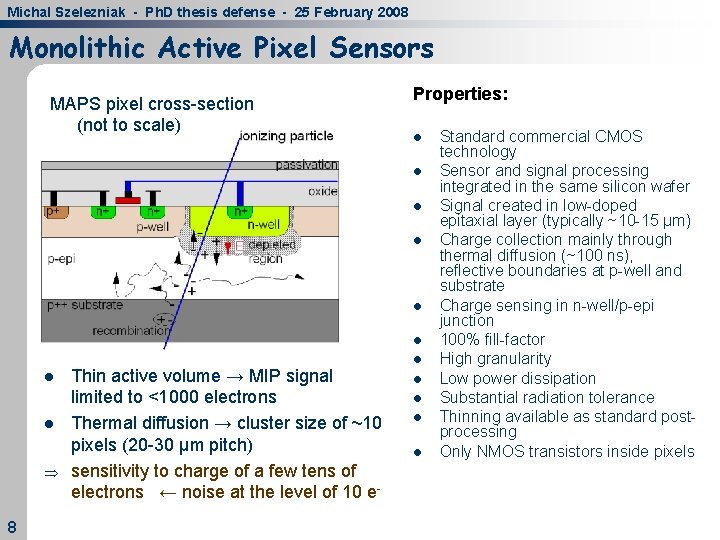
Michal Szelezniak - Ph. D thesis defense - 25 February 2008 Monolithic Active Pixel Sensors MAPS pixel cross-section (not to scale) Properties: l l l Thin active volume → MIP signal limited to <1000 electrons Thermal diffusion → cluster size of ~10 pixels (20 -30 μm pitch) sensitivity to charge of a few tens of electrons ← noise at the level of 10 e- l l 8 8 l l l Standard commercial CMOS technology Sensor and signal processing integrated in the same silicon wafer Signal created in low-doped epitaxial layer (typically ~10 -15 μm) Charge collection mainly through thermal diffusion (~100 ns), reflective boundaries at p-well and substrate Charge sensing in n-well/p-epi junction 100% fill-factor High granularity Low power dissipation Substantial radiation tolerance Thinning available as standard postprocessing Only NMOS transistors inside pixels
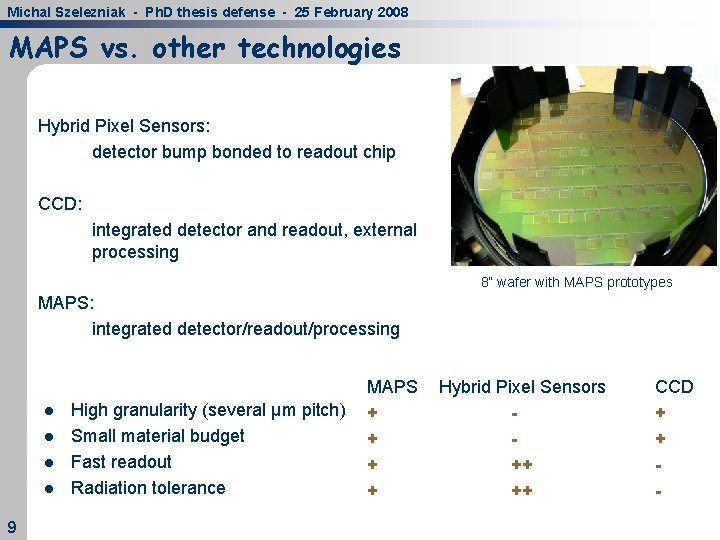
Michal Szelezniak - Ph. D thesis defense - 25 February 2008 MAPS vs. other technologies Hybrid Pixel Sensors: detector bump bonded to readout chip CCD: integrated detector and readout, external processing 8” wafer with MAPS prototypes MAPS: integrated detector/readout/processing High granularity (several μm pitch) Small material budget Fast readout Radiation tolerance l l 9 9 MAPS + + Hybrid Pixel Sensors ++ ++ CCD + + -
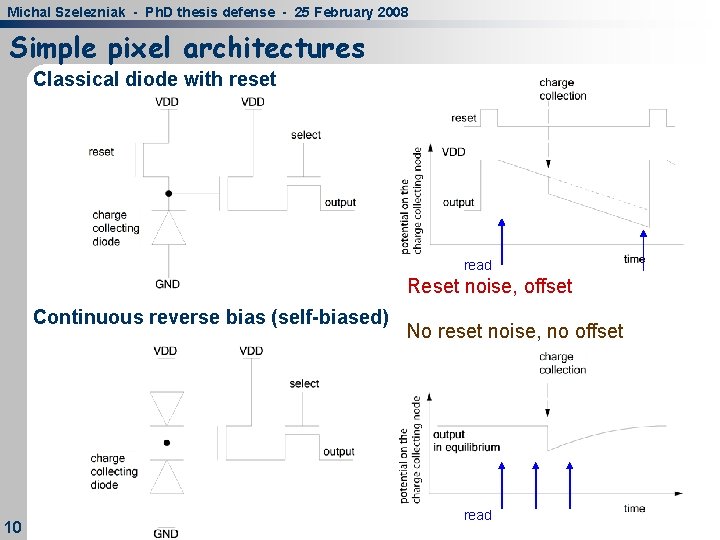
Michal Szelezniak - Ph. D thesis defense - 25 February 2008 Simple pixel architectures Classical diode with reset read Reset noise, offset Continuous reverse bias (self-biased) 10 10 No reset noise, no offset read
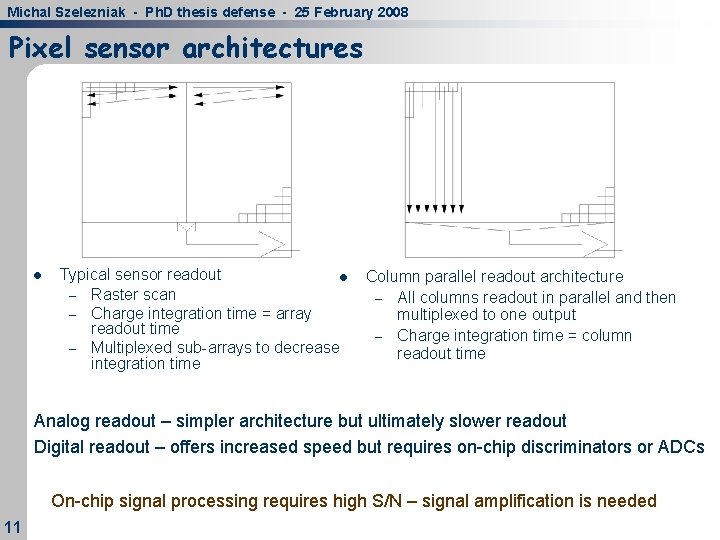
Michal Szelezniak - Ph. D thesis defense - 25 February 2008 Pixel sensor architectures l Typical sensor readout l – Raster scan – Charge integration time = array readout time – Multiplexed sub-arrays to decrease integration time Column parallel readout architecture – All columns readout in parallel and then multiplexed to one output – Charge integration time = column readout time Analog readout – simpler architecture but ultimately slower readout Digital readout – offers increased speed but requires on-chip discriminators or ADCs On-chip signal processing requires high S/N – signal amplification is needed 11 11
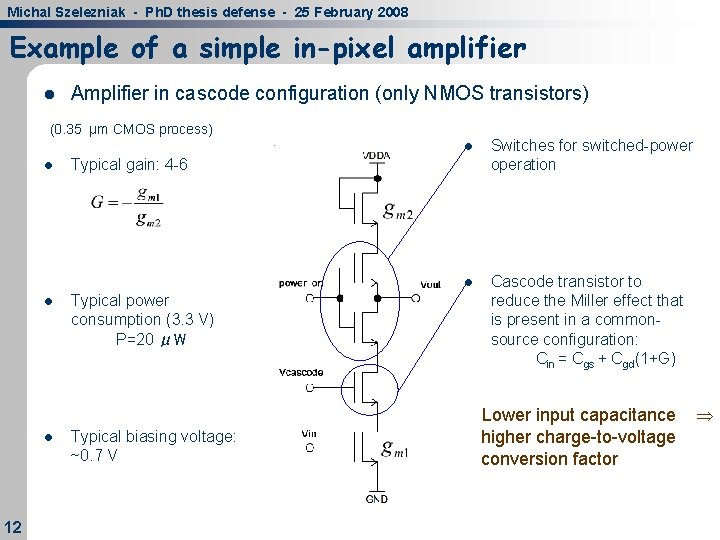
Michal Szelezniak - Ph. D thesis defense - 25 February 2008 Example of a simple in-pixel amplifier l Amplifier in cascode configuration (only NMOS transistors) (0. 35 μm CMOS process) l l l 12 l Switches for switched-power operation l Cascode transistor to reduce the Miller effect that is present in a commonsource configuration: Cin = Cgs + Cgd(1+G) Typical gain: 4 -6 Typical power consumption (3. 3 V) P=20 μW Typical biasing voltage: ~0. 7 V 12 Lower input capacitance higher charge-to-voltage conversion factor
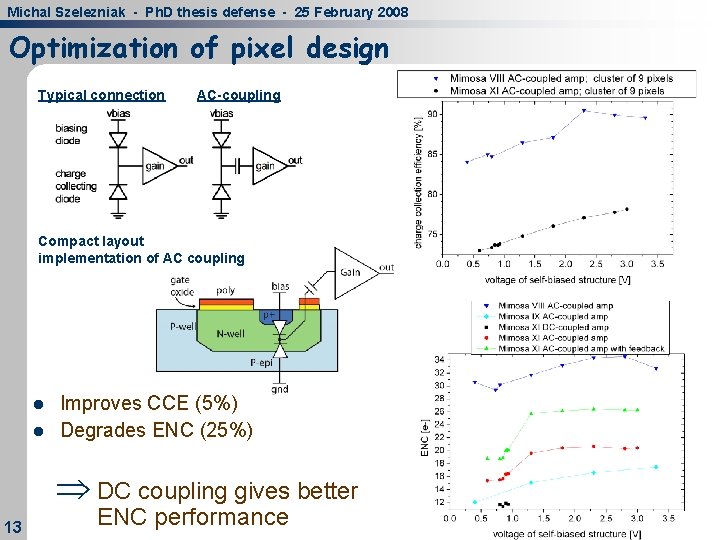
Michal Szelezniak - Ph. D thesis defense - 25 February 2008 Optimization of pixel design Typical connection AC-coupling Compact layout implementation of AC coupling l l Improves CCE (5%) Degrades ENC (25%) DC coupling gives better 13 13 ENC performance
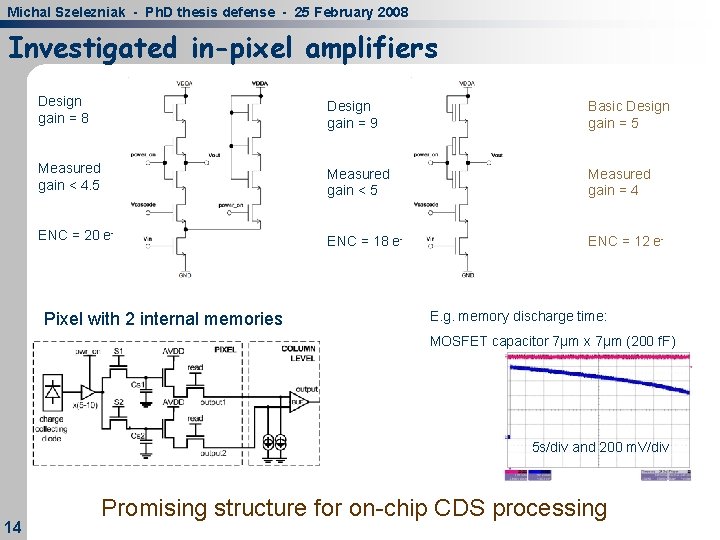
Michal Szelezniak - Ph. D thesis defense - 25 February 2008 Investigated in-pixel amplifiers Design gain = 8 Design gain = 9 Basic Design gain = 5 Measured gain < 4. 5 Measured gain < 5 Measured gain = 4 ENC = 20 e- ENC = 18 e- ENC = 12 e- Pixel with 2 internal memories E. g. memory discharge time: MOSFET capacitor 7μm x 7μm (200 f. F) 5 s/div and 200 m. V/div 14 14 Promising structure for on-chip CDS processing
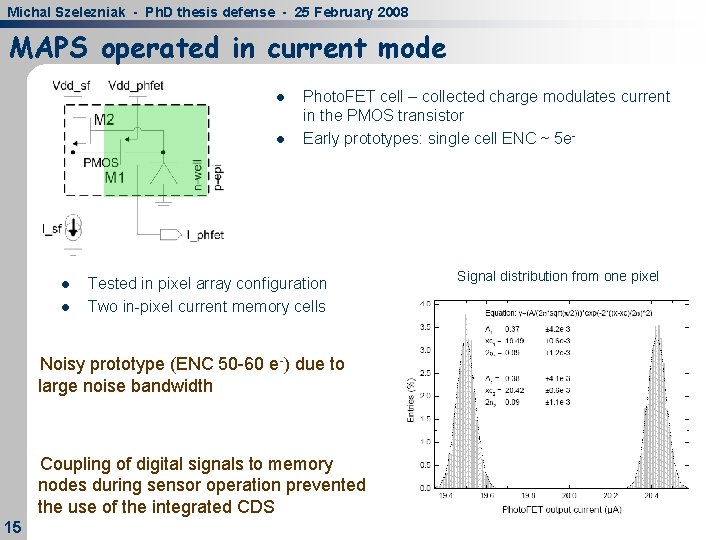
Michal Szelezniak - Ph. D thesis defense - 25 February 2008 MAPS operated in current mode l l Photo. FET cell – collected charge modulates current in the PMOS transistor Early prototypes: single cell ENC ~ 5 e- Tested in pixel array configuration Two in-pixel current memory cells Noisy prototype (ENC 50 -60 e-) due to large noise bandwidth Coupling of digital signals to memory nodes during sensor operation prevented the use of the integrated CDS 15 15 Signal distribution from one pixel
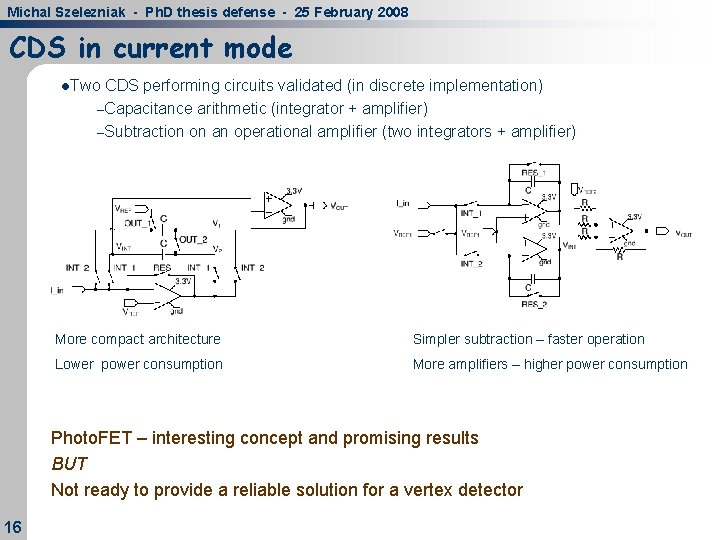
Michal Szelezniak - Ph. D thesis defense - 25 February 2008 CDS in current mode l. Two CDS performing circuits validated (in discrete implementation) –Capacitance arithmetic (integrator + amplifier) –Subtraction on an operational amplifier (two integrators + amplifier) More compact architecture Simpler subtraction – faster operation Lower power consumption More amplifiers – higher power consumption Photo. FET – interesting concept and promising results BUT Not ready to provide a reliable solution for a vertex detector 16 16
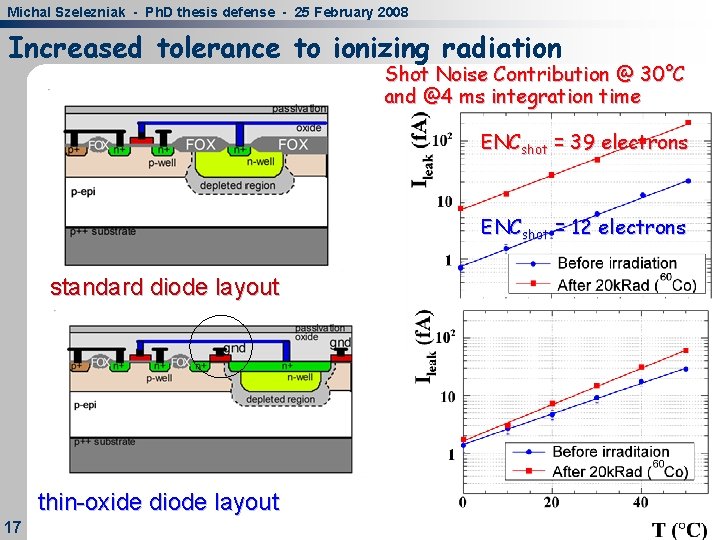
Michal Szelezniak - Ph. D thesis defense - 25 February 2008 Increased tolerance to ionizing radiation Shot Noise Contribution @ 30°C and @4 ms integration time ENCshot = 39 electrons ENCshot = 12 electrons standard diode layout thin-oxide diode layout 17 17
Michal Szelezniak - Ph. D thesis defense - 25 February 2008 Development of pixel detectors with integrated signal processing for the Vertex Detector in the STAR experiment at the RHIC collider l l l The new vertex detector for the STAR experiment Development of Monolithic Active Pixel Sensors (MAPS) at IPHC MAPS prototype for PIXEL detector – – l l l 18 18 Tests and study of performance as a function of ionizing radiation dose Tests and study of sensor’s susceptibility to latch up 3 -sensor telescope system with prototype readout for PIXEL detector Future development plans Summary and Conclusions
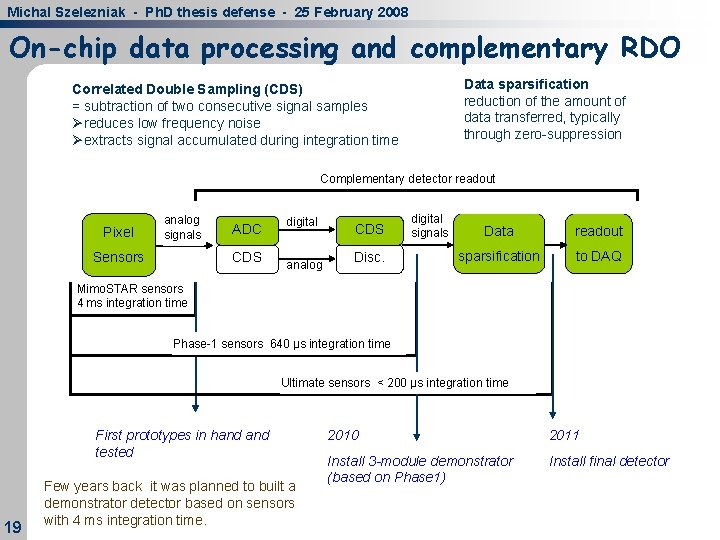
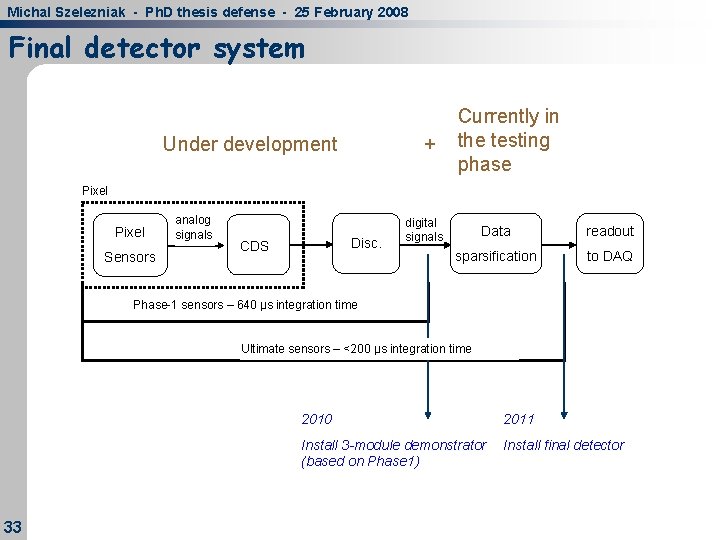
Michal Szelezniak - Ph. D thesis defense - 25 February 2008 On-chip data processing and complementary RDO Data sparsification reduction of the amount of data transferred, typically through zero-suppression Correlated Double Sampling (CDS) = subtraction of two consecutive signal samples Øreduces low frequency noise Øextracts signal accumulated during integration time Complementary detector readout Pixel analog signals Sensors ADC CDS digital analog CDS Disc. digital signals Data readout sparsification to DAQ Mimo. STAR sensors 4 ms integration time Phase-1 sensors 640 μs integration time Ultimate sensors < 200 μs integration time First prototypes in hand tested 19 Few years back it was planned to built a demonstrator detector based on sensors with 4 ms integration time. 19 2010 2011 Install 3 -module demonstrator (based on Phase 1) Install final detector
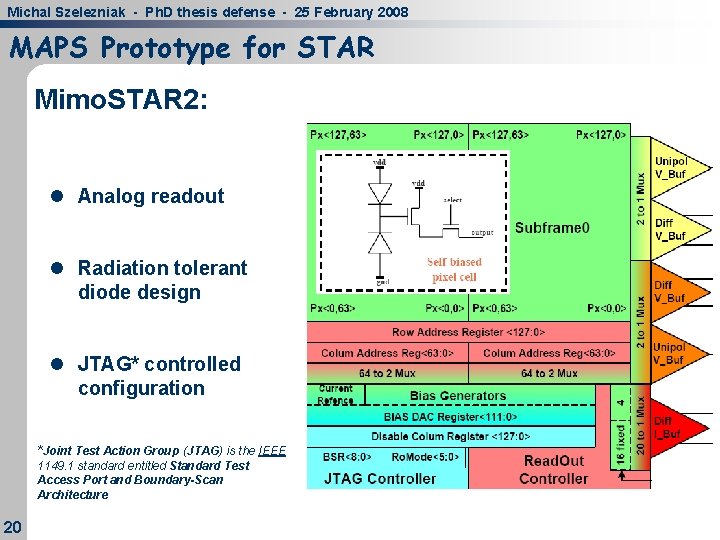
Michal Szelezniak - Ph. D thesis defense - 25 February 2008 MAPS Prototype for STAR Mimo. STAR 2: l Analog readout l Radiation tolerant diode design l JTAG* controlled configuration *Joint Test Action Group (JTAG) is the IEEE 1149. 1 standard entitled Standard Test Access Port and Boundary-Scan Architecture 20 20
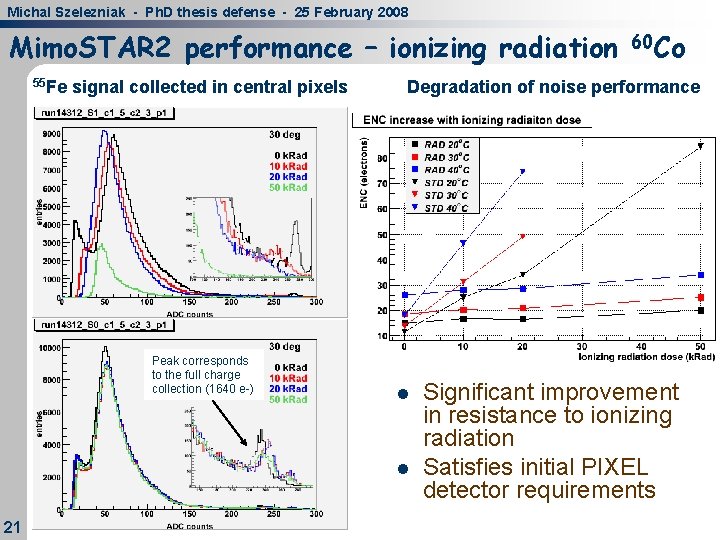
Michal Szelezniak - Ph. D thesis defense - 25 February 2008 Mimo. STAR 2 performance – ionizing radiation 55 Fe signal collected in central pixels Peak corresponds to the full charge collection (1640 e-) Degradation of noise performance l l 21 21 60 Co Significant improvement in resistance to ionizing radiation Satisfies initial PIXEL detector requirements
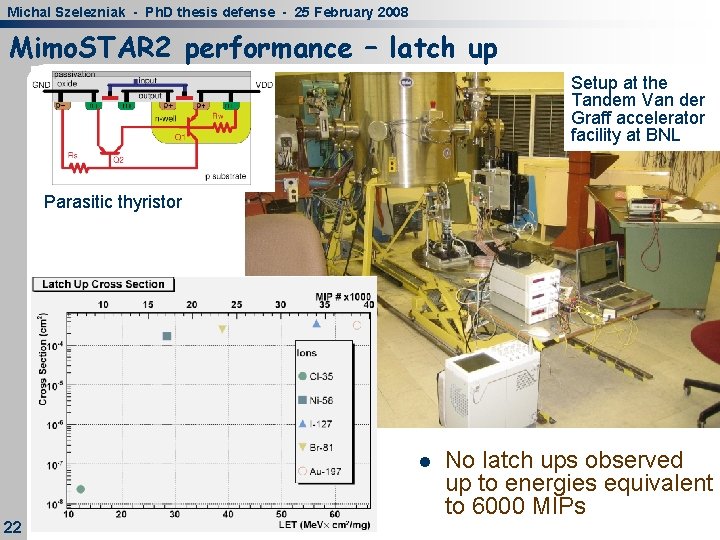
Michal Szelezniak - Ph. D thesis defense - 25 February 2008 Mimo. STAR 2 performance – latch up Setup at the Tandem Van der Graff accelerator facility at BNL Parasitic thyristor l 22 22 No latch ups observed up to energies equivalent to 6000 MIPs
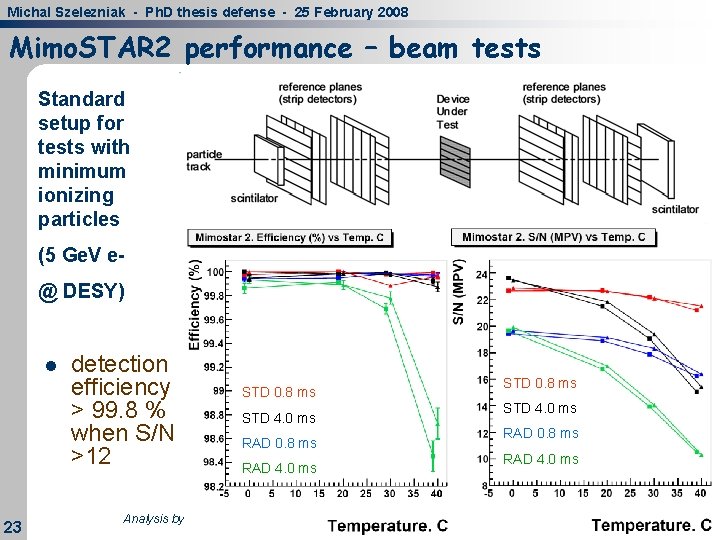
Michal Szelezniak - Ph. D thesis defense - 25 February 2008 Mimo. STAR 2 performance – beam tests Standard setup for tests with minimum ionizing particles (5 Ge. V e@ DESY) l 23 detection efficiency > 99. 8 % when S/N >12 23 STD 0. 8 ms STD 4. 0 ms RAD 0. 8 ms RAD 4. 0 ms Analysis by Auguste Besson, IPHC STD 0. 8 ms STD 4. 0 ms RAD 0. 8 ms RAD 4. 0 ms
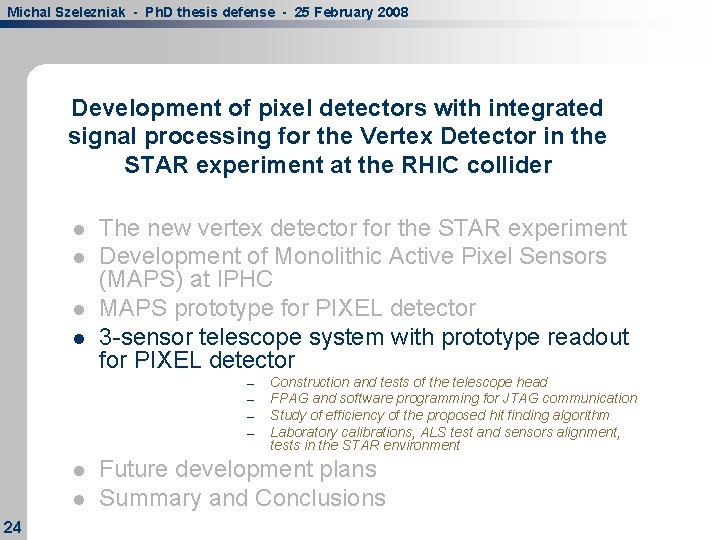
Michal Szelezniak - Ph. D thesis defense - 25 February 2008 Development of pixel detectors with integrated signal processing for the Vertex Detector in the STAR experiment at the RHIC collider l l The new vertex detector for the STAR experiment Development of Monolithic Active Pixel Sensors (MAPS) at IPHC MAPS prototype for PIXEL detector 3 -sensor telescope system with prototype readout for PIXEL detector – – l l 24 24 Construction and tests of the telescope head FPAG and software programming for JTAG communication Study of efficiency of the proposed hit finding algorithm Laboratory calibrations, ALS test and sensors alignment, tests in the STAR environment Future development plans Summary and Conclusions
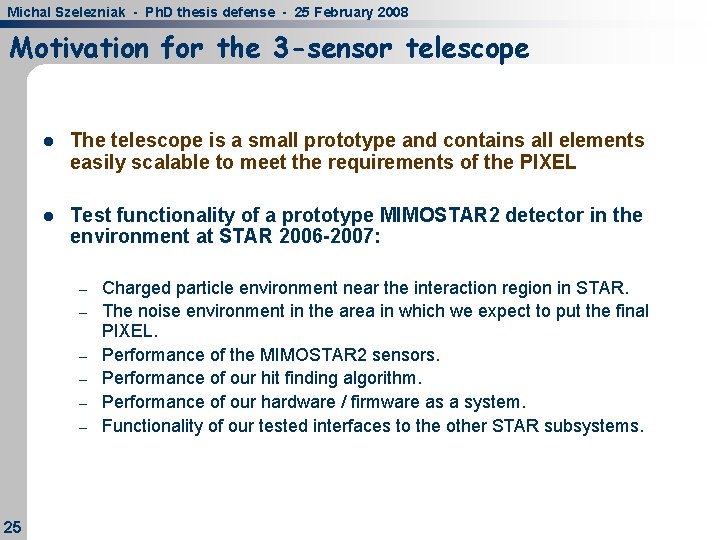
Michal Szelezniak - Ph. D thesis defense - 25 February 2008 Motivation for the 3 -sensor telescope l The telescope is a small prototype and contains all elements easily scalable to meet the requirements of the PIXEL l Test functionality of a prototype MIMOSTAR 2 detector in the environment at STAR 2006 -2007: – – – 25 25 Charged particle environment near the interaction region in STAR. The noise environment in the area in which we expect to put the final PIXEL. Performance of the MIMOSTAR 2 sensors. Performance of our hit finding algorithm. Performance of our hardware / firmware as a system. Functionality of our tested interfaces to the other STAR subsystems.
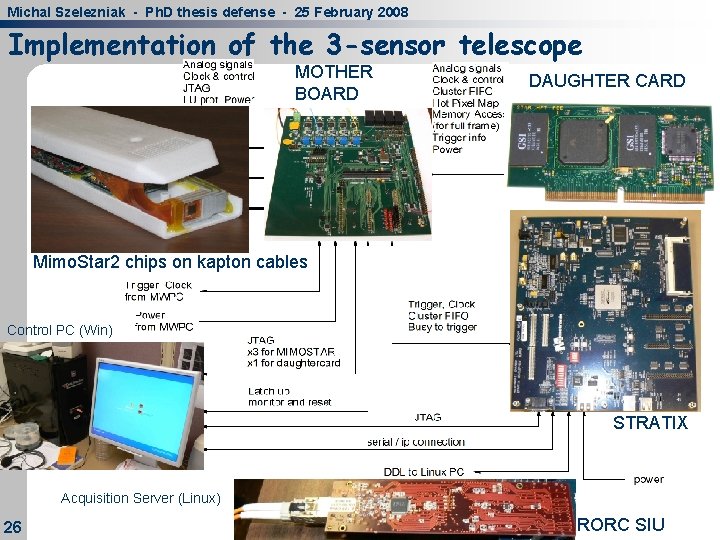
Michal Szelezniak - Ph. D thesis defense - 25 February 2008 Implementation of the 3 -sensor telescope MOTHER BOARD DAUGHTER CARD Mimo. Star 2 chips on kapton cables Control PC (Win) STRATIX Acquisition Server (Linux) 26 26 RORC SIU
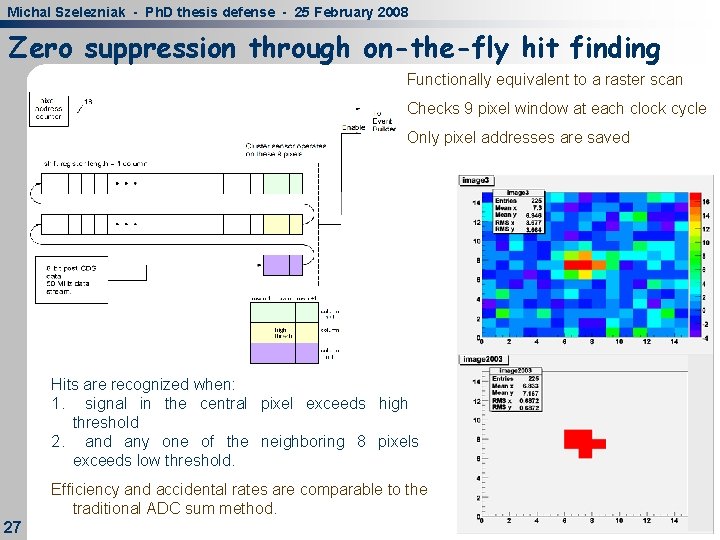
Michal Szelezniak - Ph. D thesis defense - 25 February 2008 Zero suppression through on-the-fly hit finding Functionally equivalent to a raster scan Checks 9 pixel window at each clock cycle Only pixel addresses are saved Hits are recognized when: 1. signal in the central pixel exceeds high threshold 2. and any one of the neighboring 8 pixels exceeds low threshold. 27 Efficiency and accidental rates are comparable to the traditional ADC sum method. 27
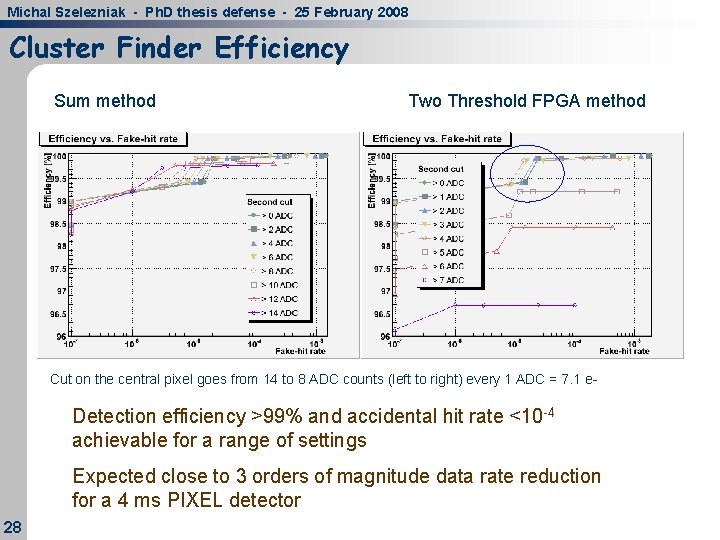
Michal Szelezniak - Ph. D thesis defense - 25 February 2008 Cluster Finder Efficiency Sum method Two Threshold FPGA method Cut on the central pixel goes from 14 to 8 ADC counts (left to right) every 1 ADC = 7. 1 e- Detection efficiency >99% and accidental hit rate <10 -4 achievable for a range of settings Expected close to 3 orders of magnitude data rate reduction for a 4 ms PIXEL detector 28 28
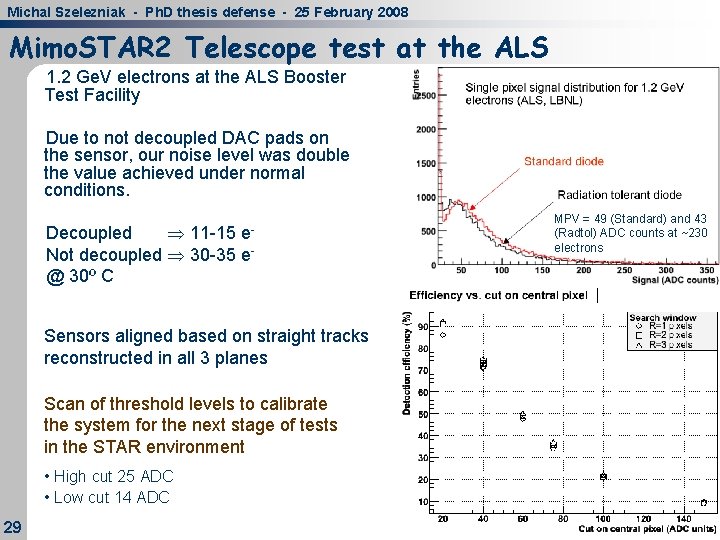
Michal Szelezniak - Ph. D thesis defense - 25 February 2008 Mimo. STAR 2 Telescope test at the ALS 1. 2 Ge. V electrons at the ALS Booster Test Facility Due to not decoupled DAC pads on the sensor, our noise level was double the value achieved under normal conditions. Decoupled 11 -15 Not decoupled 30 -35 e@ 30º C e- Sensors aligned based on straight tracks reconstructed in all 3 planes Scan of threshold levels to calibrate the system for the next stage of tests in the STAR environment • High cut 25 ADC • Low cut 14 ADC 29 29 MPV = 49 (Standard) and 43 (Radtol) ADC counts at ~230 electrons
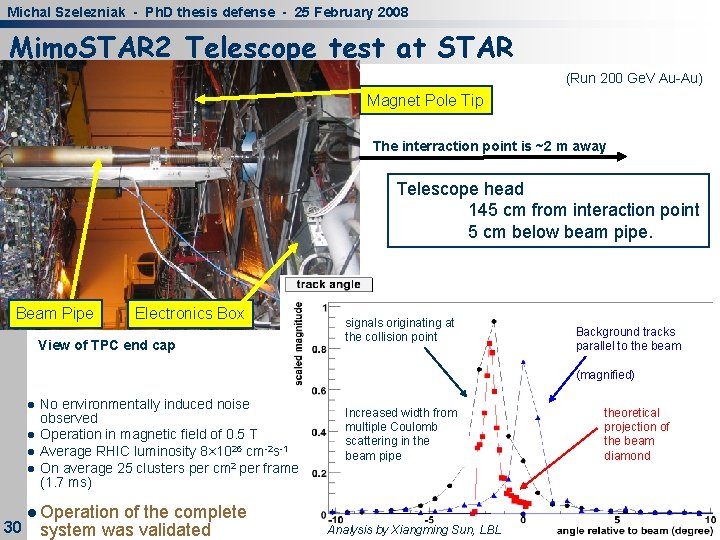
Michal Szelezniak - Ph. D thesis defense - 25 February 2008 Mimo. STAR 2 Telescope test at STAR (Run 200 Ge. V Au-Au) Magnet Pole Tip The interraction point is ~2 m away Telescope head 145 cm from interaction point 5 cm below beam pipe. Beam Pipe Electronics Box View of TPC end cap signals originating at the collision point Background tracks parallel to the beam (magnified) l l 30 No environmentally induced noise observed Operation in magnetic field of 0. 5 T Average RHIC luminosity 8× 1026 cm-2 s-1 On average 25 clusters per cm 2 per frame (1. 7 ms) of the complete 30 system was validated Increased width from multiple Coulomb scattering in the beam pipe l Operation Analysis by Xiangming Sun, LBL theoretical projection of the beam diamond
Michal Szelezniak - Ph. D thesis defense - 25 February 2008 Development of pixel detectors with integrated signal processing for the Vertex Detector in the STAR experiment at the RHIC collider l l l 31 31 The new vertex detector for the STAR experiment Development of Monolithic Active Pixel Sensors (MAPS) at IPHC MAPS prototype for PIXEL detector 3 -sensor telescope system with prototype readout for PIXEL detector Future development plans Summary and Conclusions
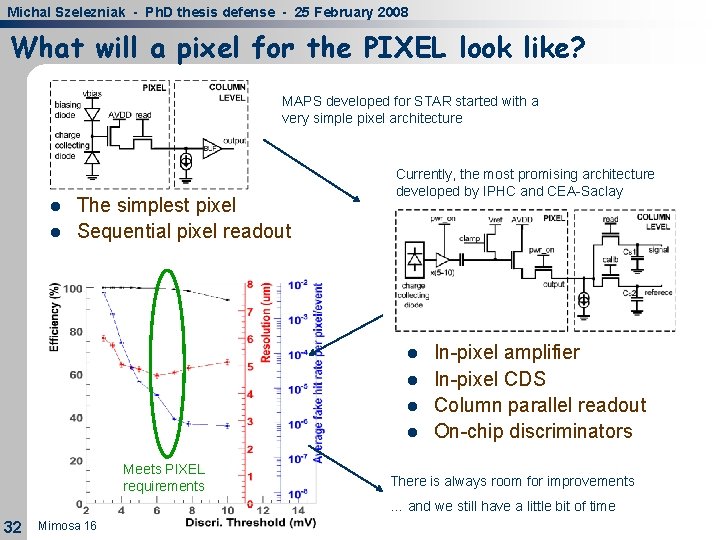
Michal Szelezniak - Ph. D thesis defense - 25 February 2008 What will a pixel for the PIXEL look like? MAPS developed for STAR started with a very simple pixel architecture l l The simplest pixel Sequential pixel readout Currently, the most promising architecture developed by IPHC and CEA-Saclay l l Meets PIXEL requirements In-pixel amplifier In-pixel CDS Column parallel readout On-chip discriminators There is always room for improvements … and we still have a little bit of time 32 Mimosa 32 16
Michal Szelezniak - Ph. D thesis defense - 25 February 2008 Final detector system Under development + Currently in the testing phase Pixel Sensors analog signals Disc. CDS digital signals Data readout sparsification to DAQ Phase-1 sensors – 640 μs integration time Ultimate sensors – <200 μs integration time 33 33 2010 2011 Install 3 -module demonstrator (based on Phase 1) Install final detector
Michal Szelezniak - Ph. D thesis defense - 25 February 2008 Development of pixel detectors with integrated signal processing for the Vertex Detector in the STAR experiment at the RHIC collider l l l 34 34 The new vertex detector for the STAR experiment Development of Monolithic Active Pixel Sensors (MAPS) at IPHC MAPS prototype for PIXEL detector 3 -sensor telescope system with prototype readout for PIXEL detector Future development plans Summary and Conclusions
Michal Szelezniak - Ph. D thesis defense - 25 February 2008 Summary and Conclusions l MAPS development is keeping pace with requirements for STAR – l Mimo. STAR 2 prototype was a necessary precursor to the final STAR PIXEL sensor – – 35 Development of pixels for on chip CDS processing (in-pixel amplifiers, on chip CDS, alternative current mode) Validation of the technology based on the first prototypes Development and testing of the PIXEL detector readout system l The existing sensor architecture with column parallel readout should satisfy PIXEL detector requirements l IPHC-LBL development plan leads us to achieving the design goals in the next few years (2010 – detector demonstrator, 2011 final installation) l PIXEL detector is going to be the first vertex detector built with MAPS technology – significant impact on the HEP field 35
Michal Szelezniak - Ph. D thesis defense - 25 February 2008 Thank you for your attention 36 36
Michal Szelezniak - Ph. D thesis defense - 25 February 2008 Backup Slides 37 37
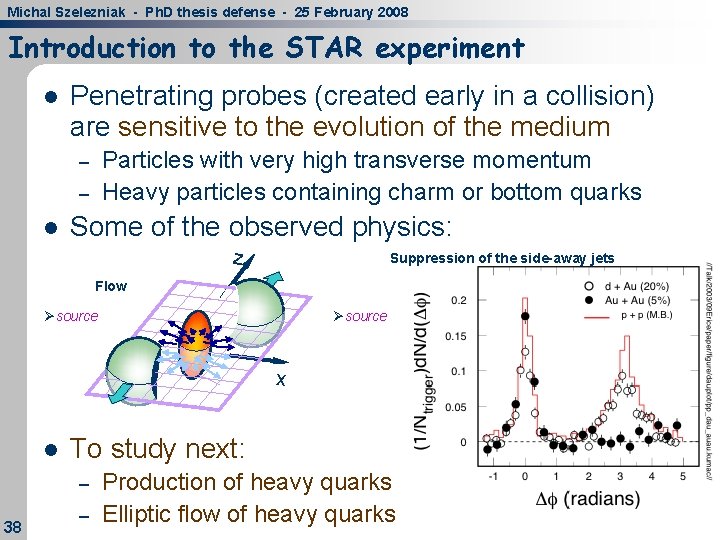
Michal Szelezniak - Ph. D thesis defense - 25 February 2008 Introduction to the STAR experiment l Penetrating probes (created early in a collision) are sensitive to the evolution of the medium Particles with very high transverse momentum Heavy particles containing charm or bottom quarks – – l Some of the observed physics: z Suppression of the side-away jets Flow Øsource x l To study next: – 38 38 – Production of heavy quarks Elliptic flow of heavy quarks
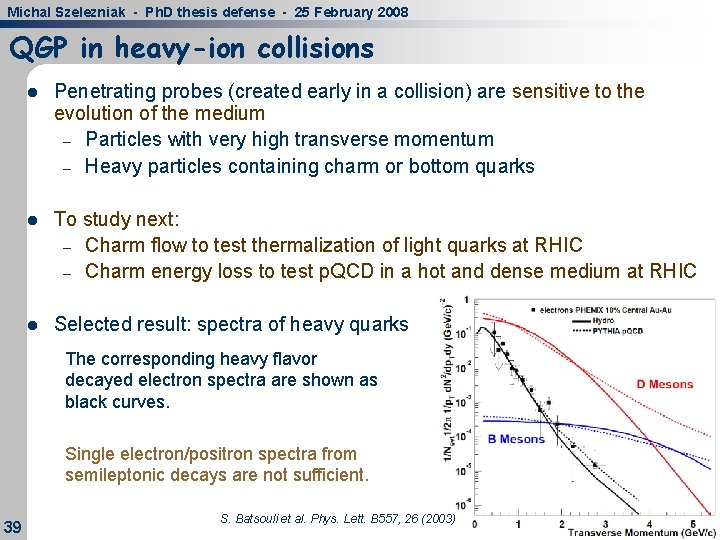
Michal Szelezniak - Ph. D thesis defense - 25 February 2008 QGP in heavy-ion collisions l Penetrating probes (created early in a collision) are sensitive to the evolution of the medium – Particles with very high transverse momentum – Heavy particles containing charm or bottom quarks l To study next: – Charm flow to test thermalization of light quarks at RHIC – Charm energy loss to test p. QCD in a hot and dense medium at RHIC l Selected result: spectra of heavy quarks The corresponding heavy flavor decayed electron spectra are shown as black curves. Single electron/positron spectra from semileptonic decays are not sufficient. 39 39 S. Batsouli et al. Phys. Lett. B 557, 26 (2003)
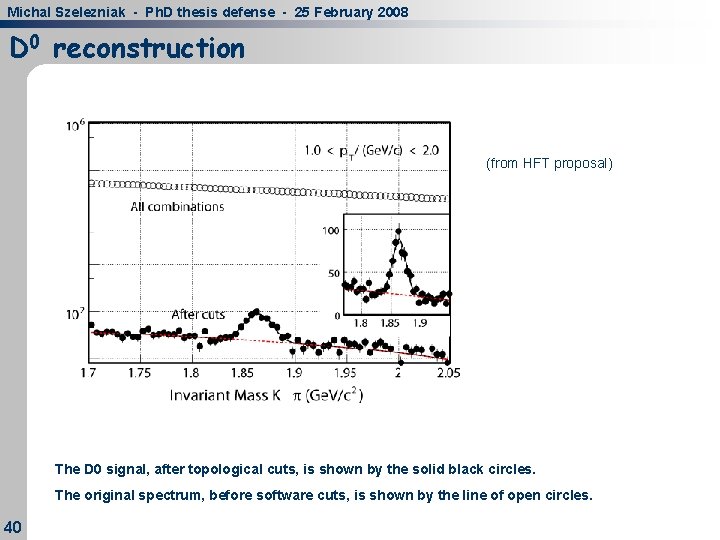
Michal Szelezniak - Ph. D thesis defense - 25 February 2008 D 0 reconstruction (from HFT proposal) The D 0 signal, after topological cuts, is shown by the solid black circles. The original spectrum, before software cuts, is shown by the line of open circles. 40 40
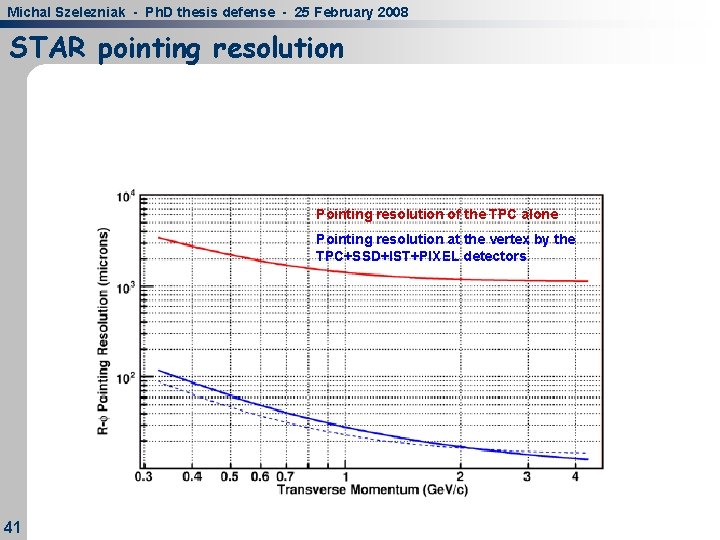
Michal Szelezniak - Ph. D thesis defense - 25 February 2008 STAR pointing resolution Pointing resolution of the TPC alone Pointing resolution at the vertex by the TPC+SSD+IST+PIXEL detectors 41 41
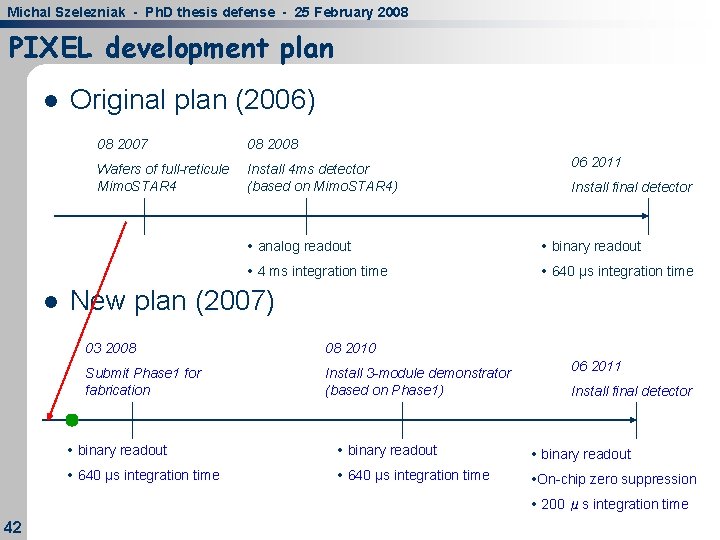
Michal Szelezniak - Ph. D thesis defense - 25 February 2008 PIXEL development plan l l Original plan (2006) 08 2007 08 2008 Wafers of full-reticule Mimo. STAR 4 Install 4 ms detector (based on Mimo. STAR 4) 06 2011 Install final detector analog readout binary readout 4 ms integration time 640 μs integration time New plan (2007) 03 2008 08 2010 Submit Phase 1 for fabrication Install 3 -module demonstrator (based on Phase 1) 06 2011 Install final detector binary readout 640 μs integration time On-chip zero suppression 200 μs integration time 42 42
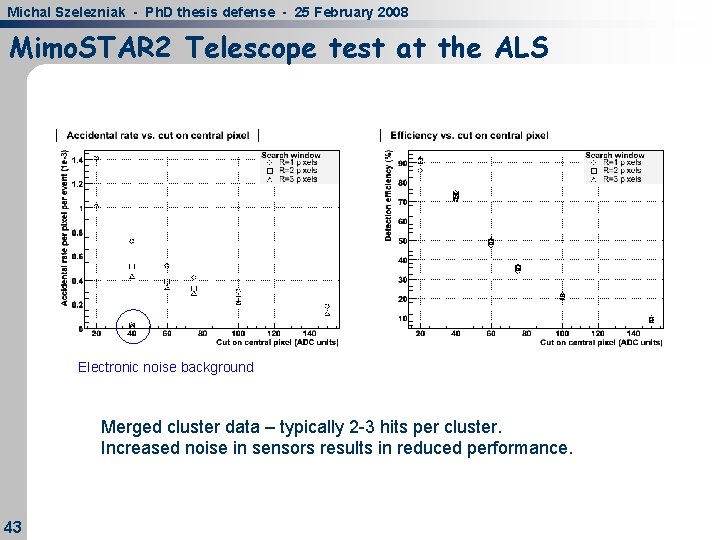
Michal Szelezniak - Ph. D thesis defense - 25 February 2008 Mimo. STAR 2 Telescope test at the ALS Electronic noise background Merged cluster data – typically 2 -3 hits per cluster. Increased noise in sensors results in reduced performance. 43 43
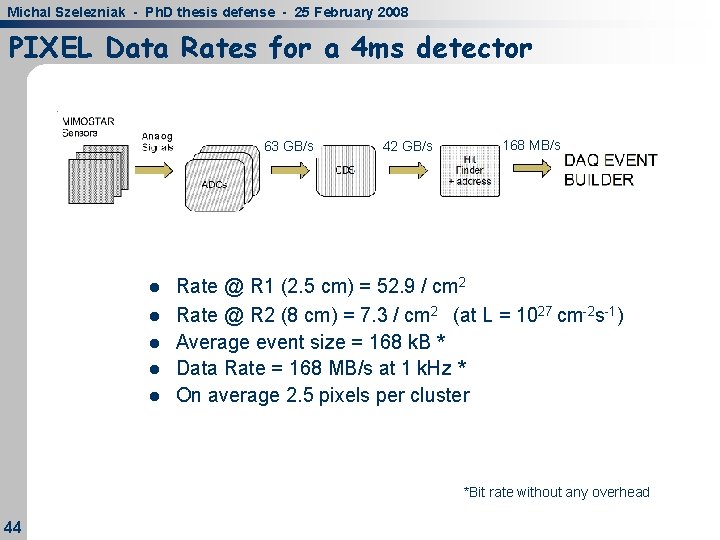
Michal Szelezniak - Ph. D thesis defense - 25 February 2008 PIXEL Data Rates for a 4 ms detector 63 GB/s l l l 42 GB/s 168 MB/s Rate @ R 1 (2. 5 cm) = 52. 9 / cm 2 Rate @ R 2 (8 cm) = 7. 3 / cm 2 (at L = 1027 cm-2 s-1) Average event size = 168 k. B * Data Rate = 168 MB/s at 1 k. Hz * On average 2. 5 pixels per cluster *Bit rate without any overhead 44 44
Michal Szelezniak - Ph. D thesis defense - 25 February 2008 PIXEL ladder 45 45
Michal Szelezniak - Ph. D thesis defense - 25 February 2008 Telescope results l l 46 46 RDO system with on-the-fly data sparsification implemented and functional for Mimostar 2 sensors. Prototype system fully functional and characterized. Fully functioning interfaces between the prototype system and STAR detector infrastructure. Completed measurements of detector environment at STAR.
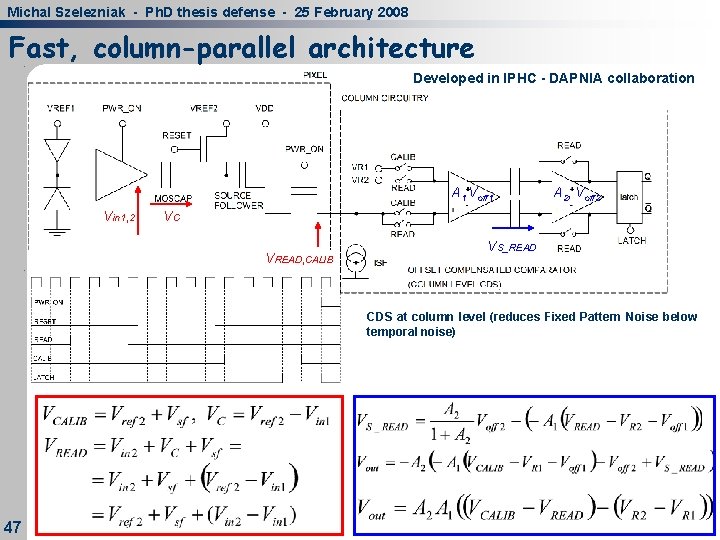
Michal Szelezniak - Ph. D thesis defense - 25 February 2008 Fast, column-parallel architecture Developed in IPHC - DAPNIA collaboration A 1 Voff 1 Vin 1, 2 A 2, Voff 2 VC VREAD, CALIB VS_READ CDS at column level (reduces Fixed Pattern Noise below temporal noise) 47 47
Michal Szelezniak - Ph. D thesis defense - 25 February 2008 Next generation of prototypes 48 l Radiation tolerant diode design l Column parallel readout with on-chip discriminators l Binary readout l JTAG controlled configuration l On-chip zero suppression (currently at prototyping stage) 48
Michal Szelezniak - Ph. D thesis defense - 25 February 2008 Summary and Conclusions l An architecture of the MAPS sensor that should comply with the final PIXEL detector requirements exists and provides very promising initial results l The on-going development of pixel architectures and in particular inpixel amplifiers has a potential of further improving the established performance l Readout architecture for the PIXEL detector has been prototyped and validated – – l 49 Reading out sensors with binary output will require adjustments w. r. t. the existing solution (fast LVDS readout) Detector dead-time is primarily limited by the number of externally allocated readout buffers The next mile-stone for MAPS and PIXEL development will integrate the new full-size (640× 640 pixels) sensor prototype (Phase-1 under development), prototype mechanical support and new readout system for fast binary sensor readout 49
Michal Szelezniak - Ph. D thesis defense - 25 February 2008 Development of pixel detectors with integrated signal processing for the Vertex Detector in the STAR experiment at the RHIC collider l The new vertex detector for the STAR experiment – – – l l l 50 50 Introduction to the STAR experiment HFT: new vertex detector for STAR PIXEL detector Development of Monolithic Active Pixel Sensors (MAPS) at IPHC MAPS prototype for PIXEL detector 3 -sensor telescope system with prototype readout for PIXEL detector Future development plans Summary and Conclusions