
Development of PID controller for Autonomous Mecanum Wheel



- Slides: 15
Development of PID controller for Autonomous Mecanum Wheel Robot (Holobot) Cole Perrault Spring 2015 ET 493 Wesley Deneke
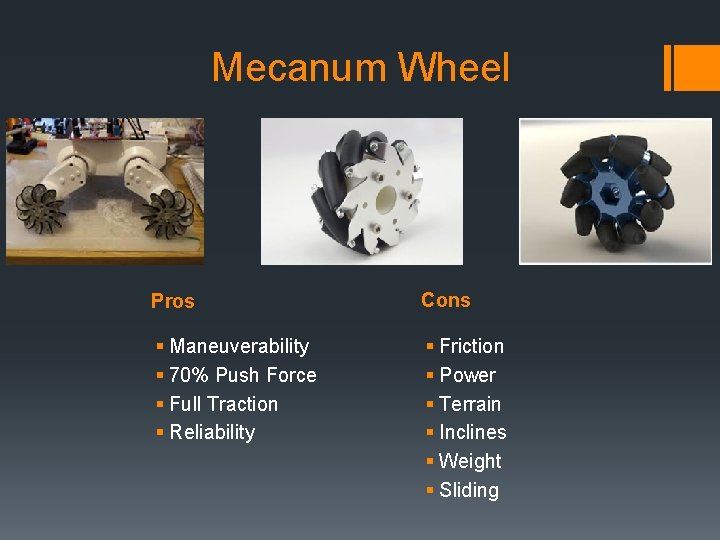
Mecanum Wheel Pros Cons § Maneuverability § 70% Push Force § Full Traction § Reliability § Friction § Power § Terrain § Inclines § Weight § Sliding
Mecanum Wheels
Proportional-Integral-Differential § Proportional – Product of gain and measured error. Reduces large part of overall error § Integral – Summing error over time to drive the system to smaller error. Reduces final error in a system § Derivative – Counteracts the Kp and Ki terms when output changes quickly.
Holobot Autonomous System § Microcontroller § Motor Shield § DC Motor with Encoders § Mecanum Wheels § Distance Sensor § 7. 2 V Battery 3 A PID System § Calculations § Implementing § Analysis § Tuning § Conclusion
Holobot
Arduino and Shields
DC Motor § Gear Ratio: 74. 83: 1 § 6 V Free-Run 130 rpm § 6 V Free-Run Current 450 m. A § 6 V Stall Current 6000 m. A § 6 V Stall Torque 130 oz*in § 48 CPR gives 3592 Counts per Revolution
PID System
Motivation § Implement PID system for personal development – learn something § Have a platform to be used by future students – teach others § Implement small research and development for the stability in systems – perform research § Contribution to the school for future interests – school merit
Accomplishments § Peripherals Research § Design Analysis § DC Motor Research § Voltage Regulation § Power Consumption § Torque and Speed Calculations § Transfer Function Equations
Methodology § Torque Calculations § Power Calculations § Battery Calculations § Speed Calculations § Transfer Function
Future Goals § Building the Holobot § Torque/Speed Analysis § Coding the Holobot § Movement § States § Testing the Holobot § Movement § Incline § Terrain § Implementation of PID § Testing of PID § Overshoot Analysis § Desired Output
Deliverables § Build Holobot……………. . ……………………. May 6 § Mathematical Methods Sheet………………. May 30 § Test each Peripheral………………April 2 § Code……………………. ……. . . ……………. April 2 § Test Holobot………………. Summer 2015 § Implementation of PI………………. . . Fall 2015 § Testing of PID………………………. ……Fall 2015
Holobot Cole Perrault Spring 2015 ET 493 Wesley Deneke