
Development of Performance Testing Methods for Dynamic Frequency
- Slides: 33
Development of Performance Testing Methods for Dynamic Frequency Selection (DFS) 5 -GHz Wireless Access Systems (WAS) Frank Sanders Chief, Telecommunications Theory Division NTIA Institute for Telecommunication Sciences U. S. Department of Commerce Fsanders@its. bldrdoc. gov International Symposium on Advanced Radio Technologies 2006 March 8, 2006 1
Challenge: Share Spectrum Between Historically Incompatible Services n n Historically, radar services have not been technically compatible with other services, such as WAS. (More on this on the next slide. ) The usual approach to technical incompatibility has been to allocate separate spectrum bands for such services. For example: • • n BSS service (2310 -2360 MHz); ISM band (2400 -2500 MHz, incl. 802. 11 b & g in 2400 -2483. 5 MHz); BSS service (2500 -2690 MHz, recently deleted by the FCC); 2700 -2900 MHz (airport surveillance radars). Benefits would be derived if some sharing could occur between 802. 11 devices and radars. Sharing benefits would include: • Less variation in worldwide in regulatory requirements, resulting in less variation in design and production of 802. 11 devices; • Easier transitions for 802. 11 devices across international boundaries for travelers; • Easier use of existing 5 -GHz ISM spectrum allocation (5725 -5875 MHz) by 802. 11 -type WAS devices with overlapping radar allocation of 5250 -5850 MHz. 2
Why Radars Don’t Share Well with Other Services n n n Although radar transmitters generate high power levels, the receivers are among the most sensitive of any radio systems. Radar receiver performance is noise-limited. This means that radar receiver performance is degraded occur when interference is about 6 -10 d. B below the radar receiver noise floor. (That is at I/N levels of -6 d. B to -10 d. B in radar receivers. ) NTIA tests over the past five years have consistently shown that these levels commonly degrade radar receiver performance. Radar receiver signal processing gain techniques and anti-jamming techniques are generally ineffective at mitigating interference from other systems, based on NTIA test results. Systems in other services therefore have to avoid operations on radar frequencies in order to prevent interference. This is why radar bands have not historically been shared with other services. 3
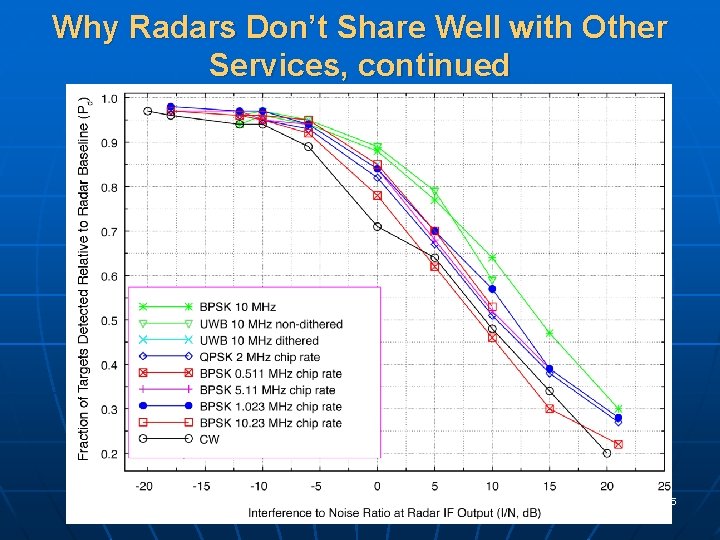
Why Radars Don’t Share Well with Other Services, continued n n When interference is injected into radar receivers at low levels (such as an I/N level of about 6 d. B), desired targets are lost. The effect is insidious because there are no overt indications of trouble. 4
Why Radars Don’t Share Well with Other Services, continued 5
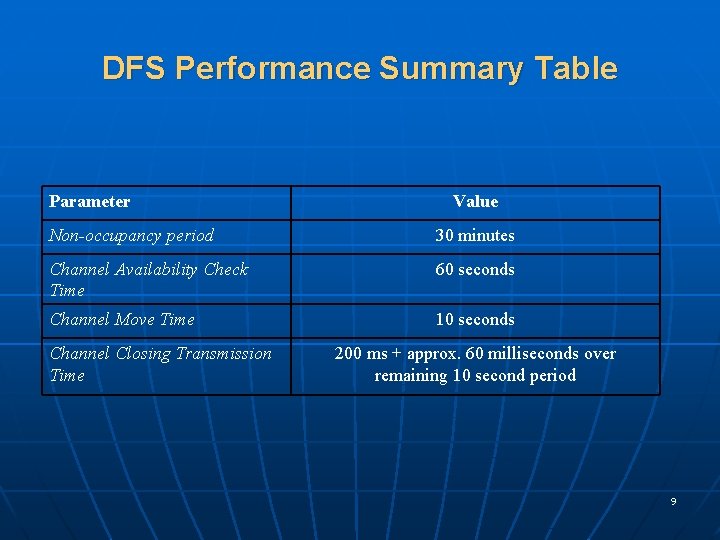
What is Dynamic Frequency Selection? DFS is an interference mitigation-avoidance mechanism in which a U-NII device operating in the 5 GHz bands is supposed to automatically “sense” if a radar is operating in its vicinity and vacate that frequency in a timely manner when detection occurs. DFS functions in Rlan devices are not to be user-controlled or accessible. The Rlan devices must totally vacate the channel (no emissions) with 10 seconds of radar detection and have 260 ms of time within that to shut the network down. It must not use that channel for 30 minutes and must check a channel for 1 minute before it uses it. 6
Radar/DFS Background and History n n In WRC-03 the bands 5250 -5350 and 5470 -5725 MHz bands were allocated to the mobile service on a co-primary basis with the radiodetermination service, with the provision that devices in the mobile service in these bands use DFS to protect radar systems. In the ITU-R, Recommendation M. 1652 was produced by Joint Task Group (JTG) 8 A/9 B internationally to facilitate development of the U-NII devices. The recommendation contains 5 GHz radar system characteristics and a description of the U-NII channel move times along with other information. In the United States, the FCC, NTIA, and Do. D along with the U-NII Industry have been working together for two years to develop certification test plans and procedures for devices that operate in the bands 5250 -5350 and 54705725 MHz bands. Bench tests with devices from multiple manufacturers have taken place at the ITS laboratory as well as field tests at a Southwestern test range in NM. Data were tabulated on the test results, but are not “official” NTIA or FCC reports. 7
The FCC Type Compliance Tests Developed with NTIA for 5 GHz U-NII Device Certification Include: n n n Power-on test: No Rlan emissions for 60 seconds after power-up done. Radar detection 6 seconds after power-on cycle completed. Radar detection 6 seconds before end of initial 1 minute check time. In-Service monitoring: This is the most comprehensive test as the U-NII device must detect various synthesized radar waveforms representative of those operating the 5 GHz bands. For in-service tests, an MPEG file is streamed from computer to computer using an access point (AP) and a Client device to load the RF channel with traffic. The AP contains built-in DFS functions. 30 minute non-occupancy test: When a channel has been identified as being used by a radar, the U-NII device must not use it for 30 minutes. 8
DFS Performance Summary Table Parameter Value Non-occupancy period 30 minutes Channel Availability Check Time 60 seconds Channel Move Time 10 seconds Channel Closing Transmission Time 200 ms + approx. 60 milliseconds over remaining 10 second period 9
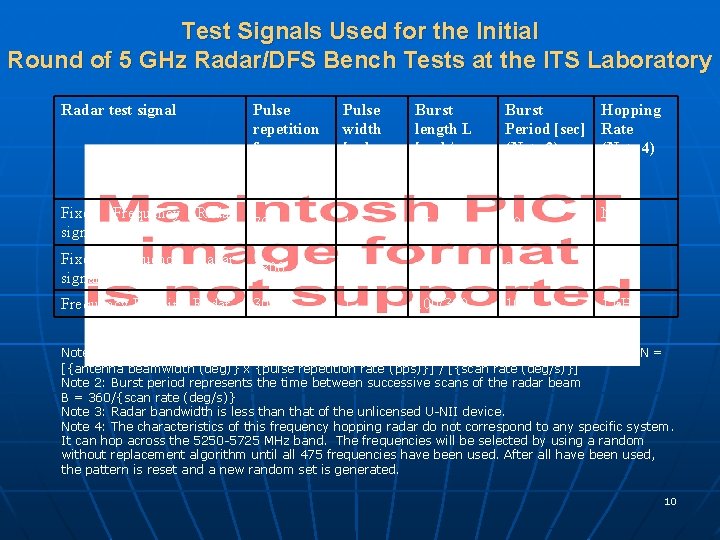
Test Signals Used for the Initial Round of 5 GHz Radar/DFS Bench Tests at the ITS Laboratory Radar test signal Pulse repetition frequency PRF [pps] Pulse width [µs] Burst length L [ms] / no. of pulses (Note 1) Burst Hopping Period [sec] Rate (Note 2) (Note 4) Fixed Frequency Radar signal 1 700 1 26 / 18 10 Fixed Frequency Radar signal 2 1800 1 5 / 10 2 Frequency Hopping Radar 3000 1 100/300 10 Na Na 1 k. Hz Note 1: This represents the number of pulses seen at the unit under test (UUT) per radar scan N = [{antenna beamwidth (deg)} x {pulse repetition rate (pps)}] / [{scan rate (deg/s)}] Note 2: Burst period represents the time between successive scans of the radar beam B = 360/{scan rate (deg/s)} Note 3: Radar bandwidth is less than that of the unlicensed U-NII device. Note 4: The characteristics of this frequency hopping radar do not correspond to any specific system. It can hop across the 5250 -5725 MHz band. The frequencies will be selected by using a random without replacement algorithm until all 475 frequencies have been used. After all have been used, the pattern is reset and a new random set is generated. 10
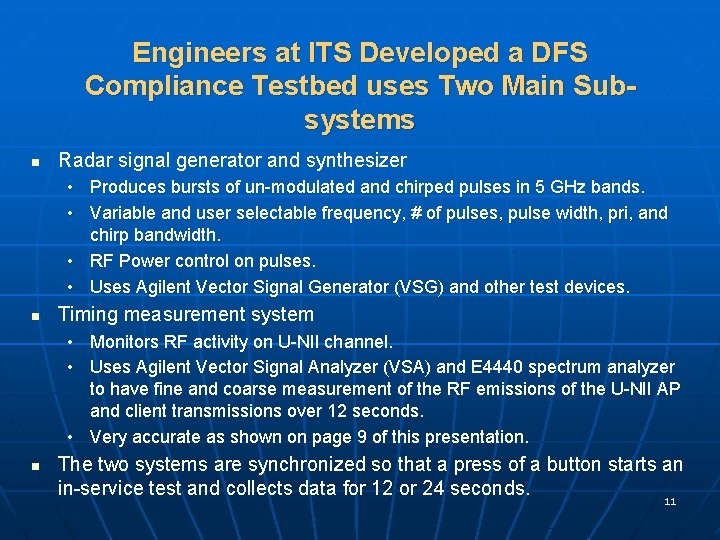
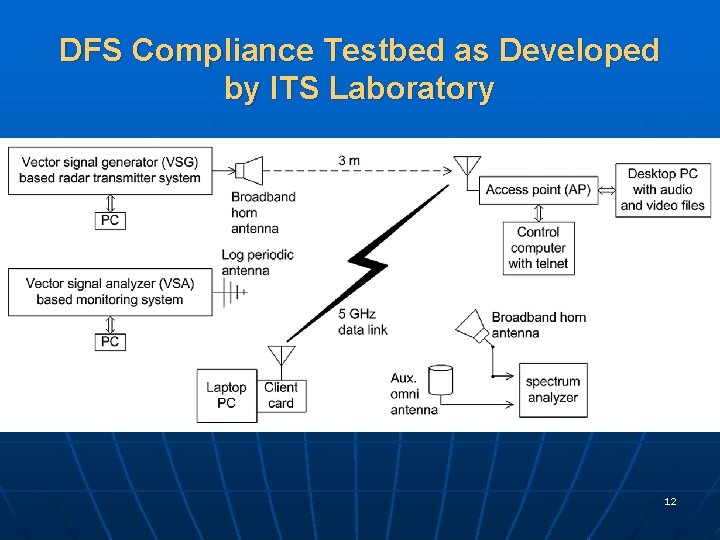
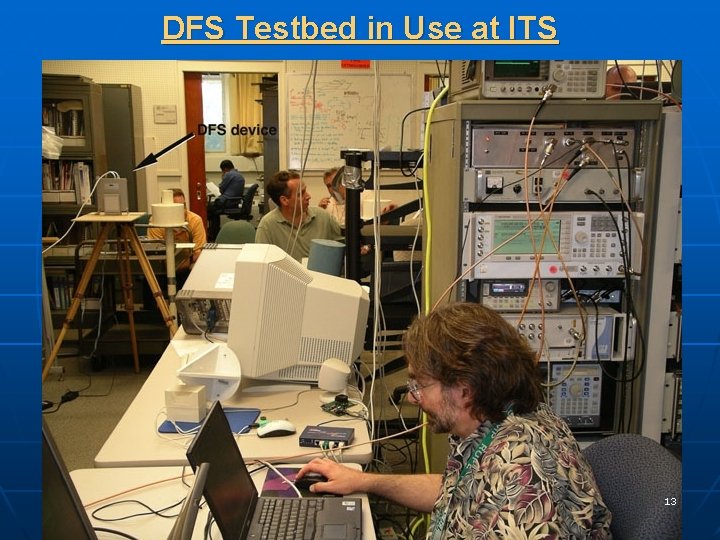
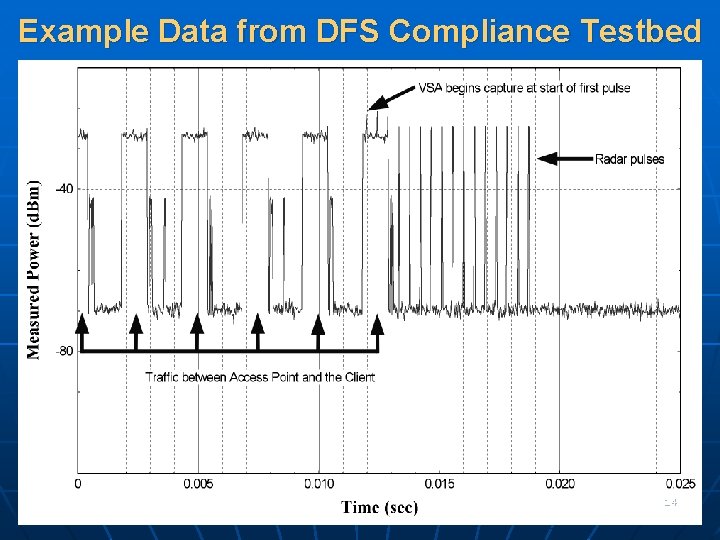
Engineers at ITS Developed a DFS Compliance Testbed uses Two Main Subsystems n Radar signal generator and synthesizer • Produces bursts of un-modulated and chirped pulses in 5 GHz bands. • Variable and user selectable frequency, # of pulses, pulse width, pri, and chirp bandwidth. • RF Power control on pulses. • Uses Agilent Vector Signal Generator (VSG) and other test devices. n Timing measurement system • Monitors RF activity on U-NII channel. • Uses Agilent Vector Signal Analyzer (VSA) and E 4440 spectrum analyzer to have fine and coarse measurement of the RF emissions of the U-NII AP and client transmissions over 12 seconds. • Very accurate as shown on page 9 of this presentation. n The two systems are synchronized so that a press of a button starts an in-service test and collects data for 12 or 24 seconds. 11
DFS Compliance Testbed as Developed by ITS Laboratory 12
DFS Testbed in Use at ITS 13
Example Data from DFS Compliance Testbed 14
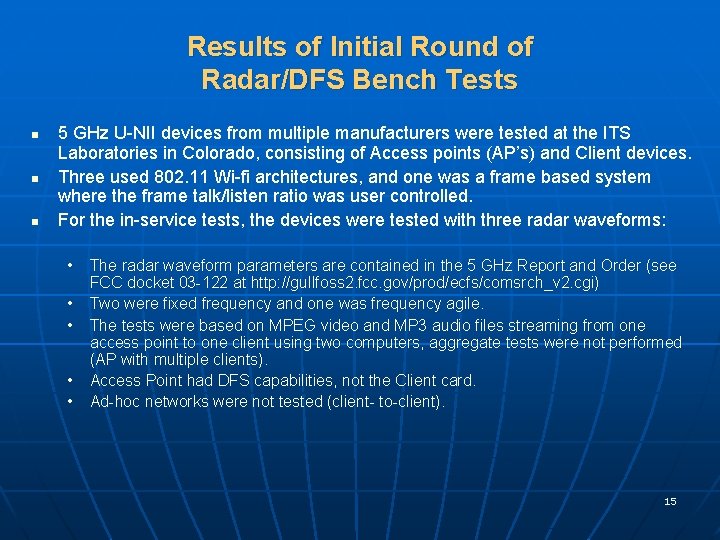
Results of Initial Round of Radar/DFS Bench Tests n n n 5 GHz U-NII devices from multiple manufacturers were tested at the ITS Laboratories in Colorado, consisting of Access points (AP’s) and Client devices. Three used 802. 11 Wi-fi architectures, and one was a frame based system where the frame talk/listen ratio was user controlled. For the in-service tests, the devices were tested with three radar waveforms: • The radar waveform parameters are contained in the 5 GHz Report and Order (see FCC docket 03 -122 at http: //gullfoss 2. fcc. gov/prod/ecfs/comsrch_v 2. cgi) • Two were fixed frequency and one was frequency agile. • The tests were based on MPEG video and MP 3 audio files streaming from one access point to one client using two computers, aggregate tests were not performed (AP with multiple clients). • Access Point had DFS capabilities, not the Client card. • Ad-hoc networks were not tested (client- to-client). 15
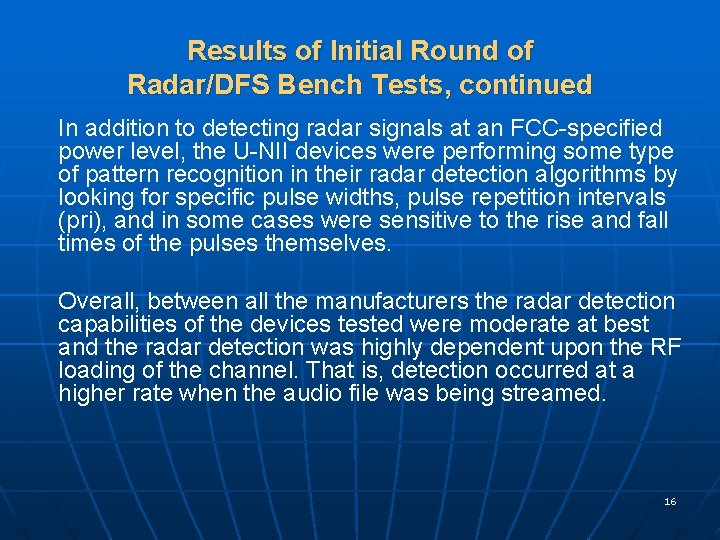
Results of Initial Round of Radar/DFS Bench Tests, continued In addition to detecting radar signals at an FCC-specified power level, the U-NII devices were performing some type of pattern recognition in their radar detection algorithms by looking for specific pulse widths, pulse repetition intervals (pri), and in some cases were sensitive to the rise and fall times of the pulses themselves. Overall, between all the manufacturers the radar detection capabilities of the devices tested were moderate at best and the radar detection was highly dependent upon the RF loading of the channel. That is, detection occurred at a higher rate when the audio file was being streamed. 16
Results of Initial Round of Radar/DFS Bench Tests, continued A key finding was that the devices were not able to detect radar pulses that were comparable in length to a typical 802. 11 data packet. The devices had no way to determine if the long radar pulse was a true radar signal or a corrupted 802. 11 data packet. Eliminating false detections (which cause channels to be unnecessarily vacated) was thus a challenge to the U-NII Industry in developing proper algorithms. 17
Results of Initial Round of Radar/DFS Bench Tests, continued Similar U-NII/radar DFS tests performed by other Administrations (Japan, France, Germany) drew similar results and conclusions. Their tests used radar test signals that were similar to those used in the NTIA bench tests. These administrations are watching the proceedings of the U. S. 5 GHz working group very closely and will may adopt similar rules and test procedures. 18
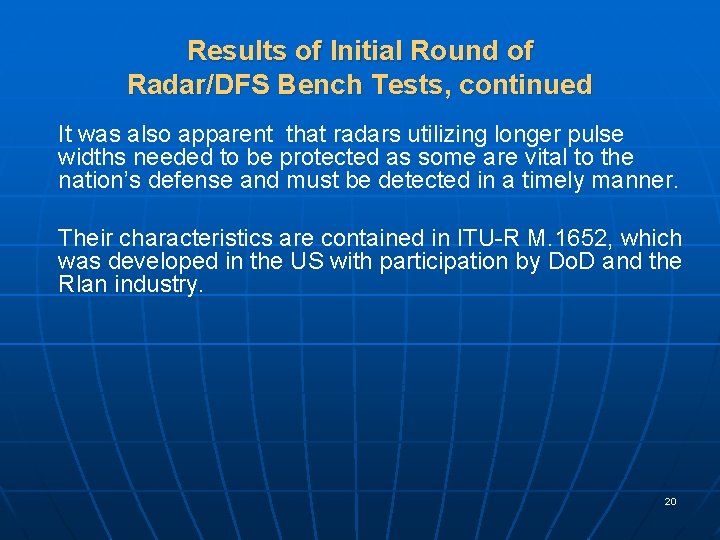
Results of Initial Round of Radar/DFS Bench Tests, continued 1 minute power-on test Radar burst at end of 1 min. check time Radar burst at start of 1 min. check time In-Service test with MPEG file 19
Results of Initial Round of Radar/DFS Bench Tests, continued It was also apparent that radars utilizing longer pulse widths needed to be protected as some are vital to the nation’s defense and must be detected in a timely manner. Their characteristics are contained in ITU-R M. 1652, which was developed in the US with participation by Do. D and the Rlan industry. 20
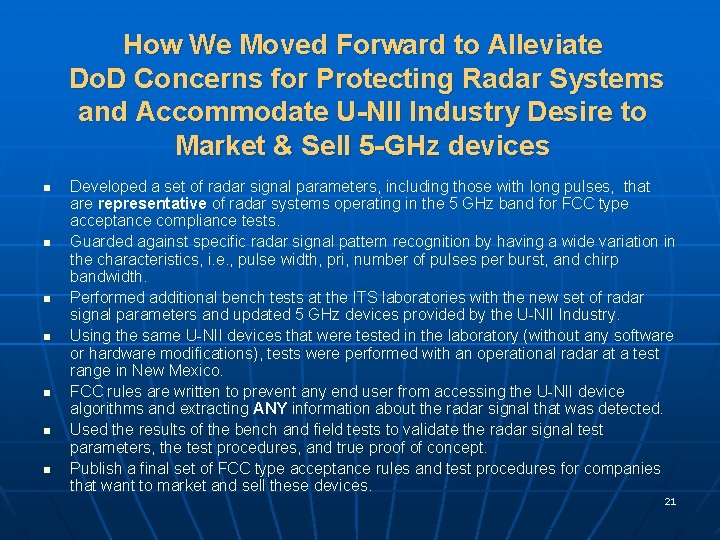
How We Moved Forward to Alleviate Do. D Concerns for Protecting Radar Systems and Accommodate U-NII Industry Desire to Market & Sell 5 -GHz devices n n n n Developed a set of radar signal parameters, including those with long pulses, that are representative of radar systems operating in the 5 GHz band for FCC type acceptance compliance tests. Guarded against specific radar signal pattern recognition by having a wide variation in the characteristics, i. e. , pulse width, pri, number of pulses per burst, and chirp bandwidth. Performed additional bench tests at the ITS laboratories with the new set of radar signal parameters and updated 5 GHz devices provided by the U-NII Industry. Using the same U-NII devices that were tested in the laboratory (without any software or hardware modifications), tests were performed with an operational radar at a test range in New Mexico. FCC rules are written to prevent any end user from accessing the U-NII device algorithms and extracting ANY information about the radar signal that was detected. Used the results of the bench and field tests to validate the radar signal test parameters, the test procedures, and true proof of concept. Publish a final set of FCC type acceptance rules and test procedures for companies that want to market and sell these devices. 21
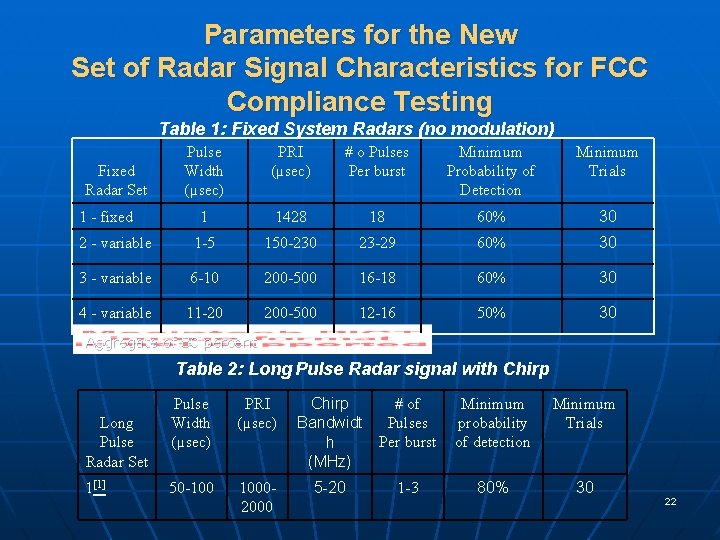
Parameters for the New Set of Radar Signal Characteristics for FCC Compliance Testing Table 1: Fixed System Radars (no modulation) Pulse Width (µsec) PRI (µsec) # o Pulses Per burst Minimum Probability of Detection Minimum Trials 1 1428 18 60% 30 2 - variable 1 -5 150 -230 23 -29 60% 30 3 - variable 6 -10 200 -500 16 -18 60% 30 4 - variable 11 -20 200 -500 12 -16 50% 30 Fixed Radar Set 1 - fixed Aggregate of 80 percent Table 2: Long Pulse Radar signal with Chirp Long Pulse Radar Set 1[1] Pulse Width (µsec) PRI (µsec) Chirp Bandwidt h (MHz) # of Pulses Per burst Minimum probability of detection Minimum Trials 50 -100 10002000 5 -20 1 -3 80% 30 22
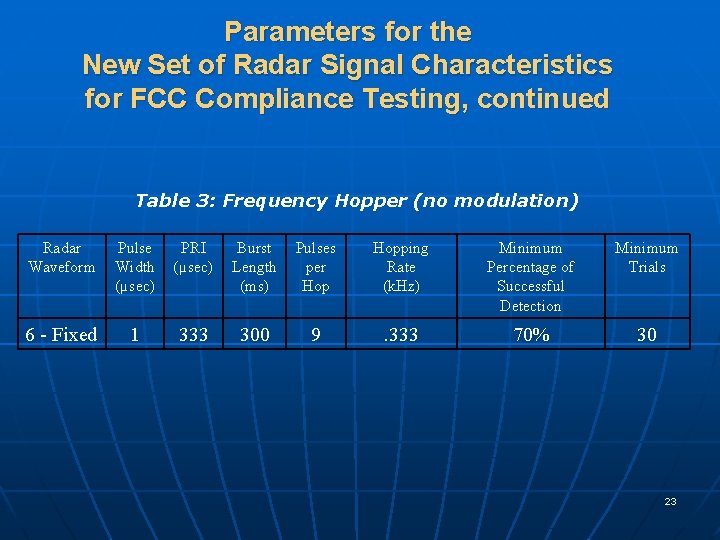
Parameters for the New Set of Radar Signal Characteristics for FCC Compliance Testing, continued Table 3: Frequency Hopper (no modulation) Radar Waveform Pulse Width (µsec) PRI (µsec) Burst Length (ms) Pulses per Hopping Rate (k. Hz) Minimum Percentage of Successful Detection Minimum Trials 6 - Fixed 1 333 300 9 . 333 70% 30 23
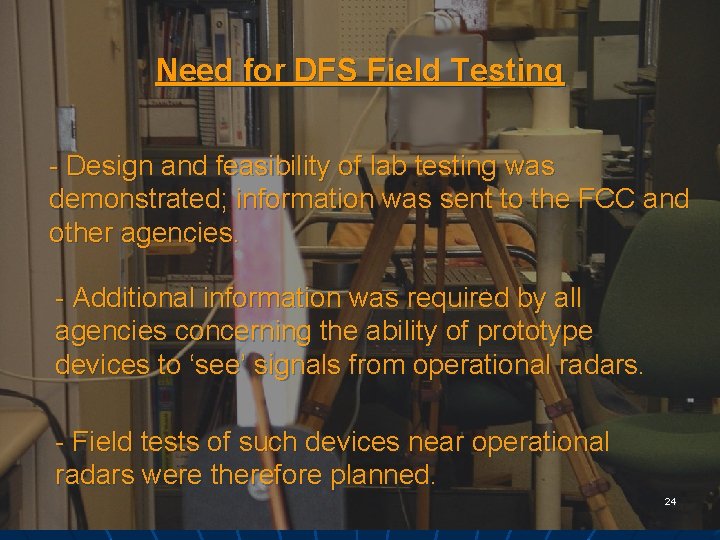
Need for DFS Field Testing - Design and feasibility of lab testing was demonstrated; information was sent to the FCC and other agencies. - Additional information was required by all agencies concerning the ability of prototype devices to ‘see’ signals from operational radars. - Field tests of such devices near operational radars were therefore planned. 24
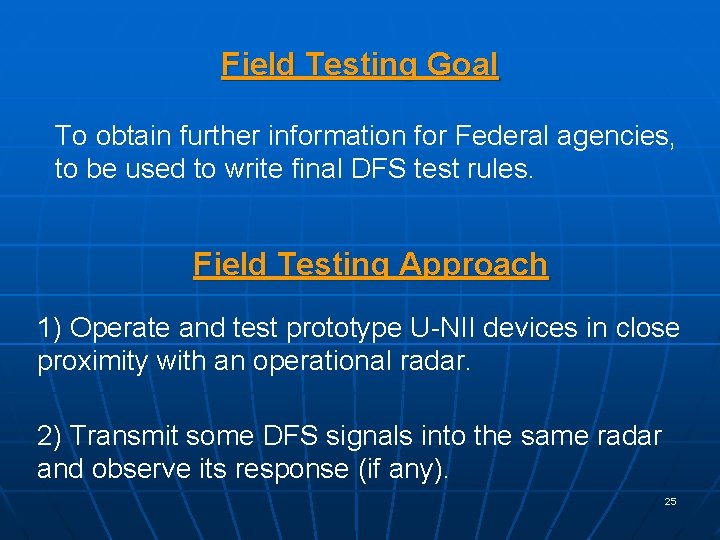
Field Testing Goal To obtain further information for Federal agencies, to be used to write final DFS test rules. Field Testing Approach 1) Operate and test prototype U-NII devices in close proximity with an operational radar. 2) Transmit some DFS signals into the same radar and observe its response (if any). 25
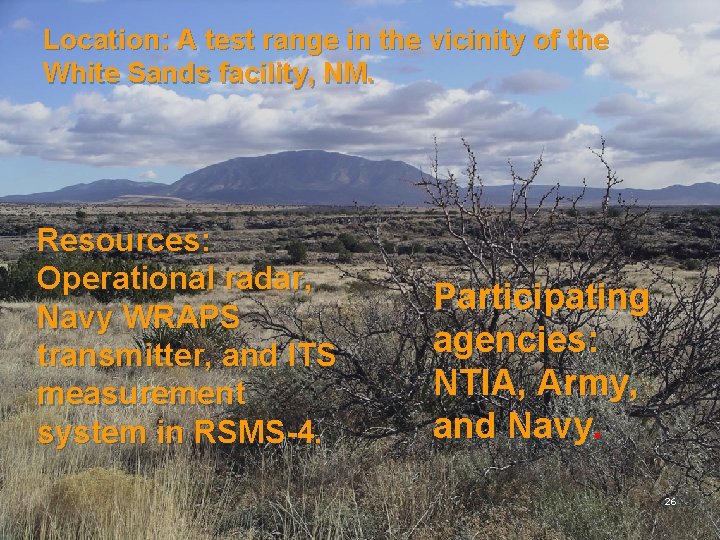
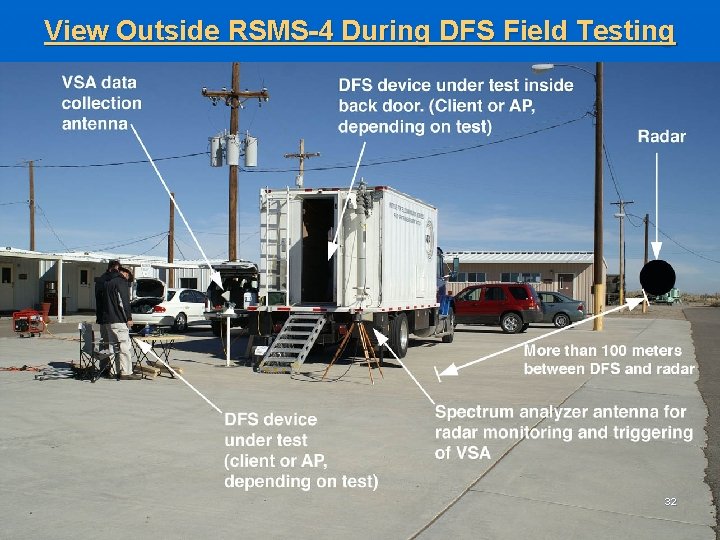
Location: A test range in the vicinity of the White Sands facility, NM. Resources: Operational radar, Navy WRAPS transmitter, and ITS measurement system in RSMS-4. Participating agencies: NTIA, Army, and Navy. 26
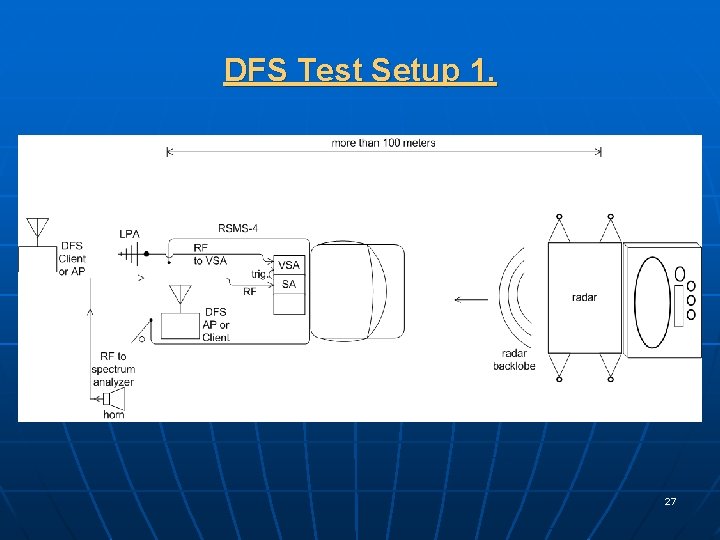
DFS Test Setup 1. 27
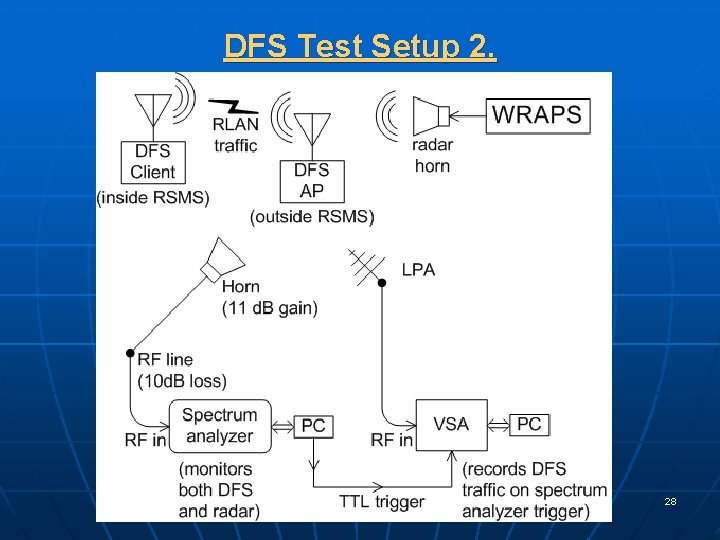
DFS Test Setup 2. 28
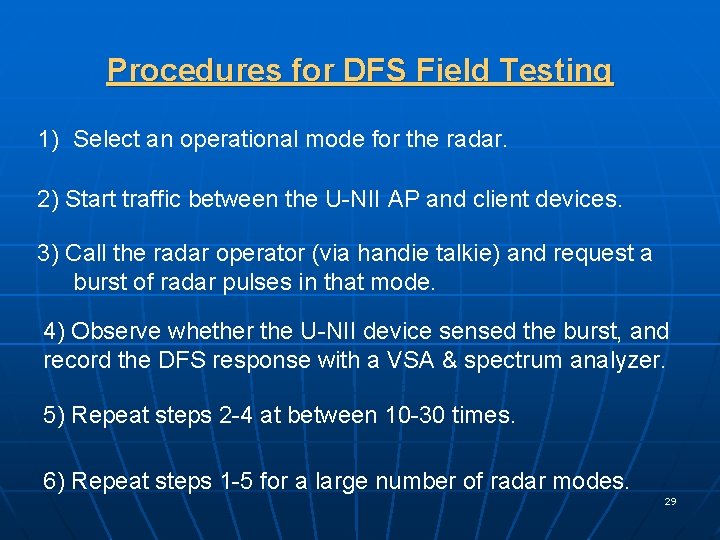
Procedures for DFS Field Testing 1) Select an operational mode for the radar. 2) Start traffic between the U-NII AP and client devices. 3) Call the radar operator (via handie talkie) and request a burst of radar pulses in that mode. 4) Observe whether the U-NII device sensed the burst, and record the DFS response with a VSA & spectrum analyzer. 5) Repeat steps 2 -4 at between 10 -30 times. 6) Repeat steps 1 -5 for a large number of radar modes. 29
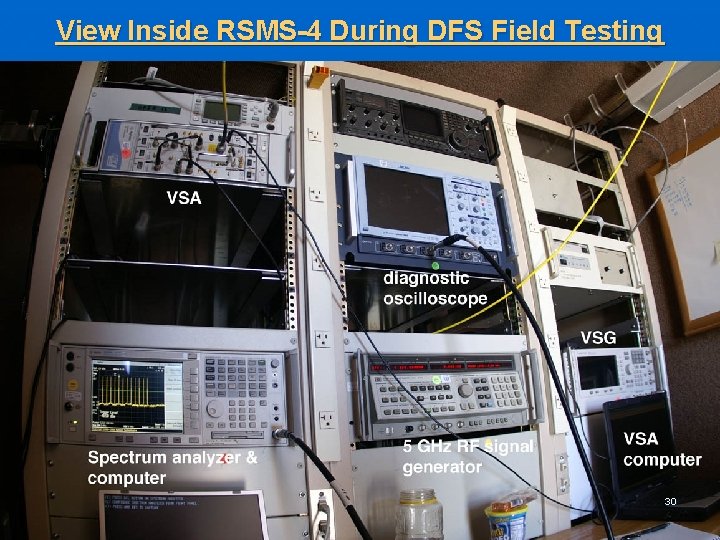
View Inside RSMS-4 During DFS Field Testing 30
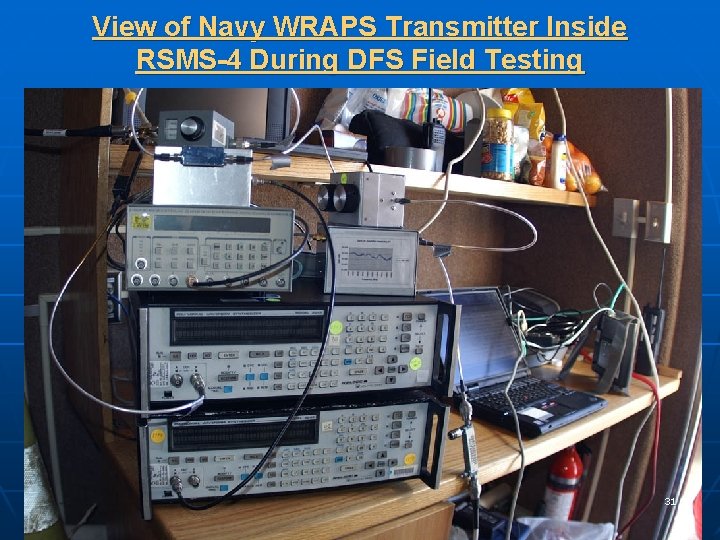
View of Navy WRAPS Transmitter Inside RSMS-4 During DFS Field Testing 31
View Outside RSMS-4 During DFS Field Testing 32
Summary of 5 GHz Radar/DFS Test Development Activities n n n Bench tests with new set of radar characteristics took place in August 2005 at ITS Laboratories in Boulder, Colorado with three U-NII vendors supplying devices. Each vendor had 1 week of laboratory time and was allowed some modifications of their equipment prior to actual tests with some experimentation with the radar test signals. Do. D and U-NII industry had representatives present at the tests in Colorado to witness and observe the results. Actual tests were performed by NTIA and ITS personnel. A report on the results was authored by NTIA (Bob Sole and Frank Sanders). Frank Sanders was the lead engineer at ITS for the project. Field tests with an operational 5 GHz radar and with the same U-NII equipment that was used in the bench tests took place in December 2005 at the Mc. Gregor Test range in New Mexico The U-NII vendors with proper clearances attended and witnessed the tests, but were not be allowed to modify their equipment for or during the tests. NTIA, ITS, and Do. D personnel performed the tests. The results of the Field tests were similar to the results of the bench tests with respect to the U-NII devices ability to detect the radar signals and move off the channel. Government and industry met in February 2006 to review the data and to write the final compliance test procedures as a revised Appendix C of the 5 GHz Report and Order. 33