
Development of Novel Fast Pyrolysis and Gasification Processes





- Slides: 38
Development of Novel Fast Pyrolysis and Gasification Processes Roger Ruan, Professor and Director Paul Chen, Associate Research Professor and Program Director Qinglong Xie, Shiyu Liu, Bo Zhang, Peng, Erik Anderson, Yanling Cheng, Yuhuan Liu, Min, Nonso Onuma Center for Biorefining and Department of Biosystems and Bioproducts Engineering
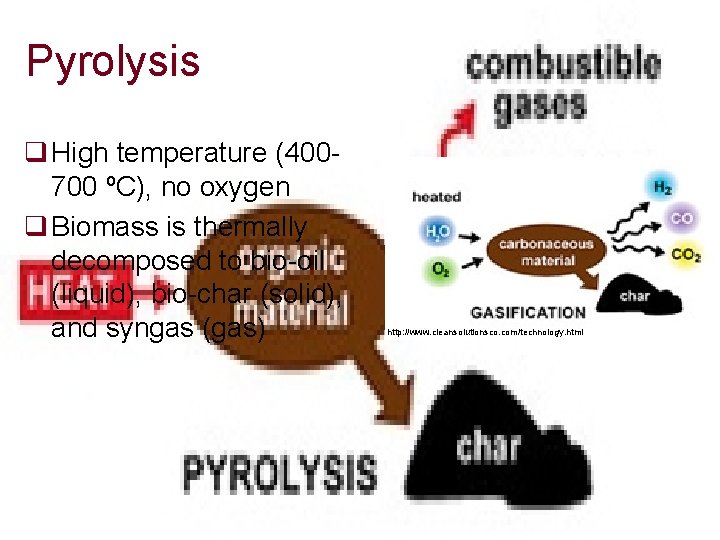
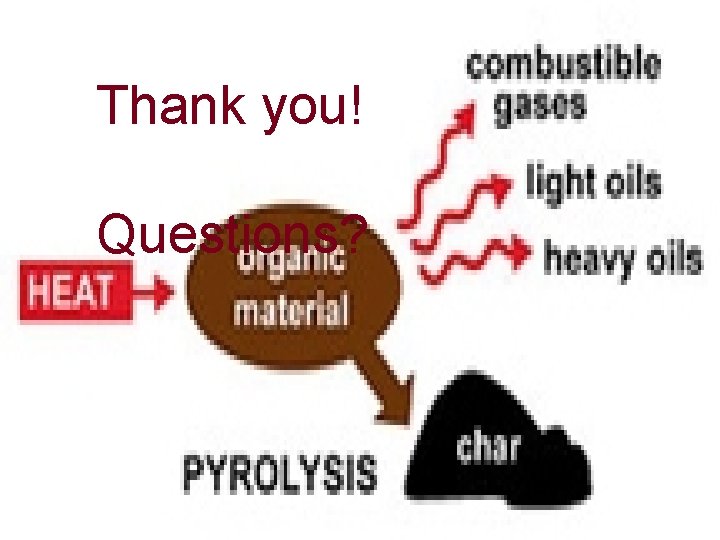
Pyrolysis q High temperature (400700 ºC), no oxygen q Biomass is thermally decomposed to bio-oil (liquid), bio-char (solid), and syngas (gas) http: //www. cleansolutionsco. com/technology. html
Gasfication q Very high temperature (800 -1100 ºC), restricted oxygen addition q Biomass is mainly converted to gas, with a little tar and char http: //www. cleansolutionsco. com/technology. html
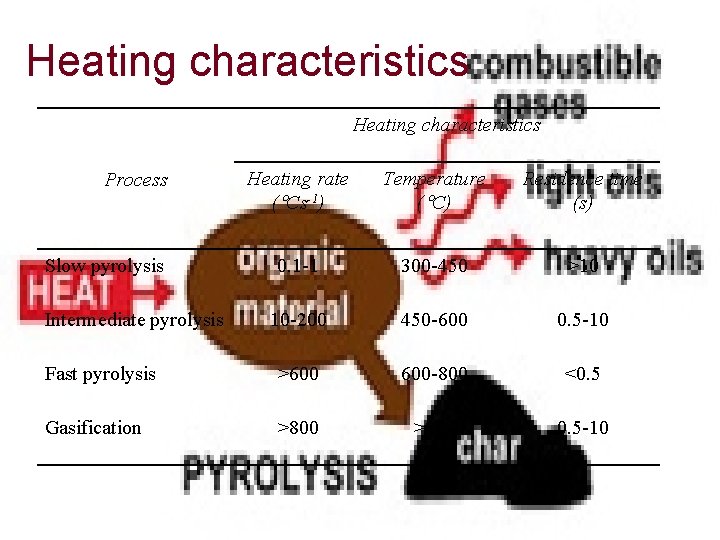
Heating characteristics Heating rate ( Cs-1) Temperature ( C) Residence time (s) 0. 1 -1 300 -450 >10 10 -200 450 -600 0. 5 -10 Fast pyrolysis >600 600 -800 <0. 5 Gasification >800 0. 5 -10 Process Slow pyrolysis Intermediate pyrolysis
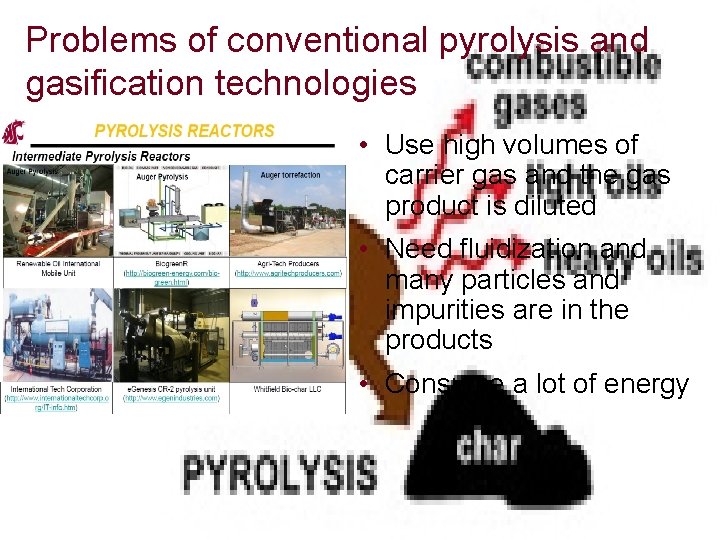
Problems of conventional pyrolysis and gasification technologies • Use high volumes of carrier gas and the gas product is diluted • Need fluidization and many particles and impurities are in the products • Consume a lot of energy
Microwave based technologies – Uniform internal heating of biomass particles – Easy to control – No need for agitation of fluidization – Syngas higher heating value since it is not diluted by the carrying gas – Mature technology and low cost – Highly scalable technology suitable for distributed conversion of bulky biomass
Mass flux Heat flux a. conventional heating approach c. Pyrolysis front development with conventional heating Microwave energy Mass flux Heat flux b. Microwave heating approach d. Pyrolysis front development with microwave heating
Fast microwave-assisted pyrolysis (f. MAP) and gasification (f. MAG) • Use of microwave absorbents – Makes f. MAP and f. MAG feasible – Helps overcome some of the drawbacks associated with fluidized bed processes – Achieves higher yield and better product quality – Further enhances all the unique characteristics and quality of the MAP.
Overall goal • To develop novel fast microwave-assisted pyrolysis (f. MAP) and gasification (f. MAG) processes for distributed conversion of solid residues, obtaining fuels and chemical building blocks for synthesis of other useful chemicals.
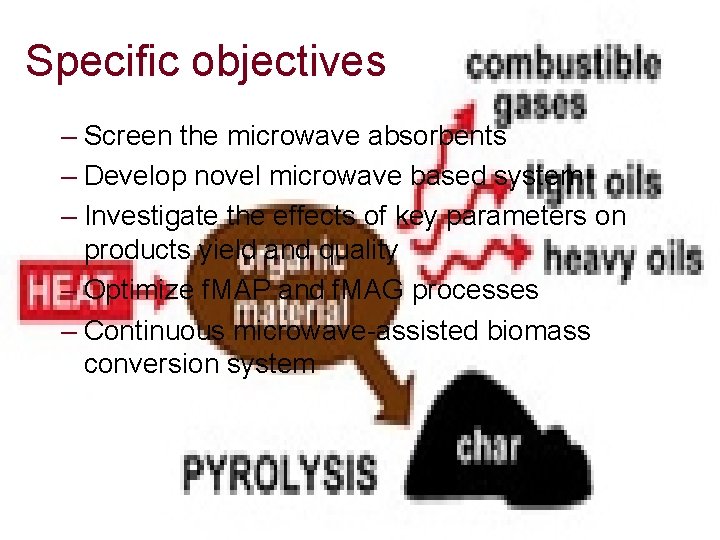
Specific objectives – Screen the microwave absorbents – Develop novel microwave based system – Investigate the effects of key parameters on products yield and quality – Optimize f. MAP and f. MAG processes – Continuous microwave-assisted biomass conversion system
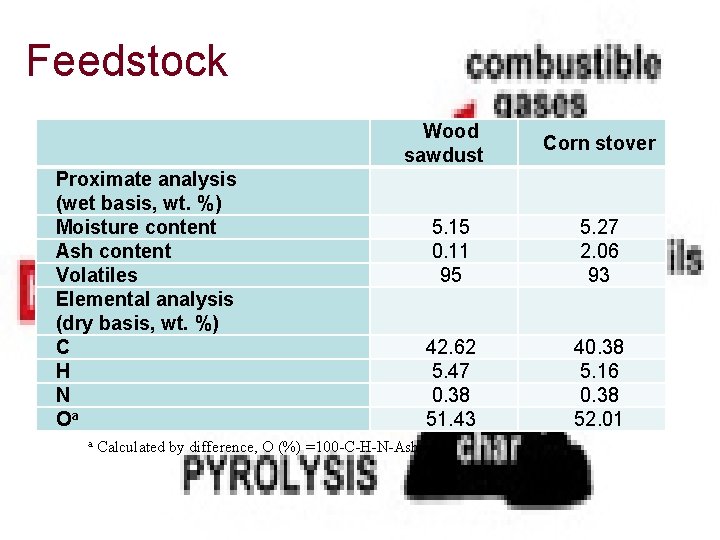
Feedstock Wood sawdust Proximate analysis (wet basis, wt. %) Moisture content Ash content Volatiles Elemental analysis (dry basis, wt. %) C H N Oa a Calculated by difference, O (%) =100 -C-H-N-Ash Corn stover 5. 15 0. 11 95 5. 27 2. 06 93 42. 62 5. 47 0. 38 51. 43 40. 38 5. 16 0. 38 52. 01
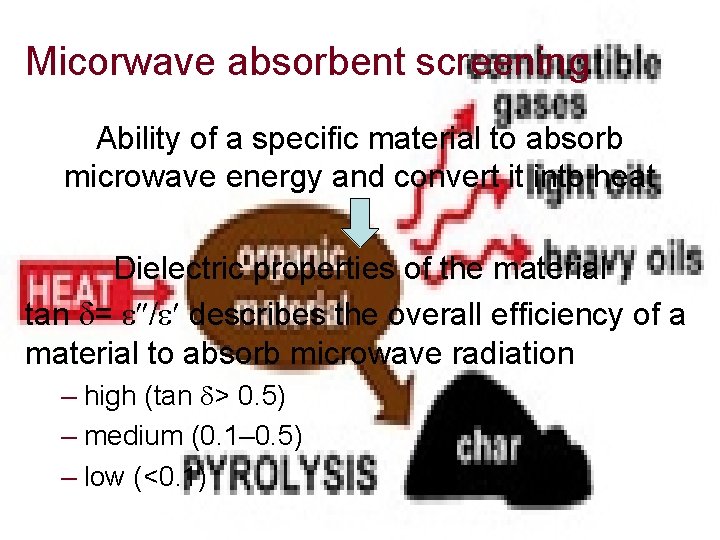
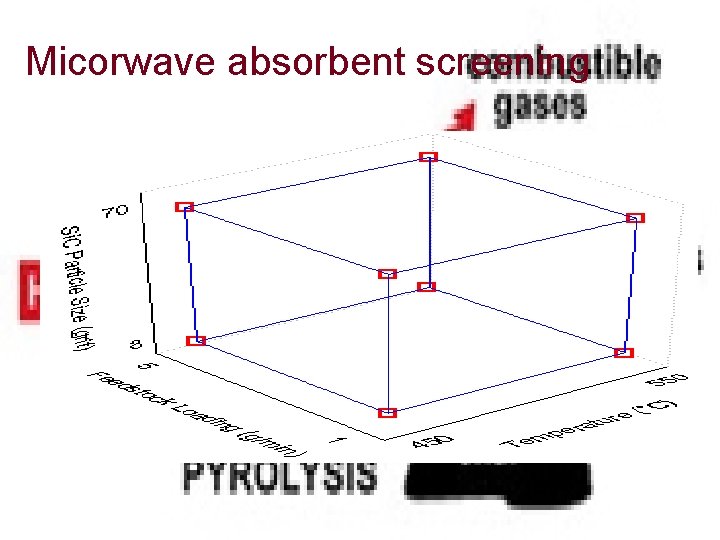
Micorwave absorbent screening Ability of a specific material to absorb microwave energy and convert it into heat Dielectric properties of the material tan = / describes the overall efficiency of a material to absorb microwave radiation – high (tan > 0. 5) – medium (0. 1– 0. 5) – low (<0. 1)
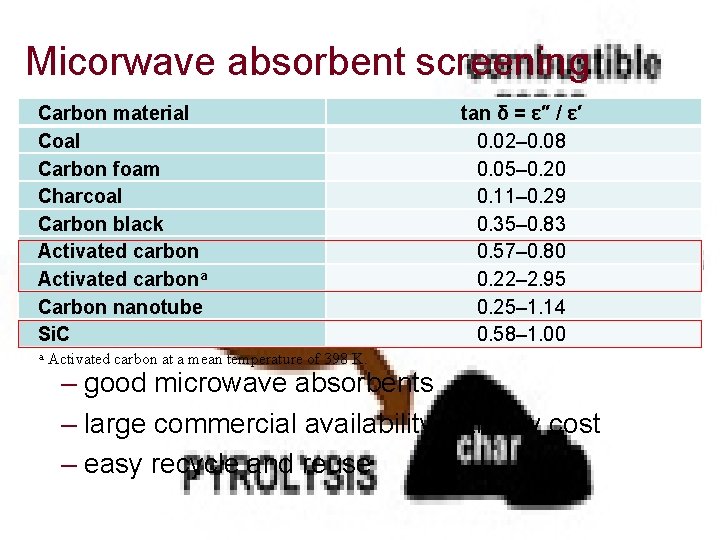
Micorwave absorbent screening Carbon material Coal Carbon foam Charcoal Carbon black Activated carbona Carbon nanotube Si. C a Activated carbon at a mean temperature of 398 K. tan δ = ε″ / ε′ 0. 02– 0. 08 0. 05– 0. 20 0. 11– 0. 29 0. 35– 0. 83 0. 57– 0. 80 0. 22– 2. 95 0. 25– 1. 14 0. 58– 1. 00 – good microwave absorbents – large commercial availability with low cost – easy recycle and reuse
Micorwave absorbent screening
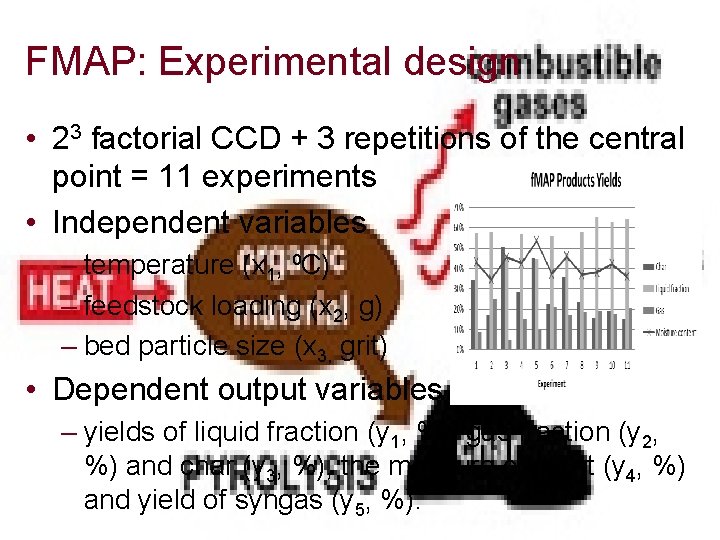
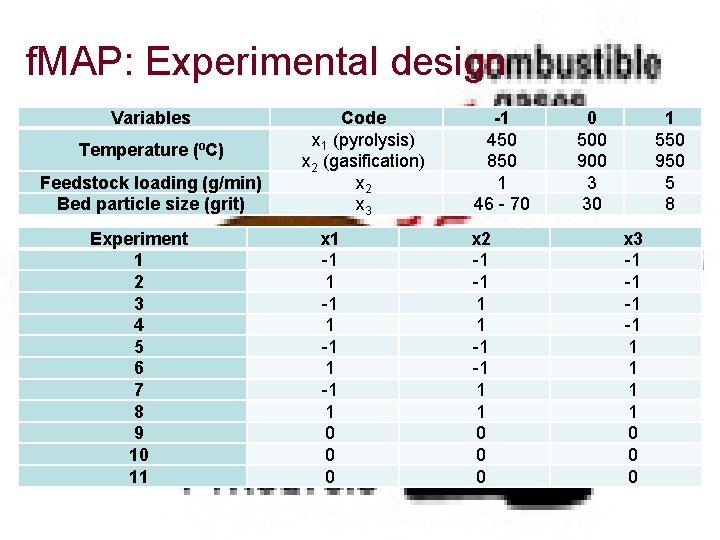
FMAP: Experimental design • 23 factorial CCD + 3 repetitions of the central point = 11 experiments • Independent variables – temperature (x 1, ⁰C) – feedstock loading (x 2, g) – bed particle size (x 3, grit) • Dependent output variables – yields of liquid fraction (y 1, %), gas fraction (y 2, %) and char (y 3, %), the moisture content (y 4, %) and yield of syngas (y 5, %).
f. MAP: Experimental design Variables Temperature (⁰C) Feedstock loading (g/min) Bed particle size (grit) Experiment 1 2 3 4 5 6 7 8 9 10 11 Code x 1 (pyrolysis) x 2 (gasification) x 2 x 3 x 1 -1 1 0 0 0 -1 450 850 1 46 - 70 x 2 -1 -1 1 1 0 0 500 900 3 30 1 550 950 5 8 x 3 -1 -1 1 1 0 0 0
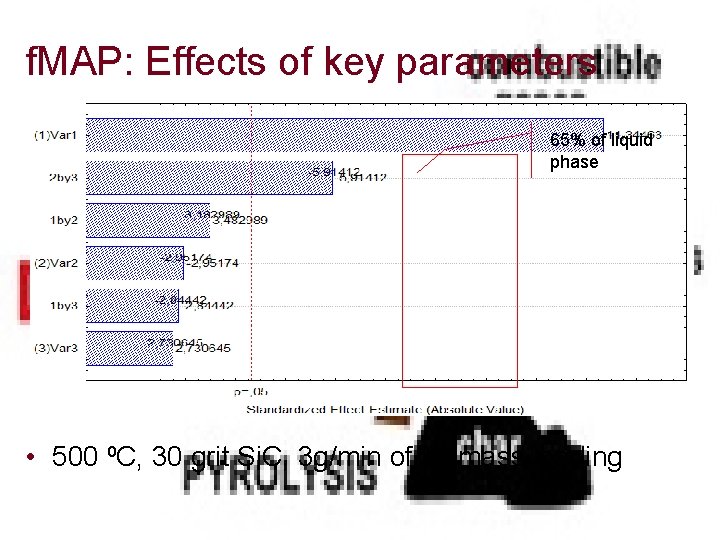
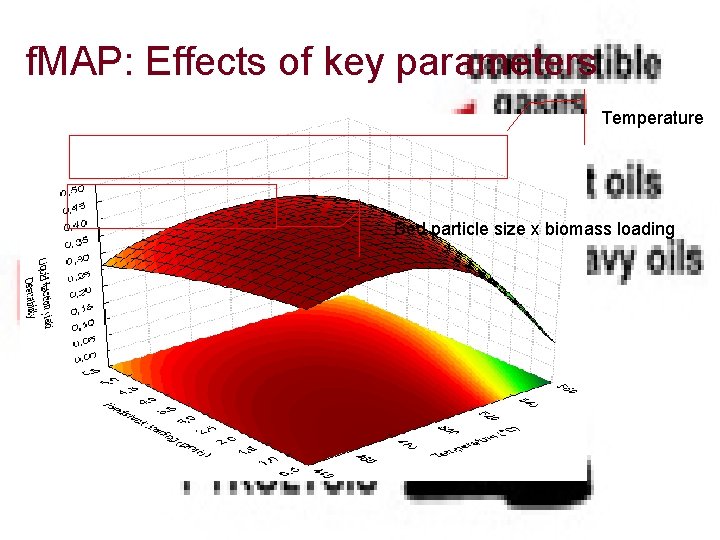
f. MAP: Effects of key parameters 65% of liquid phase • 500 ⁰C, 30 grit Si. C, 3 g/min of biomass loading
f. MAP: Effects of key parameters Temperature Bed particle size x biomass loading
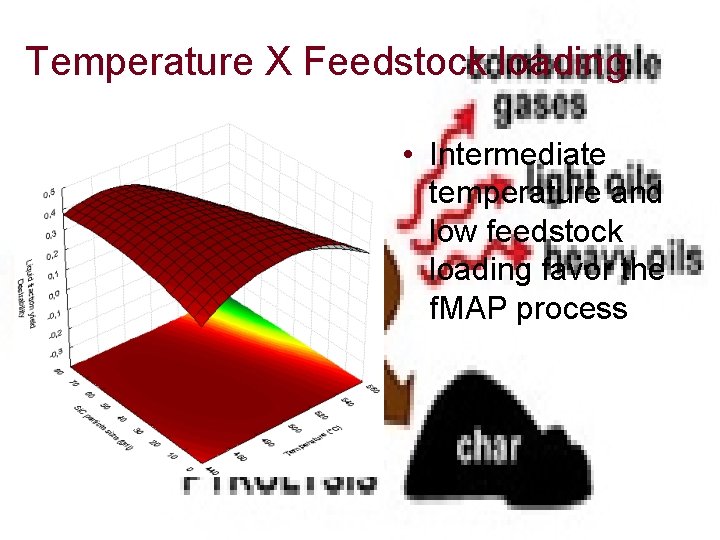
Temperature X Feedstock loading • Intermediate temperature and low feedstock loading favor the f. MAP process
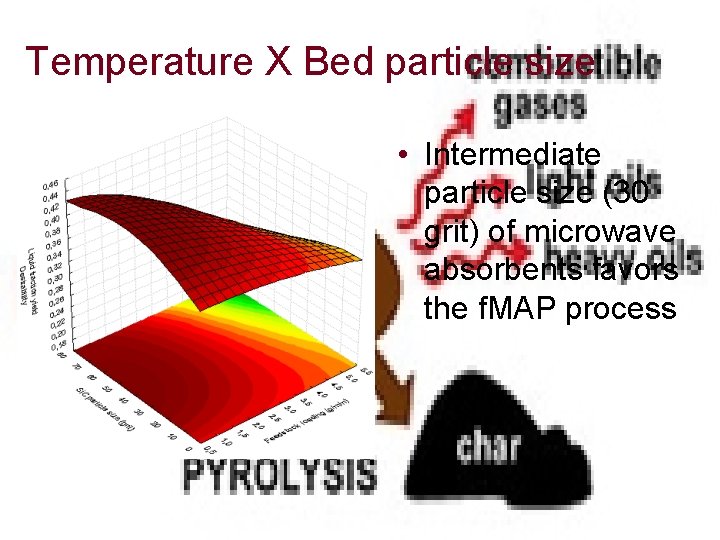
Temperature X Bed particle size • Intermediate particle size (30 grit) of microwave absorbents favors the f. MAP process
Feedstock loading x Bed particle size • Low feedstock loading • Intermediate particle size of microwave absorbents
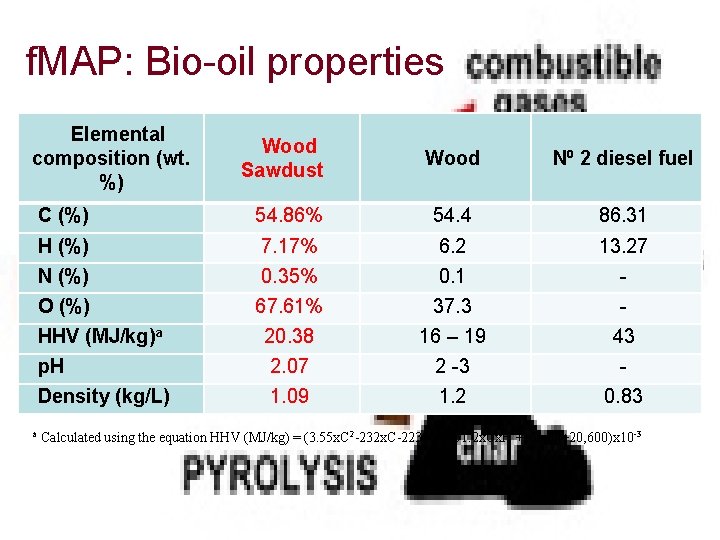
f. MAP: Bio-oil properties Elemental composition (wt. %) Wood Sawdust Wood N⁰ 2 diesel fuel C (%) 54. 86% 54. 4 86. 31 H (%) 7. 17% 6. 2 13. 27 N (%) 0. 35% 0. 1 - O (%) 67. 61% 37. 3 - HHV (MJ/kg)a 20. 38 16 – 19 43 p. H 2. 07 2 -3 - Density (kg/L) 1. 09 1. 2 0. 83 a Calculated using the equation HHV (MJ/kg) = (3. 55 x. C 2 -232 x. C-2230 x. H+51. 2 x. Cx. H +131 x. N+20, 600)x 10 -3
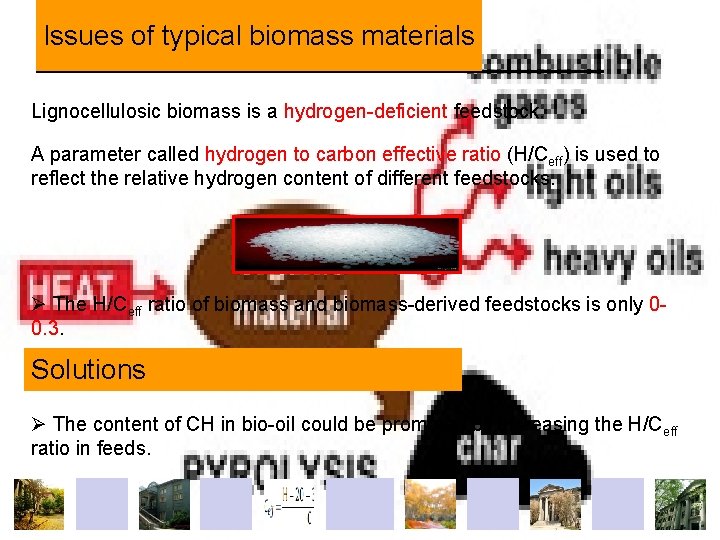
Issues of typical biomass materials Lignocellulosic biomass is a hydrogen-deficient feedstock. A parameter called hydrogen to carbon effective ratio (H/Ceff) is used to reflect the relative hydrogen content of different feedstocks. Ø The H/Ceff ratio of biomass and biomass-derived feedstocks is only 00. 3. Solutions Ø The content of CH in bio-oil could be promoted by increasing the H/Ceff ratio in feeds.
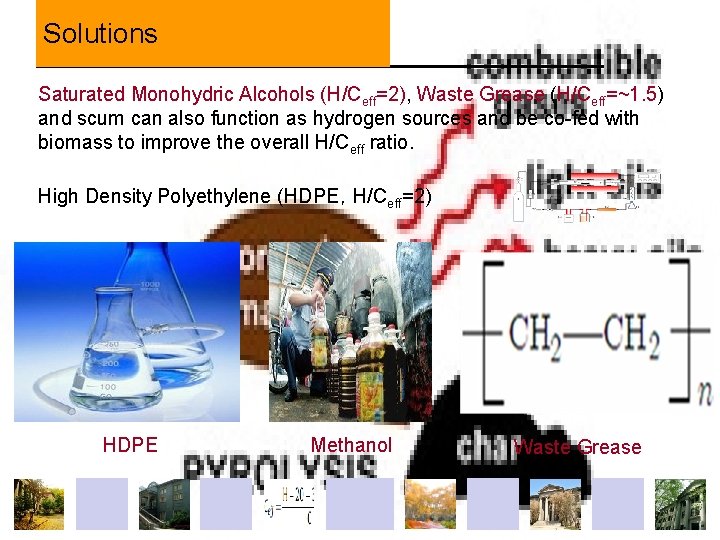
Solutions Saturated Monohydric Alcohols (H/Ceff=2), Waste Grease (H/Ceff=~1. 5) and scum can also function as hydrogen sources and be co-fed with biomass to improve the overall H/Ceff ratio. High Density Polyethylene (HDPE,H/Ceff=2) HDPE Methanol Waste Grease
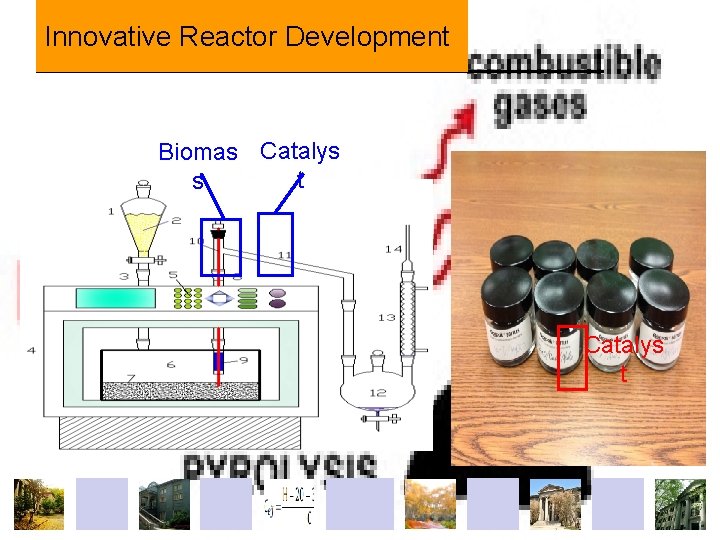
Innovative Reactor Development Biomas Catalys t
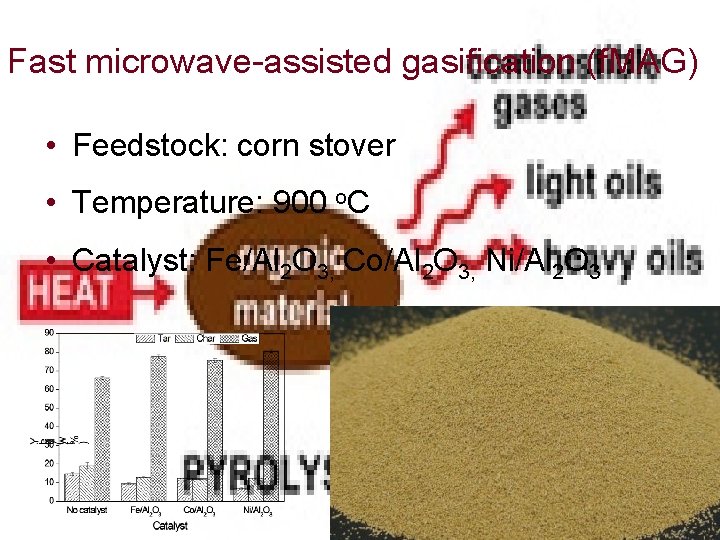
Fast microwave-assisted gasification (f. MAG) • Feedstock: corn stover • Temperature: 900 o. C • Catalyst: Fe/Al 2 O 3, Co/Al 2 O 3, Ni/Al 2 O 3
FMAG: Effect of catalyst type on product distribution
FMAG: Effect of catalyst type on gas composition
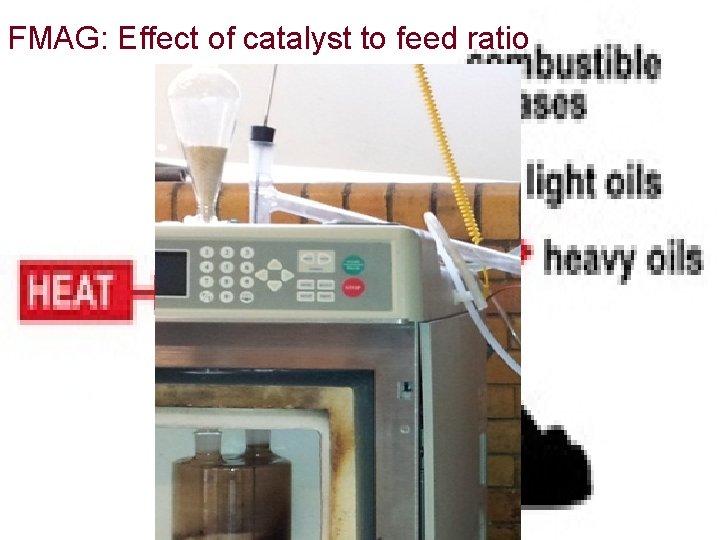
FMAG: Effect of catalyst to feed ratio
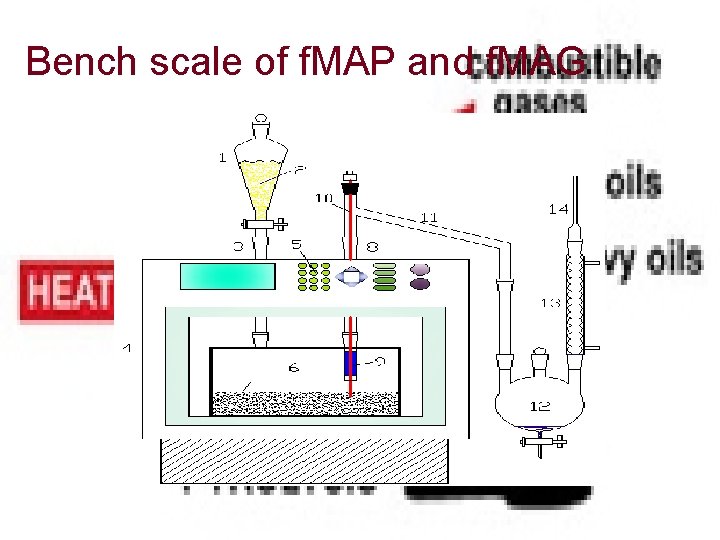
Bench scale of f. MAP and f. MAG
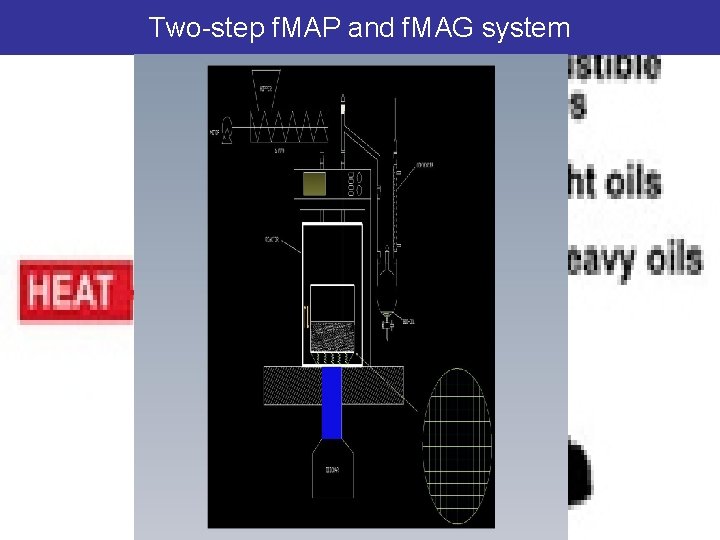
Two-step f. MAP and f. MAG system
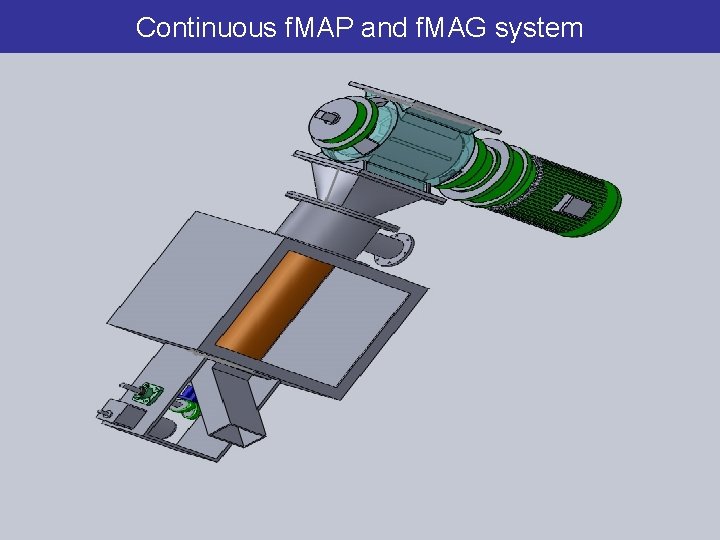
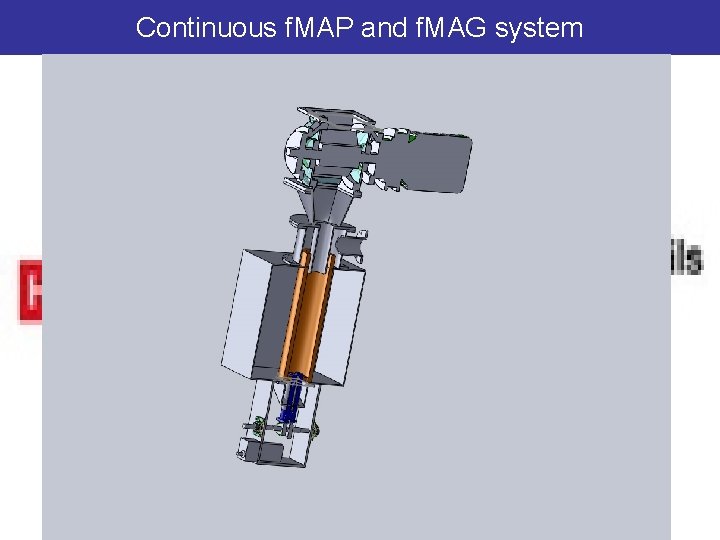
Continuous f. MAP and f. MAG system
Continuous f. MAP and f. MAG system
Continuous f. MAP and f. MAG system
Conclusions and future work • A bench scale system for f. MAP and f. MAG has been developed. • The use of microwave absorbents makes microwave heating much more efficient. • The effects of various parameters on f. MAP and f. MAG processes have been examined. • Continuous microwave based fast pyrolysis and gasification system are under development.
Acknowledgments: Related Group Members and Collaborators: B. Polta, J. Willett, A. Sealock, R. Hemmingsen, P. Chen, M. Min, W. Zhou, M. Mohr, Y. Chen, L. Wang, Yecong Li, Bing Hu, Q. Kong, X. Wang, Y. Wan, K. Hennessy, Y. Liu, X. Lin, Yun Li, Y. Cheng, S. Deng, Q. Chen, C. Wang, Y. Wang, Z. Du, X. Lu, Z. Wang, R. Griffith, J. Thissen, Q. Xie, Y. Nie, F. Borge, F. Hussain, Y. Jiang, Y. Sun, Z. Fu, R. Zhu, A. Olson, B. Martinez, B. Zhang, J. Zhu, B. Hu, L. Schmidt, D. Kittelson, R. Morey, D. Tiffany, F. Yu, H. Lei, X. Ye, M. Muthukumarappan, P. Heyerdahl, …… Funding Agencies:
Thank you! Questions?