
Development of Methodologies for Independent Verification and Validation
- Slides: 14
Development of Methodologies for Independent Verification and Validation of Neural Networks Methods and Procedures for the Independent Verification and Validation of Neural Networks 19 July 2004 NAG 5 -12069 -OSMA-F 001 -UNCLASS-071904
Project Description • The IVVNN Project began in May 2002 in an effort to develop a standard for verifying and validating NN and adaptive systems for the NASA IV&V Facility – As NN and adaptive systems are becoming more common in NASA and commercial applications, the need for such a standard became paramount – The project is scheduled to continue until September 2005 • The IVVNN project is a collaborative effort among the ISR, the NASA IV&V Facility, and WVU – The majority of the research under this initiative was conducted by the ISR with support from WVU – Previous research efforts conducted by the NASA DFRC and the NASA ARC provided both insight and direction NAG 5 -12069 -OSMA-F 001 -UNCLASS-071904 2
Project Overview • Goals: – To develop a methodology for the IVVNN – To test the IVVNN methodology on the NASA DFRC IFCS GEN 1 system (and possibly the IFCS GEN 2 system) – To train IV&V personnel on the use of IVVNN methodology – To integrate the IVVNN methodology as guidance augmentation to the IEEE 1012 • The IVVNN project is separated into 4 major tasks: – – Task 1: NN (I)V&V Literature Search Task 2: Methodology Research Task 3: Methodology Development Task 4: Methodology Training NAG 5 -12069 -OSMA-F 001 -UNCLASS-071904 3
Task 1: NN IV&V Literature Search • Goal was to identify the current state-of-the-art for the V&V and IV&V of NN research – Conducted an extensive literature search in which over 300 artifacts were collected • Artifacts included conference papers, journals, technical reports, tools, applications, and presentations that were available in the public domain • Artifacts contained methods and techniques that were claimed to be useful for the V&V, and potentially IV&V, of NN • All collected artifacts were evaluated to determine which ones were more promising and applicable to the IV&V of NN. – The results of the literature search and evaluation of collected artifacts were collected in a document titled Toward Reliable Neural Network Software for the Development of Methodologies for the Independent Verification and Validation of Neural Networks • The conclusion was made that six methods were found to be most promising for the V&V of NN and consisted of: – – – traditional and automated testing techniques run-time monitoring Lyapunov stability analysis rule extraction cross validation Visualization • The ISR also concluded that there were very few tools that were directly applicable to the V&V of NN NAG 5 -12069 -OSMA-F 001 -UNCLASS-071904 4
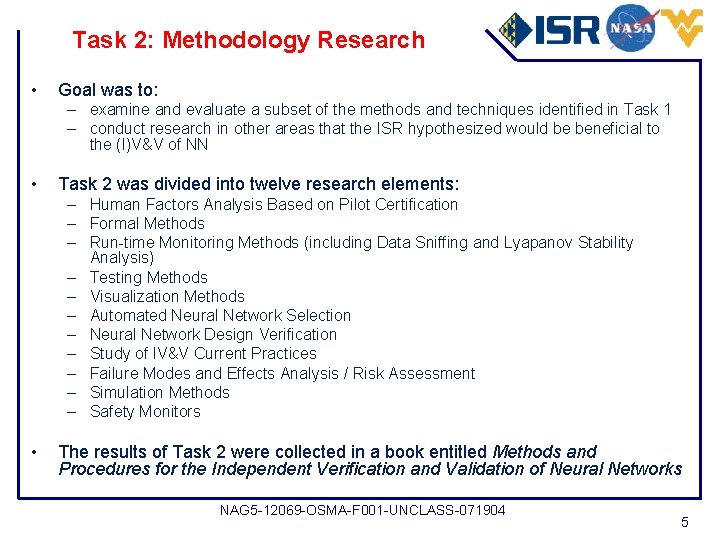
Task 2: Methodology Research • Goal was to: – examine and evaluate a subset of the methods and techniques identified in Task 1 – conduct research in other areas that the ISR hypothesized would be beneficial to the (I)V&V of NN • Task 2 was divided into twelve research elements: – Human Factors Analysis Based on Pilot Certification – Formal Methods – Run-time Monitoring Methods (including Data Sniffing and Lyapanov Stability Analysis) – Testing Methods – Visualization Methods – Automated Neural Network Selection – Neural Network Design Verification – Study of IV&V Current Practices – Failure Modes and Effects Analysis / Risk Assessment – Simulation Methods – Safety Monitors • The results of Task 2 were collected in a book entitled Methods and Procedures for the Independent Verification and Validation of Neural Networks NAG 5 -12069 -OSMA-F 001 -UNCLASS-071904 5
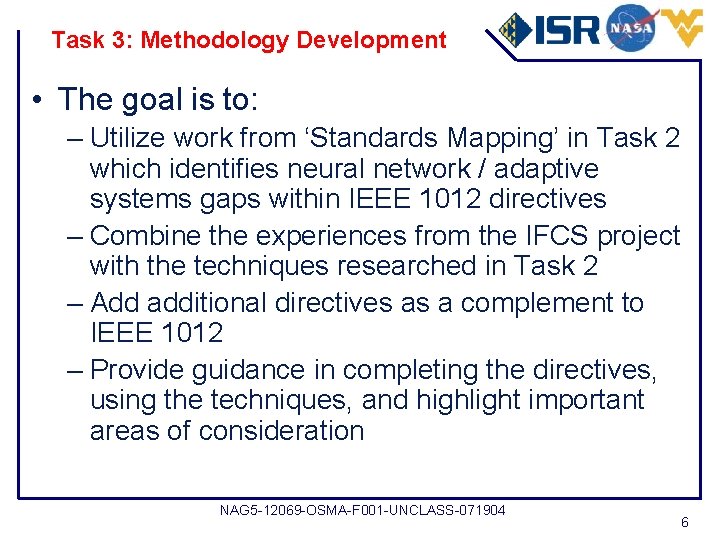
Task 3: Methodology Development • The goal is to: – Utilize work from ‘Standards Mapping’ in Task 2 which identifies neural network / adaptive systems gaps within IEEE 1012 directives – Combine the experiences from the IFCS project with the techniques researched in Task 2 – Add additional directives as a complement to IEEE 1012 – Provide guidance in completing the directives, using the techniques, and highlight important areas of consideration NAG 5 -12069 -OSMA-F 001 -UNCLASS-071904 6
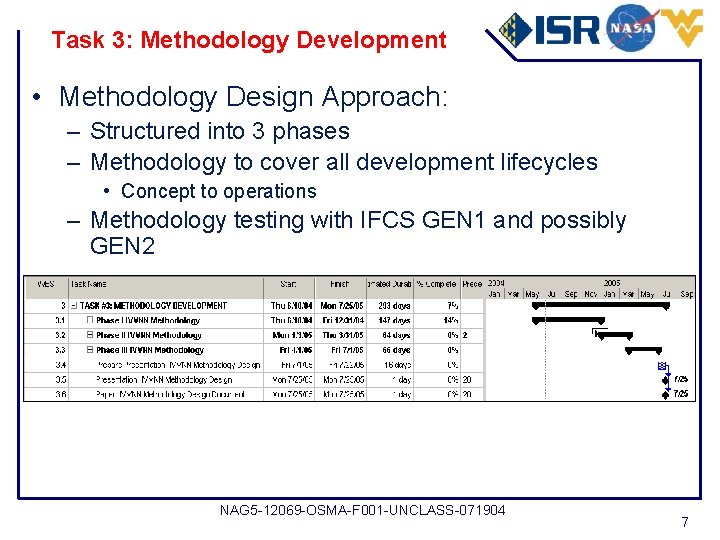
Task 3: Methodology Development • Methodology Design Approach: – Structured into 3 phases – Methodology to cover all development lifecycles • Concept to operations – Methodology testing with IFCS GEN 1 and possibly GEN 2 NAG 5 -12069 -OSMA-F 001 -UNCLASS-071904 7
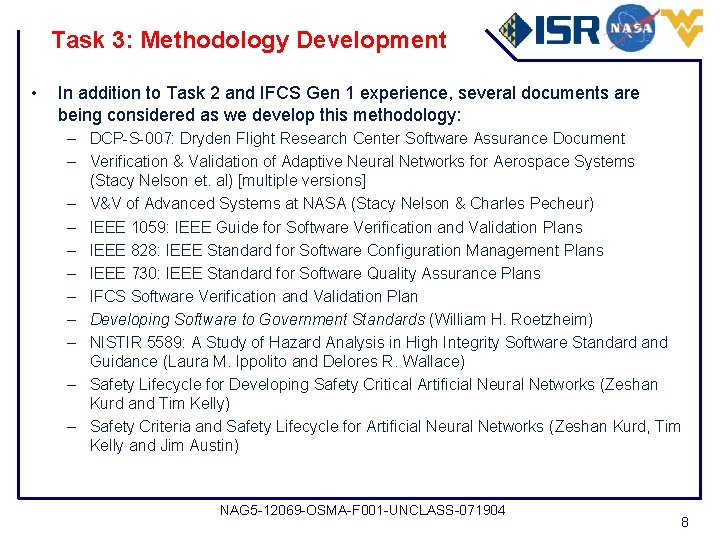
Task 3: Methodology Development • In addition to Task 2 and IFCS Gen 1 experience, several documents are being considered as we develop this methodology: – DCP-S-007: Dryden Flight Research Center Software Assurance Document – Verification & Validation of Adaptive Neural Networks for Aerospace Systems (Stacy Nelson et. al) [multiple versions] – V&V of Advanced Systems at NASA (Stacy Nelson & Charles Pecheur) – IEEE 1059: IEEE Guide for Software Verification and Validation Plans – IEEE 828: IEEE Standard for Software Configuration Management Plans – IEEE 730: IEEE Standard for Software Quality Assurance Plans – IFCS Software Verification and Validation Plan – Developing Software to Government Standards (William H. Roetzheim) – NISTIR 5589: A Study of Hazard Analysis in High Integrity Software Standard and Guidance (Laura M. Ippolito and Delores R. Wallace) – Safety Lifecycle for Developing Safety Critical Artificial Neural Networks (Zeshan Kurd and Tim Kelly) – Safety Criteria and Safety Lifecycle for Artificial Neural Networks (Zeshan Kurd, Tim Kelly and Jim Austin) NAG 5 -12069 -OSMA-F 001 -UNCLASS-071904 8
Task 3: Methodology Development • Concept Phase – Analysis of the concept tasks completed – Rough draft of concept IVVNN guidance created – To date, have written guidance for the following concept phase tasks for NN and adaptive systems • • • Concept documentation evaluation Criticality analysis Hardware/software/user requirements allocation analysis Traceability analysis Hazard analysis Risk analysis – Preliminary testing involved applying the concept phase guidance to the IFCS GEN 1 documentation NAG 5 -12069 -OSMA-F 001 -UNCLASS-071904 9
Task 3: Methodology Development • Concept Documents Considered: – – – – – IFCS Objectives and Requirements Document IFCS Project Plan IFCS Systems Requirement Document Pre-Trained Neural Network Report Dynamic Cell Structure Neural Network Report Sigma-Pi Neural Network Report (GEN 2) Single Hidden Layer Neural Network Report (GEN 2) Neural Network Evaluator Design Document (GEN 2) Software Verification and Validation Report - Traceability Analysis, Criticality Analysis – IFCS System Safety Plan – IFCS Preliminary Hazard Analysis NAG 5 -12069 -OSMA-F 001 -UNCLASS-071904 10
Task 3: Methodology Development • Requirements Phase – Currently working on analysis of requirements tasks – Begun writing guidance for the requirements task of traceability analysis • Requirements Documents Considered: – IFCS Systems Requirement Document – IFCS Software and Interface Requirements Specification (ISR) – IFCS System Test Plan and Description Document (ISR) – IFCS Preliminary Hazard Analysis NAG 5 -12069 -OSMA-F 001 -UNCLASS-071904 11
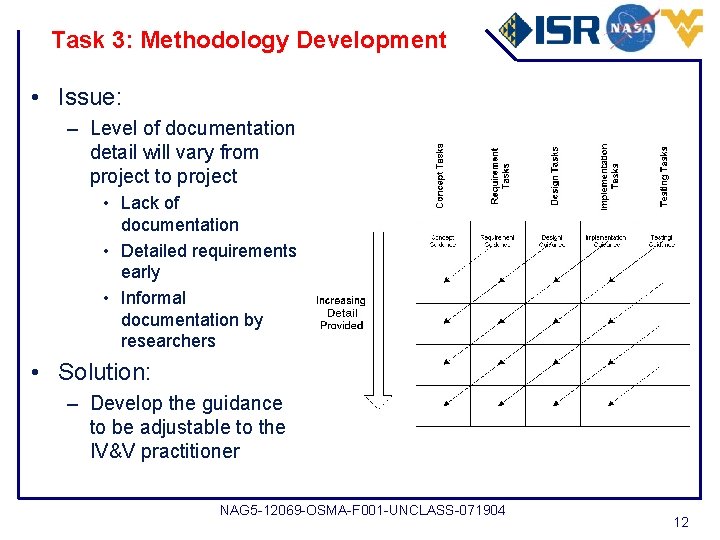
Task 3: Methodology Development • Issue: – Level of documentation detail will vary from project to project • Lack of documentation • Detailed requirements early • Informal documentation by researchers • Solution: – Develop the guidance to be adjustable to the IV&V practitioner NAG 5 -12069 -OSMA-F 001 -UNCLASS-071904 12
Next Steps • Remaining Phase I Methodology Design Tasks – – – – Requirements Design Implementation Testing Operations Management Acquisition Methodology Design Review (MDR) • Phase III • IFCS GEN 2 Testing – NASA Dryden Flight Research Center – NASA IV&V Facility NAG 5 -12069 -OSMA-F 001 -UNCLASS-071904 13
Questions NAG 5 -12069 -OSMA-F 001 -UNCLASS-071904 14