
Development of Internal Quality Assurance and its Challenges
- Slides: 22
Development of Internal Quality Assurance and its Challenges in Taiwan Higher Education from University and Students’ Perspectives Angela Yung Chi Hou Executive Director, Higher Education Evaluation & Accreditation Council of Taiwan Professor, National Cheng Chi University Jackson Chun- Chih Associate Researcher, Higher Education Evaluation & Accreditation Council of Taiwan Ping Chuan Hsu, WENHSING KUO, Chia Yi Lin, LIAO, YU-RONG Research Coordinator, Higher Education Evaluation & Accreditation Council of Taiwan
Introduction � � � Quality assurance is ‘a process of establishing stakeholder confidence that higher education provision (input, process and outcomes) fulfills expectations or measures up to threshold minimum requirements’ (INQAAHE, 2018). It consists of two major parts, internal quality assurance and external quality assurance Internal quality assurance is considered as the part of the external process that an institution undertakes in preparation for an external quality assurance.
Internal evaluation (review) � � Internal evaluation a ‘process of quality review undertaken within an institution for its own ends’ development and management of internal quality assurance system is ‘at the discretion of the higher education institution, which usually carries out this mandate in the context of available institutional resources and capacities’ (Paintsil, 2016, p. 4)
The Council for Higher Education Accreditation’s (CHEA) Principle One � achieving quality in higher education is the primary responsibility of higher education providers and their staff’ (Hou, 2016, p. 7).
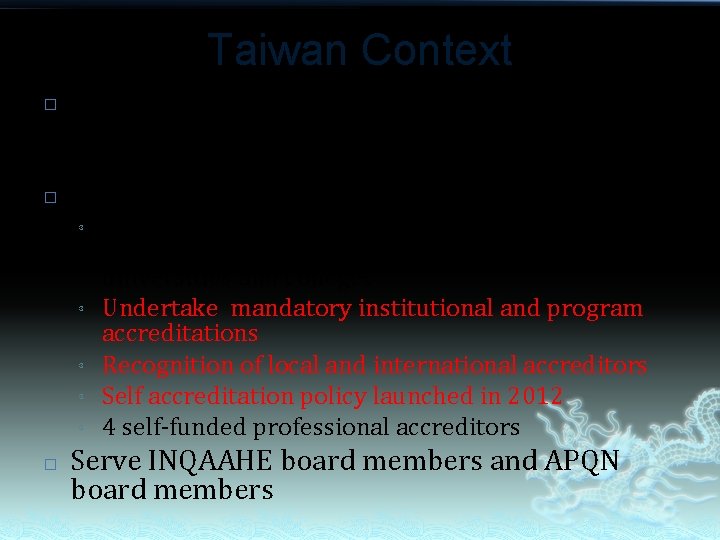
Taiwan Context � � Without Qualification Framework but having a well-structured qualification system from elementary school to post secondary National QA system was established in 2005 ³ ³ ³ � Higher education Evaluation & Accreditation Council (HEEACT) was founded by MOE and all universities and colleges Undertake mandatory institutional and program accreditations Recognition of local and international accreditors Self accreditation policy launched in 2012 4 self-funded professional accreditors Serve INQAAHE board members and APQN board members
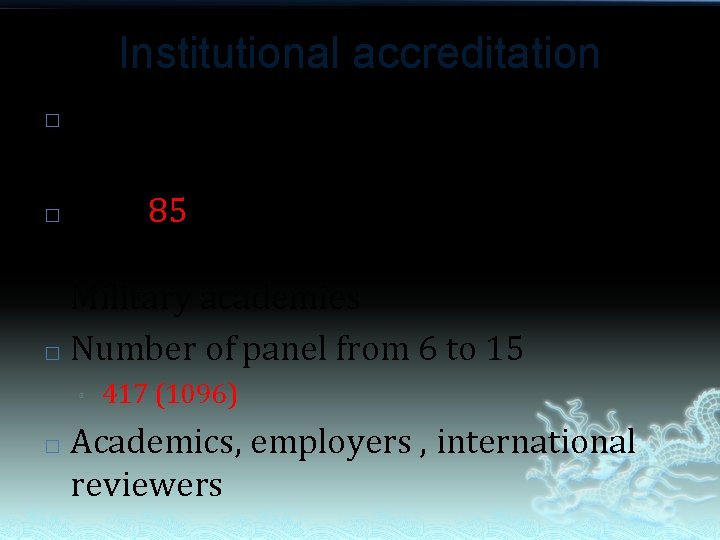
Institutional accreditation Started in 2011 and second cycle was implemented from 2016 to 2018 � over 85 universities and several religious institutions and Police and Military academies � Number of panel from 6 to 15 � ³ � 417 (1096) Academics, employers , international reviewers
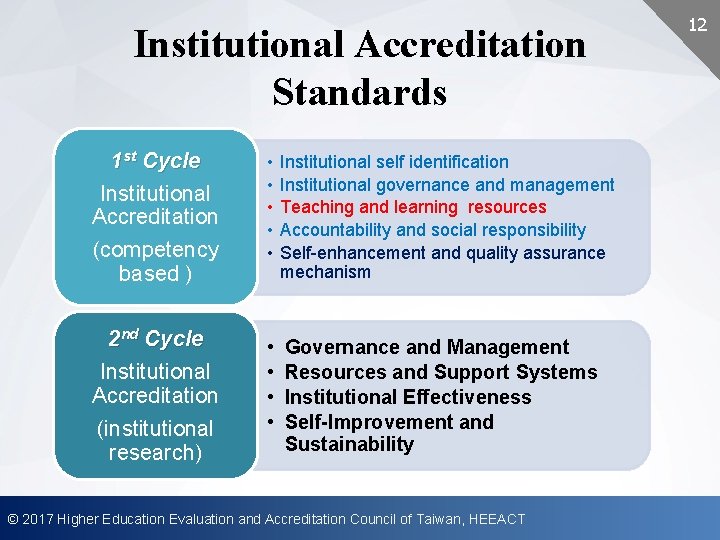
Institutional Accreditation Standards 1 st Cycle Institutional Accreditation (competency based ) • • • Institutional self identification Institutional governance and management Teaching and learning resources Accountability and social responsibility Self-enhancement and quality assurance mechanism 2 nd Cycle Institutional Accreditation (institutional research) • • Governance and Management Resources and Support Systems Institutional Effectiveness Self-Improvement and Sustainability © 2017 Higher Education Evaluation and Accreditation Council of Taiwan, HEEACT 12
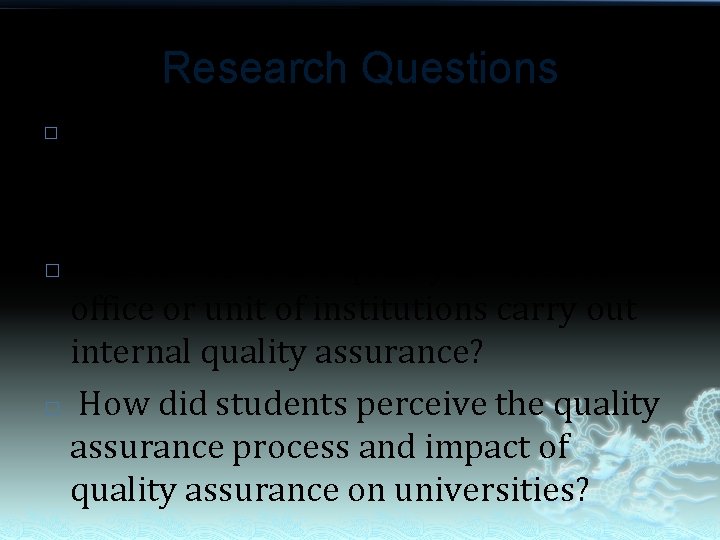
Research Questions How were internal quality assurance mechanisms established by Taiwan higher education institutions? � What roles of the quality assurance office or unit of institutions carry out internal quality assurance? � How did students perceive the quality assurance process and impact of quality assurance on universities? �
Research Design � � Meta evaluation over the 2 nd cycle of institutional accreditation targeting the administrators, faculty members and staff, and students for their perception toward ³ ³ ³ � the roles of internal quality assurance office internal quality assurance implementation and effectiveness the impact on institutional governance on campus A total of 787 questionnaires from 33 universities from the first cycle of institutional accreditation were distributed ³ 715 returned, a response rate of 90. 9%
Results � � 1. Perception of university’s representatives over internal quality assurance mechanism 2. Students’ attitude toward appropriateness of external review process
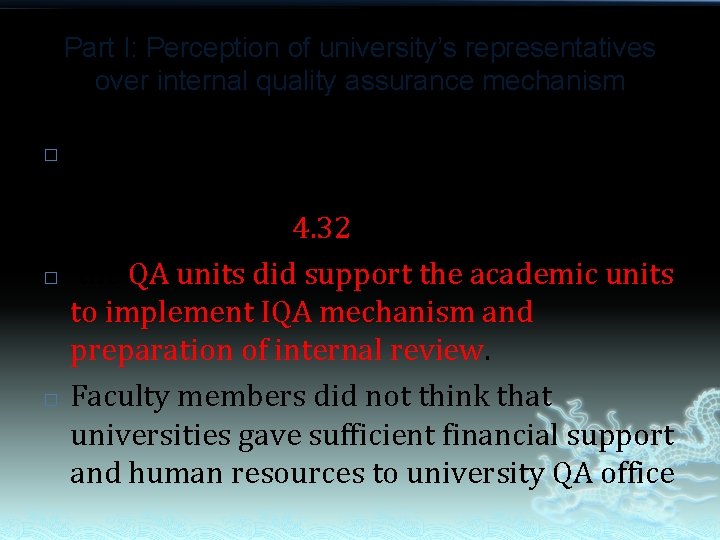
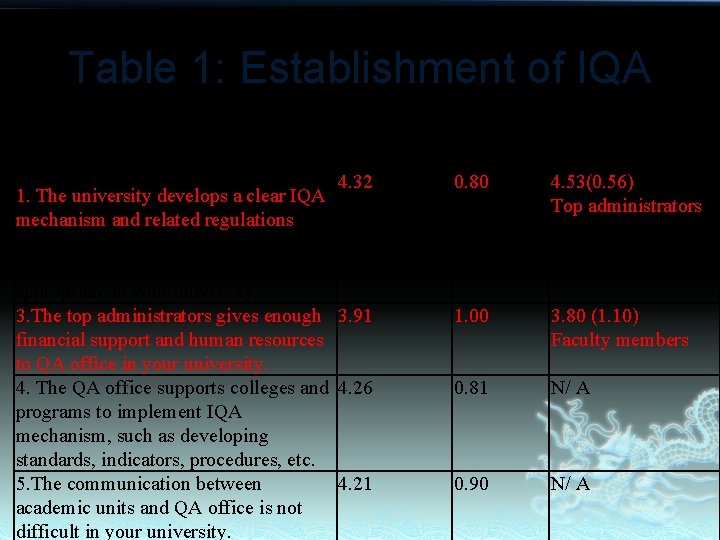
Part I: Perception of university’s representatives over internal quality assurance mechanism � � � most universities developed a clear IQA mechanism and related regulations with a highest score of 4. 32 on average the QA units did support the academic units to implement IQA mechanism and preparation of internal review. Faculty members did not think that universities gave sufficient financial support and human resources to university QA office
Table 1: Establishment of IQA Items/Categories 1. The university develops a clear IQA mechanism and related regulations 2. The organizational structure, level and amount of staff in the QA office is appropriate in your university. 3. The top administrators gives enough financial support and human resources to QA office in your university. 4. The QA office supports colleges and programs to implement IQA mechanism, such as developing standards, indicators, procedures, etc. 5. The communication between academic units and QA office is not difficult in your university. Average score Standard deviation Sources of Highest and Lowest scores 4. 32 0. 80 4. 53(0. 56) Top administrators 4. 00 0. 96 N/ A 3. 91 1. 00 3. 80 (1. 10) Faculty members 4. 26 0. 81 N/ A 4. 21 0. 90 N/ A
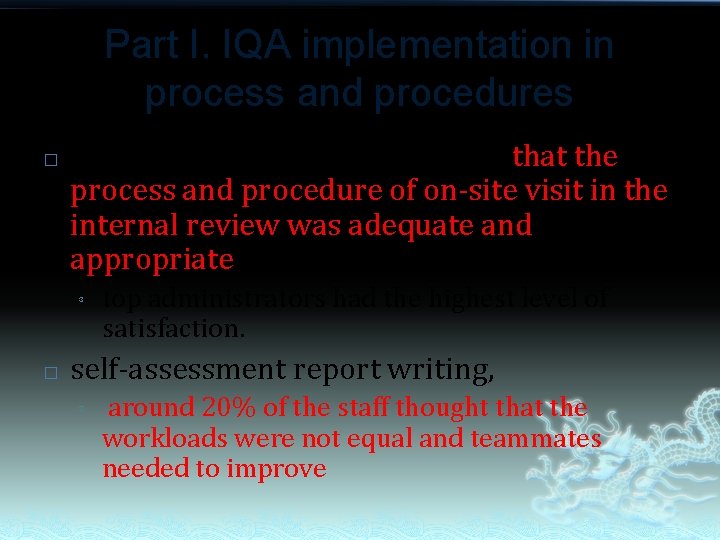
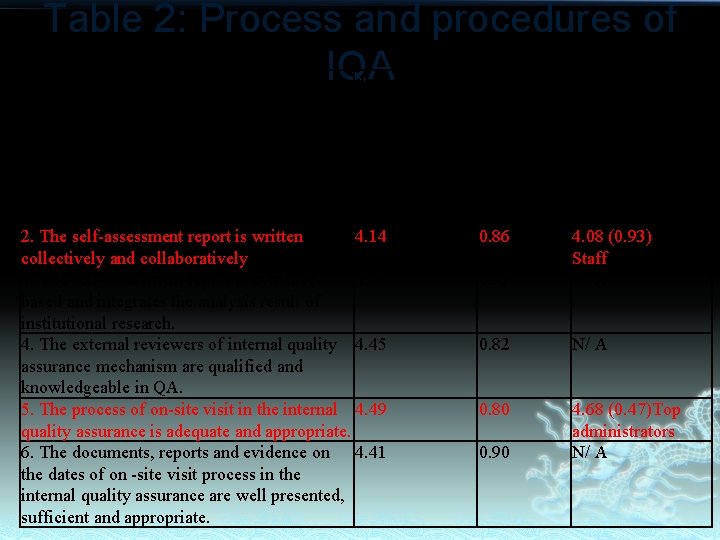
Part I. IQA implementation in process and procedures � 95 % of the respondents agreed that the process and procedure of on-site visit in the internal review was adequate and appropriate with a highest score of 4. 49. ³ � top administrators had the highest level of satisfaction. self-assessment report writing, ³ around 20% of the staff thought that the workloads were not equal and teammates needed to improve
Table 2: Process and procedures of IQA Average score Standard Sources of Highest Items/Categories 1. The opinions of varying stakeholders are 4. 22 collected, including management team, administration office, academic units, faculty members, staff, students, alumni, etc. in the process of IQA. 2. The self-assessment report is written 4. 14 collectively and collaboratively 3. The self-assessment report is evidence 4. 15 based and integrates the analysis result of institutional research. 4. The external reviewers of internal quality 4. 45 assurance mechanism are qualified and knowledgeable in QA. 5. The process of on-site visit in the internal 4. 49 quality assurance is adequate and appropriate. 6. The documents, reports and evidence on 4. 41 the dates of on -site visit process in the internal quality assurance are well presented, sufficient and appropriate. deviation 0. 87 and Lowest scores N/ A 0. 86 0. 91 4. 08 (0. 93) Staff N/ A 0. 82 N/ A 0. 80 4. 68 (0. 47)Top administrators N/ A 0. 90
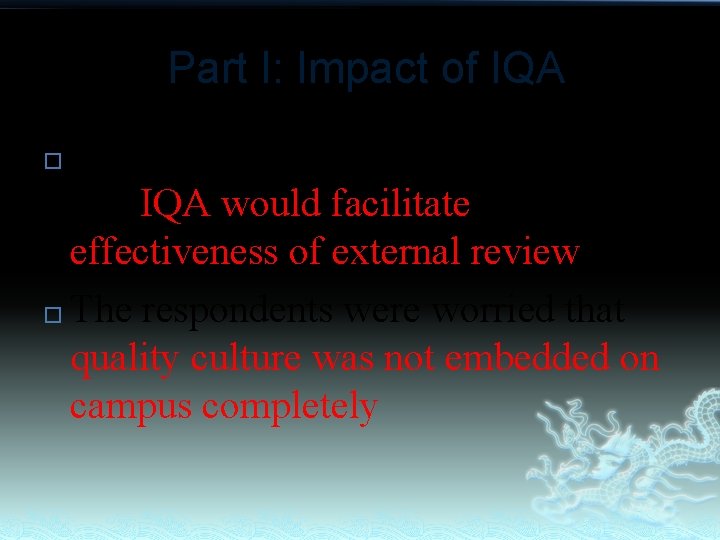
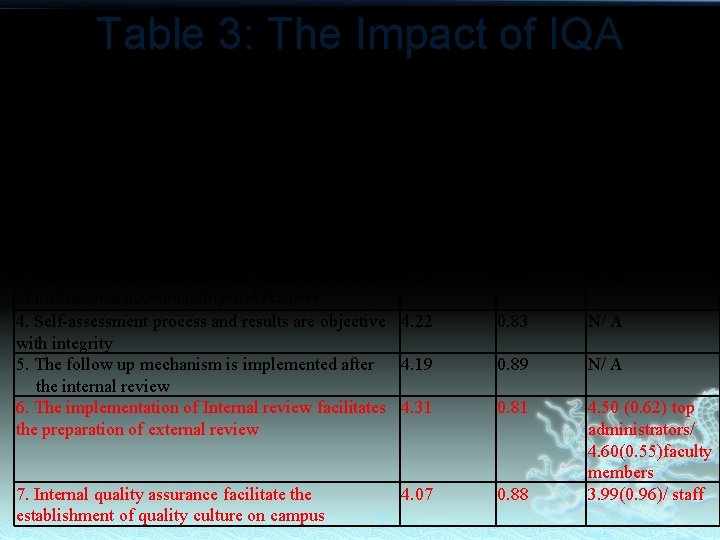
Part I: Impact of IQA Overall, the respondents indicated that IQA would facilitate effectiveness of external review � The respondents were worried that quality culture was not embedded on campus completely �
Table 3: The Impact of IQA Items/Categories 1. Internal quality assurance facilitates the integration and effective use of institutional resources. 2. The implementation of internal quality assurance facilitates faculty and staff engagement in institutional development and planning 3. Self-assessment facilitates the actual examination of institutional accountability and features 4. Self-assessment process and results are objective with integrity 5. The follow up mechanism is implemented after the internal review 6. The implementation of Internal review facilitates the preparation of external review 7. Internal quality assurance facilitate the establishment of quality culture on campus Average score Standard deviation 4. 20 0. 86 Sources of Highest and Lowest scores N/ A 4. 10 0. 95 N/ A 4. 21 0. 89 N/ A 4. 22 0. 83 N/ A 4. 19 0. 89 N/ A 4. 31 0. 81 4. 07 0. 88 4. 50 (0. 62) top administrators/ 4. 60(0. 55)faculty members 3. 99(0. 96)/ staff
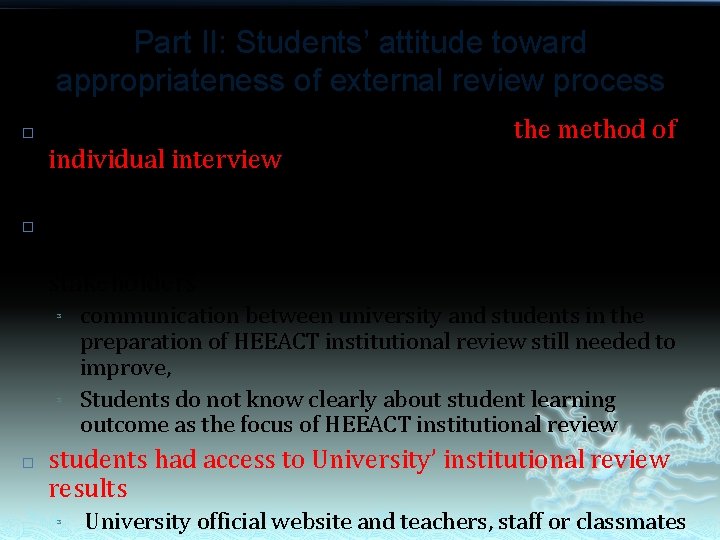
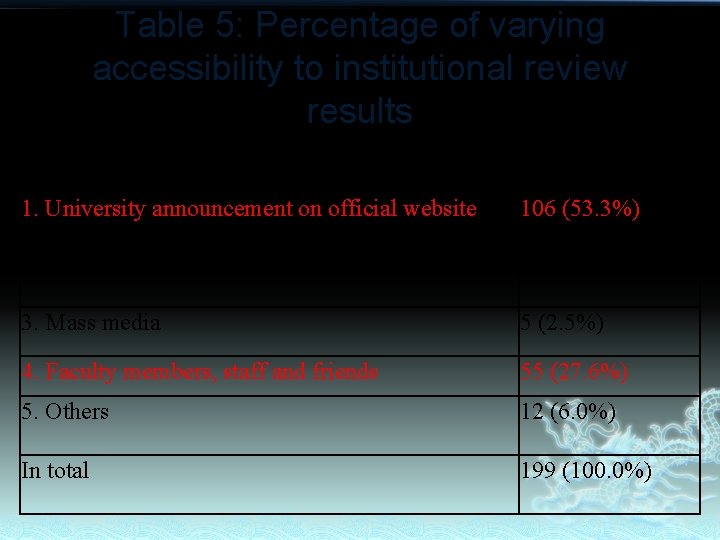
Part II: Students’ attitude toward appropriateness of external review process � � student respondents strongly agreed on the method of individual interview during HEEACT on-site visit is adequate. University did not informed students about HEEACT institutional review and promoted the value to all stakeholders ³ ³ � communication between university and students in the preparation of HEEACT institutional review still needed to improve, Students do not know clearly about student learning outcome as the focus of HEEACT institutional review students had access to University’ institutional review results ³ University official website and teachers, staff or classmates
Table 5: Percentage of varying accessibility to institutional review results Access to University’s institutional review result 1. University announcement on official website Number / % 106 (53. 3%) 2. HEEACT website 21 (10. 6%) 3. Mass media 5 (2. 5%) 4. Faculty members, staff and friends 55 (27. 6%) 5. Others 12 (6. 0%) In total 199 (100. 0%)
Discussions � � IQA system has been established on campus Writing the assessment report is a burden to all universities, particularly staff Students have access to the QA information but not participate in institutional QA committees Promotion of QA goals, process and procedures and communication among stakeholders should be strengthened
Conclusion (1) � The internal review / evaluation is used as a reference for the establishment of institutional favorable governance ³ � internal quality assurance is a means to the success of external review by HEEACT ³ � university's overall resource allocation, development of long-term institutional development plans, and organizational reforms on administrative units and academic programs particularly preparation of on-site visit Students either act as one of the panel or takes part in the governance of the board of accreditors in some Asian nations, but not in Taiwan
Conclusion (2) � It remains a very challenging job for universities to implement them collaboratively on campus ³ � self-assessment report writing and student engagement The process of instilling and embedding a quality culture remain problematic and time consuming Taiwan higher education institutions.
Thank you for your attention Higher Education Evaluation & Accreditation Council of Taiwan National Chengchi University yungchi@nccu. edu. tw