
Development of Integrated Approach for Poultry Waste Management



- Slides: 25
Development of Integrated Approach for Poultry Waste Management in Bangladesh: The Potential Socio-economic and Environmental Benefits of Introducing Geo-spatial Analysis Zinat Mahal Student ID. 201726062 Supervisor: Prof. Helmut Yabar
Content of the Presentation 1. 2. 3. 4. 5. Background Literature Review Methodology Results Future Works
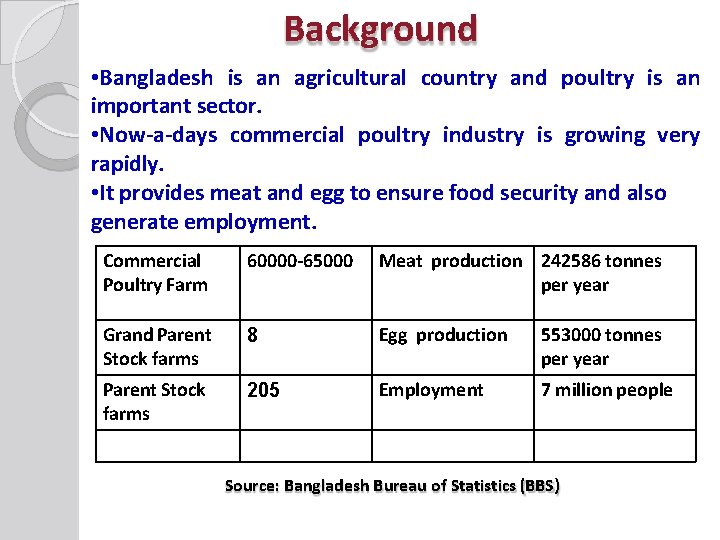
Background • Bangladesh is an agricultural country and poultry is an important sector. • Now-a-days commercial poultry industry is growing very rapidly. • It provides meat and egg to ensure food security and also generate employment. Commercial Poultry Farm 60000 -65000 Meat production 242586 tonnes per year Grand Parent Stock farms 8 Egg production 553000 tonnes per year Parent Stock farms 205 Employment 7 million people Source: Bangladesh Bureau of Statistics (BBS)
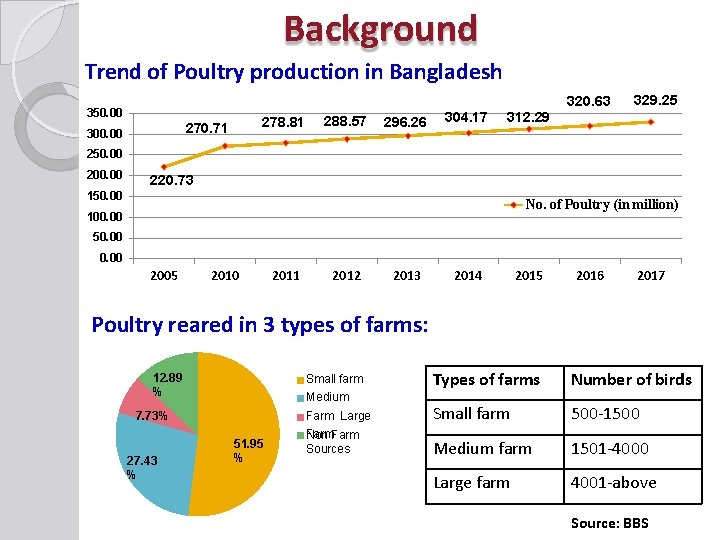
Background Trend of Poultry production in Bangladesh 350. 00 278. 81 270. 71 300. 00 288. 57 296. 26 304. 17 312. 29 320. 63 329. 25 250. 00 200. 00 220. 73 150. 00 No. of Poultry (in million) 100. 00 50. 00 2005 2010 2011 2012 2013 2014 2015 2016 2017 Poultry reared in 3 types of farms: 12. 89 % Number of birds Farm Large Small farm 500 -1500 Farm Non Farm Sources Medium farm 1501 -4000 Large farm 4001 -above Medium 7. 73% 27. 43 % Types of farms Small farm 51. 95 % Source: BBS
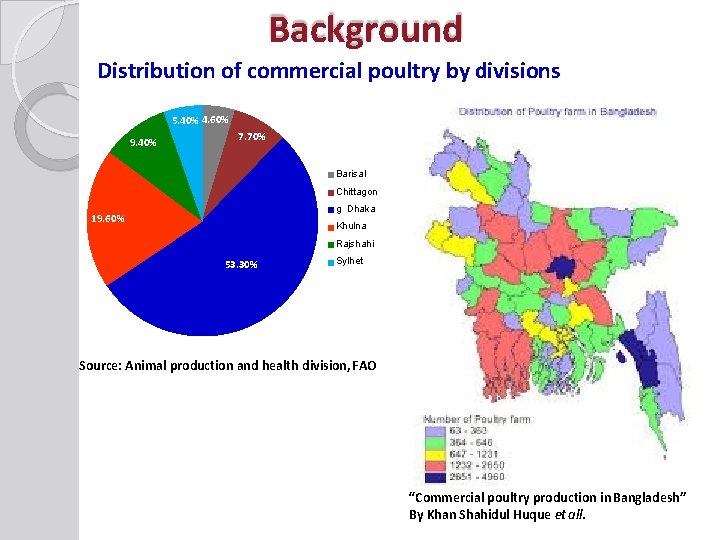
Background Distribution of commercial poultry by divisions 5. 40% 4. 60% 9. 40% 7. 70% Barisal Chittagon g Dhaka 19. 60% Khulna Rajshahi 53. 30% Sylhet Source: Animal production and health division, FAO “Commercial poultry production in Bangladesh” By Khan Shahidul Huque et all.
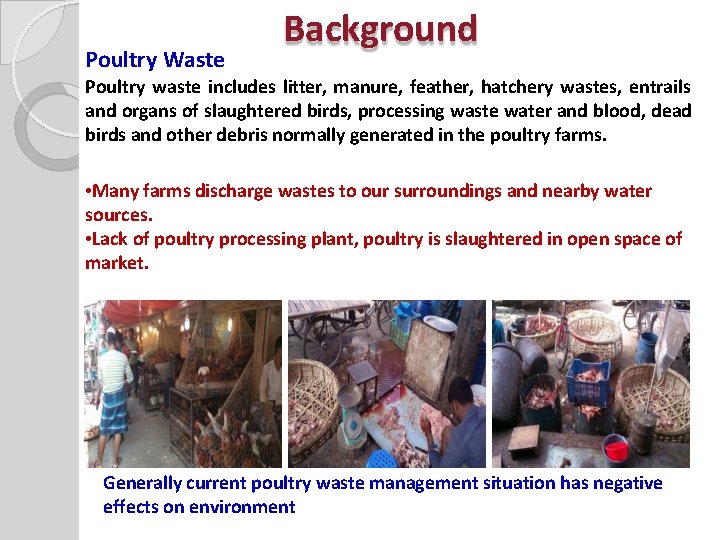
Poultry Waste Background Poultry waste includes litter, manure, feather, hatchery wastes, entrails and organs of slaughtered birds, processing waste water and blood, dead birds and other debris normally generated in the poultry farms. • Many farms discharge wastes to our surroundings and nearby water sources. • Lack of poultry processing plant, poultry is slaughtered in open space of market. Generally current poultry waste management situation has negative effects on environment
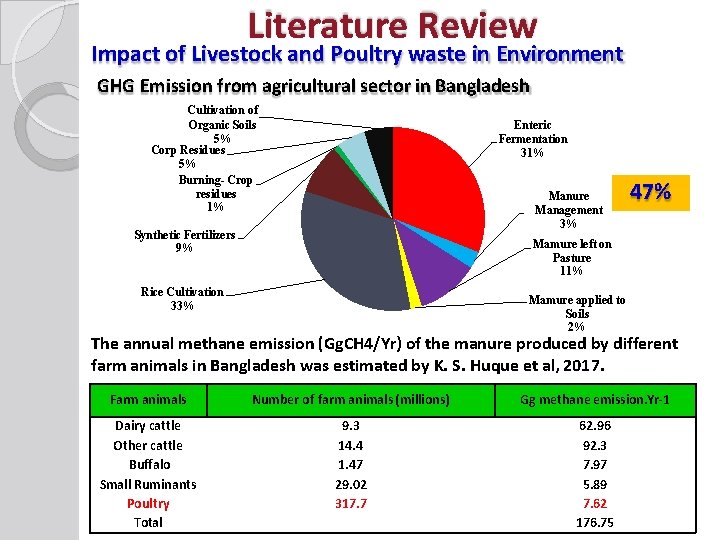
Literature Review Impact of Livestock and Poultry waste in Environment GHG Emission from agricultural sector in Bangladesh Cultivation of Organic Soils 5% Corp Residues 5% Burning- Crop residues 1% Enteric Fermentation 31% Manure Management 3% Synthetic Fertilizers 9% 47% Mamure left on Pasture 11% Rice Cultivation 33% Mamure applied to Soils 2% The annual methane emission (Gg. CH 4/Yr) of the manure produced by different farm animals in Bangladesh was estimated by K. S. Huque et al, 2017. Farm animals Number of farm animals (millions) Gg methane emission. Yr-1 Dairy cattle Other cattle Buffalo Small Ruminants Poultry Total 9. 3 14. 4 1. 47 29. 02 317. 7 62. 96 92. 3 7. 97 5. 89 7. 62 176. 75
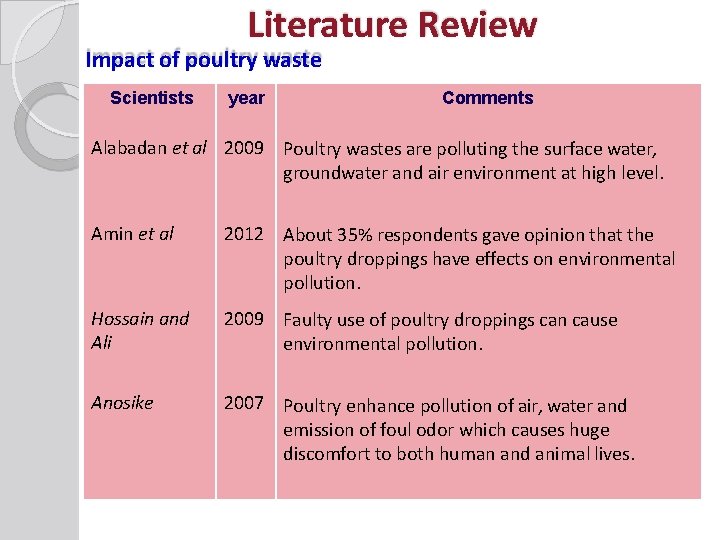
Literature Review Impact of poultry waste Scientists year Comments Alabadan et al 2009 Poultry wastes are polluting the surface water, groundwater and air environment at high level. Amin et al 2012 About 35% respondents gave opinion that the poultry droppings have effects on environmental pollution. Hossain and Ali 2009 Faulty use of poultry droppings can cause environmental pollution. Anosike 2007 Poultry enhance pollution of air, water and emission of foul odor which causes huge discomfort to both human and animal lives.
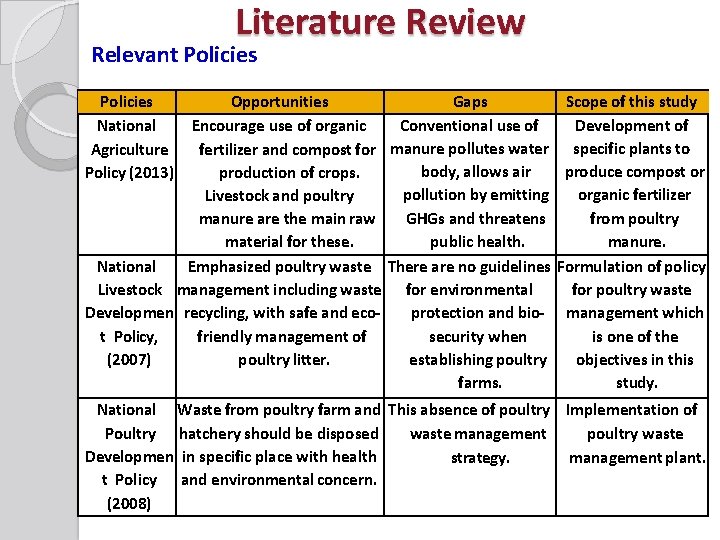
Literature Review Relevant Policies National Agriculture Policy (2013) Opportunities Gaps Encourage use of organic Conventional use of fertilizer and compost for manure pollutes water body, allows air production of crops. pollution by emitting Livestock and poultry GHGs and threatens manure are the main raw public health. material for these. National Emphasized poultry waste There are no guidelines Livestock management including waste for environmental protection and bio. Developmen recycling, with safe and ecot Policy, security when friendly management of (2007) establishing poultry litter. farms. Scope of this study Development of specific plants to produce compost or organic fertilizer from poultry manure. Formulation of policy for poultry waste management which is one of the objectives in this study. National Waste from poultry farm and This absence of poultry Implementation of Poultry hatchery should be disposed waste management poultry waste Developmen in specific place with health strategy. management plant. t Policy and environmental concern. (2008)
Objectives Analysis of existing poultry waste management situation in Bangladesh. Propose scenarios to develop poultry manure recycling plants. Assessment the socio-economic and environmental benefits of the suggested scenarios. Development of guidelines/policies for better management of poultry wastes.
Methodology 1. Analysis of current poultry waste management in Bangladesh Secondary information (DLS, BBS, FAOSTAT, Journals) Use of Ms Excel 2. Propose scenarios for the development of current situation (using geographic information system) Step 1 GIS Suitability Analysis Mapping Restriction Mapping Suitability Final Suitable Locations for Poultry Waste Development Plants
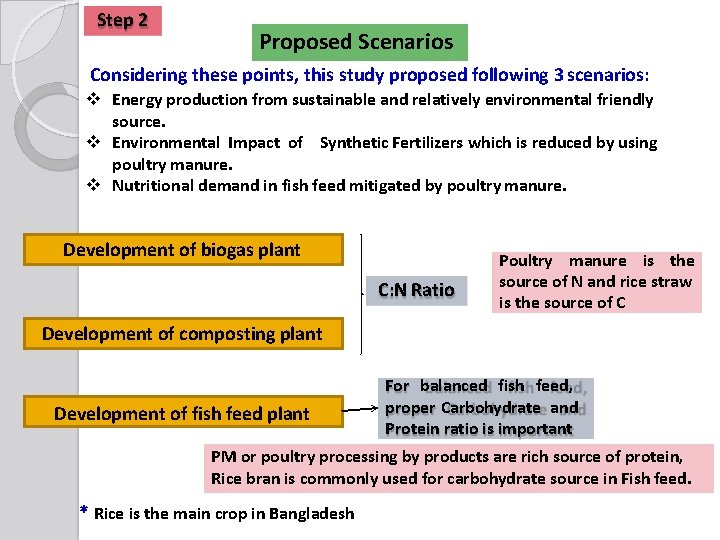
Step 2 Proposed Scenarios Considering these points, this study proposed following 3 scenarios: Energy production from sustainable and relatively environmental friendly source. Environmental Impact of Synthetic Fertilizers which is reduced by using poultry manure. Nutritional demand in fish feed mitigated by poultry manure. Development of biogas plant C: N Ratio Poultry manure is the source of N and rice straw is the source of C Development of composting plant Development of fish feed plant For balanced fish feed, proper Carbohydrate and Protein ratio is important PM or poultry processing by products are rich source of protein, Rice bran is commonly used for carbohydrate source in Fish feed. * Rice is the main crop in Bangladesh
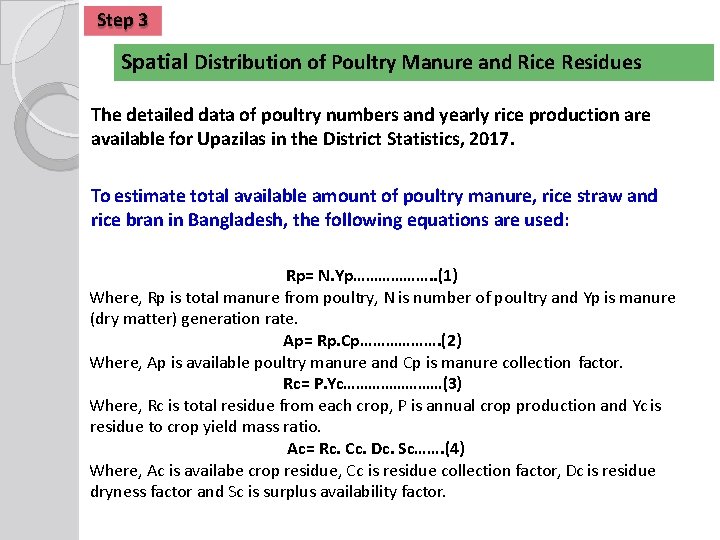
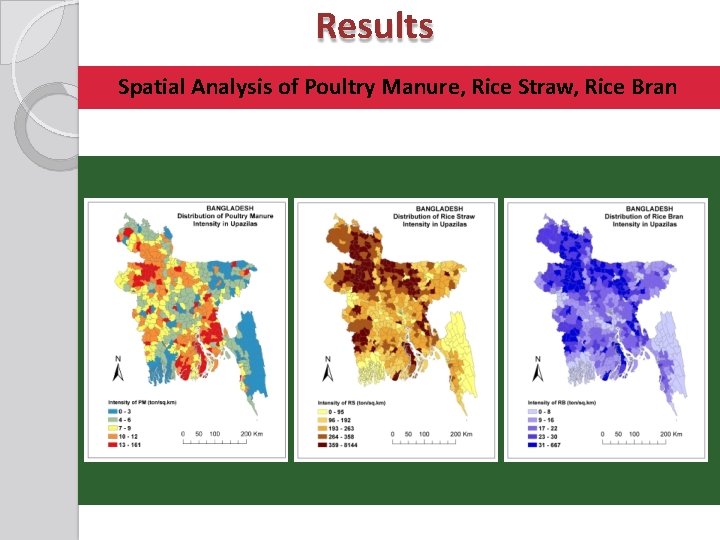
Step 3 Spatial Distribution of Poultry Manure and Rice Residues The detailed data of poultry numbers and yearly rice production are available for Upazilas in the District Statistics, 2017. To estimate total available amount of poultry manure, rice straw and rice bran in Bangladesh, the following equations are used: Rp= N. Yp………………. . (1) Where, Rp is total manure from poultry, N is number of poultry and Yp is manure (dry matter) generation rate. Ap= Rp. Cp………………. (2) Where, Ap is available poultry manure and Cp is manure collection factor. Rc= P. Yc…………(3) Where, Rc is total residue from each crop, P is annual crop production and Yc is residue to crop yield mass ratio. Ac= Rc. Cc. Dc. Sc……. (4) Where, Ac is availabe crop residue, Cc is residue collection factor, Dc is residue dryness factor and Sc is surplus availability factor.
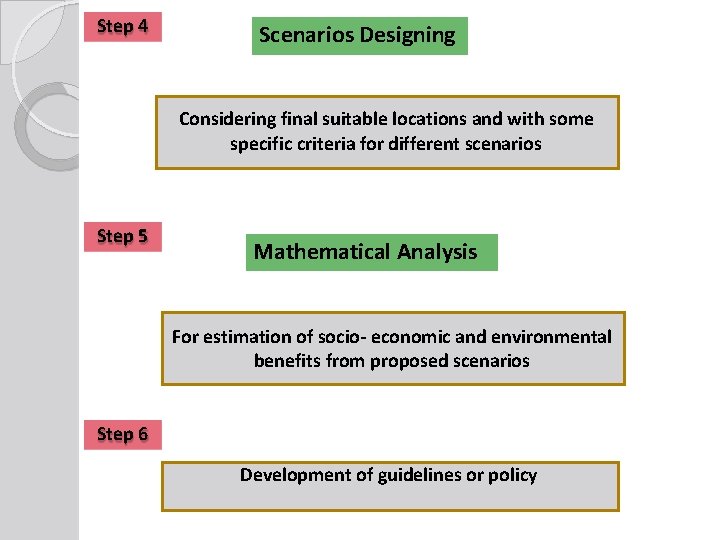
Step 4 Scenarios Designing Considering final suitable locations and with some specific criteria for different scenarios Step 5 Mathematical Analysis For estimation of socio- economic and environmental benefits from proposed scenarios Step 6 Development of guidelines or policy
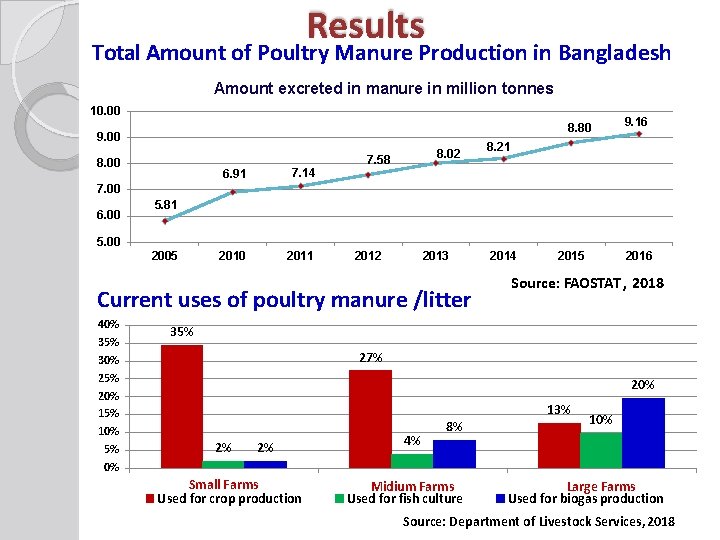
Results Total Amount of Poultry Manure Production in Bangladesh Amount excreted in manure in million tonnes 10. 00 8. 80 9. 00 8. 00 6. 91 7. 14 2010 2011 8. 02 7. 58 9. 16 8. 21 7. 00 6. 00 5. 81 5. 00 2005 2012 2013 Current uses of poultry manure /litter 40% 35% 30% 25% 20% 15% 10% 5% 0% 2014 2015 2016 Source: FAOSTAT , 2018 35% 27% 20% 13% 2% 2% Small Farms Used for crop production 4% 8% Midium Farms Used for fish culture 10% Large Farms Used for biogas production Source: Department of Livestock Services, 2018
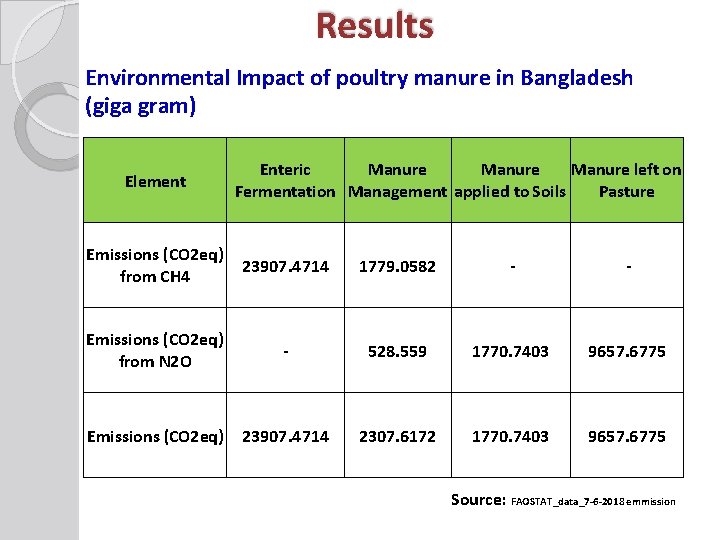
Results Environmental Impact of poultry manure in Bangladesh (giga gram) Element Enteric Manure left on Fermentation Management applied to Soils Pasture Emissions (CO 2 eq) from CH 4 23907. 4714 1779. 0582 - - Emissions (CO 2 eq) from N 2 O - 528. 559 1770. 7403 9657. 6775 Emissions (CO 2 eq) 23907. 4714 2307. 6172 1770. 7403 9657. 6775 Source: FAOSTAT_data_7 -6 -2018 emmission
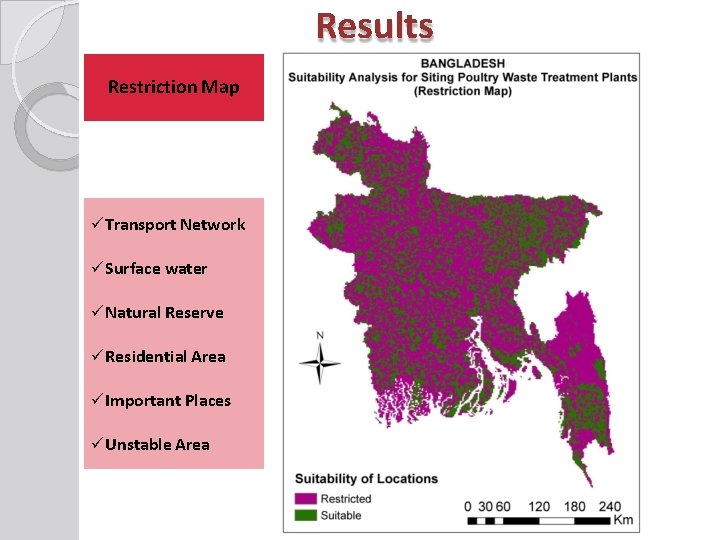
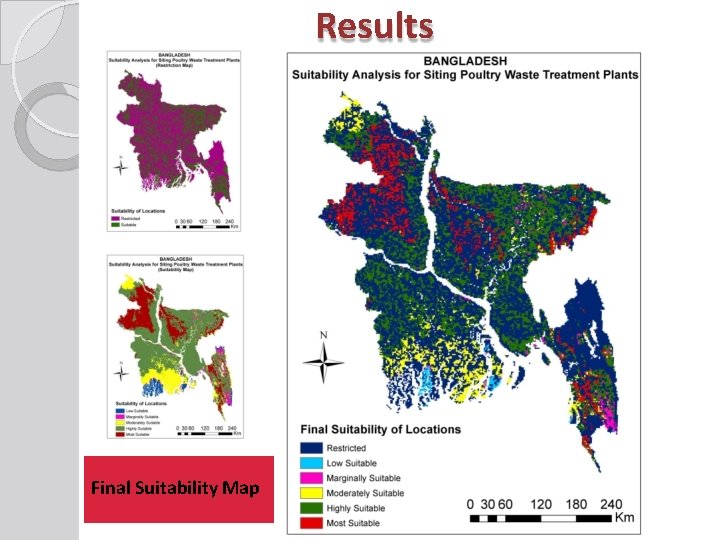
Results Restriction Map Transport Network Surface water Natural Reserve Residential Area Important Places Unstable Area
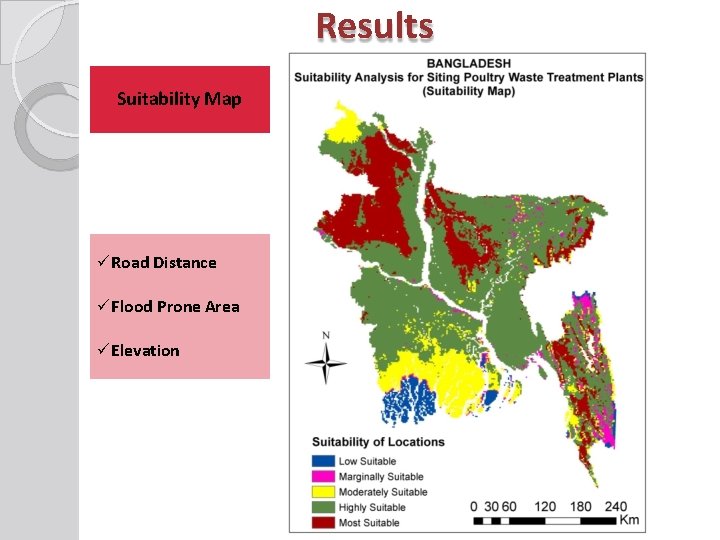
Results Suitability Map Road Distance Flood Prone Area Elevation
Results Final Suitability Map
Results Spatial Analysis of Poultry Manure, Rice Straw, Rice Bran
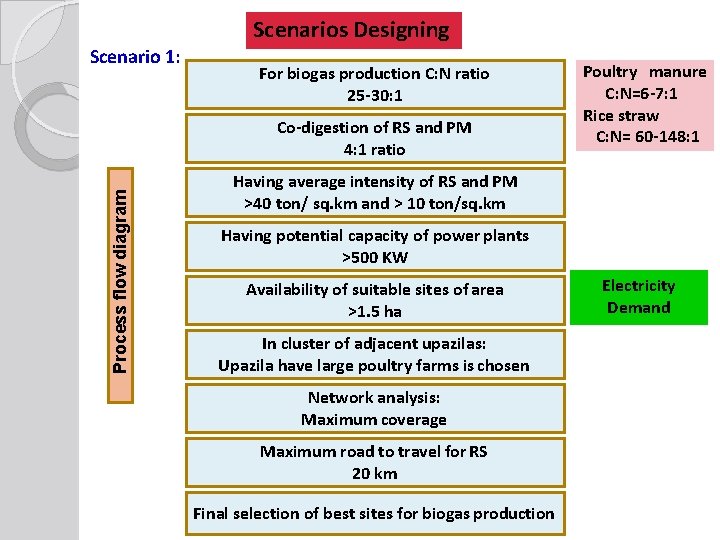
Scenarios Designing Scenario 1: For biogas production C: N ratio 25 -30: 1 Process flow diagram Co-digestion of RS and PM 4: 1 ratio Poultry manure C: N=6 -7: 1 Rice straw C: N= 60 -148: 1 Having average intensity of RS and PM ˃40 ton/ sq. km and > 10 ton/sq. km Having potential capacity of power plants ˃500 KW Availability of suitable sites of area ˃1. 5 ha In cluster of adjacent upazilas: Upazila have large poultry farms is chosen Network analysis: Maximum coverage Maximum road to travel for RS 20 km Final selection of best sites for biogas production Electricity Demand
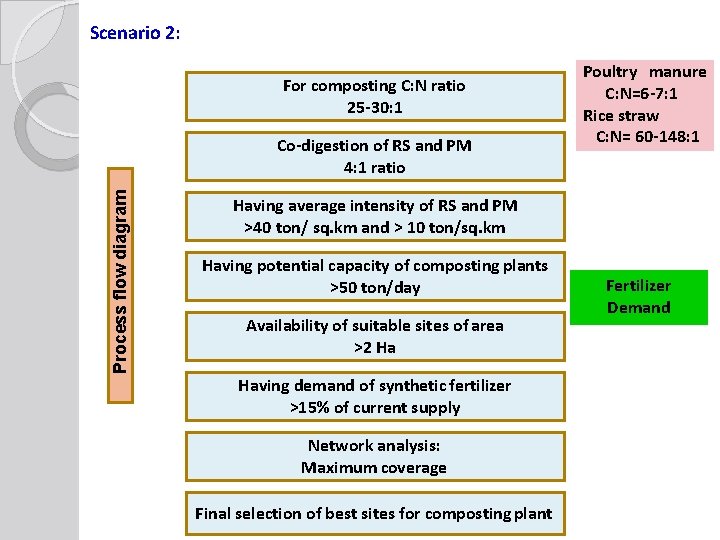
Scenario 2: For composting C: N ratio 25 -30: 1 Process flow diagram Co-digestion of RS and PM 4: 1 ratio Poultry manure C: N=6 -7: 1 Rice straw C: N= 60 -148: 1 Having average intensity of RS and PM ˃40 ton/ sq. km and > 10 ton/sq. km Having potential capacity of composting plants ˃50 ton/day Availability of suitable sites of area ˃2 Ha Having demand of synthetic fertilizer ˃15% of current supply Network analysis: Maximum coverage Final selection of best sites for composting plant Fertilizer Demand
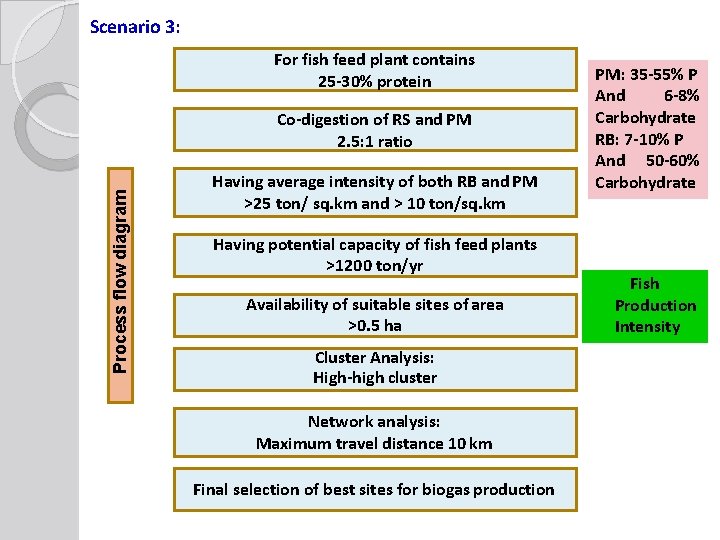
Scenario 3: For fish feed plant contains 25 -30% protein Process flow diagram Co-digestion of RS and PM 2. 5: 1 ratio Having average intensity of both RB and PM ˃25 ton/ sq. km and > 10 ton/sq. km Having potential capacity of fish feed plants ˃1200 ton/yr Availability of suitable sites of area ˃0. 5 ha Cluster Analysis: High-high cluster Network analysis: Maximum travel distance 10 km Final selection of best sites for biogas production PM: 35 -55% P And 6 -8% Carbohydrate RB: 7 -10% P And 50 -60% Carbohydrate Fish Production Intensity
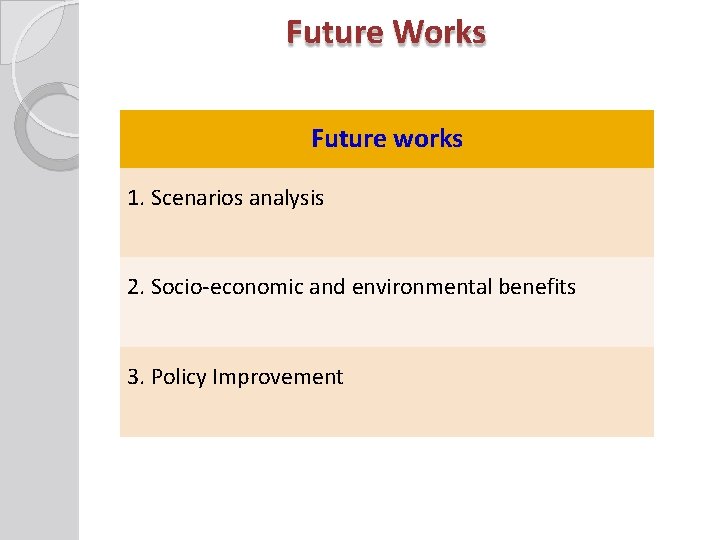
Future Works Future works 1. Scenarios analysis 2. Socio-economic and environmental benefits 3. Policy Improvement
Thank you