
Development of Human Settlements Challenges for Sustainability Vienna
Development of Human Settlements Challenges for Sustainability Vienna International Center December 18 - 19, 2013 Introducing the Concept of Social Innovation to Urban Development Josef Hochgerner Zentrum für Soziale Innovation
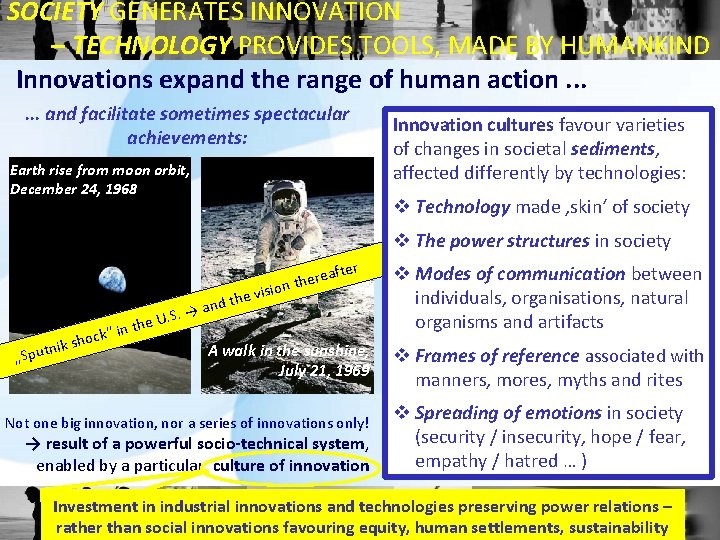
SOCIETY GENERATES INNOVATION – TECHNOLOGY PROVIDES TOOLS, MADE BY HUMANKIND Innovations expand the range of human action. . . and facilitate sometimes spectacular achievements: Earth rise from moon orbit, December 24, 1968 Innovation cultures favour varieties of changes in societal sediments, affected differently by technologies: v Technology made ‚skin‘ of society v The power structures in society fter nik „Sput “ in shock nd t erea h t n io he vis v Modes of communication between individuals, organisations, natural organisms and artifacts A walk in the sunshine, July 21, 1969 v Frames of reference associated with manners, mores, myths and rites . →a S. U he t Not one big innovation, nor a series of innovations only! → result of a powerful socio-technical system, enabled by a particular culture of innovation v Spreading of emotions in society (security / insecurity, hope / fear, empathy / hatred … ) Investment in industrial innovations and technologies preserving power relations – rather than social innovations favouring equity, human settlements, sustainability
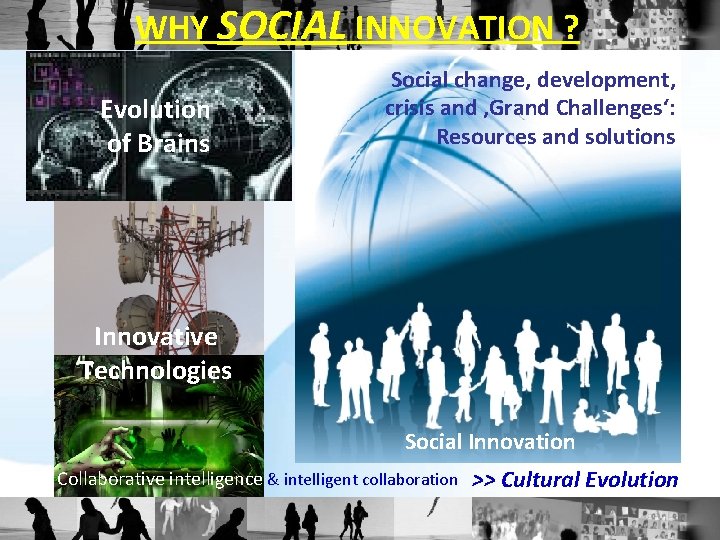
WHY SOCIAL INNOVATION ? Evolution of Brains Social change, development, crisis and ‚Grand Challenges‘: Resources and solutions Innovative Technologies Social Innovation Collaborative intelligence & intelligent collaboration >> Cultural Evolution
SECOND THOUGHTS ABOUT ‚GRAND CHALLENGES‘ The emergence of the European type welfare state was a result of responses to the 19 th century‘s „grand challenges“ of the industrial society. … in the „welfare islands“ of the world Outcome during the ‘golden age of capitalism’ ≈1950 s― 1970 s, Eric Hobsbawm: An adequate part of productivity gains was used to Øavert most existential threats to social security, health and wellbeing from most of the population in highly industrialized societies; Øand to enable the emancipation of a previously suppressed working class to become fully recognized citizens – with justified hopes for better life for them and their children.
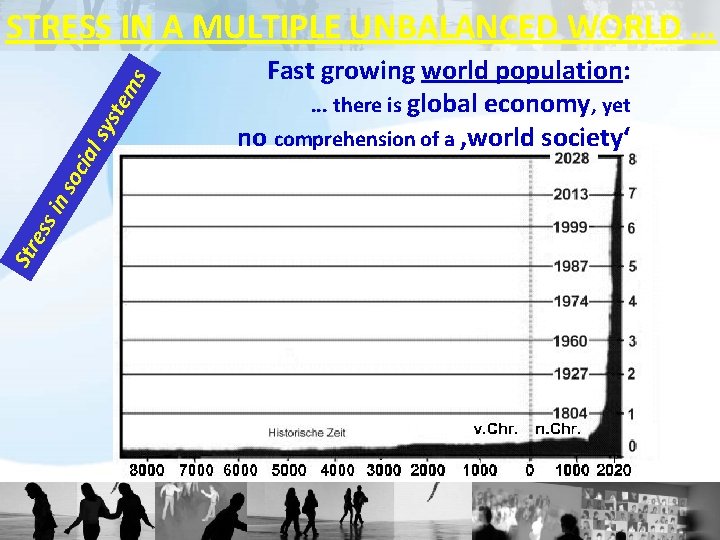
Str ess in soc i al sys te ms STRESS IN A MULTIPLE UNBALANCED WORLD … Fast growing world population: . . . there is global economy, yet no comprehension of a ‚world society‘
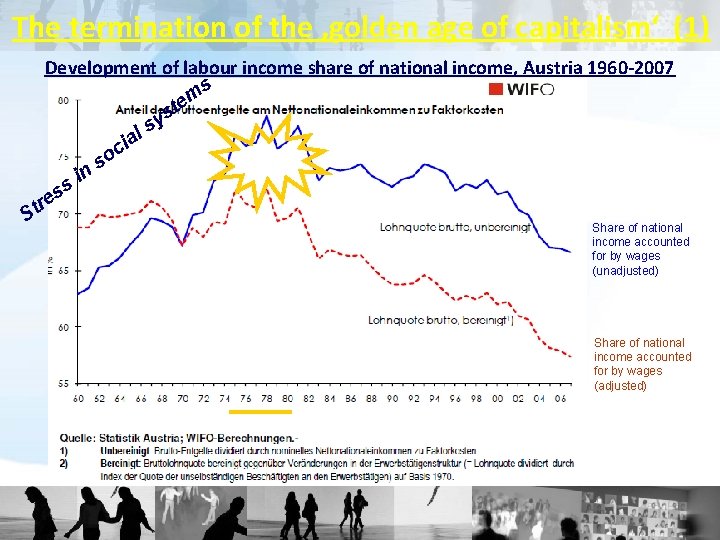
The termination of the ‚golden age of capitalism‘ (1) S Development of labour income share of national income, Austria 1960 -2007 s m te s sy l ia c so in s s e r t Share of national income accounted for by wages (unadjusted) Share of national income accounted for by wages (adjusted)
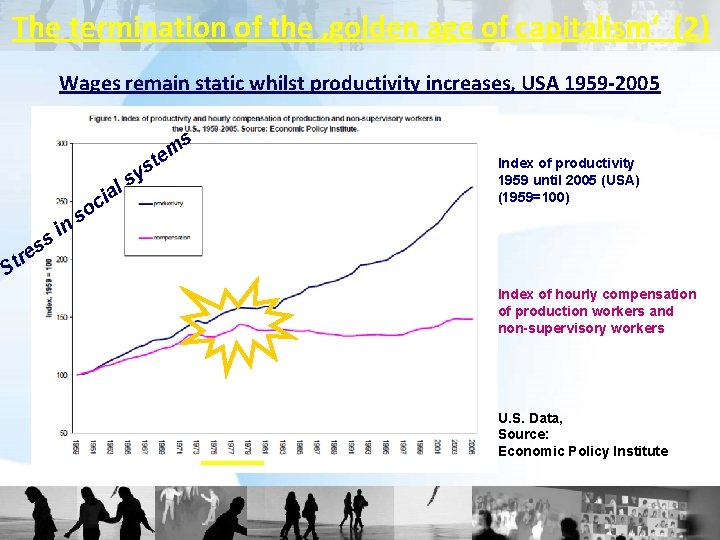
The termination of the ‚golden age of capitalism‘ (2) Wages remain static whilst productivity increases, USA 1959 -2005 t s y n i s s so c s l ia s em Index of productivity 1959 until 2005 (USA) (1959=100) re t S Index of hourly compensation of production workers and non-supervisory workers U. S. Data, Source: Economic Policy Institute
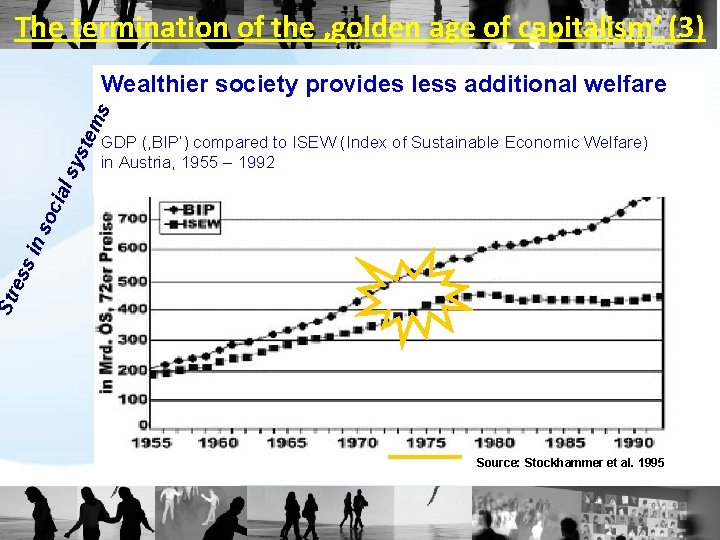
The termination of the ‚golden age of capitalism‘ (3) GDP (‚BIP‘) compared to ISEW (Index of Sustainable Economic Welfare) in Austria, 1955 – 1992 Str ess in so cia l sy ste ms Wealthier society provides less additional welfare Source: Stockhammer et al. 1995
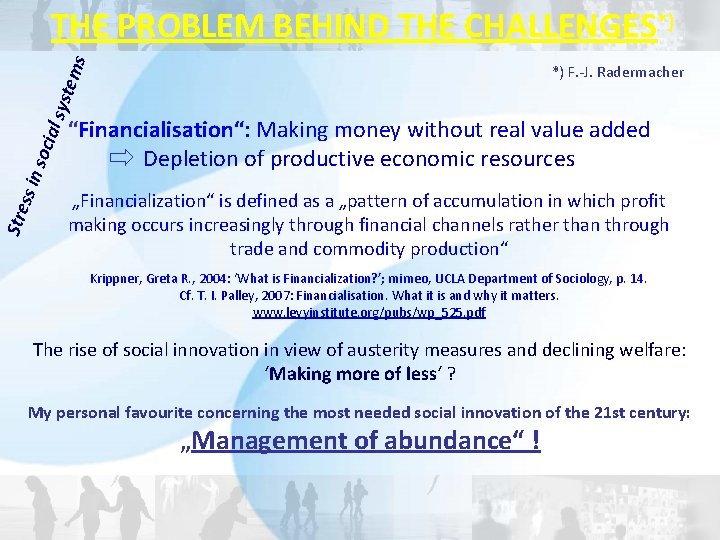
stem s THE PROBLEM BEHIND THE CHALLENGES*) Stre ss in soci al sy *) F. -J. Radermacher “Financialisation“: Making money without real value added Depletion of productive economic resources „Financialization“ is defined as a „pattern of accumulation in which profit making occurs increasingly through financial channels rather than through trade and commodity production“ Krippner, Greta R. , 2004: ‘What is Financialization? ’; mimeo, UCLA Department of Sociology, p. 14. Cf. T. I. Palley, 2007: Financialisation. What it is and why it matters. www. levyinstitute. org/pubs/wp_525. pdf The rise of social innovation in view of austerity measures and declining welfare: ‘Making more of less‘ ? My personal favourite concerning the most needed social innovation of the 21 st century: „Management of abundance“ !
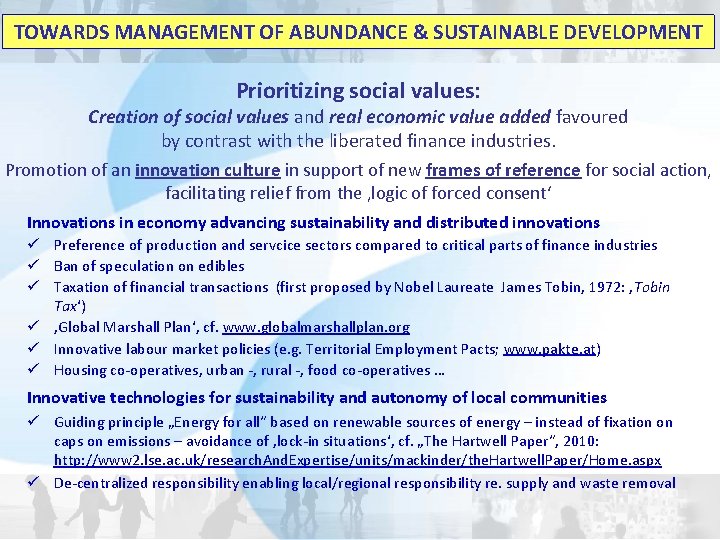
TOWARDS MANAGEMENT OF ABUNDANCE & SUSTAINABLE DEVELOPMENT Prioritizing social values: Creation of social values and real economic value added favoured by contrast with the liberated finance industries. Promotion of an innovation culture in support of new frames of reference for social action, facilitating relief from the ‚logic of forced consent‘ Innovations in economy advancing sustainability and distributed innovations ü Preference of production and servcice sectors compared to critical parts of finance industries ü Ban of speculation on edibles ü Taxation of financial transactions (first proposed by Nobel Laureate James Tobin, 1972: ‚Tobin Tax‘) ü ‚Global Marshall Plan‘, cf. www. globalmarshallplan. org ü Innovative labour market policies (e. g. Territorial Employment Pacts; www. pakte. at) ü Housing co-operatives, urban -, rural -, food co-operatives … Innovative technologies for sustainability and autonomy of local communities ü Guiding principle „Energy for all“ based on renewable sources of energy – instead of fixation on caps on emissions – avoidance of ‚lock-in situations‘, cf. „The Hartwell Paper“, 2010: http: //www 2. lse. ac. uk/research. And. Expertise/units/mackinder/the. Hartwell. Paper/Home. aspx ü De-centralized responsibility enabling local/regional responsibility re. supply and waste removal
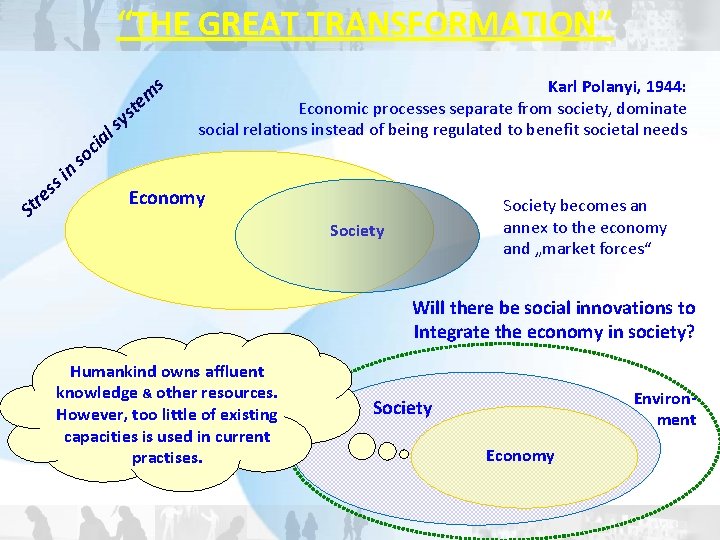
“THE GREAT TRANSFORMATION” s em st y ls re t S i ss n ia c so Karl Polanyi, 1944: Economic processes separate from society, dominate social relations instead of being regulated to benefit societal needs Economy Society becomes an annex to the economy and „market forces“ Society Will there be social innovations to Integrate the economy in society? Humankind owns affluent knowledge & other resources. However, too little of existing capacities is used in current practises. Environment Society Economy
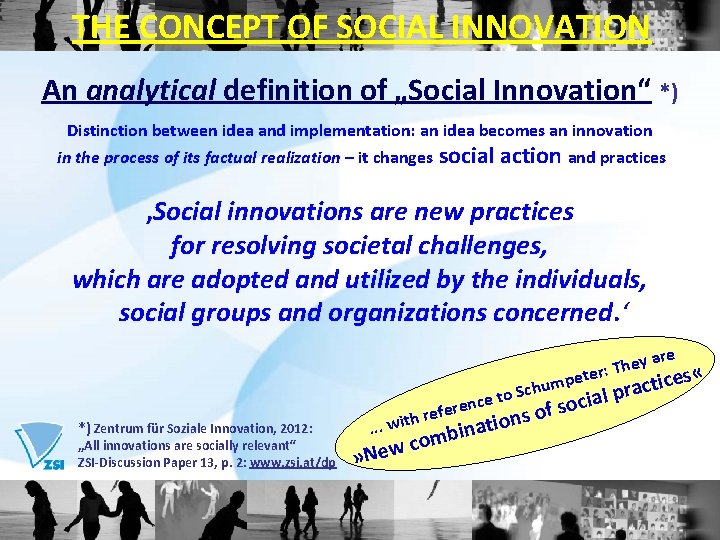
THE CONCEPT OF SOCIAL INNOVATION An analytical definition of „Social Innovation“ *) Distinction between idea and implementation: an idea becomes an innovation in the process of its factual realization – it changes social action and practices ‚Social innovations are new practices for resolving societal challenges, which are adopted and utilized by the individuals, social groups and organizations concerned. ‘ oci s f o ns o i t a. . . w bin m o c » New nce *) Zentrum für Soziale Innovation, 2012: „All innovations are socially relevant“ ZSI-Discussion Paper 13, p. 2: www. zsi. at/dp um to Sch pe hey T : r e t fere ith re are es « c i t c a al pr
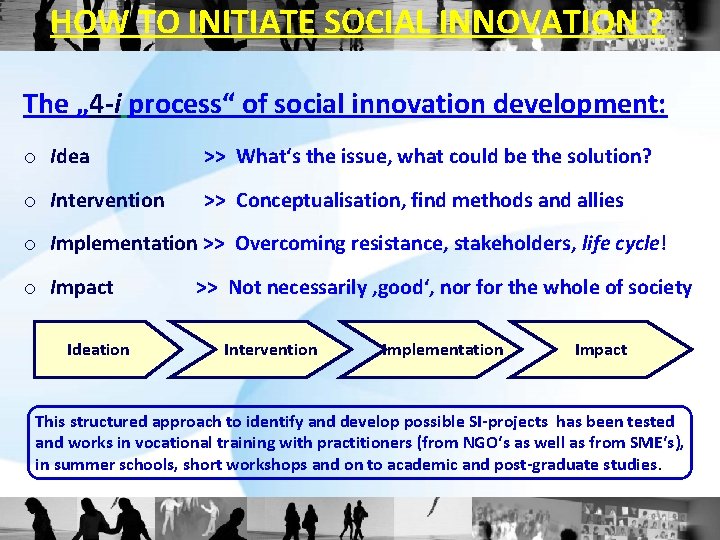
HOW TO INITIATE SOCIAL INNOVATION ? The „ 4 -i process“ of social innovation development: o Idea >> What‘s the issue, what could be the solution? o Intervention >> Conceptualisation, find methods and allies o Implementation >> Overcoming resistance, stakeholders, life cycle! o Impact Ideation >> Not necessarily ‚good‘, nor for the whole of society Intervention Implementation Impact This structured approach to identify and develop possible SI-projects has been tested and works in vocational training with practitioners (from NGO‘s as well as from SME‘s), in summer schools, short workshops and on to academic and post-graduate studies.
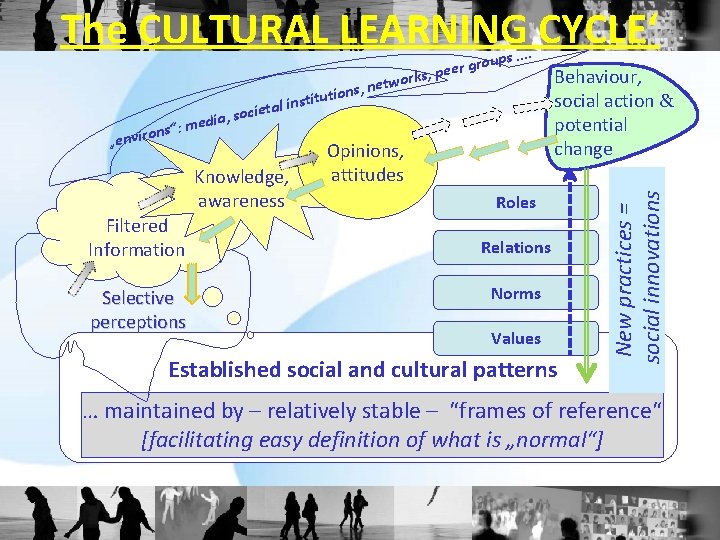
The CULTURAL LEARNING CYCLE‘ „env Knowledge, awareness Filtered Information Selective perceptions Opinions, attitudes Behaviour, social action & potential change Roles Relations Norms Values Established social and cultural patterns New practices = social innovations , so edia m : “ s iron utio stit n i l a t e ci ks, twor e n , s n s. . roup peer g … maintained by – relatively stable – “frames of reference“ [facilitating easy definition of what is „normal“]
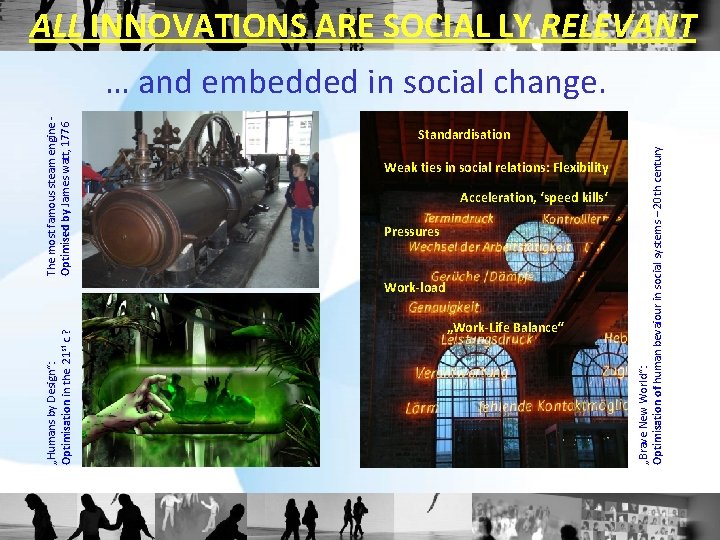
ALL INNOVATIONS ARE SOCIAL LY RELEVANT Standardisation Weak ties in social relations: Flexibility Acceleration, ‘speed kills‘ Pressures „Humans by Design“: Optimisation in the 21 st c. ? Work-load „Work-Life Balance“ „Brave New World“: Optimisation of human bevaiour in social systems – 20 th century The most famous steam engine Optimised by James watt, 1776 … and embedded in social change.
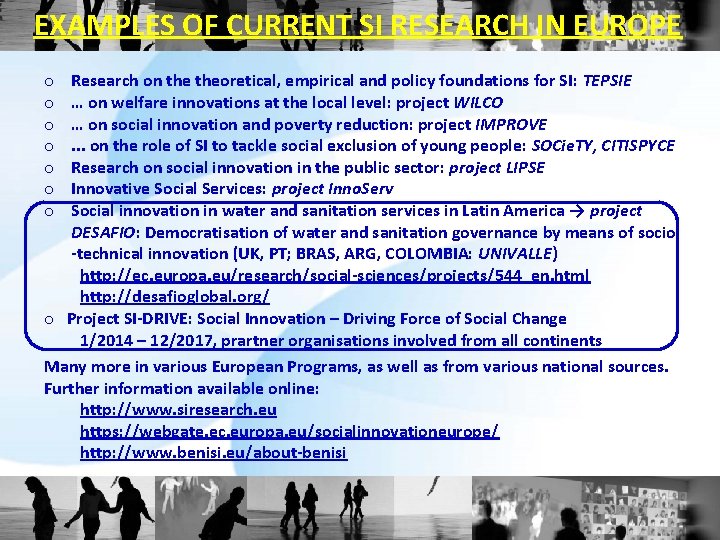
EXAMPLES OF CURRENT SI RESEARCH IN EUROPE Research on theoretical, empirical and policy foundations for SI: TEPSIE … on welfare innovations at the local level: project WILCO … on social innovation and poverty reduction: project IMPROVE. . . on the role of SI to tackle social exclusion of young people: SOCie. TY, CITISPYCE Research on social innovation in the public sector: project LIPSE Innovative Social Services: project Inno. Serv Social innovation in water and sanitation services in Latin America → project DESAFIO: Democratisation of water and sanitation governance by means of socio -technical innovation (UK, PT; BRAS, ARG, COLOMBIA: UNIVALLE) http: //ec. europa. eu/research/social-sciences/projects/544_en. html http: //desafioglobal. org/ o Project SI-DRIVE: Social Innovation – Driving Force of Social Change 1/2014 – 12/2017, prartner organisations involved from all continents Many more in various European Programs, as well as from various national sources. Further information available online: http: //www. siresearch. eu https: //webgate. ec. europa. eu/socialinnovationeurope/ http: //www. benisi. eu/about-benisi o o o o
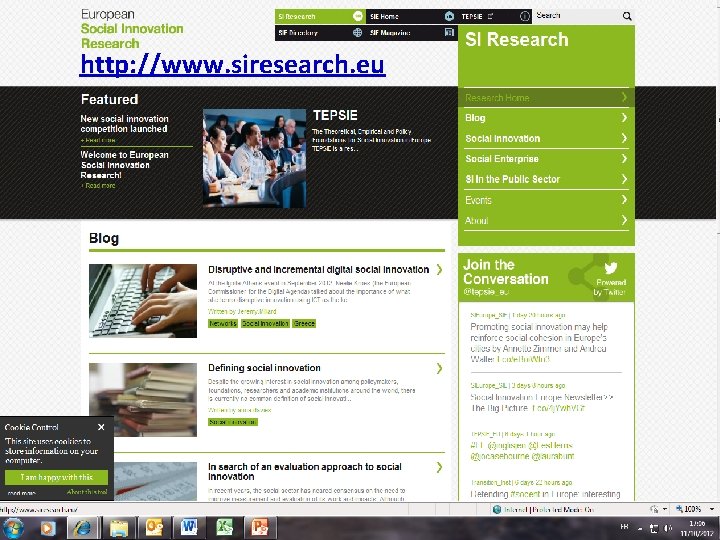
http: //www. siresearch. eu
A network of social innovation scholars and institutions (umbrella organisation): Educators, promotors, researchers and practitioners of social innovation Legal status: Association according to Austrian Law Members: Individuals (physical persons) and institutions, i. e. legal bodies like ZSI (AT), SINNERGIAK (ES) and universities, currently one from Austria, two from Germany, one from Spain; several candidates. Head office: ZSI – Centre for Social Innovation, Vienna Executive Board: J. Hochgerner, Vienna, H. W. Franz, Dortmund, A. Unceta-Satrustegui, San Sebastian Activities: Ø Ø Education & Training (e. g. M. A. SI, Summer Schools), Provision of Online Learning; SME-Training … Conferences, media, p. r. and promotion of social innovation Research: Development of methodologies, indicators towards an ‚Oslo Manual‘ for S. I. The role of ESSI in the project (IP) „SI DRIVE: Social innovation – Driving force of social change“
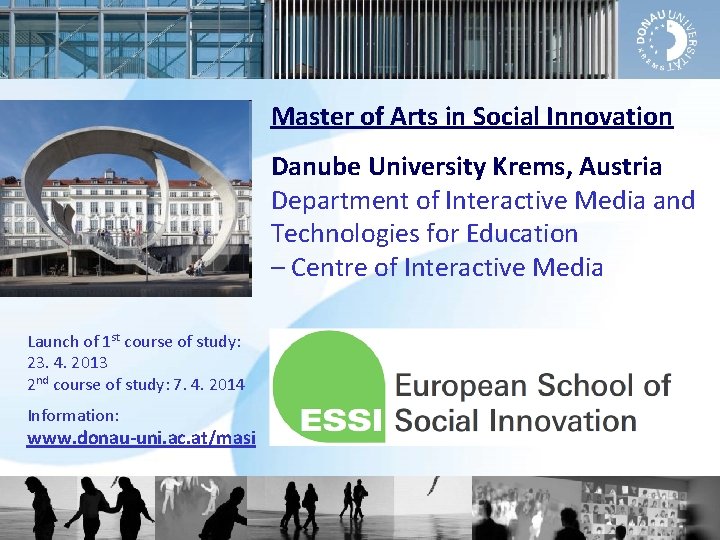
Master of Arts in Social Innovation Danube University Krems, Austria Department of Interactive Media and Technologies for Education – Centre of Interactive Media Launch of 1 st course of study: 23. 4. 2013 2 nd course of study: 7. 4. 2014 Information: www. donau-uni. ac. at/masi

Prof. Dr. Josef Hochgerner Centre for Social Innovation Linke Wienzeile 246 A - 1150 Vienna Tel. ++43. 1. 4950442 Fax. ++43. 1. 4950442 -40 email: hochgerner@zsi. at http: //www. zsi. at
- Slides: 20