
Development of Health Information Database using Spatial Technologies
Development of Health Information Database using Spatial Technologies for Japanese Encephalitis Shipra Verma, Prof. R. D. Gupta Presented By Shipra Verma GIS Cell Motilal Nehru National Institute Of Technology Allahabad - 211004 GIS Cell, MNNIT-A 1
INTRODUCTION • Health is essential for every human as their basic right and must be at reach to all in an affordable manner (Wennberg JE, 2002). • Health is geographically differentiated between “place” and “health”. • Public Health is the science and art of protecting and improving the health of communities through education, promotion of healthy lifestyle, and research of disease and injury prevention. 2 GIS Cell, MNNIT-A

• Health data needs to produced, to assess the ability of the system for valid, reliable, timely, and reasonably accurate health information. • The planner and decision makers allow the user to “integrate data collection, processing, reporting, and use of the information necessary for improving health service, effectiveness and efficiency through better management at all levels of health services”. 3
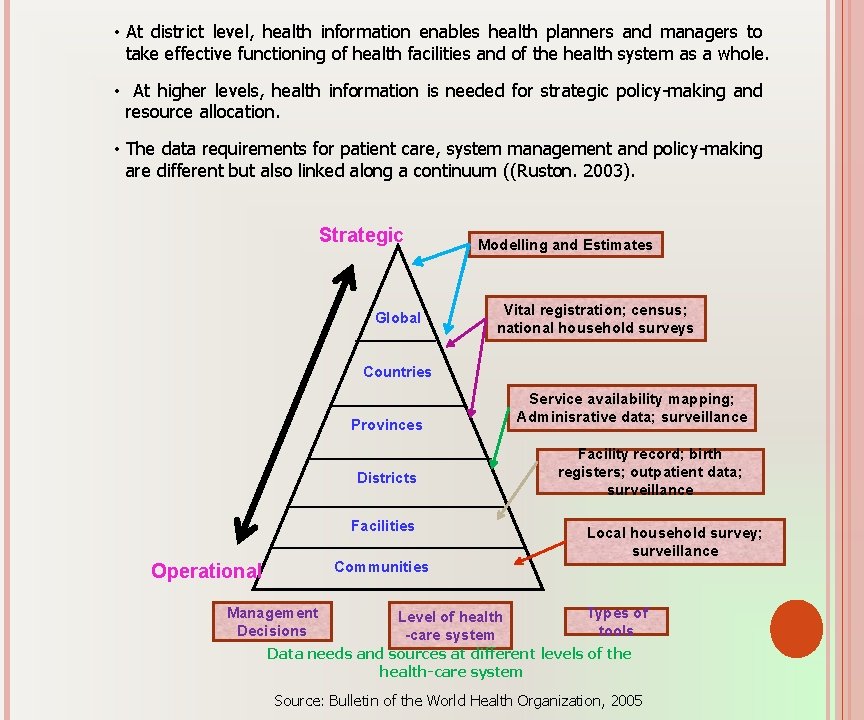
• At district level, health information enables health planners and managers to take effective functioning of health facilities and of the health system as a whole. • At higher levels, health information is needed for strategic policy-making and resource allocation. • The data requirements for patient care, system management and policy-making are different but also linked along a continuum ((Ruston. 2003). Strategic Global Modelling and Estimates Vital registration; census; national household surveys Countries Provinces Districts Facilities Communities Operational Service availability mapping; Adminisrative data; surveillance Facility record; birth registers; outpatient data; surveillance Local household survey; surveillance Management Decisions Types of Level of health tools -care system Data needs and sources at different levels of the health-care system Source: Bulletin of the World Health Organization, 2005

§ Such an infrastructure serves as the foundation for planning, delivering, and evaluating public health At district level Health units Sub Centers State Surveillance Unit P. H. C. s C. H. C. s District Surveillance Unit Dist. Hosp. Pvt. Practitioners Nursing Homes Private Hospitals Med. Col. P. H. Lab. Central Surveillanc e Unit Programme Officers Other Hospitals: ESI, Municipal Rl, Army etc. Private Labs. Corporate Hospitals
• Vector-borne diseases represents one of the greatest global public health challenges of the 21 st century. • Changes in public health including lack of effective vector control, deterioration of public health infrastructure to deal with vector-borne diseases, disease surveillance and prevention programs and possible climate change. • In the absence of effective control, these diseases have a major impact on public health and socio-economic development. 6 GIS Cell, MNNIT-A
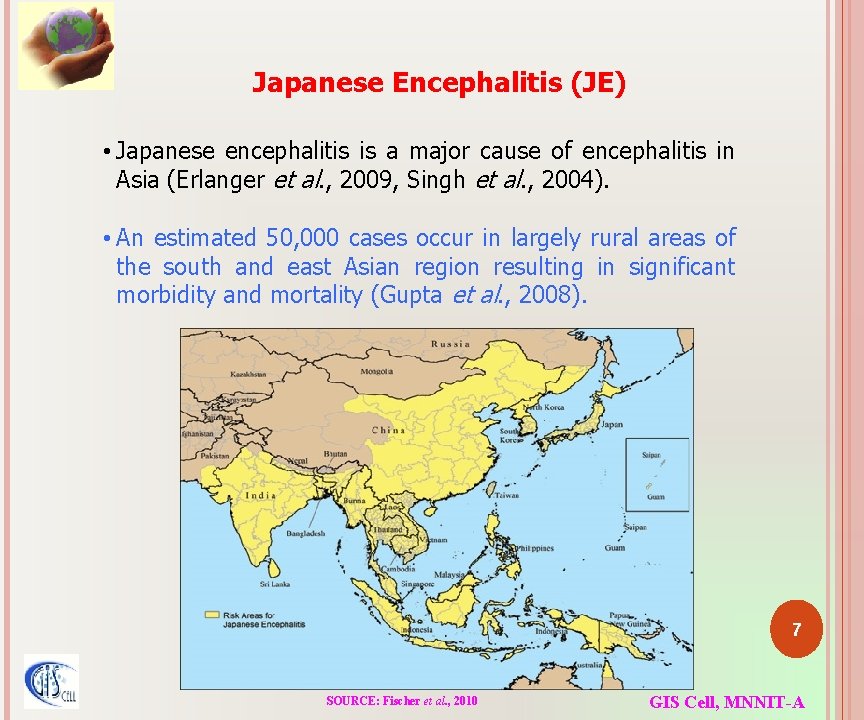
Japanese Encephalitis (JE) • Japanese encephalitis is a major cause of encephalitis in Asia (Erlanger et al. , 2009, Singh et al. , 2004). • An estimated 50, 000 cases occur in largely rural areas of the south and east Asian region resulting in significant morbidity and mortality (Gupta et al. , 2008). 7 SOURCE: Fischer et al. , 2010 GIS Cell, MNNIT-A
• JE is caused by a zoonotic flavivirus which is one of the common causes of AES. • It is difficult to eradicate JE because it is transmitted from natural reservoirs like pigs, waddling birds which are important amplifying hosts and man is involved as an accidental host (Khinchi et al. , 2010, Fischer et al. , 2010). • Among 175 districts 80 districts classified as endemic 54 (68%) are from Uttar Pradesh state alone (Sabenson, 2008, Saxena et al. , 2008). • The scourge of the disease is most severe in Gorakhpur District (Singh. 2007). 8 GIS Cell, MNNIT-A
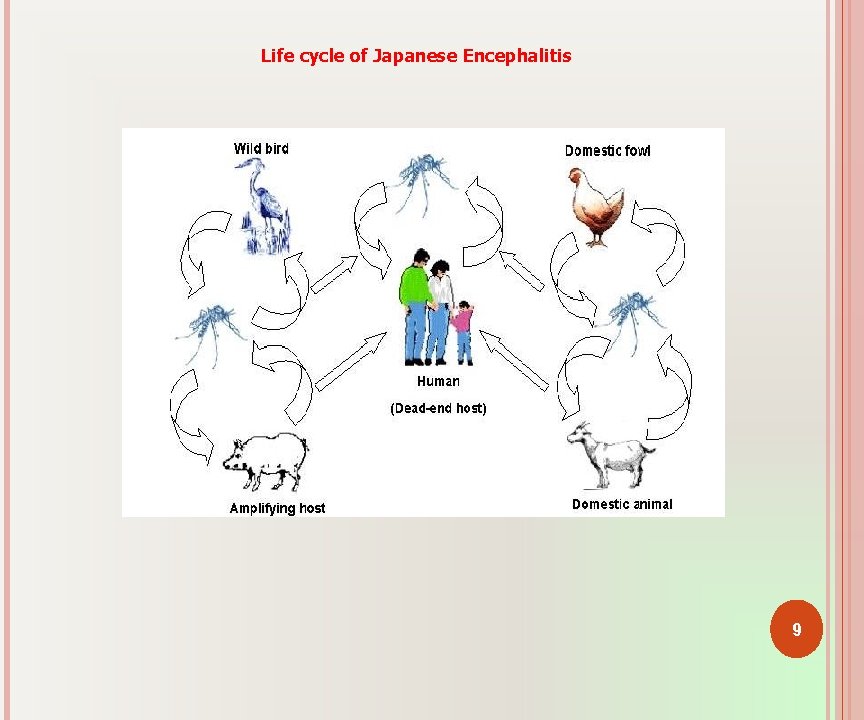
Life cycle of Japanese Encephalitis 9
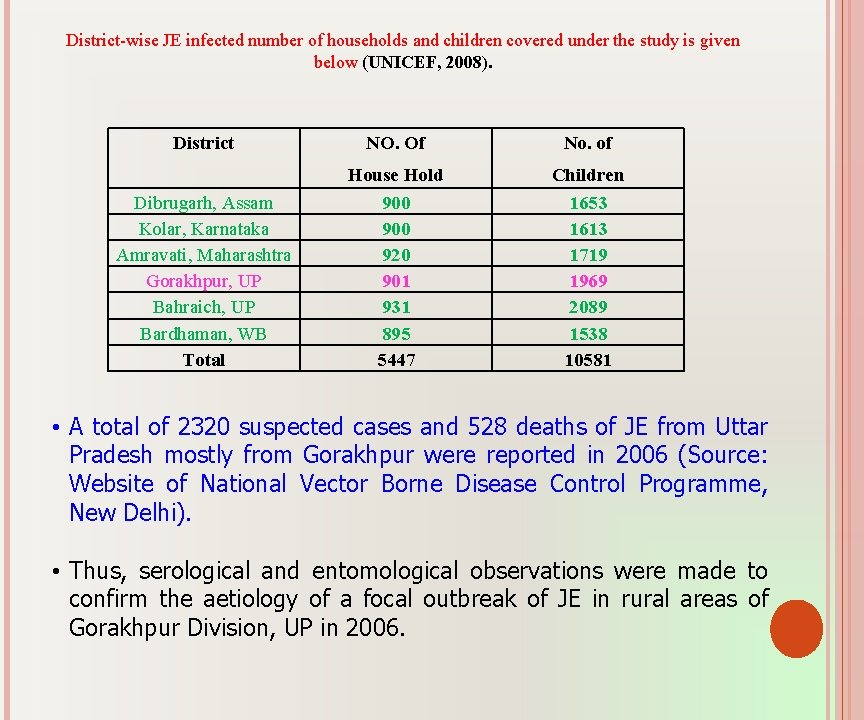
District-wise JE infected number of households and children covered under the study is given below (UNICEF, 2008). District NO. Of No. of Dibrugarh, Assam Kolar, Karnataka Amravati, Maharashtra Gorakhpur, UP Bahraich, UP Bardhaman, WB Total House Hold 900 920 901 931 895 5447 Children 1653 1613 1719 1969 2089 1538 10581 • A total of 2320 suspected cases and 528 deaths of JE from Uttar Pradesh mostly from Gorakhpur were reported in 2006 (Source: Website of National Vector Borne Disease Control Programme, New Delhi). • Thus, serological and entomological observations were made to confirm the aetiology of a focal outbreak of JE in rural areas of Gorakhpur Division, UP in 2006.

ROLE OF GIS AND REMOTE SENSING • GIS has proved extremely useful for supporting the extent of various infections in the world. • A simplified GIS supported database management tool facilitates the collection, storage, retrieval and analysis of data for public health purposes (Berquist. , 2001). • By utilizing a GIS, various departments can share information through databases on computer generated maps in one location. • Disease mapping is used to understand the geographical distribution and spread of disease in the past or present. 11 GIS Cell, MNNIT-A
• Remote sensing (RS) by earth-observing satellites has become increasingly important for the analysis and integration of various data. • The heterogeneity of climates and landscapes determines the distribution of vector-borne diseases. • These new technologies through their propensity for powerful data collection and data handling are particularly well suited to pinpointing constraining factors. • Remote Sensing technique used to obtained disease information on vegetation properties, canopy, surface temperature and soil moisture over large areas. 12 GIS Cell, MNNIT-A

GIS Health Dataset Ø To integrate and make the health database in GIS environment , the following data layers to perform different types of health-related analyses (Boulos et al; 2001): i. Population data, e. g. ; census and socioeconomic data; ii. Environmental and ecological data, e. g. , monitored data on pollution and vegetation (satellite pictures); iii. Topography, hydrology and climatic data; iv. Land-use and public infrastructure data, e. g. , schools and main drinking water supply; v. Transportation networks (access routes) data, e. g. , roads and railways; vi. Health infrastructure and epidemiological data, e. g. , data on mortality, morbidity, disease distribution and healthcare facilities; Health Data Administrative Data Environmental Data Geographic Data Demographic Data Combined Data Layer
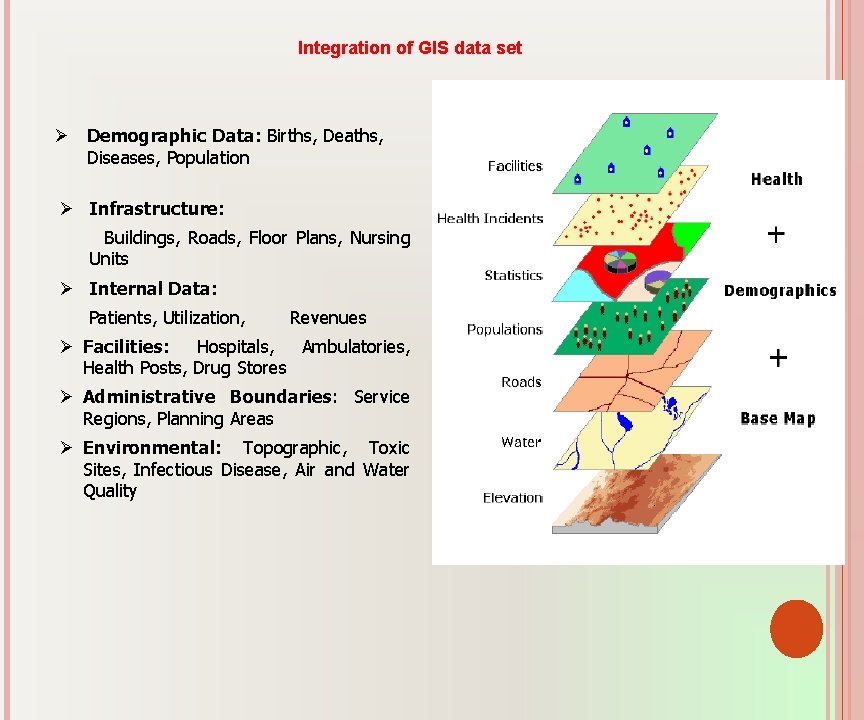
Integration of GIS data set Ø Demographic Data: Births, Deaths, Diseases, Population Ø Infrastructure: Buildings, Roads, Floor Plans, Nursing Units Ø Internal Data: Patients, Utilization, Revenues Ø Facilities: Hospitals, Ambulatories, Health Posts, Drug Stores Ø Administrative Boundaries: Service Regions, Planning Areas Ø Environmental: Topographic, Toxic Sites, Infectious Disease, Air and Water Quality
Objective Of The Present Work • The objective of present work includes creating a GIS based health data set using spatial data and their attribute information particularly for Japanese encephalitis. • The collected statistical dataset has been integrated in GIS using Arc. GIS 10 software. • The statistical information has been converted into GIS based thematic map for better visualization and interpretation. 15 GIS Cell, MNNIT-A
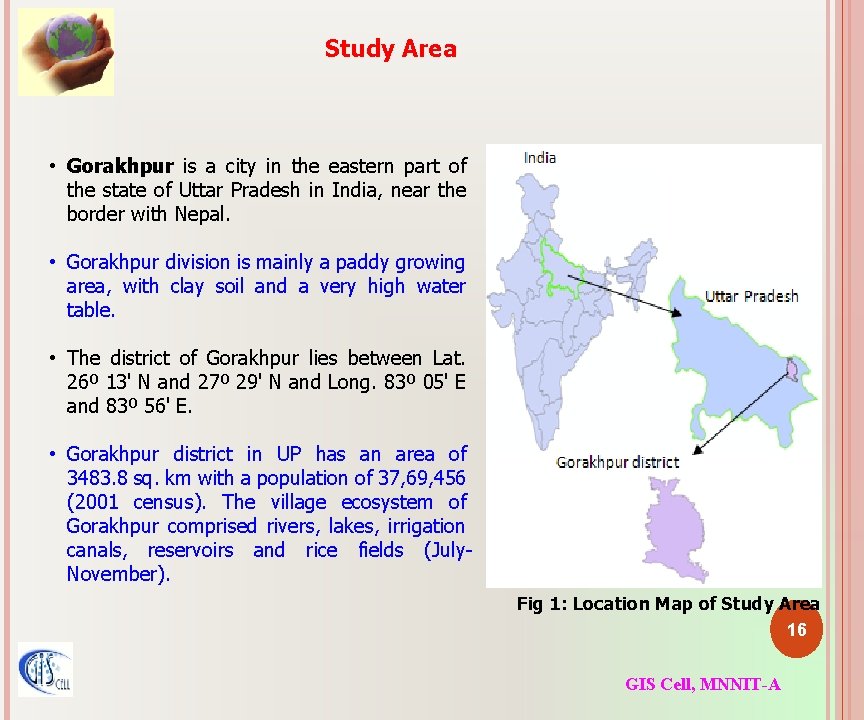
Study Area • Gorakhpur is a city in the eastern part of the state of Uttar Pradesh in India, near the border with Nepal. • Gorakhpur division is mainly a paddy growing area, with clay soil and a very high water table. • The district of Gorakhpur lies between Lat. 26º 13' N and 27º 29' N and Long. 83º 05' E and 83º 56' E. • Gorakhpur district in UP has an area of 3483. 8 sq. km with a population of 37, 69, 456 (2001 census). The village ecosystem of Gorakhpur comprised rivers, lakes, irrigation canals, reservoirs and rice fields (July. November). Fig 1: Location Map of Study Area 16 GIS Cell, MNNIT-A
Collection of Health data • The health data is collected from district hospital Gorakhpur, Vikas Bhawan and NIC center of Gorakhpur. • The collected data is on the basis of : v Month wise disease data from year 2005 to 2010 v Age wise and Sex wise data from age 0 -5, 5 -10, 10 -15, 15 -20, 20 -30, 3040 40 -50 50 -ABOVE. v Use of Census data 2001. • The satellite data is also used, i. e. , Landsat ETM images 2010 from April and November. 17 GIS Cell, MNNIT-A
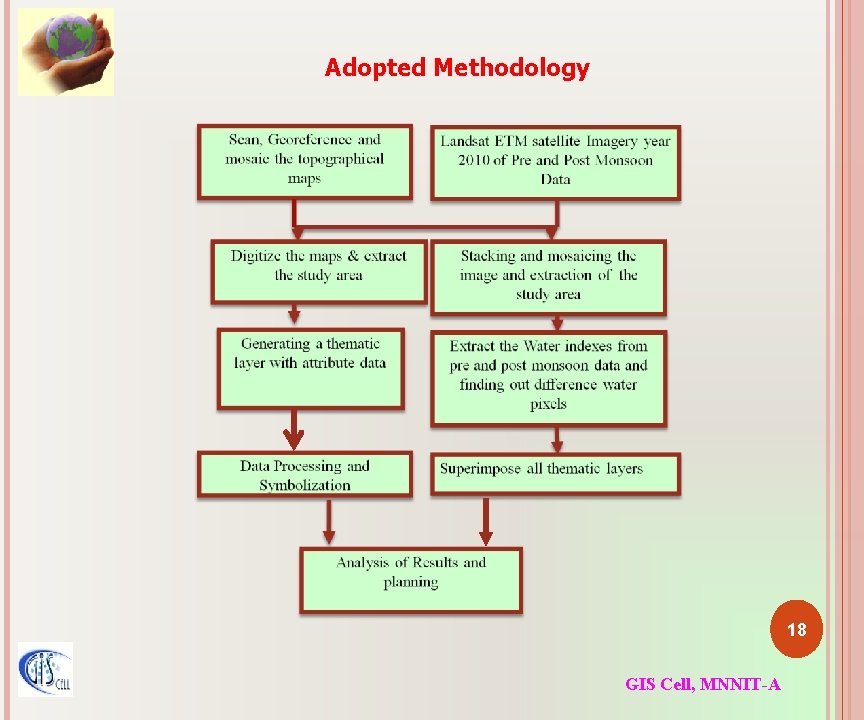
Adopted Methodology 18 GIS Cell, MNNIT-A
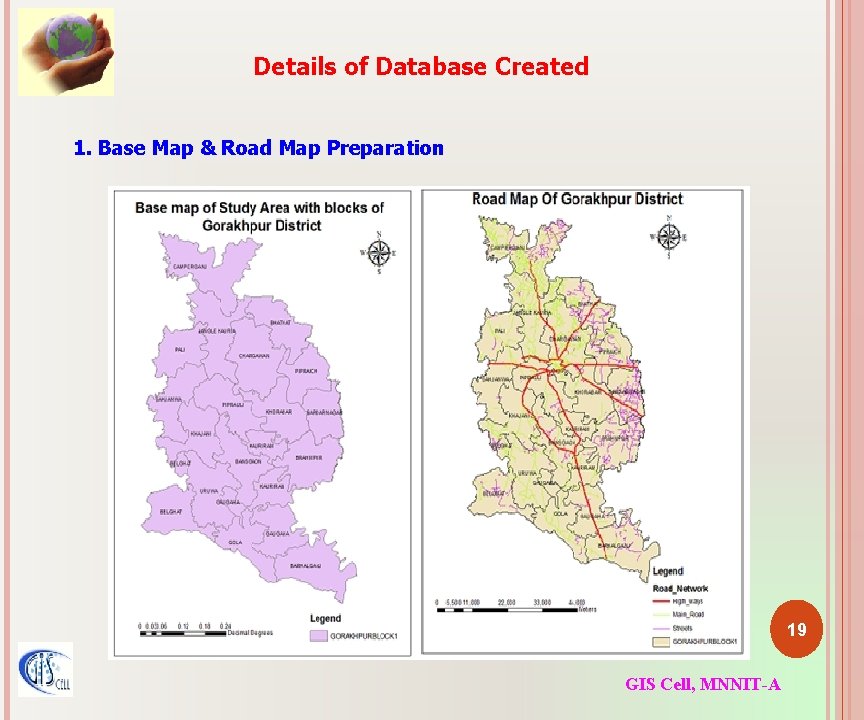
Details of Database Created 1. Base Map & Road Map Preparation 19 GIS Cell, MNNIT-A
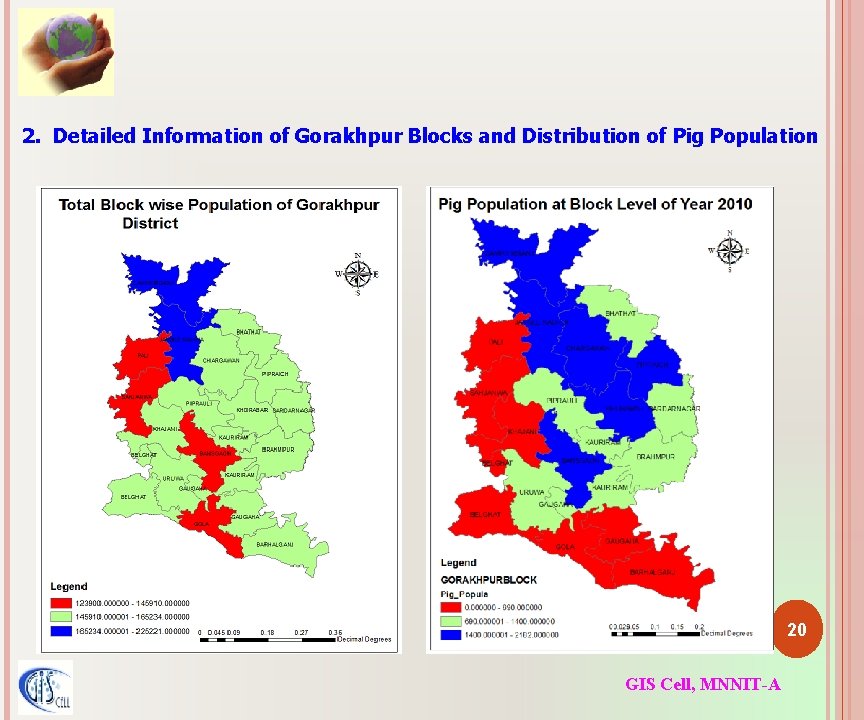
2. Detailed Information of Gorakhpur Blocks and Distribution of Pig Population 20 GIS Cell, MNNIT-A
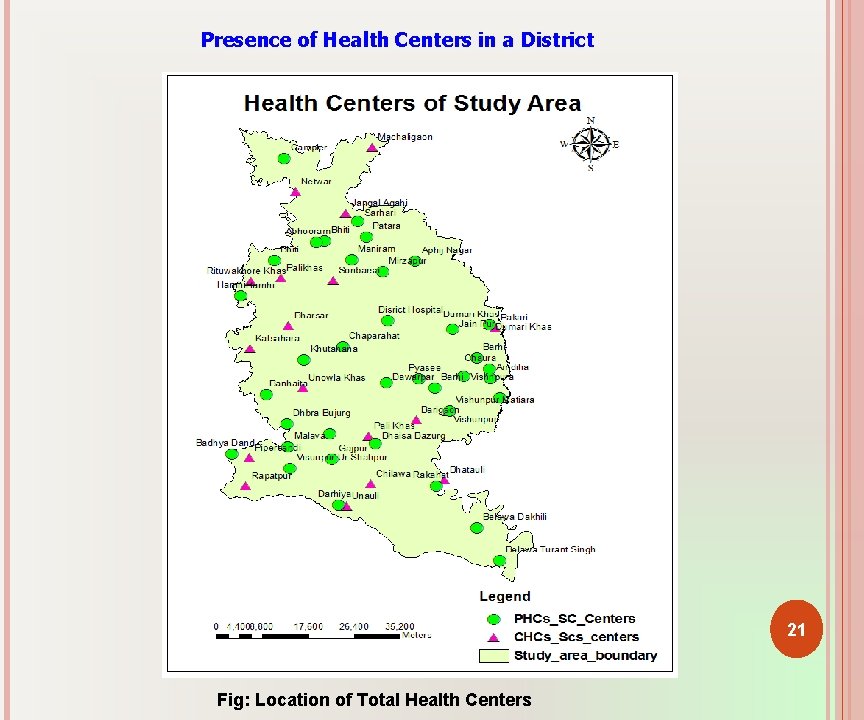
Presence of Health Centers in a District 21 Fig: Location of Total Health Centers
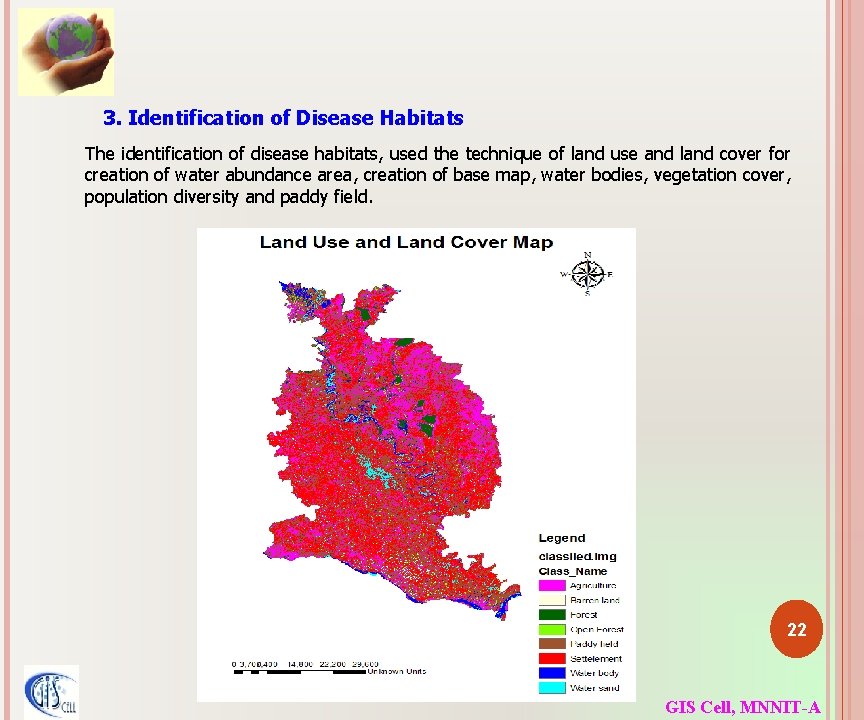
3. Identification of Disease Habitats The identification of disease habitats, used the technique of land use and land cover for creation of water abundance area, creation of base map, water bodies, vegetation cover, population diversity and paddy field. 22 GIS Cell, MNNIT-A
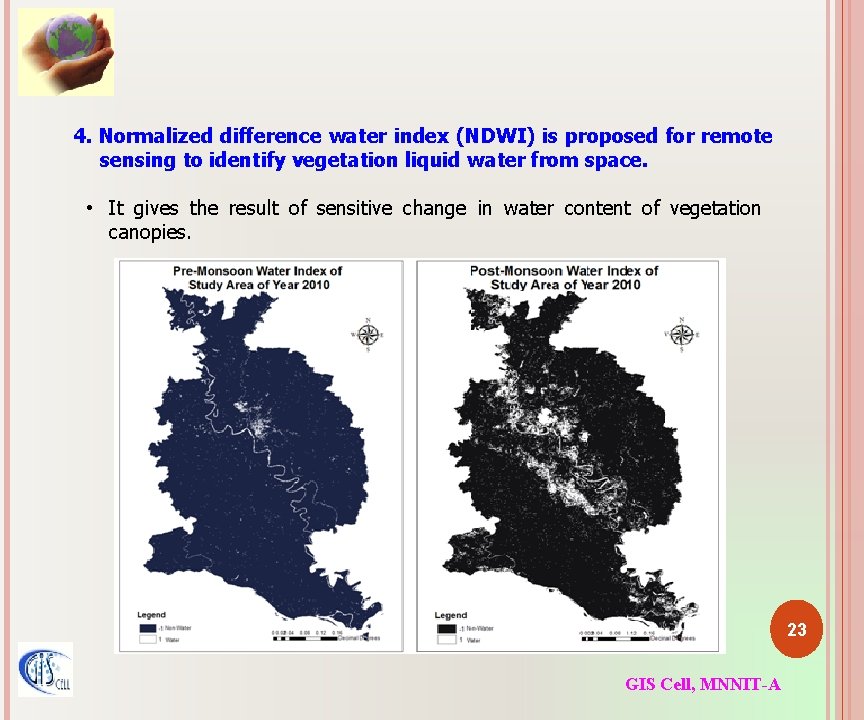
4. Normalized difference water index (NDWI) is proposed for remote sensing to identify vegetation liquid water from space. • It gives the result of sensitive change in water content of vegetation canopies. 23 GIS Cell, MNNIT-A
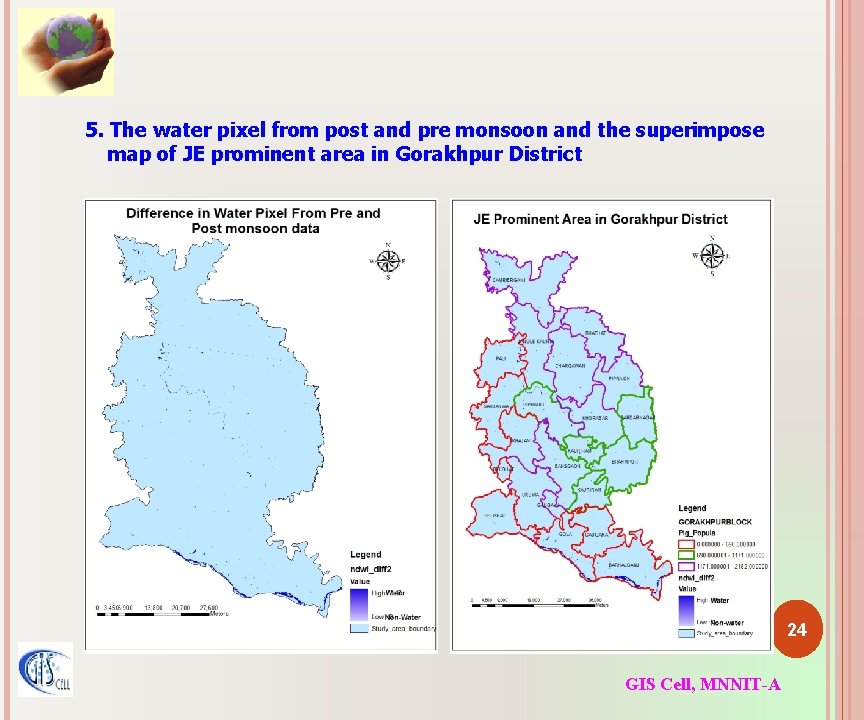
5. The water pixel from post and pre monsoon and the superimpose map of JE prominent area in Gorakhpur District 24 GIS Cell, MNNIT-A
CONCLUDING REMARKS • The analysis of data in the present study reveals the details about health and sanitation awareness in rural people. • Their living behavior near the pond, river and water body creates more disease habitation due to the pig habitation too. • The available health facility is insufficient due to the presence of habitat population and their surrounding impact. • As poor transportation, and water management and sanitation are the main reason to facilitate the disease habitation 25 GIS Cell, MNNIT-A
• The study by using GIS and remote sensing helped to extract the update information and prepare the data for disease control and management strategies. • This geospatial database is update and contains the latest information through which health planners can perform their task of epidemiological mapping more efficiently. 26 GIS Cell, MNNIT-A
THANK YOU 27
- Slides: 27