
Development of Gender Sensitive ME Tools and Strategies
- Slides: 23
Development of Gender Sensitive M&E: Tools and Strategies
Session Outline • Recap on why gender sensitive M&E is important • What is a gender sensitive indicator? • How to develop an effective gender sensitive indicator? • Practical examples
Why are gender sensitive Monitoring & Evaluation (M&E) frameworks important?
Gender Sensitive M&E Implementing gender sensitive M&E systems will help: 1. Determine gendered dimensions of resource access & use 2. Detail project effects on women and men 3. Help strengthen accountability for implementing national, sub-national and local commitments on gender equality 4. Achieve practical benefits for women & progress toward changes in gender relations 5. Lead to more effective & sustainable REDD+ action
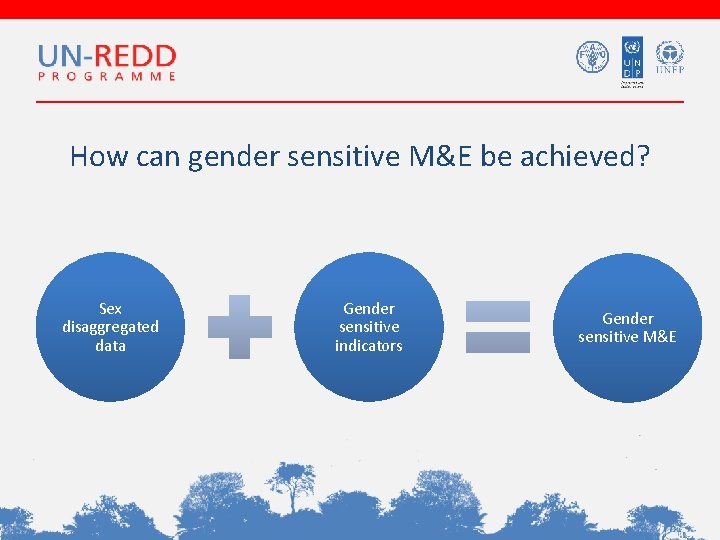
How can gender sensitive M&E be achieved? Sex disaggregated data Gender sensitive indicators Gender sensitive M&E
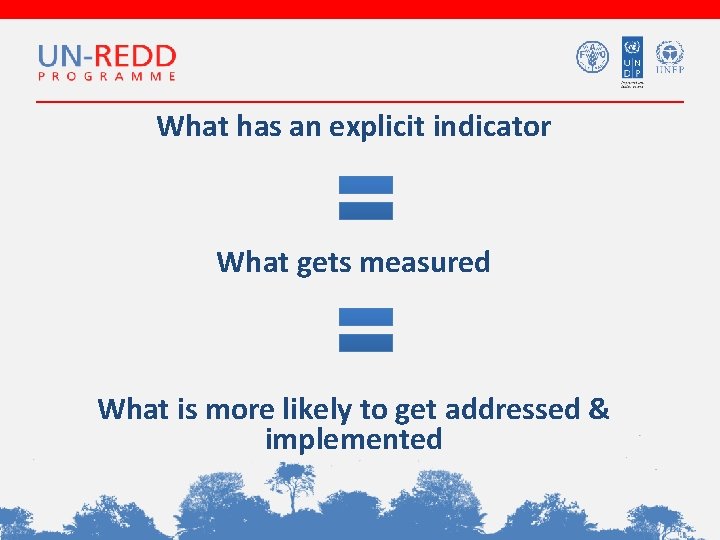
What has an explicit indicator What gets measured What is more likely to get addressed & implemented
What is a gender sensitive indicator?
What is a gender sensitive indicator? There are varying aspects which would help result in an indicator to be gender sensitive: 1) 2) 3) 4) Data disaggregated by sex; Gender specific; Implicitly gendered; and Chosen separately by men & women.
What is a gender sensitive indicator? 1. Data disaggregated by sex • • • Data calculated separately for men and women Allows for comparisons to be made Reveals the differential impact & reach of a intervention on men & women (i. e. in relation to a governance practice or capacity building workshop) EXAMPLE: Ratio of number of workshop participants who are men to that of women
What is a gender sensitive indicator? 2. Gender specific • • Indicator is specifically targeted at women or men In practice, this type of indicator is used to measure the output or outcomes designed to increase women’s empowerment EXAMPLE: • • Proportion of seats (%) in National Parliament that are reserved for women (Over the course of a certain time period) what is the proportion of senior level positions, within a certain sector, that are held by women?
What is a gender sensitive indicator? 3. Implicitly Gendered • • Indicator makes no explicit reference to gender terms of women and men. However, if it is interpreted within a broader context, it is clear that the indicator is of particular relevance to women or men. EXAMPLE: Time saving or time increase in collecting & carrying water, fuel, & forest products as a result of a REDD+ intervention or activity
What is a gender sensitive indicator? 4. Chosen by women • Often simply reflect differences in men’s & women’s preferences & priorities regarding different aspects of a sector, policy or action. EXAMPLE: Percentage of women who say that they receive adequate information from the national government or sub-national authorities on REDD+ activities that affect them.
How to develop an effective gender sensitive indicator?
Guidance Steps 1) Identify the action & area to be measured 2) Conduct gender analysis at field level – Can be used to help form baseline data 3) Develop gender-sensitive indicators that are objectively (quantitative) & subjectively (qualitatively) verifiable & that meet the following SMART criteria 4) Access – Determine whether data exists or there is a need to collect data & monitor change 5) Monitor the indicator over time, & make corrections if needed.
SMART Criteria • Specific. Indicators should be linked to the goal or objective. One indicator per objective is useful. • Measurable. Baseline data is used to measure change. This data is disaggregated by sex, socio- economic grouping, age, & ethnicity, & reveals the situation in the project area before intervention. • Achievable. Measurements (costs, etc. ) & timelines (e. g. project life) are realistic. Data realistic to obtain. • Reliable. The same conclusion is yielded if the measurement is carried out: i) with different tools; ii) by different people; iii) in similar circumstances. • Time-bound. Ideally, time frames should develop from the project & not be imposed.
Supportive Frameworks 1) Capacity building to promote the effective collection, retrieval, and analyzation of data on gender equality indicators 2) Indicators & data collection developed in a participatory, consultative process with key stakeholders (promotes ownership) – Both women and men should be involved in the process 3) Adequate financial resources 4) Involve women’s organizations & groups, gender focused NGOs, etc. , in monitoring activities
Practical Examples
Forest Use & Knowledge Indicators • Ratio in amount of land as accessed by women and men, compared to baseline • Ratio between the number of hours women & men apply to the management & conservation of forests, compared to baseline • Evidence that sex-disaggregated information on women’s and men’s access to & use of forests applied to REDD+ action planning & implementation • Number of research activities that involve women in documenting women’s & men’s local knowledge of resource management & changes in resource availability & use
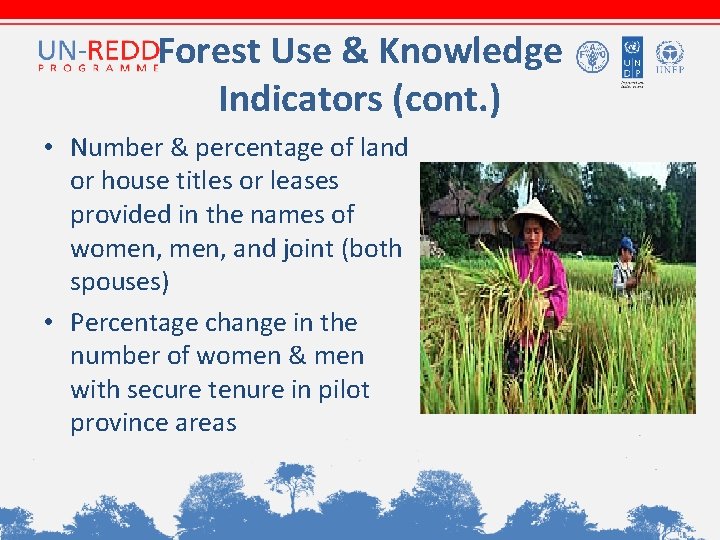
Forest Use & Knowledge Indicators (cont. ) • Number & percentage of land or house titles or leases provided in the names of women, and joint (both spouses) • Percentage change in the number of women & men with secure tenure in pilot province areas
Participation Indicators • Number & percentage of women & men, as well as representatives from women and gender focused organizations, who attend REDD+ training, by type of training (e. g. , benefit sharing, FPIC, grievance mechanisms, NFMS, etc. ) • Number of training/workshops sessions designed to account for women’s constraints (e. g. safety issues, childcare, women’s only groups, etc. ) • Number of gender training & awareness sessions with agencies & other stakeholders involved in REDD+ design & implementation; & number and percentage of women & men attending • Number of women & men who actively participate in each training/workshops sessions
Benefit Sharing Indicators • Number of REDD+ value-chain improvement activities benefiting women & men • Percentage of REDD+ benefits (disaggregated by monetary & non-monetary) that reaches women, boy & girls • Ratio of REDD+ benefits (disaggregated by monetary & non-monetary) that reaches women & men in relation to the percentage of women & men who participate in forest conservation & sustainable management
Decision-making, Finance & Management • Number & percentage of women & men employed in REDD+ agencies & as project & field staff • Percentage change in the amount of women in management, technical, & professional positions associated with REDD+ action • Evidence that REDD+ finance facilities include gendersensitive guidelines for all funded activities, & employ women & men in REDD+ fund management • Percentage of women staff to be invited to & attend relevant REDD+ and REDD+ financial management trainings • Percentage of women who are members of the Independent Monitoring Board
Thank You Elizabeth Eggerts elizabeth. eggerts@undp. org