
DEVELOPMENT OF FINGERPRINTS Latent Prints Latent Fingerprints detection
- Slides: 22
DEVELOPMENT OF FINGERPRINTS • Latent Prints • Latent Fingerprints detection by physical and chemical techniques
LATENT PRINTS • Latent means hidden. • Caused when friction ridges of the skin is pressed against another surface (due to the presence of sweat). • Also known as chance prints. • Can be visualized by using oblique lighting, • Development through either physical or chemical method is required in order to make the print usable or readable.
CONDITIONS AFFECTING LATENT PRINTS • Type of surface: best surface is smooth, clean, and glossy or nonporous. • Manner in which the object was touched: If the finger moves slightly while in contact with the object, ridge detail may be lost or distorted. • Weather: May dry out or wash away the print • Humidity: May cause print to be absorbed into a surface or to dissipate. • Perspiration: May obliterate print if both ridges and valleys are covered and constituent of perspiration may affect the print. • Use of the object • Care of the suspect
FINGERPRINT DEVELOPMENT TECHNIQUES • Visual examination • Powder Techniques • Chemical Techniques
VISUAL EXAMINATION • Inherent lighting can be used followed by illumination with oblique lighting. • Infrared, or ultraviolet lighting may be utilized. • Moisture from the breath can also assist in detection of the prints
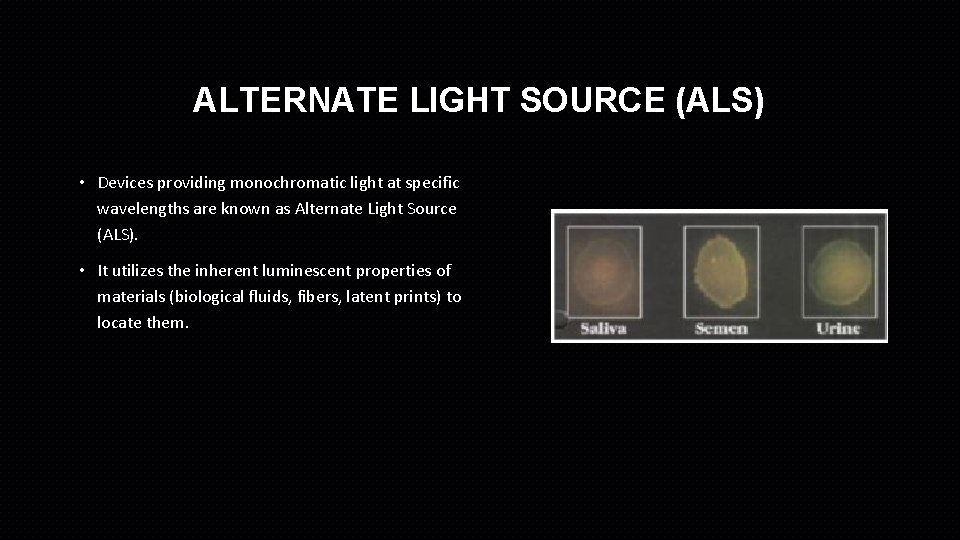
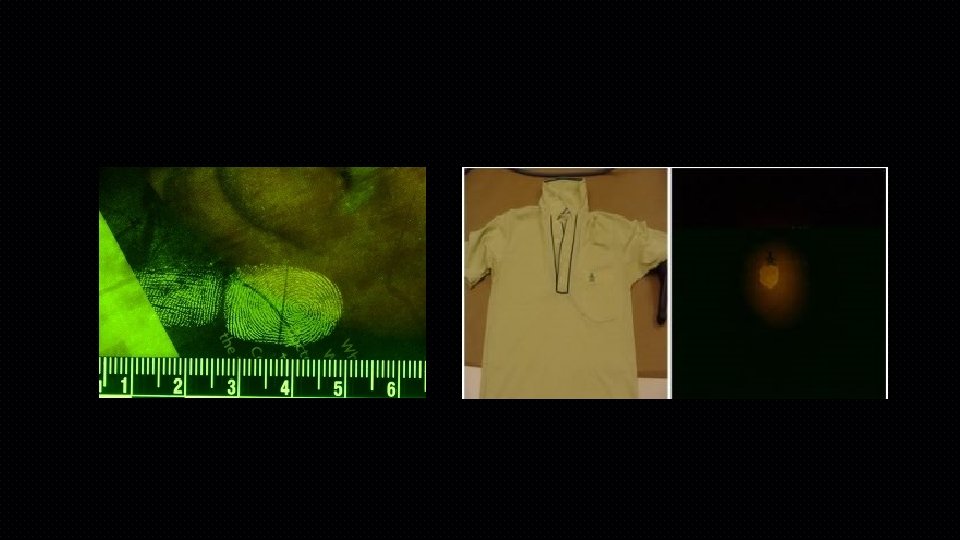
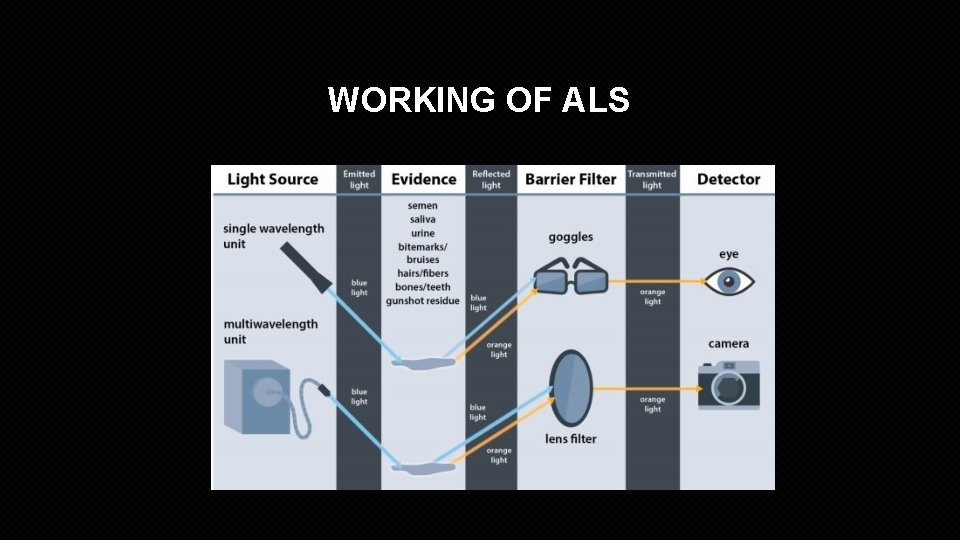
ALTERNATE LIGHT SOURCE (ALS) • Devices providing monochromatic light at specific wavelengths are known as Alternate Light Source (ALS). • It utilizes the inherent luminescent properties of materials (biological fluids, fibers, latent prints) to locate them.
WORKING OF ALS
POWDER TECHNIQUES • Black Powder • White Powder • Fluorescent Powder • Bichromatic Powder • Fluorescent Powders : additional luminescence is required in the form of an alternate light source (ALS) or laser. • Magnetic Powder Not for prints on metal surfaces cause it may cause scratches on a surface and degrade or contaminate latent prints. • The reason for the variety of powders is to provide the greatest contrast with the background on which the fingerprint is developed.
CHEMICAL TECHNIQUES • Reagents react with substances contained in the sweat and with fingerprint impression. • Chloride), protein, amino acids, lipids, and oil react with the sweat and it’s constituents to reveal the latent prints. • Other substances might include blood, grease, or food stuffs.
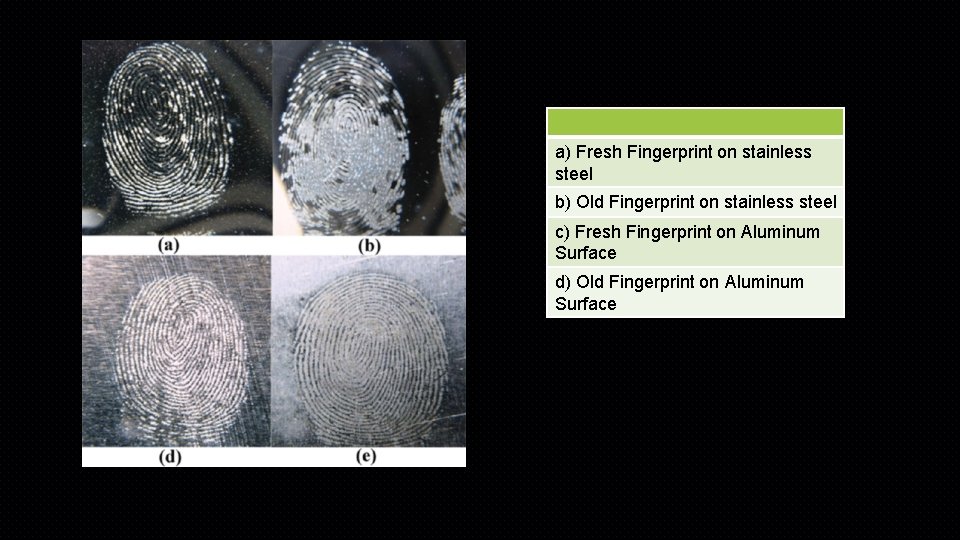
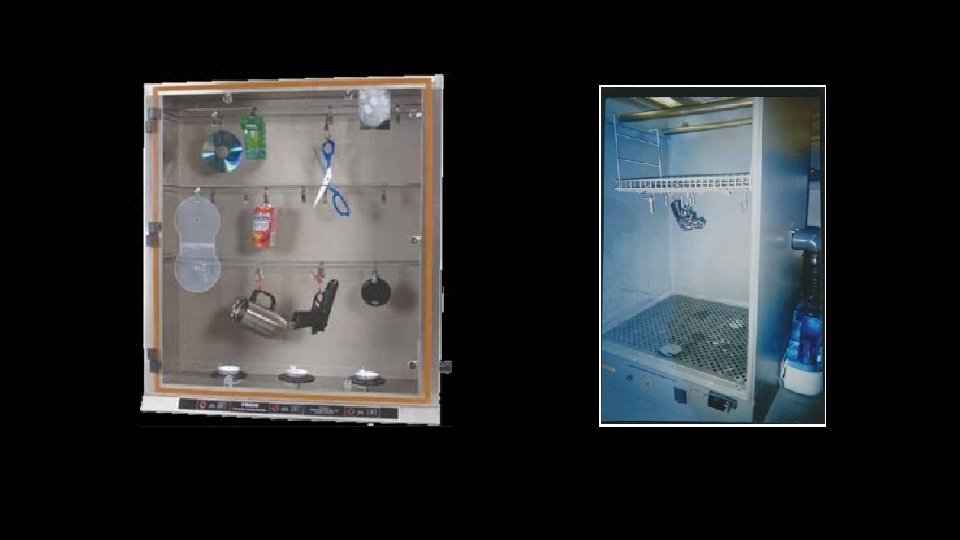
1. CYANOACRYLATE ESTER • Reacts with the amino acids and fatty acids in the perspiration and form a white coloured polymer. • Contrast may be enhanced by using powders or dye stains on the developed polymer. • An ALS or laser (in case of fluorescent powder) is used to enhance the print • Method may be applied to metal, glass, plastic, garbage bags, electrical tape, and many other nonporous surfaces. • Can be used by fuming chamber or tenting method, or with a wand.
a) Fresh Fingerprint on stainless steel b) Old Fingerprint on stainless steel c) Fresh Fingerprint on Aluminum Surface d) Old Fingerprint on Aluminum Surface
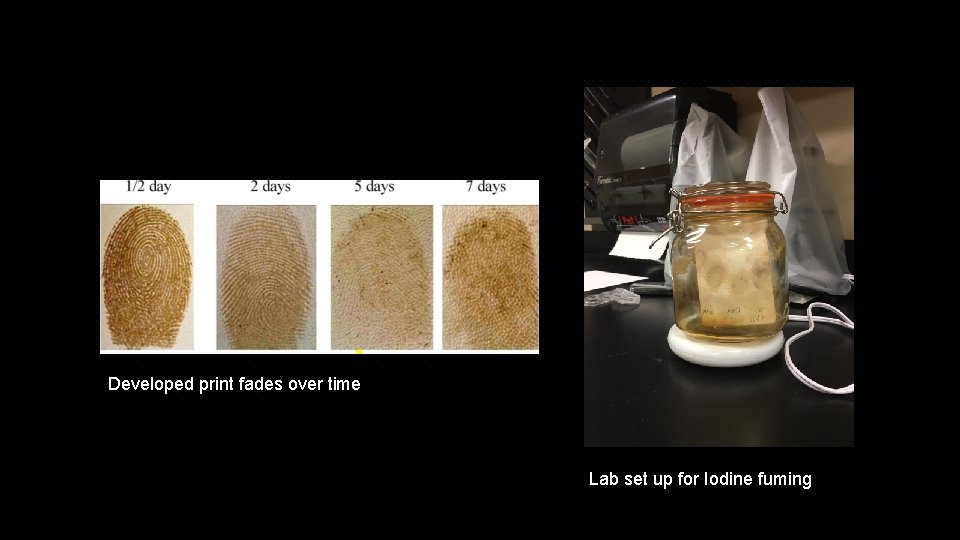
2. IODINE FUMING • Iodine reacts with fatty acids and lipids contained in the fingerprint and gives a dark brownish to blackish appearance • Can be used for paper and on human skin (porous surfaces) • The two most common : • • Iodine fuming gun Fuming cabinet. Iodine dusting Iodine solution. • Technique corrosive and may pose safety issues when improperly applied. • The developed prints must be photographed as the prints tend to fade over time.
Developed print fades over time Lab set up for Iodine fuming
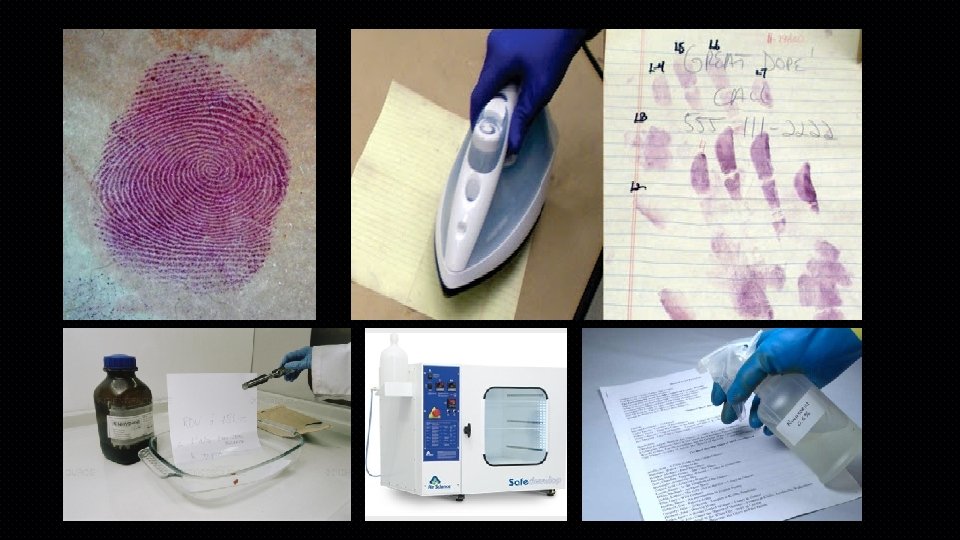
NINHYDRIN • Ninhydrin reacts with the amino acids, peptides, and protein present in the print and produces Ruhemann’s purple ( pinkish-purple color). • One can use commercially available Ninhydrin solution or make a fresh one too. • Solution can be made by mixing 25 grams of Ninhydrin crystals into 4 liters of solvent. • Solution that can be applied by using • Spray. • Swabbing method. • Dipping method. • Can be used on items such as paper, cardboard, and unfinished wood (porous surfaces). • Temperature should be approximately 80°F (26. 6 Celsius), with a humidity rate of approximately 80 percent. • Effective for old prints too.
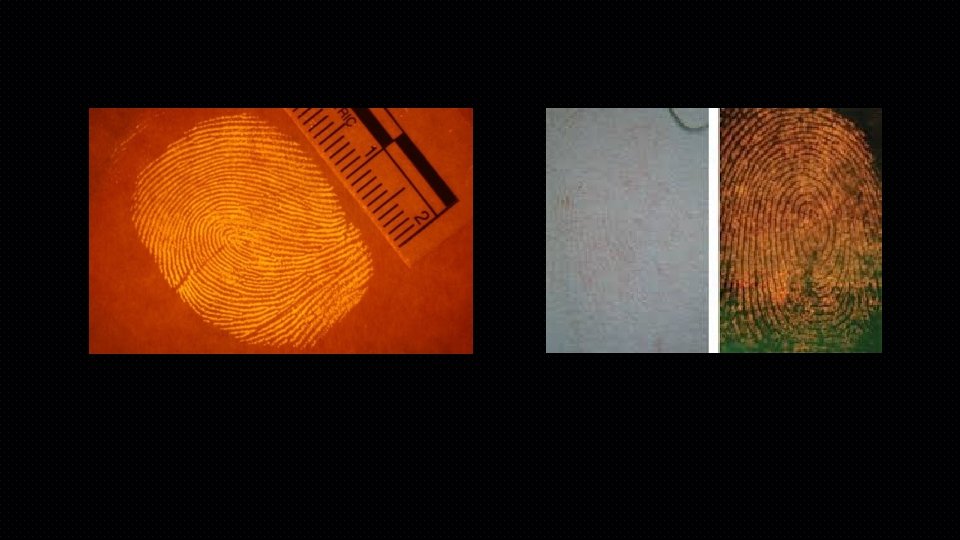
DFO (1, 8, -DIAZAFLUOREN-9 -ONE) • It reacts with amino acids, peptides, and protein contained in the print and results in faint red or pink fingerprints which are intensely fluorescent at room temperature. • Ninhydrin analogue and is 2. 5 times more sensitive than Ninhydrin. • Can be used on porous surfaces. • Methods - Dipping or swabbing. • DFO reaction requires a • Unlike Ninhydrin, high-temperature, low-humidity environment are required for good development. • After DFO application and heating, developed fingerprints can be observed using 530 nm excitation light and a 590 nm barrier. • ALS or laser are used for better visualization.
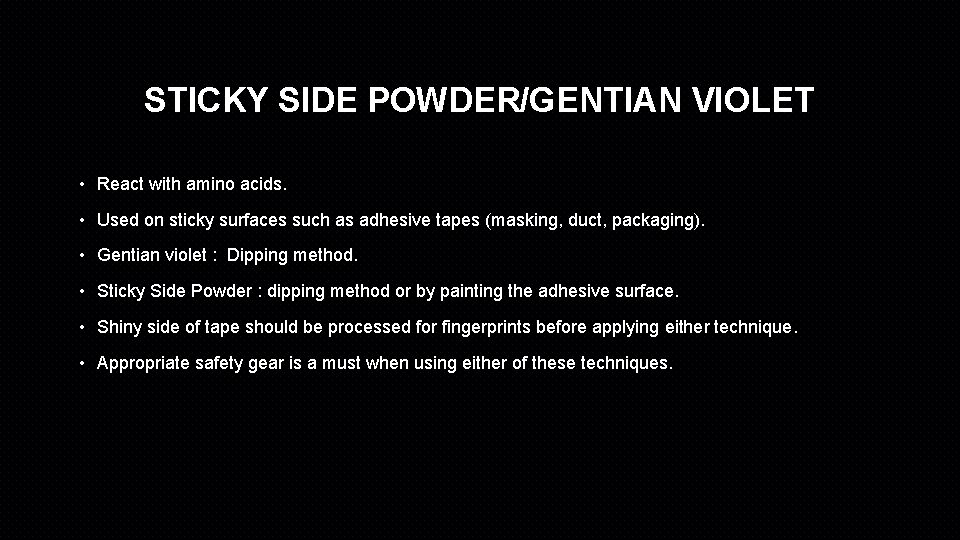
STICKY SIDE POWDER/GENTIAN VIOLET • React with amino acids. • Used on sticky surfaces such as adhesive tapes (masking, duct, packaging). • Gentian violet : Dipping method. • Sticky Side Powder : dipping method or by painting the adhesive surface. • Shiny side of tape should be processed for fingerprints before applying either technique. • Appropriate safety gear is a must when using either of these techniques.
CHEMICALS THAT REACT WITH BLOOD • Leuco-malachite Green: spraying on the suspected area, yields green colored prints. • Leuco-Crystal Violet: When sprayed on the suspected area, the prints will turn purplishblack. • Amido Black/Sudan Black: When sprayed on the suspected area, the prints will turn dark bluish-black. • Luminol: When sprayed on the suspected area, the prints will fluoresce. Must be used in darkened room. • Prints must be photographed at the time of fluorescence because when luminol stops reacting with the blood, the prints will no longer be visible.
SEQUENTIAL PROCESSING • Available light (ambient light/flashlight/ALS/ultraviolet) • Powder techniques • DFO • Ninhydrin • Dye stain