
DEVELOPMENT OF FACE NOSE AND PALATE By Prof
DEVELOPMENT OF FACE , NOSE AND PALATE By Prof. Saeed Abuel Makarem Prof. Makarem 1
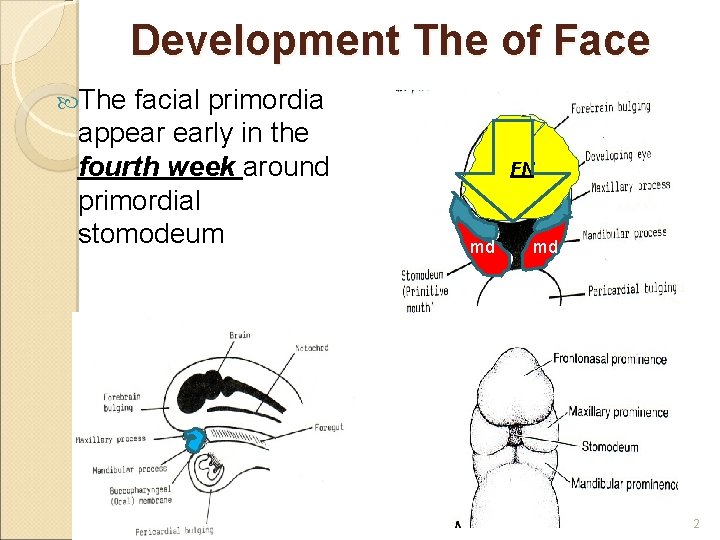
Development The of Face The facial primordia appear early in the fourth week around primordial stomodeum FN md md S Prof. Makarem 2
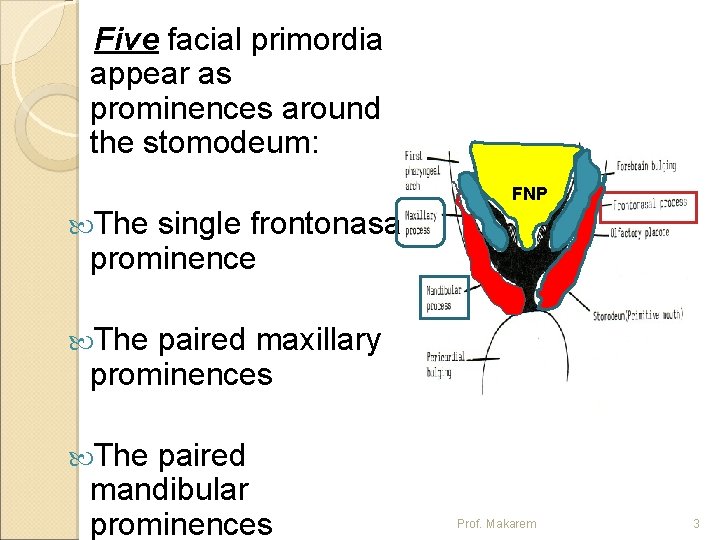
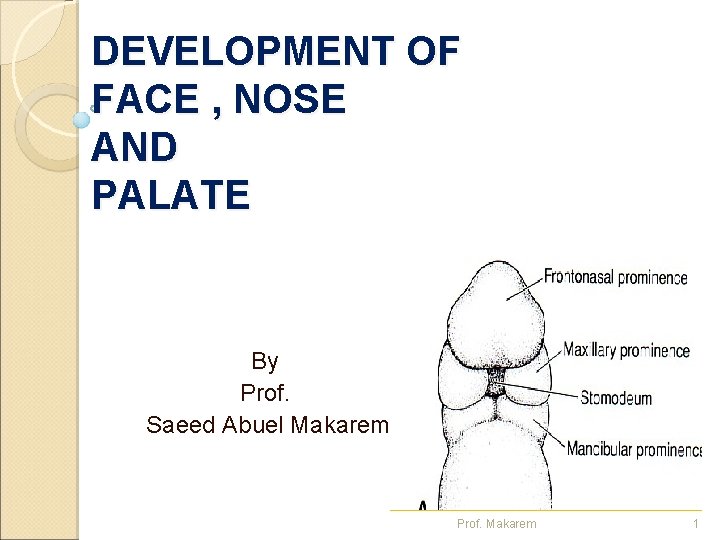
Five facial primordia appear as prominences around the stomodeum: FNP The single frontonasal prominence The paired maxillary prominences The paired mandibular prominences Prof. Makarem 3

The paired facial prominences are derivatives of the first pair of pharyngeal arches The prominences are produced mainly by the proliferation of neural crest cells. These cells migrate from lower Mesencephalon and upper Rhombencephalon regions of the neural folds into the arches during the fourth week 1 st Prof. Makarem 4
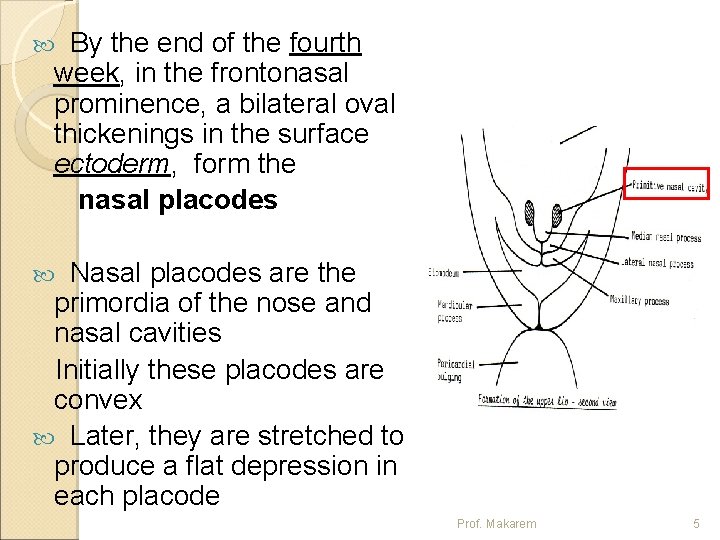
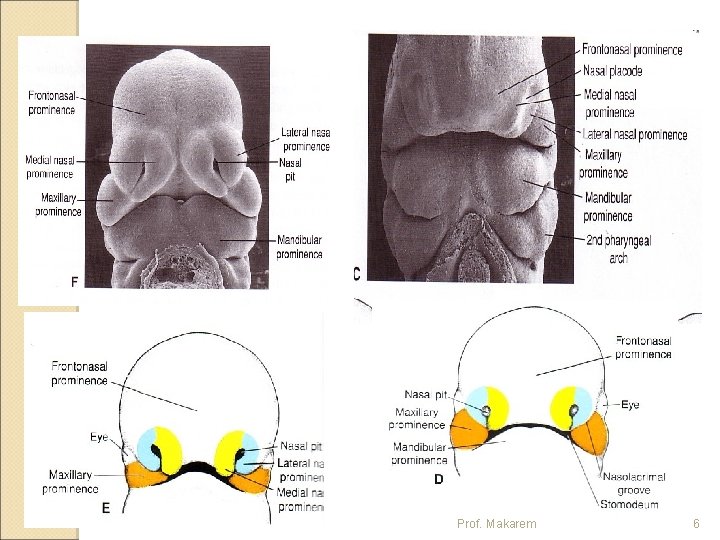
By the end of the fourth week, in the frontonasal prominence, a bilateral oval thickenings in the surface ectoderm, form the nasal placodes Nasal placodes are the primordia of the nose and nasal cavities Initially these placodes are convex Later, they are stretched to produce a flat depression in each placode Prof. Makarem 5
Prof. Makarem 6
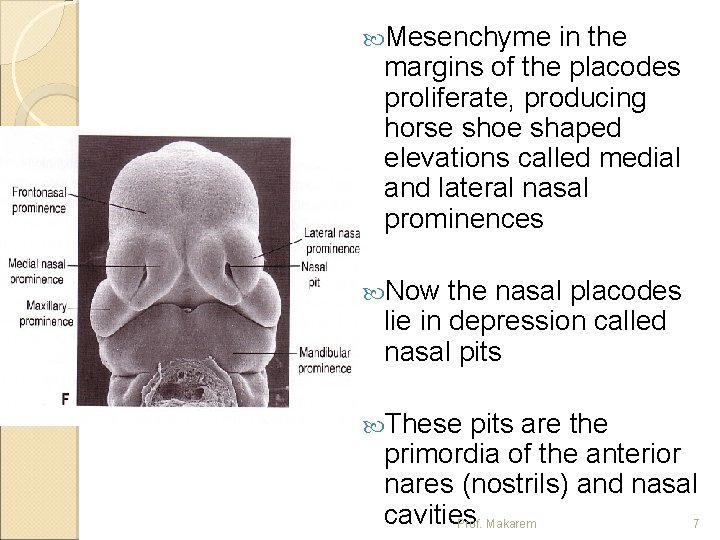
Mesenchyme in the margins of the placodes proliferate, producing horse shoe shaped elevations called medial and lateral nasal prominences Now the nasal placodes lie in depression called nasal pits These pits are the primordia of the anterior nares (nostrils) and nasal cavities Prof. Makarem 7

These mesenchymal cells are the major source of the connective tissue components, including muscles, cartilage, bone, and ligaments in the facial and in the oral regions. Prof. Makarem 8
The frontonasal prominence (FNP) is formed of 2 parts: 1 - Frontal part of the (FNP) forms the forehead 2 - Nasal part of the (FNP) forms the rostral boundary of the stomodeum. The paired maxillary prominences form the lateral boundaries of the stomodeum The paired mandibular prominences constitute the caudal boundary of the primitive mouth Prof. Makarem 9
Facial development occurs mainly between the fourth and eighth weeks. By the end of the embryonic period, (8 th week) the face has an unquestionably human appearance. Prof. Makarem 10
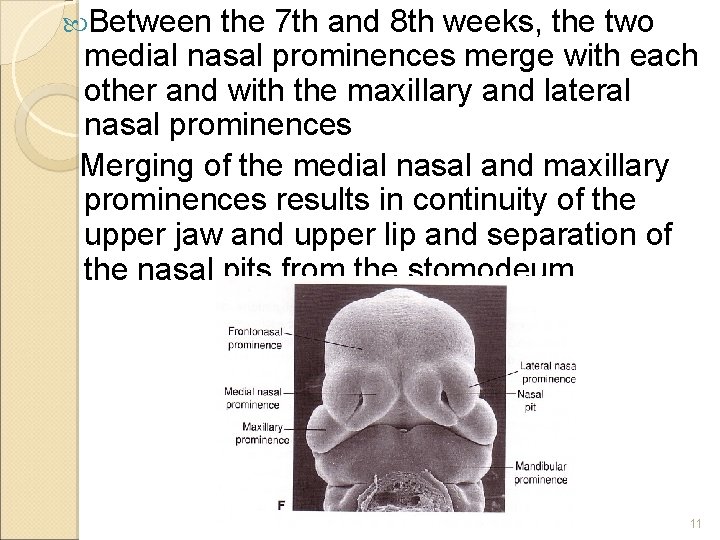
Between the 7 th and 8 th weeks, the two medial nasal prominences merge with each other and with the maxillary and lateral nasal prominences Merging of the medial nasal and maxillary prominences results in continuity of the upper jaw and upper lip and separation of the nasal pits from the stomodeum Prof. Makarem 11
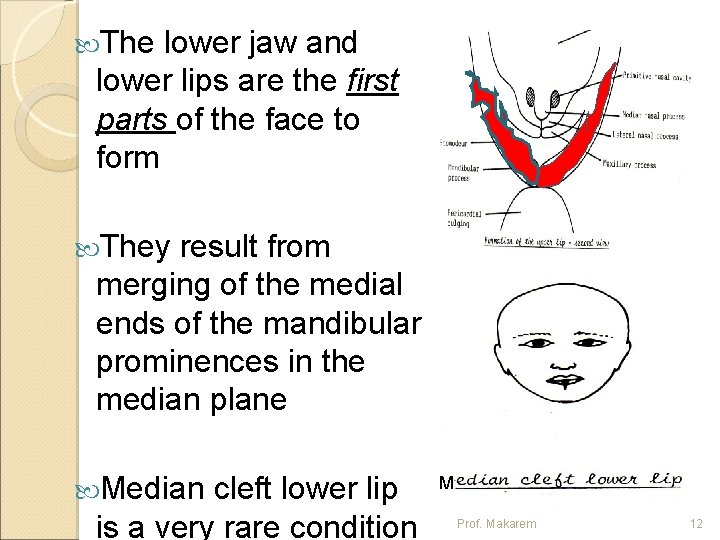
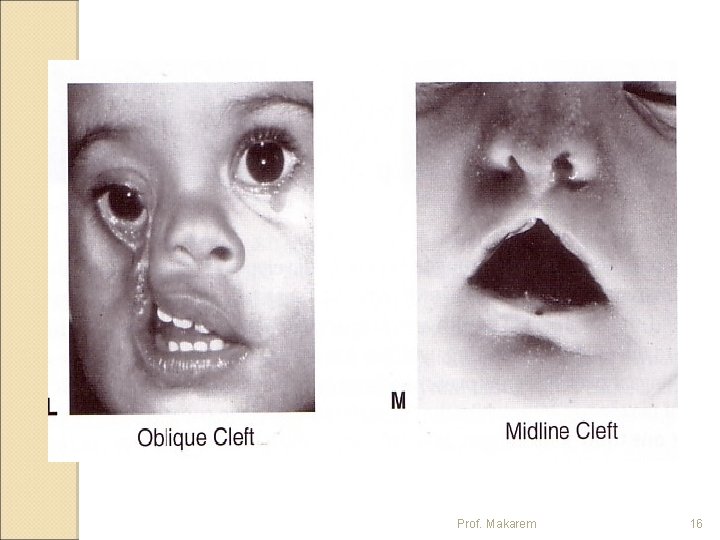
The lower jaw and lower lips are the first parts of the face to form They result from merging of the medial ends of the mandibular prominences in the median plane Median cleft lower lip is a very rare condition M Prof. Makarem 12
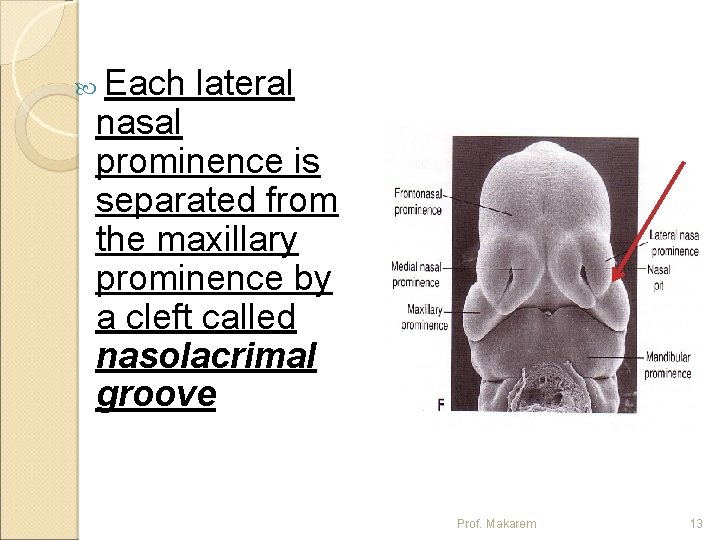
Each lateral nasal prominence is separated from the maxillary prominence by a cleft called nasolacrimal groove Prof. Makarem 13
The nasolacrimal duct develops from a rodlike thickening of ectoderm in the floor of the nasolacrimal groove This thickening gives rise to a solid epithelial cord that separates from the ectoderm and sinks into the mesenchyme As a result of cell degeneration, this epithelial cord canalizes to form the nasolacrimal duct Prof. Makarem 14
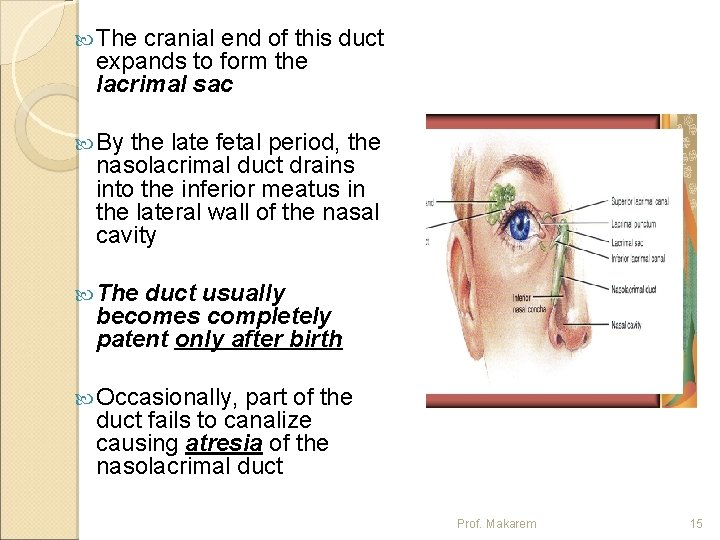
The cranial end of this duct expands to form the lacrimal sac By the late fetal period, the nasolacrimal duct drains into the inferior meatus in the lateral wall of the nasal cavity The duct usually becomes completely patent only after birth Occasionally, part of the duct fails to canalize causing atresia of the nasolacrimal duct Prof. Makarem 15
Prof. Makarem 16
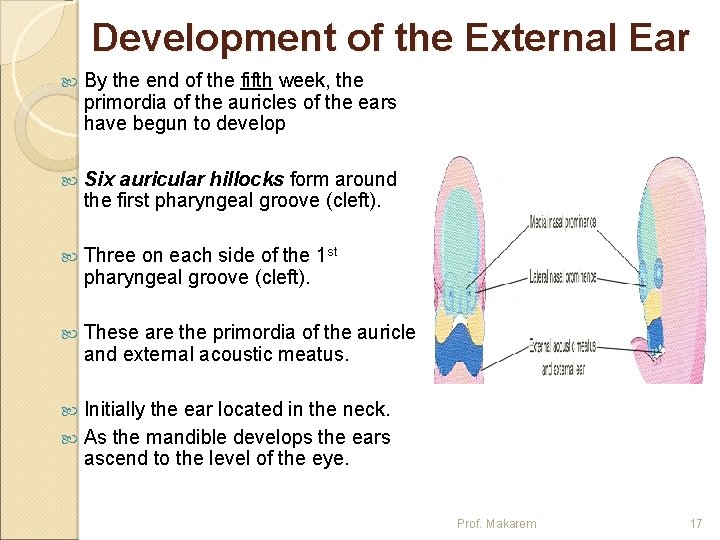
Development of the External Ear By the end of the fifth week, the primordia of the auricles of the ears have begun to develop Six auricular hillocks form around the first pharyngeal groove (cleft). Three on each side of the 1 st pharyngeal groove (cleft). These are the primordia of the auricle and external acoustic meatus. Initially the ear located in the neck. As the mandible develops the ears ascend to the level of the eye. Prof. Makarem 17
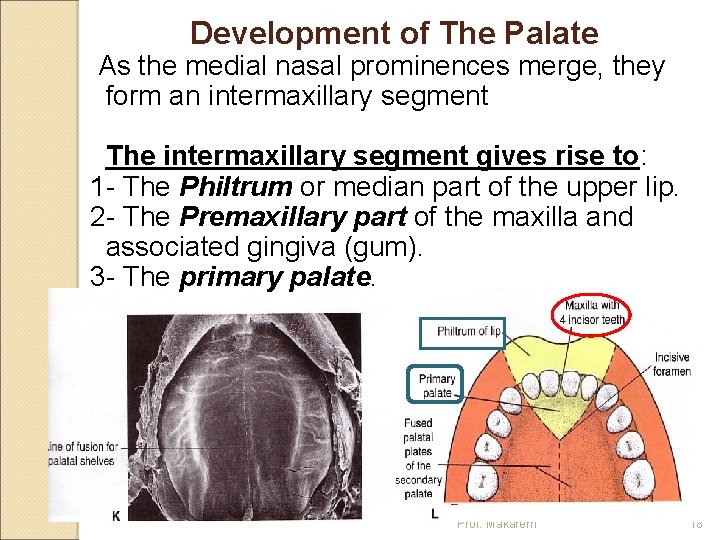
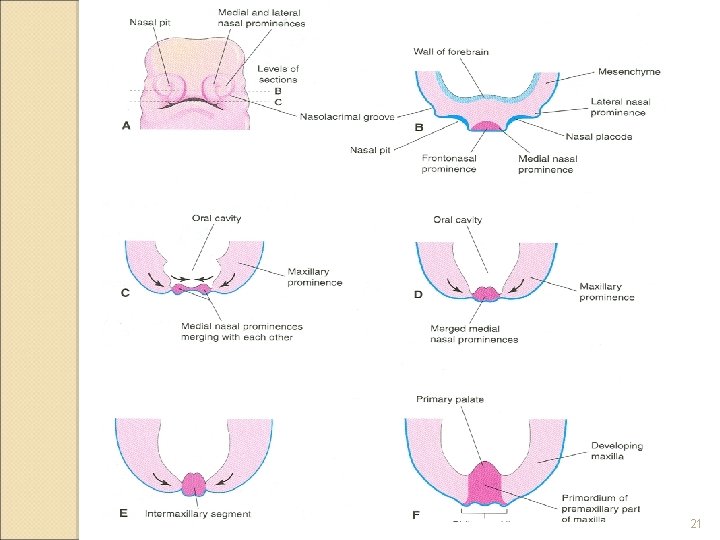
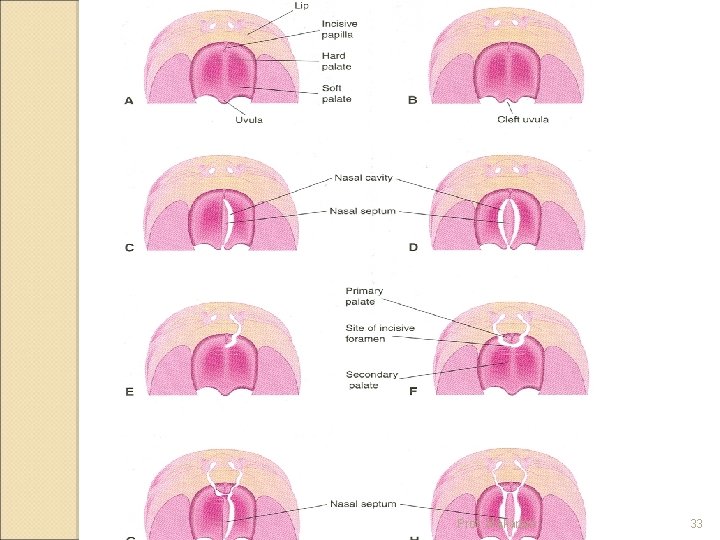
Development of The Palate As the medial nasal prominences merge, they form an intermaxillary segment The intermaxillary segment gives rise to: 1 - The Philtrum or median part of the upper lip. 2 - The Premaxillary part of the maxilla and associated gingiva (gum). 3 - The primary palate. Prof. Makarem 18
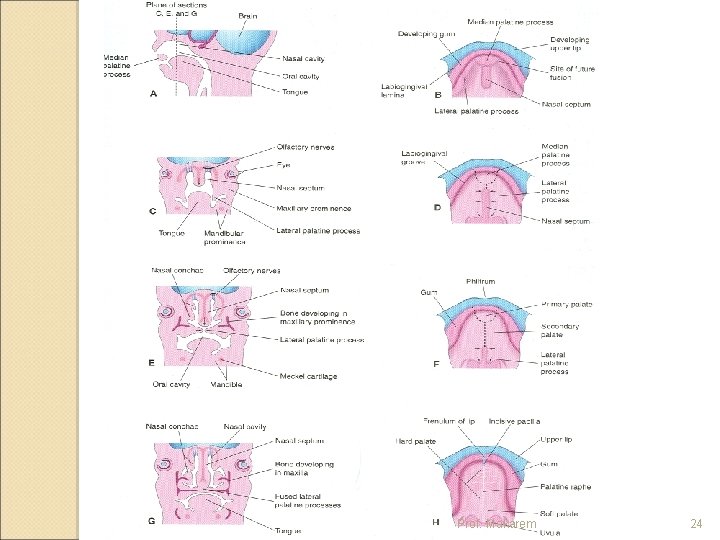
Development of Palate The palate develops from two primordia: The primary palate The secondary palate Palatogenesis begins at the end of fifth week and is completed at twelfth week (5 ------ 12 ) The critical period of palate development is from the end of the sixth week until the beginning of ninth week (6 ------ 9) Prof. Makarem 19

Primary Palate Early in the sixth week the primary palate or median palatine process begins to develop from the intermaxillary segment of the maxilla Initially this segment is formed by merging of the medial nasal prominences The primary palate forms the premaxillary part of the maxilla It represents only a small part of the adult hard palate (2 Medial nasal prominences >>>> intermaxillary segment. >>>>> primary palate). Prof. Makarem 20
21
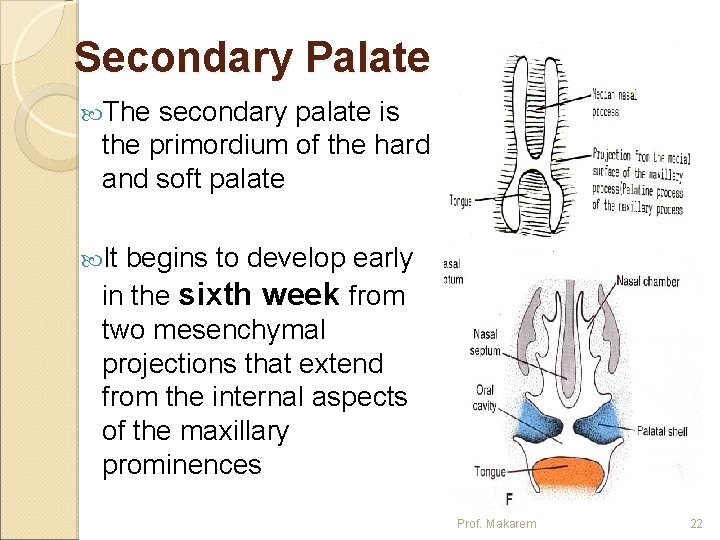
Secondary Palate The secondary palate is the primordium of the hard and soft palate It begins to develop early in the sixth week from two mesenchymal projections that extend from the internal aspects of the maxillary prominences Prof. Makarem 22
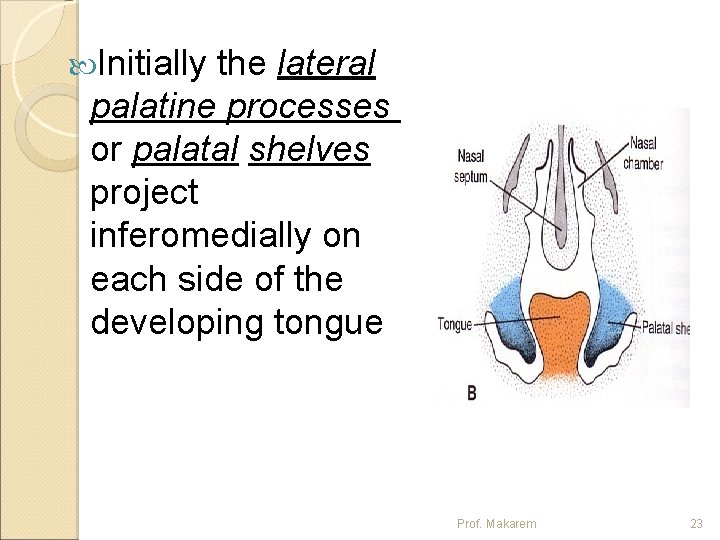
Initially the lateral palatine processes or palatal shelves project inferomedially on each side of the developing tongue Prof. Makarem 23
Prof. Makarem 24
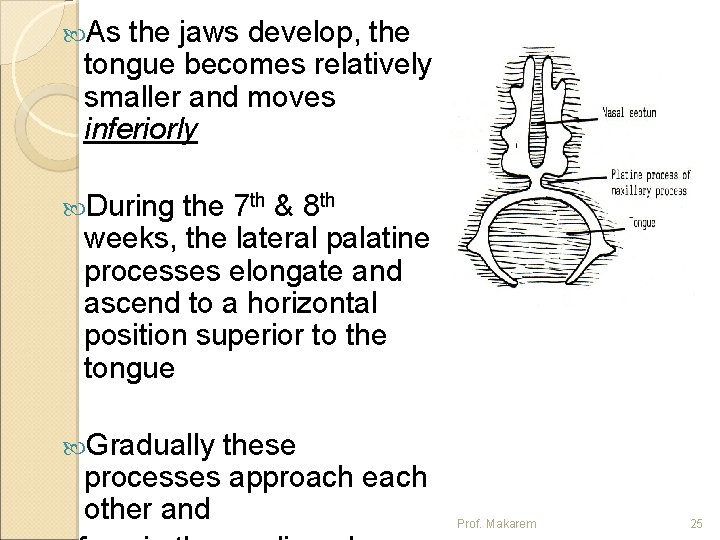
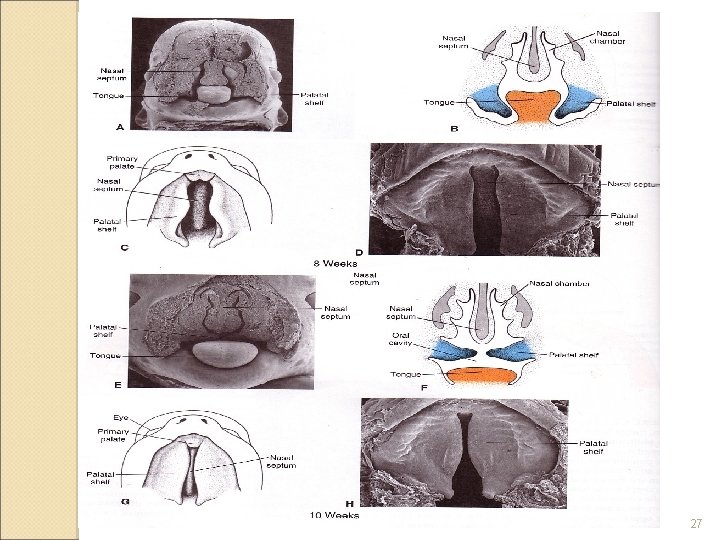
As the jaws develop, the tongue becomes relatively smaller and moves inferiorly During the 7 th & 8 th weeks, the lateral palatine processes elongate and ascend to a horizontal position superior to the tongue Gradually these processes approach each other and Prof. Makarem 25
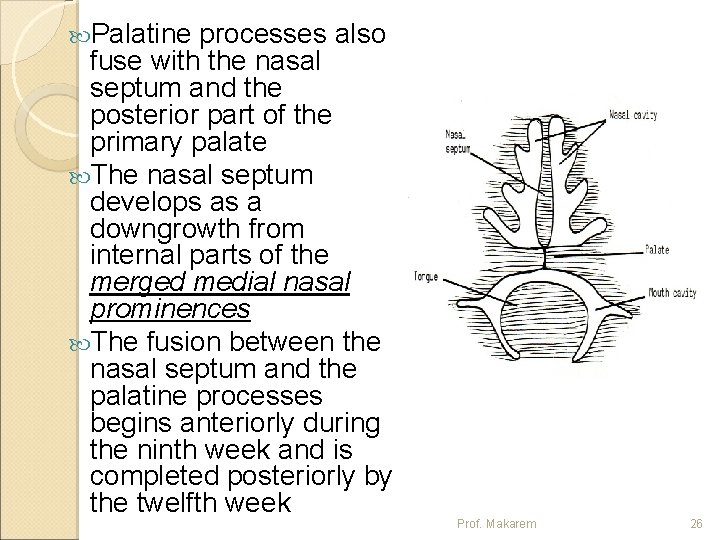
Palatine processes also fuse with the nasal septum and the posterior part of the primary palate The nasal septum develops as a downgrowth from internal parts of the merged medial nasal prominences The fusion between the nasal septum and the palatine processes begins anteriorly during the ninth week and is completed posteriorly by the twelfth week Prof. Makarem 26
Prof. Makarem 27
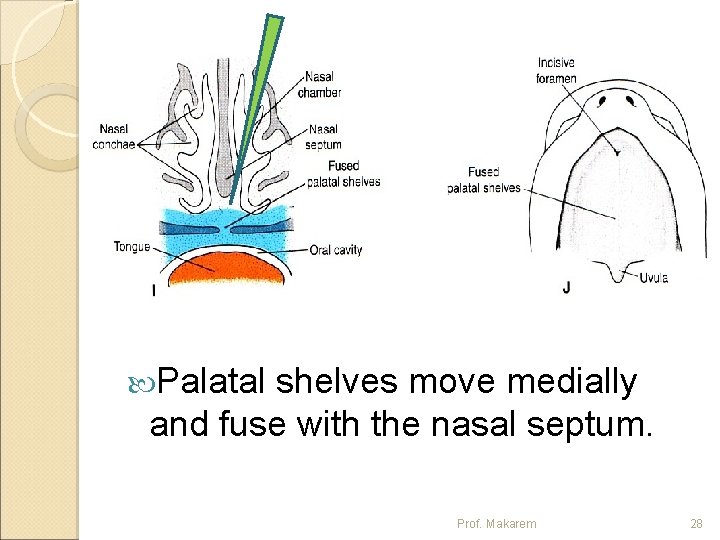
Palatal shelves move medially and fuse with the nasal septum. Prof. Makarem 28

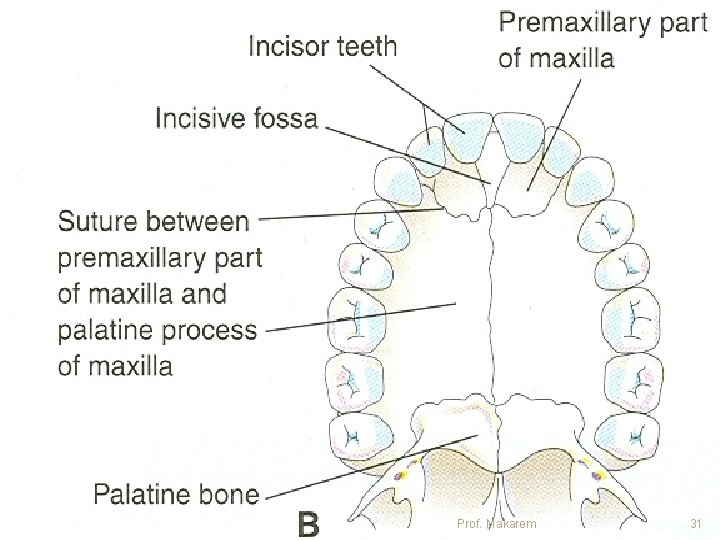
Bone gradually develops in the primary palate, forming the premaxillary part of the maxilla, which lodges the incisor teeth Concurrently bone extends from the maxillae and palatine bones into the lateral palatine processes to form the hard palate The posterior part of these processes do not ossified. Prof. Makarem 29
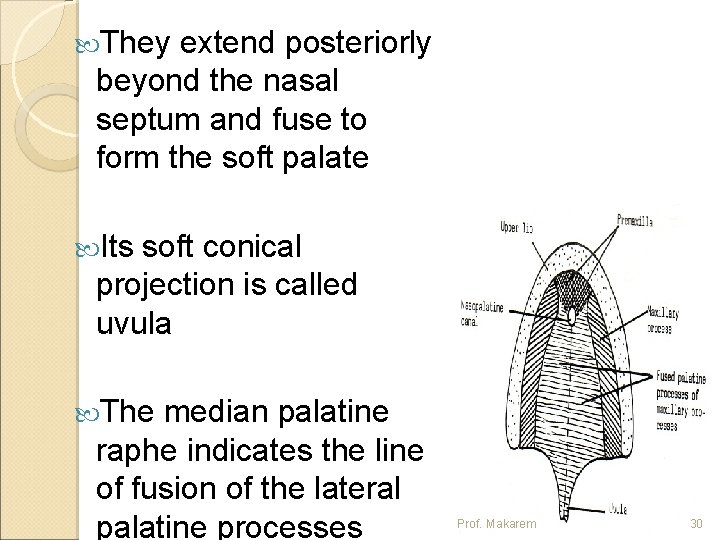
They extend posteriorly beyond the nasal septum and fuse to form the soft palate Its soft conical projection is called uvula The median palatine raphe indicates the line of fusion of the lateral palatine processes Prof. Makarem 30
Prof. Makarem 31
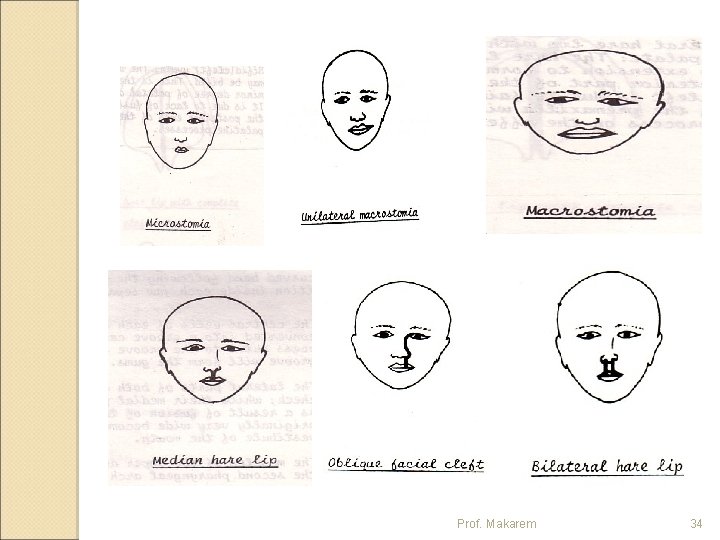
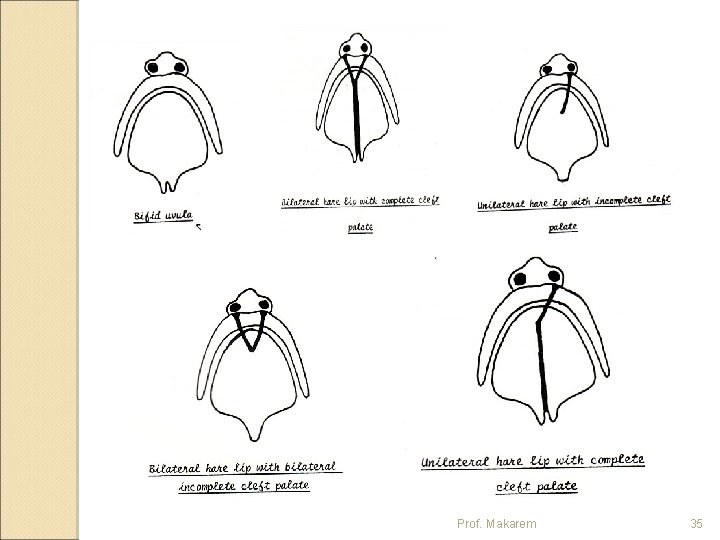
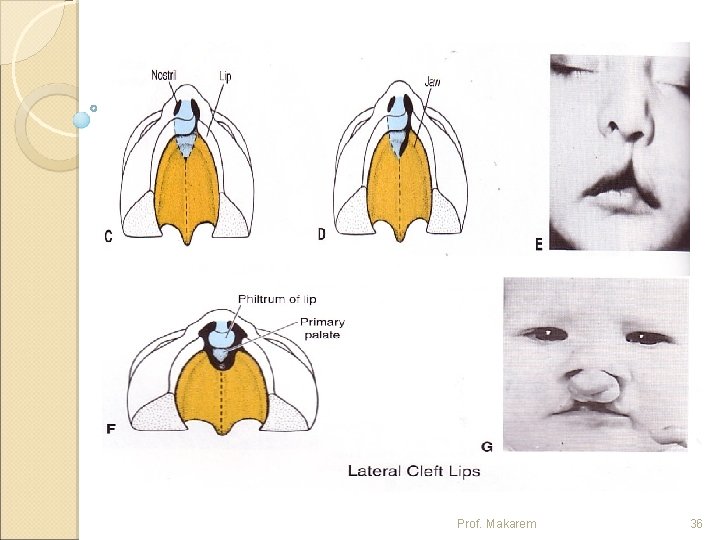
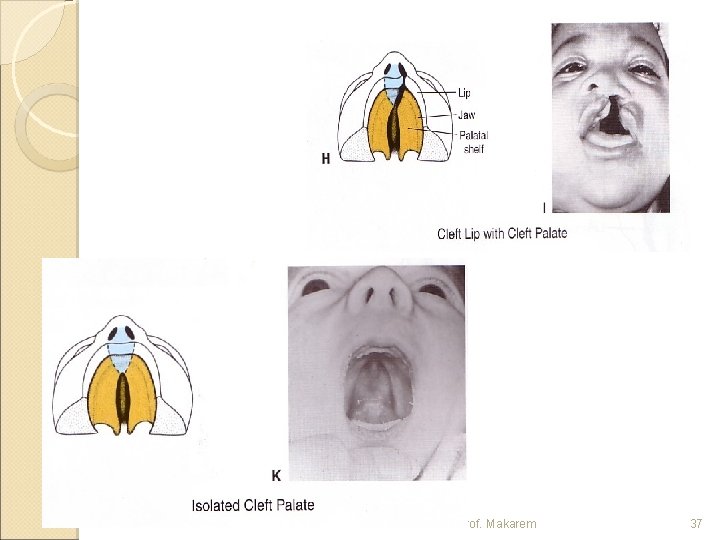
Cleft Lip and Palate The defect is usually classified according to developmental criteria There are two major groups of cleft lip and palate: Clefts involving the upper lip and anterior part of the maxilla Clefts involving the hard and soft regions of the palate Prof. Makarem 32
Prof. Makarem 33
Prof. Makarem 34
Prof. Makarem 35
Prof. Makarem 36
Prof. Makarem 37
- Slides: 37