
Development of EULAR Recommendations for the Reporting of

- Slides: 26
Development of EULAR Recommendations for the Reporting of Clinical Trial Extension Studies
Target population/question Using biological DMARD trials in RA as a case study: • To develop practical recommendations on key aspects of TES on the basis of the EULAR standard operating procedures 1 • To develop a standardised format for future TES data reporting and thereby achieve greater transparency 2 17/12/2021
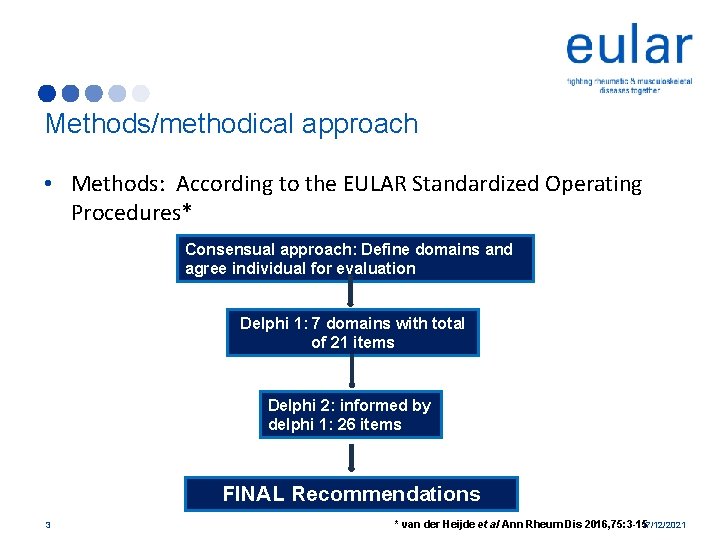
Methods/methodical approach • Methods: According to the EULAR Standardized Operating Procedures* Consensual approach: Define domains and agree individual for evaluation Delphi 1: 7 domains with total of 21 items Delphi 2: informed by delphi 1: 26 items FINAL Recommendations 3 * van der Heijde et al Ann Rheum Dis 2016, 75: 3 -15 17/12/2021
Overarching prinicples • The report of a TES should be consistent with and consolidate existing established guidelines including CONSORT and STROBE • The report of a TES should be consistent with the ACR/EULAR recommendations on the reporting of clinical trials in RA • A report of a TES should include a flow diagram detailing numbers at each relevant time-point • For those patients entering the TES having achieved low disease activity or remission during the RCT, the sustainability of such disease states should be evaluated and made available 4 17/12/2021
Overarching prinicples • For those subjects that enter a TES not having achieved remission/acceptable disease activity state following the RCT, the number that achieve this during the TES should be reported – to determine whether longer drug exposure has the potential to improve disease state of such subjects further • The drop-out rates from each arm during the original RCT and the cross-over groups should be available • All drop-outs should be detailed 5 17/12/2021
Recommendations • Potential sources of bias or lack of generalisability • The requirement of a certain level of response • The stage of the disease of the patient • The investigator is remunerated for each patient recruited and/or that the patients may also receive financial compensation and that the drug is free of charge • Geographical differences in practice/approach • Unwanted heterogeneity from countries where treatment options may be more limited 6 17/12/2021
Recommendations: Definition of a TES • A TES follows all patients beyond a pre-specified trial period whether the trial was PBO-controlled RCT with cross-over to openlabel experimental drug/usual care or an active comparator trial • Starting point of a TES should be stated in the pre-specified protocol with clear justification; and should be at the point of exposure to the experimental drug • Minimum length of a TES cannot be defined since the length of a TES depends on the research question • Population of TES should not be stipulated: but determined by research question. Ideally, should include all patients included in the RCT, with the ability to separately report on patients who are of specific interest 7 17/12/2021
Recommendations: Minimal information • Reason for exclusion from the TES if the patient discontinues the drug • Reason for cessation of follow-up • Specification of reasons for cessation of follow up other than adverse event or inefficacy 8 17/12/2021
Recommendations: Minimal information Progression from RCT to TES • Progress at each stage from RCT start to TES completion • A flow diagram detailing absolute numbers of subjects at each relevant time-point • Duration of active treatment • Time of last observation 9 17/12/2021
Recommendations: Minimal information Drop-outs • All drop-outs detailed • The drop-out rates from each arm during the original RCT and the cross-over groups • Reason for exclusion from the TES if the patient discontinues the drug • Reason for cessation of follow-up • Specification of reasons for cessation of follow up other than adverse event or inefficacy 10 17/12/2021
Recommendations: Minimal information Outcomes • Functional status at the time of inclusion in the TES if applicable • Functional status at last observation if applicable • Disease activity at the time of inclusion in the TES if applicable • Disease activity at last observation if applicable 11 17/12/2021
Recommendations: Minimal information Outcomes 2 • For those patients entering the TES having achieved low disease activity or remission during the RCT, the sustainability of such disease states should be evaluated • For those subjects that enter a TES not having achieved remission/acceptable disease activity state following the RCT, the number that achieve this during the TES should be reported – to determine whether longer drug exposure has the potential to improve disease state of such subjects further 12 17/12/2021
Recommendations: Minimal information Treatment • The disease –related co-medication (DMARD , corticosteroid) at each stage from RCT start to TES completion Safety • The serious adverse events and any outcome related to safety at each stage from RCT start to TES completion 13 17/12/2021
Recommendations • The minimum data requirements for TES following placebo- and active-controlled trials should be the same • A TES that follows an active-comparator RCT should follow all randomised patients for the same period of time (not only patients on the experimental treatment) and including patients who may switch to an active comparator treatment (analysed separately) 14 17/12/2021
Recommendations Safety • TES may identify new adverse effects that the original RCT was not able to detect due to greater cumulative exposure to the drug • TES may identify whether the incidence of known adverse effects changes with longer-term drug exposure (e. g. infection risk) • TES may confirm whether the nature of known adverse effects identified from the RCT changes with longer-term exposure (e. g. infection risk) 15 17/12/2021
Recommendations Safety (cont) • TES are sub-optimal to detect rare safety events because it is not powered for this • TES are sub-optimal to detect rare safety events because it includes a selected population (responders with likely no previous adverse events) 16 17/12/2021
Recommendations Efficacy • Greater cumulative exposure of the active drug in a TES might identify additional information on the drug's efficacy. A TES might allow evaluation of relapse including time to relapse Additional outputs to safety and efficacy • Economic evaluation of long-term treatment with the active drug may be possible if appropriate measures are recorded in the TES could not accurately evaluate health-related quality of life, risk-benefit ratio and therefore overall advantage of the drug, or compliance. 17 17/12/2021
Recommendations: Data management & statistical approach • The null hypothesis should be stated at the start • Multiple comparisons should be taken into account when determining the level of statistical significance • The null hypothesis should take account of the results of the original RCT. Depending on the research question, the results of a RCT should be accommodated in the TES • The report should comment on cumulative outcome analysis (beneficial and adverse events) maintaining the original trial groups i. e. from RCT start, not TES start to avoid reporting of only the sub-selected patient group that proceeds onto the TES 18 17/12/2021
Recommendations: Data management & statistical approach • The selection bias associated with a TES population means meaningful non-inferiority/ superiority analysis would not be reliable. § The report should focus on how data for sustained effect from the start to the end of TES period, within a single group or the difference between groups was analysed and whethere was any suggestion of genuine increased effect (although this could not be subject to formal statistical testing). • The plan for subjects that drop out of a TES should be specified to demonstrate sustained effect from the start to end of TES period. 19 17/12/2021
Data management & statistical approach • With reducing number of participants (the denominator), the proportion responding will artificially increase if/when the number of patients (numerator) responding stays the same • The analysis should include survival/retention rates on therapy explicitly reporting the number of patients at each milestone with reasons for change detailed • A plan on how to analyse this should be included - both intentto-treat and completer analyses could be reported. i. e. denominator as original number entering RCT (ITT) and only those entering 20 17/12/2021
Data management & statistical approach • The repeated measures analysis of the data from a TES in rheumatology should include the area under the curve of absolute disease activity (i. e. not dichotomous response/change) preferentially expressed as a score (e. g. , DAS, SDAI, etc. ) • The analysis should include survival/retention rates on therapy explicitly reporting the number of patients at each milestone • A TES should preferably include hard endpoints (e. g. death, work disability, joint replacement surgery, hospital admission) from linkages with other data sources 21 17/12/2021
Frequency of reporting TES • The protocol of each TES should pre-specify the frequency of reports to be written and the basis for them (purpose, outcomes, length of RCT) • Regarding the nature of reports, it was agreed that the results of efficacy and safety of a TES should be reported together • the credibility of split reporting (for example, one abstract on efficacy, one on safety, one on quality of life outcomes) is questionable and should be discouraged by abstract selection committees and journal editors 22 17/12/2021
Consent • All of the subjects undergoing a RCT should be given the opportunity of entering in the long-term follow-up • The subjects included in a TES should sign a new informed consent form (different from the one for the RCT) for continuation of data collection 23 17/12/2021
Summary of Recommendations • Pre-define a TES, its starting point and population • Minimal information in a TES: progress from RCT to TES, dropouts (with reasons), outcomes, disease co-medication and serious adverse events • Follow all randomised patients (active comparator and/or placebo) for the same period of time • TES may identify new adverse effects, effect of longer-term exposure and change in any adverse effects 24 17/12/2021
Summary of Recommendations in lay format • A TES should be defined from the outset of the original RCT, including when it will start and which patient population of interest • As a minimum, a TES should include participant progress form RCT to the TES, how may dropped out and reasons, additional drugs started and serious safety events • All patients recruited to a RCT should be included, whether they received the dummy (placebo) drug or the drug under investigation 25 17/12/2021
Acknowledgements Task Force • Daniel Aletaha • Neil Betteridge (Chief Exec, Arthritis Care, UK) • Maarten Boers (E) • Maya H Buch (C) • Loreto Camona • Robin Christensen • Bernard Combe • Paul Emery • Gianfranco Ferracioli • Ruth Hawkins (Patient Representative) • Tore Kvien 26 Task Force (cont) • Robert Landewe • Kenneth Saag • Lucia Silva-Fernandes (Fellow) • Josef Smolen • Deborah Symmons • Desiree van der Heijde • George Wells • Rene Westhoven • Angela Zink • Joep Welling (Patient Representative) 17/12/2021