
Development of CVS 2 Systemic Embryology Formation of
Development of CVS 2 Systemic Embryology
Formation of cardiac loop • Tubular heart elongates and develops dilations and constrictions: the bulbus cordis (composed of the truncus arteriosus [TA], the conus arteriosus, and the conus cordis), ventricle, atrium, and sinus venosus. • Sinus venosus receives the umbilical, vitelline, and common cardinal veins from the chorion, umbilical vesicle, and embryo, respectively. • The arterial and venous ends of the heart are fixed by the pharyngeal arches and septum transversum, respectively. 2
• Tubular heart undergoes a dextral (right-handed) looping at approximately 23 to 28 days, forming a Ushaped D-loop that results in a heart with the apex pointing to the left. • As the primordial heart bends, the atrium and sinus venosus come to lie dorsal to the TA, bulbus cordis, and ventricle. • Sinus venosus has developed lateral expansions, the right and left sinus horns. • As the heart elongates and bends, it invaginates into the pericardial cavity. 3
• Heart is initially suspended from the dorsal wall by a mesentery, the dorsal mesocardium - Central part of this mesentery degenerates forming the transverse pericardial sinus, a communication between the right and left sides of the pericardial cavity. • Heart is now suspended in the cavity at its cranial and caudal ends. • Developing heart tube bulges more and more into the pericardial cavity. 4
Position of the Heart Tube • Central portion of the cardiogenic area is anterior to the buccopharyngeal membrane and the neural plate. • CNS grows cephalad and extends over the cardiogenic area and the future pericardial cavity. • Heart and pericardial cavity move first to the cervical region and finally to the thorax. 5
Formation of the Cardiac Loop • Heart tube continues to elongate and bend on day 23. • Cephalic portion of the tube bends ventrally, caudally, and to the right, and the atrial (caudal) portion shifts dorsocranially and to the left. • Bending may be due to cell shape changes, creates the cardiac loop and is complete by day 28. • Atrial portion, initially a paired structure outside the pericardial cavity, forms a common atrium and is incorporated into the pericardial cavity. 6
• Atrioventricular junction remains narrow and forms the atrioventricular canal, which connects the common atrium and the early embryonic ventricle. • Bulbus cordis will form the trabeculated part of the right ventricle. • Conus cordis will form the outflow tracts of both ventricles. • Truncus arteriosus will form the roots and proximal portion of the aorta and pulmonary artery. • Junction between the ventricle and the bulbus cordis, externally indicated by the bulboventricular sulcus is called the primary interventricular foramen. 7
• At the end of loop formation, the smooth-walled heart tube forms the primitive trabeculae in two areas just proximal and distal to the primary interventricular foramen. • Bulbus temporarily remains smooth walled. The primitive ventricle, which is now trabeculated, is called the primitive left ventricle. • Trabeculated proximal third of the bulbus cordis may be called the primitive right ventricle. 8
• Conotruncal portion of the heart tube, initially on the right side of the pericardial cavity, shifts to a more medial position. • This change in position is the result of formation of two transverse dilations of the atrium, bulging on each side of the bulbus cordis. 9
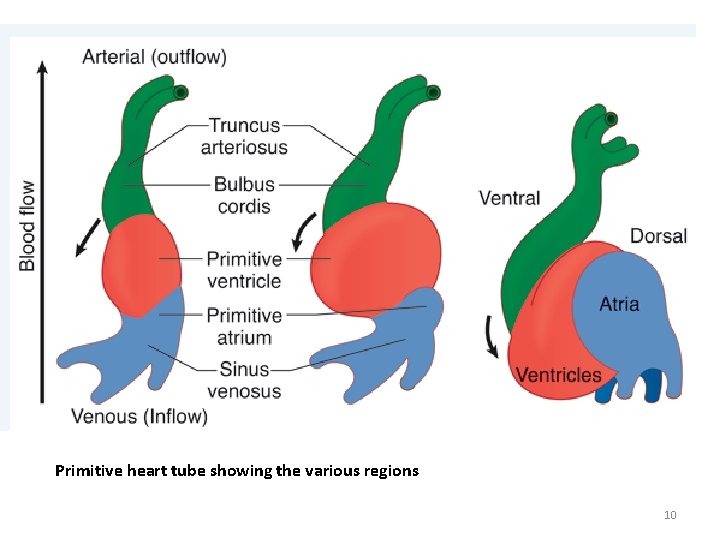
Primitive heart tube showing the various regions 10
Abnormalities of Cardiac Looping Dextrocardia • Heart lies on the right side of the thorax instead of the left, is caused because the heart loops to the left instead of the right. • Dextrocardia may coincide with situs inversus, a complete reversal of asymmetry in all organs. • In other cases sidedness is random, such that some organs are reversed and others are not; this is heterotaxy. 11
Molecular Regulation of Cardiac Development • Signals from anterior endoderm induce the splanchnic mesoderm by turning on the transcription factor NKX 2. 5. • Others are bone morphogenetic proteins (BMPs) 2 and 4 and inhibitors of WNT genes • These genes induce expression of NKX 2. 5 - Specifies the cardiogenic field - Plays a role in septation and in development of the conduction system. • TBX 5 is expressed later and plays a role in septation. 12
Development of the Sinus Venosus • In the middle of the fourth week, the sinus venosus receives venous blood from the right and left sinus horns. • Each horn receives blood from three important veins: - Vitelline or omphalomesenteric vein - Umbilical vein - Common cardinal vein. 13
• At first communication between the sinus and the atrium is wide. • Soon the entrance of the sinus shifts to the right. This shift is caused primarily by left-to-right shunts of blood, which occur in the venous system during the fourth and fifth weeks of development. • With obliteration of the right umbilical vein and the left vitelline vein during the fifth week, the left sinus horn loses its importance. • Left common cardinal vein is obliterated at 10 weeks, all that remains of the left sinus horn is the oblique vein of the left atrium and the coronary sinus 14
• As a result of left-to-right shunts of blood, the right sinus horn and veins enlarge greatly. • The right horn forms the only communication between the original sinus venosus and the atrium - It is incorporated into the right atrium to form the smooth-walled part of the right atrium. • Its entrance, the sinuatrial orifice, is flanked on each side by a valvular fold, the right and left venous valves • Dorsocranially the valves fuse, forming a ridge septum spurium. 15
• Initially the valves are large, but when the right sinus horn is incorporated into the wall of the atrium, the left venous valve and the septum spurium fuse with the developing atrial septum. • Superior portion of the right venous valve disappears entirely. • Inferior portion develops into two parts: - Valve of the inferior vena cava - Valve of the coronary sinus. • Crista terminalis forms the dividing line between the original trabeculated part of the right atrium and the smooth-walled part (sinus venarum), which originates from the right sinus horn. 16
Formation of the Cardiac Septa • Major septa of the heart are formed between the 27 th and 37 th days of development • One method by which a septum may be formed involves two actively growing masses of tissue that approach each other until they fuse, dividing the lumen into two separate canals. • Endocardial cushions are tissue masses that depends on synthesis and deposition of extracellular matrices and cell proliferation - Develop in the atrioventricular and conotruncal regions where they assist in formation of the atrial and ventricular (membranous portion)septa, the atrioventricular canals and valves, and the aortic and pulmonary channels. 17
Endocardial Cushions and Heart Defects • Abnormalities in endocardial cushion formation contribute to many cardiac malformations, including atrial and ventricular septal defects and defects involving the great vessels eg transposition of the great vessels and tetralogy of Fallot. • Cells populating the conotruncal cushions include neural crest cells which also contribute to development of the head and neck - Abnormalities in these cells, produced by teratogenic agents or genetic causes, often produce both heart and craniofacial defects in the same individual. 18
- Slides: 18