
Development of Control for Multiple Autonomous Surface Vehicles
- Slides: 1
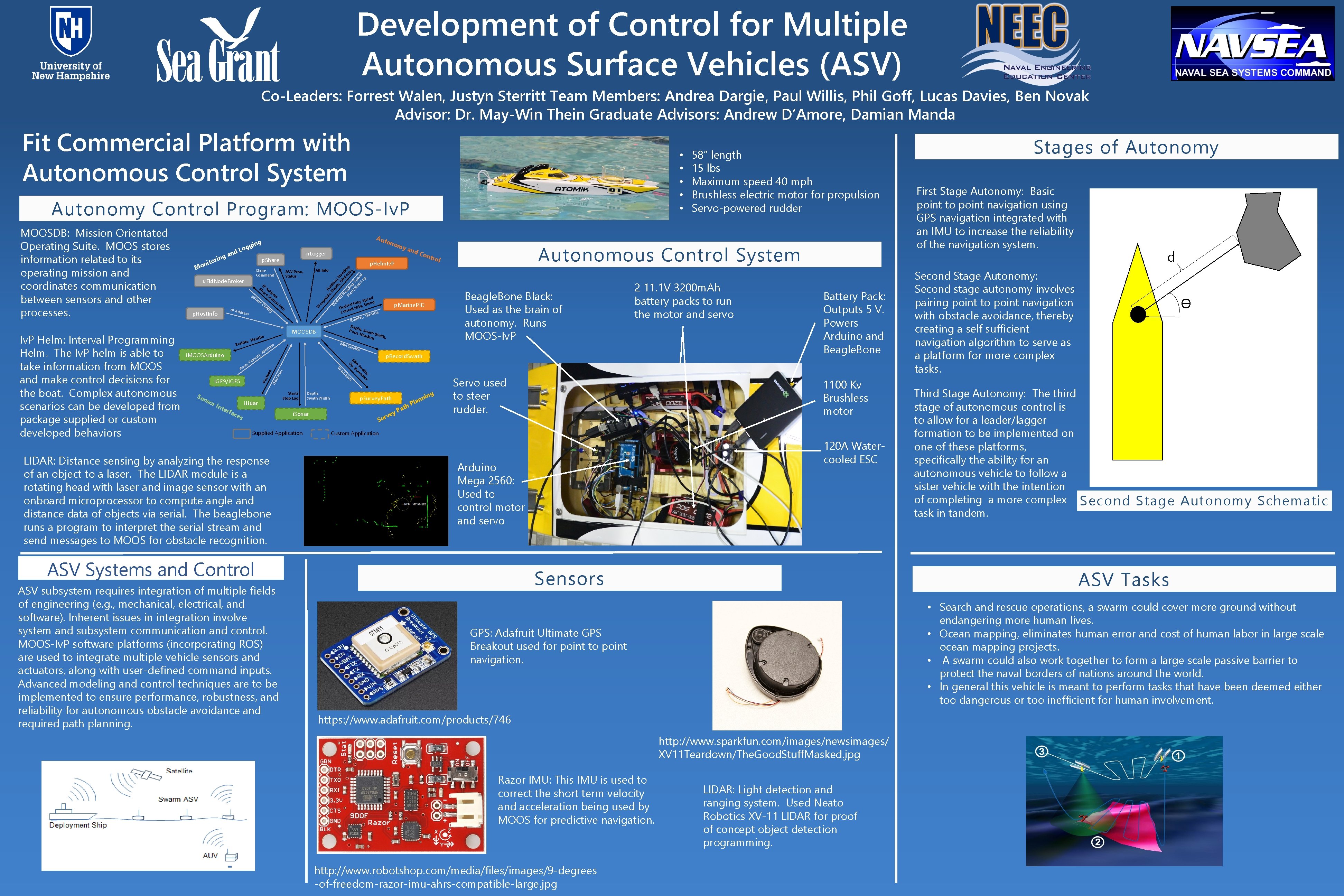
Development of Control for Multiple Autonomous Surface Vehicles (ASV) Co-Leaders: Forrest Walen, Justyn Sterritt Team Members: Andrea Dargie, Paul Willis, Phil Goff, Lucas Davies, Ben Novak Advisor: Dr. May-Win Thein Graduate Advisors: Andrew D’Amore, Damian Manda Fit Commercial Platform with Autonomous Control System • • • Autonomy Control Program: MOOS-Iv. P Shore Command d Rud h er, T i. MOOSArduino n, ay W sta i. Lidar erf ts Int ace Start/ Stop Log Depth, Swath Width i. Sonar s Supplied Application LIDAR: Distance sensing by analyzing the response of an object to a laser. The LIDAR module is a rotating head with laser and image sensor with an onboard microprocessor to compute angle and distance data of objects via serial. The beaglebone runs a program to interpret the serial stream and send messages to MOOS for obstacle recognition. p. Record. Swath M O in p. Sw Bo a un ths da , ry in sor ths po Sen p. Marine. PID Beagle. Bone Black: Used as the brain of autonomy. Runs MOOS-Iv. P p. Survey. Path P y e rv Su ath P ing n lan Servo used to steer rudder. Battery Pack: Outputs 5 V. Powers Arduino and Beagle. Bone 1100 Kv Brushless motor Custom Application 120 A Watercooled ESC Arduino Mega 2560: Used to control motor and servo ASV Systems and Control ASV subsystem requires integration of multiple fields of engineering (e. g. , mechanical, electrical, and software). Inherent issues in integration involve system and subsystem communication and control. MOOS-Iv. P software platforms (incorporating ROS) are used to integrate multiple vehicle sensors and actuators, along with user-defined command inputs. Advanced modeling and control techniques are to be implemented to ensure performance, robustness, and reliability for autonomous obstacle avoidance and required path planning. 2 11. 1 V 3200 m. Ah battery packs to run the motor and servo Swa ay i. GP 9/i. GPS Min de itu sit V cit o l e Autonomous Control System Con trol Dep t Pos h, Swat n, H ead h Width ing , r t At and p. Helm. Iv. P eed , Sp ed g d H e , Sp ired Des nt Hdg e Curr le rott h T der, Rud MOOSDB ottle y, s Po po in IP Sh Ad or dr e es p. S St s at ha io re n Co In nf fo ig s dress my All Info ASV Posn, Status cle IP Ad ts Po , D si De ep tio sir th n, , O He ed bs ad H ea ta in cl g, St di es ar ng t/ , St Sp op e Lo ed g p. Share u. Fld. Node. Broker p. Host. Info p. Logger Ob M L and ion t oni ono ogg W Iv. P Helm: Interval Programming Helm. The Iv. P helm is able to take information from MOOS and make control decisions for the boat. Complex autonomous scenarios can be developed from package supplied or custom developed behaviors g orin Aut ing Po MOOSDB: Mission Orientated Operating Suite. MOOS stores information related to its operating mission and coordinates communication between sensors and other processes. 58” length 15 lbs Maximum speed 40 mph Brushless electric motor for propulsion Servo-powered rudder Sensors d Second Stage Autonomy: Second stage autonomy involves pairing point to point navigation with obstacle avoidance, thereby creating a self sufficient navigation algorithm to serve as a platform for more complex tasks. Third Stage Autonomy: The third stage of autonomous control is to allow for a leader/lagger formation to be implemented on one of these platforms, specifically the ability for an autonomous vehicle to follow a sister vehicle with the intention of completing a more complex task in tandem. Ɵ Second Stage Autonomy Schematic • Search and rescue operations, a swarm could cover more ground without endangering more human lives. • Ocean mapping, eliminates human error and cost of human labor in large scale ocean mapping projects. • A swarm could also work together to form a large scale passive barrier to protect the naval borders of nations around the world. • In general this vehicle is meant to perform tasks that have been deemed either too dangerous or too inefficient for human involvement. https: //www. adafruit. com/products/746 http: //www. sparkfun. com/images/newsimages/ XV 11 Teardown/The. Good. Stuff. Masked. jpg http: //www. robotshop. com/media/files/images/9 -degrees -of-freedom-razor-imu-ahrs-compatible-large. jpg First Stage Autonomy: Basic point to point navigation using GPS navigation integrated with an IMU to increase the reliability of the navigation system. ASV Tasks GPS: Adafruit Ultimate GPS Breakout used for point to point navigation. Razor IMU: This IMU is used to correct the short term velocity and acceleration being used by MOOS for predictive navigation. Stages of Autonomy LIDAR: Light detection and ranging system. Used Neato Robotics XV-11 LIDAR for proof of concept object detection programming.