
Development of Colonies Throughout the 17 th Century
- Slides: 39
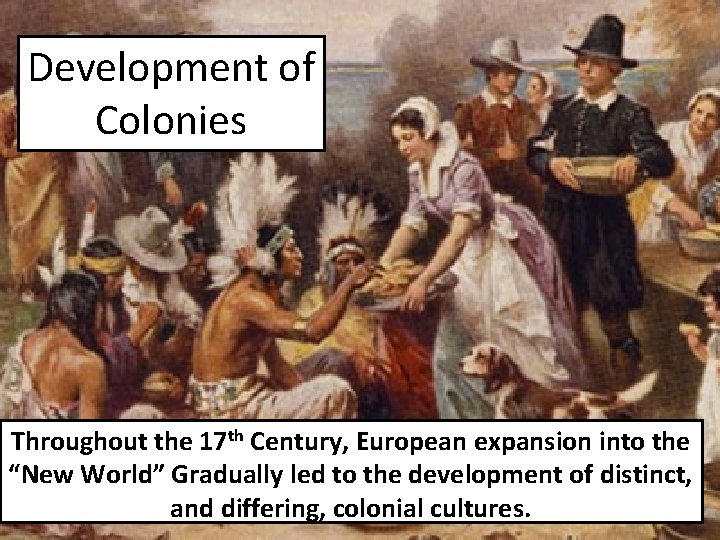
Development of Colonies Throughout the 17 th Century, European expansion into the “New World” Gradually led to the development of distinct, and differing, colonial cultures.
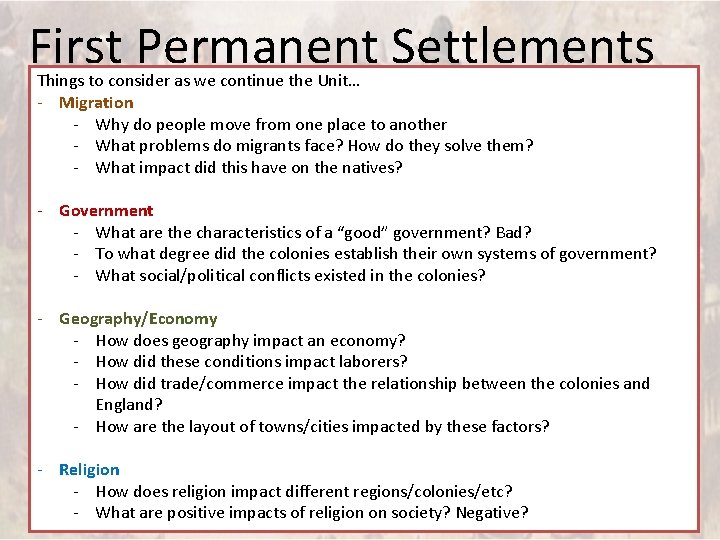
First Permanent Settlements Things to consider as we continue the Unit… - Migration - Why do people move from one place to another - What problems do migrants face? How do they solve them? - What impact did this have on the natives? - Government - What are the characteristics of a “good” government? Bad? - To what degree did the colonies establish their own systems of government? - What social/political conflicts existed in the colonies? - Geography/Economy - How does geography impact an economy? - How did these conditions impact laborers? - How did trade/commerce impact the relationship between the colonies and England? - How are the layout of towns/cities impacted by these factors? - Religion - How does religion impact different regions/colonies/etc? - What are positive impacts of religion on society? Negative?
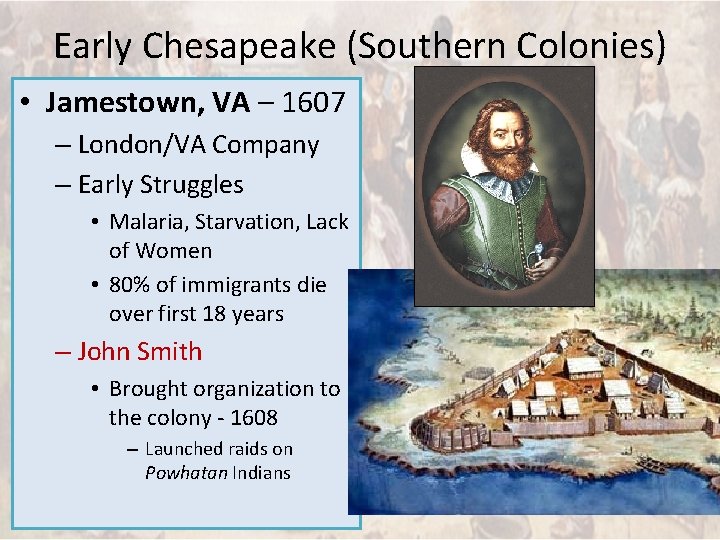
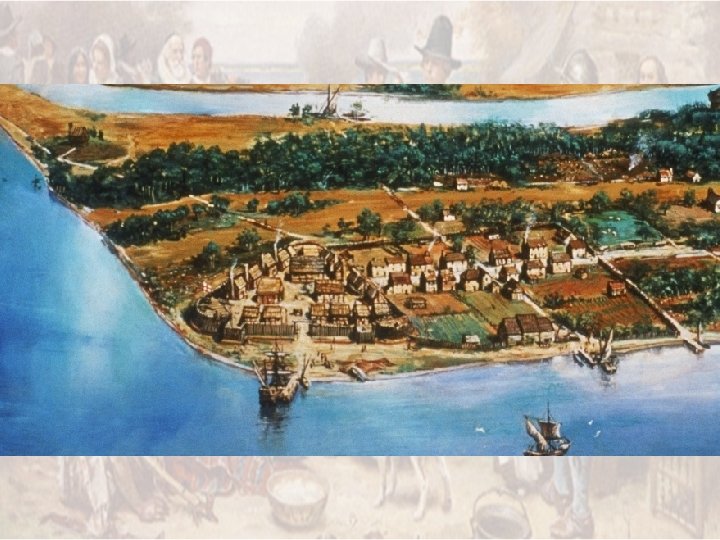
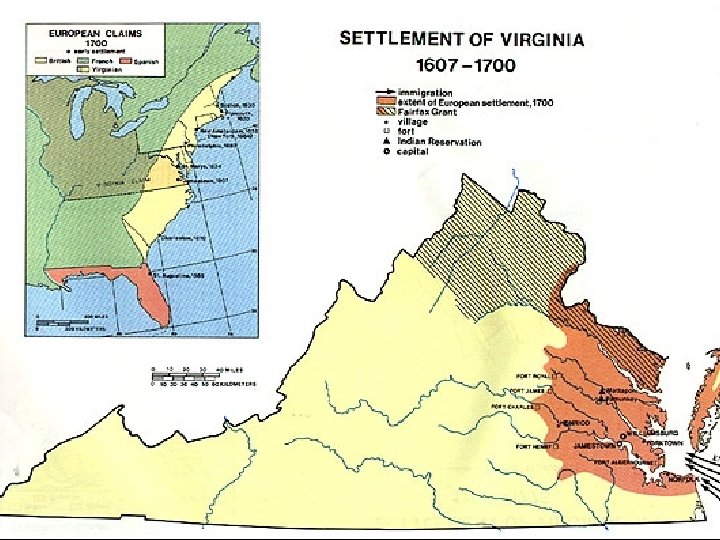
Early Chesapeake (Southern Colonies) • Jamestown, VA – 1607 – London/VA Company – Early Struggles • Malaria, Starvation, Lack of Women • 80% of immigrants die over first 18 years – John Smith • Brought organization to the colony - 1608 – Launched raids on Powhatan Indians
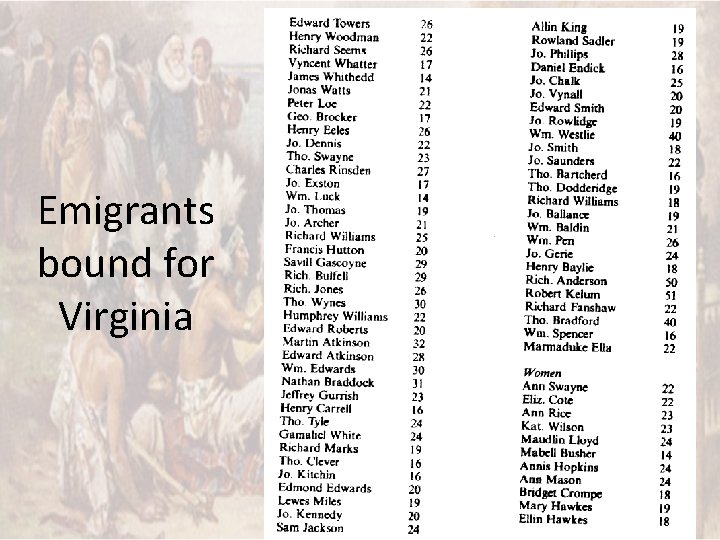
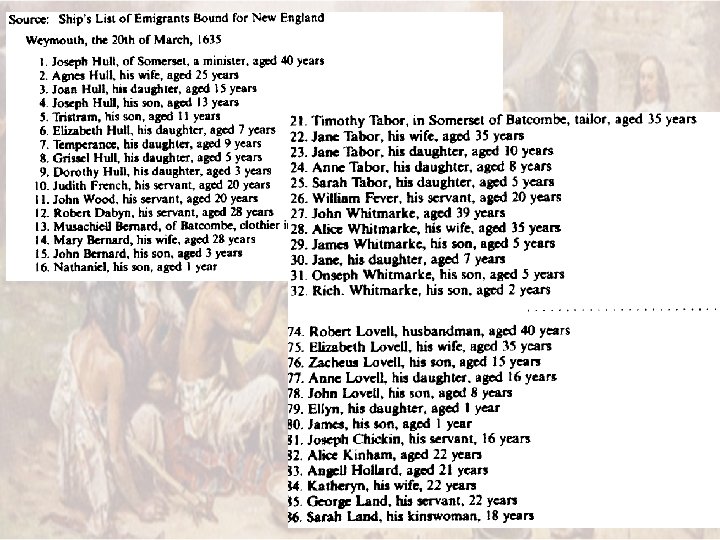
Emigrants bound for Virginia
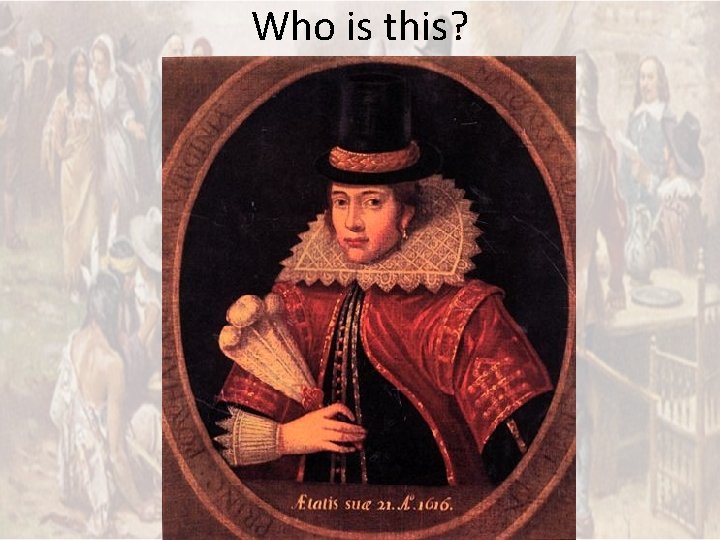
Who is this?
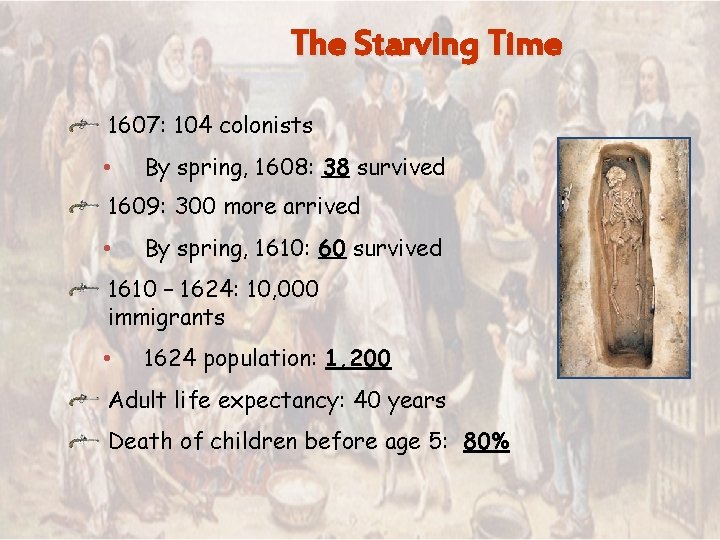
The Starving Time 1607: 104 colonists • By spring, 1608: 38 survived 1609: 300 more arrived • By spring, 1610: 60 survived 1610 – 1624: 10, 000 immigrants • 1624 population: 1, 200 Adult life expectancy: 40 years Death of children before age 5: 80%
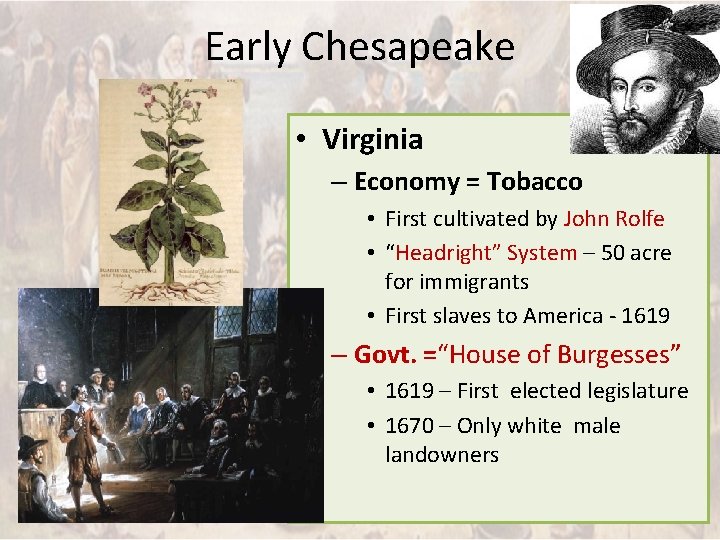
Early Chesapeake • Virginia – Economy = Tobacco • First cultivated by John Rolfe • “Headright” System – 50 acre for immigrants • First slaves to America - 1619 – Govt. =“House of Burgesses” • 1619 – First elected legislature • 1670 – Only white male landowners
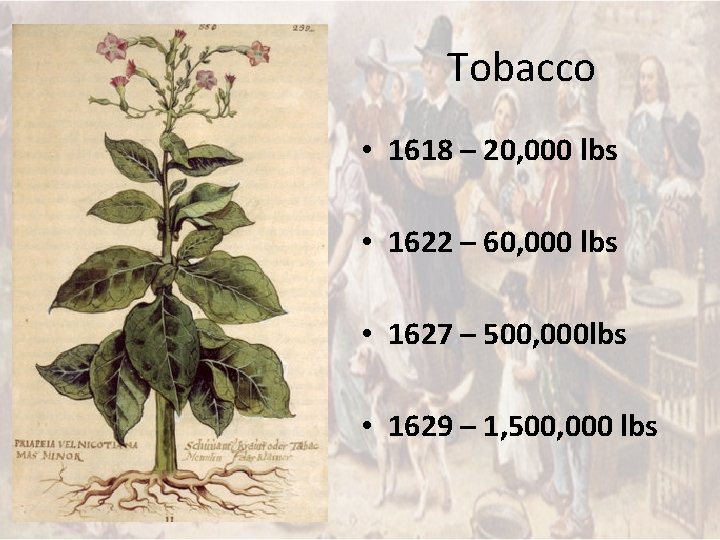
Tobacco • 1618 – 20, 000 lbs • 1622 – 60, 000 lbs • 1627 – 500, 000 lbs • 1629 – 1, 500, 000 lbs
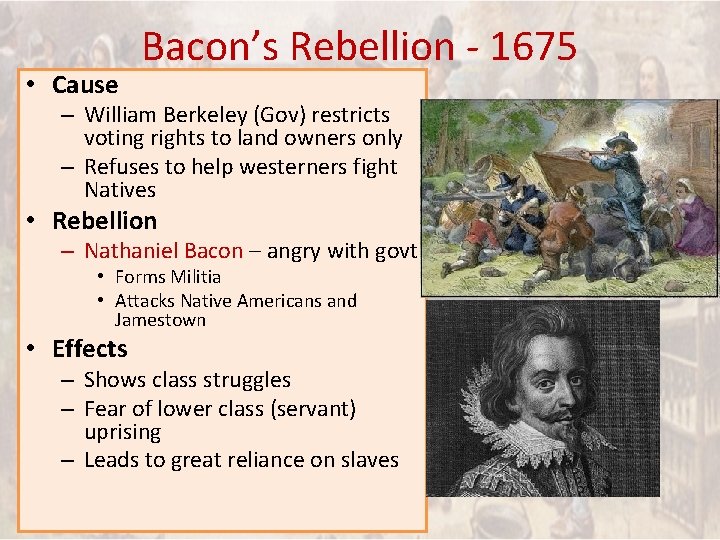
• Cause Bacon’s Rebellion - 1675 – William Berkeley (Gov) restricts voting rights to land owners only – Refuses to help westerners fight Natives • Rebellion – Nathaniel Bacon – angry with govt. • Forms Militia • Attacks Native Americans and Jamestown • Effects – Shows class struggles – Fear of lower class (servant) uprising – Leads to great reliance on slaves
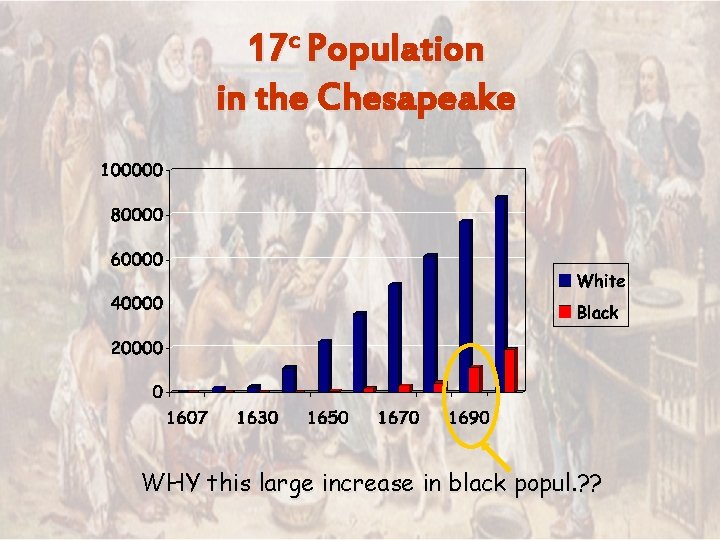
17 c Population in the Chesapeake WHY this large increase in black popul. ? ?
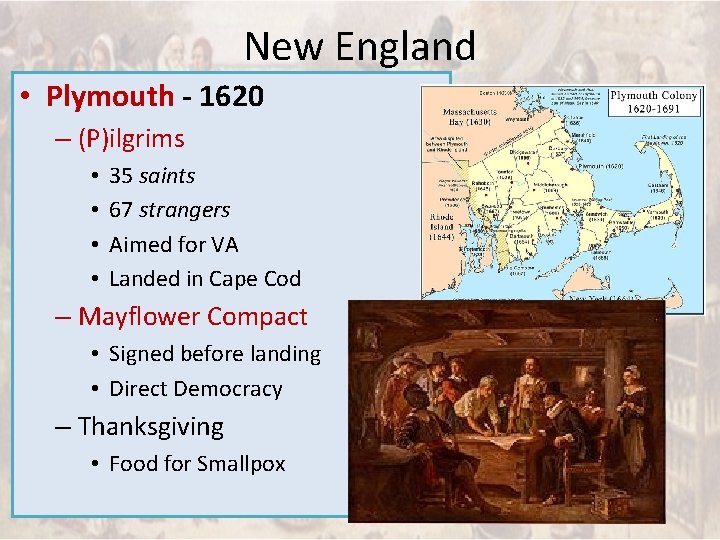
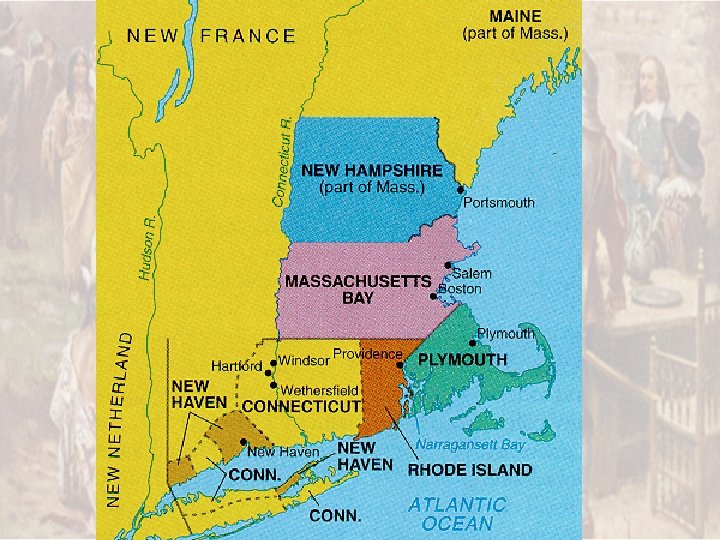
New England • Plymouth - 1620 – (P)ilgrims • • 35 saints 67 strangers Aimed for VA Landed in Cape Cod – Mayflower Compact • Signed before landing • Direct Democracy – Thanksgiving • Food for Smallpox
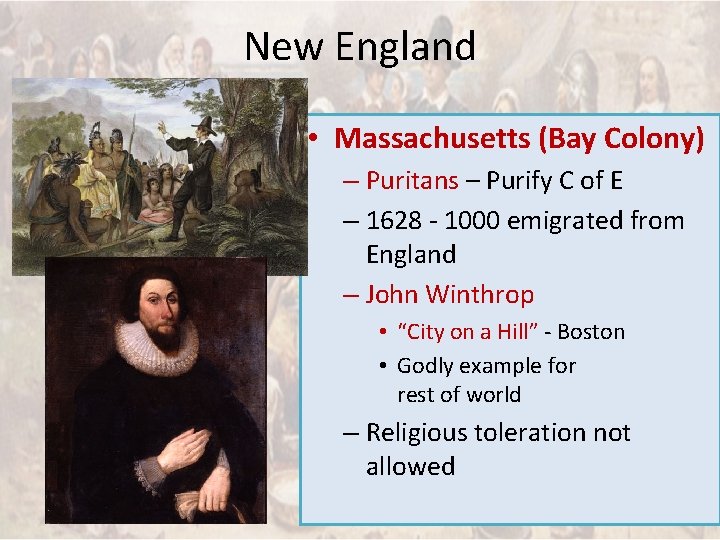
New England • Massachusetts (Bay Colony) – Puritans – Purify C of E – 1628 - 1000 emigrated from England – John Winthrop • “City on a Hill” - Boston • Godly example for rest of world – Religious toleration not allowed
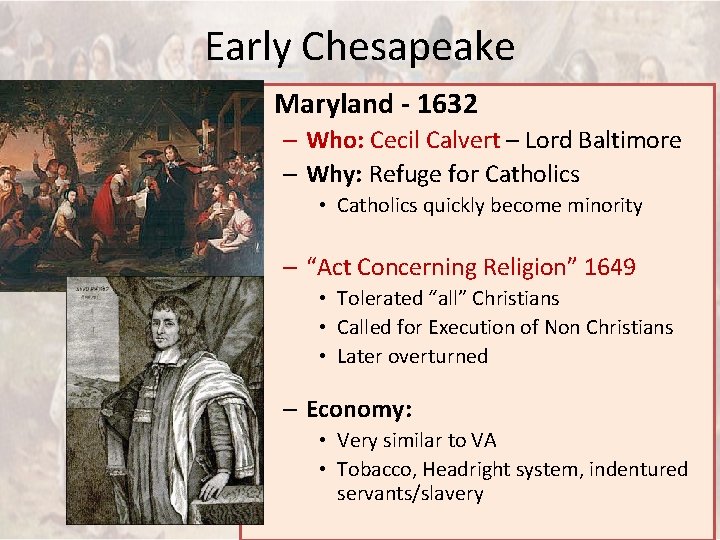
Early Chesapeake • Maryland - 1632 – Who: Cecil Calvert – Lord Baltimore – Why: Refuge for Catholics • Catholics quickly become minority – “Act Concerning Religion” 1649 • Tolerated “all” Christians • Called for Execution of Non Christians • Later overturned – Economy: • Very similar to VA • Tobacco, Headright system, indentured servants/slavery
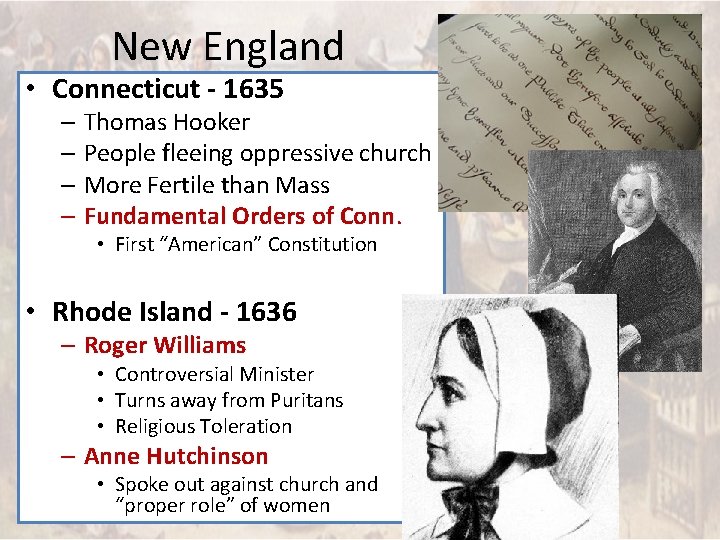
New England • Connecticut - 1635 – Thomas Hooker – People fleeing oppressive church – More Fertile than Mass – Fundamental Orders of Conn. • First “American” Constitution • Rhode Island - 1636 – Roger Williams • Controversial Minister • Turns away from Puritans • Religious Toleration – Anne Hutchinson • Spoke out against church and “proper role” of women
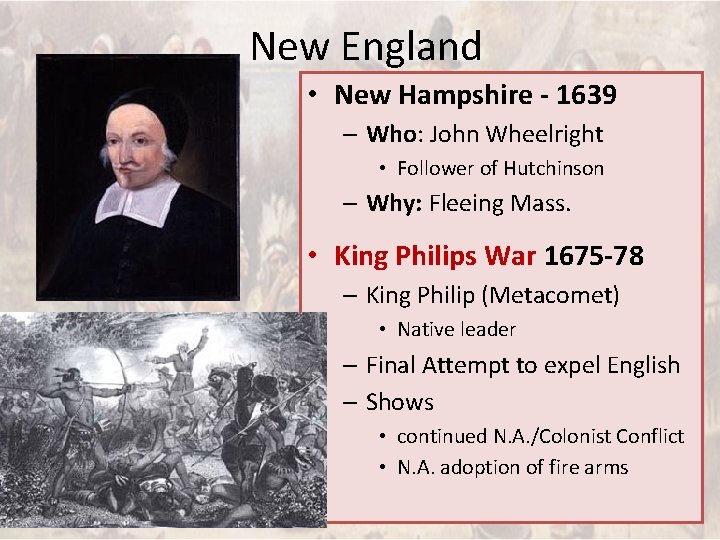
New England • New Hampshire - 1639 – Who: John Wheelright • Follower of Hutchinson – Why: Fleeing Mass. • King Philips War 1675 -78 – King Philip (Metacomet) • Native leader – Final Attempt to expel English – Shows • continued N. A. /Colonist Conflict • N. A. adoption of fire arms
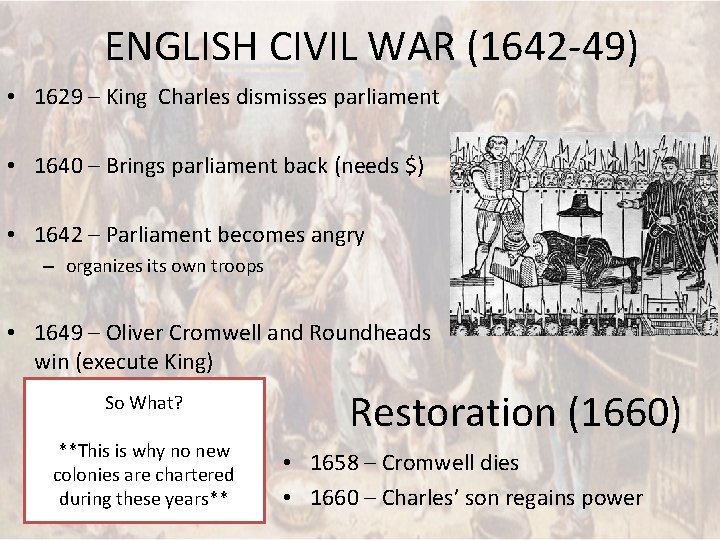
ENGLISH CIVIL WAR (1642 -49) • 1629 – King Charles dismisses parliament • 1640 – Brings parliament back (needs $) • 1642 – Parliament becomes angry – organizes its own troops • 1649 – Oliver Cromwell and Roundheads win (execute King) So What? **This is why no new colonies are chartered during these years** Restoration (1660) • 1658 – Cromwell dies • 1660 – Charles’ son regains power
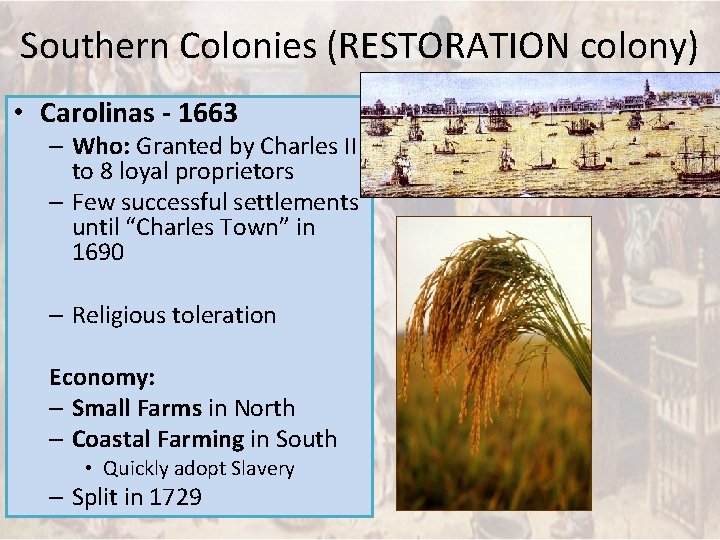
Southern Colonies (RESTORATION colony) • Carolinas - 1663 – Who: Granted by Charles II to 8 loyal proprietors – Few successful settlements until “Charles Town” in 1690 – Religious toleration Economy: – Small Farms in North – Coastal Farming in South • Quickly adopt Slavery – Split in 1729
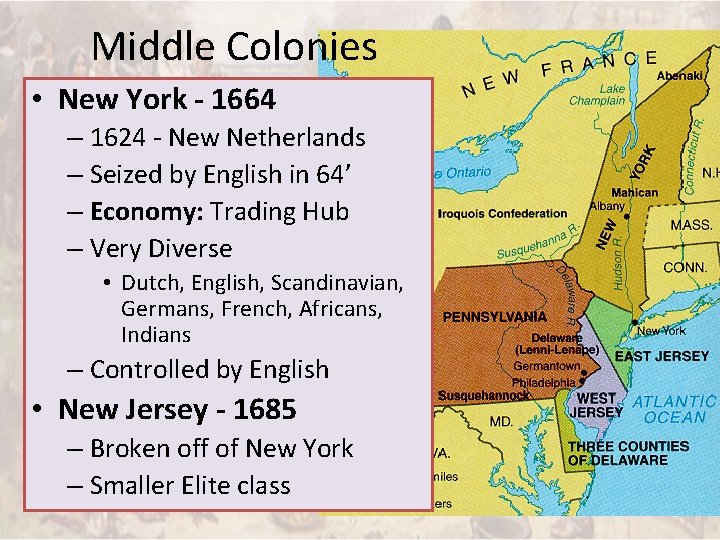
Middle Colonies • New York - 1664 – 1624 - New Netherlands – Seized by English in 64’ – Economy: Trading Hub – Very Diverse • Dutch, English, Scandinavian, Germans, French, Africans, Indians – Controlled by English • New Jersey - 1685 – Broken off of New York – Smaller Elite class
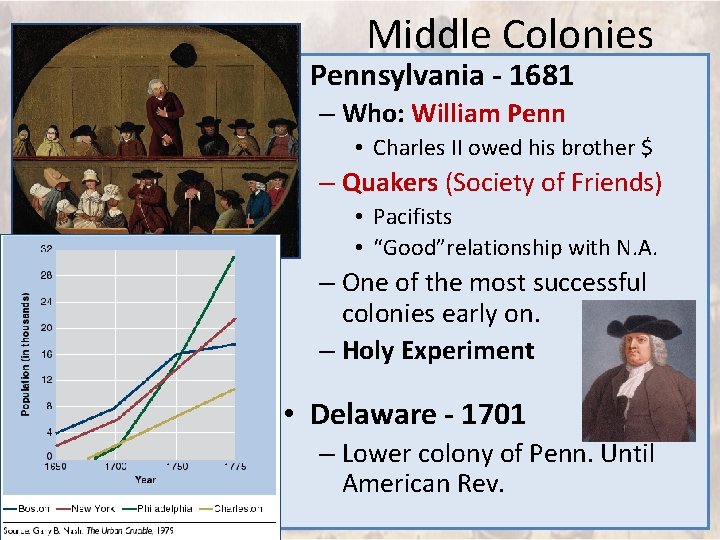
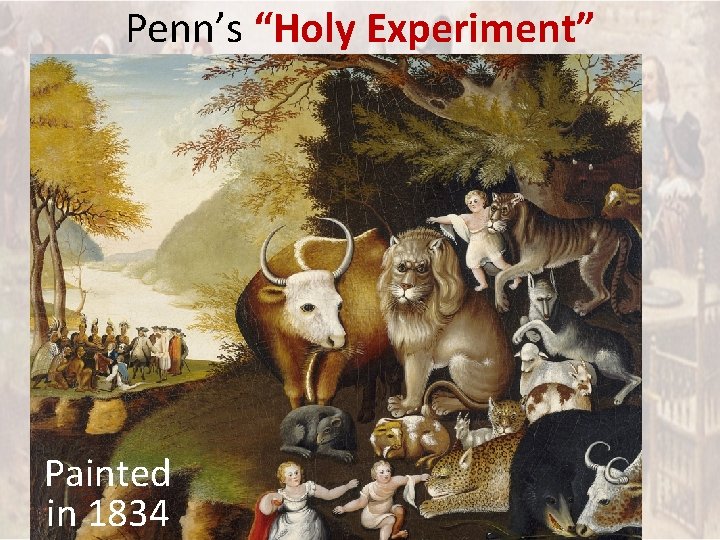
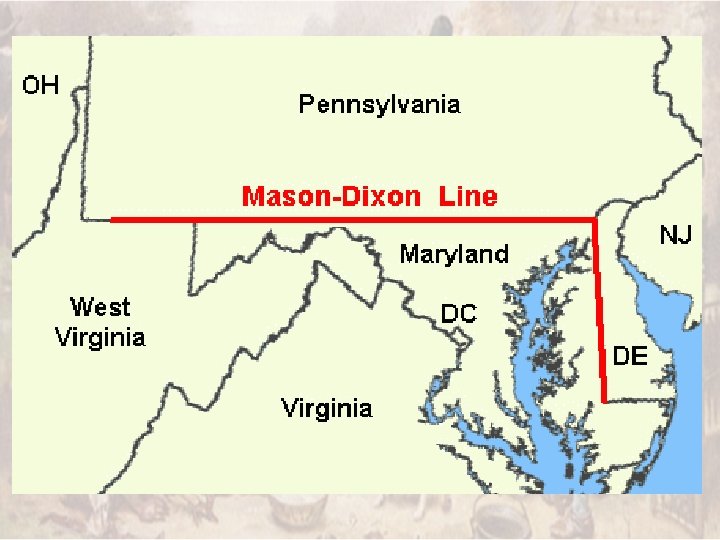
Middle Colonies • Pennsylvania - 1681 – Who: William Penn • Charles II owed his brother $ – Quakers (Society of Friends) • Pacifists • “Good”relationship with N. A. – One of the most successful colonies early on. – Holy Experiment • Delaware - 1701 – Lower colony of Penn. Until American Rev.
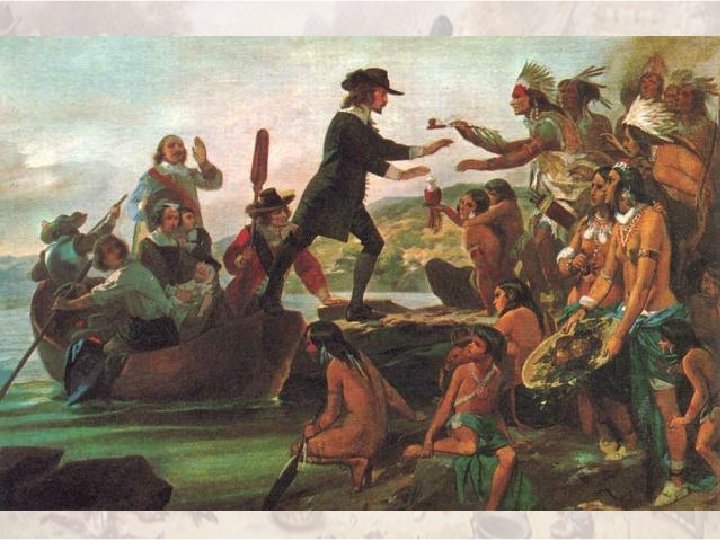
Penn’s “Holy Experiment” Painted in 1834
16
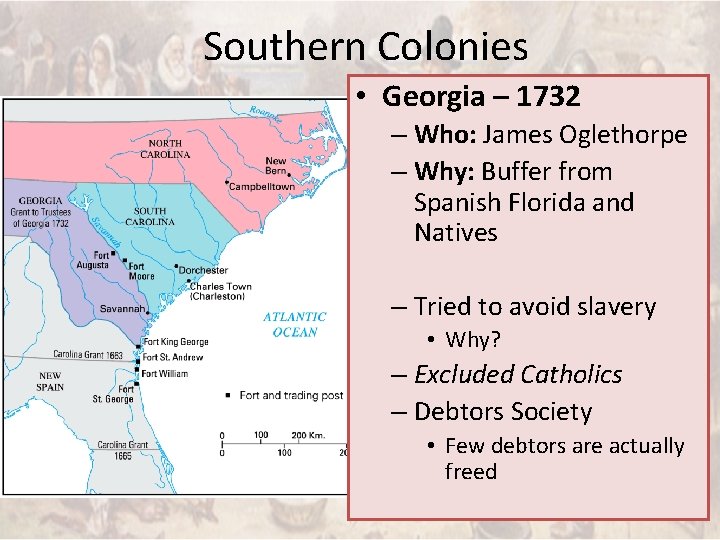
Southern Colonies • Georgia – 1732 – Who: James Oglethorpe – Why: Buffer from Spanish Florida and Natives – Tried to avoid slavery • Why? – Excluded Catholics – Debtors Society • Few debtors are actually freed
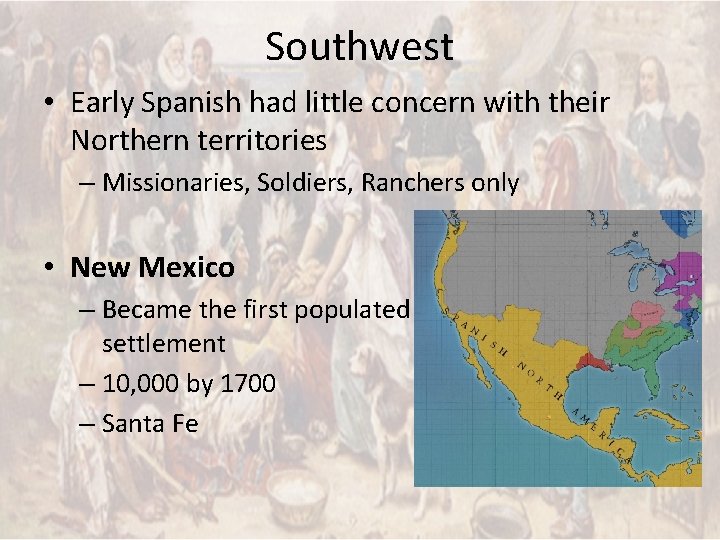
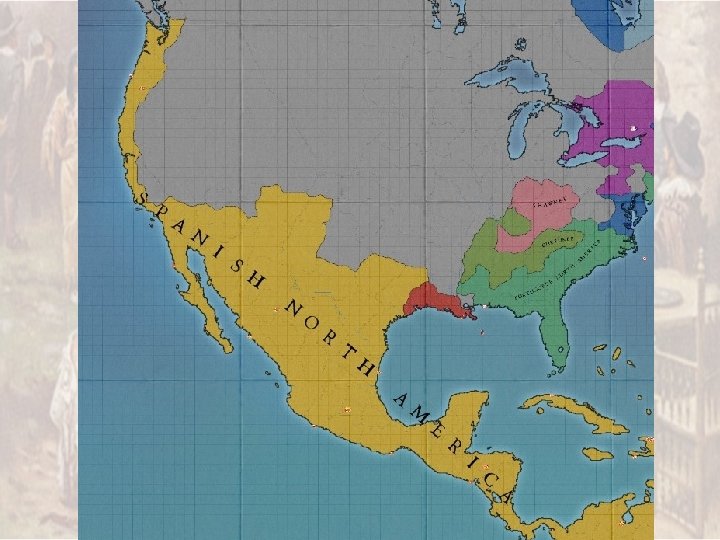
Southwest • Early Spanish had little concern with their Northern territories – Missionaries, Soldiers, Ranchers only • New Mexico – Became the first populated settlement – 10, 000 by 1700 – Santa Fe
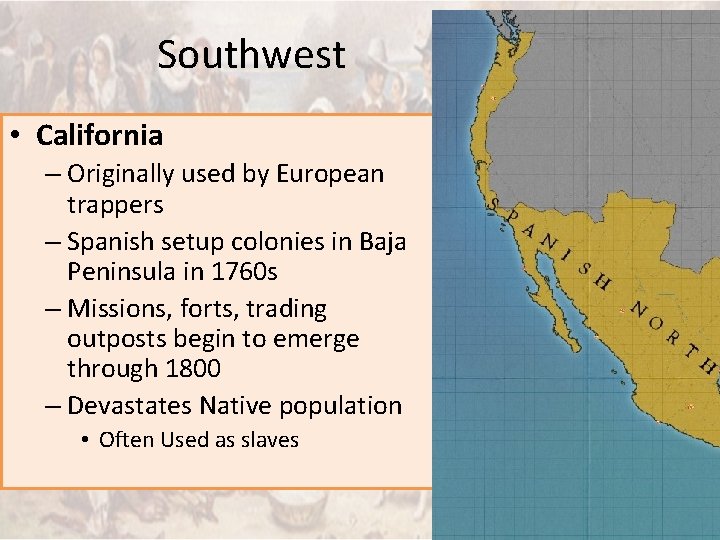
Southwest • California – Originally used by European trappers – Spanish setup colonies in Baja Peninsula in 1760 s – Missions, forts, trading outposts begin to emerge through 1800 – Devastates Native population • Often Used as slaves
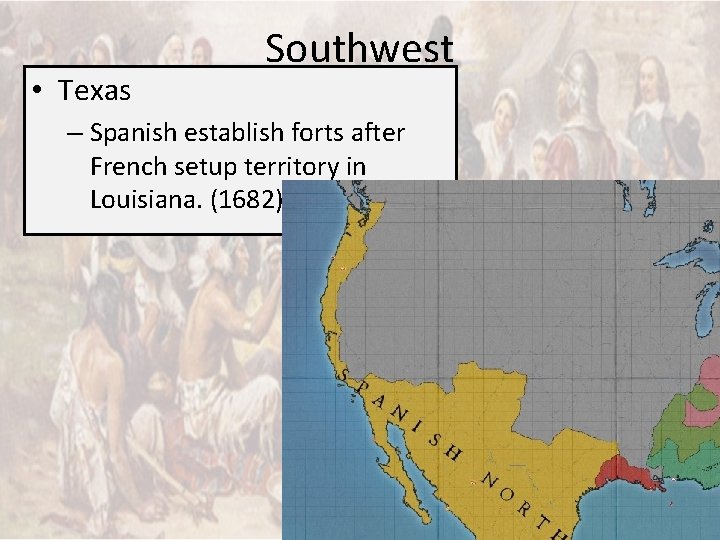
• Texas Southwest – Spanish establish forts after French setup territory in Louisiana. (1682)
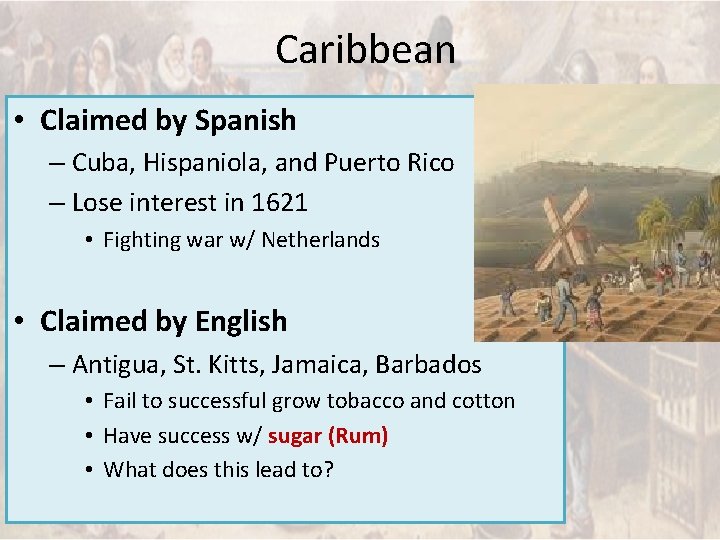
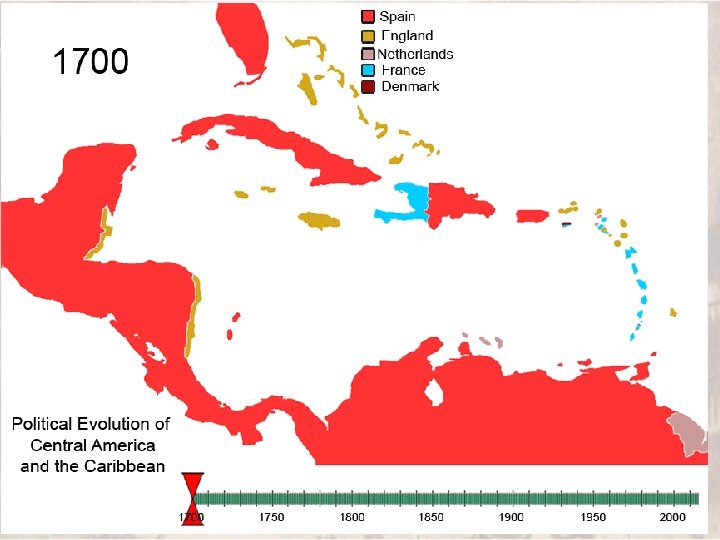
Caribbean • Claimed by Spanish – Cuba, Hispaniola, and Puerto Rico – Lose interest in 1621 • Fighting war w/ Netherlands • Claimed by English – Antigua, St. Kitts, Jamaica, Barbados • Fail to successful grow tobacco and cotton • Have success w/ sugar (Rum) • What does this lead to?
British & Colonial Relationship Benefits for Brits • New Raw Materials/Resources • Colonists buy finished products from Britain • Spread of British Ideas and Religion Benefits for Colonies • Form their own local governments • Make/Enforce their own local laws • Military protection Sa N y r a t lu t c e l eg
British & Colonial Relationship Trouble in Paradise? • The colonies began trading directly with countries OTHER than the British • Most colonies have established a government without consulting the Crown. • Why is this a problem for the British? • What would you do about it? Sa N y r a t lu t c e l eg
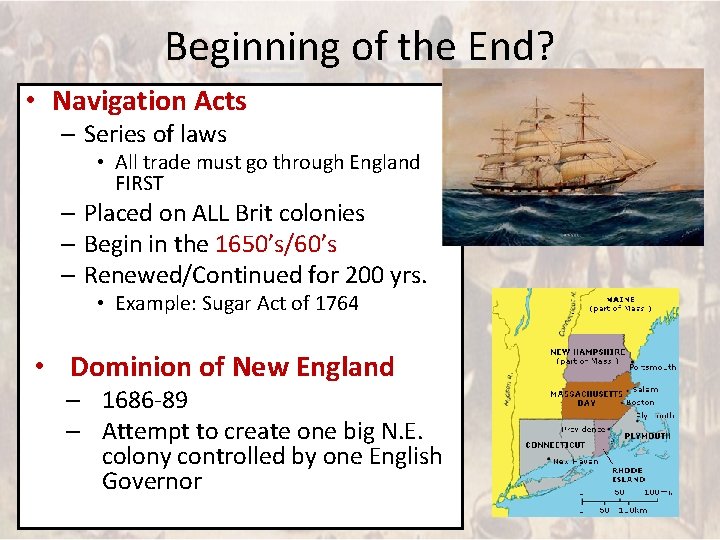
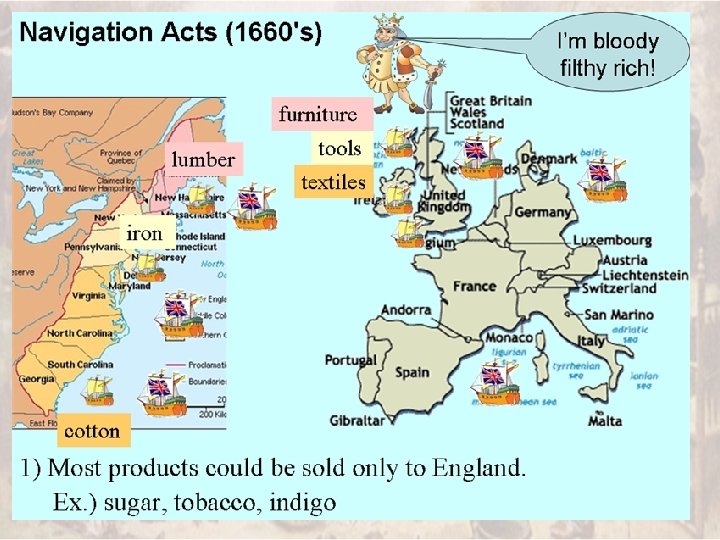
Beginning of the End? • Navigation Acts – Series of laws • All trade must go through England FIRST – Placed on ALL Brit colonies – Begin in the 1650’s/60’s – Renewed/Continued for 200 yrs. • Example: Sugar Act of 1764 • Dominion of New England – 1686 -89 – Attempt to create one big N. E. colony controlled by one English Governor
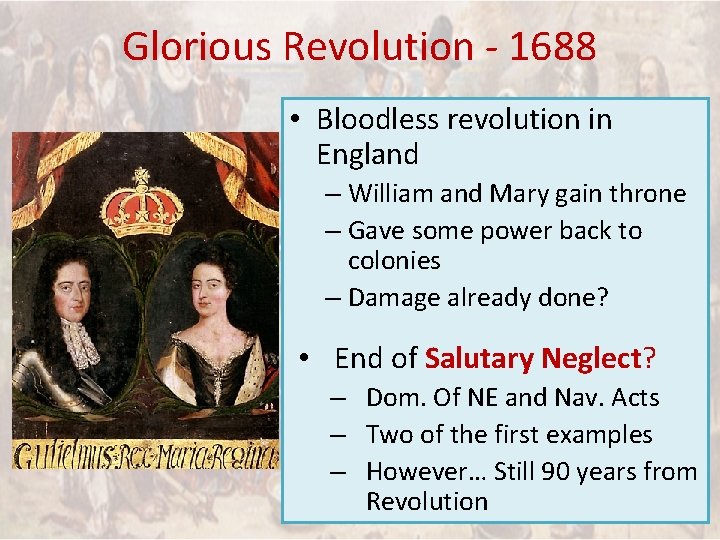
Glorious Revolution - 1688 • Bloodless revolution in England – William and Mary gain throne – Gave some power back to colonies – Damage already done? • End of Salutary Neglect? – Dom. Of NE and Nav. Acts – Two of the first examples – However… Still 90 years from Revolution
First Permanent Settlements Things to consider as we continue the Unit… - Migration - Why do people move from one place to another - What problems do migrants face? How do they solve them? - What impact did this have on the natives? - Government - What are the characteristics of a “good” government? Bad? - To what degree did the colonies establish their own systems of government? - What social/political conflicts existed in the colonies? - Geography/Economy - How does geography impact an economy? - How did these conditions impact laborers? - How did trade/commerce impact the relationship between the colonies and England? - How are the layout of towns/cities impacted by these factors? - Religion - How does religion impact different regions/colonies/etc? - What are positive impacts of religion on society? Negative?