
Development of B and T lymphocytes Ali Al
Development of B and T lymphocytes Ali Al Khader, MD Faculty of Medicine Al-Balqa’ Applied University Email: ali. alkhader@bau. edu. jo
What will we discuss today? • B-cell development • T-cell development
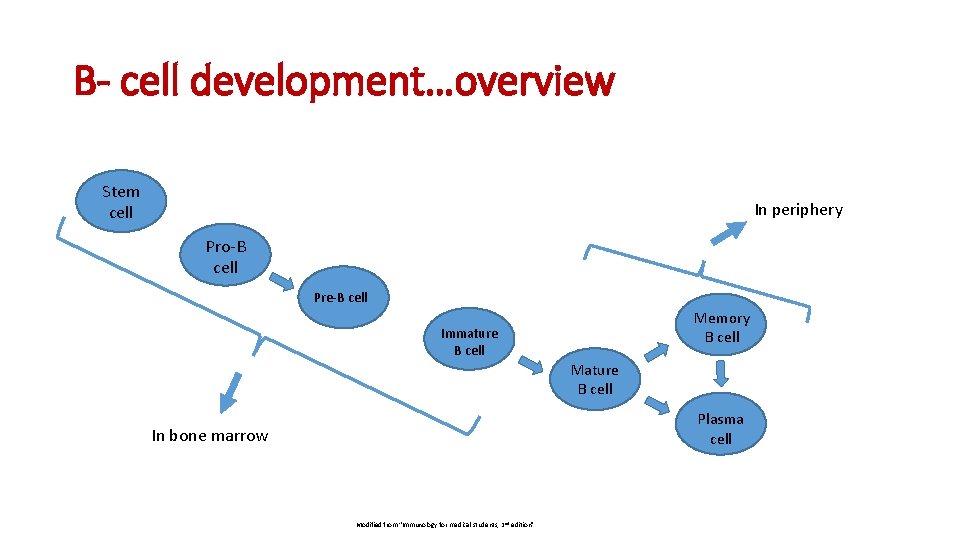
B- cell development…overview Stem cell In periphery Pro-B cell Pre-B cell Memory B cell Immature B cell Mature B cell Plasma cell In bone marrow Modified from “Immunology for medical students, 2 nd edition”
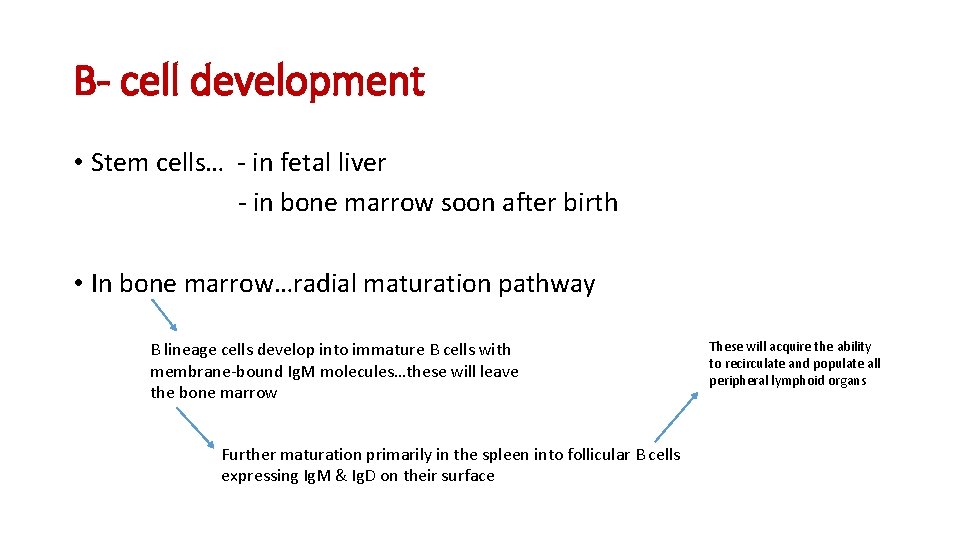
B- cell development • Stem cells… - in fetal liver - in bone marrow soon after birth • In bone marrow…radial maturation pathway B lineage cells develop into immature B cells with membrane-bound Ig. M molecules…these will leave the bone marrow Further maturation primarily in the spleen into follicular B cells expressing Ig. M & Ig. D on their surface These will acquire the ability to recirculate and populate all peripheral lymphoid organs
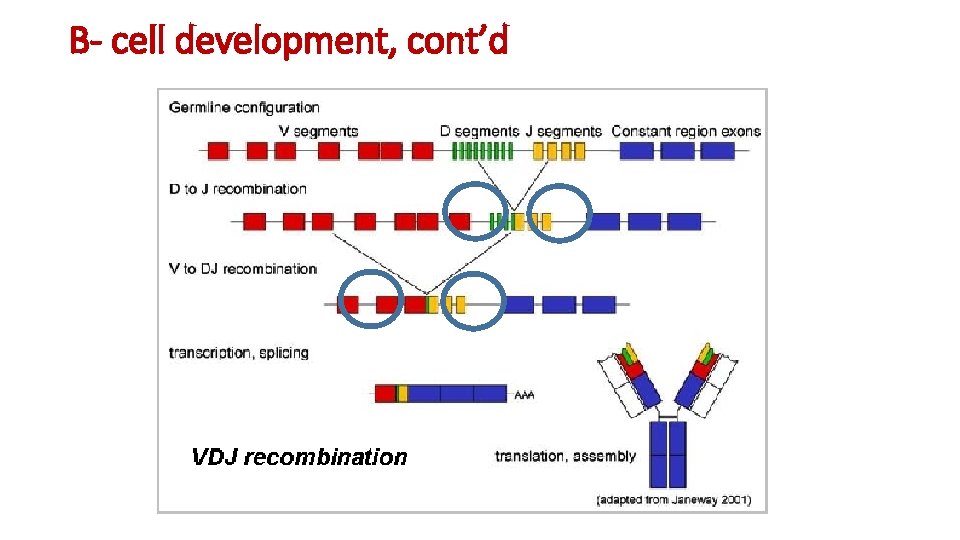
B- cell development, cont’d • From lymphoid progenitor to mature B cells: 2 -3 days • The earliest committed B-lineage cell is pro-B cell Characterized by appearance of B lineage surface markers, e. g. , CD 19 -RAG proteins are first expressed at this stage -DJ & V to DJ recombination then occurs, and mu heavy chain is produced -Td. T is most abundantly expressed here
B- cell development, cont’d
B- cell development, cont’d • Rearrangements at Ig. H locus must be productive… 1/3 of pro-B cells …now Ig mu heavy chain can be formed now the cell become: pre-B cell • In early pre-B stage: two polypeptides associate non-covalently to form the surrogate light chain, and pair with the heavy chain -delta 5 -Vpre. B

B- cell development, cont’d • Surrogate light chains are invariant • Mu + surrogate light chains + Ig alpha + Ig beta = pre-B cell receptor Bruton’s tyrosine kinase (BTK gene) is activated downstream Its mutation will cause: ……. Its signaling is responsible for B lineage expansion (survival, proliferation and maturation)
B- cell development, cont’d • Pre-B cell receptor also inhibits rearrangement of heavy chain locus on the other chromosome • If the rearrangement was non-productive, the other allele can compensate • Pre-B cell receptor also inactivate surrogate light chain gene expression • Rearrangement of kappa or lambda which associates with mu…here the cell becomes immature B cell
B- cell development, cont’d • Kappa is rearranged after heavy chain and before delta …rearrangement of kappa inhibits delta rearrangement … 2 conditions in which delta will undergo recombination? ? ? • Allelic exclusion also applies for light chain • Immature B cell will exit the bone marrow and complete maturation in spleen By reactivation of Rag genes and new recombination of light chains …otherwise they -undergo receptor editing -die = clonal deletion (Negative selection) -or become unresponsive = anergy
B- cell development, cont’d • Mature naive B cells will die in a few months if they do not encounter antigens and recognize them with high affinity (respond to antigens) • For mature B cells expressing Ig. M & Ig. D: binding with high affinity leads to proliferation & differentiation…leads to humoral immune responses • B-1 and marginal zone B lymphocytes? ? ?
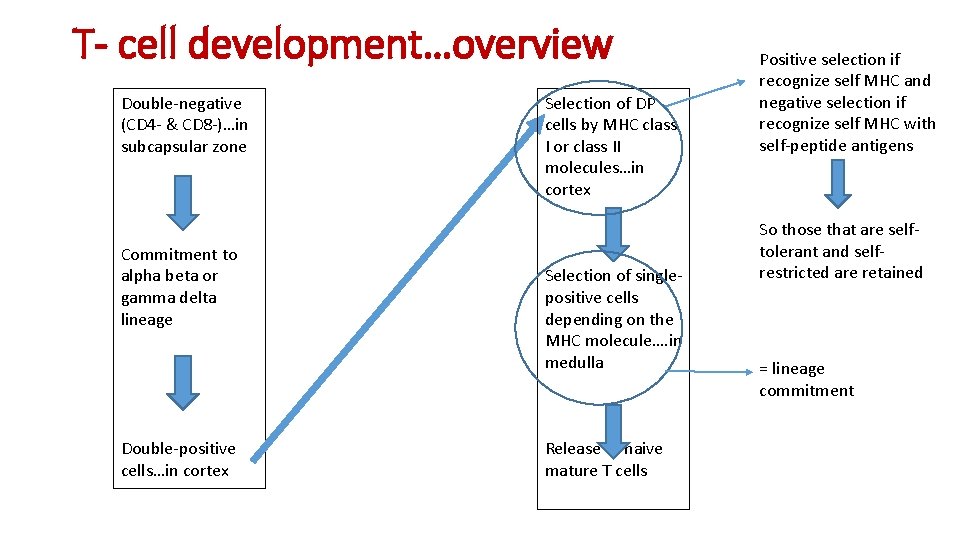
T- cell development…overview Double-negative (CD 4 - & CD 8 -)…in subcapsular zone Commitment to alpha beta or gamma delta lineage Double-positive cells…in cortex Selection of DP cells by MHC class I or class II molecules…in cortex Selection of singlepositive cells depending on the MHC molecule…. in medulla Release of naive mature T cells Positive selection if recognize self MHC and negative selection if recognize self MHC with self-peptide antigens So those that are selftolerant and selfrestricted are retained = lineage commitment
T- cell development • Congenital absence of thymus will cause immunodeficiency • Thymus involutes with age…but memory T cells have long life span • Precursors from fetal liver and adult bone marrow will seed the thymus • … thymocytes
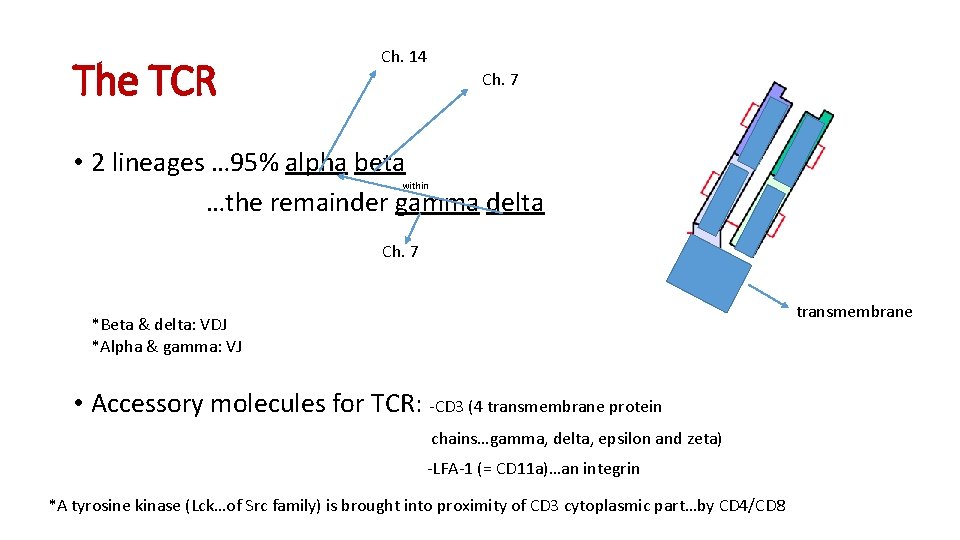
The TCR Ch. 14 Ch. 7 • 2 lineages … 95% alpha beta …the remainder gamma delta within Ch. 7 transmembrane *Beta & delta: VDJ *Alpha & gamma: VJ • Accessory molecules for TCR: -CD 3 (4 transmembrane protein chains…gamma, delta, epsilon and zeta) -LFA-1 (= CD 11 a)…an integrin *A tyrosine kinase (Lck…of Src family) is brought into proximity of CD 3 cytoplasmic part…by CD 4/CD 8
T- cell development, cont’d • The most immature thymocytes: negative for TCR, CD 4 or CD 8 In subcapsular sinus and outer cortex (+) for CD 44 & CD 25 (alpha chain of IL-2 receptor) • In cortex: expression of gamma delta and alpha beta TCRs…see next slide • Alpha beta T cells begin to mature into CD 4+ class II MHC-restricted or CD 8+ class I MHC-restricted T cells…see slide 17 • Then to the medulla then to the circulation • Role of other cells in thymus (expressing MHC & secreting cytokines)
T- cell development, cont’d • Cortical thymocytes… proliferation and apoptotic activity 95% before reaching the medulla Sensitive to irradiation and steroids • Rearrangement of beta, gamma, and delta -at DN stage -if functional gamma delta receptor produced…gamma delta TCR-expressing T cell results -if TCR beta chain…with invariant pre-T alpha chain and CD 3: = pre-TCR complex…signal transduction: stimulation of proliferation, halting beta rearrangement and promoting alpha rearrangement
T- cell development, cont’d • Positive selection of DP thymocyte…with help of cortical epithelial cells • Self-MHC restricted cells are produced …these need to be self-tolerant…otherwise? ? With help of dendritic cells in medulla
Autoimmune regulator gene (AIRE) • Regulate expression of antigens of endocrine cells in thymic epithelial and non-epithelial cells • Mutation…autosomal recessive disease autoimmune polyendocrine syndrome I (APS-I)

Thank You
- Slides: 19