
Development of Automatic Temperature Compensation Software for Optical

- Slides: 14
Development of Automatic Temperature Compensation Software for Optical Fibre Sensing Data M. Res in Photonic Systems Development Mini Project Malcolm Scott Supervisor: Prof. Kenichi Soga
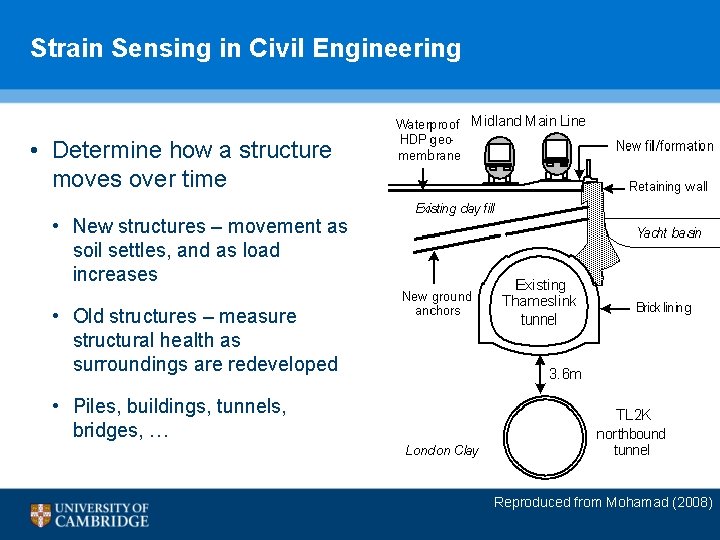
Strain Sensing in Civil Engineering • Determine how a structure moves over time • New structures – movement as soil settles, and as load increases • Old structures – measure structural health as surroundings are redeveloped • Piles, buildings, tunnels, bridges, … Reproduced from Mohamad (2008)
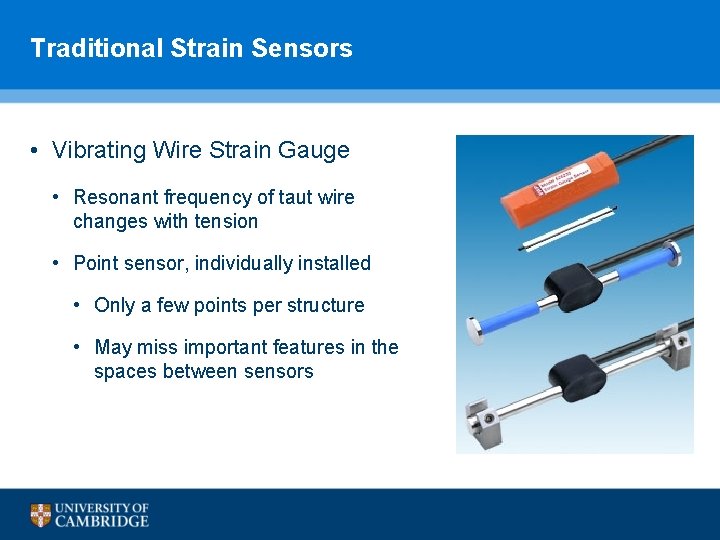
Traditional Strain Sensors • Vibrating Wire Strain Gauge • Resonant frequency of taut wire changes with tension • Point sensor, individually installed • Only a few points per structure • May miss important features in the spaces between sensors
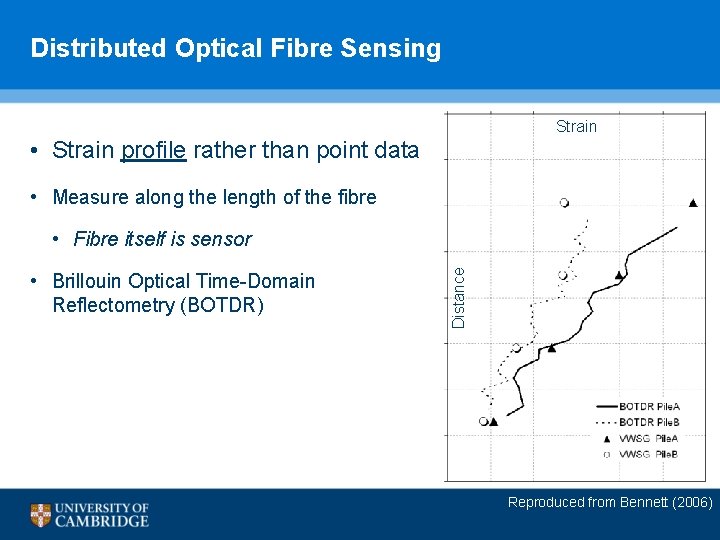
Distributed Optical Fibre Sensing Strain • Strain profile rather than point data • Measure along the length of the fibre • Brillouin Optical Time-Domain Reflectometry (BOTDR) Distance • Fibre itself is sensor Reproduced from Bennett (2006)
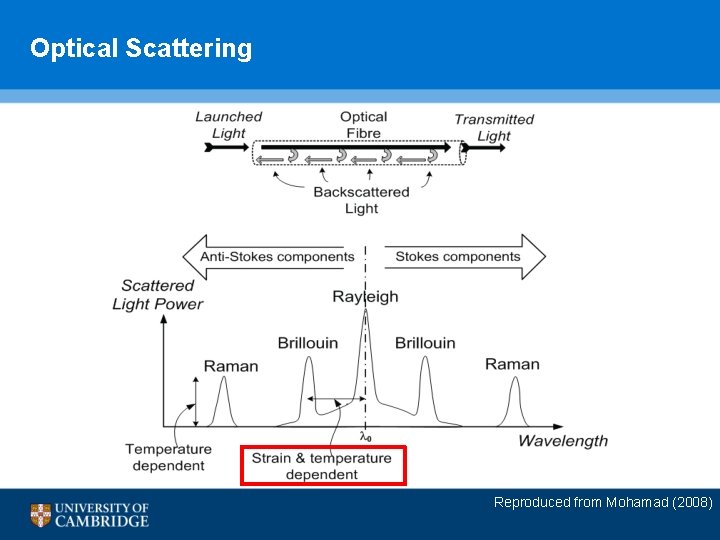
Optical Scattering Reproduced from Mohamad (2008)
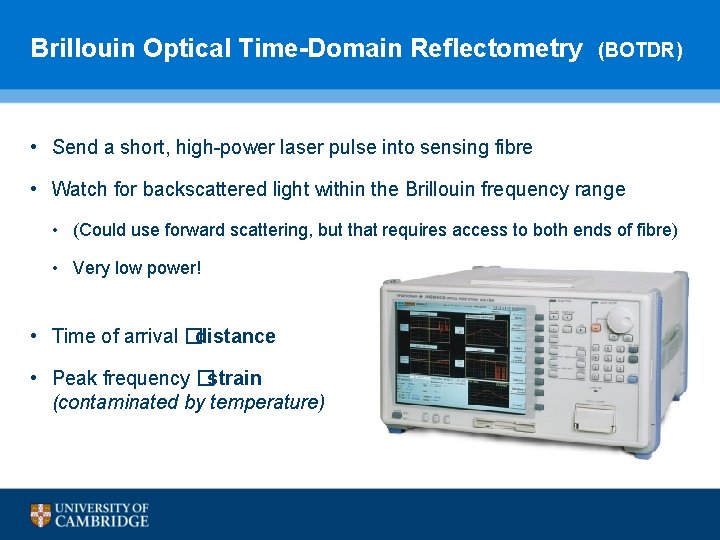
Brillouin Optical Time-Domain Reflectometry (BOTDR) • Send a short, high-power laser pulse into sensing fibre • Watch for backscattered light within the Brillouin frequency range • (Could use forward scattering, but that requires access to both ends of fibre) • Very low power! • Time of arrival �distance • Peak frequency �strain (contaminated by temperature)
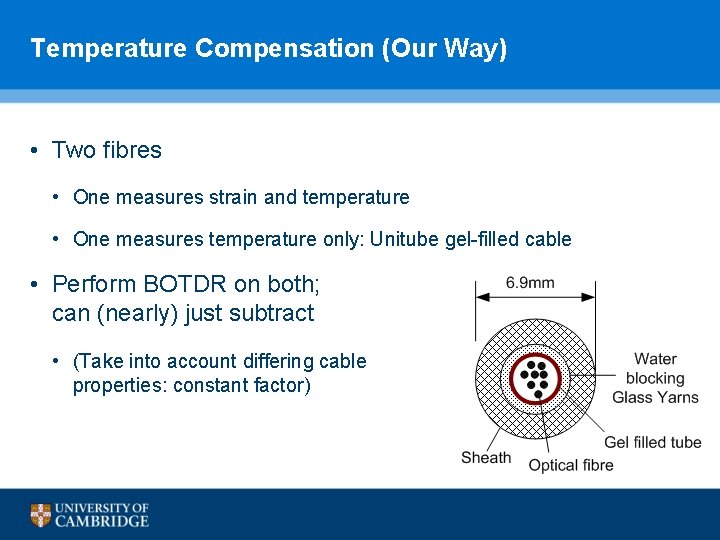
Temperature Compensation (Our Way) • Two fibres • One measures strain and temperature • One measures temperature only: Unitube gel-filled cable • Perform BOTDR on both; can (nearly) just subtract • (Take into account differing cable properties: constant factor)
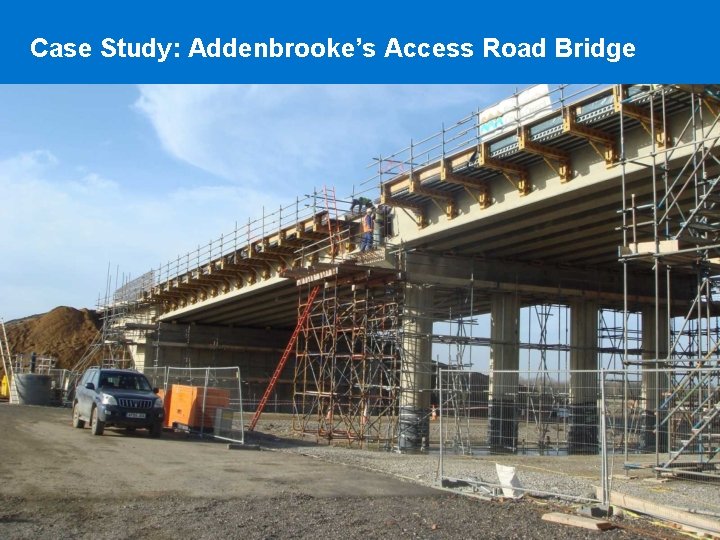
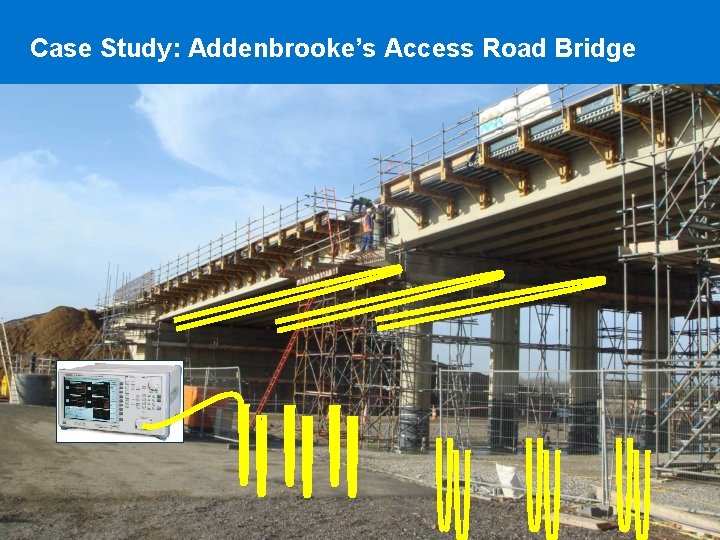
Case Study: Addenbrooke’s Access Road Bridge
Case Study: Addenbrooke’s Access Road Bridge
The Data • One strain profile: 10, 000 -100, 000 points (calculated by equipment) • One pile/beam: ~10 strain profiles (strain + temperature, repeated; also both ends where fibre is broken) • One day’s readings: 2 beams + 7 piles • One project: so far, 7 individual days of readings; more to come • Potentially on the order of hundreds of millions of points • Processing and analysing this data is time-consuming
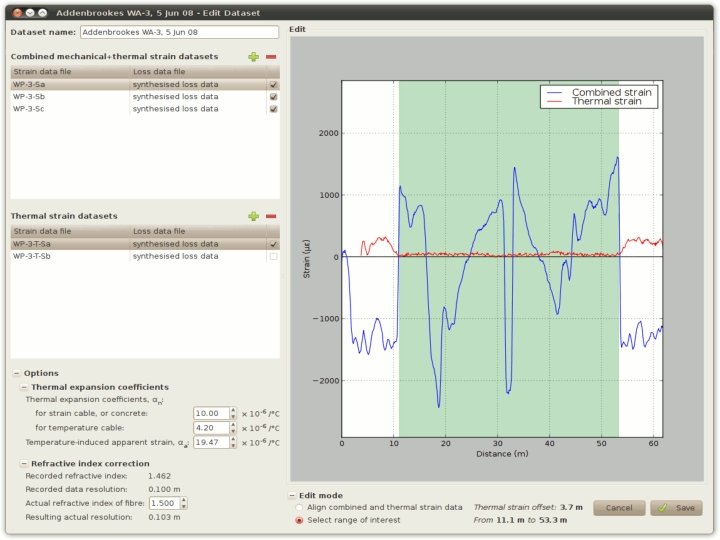
Analysis the Hard Way 1. 2. 3. 4. 5. 6. 7. 8. 9. 10. Parse data Remove bogus data from beyond the end of the fibre Align & average repeat readings (fibre length may change: resplicing) Mark region of interest Correct for analyser miscalibration Align temperature data and perform compensation Filter noise (Savitzky-Golay) Graph individual data sets Resample and align successive days’ data sets Compute and graph changes in strain profile over time • Huge Excel spreadsheet!
Analysis the Easy Way • Software for use by geotechnical researchers and civil engineers • Open source software • Written in Python • Object-oriented, modular, model-view-controller based • Using scientific computing libraries: Num. Py, Sci. Py, Matplotlib • Easy to adapt and extend • Will be available online: http: //strainanalyser. malc. org. uk/
Thank you http: //strainanalyser. malc. org. uk/