
Development of Art in Europe Medieval Renaissance BAROQUE
Development of Art in Europe Medieval Renaissance BAROQUE
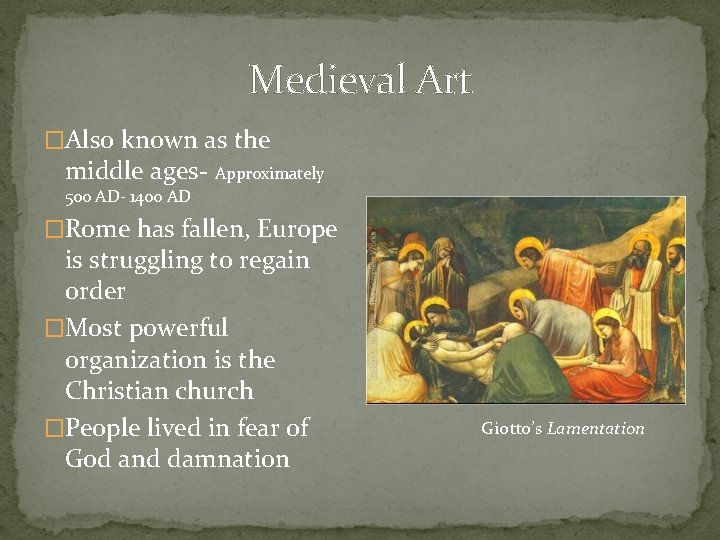
Medieval Art �Also known as the middle ages- Approximately 500 AD- 1400 AD �Rome has fallen, Europe is struggling to regain order �Most powerful organization is the Christian church �People lived in fear of God and damnation Giotto’s Lamentation
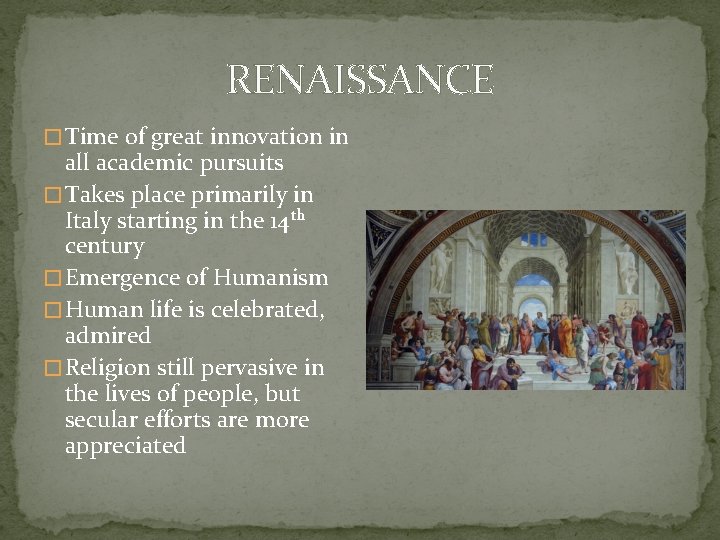
RENAISSANCE � Time of great innovation in all academic pursuits � Takes place primarily in Italy starting in the 14 th century � Emergence of Humanism � Human life is celebrated, admired � Religion still pervasive in the lives of people, but secular efforts are more appreciated
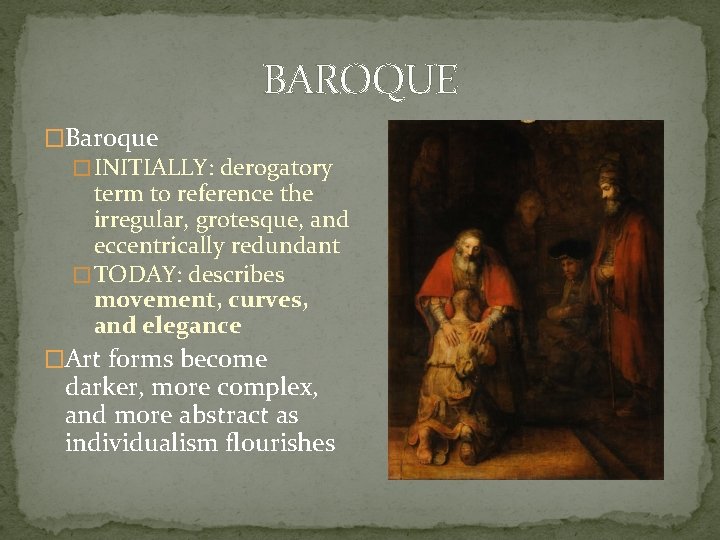
BAROQUE �Baroque � INITIALLY: derogatory term to reference the irregular, grotesque, and eccentrically redundant � TODAY: describes movement, curves, and elegance �Art forms become darker, more complex, and more abstract as individualism flourishes
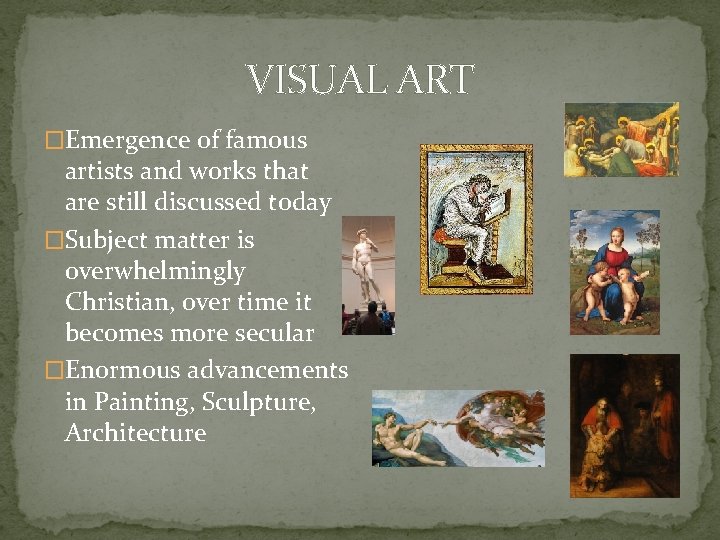
VISUAL ART �Emergence of famous artists and works that are still discussed today �Subject matter is overwhelmingly Christian, over time it becomes more secular �Enormous advancements in Painting, Sculpture, Architecture
MUSIC � Medieval music was very much written to be used in church- Gregorian Chant � Renaissance music started to become more stylized and polyphonic, more useful as entertainment � Baroque composers work with symphonies to develop world wide acclaim, their creations become known as “classical music”(1750 -1825) � Dies Irae � Motet � Palestrina- Missa Brevis � J. S. Bach (German) � Brandenburg Concerto No. 3 � Handel (German) � Messiah � Pachelbel (German) � Canon in D � Vivaldi (Italian) � The Four Seasons
DRAMA � Medieval plays were performed in churches and monasteries and had Christian themes � During the Renaissance, English Queen Elizabeth I promoted the rise of theater in Europe by hiring Shakespeare. � Baroque Drama became entertainment for royaltyoften a very lavish spectacle, religion disappears in favor of humanism � Medieval- Cycle Plays- many separate stages were lined up. Each one performed a different biblical passage. � Renaissance- The Globe theatre and Shakespeare’s own company for theatre performances. � Baroque plays
DANCE � Medieval Dance was only done for the glory of God, Did not emphasize the human body � In the Renaissance, Dance became part of social gatherings. Certain dances were practiced for certain occasions by certain people � Baroque produced the “ballerina” who was a female star, as well as the continuation of dances that only were known and practiced by the rich � Medieval Dance at Conwy Castle � Branles, Lavolta, GALLIARD, PAVANE � Minuet, Contredance
- Slides: 8