
Development of an Upper Extremity Motion Capture System
- Slides: 1
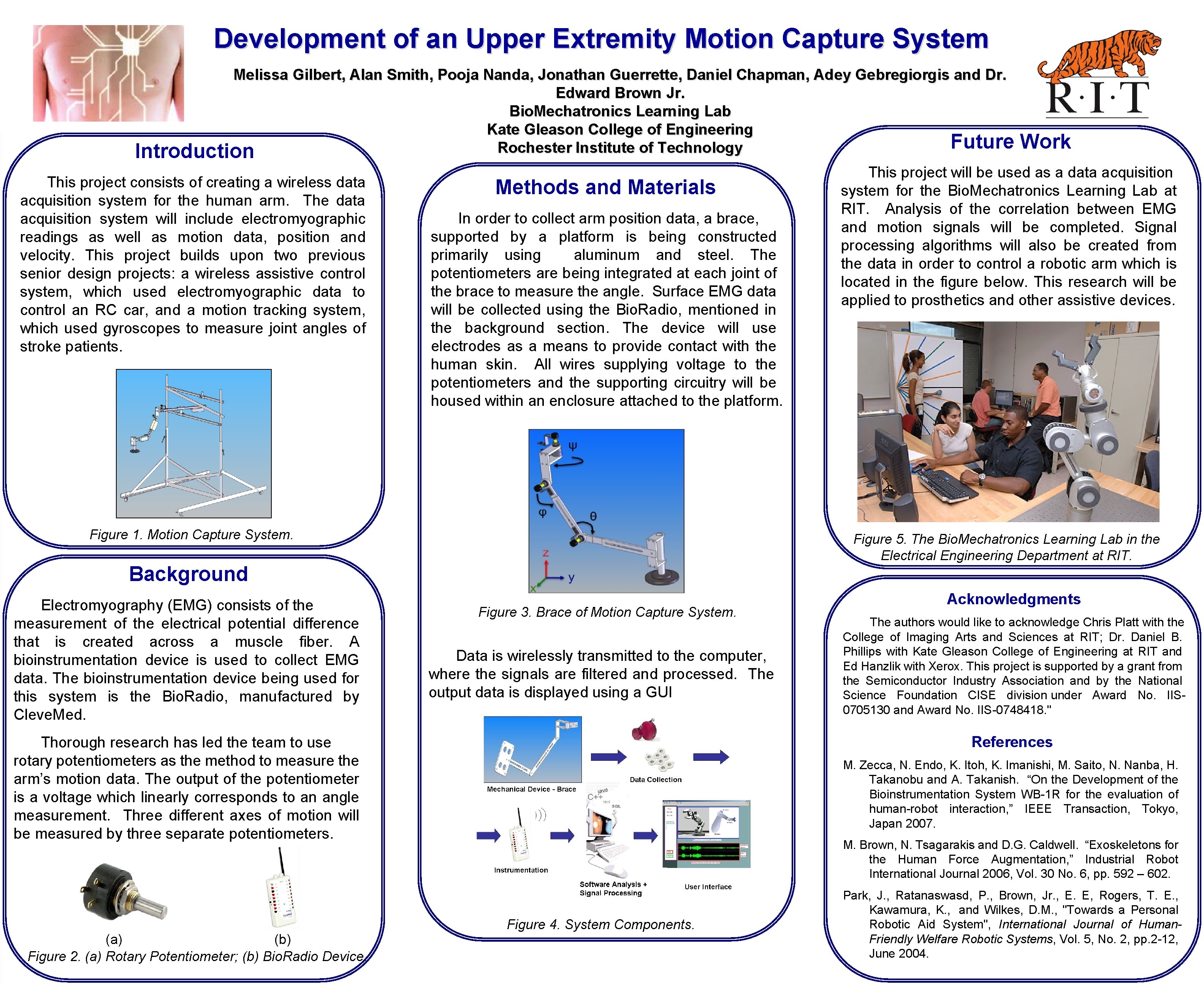
Development of an Upper Extremity Motion Capture System Melissa Gilbert, Alan Smith, Pooja Nanda, Jonathan Guerrette, Daniel Chapman, Adey Gebregiorgis and Dr. Edward Brown Jr. Bio. Mechatronics Learning Lab Kate Gleason College of Engineering Future Rochester Institute of Technology Introduction This project consists of creating a wireless data acquisition system for the human arm. The data acquisition system will include electromyographic readings as well as motion data, position and velocity. This project builds upon two previous senior design projects: a wireless assistive control system, which used electromyographic data to control an RC car, and a motion tracking system, which used gyroscopes to measure joint angles of stroke patients. Methods and Materials In order to collect arm position data, a brace, supported by a platform is being constructed primarily using aluminum and steel. The potentiometers are being integrated at each joint of the brace to measure the angle. Surface EMG data will be collected using the Bio. Radio, mentioned in the background section. The device will use electrodes as a means to provide contact with the human skin. All wires supplying voltage to the potentiometers and the supporting circuitry will be housed within an enclosure attached to the platform. Figure 1. Motion Capture System. Figure 3. Brace of Motion Capture System. Data is wirelessly transmitted to the computer, where the signals are filtered and processed. The output data is displayed using a GUI Acknowledgments The authors would like to acknowledge Chris Platt with the College of Imaging Arts and Sciences at RIT; Dr. Daniel B. Phillips with Kate Gleason College of Engineering at RIT and Ed Hanzlik with Xerox. This project is supported by a grant from the Semiconductor Industry Association and by the National Science Foundation CISE division under Award No. IIS 0705130 and Award No. IIS-0748418. " References Thorough research has led the team to use rotary potentiometers as the method to measure the arm’s motion data. The output of the potentiometer is a voltage which linearly corresponds to an angle measurement. Three different axes of motion will be measured by three separate potentiometers. (a) (b) Figure 2. (a) Rotary Potentiometer; (b) Bio. Radio Device. This project will be used as a data acquisition system for the Bio. Mechatronics Learning Lab at RIT. Analysis of the correlation between EMG and motion signals will be completed. Signal processing algorithms will also be created from the data in order to control a robotic arm which is located in the figure below. This research will be applied to prosthetics and other assistive devices. Figure 5. The Bio. Mechatronics Learning Lab in the Electrical Engineering Department at RIT. Background Electromyography (EMG) consists of the measurement of the electrical potential difference that is created across a muscle fiber. A bioinstrumentation device is used to collect EMG data. The bioinstrumentation device being used for this system is the Bio. Radio, manufactured by Cleve. Med. Work M. Zecca, N. Endo, K. Itoh, K. Imanishi, M. Saito, N. Nanba, H. Takanobu and A. Takanish. “On the Development of the Bioinstrumentation System WB-1 R for the evaluation of human-robot interaction, ” IEEE Transaction, Tokyo, Japan 2007. M. Brown, N. Tsagarakis and D. G. Caldwell. “Exoskeletons for the Human Force Augmentation, ” Industrial Robot International Journal 2006, Vol. 30 No. 6, pp. 592 – 602. Figure 4. System Components. Park, J. , Ratanaswasd, P. , Brown, Jr. , E. E, Rogers, T. E. , Kawamura, K. , and Wilkes, D. M. , "Towards a Personal Robotic Aid System", International Journal of Human. Friendly Welfare Robotic Systems, Vol. 5, No. 2, pp. 2 -12, June 2004.