
Development of an Improved Ignition Train for the
- Slides: 18
Development of an Improved Ignition Train for the 120 mm Tank Ammunition Primer Peter L. Langsjoen ATK Ordnance and Ground Systems Plymouth, MN For presentation at the NDIA 39 th Annual Gun & Ammunition / Missiles & Rockets Conference & Exhibition April 13 -16, 2004, Baltimore, MD
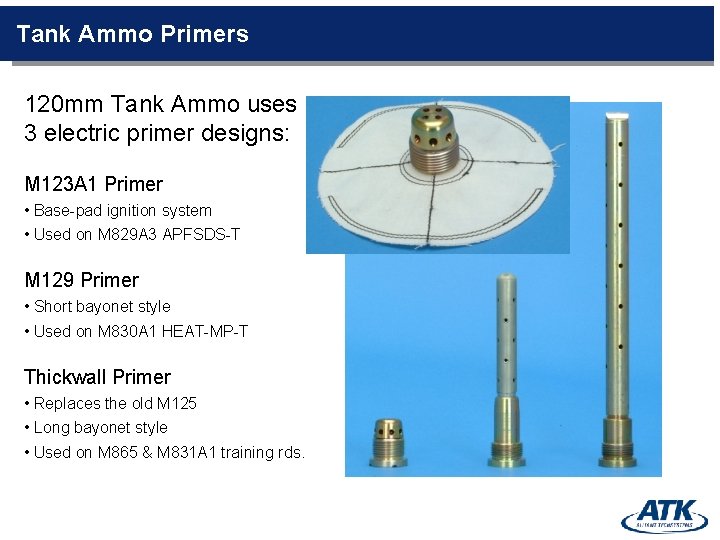
Tank Ammo Primers 120 mm Tank Ammo uses 3 electric primer designs: M 123 A 1 Primer • Base-pad ignition system • Used on M 829 A 3 APFSDS-T M 129 Primer • Short bayonet style • Used on M 830 A 1 HEAT-MP-T Thickwall Primer • Replaces the old M 125 • Long bayonet style • Used on M 865 & M 831 A 1 training rds.
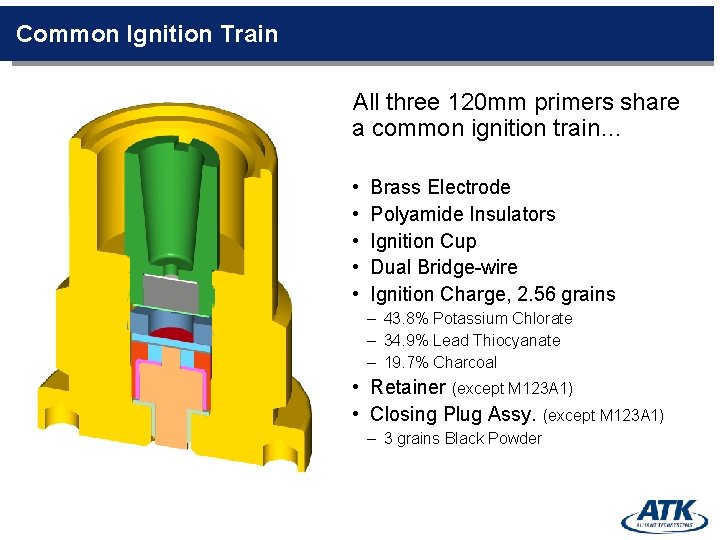
Common Ignition Train All three 120 mm primers share a common ignition train… • • • Brass Electrode Polyamide Insulators Ignition Cup Dual Bridge-wire Ignition Charge, 2. 56 grains – 43. 8% Potassium Chlorate – 34. 9% Lead Thiocyanate – 19. 7% Charcoal • Retainer (except M 123 A 1) • Closing Plug Assy. (except M 123 A 1) – 3 grains Black Powder
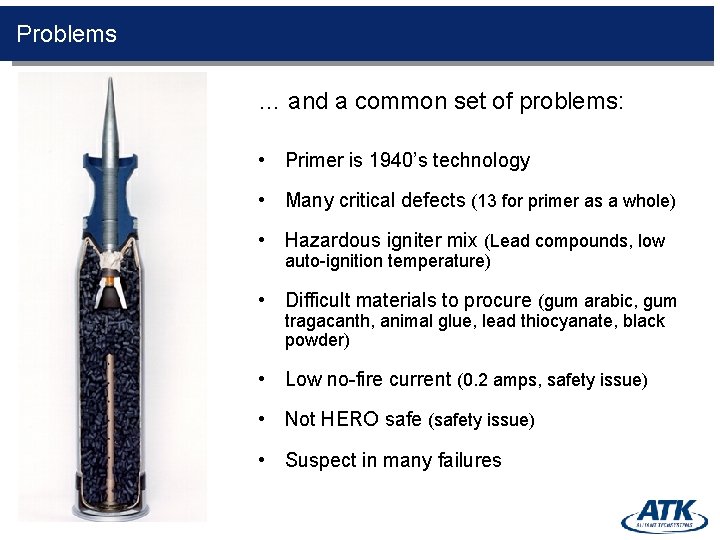
Problems … and a common set of problems: • Primer is 1940’s technology • Many critical defects (13 for primer as a whole) • Hazardous igniter mix (Lead compounds, low auto-ignition temperature) • Difficult materials to procure (gum arabic, gum tragacanth, animal glue, lead thiocyanate, black powder) • Low no-fire current (0. 2 amps, safety issue) • Not HERO safe (safety issue) • Suspect in many failures
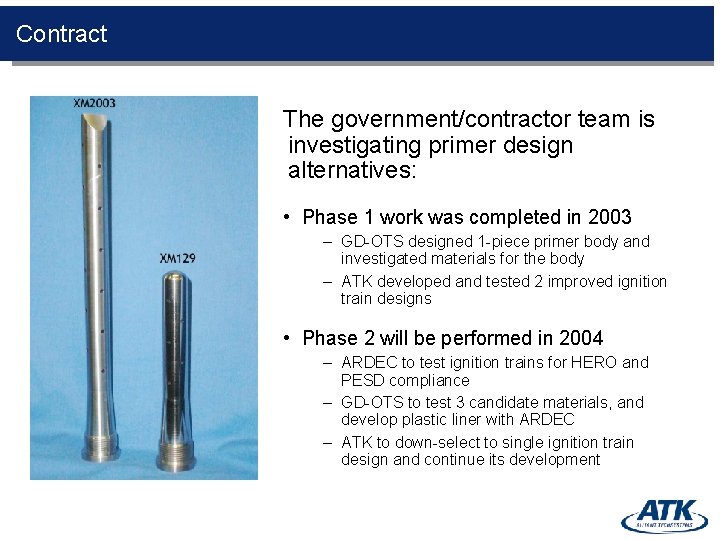
Contract The government/contractor team is investigating primer design alternatives: • Phase 1 work was completed in 2003 – GD-OTS designed 1 -piece primer body and investigated materials for the body – ATK developed and tested 2 improved ignition train designs • Phase 2 will be performed in 2004 – ARDEC to test ignition trains for HERO and PESD compliance – GD-OTS to test 3 candidate materials, and develop plastic liner with ARDEC – ATK to down-select to single ignition train design and continue its development
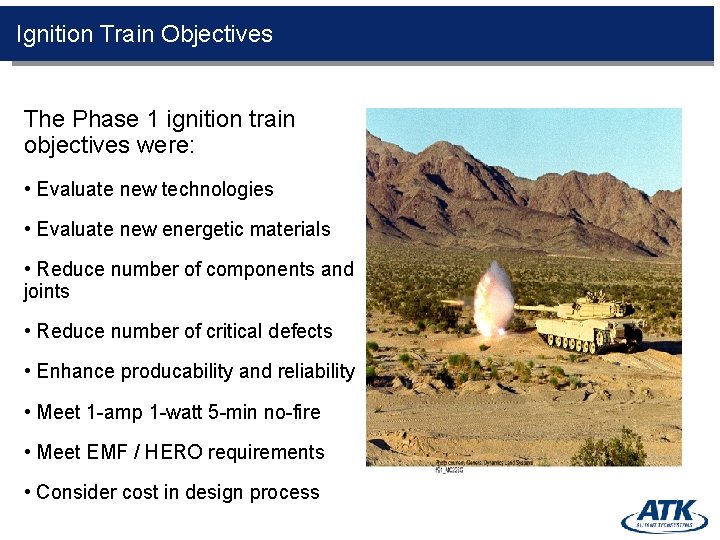
Ignition Train Objectives The Phase 1 ignition train objectives were: • Evaluate new technologies • Evaluate new energetic materials • Reduce number of components and joints • Reduce number of critical defects • Enhance producability and reliability • Meet 1 -amp 1 -watt 5 -min no-fire • Meet EMF / HERO requirements • Consider cost in design process
Teaming Kilgore Flares Co. (KFC) • Updated hot bridgewire design • Current primer supplier to ATK Ensign-Bickford Aerospace & Defense (EBA&D) • Semiconductor bridge (SCB) design ATK • Direction and coordination
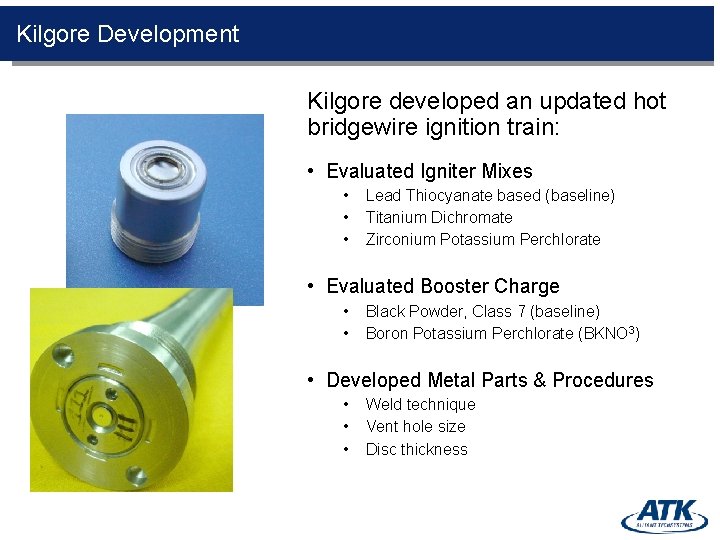
Kilgore Development Kilgore developed an updated hot bridgewire ignition train: • Evaluated Igniter Mixes • • • Lead Thiocyanate based (baseline) Titanium Dichromate Zirconium Potassium Perchlorate • Evaluated Booster Charge • • Black Powder, Class 7 (baseline) Boron Potassium Perchlorate (BKNO 3) • Developed Metal Parts & Procedures • • • Weld technique Vent hole size Disc thickness
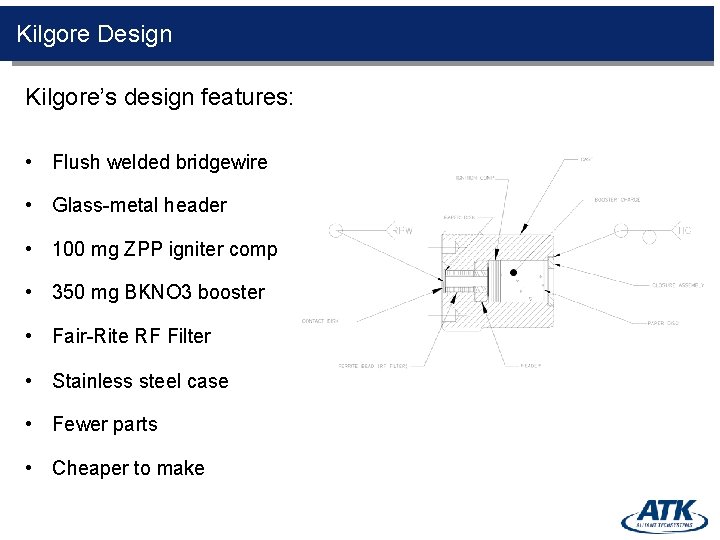
Kilgore Design Kilgore’s design features: • Flush welded bridgewire • Glass-metal header • 100 mg ZPP igniter comp • 350 mg BKNO 3 booster • Fair-Rite RF Filter • Stainless steel case • Fewer parts • Cheaper to make
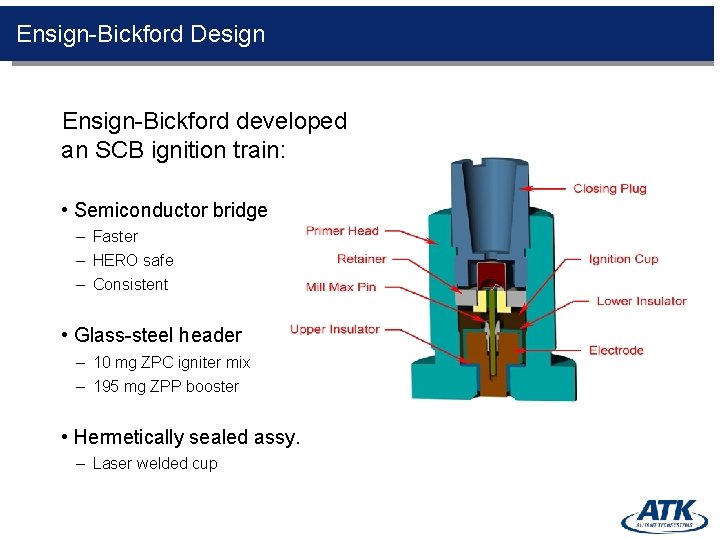
Ensign-Bickford Design Ensign-Bickford developed an SCB ignition train: • Semiconductor bridge – Faster – HERO safe – Consistent • Glass-steel header – 10 mg ZPC igniter mix – 195 mg ZPP booster • Hermetically sealed assy. – Laser welded cup
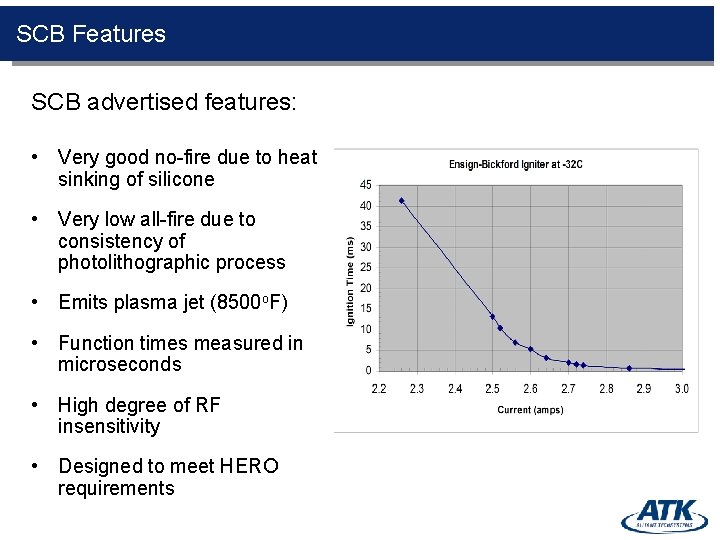
SCB Features SCB advertised features: • Very good no-fire due to heat sinking of silicone • Very low all-fire due to consistency of photolithographic process • Emits plasma jet (8500 o. F) • Function times measured in microseconds • High degree of RF insensitivity • Designed to meet HERO requirements
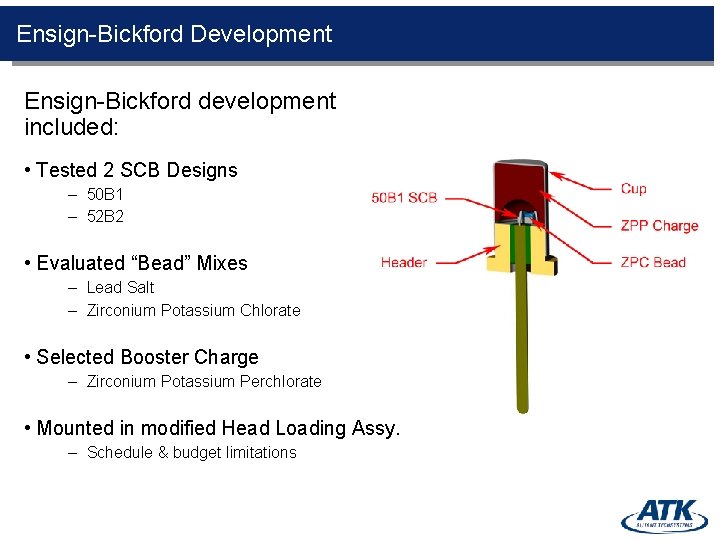
Ensign-Bickford Development Ensign-Bickford development included: • Tested 2 SCB Designs – 50 B 1 – 52 B 2 • Evaluated “Bead” Mixes – Lead Salt – Zirconium Potassium Chlorate • Selected Booster Charge – Zirconium Potassium Perchlorate • Mounted in modified Head Loading Assy. – Schedule & budget limitations
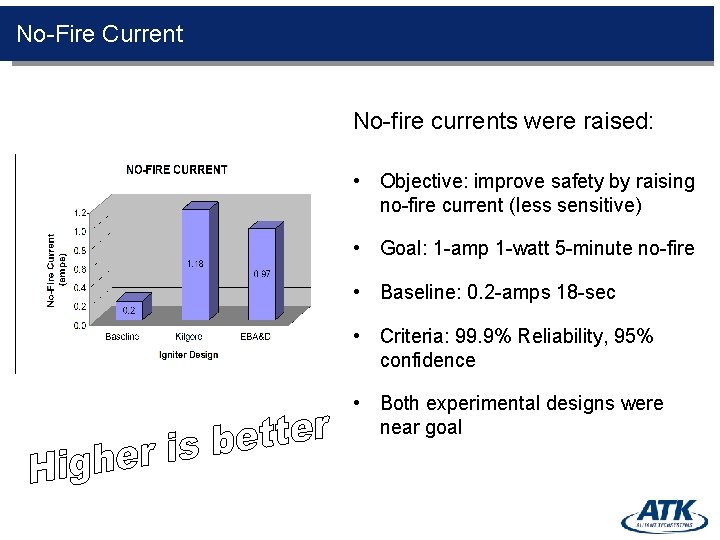
No-Fire Current No-fire currents were raised: • Objective: improve safety by raising no-fire current (less sensitive) • Goal: 1 -amp 1 -watt 5 -minute no-fire • Baseline: 0. 2 -amps 18 -sec • Criteria: 99. 9% Reliability, 95% confidence • Both experimental designs were near goal
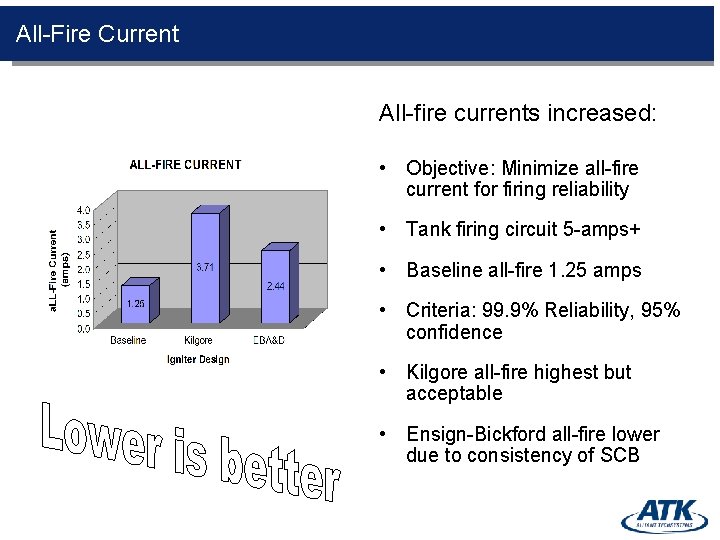
All-Fire Current All-fire currents increased: • Objective: Minimize all-fire current for firing reliability • Tank firing circuit 5 -amps+ • Baseline all-fire 1. 25 amps • Criteria: 99. 9% Reliability, 95% confidence • Kilgore all-fire highest but acceptable • Ensign-Bickford all-fire lower due to consistency of SCB
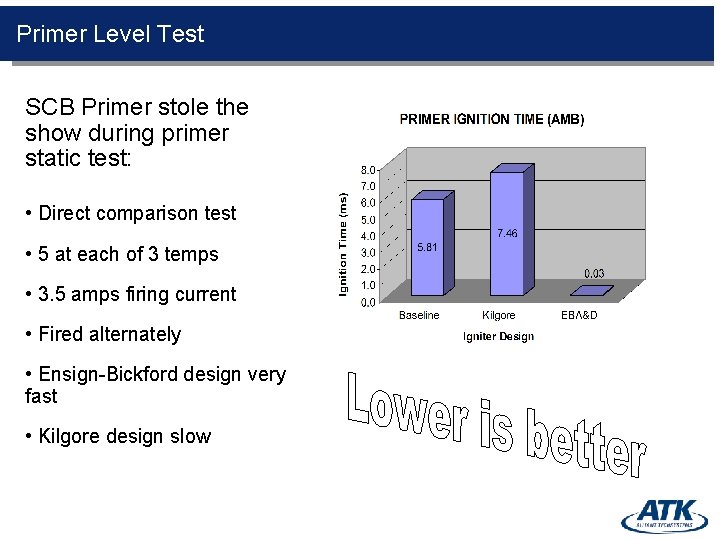
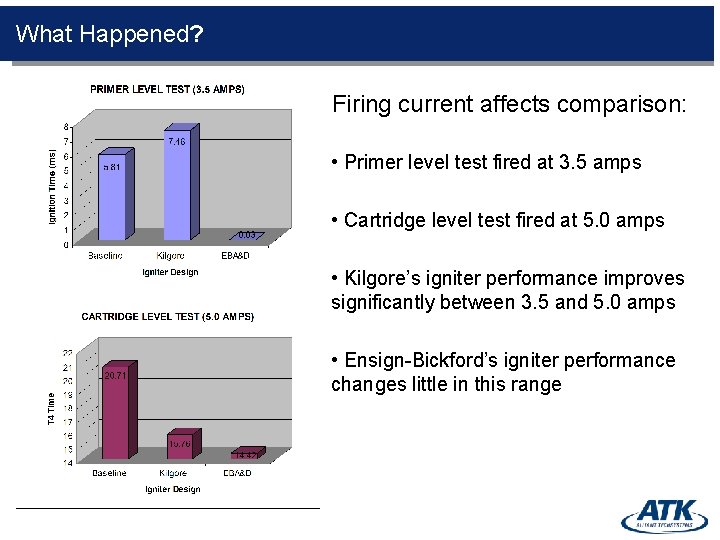
Primer Level Test SCB Primer stole the show during primer static test: • Direct comparison test • 5 at each of 3 temps • 3. 5 amps firing current • Fired alternately • Ensign-Bickford design very fast • Kilgore design slow
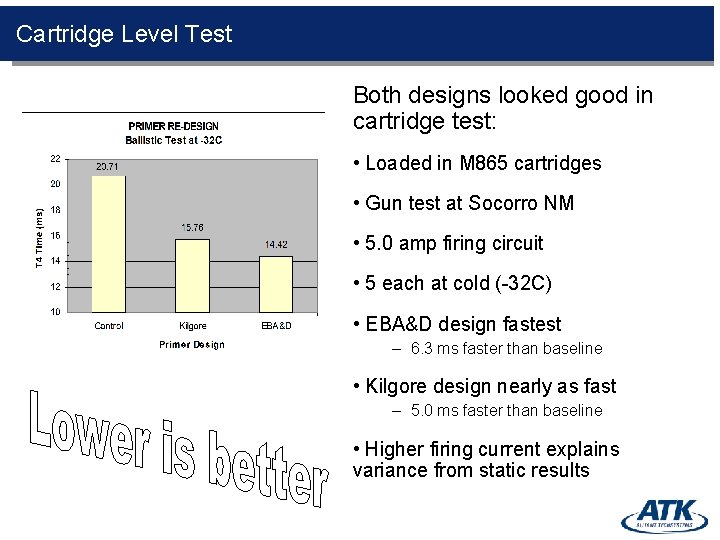
Cartridge Level Test Both designs looked good in cartridge test: • Loaded in M 865 cartridges • Gun test at Socorro NM • 5. 0 amp firing circuit • 5 each at cold (-32 C) • EBA&D design fastest – 6. 3 ms faster than baseline • Kilgore design nearly as fast – 5. 0 ms faster than baseline • Higher firing current explains variance from static results
What Happened? Firing current affects comparison: • Primer level test fired at 3. 5 amps • Cartridge level test fired at 5. 0 amps • Kilgore’s igniter performance improves significantly between 3. 5 and 5. 0 amps • Ensign-Bickford’s igniter performance changes little in this range
Conclusions • Two improved primer ignition train designs have been demonstrated – Welded bridgewire – SCB • Both designs are viable candidates – Both meet the objectives – Both improve cartridge T 4 time • Additional tests planned before downselect – HERO – PESD • Final design will be further developed and tested in Phase 2 – Phase 2 to begin in 2004