
Development of an H plasma generator for SPL

- Slides: 24
Development of an H- plasma generator for SPL Matthias Kronberger, CERN BE/ABP-HSL SPL collaboration meeting,
Formation of H- ions SPL is foreseen to operate with an ion source producing up to 80 m. A of H-. However, high brightness H- beams are difficult to achieve and require a sophisticated ion source ! Possibilities for H- formation: Ø Volume production: dissociation of a vibrationally excited H 2 molecule by a slow e-: 2: dissociative attachment H 2(υ"=0) + e- (fast) H 2(υ"≥ 5) + e- + hν H 2(υ"≥ 5) + e- (slow) H + H- Ø Surface production: H- formation by wall collisions of H and H+: 1: H 2(υ") generation H + e-(wall) HH+ + 2 e-(wall) H- requires surface with low work function (typically Cs-on-metal) M. Kronberger, SPL collaboration meeting, 2010/11/25, CERN fast e- cannot migrate into the extraction region H- destruction rate: ↓ IH-: ↑
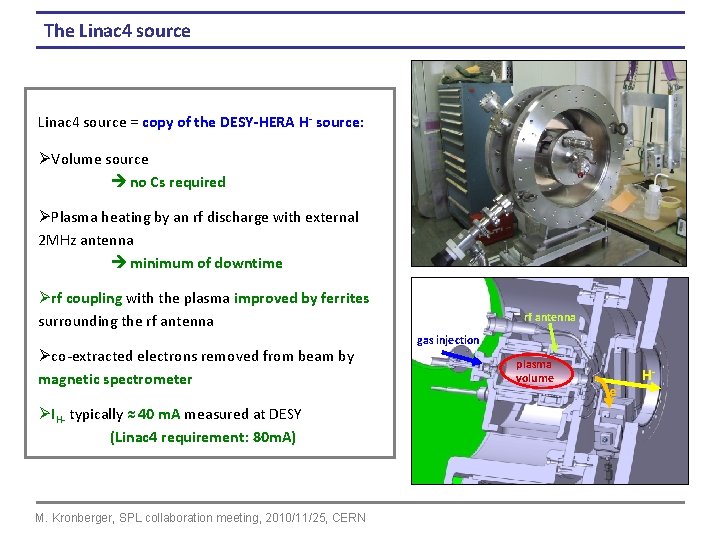
The Linac 4 source = copy of the DESY-HERA H- source: ØVolume source no Cs required ØPlasma heating by an rf discharge with external 2 MHz antenna minimum of downtime Ørf coupling with the plasma improved by ferrites surrounding the rf antenna Øco-extracted electrons removed from beam by magnetic spectrometer ØIH- typically ≈ 40 m. A measured at DESY (Linac 4 requirement: 80 m. A) M. Kronberger, SPL collaboration meeting, 2010/11/25, CERN rf antenna gas injection plasma volume e- H-
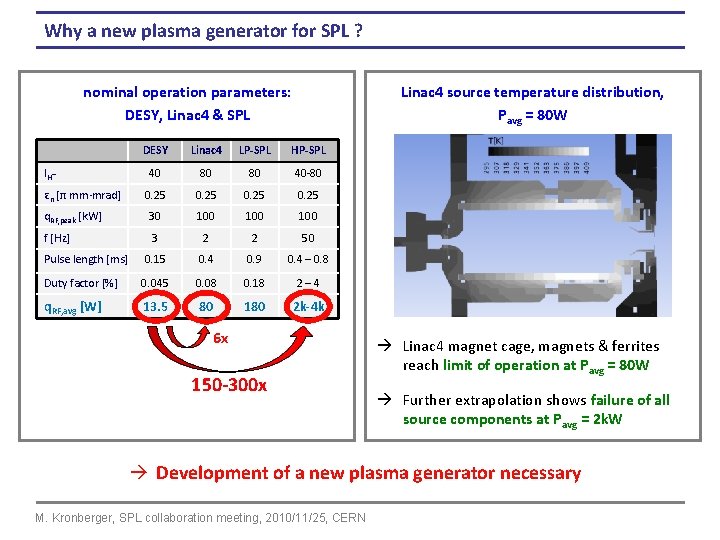
Why a new plasma generator for SPL ? nominal operation parameters: DESY, Linac 4 & SPL Linac 4 source temperature distribution, Pavg = 80 W DESY Linac 4 LP-SPL HP-SPL 40 80 80 40 -80 0. 25 q. RF, peak [k. W] 30 100 100 f [Hz] 3 2 2 50 Pulse length [ms] 0. 15 0. 4 0. 9 0. 4 – 0. 8 Duty factor [%] 0. 045 0. 08 0. 18 2– 4 q. RF, avg [W] 13. 5 80 180 2 k-4 k IH_ εn [π mm·mrad] 6 x 150 -300 x Linac 4 magnet cage, magnets & ferrites reach limit of operation at Pavg = 80 W Further extrapolation shows failure of all source components at Pavg = 2 k. W Development of a new plasma generator necessary M. Kronberger, SPL collaboration meeting, 2010/11/25, CERN
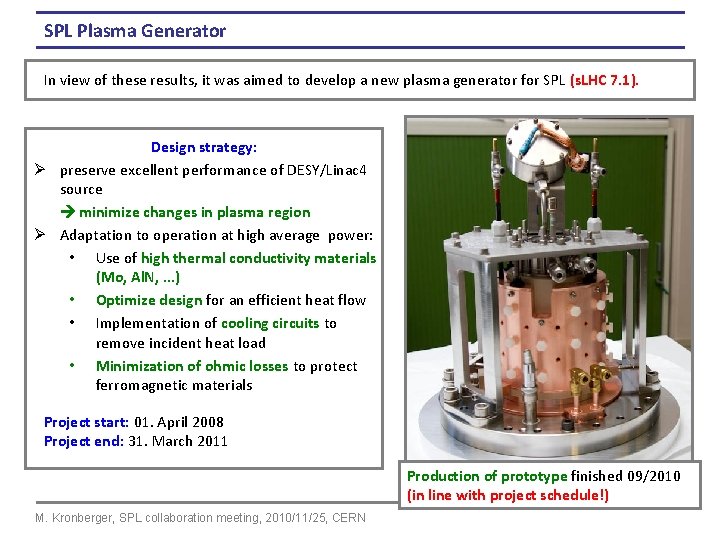
SPL Plasma Generator In view of these results, it was aimed to develop a new plasma generator for SPL (s. LHC 7. 1). Design strategy: Ø preserve excellent performance of DESY/Linac 4 source minimize changes in plasma region Ø Adaptation to operation at high average power: • Use of high thermal conductivity materials (Mo, Al. N, . . . ) • Optimize design for an efficient heat flow • Implementation of cooling circuits to remove incident heat load • Minimization of ohmic losses to protect ferromagnetic materials Project start: 01. April 2008 Project end: 31. March 2011 Production of prototype finished 09/2010 (in line with project schedule!) M. Kronberger, SPL collaboration meeting, 2010/11/25, CERN
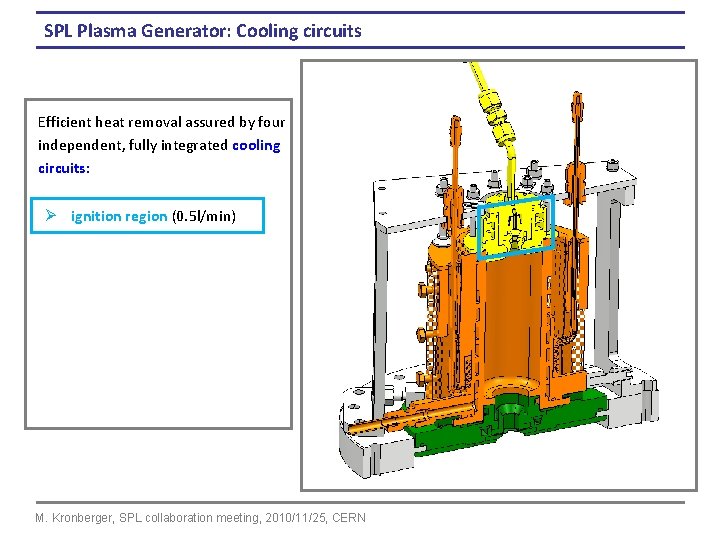
SPL Plasma Generator: Cooling circuits Efficient heat removal assured by four independent, fully integrated cooling circuits: Ø ignition region (0. 5 l/min) M. Kronberger, SPL collaboration meeting, 2010/11/25, CERN
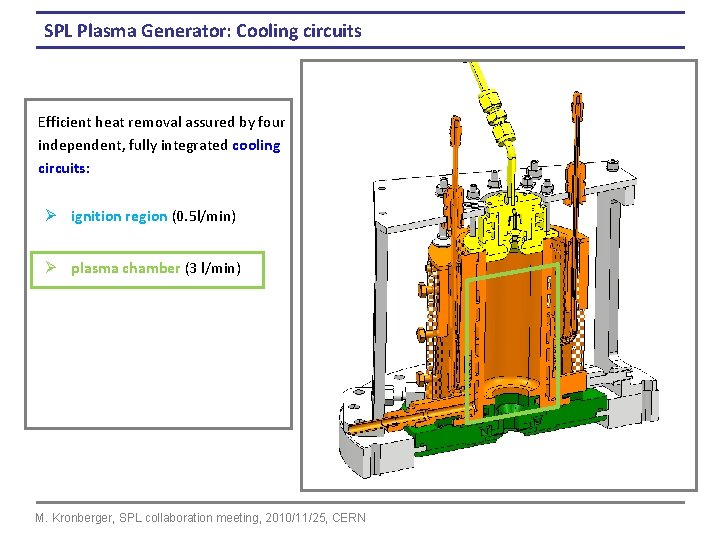
SPL Plasma Generator: Cooling circuits Efficient heat removal assured by four independent, fully integrated cooling circuits: Ø ignition region (0. 5 l/min) Ø plasma chamber (3 l/min) M. Kronberger, SPL collaboration meeting, 2010/11/25, CERN
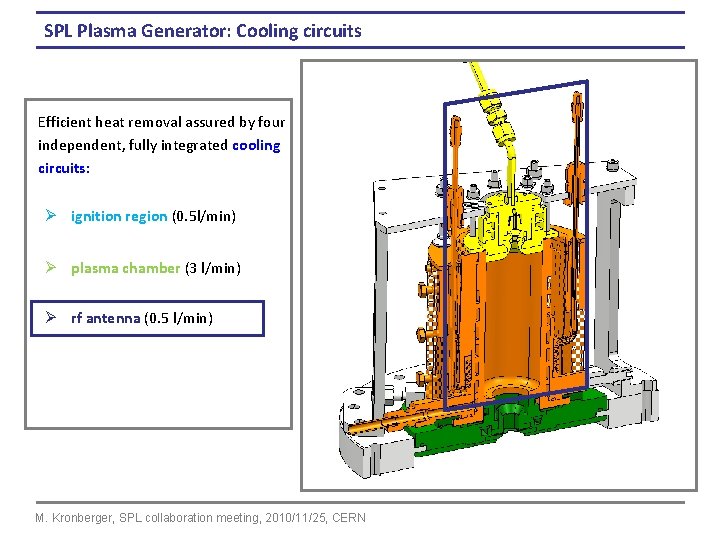
SPL Plasma Generator: Cooling circuits Efficient heat removal assured by four independent, fully integrated cooling circuits: Ø ignition region (0. 5 l/min) Ø plasma chamber (3 l/min) Ø rf antenna (0. 5 l/min) M. Kronberger, SPL collaboration meeting, 2010/11/25, CERN
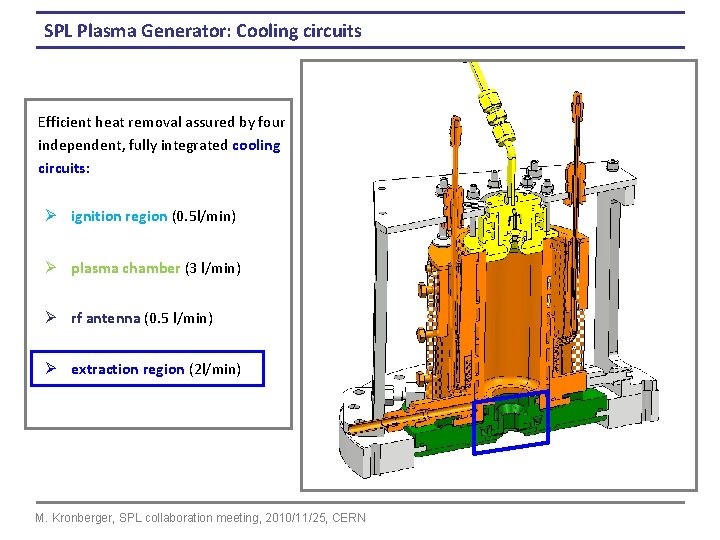
SPL Plasma Generator: Cooling circuits Efficient heat removal assured by four independent, fully integrated cooling circuits: Ø ignition region (0. 5 l/min) Ø plasma chamber (3 l/min) Ø rf antenna (0. 5 l/min) Ø extraction region (2 l/min) M. Kronberger, SPL collaboration meeting, 2010/11/25, CERN
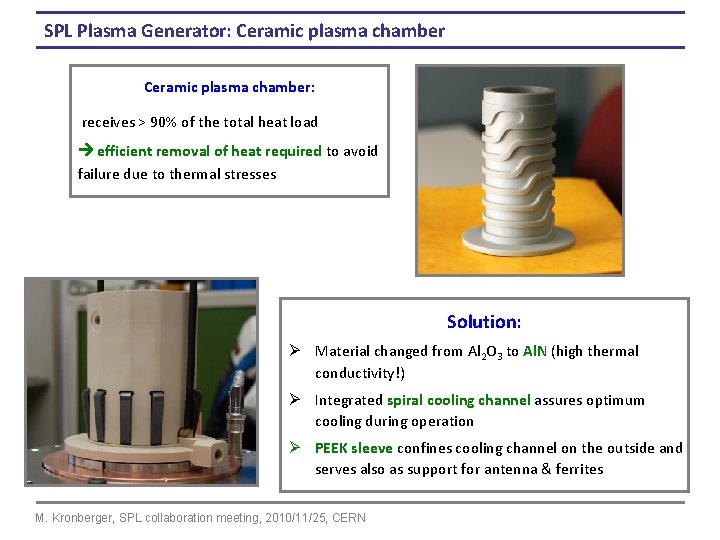
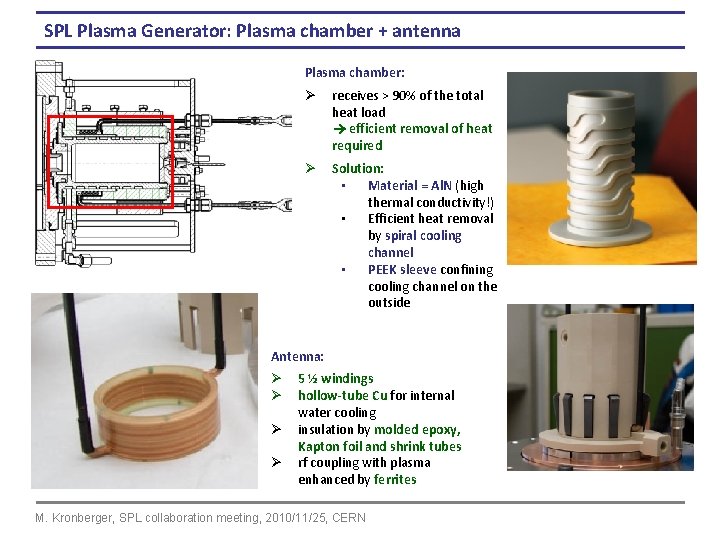
SPL Plasma Generator: Ceramic plasma chamber: receives > 90% of the total heat load efficient removal of heat required to avoid failure due to thermal stresses Solution: Ø Material changed from Al 2 O 3 to Al. N (high thermal conductivity!) Ø Integrated spiral cooling channel assures optimum cooling during operation Ø PEEK sleeve confines cooling channel on the outside and serves also as support for antenna & ferrites M. Kronberger, SPL collaboration meeting, 2010/11/25, CERN
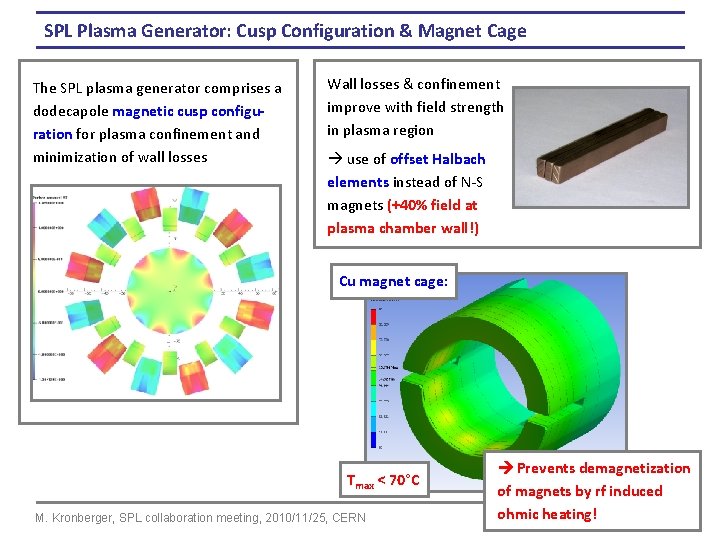
SPL Plasma Generator: Cusp Configuration & Magnet Cage The SPL plasma generator comprises a dodecapole magnetic cusp configuration for plasma confinement and minimization of wall losses Wall losses & confinement improve with field strength in plasma region use of offset Halbach elements instead of N-S magnets (+40% field at plasma chamber wall!) Cu magnet cage: Tmax < 70°C M. Kronberger, SPL collaboration meeting, 2010/11/25, CERN Prevents demagnetization of magnets by rf induced ohmic heating!
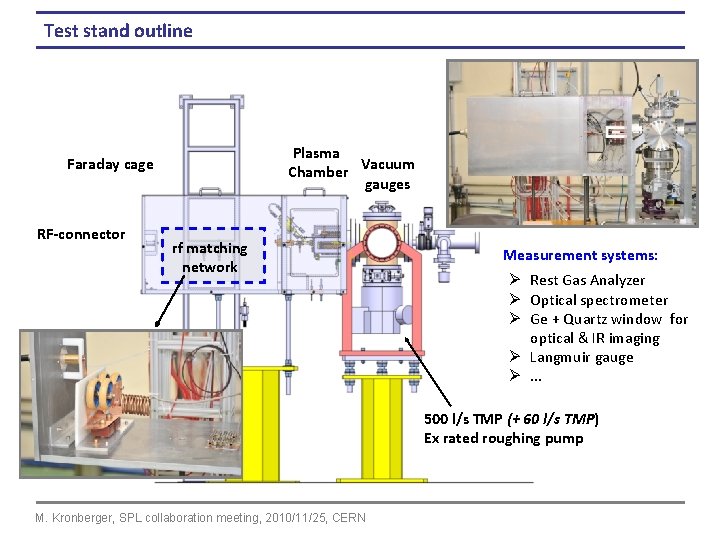
Test stand outline Plasma Chamber Vacuum gauges Faraday cage RF-connector rf matching network Measurement systems: Ø Rest Gas Analyzer Ø Optical spectrometer Ø Ge + Quartz window for optical & IR imaging Ø Langmuir gauge Ø. . . 500 l/s TMP (+ 60 l/s TMP) Ex rated roughing pump M. Kronberger, SPL collaboration meeting, 2010/11/25, CERN
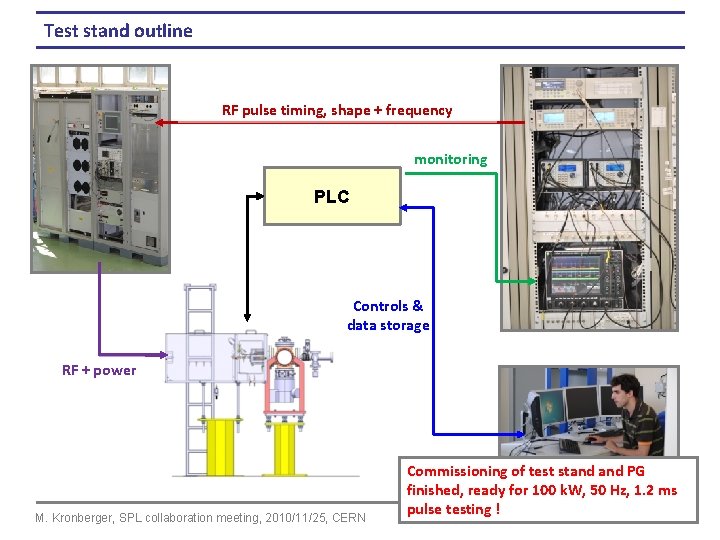
Test stand outline RF pulse timing, shape + frequency monitoring PLC Controls & data storage RF + power M. Kronberger, SPL collaboration meeting, 2010/11/25, CERN Commissioning of test stand PG finished, ready for 100 k. W, 50 Hz, 1. 2 ms pulse testing !
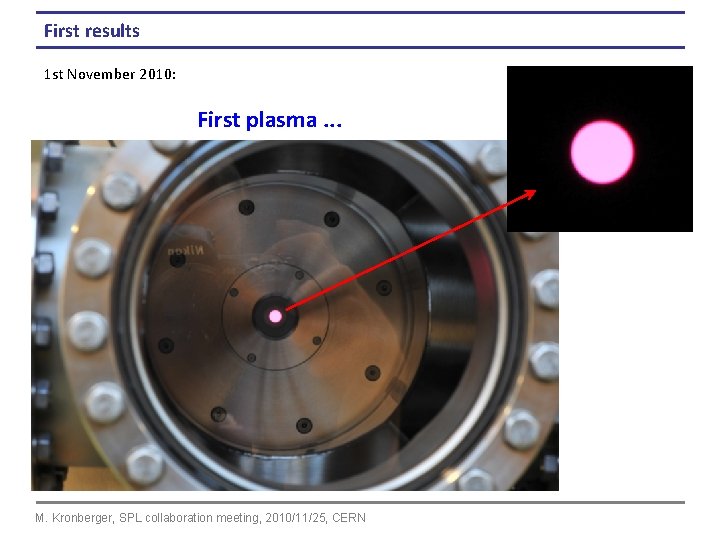
First results 1 st November 2010: First plasma. . . M. Kronberger, SPL collaboration meeting, 2010/11/25, CERN
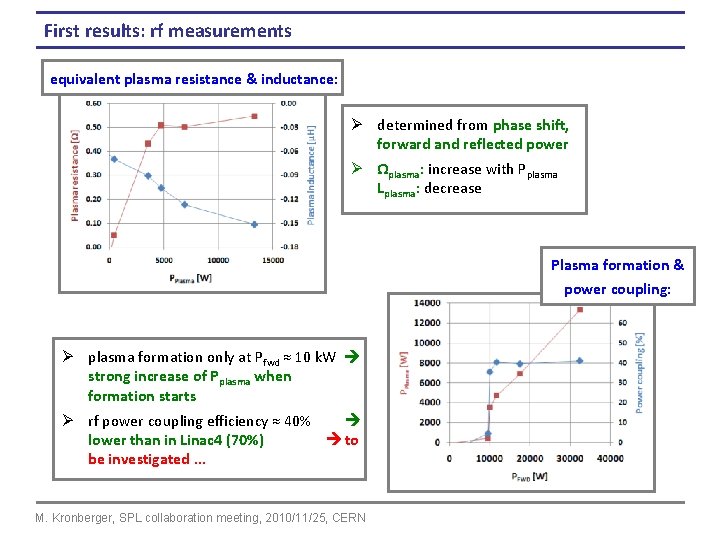
First results: rf measurements equivalent plasma resistance & inductance: Ø determined from phase shift, forward and reflected power Ø Ωplasma: increase with Pplasma Lplasma: decrease Plasma formation & power coupling: Ø plasma formation only at Pfwd ≈ 10 k. W strong increase of Pplasma when formation starts Ø rf power coupling efficiency ≈ 40% lower than in Linac 4 (70%) to be investigated. . . M. Kronberger, SPL collaboration meeting, 2010/11/25, CERN
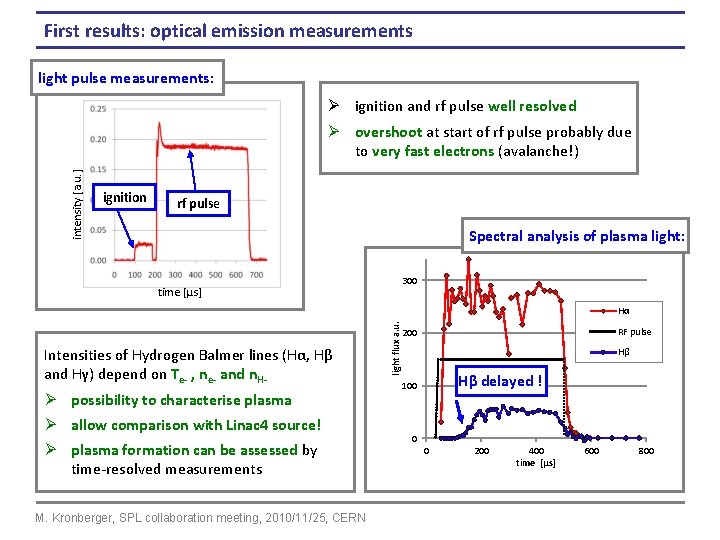
First results: optical emission measurements light pulse measurements: Ø ignition and rf pulse well resolved intensity [a. u. ] Ø overshoot at start of rf pulse probably due to very fast electrons (avalanche!) ignition rf pulse Spectral analysis of plasma light: 300 time [μs] Intensities of Hydrogen Balmer lines (Hα, Hβ and Hγ) depend on Te- , ne- and n. H- Ø possibility to characterise plasma Ø allow comparison with Linac 4 source! Ø plasma formation can be assessed by time-resolved measurements M. Kronberger, SPL collaboration meeting, 2010/11/25, CERN light flux a. u. Hα RF pulse 200 Hβ Hβ delayed ! 100 0 0 200 400 time [μs] 600 800
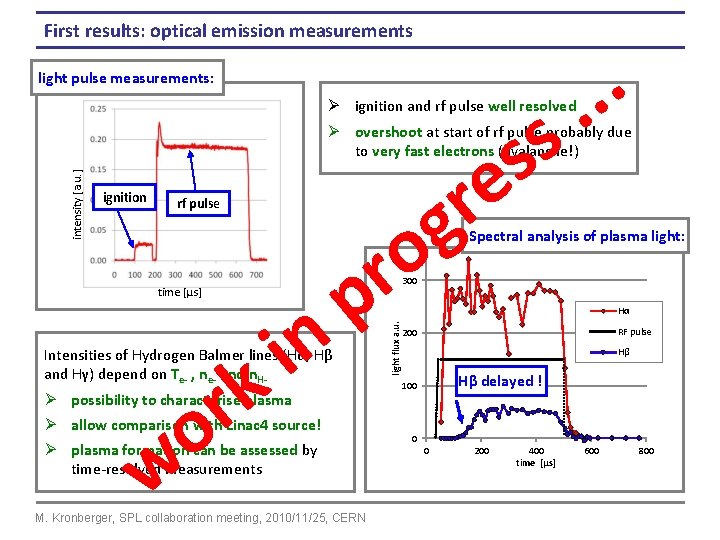
First results: optical emission measurements light pulse measurements: s s Ø ignition and rf pulse well resolved . . . ignition g o rf pulse time [μs] k r o r p in Intensities of Hydrogen Balmer lines (Hα, Hβ and Hγ) depend on Te- , ne- and n. H- Ø possibility to characterise plasma Ø allow comparison with Linac 4 source! w e r Spectral analysis of plasma light: 300 Ø plasma formation can be assessed by time-resolved measurements M. Kronberger, SPL collaboration meeting, 2010/11/25, CERN light flux a. u. intensity [a. u. ] Ø overshoot at start of rf pulse probably due to very fast electrons (avalanche!) Hα RF pulse 200 Hβ Hβ delayed ! 100 0 0 200 400 time [μs] 600 800
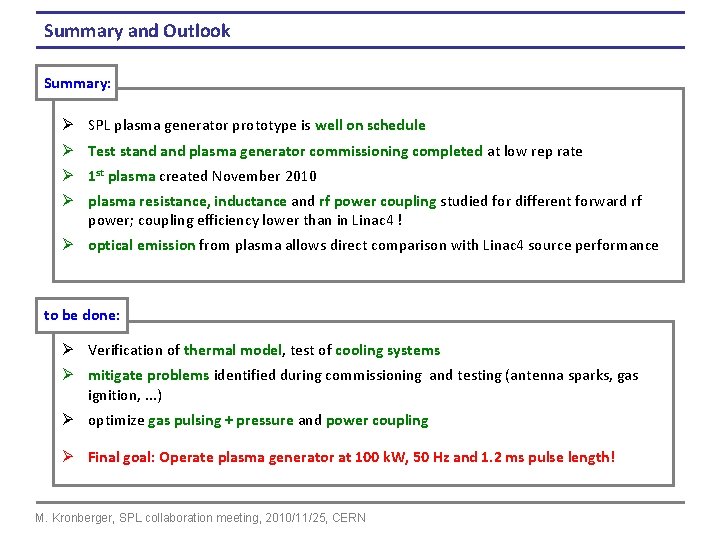
Summary and Outlook Summary: Ø SPL plasma generator prototype is well on schedule Ø Test stand plasma generator commissioning completed at low rep rate Ø 1 st plasma created November 2010 Ø plasma resistance, inductance and rf power coupling studied for different forward rf power; coupling efficiency lower than in Linac 4 ! Ø optical emission from plasma allows direct comparison with Linac 4 source performance to be done: Ø Verification of thermal model, test of cooling systems Ø mitigate problems identified during commissioning and testing (antenna sparks, gas ignition, . . . ) Ø optimize gas pulsing + pressure and power coupling Ø Final goal: Operate plasma generator at 100 k. W, 50 Hz and 1. 2 ms pulse length! M. Kronberger, SPL collaboration meeting, 2010/11/25, CERN
Thank you for your attention ! M. Kronberger, SPL collaboration meeting, 2010/11/25, CERN
Backup slides M. Kronberger, SPL collaboration meeting, 2010/11/25, CERN
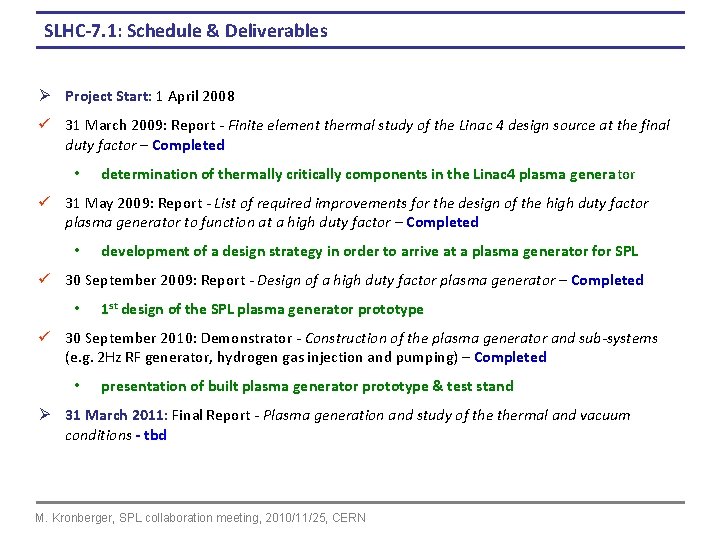
SLHC-7. 1: Schedule & Deliverables Ø Project Start: 1 April 2008 ü 31 March 2009: Report - Finite element thermal study of the Linac 4 design source at the final duty factor – Completed • determination of thermally critically components in the Linac 4 plasma generator ü 31 May 2009: Report - List of required improvements for the design of the high duty factor plasma generator to function at a high duty factor – Completed • development of a design strategy in order to arrive at a plasma generator for SPL ü 30 September 2009: Report - Design of a high duty factor plasma generator – Completed • 1 st design of the SPL plasma generator prototype ü 30 September 2010: Demonstrator - Construction of the plasma generator and sub-systems (e. g. 2 Hz RF generator, hydrogen gas injection and pumping) – Completed • presentation of built plasma generator prototype & test stand Ø 31 March 2011: Final Report - Plasma generation and study of thermal and vacuum conditions - tbd M. Kronberger, SPL collaboration meeting, 2010/11/25, CERN
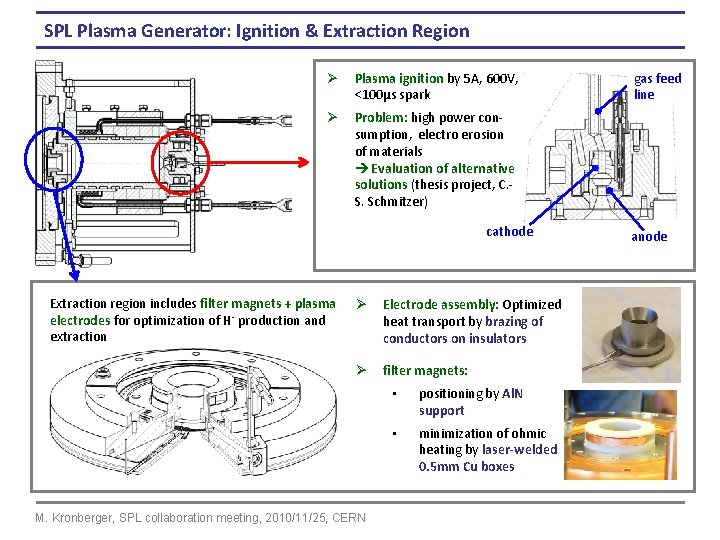
SPL Plasma Generator: Ignition & Extraction Region Ø Plasma ignition by 5 A, 600 V, <100μs spark Ø Problem: high power consumption, electro erosion of materials Evaluation of alternative solutions (thesis project, C. S. Schmitzer) cathode Extraction region includes filter magnets + plasma electrodes for optimization of H- production and extraction Ø Electrode assembly: Optimized heat transport by brazing of conductors on insulators Ø filter magnets: M. Kronberger, SPL collaboration meeting, 2010/11/25, CERN • positioning by Al. N support • minimization of ohmic heating by laser-welded 0. 5 mm Cu boxes gas feed line anode
SPL Plasma Generator: Plasma chamber + antenna Plasma chamber: Ø receives > 90% of the total heat load efficient removal of heat required Ø Solution: • Material = Al. N (high thermal conductivity!) • Efficient heat removal by spiral cooling channel • PEEK sleeve confining cooling channel on the outside Antenna: Ø Ø 5 ½ windings hollow-tube Cu for internal water cooling insulation by molded epoxy, Kapton foil and shrink tubes rf coupling with plasma enhanced by ferrites M. Kronberger, SPL collaboration meeting, 2010/11/25, CERN
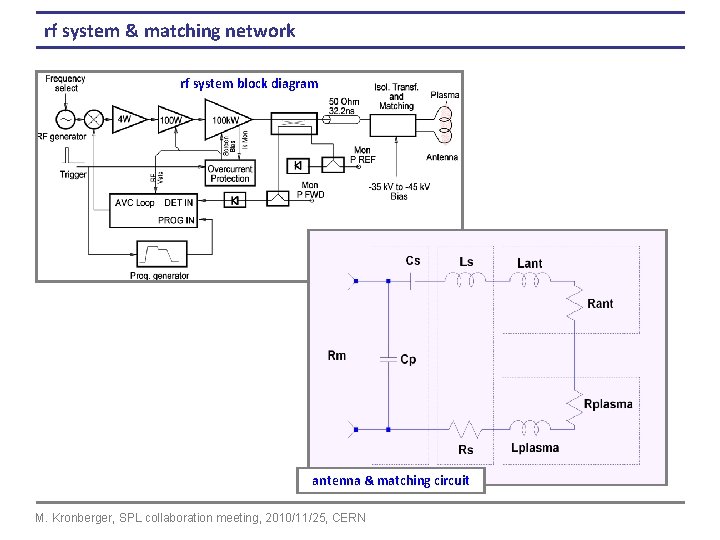
rf system & matching network rf system block diagram antenna & matching circuit M. Kronberger, SPL collaboration meeting, 2010/11/25, CERN