
Development of an Antennacoupled Al Superconducting Tunnel Junction
- Slides: 1
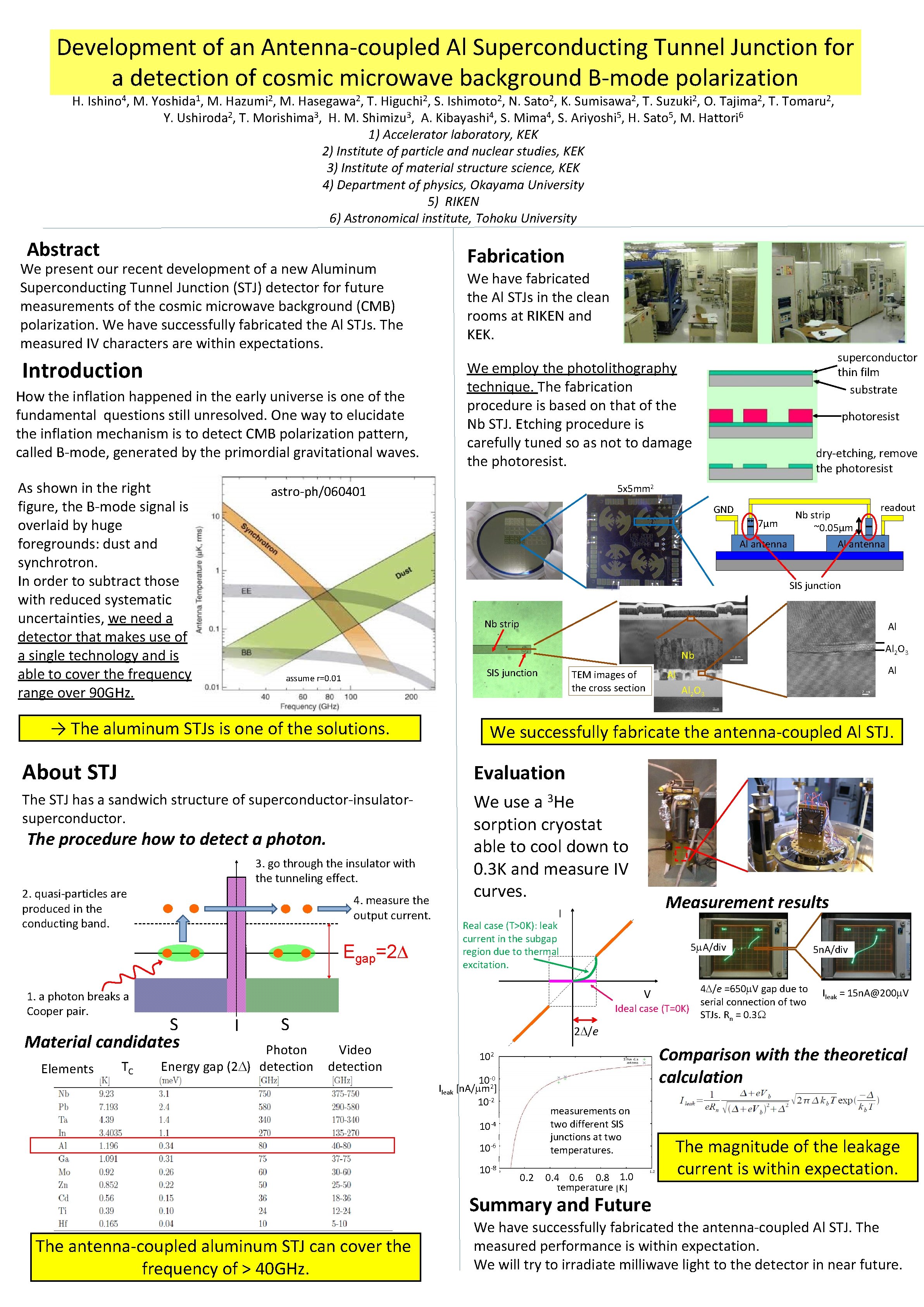
Development of an Antenna-coupled Al Superconducting Tunnel Junction for a detection of cosmic microwave background B-mode polarization H. Ishino 4, M. Yoshida 1, M. Hazumi 2, M. Hasegawa 2, T. Higuchi 2, S. Ishimoto 2, N. Sato 2, K. Sumisawa 2, T. Suzuki 2, O. Tajima 2, T. Tomaru 2, Y. Ushiroda 2, T. Morishima 3, H. M. Shimizu 3, A. Kibayashi 4, S. Mima 4, S. Ariyoshi 5, H. Sato 5, M. Hattori 6 1) Accelerator laboratory, KEK 2) Institute of particle and nuclear studies, KEK 3) Institute of material structure science, KEK 4) Department of physics, Okayama University 5) RIKEN 6) Astronomical institute, Tohoku University Abstract We present our recent development of a new Aluminum Superconducting Tunnel Junction (STJ) detector future measurements of the cosmic microwave background (CMB) polarization. We have successfully fabricated the Al STJs. The measured IV characters are within expectations. Introduction How the inflation happened in the early universe is one of the fundamental questions still unresolved. One way to elucidate the inflation mechanism is to detect CMB polarization pattern, called B-mode, generated by the primordial gravitational waves. As shown in the right figure, the B-mode signal is overlaid by huge foregrounds: dust and synchrotron. In order to subtract those with reduced systematic uncertainties, we need a detector that makes use of a single technology and is able to cover the frequency range over 90 GHz. Fabrication We have fabricated the Al STJs in the clean rooms at RIKEN and KEK. We employ the photolithography technique. The fabrication procedure is based on that of the Nb STJ. Etching procedure is carefully tuned so as not to damage the photoresist. Nb strip 7μm ~0. 05μm Al antenna Nb strip Al Al 2 O 3 Nb SIS junction assume r=0. 01 TEM images of the cross section We use a 3 He sorption cryostat able to cool down to 0. 3 K and measure IV curves. The procedure how to detect a photon. 3. go through the insulator with the tunneling effect. 2. quasi-particles are produced in the conducting band. 4. measure the output current. Egap=2 D I I Real case (T>0 K): leak current in the subgap region due to thermal excitation. Al 2 O 3 Measurement results 5 m. A/div 4 D/e =650 m. V gap due to V serial connection of two Ideal case (T=0 K) STJs. Rn = 0. 3 W S Photon Energy gap (2 D) detection Al Al We successfully fabricate the antenna-coupled Al STJ. The STJ has a sandwich structure of superconductor-insulatorsuperconductor. TC readout SIS junction Evaluation Elements dry-etching, remove the photoresist GND About STJ S Material candidates photoresist 5 x 5 mm 2 astro-ph/060401 → The aluminum STJs is one of the solutions. 1. a photon breaks a Cooper pair. superconductor thin film substrate 5 n. A/div Ileak = 15 n. A@200 m. V 2 D/e Video detection Comparison with theoretical calculation 102 10 -02 Ileak [n. A/mm ] 10 -2 measurements on two different SIS junctions at two temperatures. 10 -4 10 -6 10 -8 0. 2 0. 4 0. 6 0. 8 1. 0 temperature [K] The magnitude of the leakage current is within expectation. Summary and Future The antenna-coupled aluminum STJ can cover the frequency of > 40 GHz. We have successfully fabricated the antenna-coupled Al STJ. The measured performance is within expectation. We will try to irradiate milliwave light to the detector in near future.