
Development of an Animal Model for Robotic Stroke
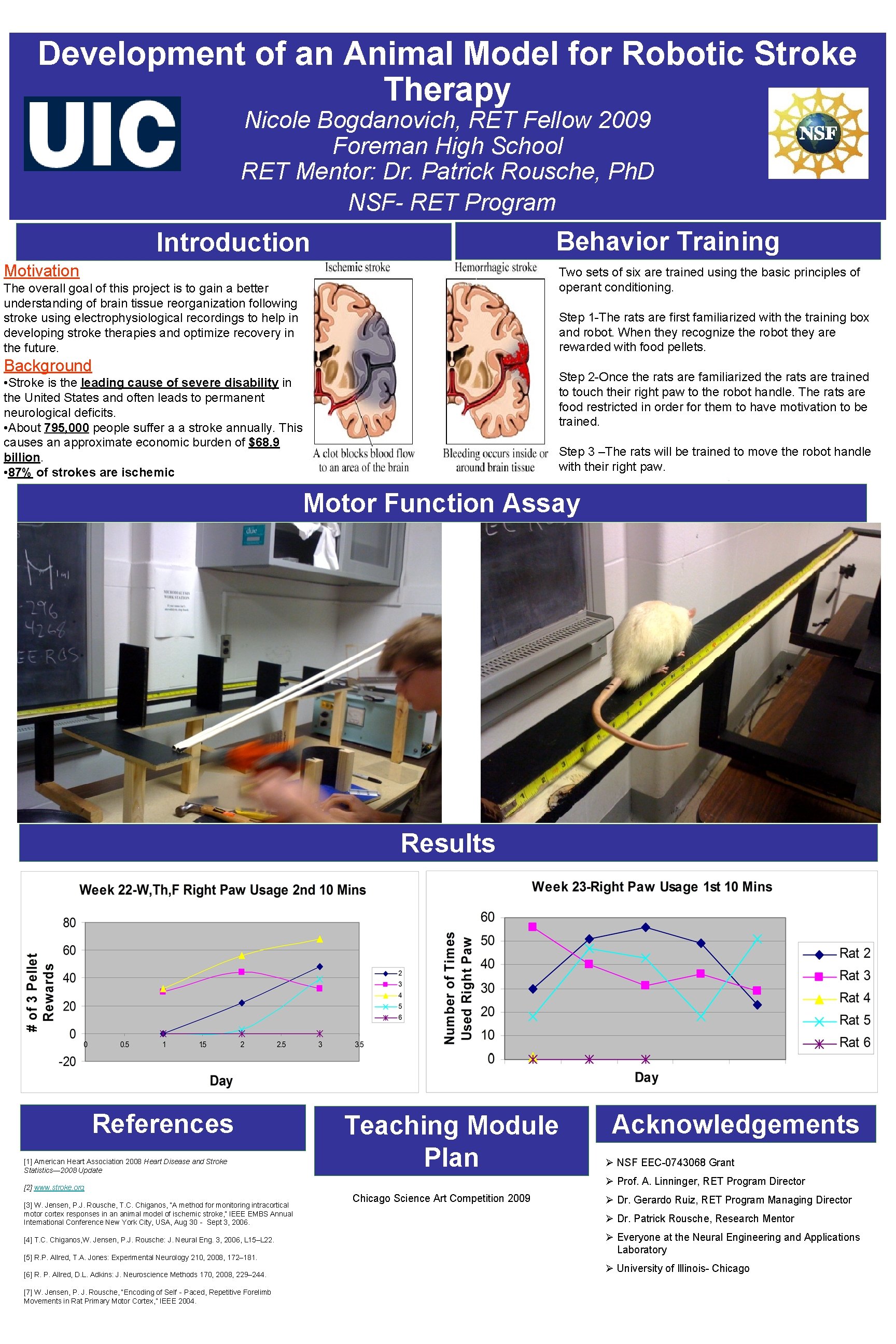
Development of an Animal Model for Robotic Stroke Therapy Nicole Bogdanovich, RET Fellow 2009 Foreman High School RET Mentor: Dr. Patrick Rousche, Ph. D NSF- RET Program Behavior Training Introduction Motivation The overall goal of this project is to gain a better understanding of brain tissue reorganization following stroke using electrophysiological recordings to help in developing stroke therapies and optimize recovery in the future. Background cerebral artery Two sets of six are trained using the basic principles of operant conditioning. Step 1 -The rats are first familiarized with the training box and robot. When they recognize the robot they are rewarded with food pellets. Hypothesis • Stroke is the leading cause of severe disability in the United States and often leads to permanent neurological deficits. • About 795, 000 people suffer a a stroke annually. This causes an approximate economic burden of $68. 9 billion. • 87% of strokes are ischemic Step 2 -Once the rats are familiarized the rats are trained to touch their right paw to the robot handle. The rats are food restricted in order for them to have motivation to be trained. Step 3 –The rats will be trained to move the robot handle with their right paw. Motor Function Assay Results References [1] American Heart Association 2008 Heart Disease and Stroke Statistics— 2008 Update Teaching Module Plan [4] T. C. Chiganos, W. Jensen, P. J. Rousche: J. Neural Eng. 3, 2006, L 15–L 22. [5] R. P. Allred, T. A. Jones: Experimental Neurology 210, 2008, 172– 181. [6] R. P. Allred, D. L. Adkins: J. Neuroscience Methods 170, 2008, 229– 244. [7] W. Jensen, P. J. Rousche, “Encoding of Self‐Paced, Repetitive Forelimb Movements in Rat Primary Motor Cortex, ” IEEE 2004. Ø NSF EEC-0743068 Grant Ø Prof. A. Linninger, RET Program Director [2] www. stroke. org [3] W. Jensen, P. J. Rousche, T. C. Chiganos, “A method for monitoring intracortical motor cortex responses in an animal model of ischemic stroke, ” IEEE EMBS Annual International Conference New York City, USA, Aug 30‐ Sept 3, 2006. Acknowledgements Chicago Science Art Competition 2009 Ø Dr. Gerardo Ruiz, RET Program Managing Director Ø Dr. Patrick Rousche, Research Mentor Ø Everyone at the Neural Engineering and Applications Laboratory Ø University of Illinois- Chicago
- Slides: 1