
Development of a visuospatial representation method and evidence

- Slides: 21
Development of a visuospatial representation method and evidence for rhythmic categorical perception Amandine Penel, Christopher A. Hollweg, & Carlos D. Brody Cold Spring Harbor Laboratory Cold Spring Harbor, NY USA
u Development of a visuospatial representation method to investigate the perception of temporal patterns u Serendipitous evidence for rhythmic categorical perception
u Various processes have been proposed for the representation of temporal information in sequences, e. g. : • a multiple-look estimation of the mean time interval & variability (Drake & Botte, 1993) • the induction of a regular clock / entrainment of an attentional pulse (Povel & Essens, 1985; Large & Jones, 1999; Penel & Jones, 2005) • grouping by temporal proximity (Handel, 1998; Penel & Drake, 2004) u How do they interact? Are they the only ones to operate? (unlikely)
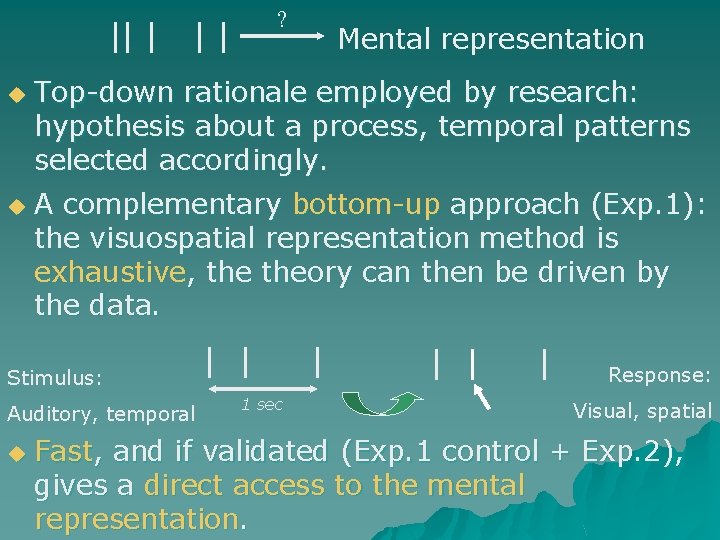
? u u Top-down rationale employed by research: hypothesis about a process, temporal patterns selected accordingly. A complementary bottom-up approach (Exp. 1): the visuospatial representation method is exhaustive, theory can then be driven by the data. Response: Stimulus: Auditory, temporal u Mental representation 1 sec Visual, spatial Fast, and if validated (Exp. 1 control + Exp. 2), gives a direct access to the mental representation.
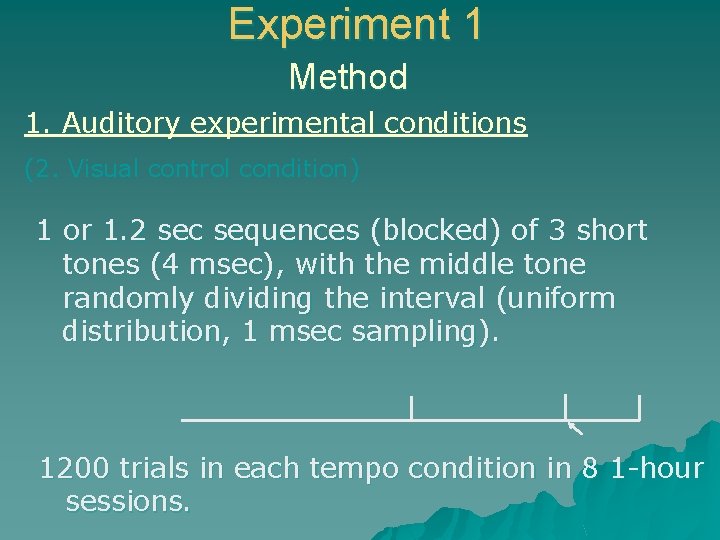
Experiment 1 Method 1. Auditory experimental conditions (2. Visual control condition) 1 or 1. 2 sec sequences (blocked) of 3 short tones (4 msec), with the middle tone randomly dividing the interval (uniform distribution, 1 msec sampling). 1200 trials in each tempo condition in 8 1 -hour sessions.
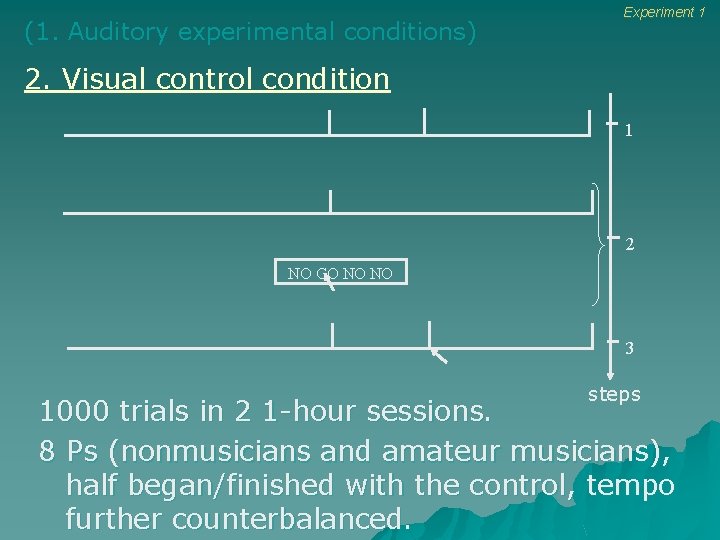
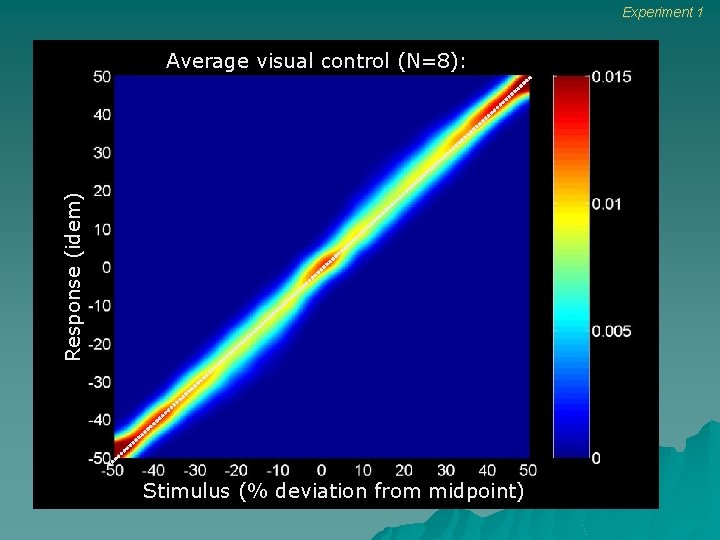
(1. Auditory experimental conditions) Experiment 1 2. Visual control condition 1 2 NO GO NO NO 3 steps 1000 trials in 2 1 -hour sessions. 8 Ps (nonmusicians and amateur musicians), half began/finished with the control, tempo further counterbalanced.
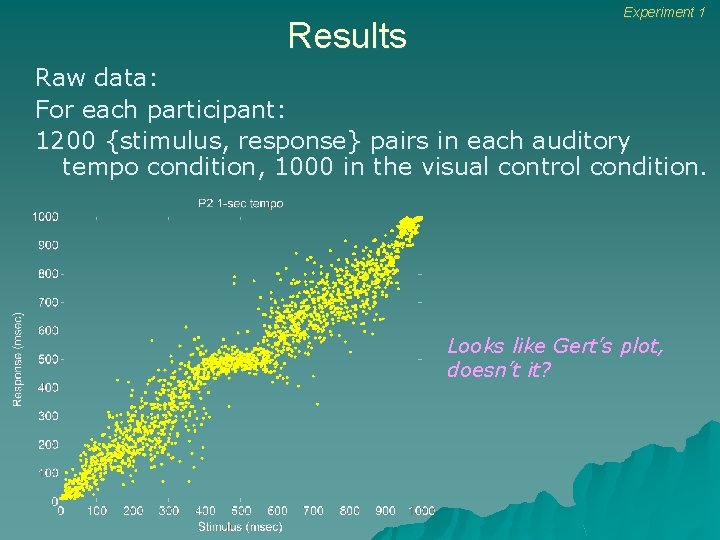
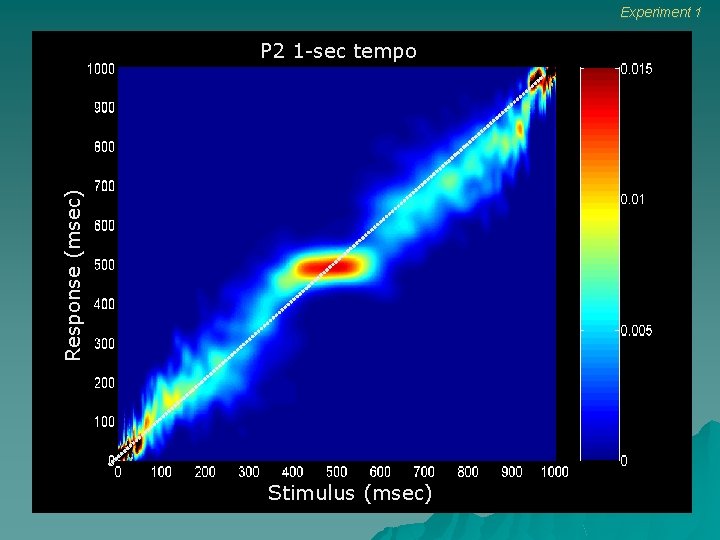
Results Experiment 1 Raw data: For each participant: 1200 {stimulus, response} pairs in each auditory tempo condition, 1000 in the visual control condition. Looks like Gert’s plot, doesn’t it?
Experiment 1 Response (msec) P 2 1 -sec tempo Stimulus (msec)
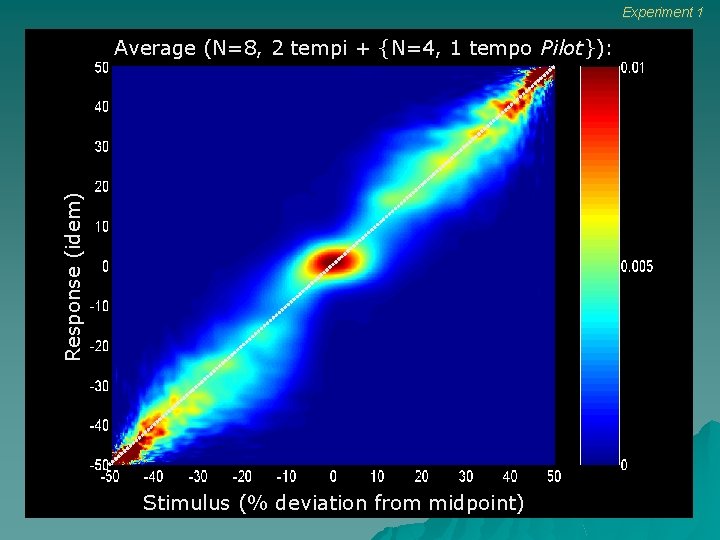
Experiment 1 Response (idem) Average (N=8, 2 tempi + {N=4, 1 tempo Pilot}): Stimulus (% deviation from midpoint)
Experiment 1 Response (idem) Average visual control (N=8): Stimulus (% deviation from midpoint)
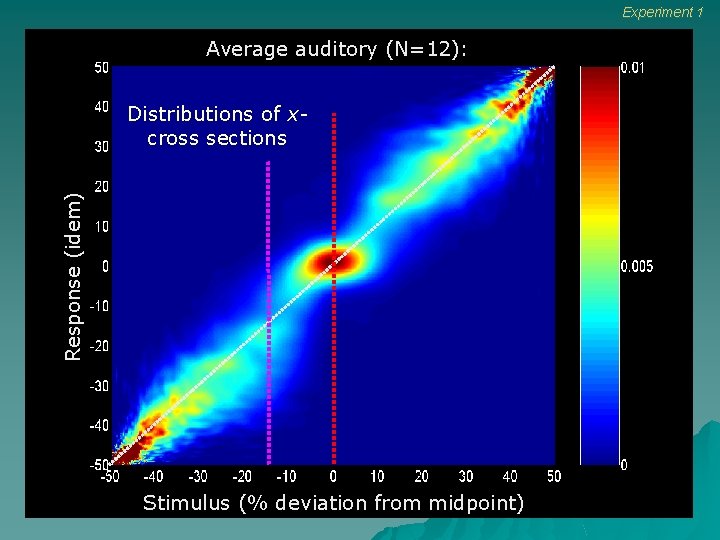
Experiment 1 Average auditory (N=12): Response (idem) Distributions of xcross sections Stimulus (% deviation from midpoint)
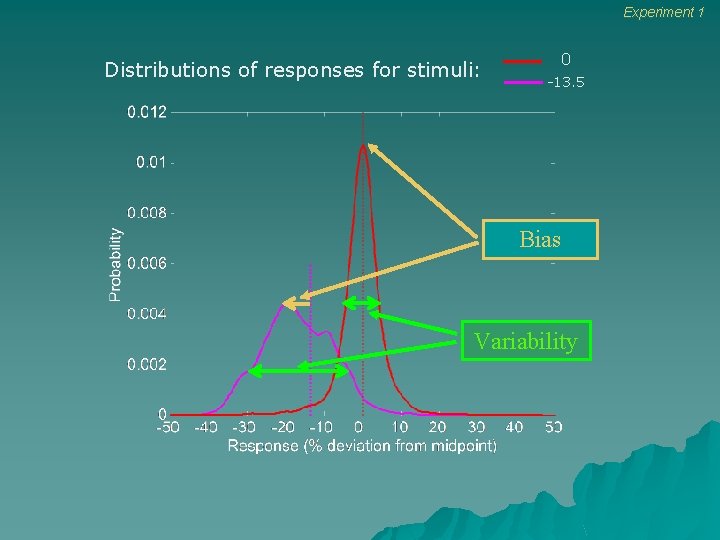
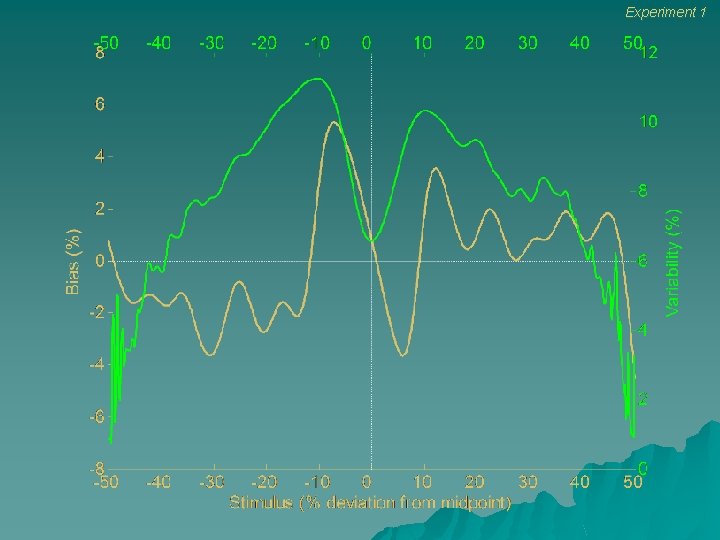
Experiment 1 Distributions of responses for stimuli: 0 -13. 5 Bias Variability
Experiment 1
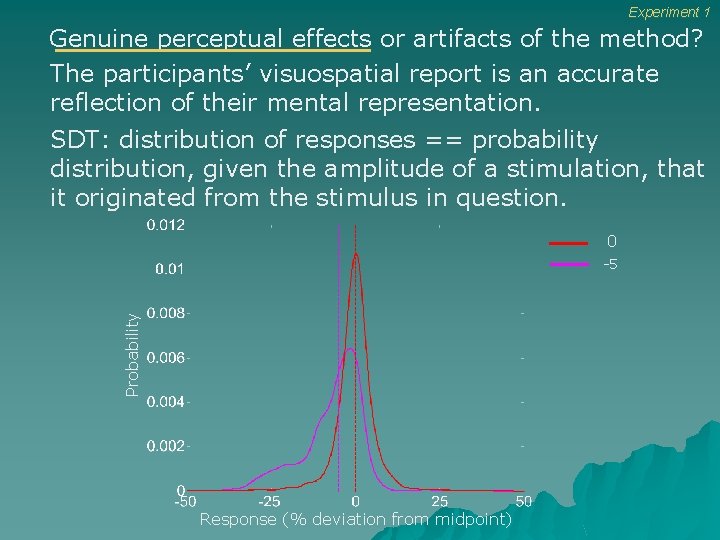
Experiment 1 Genuine perceptual effects or artifacts of the method? The participants’ visuospatial report is an accurate reflection of their mental representation. SDT: distribution of responses == probability distribution, given the amplitude of a stimulation, that it originated from the stimulus in question. 0 Probability -5 Response (% deviation from midpoint)
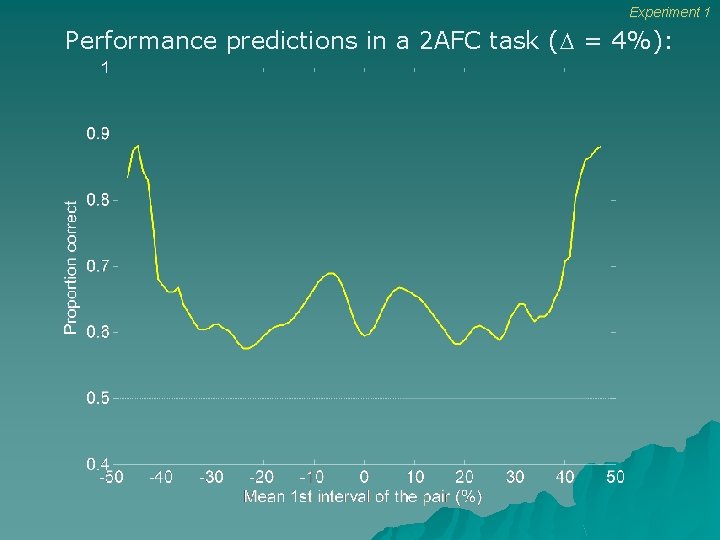
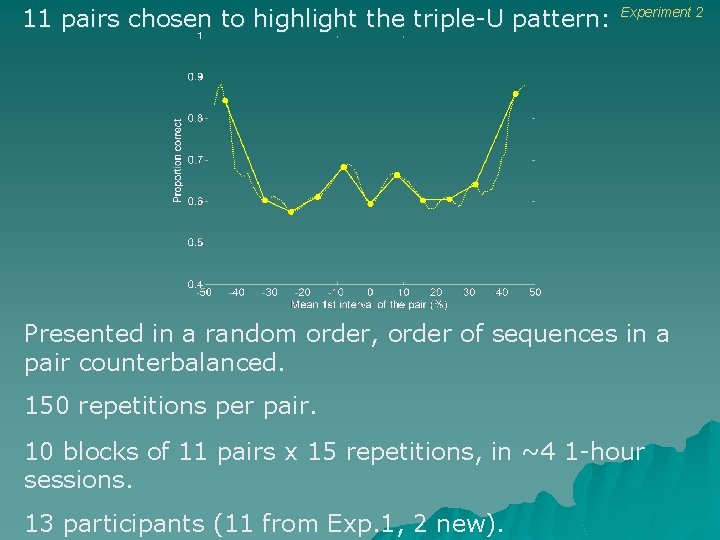
Experiment 1 Performance predictions in a 2 AFC task (D = 4%):
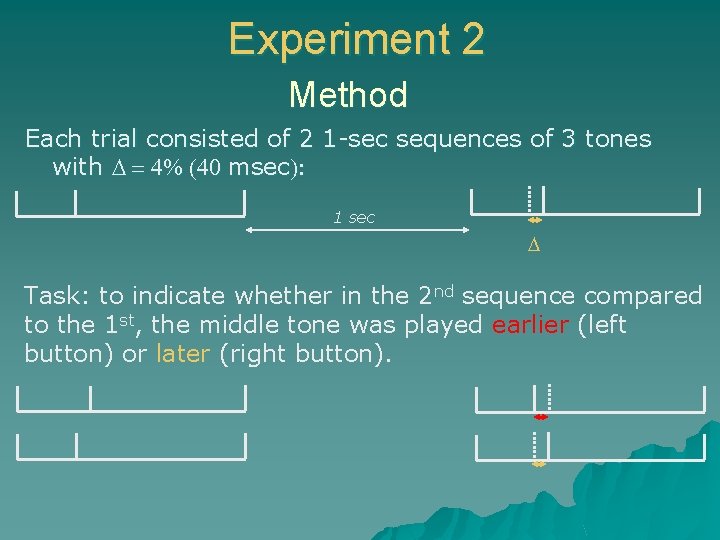
Experiment 2 Method Each trial consisted of 2 1 -sec sequences of 3 tones with D = 4% (40 msec): 1 sec D Task: to indicate whether in the 2 nd sequence compared to the 1 st, the middle tone was played earlier (left button) or later (right button).
11 pairs chosen to highlight the triple-U pattern: Experiment 2 Presented in a random order, order of sequences in a pair counterbalanced. 150 repetitions per pair. 10 blocks of 11 pairs x 15 repetitions, in ~4 1 -hour sessions. 13 participants (11 from Exp. 1, 2 new).
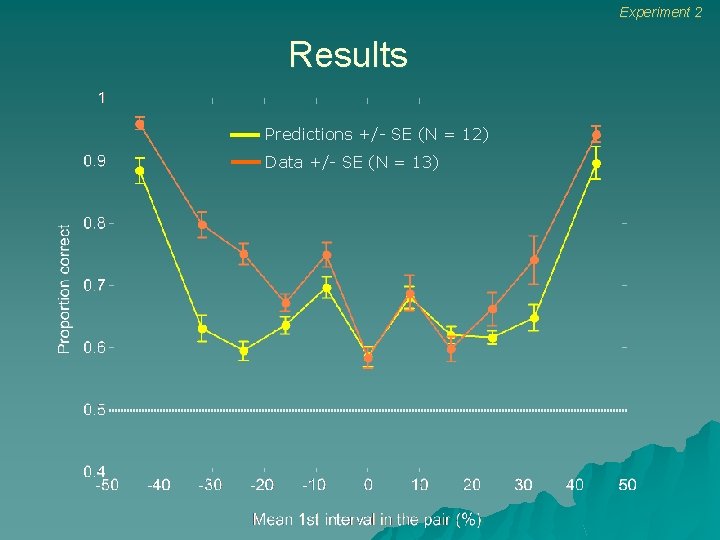
Experiment 2 Results Predictions +/- SE (N = 12) Data +/- SE (N = 13)
Conclusion u We have developed a visuospatial representation method to investigate the perception of temporal patterns which is: • • u Exhaustive Bottom-up Fast Gives a direct access to the mental representation Evidence for rhythmic categorical perception (1: 1 ratio), generalizing previous findings (Clarke, 1987; Schultze, 1989; Desain & Honing, 2003): • to a task which does not involve rhythmic categorization (or quantization) via (1) the use of musical notation and (2) the explicit instruction to disregard expressive timing, • to participants who are not highly musically trained. See also Gert and Ryota & Yoshitaka’s talks today! u Confirmed in a classic 2 AFC experiment, validating the method
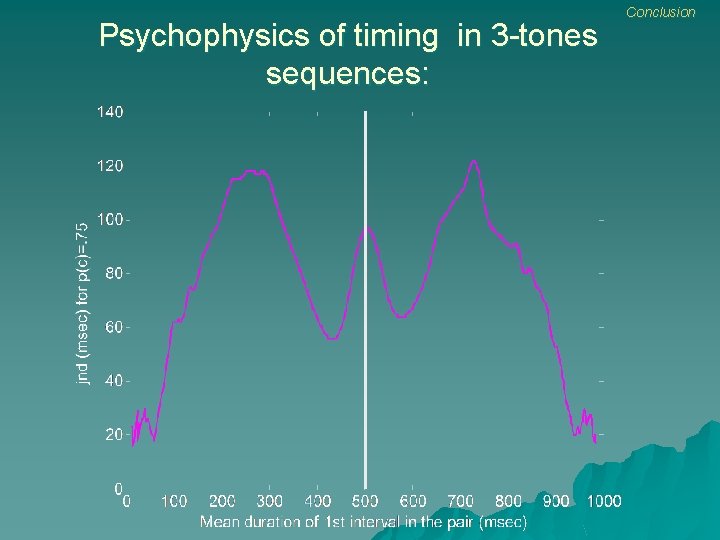
Psychophysics of timing in 3 -tones sequences: Conclusion
Thank you!