
Development of a Solid Spectroscopy Data Model SSDM

- Slides: 23
Development of a Solid Spectroscopy Data Model (SSDM) and the Gho. SST Data. Base Gho. SST “Grenoble Astrophysics and Planetology Solid Spectroscopy and Thermodynamics" database service Bernard Schmitt, Damien Albert, Philippe Bollard, Lydie Bonal, Maria Gorbacheva, (Pierre Volcke) and the SSDM Expert group* Institut de Planétologie et Astrophysique de Grenoble (former LPG), CNRS / UJF ASOV Janvier 2012
Task “New databases” of IDIS/Europlanet (WP 25) + interoperability/deployment of VAMDC (WP 6 / WP 4) Laboratory spectroscopic databases for solids : - Develop a Solid spectroscopy data model (SSDM) - Develop a generic database infrastructure (+ some tools) for spectroscopic data of solids (intended to be available to other data producers, in a second step). - Generate a first new database (Gho. SST) covering : - UV-to-FIR transmission spectroscopy of ices and simple organics - UV-to-NIR bidirectional reflection spectroscopy of solid surfaces (planetary materials; minerals and ices, meteorites, organics, adsorption, processed, …) - Raman and Fluorescence micro-spectrometry (minerals, meteorites, organics…) - Infrared micro-spectroscopy - Band list of molecular solids and adsorbed molecules prototype delivery: July 2011 VO compliant infrastructure
Why a Solid Spectroscopy Data Model ? • For efficient interoperability (cross search …) we develop an uniform and as complete as possible description of the solid samples, instruments & techniques used and of the spectral data (spectra and band list) produced by experimentalist of this field. Development of a “Solid Spectroscopy Data Model” (SSDM) that we intend to propose to be, at least, an European standard, and possibly an international one. Include in the data model schema, up to some limited complexity level, the requirements of most of the European solid spectroscopy data producers (SSDM Expert Group*)
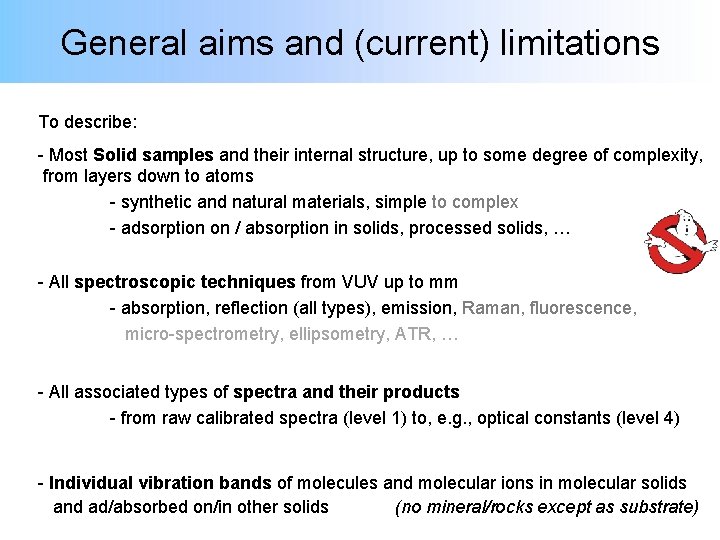
General aims and (current) limitations To describe: - Most Solid samples and their internal structure, up to some degree of complexity, from layers down to atoms - synthetic and natural materials, simple to complex - adsorption on / absorption in solids, processed solids, … - All spectroscopic techniques from VUV up to mm - absorption, reflection (all types), emission, Raman, fluorescence, micro-spectrometry, ellipsometry, ATR, … - All associated types of spectra and their products - from raw calibrated spectra (level 1) to, e. g. , optical constants (level 4) - Individual vibration bands of molecules and molecular ions in molecular solids and ad/absorbed on/in other solids (no mineral/rocks except as substrate)
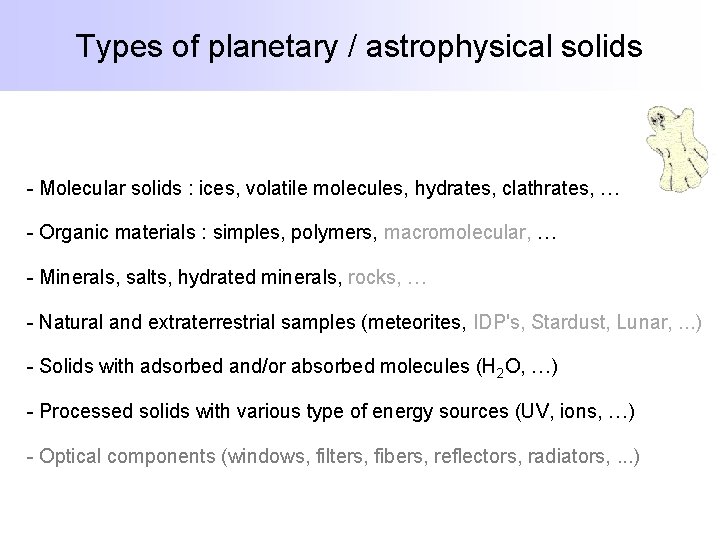
Types of planetary / astrophysical solids - Molecular solids : ices, volatile molecules, hydrates, clathrates, … - Organic materials : simples, polymers, macromolecular, … - Minerals, salts, hydrated minerals, rocks, … - Natural and extraterrestrial samples (meteorites, IDP's, Stardust, Lunar, . . . ) - Solids with adsorbed and/or absorbed molecules (H 2 O, …) - Processed solids with various type of energy sources (UV, ions, …) - Optical components (windows, filters, fibers, reflectors, radiators, . . . )
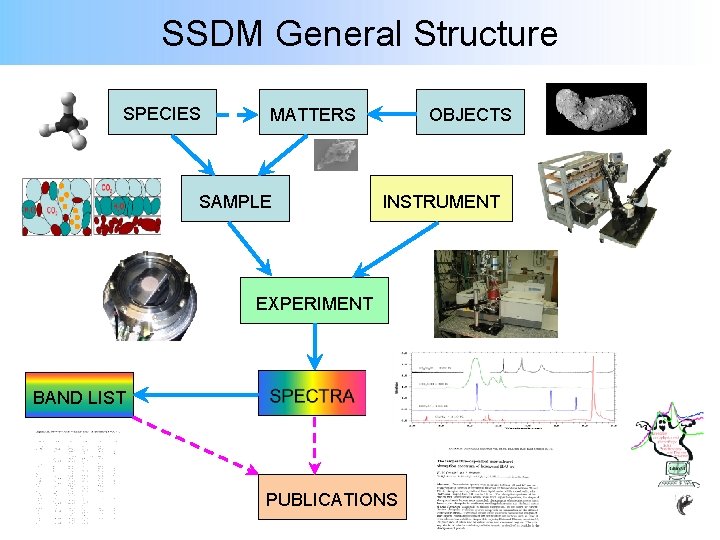
SSDM General Structure SPECIES MATTERS SAMPLE OBJECTS INSTRUMENT EXPERIMENT BAND LIST PUBLICATIONS
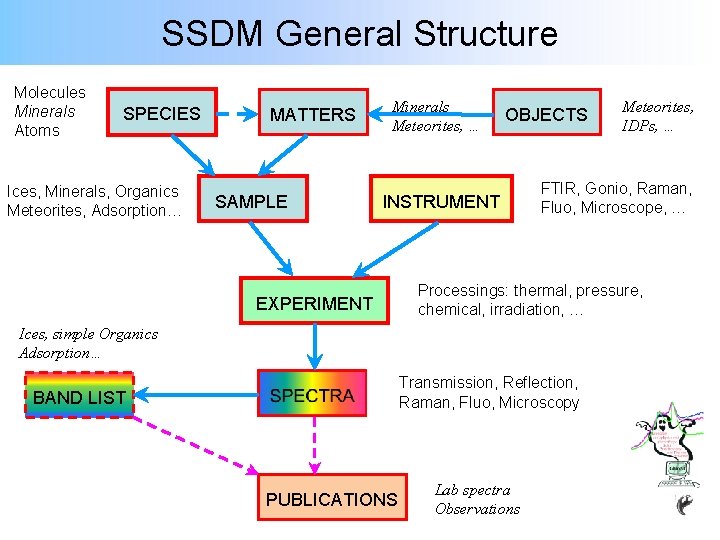
SSDM General Structure Molecules Minerals Atoms SPECIES Ices, Minerals, Organics Meteorites, Adsorption… MATTERS SAMPLE Minerals Meteorites, … OBJECTS INSTRUMENT EXPERIMENT FTIR, Gonio, Raman, Fluo, Microscope, … Processings: thermal, pressure, chemical, irradiation, … Ices, simple Organics Adsorption… Transmission, Reflection, Raman, Fluo, Microscopy BAND LIST PUBLICATIONS Meteorites, IDPs, … Lab spectra Observations
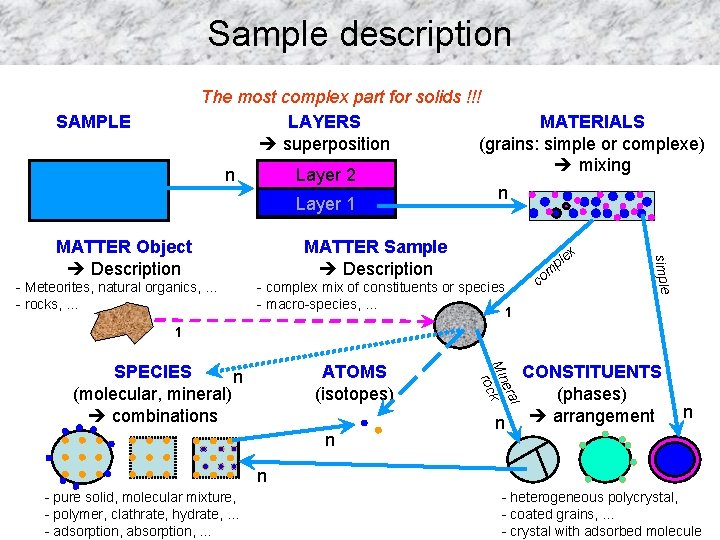
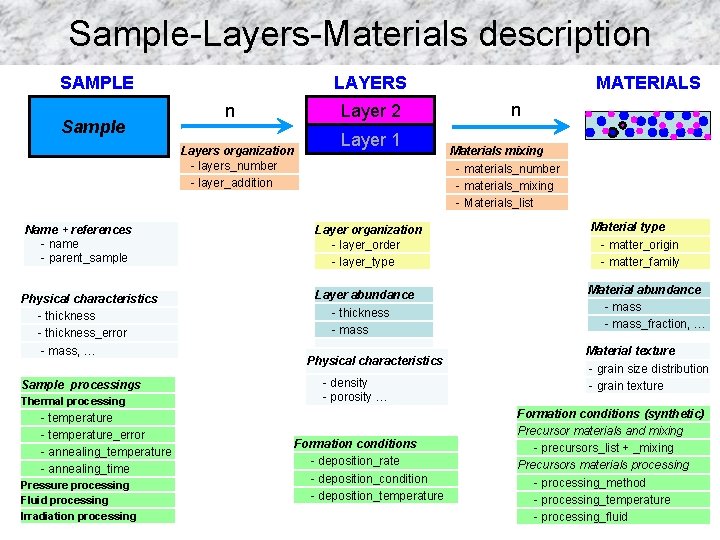
Sample description The most complex part for solids !!! LAYERS MATERIALS superposition (grains: simple or complexe) mixing Layer 2 n n Layer 1 SAMPLE - Meteorites, natural organics, … - rocks, … MATTER Sample Description - complex mix of constituents or species - macro-species, … m co ex pl simple MATTER Object Description 1 1 ATOMS (isotopes) n CONSTITUENTS (phases) n n arrangement l era Min ck ro SPECIES n (molecular, mineral) combinations n - pure solid, molecular mixture, - polymer, clathrate, hydrate, … - adsorption, absorption, … - heterogeneous polycrystal, - coated grains, … - crystal with adsorbed molecule
Sample-Layers-Materials description SAMPLE Sample LAYERS n Layers organization - layers_number - layer_addition Name + references - name - parent_sample Physical characteristics - thickness_error - mass, … Sample processings Thermal processing - temperature_error - annealing_temperature - annealing_time Pressure processing Fluid processing Irradiation processing Layer 2 Layer 1 MATERIALS n Materials mixing - materials_number - materials_mixing - Materials_list Layer organization - layer_order - layer_type Material type - matter_origin - matter_family Layer abundance - thickness - mass Material abundance - mass_fraction, … Physical characteristics - density - porosity … Formation conditions - deposition_rate - deposition_condition - deposition_temperature Material texture - grain size distribution - grain texture Formation conditions (synthetic) Precursor materials and mixing - precursors_list + _mixing Precursors materials processing - processing_method - processing_temperature - processing_fluid
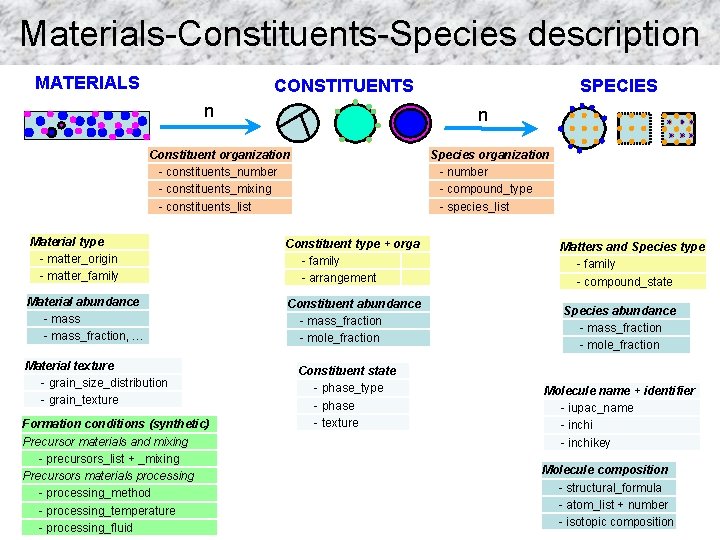
Materials-Constituents-Species description MATERIALS CONSTITUENTS n n Constituent organization - constituents_number - constituents_mixing - constituents_list Species organization - number - compound_type - species_list Material type - matter_origin - matter_family Constituent type + orga - family - arrangement Material abundance - mass_fraction, … Constituent abundance - mass_fraction - mole_fraction Material texture - grain_size_distribution - grain_texture Formation conditions (synthetic) Precursor materials and mixing - precursors_list + _mixing Precursors materials processing - processing_method - processing_temperature - processing_fluid SPECIES Constituent state - phase_type - phase - texture Matters and Species type - family - compound_state Species abundance - mass_fraction - mole_fraction Molecule name + identifier - iupac_name - inchikey Molecule composition - structural_formula - atom_list + number - isotopic composition
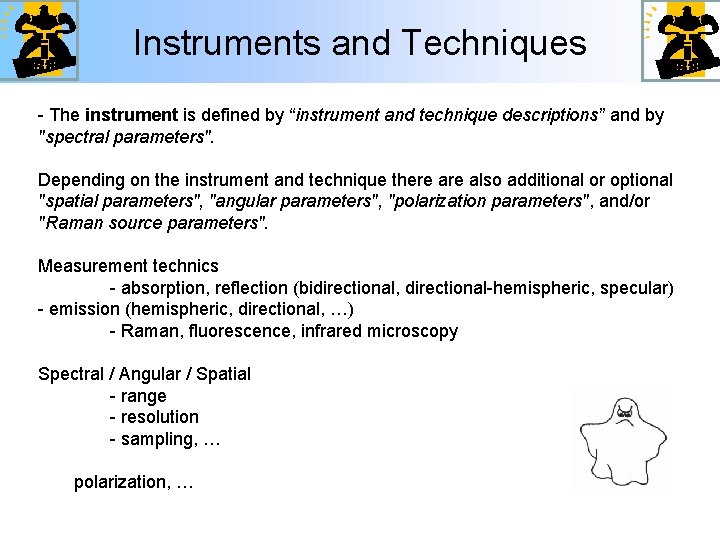
Instruments and Techniques - The instrument is defined by “instrument and technique descriptions” and by "spectral parameters". Depending on the instrument and technique there also additional or optional "spatial parameters", "angular parameters", "polarization parameters", and/or "Raman source parameters". Measurement technics - absorption, reflection (bidirectional, directional-hemispheric, specular) - emission (hemispheric, directional, …) - Raman, fluorescence, infrared microscopy Spectral / Angular / Spatial - range - resolution - sampling, … polarization, …
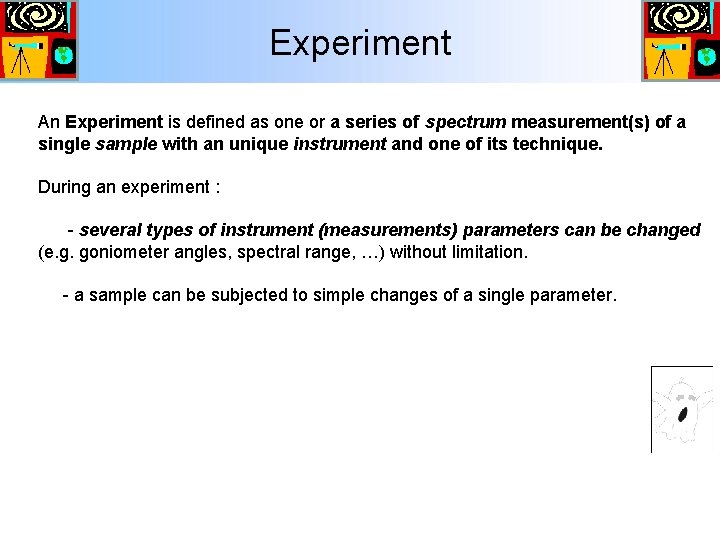
Experiment An Experiment is defined as one or a series of spectrum measurement(s) of a single sample with an unique instrument and one of its technique. During an experiment : - several types of instrument (measurements) parameters can be changed (e. g. goniometer angles, spectral range, …) without limitation. - a sample can be subjected to simple changes of a single parameter.
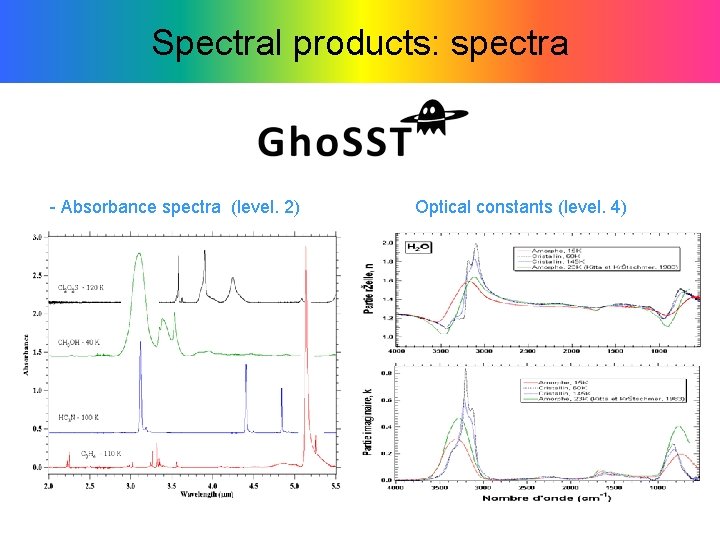
Spectral products: spectra The spectroscopic data consist of a spectrum file and some "file and spectrum information". The spectrum is linked with an "experiment" which connect to the "sample" and the "instrument parameters" used. Case of transmission spectroscopy: o Transmission spectrum (level 1) o Normalized absorbance spectrum (level 2) o Absorption coefficient spectrum (level 3) o Optical constants spectrum (level 4) - reflection spectra, polarized spectra, BRDF, spectral scattering functions - emission spectra, spectral emissivity, … - Raman, Fluorescence, micro-spectroscopy, …
Spectral products: spectra - Absorbance spectra (level. 2) Optical constants (level. 4)
Spectral products: vibrations band list A band list contains individual information on each known vibration bands of one particular species inside a constituent in a given phase and physical conditions. This band information may have different and complementary origins in term of measurement type (absorption, reflection, emission, Raman, …) - Description of the molecule in its constituent, and the physical conditions - Description of the vibration band: - Frequency [+ uncertainty] - Width (FWHM) [+ uncertainty] - Peak Intensity (abs. coeff. , or k) [+ uncertainty] - Integrated intensity (abs. coeff. , or k) [+ uncertainty] - Vibration mode (ex: 2 n 1 + n 2 + 3 n 3) - Vibration mode type (ex: O-H stretching) - Reference list (1 st measurement/attribution)
Spectral products: molecular parameters list The molecular parameters list contain quantum numbers and interaction parameters on defined molecular solid. Derived from the analysis and attribution of the known absorption bands and allow to calculate the band position (and intensity ? ) of the fundamental, overtone and combination internal vibration modes, measured or not. This band information may have different and complementary origins in term of measurement type (absorption, reflection, emission, Raman, …) - Description of the molecule in its constituent, and the physical conditions - Description of the vibration parameters: - Fundamental modes - Vibration parameters and band position equation - Reference list (model, parameter)
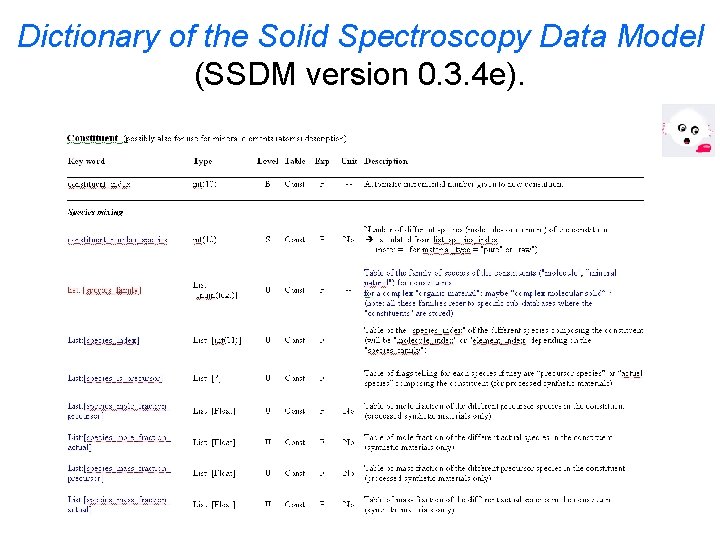
Dictionary of the Solid Spectroscopy Data Model (SSDM version 0. 3. 4 e).
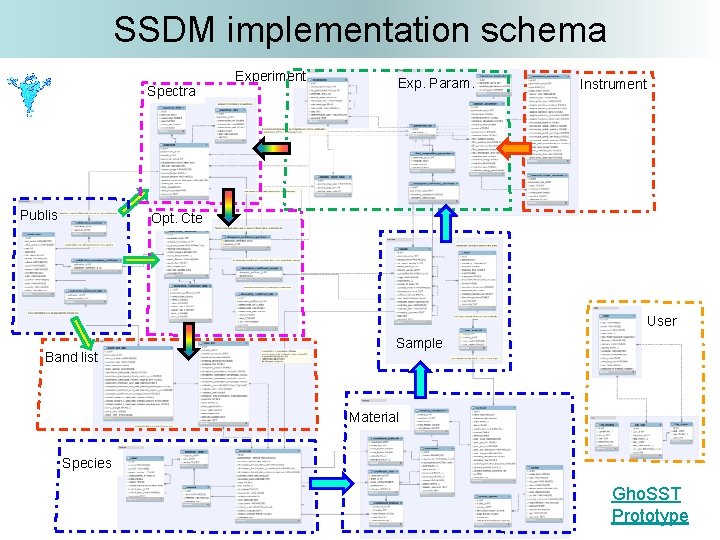
SSDM implementation schema Spectra Publis Experiment Exp. Param. Instrument Opt. Cte User Band list Sample Material Species Gho. SST Prototype
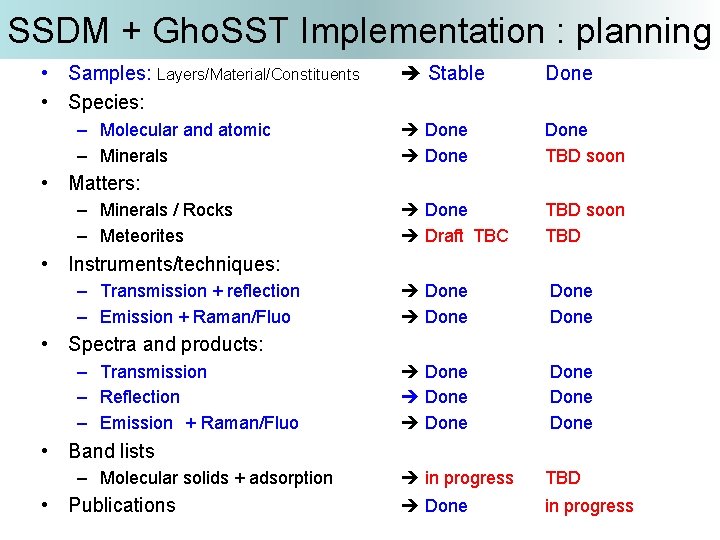
SSDM + Gho. SST Implementation : planning • Samples: Layers/Material/Constituents • Species: – Molecular and atomic – Minerals Stable Done TBD soon Done Draft TBC TBD soon TBD Done Done Done in progress TBD Done in progress • Matters: – Minerals / Rocks – Meteorites • Instruments/techniques: – Transmission + reflection – Emission + Raman/Fluo • Spectra and products: – Transmission – Reflection – Emission + Raman/Fluo • Band lists – Molecular solids + adsorption • Publications
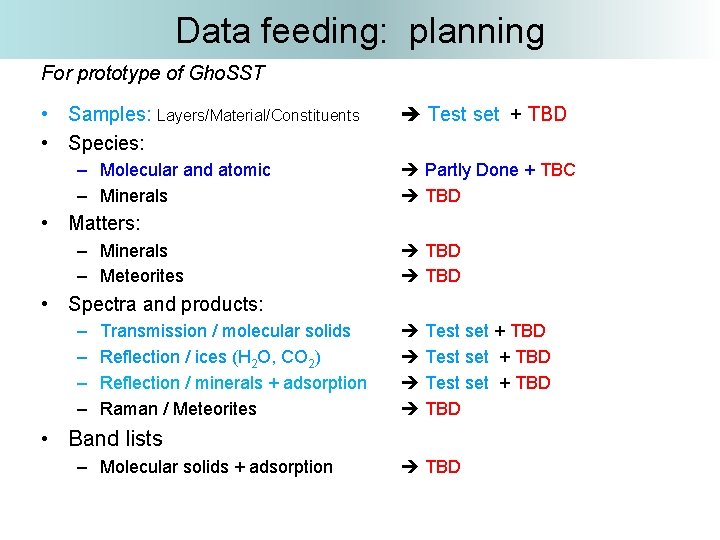
Data feeding: planning For prototype of Gho. SST • Samples: Layers/Material/Constituents • Species: – Molecular and atomic – Minerals Test set + TBD Partly Done + TBC TBD • Matters: – Minerals – Meteorites TBD • Spectra and products: – – Transmission / molecular solids Reflection / ices (H 2 O, CO 2) Reflection / minerals + adsorption Raman / Meteorites Test set + TBD • Band lists – Molecular solids + adsorption TBD
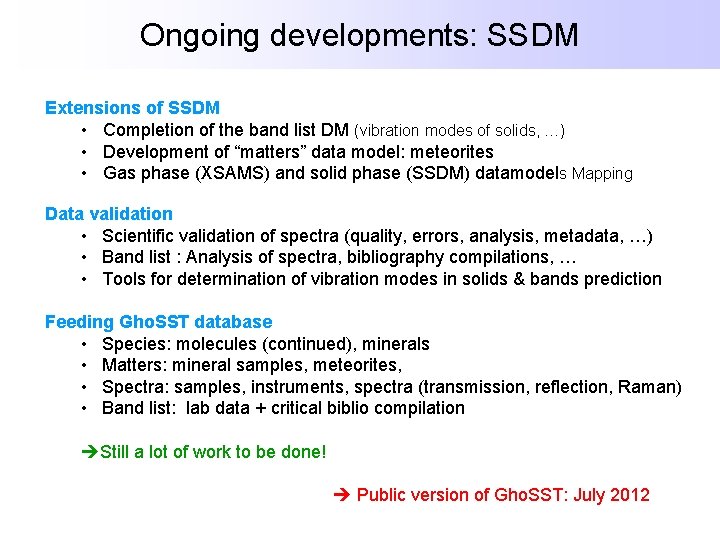
Ongoing developments: SSDM Extensions of SSDM • Completion of the band list DM (vibration modes of solids, …) • Development of “matters” data model: meteorites • Gas phase (XSAMS) and solid phase (SSDM) datamodels Mapping Data validation • Scientific validation of spectra (quality, errors, analysis, metadata, …) • Band list : Analysis of spectra, bibliography compilations, … • Tools for determination of vibration modes in solids & bands prediction Feeding Gho. SST database • Species: molecules (continued), minerals • Matters: mineral samples, meteorites, • Spectra: samples, instruments, spectra (transmission, reflection, Raman) • Band list: lab data + critical biblio compilation Still a lot of work to be done! Public version of Gho. SST: July 2012
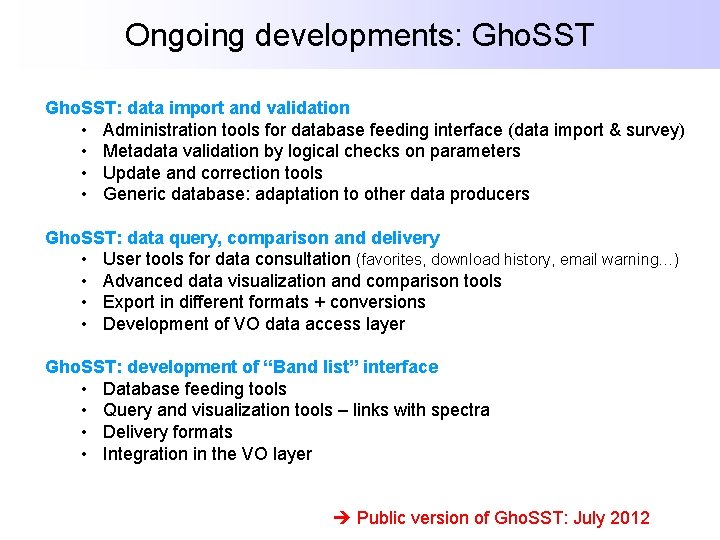
Ongoing developments: Gho. SST: data import and validation • Administration tools for database feeding interface (data import & survey) • Metadata validation by logical checks on parameters • Update and correction tools • Generic database: adaptation to other data producers Gho. SST: data query, comparison and delivery • User tools for data consultation (favorites, download history, email warning…) • Advanced data visualization and comparison tools • Export in different formats + conversions • Development of VO data access layer Gho. SST: development of “Band list” interface • Database feeding tools • Query and visualization tools – links with spectra • Delivery formats • Integration in the VO layer Public version of Gho. SST: July 2012