
DEVELOPMENT OF A REALISTIC HYDROGEN FLAMMABLE ATMOSPHERE INSIDE
DEVELOPMENT OF A REALISTIC HYDROGEN FLAMMABLE ATMOSPHERE INSIDE A 4 -M 3 ENCLOSURE Audrey DUCLOS 1, C. Proust 2, 3, J. Daubech 2, and F. Verbecke 1 7 th ICHS, September 11 -13, 2017 – Hamburg, Germany 1 AREVA ENERGY STORAGE 2 INERIS 3 UTC
Introduction Since a few years, hydrogen appears as a credible energyvector and some of those hydrogen applications can be containerized. However, hydrogen applications are still considered dangerous. To define a strategy of mitigation against explosion, the main characteristics of flammable atmosphere (size, concentration, turbulence…) should be well-known. p. 2
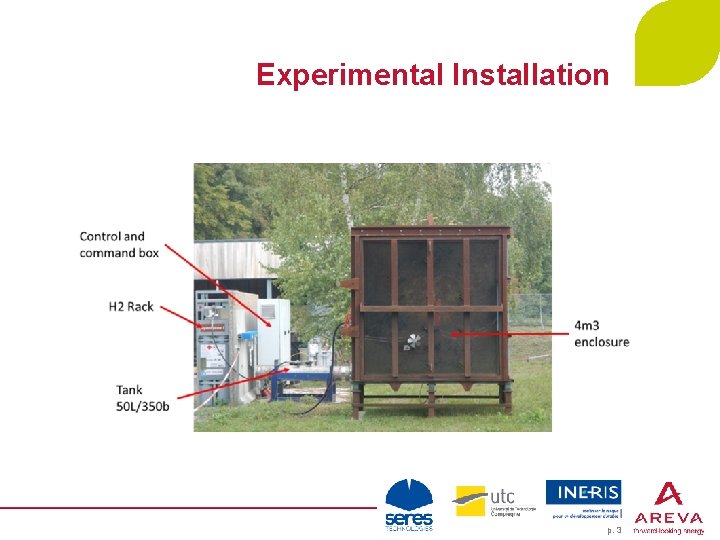
Experimental Installation p. 3
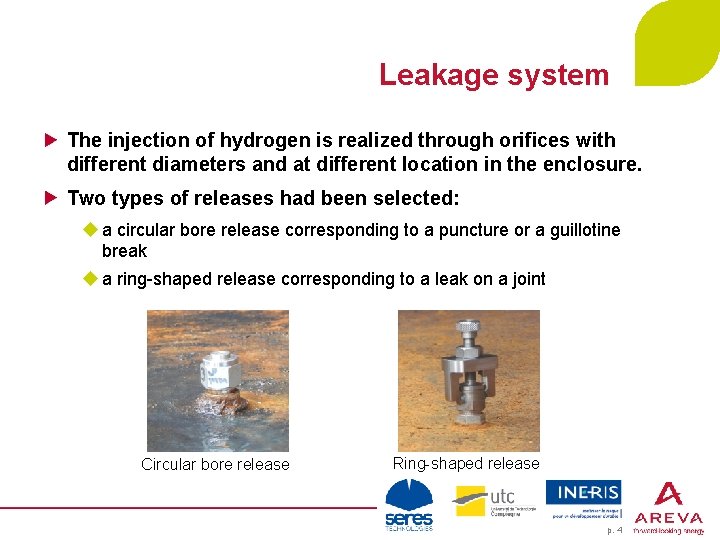
Leakage system The injection of hydrogen is realized through orifices with different diameters and at different location in the enclosure. Two types of releases had been selected: u a circular bore release corresponding to a puncture or a guillotine break u a ring-shaped release corresponding to a leak on a joint Circular bore release Ring-shaped release p. 4
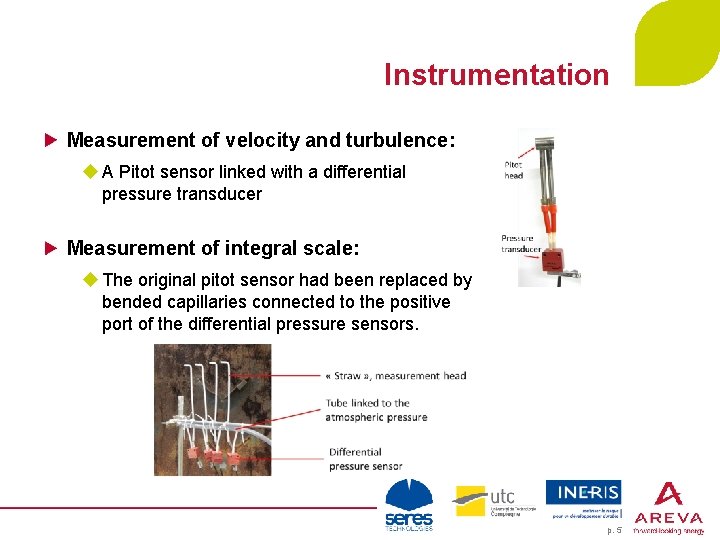
Instrumentation Measurement of velocity and turbulence: u A Pitot sensor linked with a differential pressure transducer Measurement of integral scale: u The original pitot sensor had been replaced by bended capillaries connected to the positive port of the differential pressure sensors. p. 5
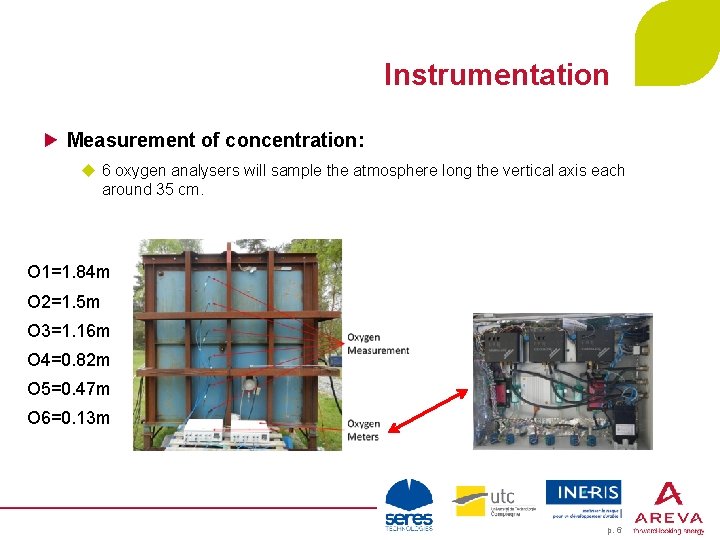
Instrumentation Measurement of concentration: u 6 oxygen analysers will sample the atmosphere long the vertical axis each around 35 cm. O 1=1. 84 m O 2=1. 5 m O 3=1. 16 m O 4=0. 82 m O 5=0. 47 m O 6=0. 13 m p. 6
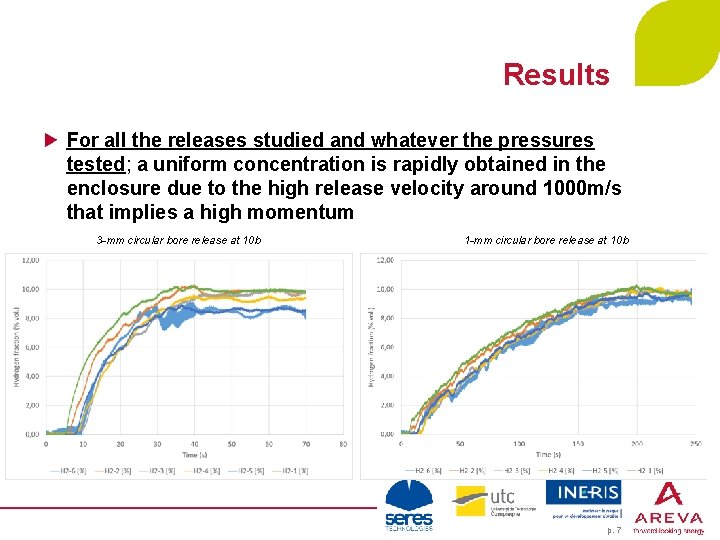
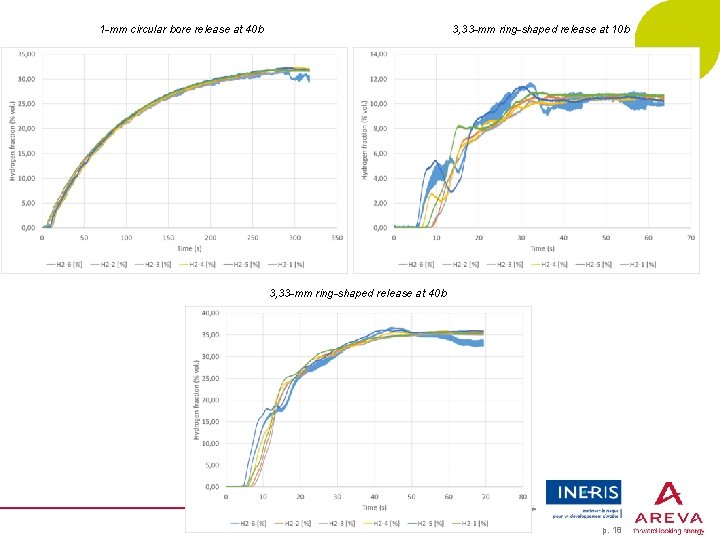
Results For all the releases studied and whatever the pressures tested; a uniform concentration is rapidly obtained in the enclosure due to the high release velocity around 1000 m/s that implies a high momentum 3 -mm circular bore release at 10 b 1 -mm circular bore release at 10 b p. 7
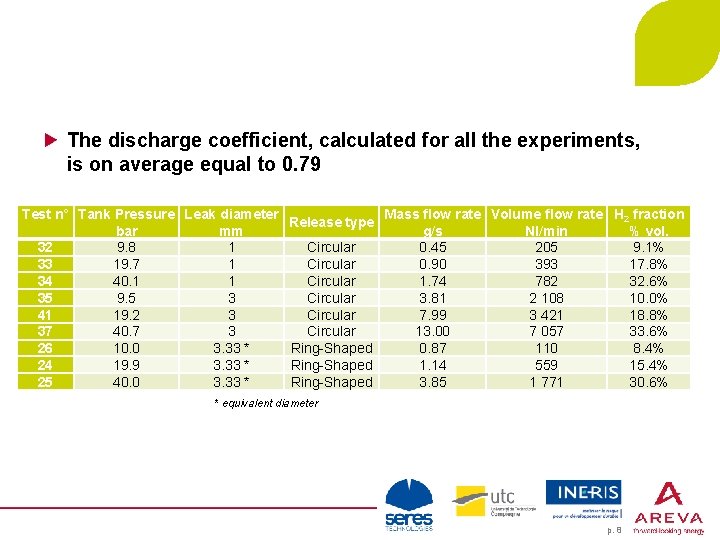
The discharge coefficient, calculated for all the experiments, is on average equal to 0. 79 Test n° Tank Pressure Leak diameter bar mm 32 9. 8 1 33 19. 7 1 34 40. 1 1 35 9. 5 3 41 19. 2 3 37 40. 7 3 26 10. 0 3. 33 * 24 19. 9 3. 33 * 25 40. 0 3. 33 * Mass flow rate Volume flow rate H 2 fraction g/s Nl/min % vol. Circular 0. 45 205 9. 1% Circular 0. 90 393 17. 8% Circular 1. 74 782 32. 6% Circular 3. 81 2 108 10. 0% Circular 7. 99 3 421 18. 8% Circular 13. 00 7 057 33. 6% Ring-Shaped 0. 87 110 8. 4% Ring-Shaped 1. 14 559 15. 4% Ring-Shaped 3. 85 1 771 30. 6% Release type * equivalent diameter p. 8
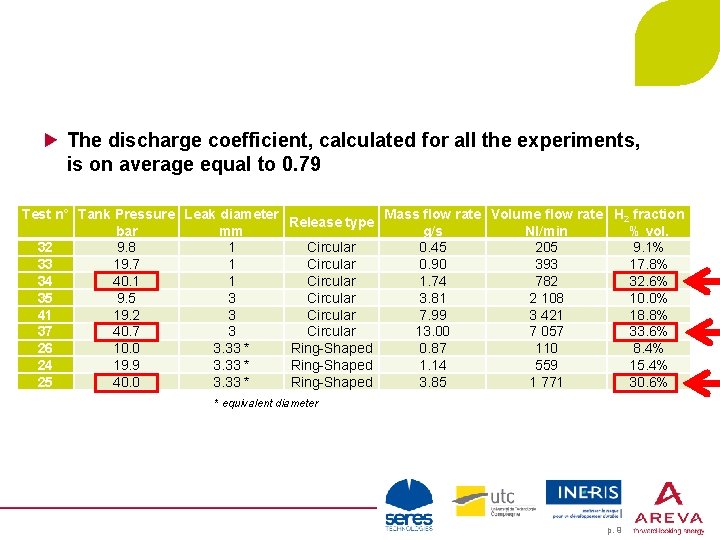
The discharge coefficient, calculated for all the experiments, is on average equal to 0. 79 Test n° Tank Pressure Leak diameter bar mm 32 9. 8 1 33 19. 7 1 34 40. 1 1 35 9. 5 3 41 19. 2 3 37 40. 7 3 26 10. 0 3. 33 * 24 19. 9 3. 33 * 25 40. 0 3. 33 * Mass flow rate Volume flow rate H 2 fraction g/s Nl/min % vol. Circular 0. 45 205 9. 1% Circular 0. 90 393 17. 8% Circular 1. 74 782 32. 6% Circular 3. 81 2 108 10. 0% Circular 7. 99 3 421 18. 8% Circular 13. 00 7 057 33. 6% Ring-Shaped 0. 87 110 8. 4% Ring-Shaped 1. 14 559 15. 4% Ring-Shaped 3. 85 1 771 30. 6% Release type * equivalent diameter p. 9
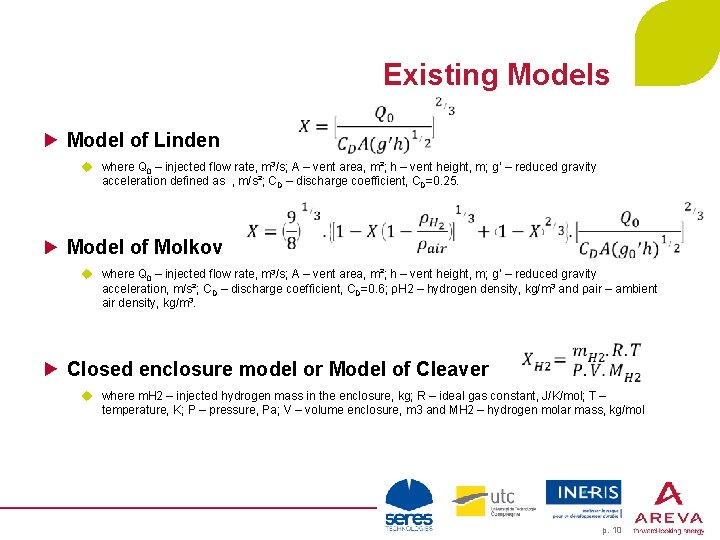
Existing Models Model of Linden u where Q 0 – injected flow rate, m 3/s; A – vent area, m²; h – vent height, m; g’ – reduced gravity acceleration defined as , m/s²; CD – discharge coefficient, CD=0. 25. Model of Molkov u where Q 0 – injected flow rate, m 3/s; A – vent area, m²; h – vent height, m; g’ – reduced gravity acceleration, m/s²; CD – discharge coefficient, CD=0. 6; ρH 2 – hydrogen density, kg/m 3 and ρair – ambient air density, kg/m 3. Closed enclosure model or Model of Cleaver u where m. H 2 – injected hydrogen mass in the enclosure, kg; R – ideal gas constant, J/K/mol; T – temperature, K; P – pressure, Pa; V – volume enclosure, m 3 and MH 2 – hydrogen molar mass, kg/mol p. 10
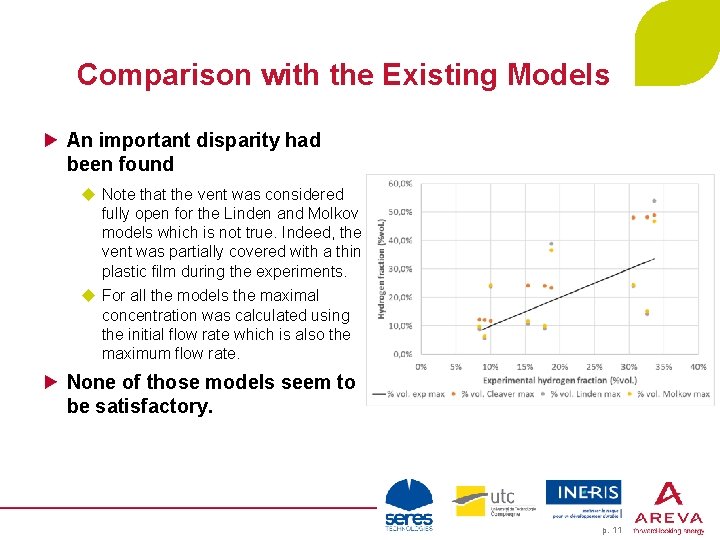
Comparison with the Existing Models An important disparity had been found u Note that the vent was considered fully open for the Linden and Molkov models which is not true. Indeed, the vent was partially covered with a thin plastic film during the experiments. u For all the models the maximal concentration was calculated using the initial flow rate which is also the maximum flow rate. None of those models seem to be satisfactory. p. 11
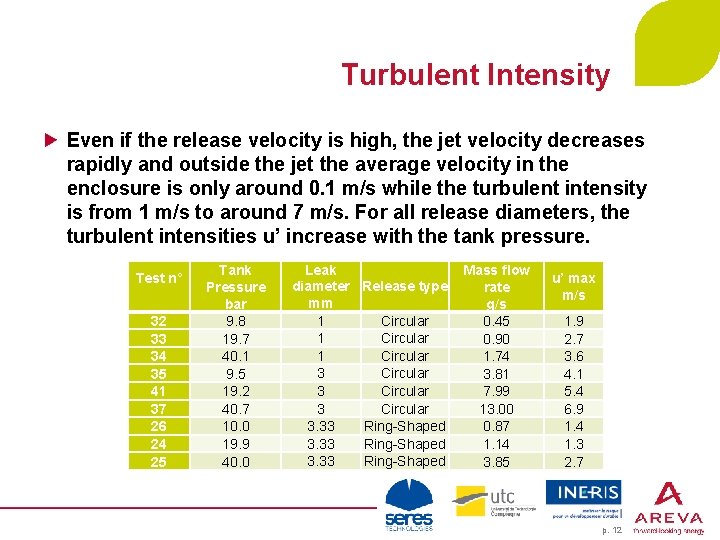
Turbulent Intensity Even if the release velocity is high, the jet velocity decreases rapidly and outside the jet the average velocity in the enclosure is only around 0. 1 m/s while the turbulent intensity is from 1 m/s to around 7 m/s. For all release diameters, the turbulent intensities u’ increase with the tank pressure. Test n° 32 33 34 35 41 37 26 24 25 Tank Pressure bar 9. 8 19. 7 40. 1 9. 5 19. 2 40. 7 10. 0 19. 9 40. 0 Leak diameter Release type mm 1 Circular 3 Circular 3. 33 Ring-Shaped Mass flow rate g/s 0. 45 0. 90 1. 74 3. 81 7. 99 13. 00 0. 87 1. 14 3. 85 u’ max m/s 1. 9 2. 7 3. 6 4. 1 5. 4 6. 9 1. 4 1. 3 2. 7 p. 12
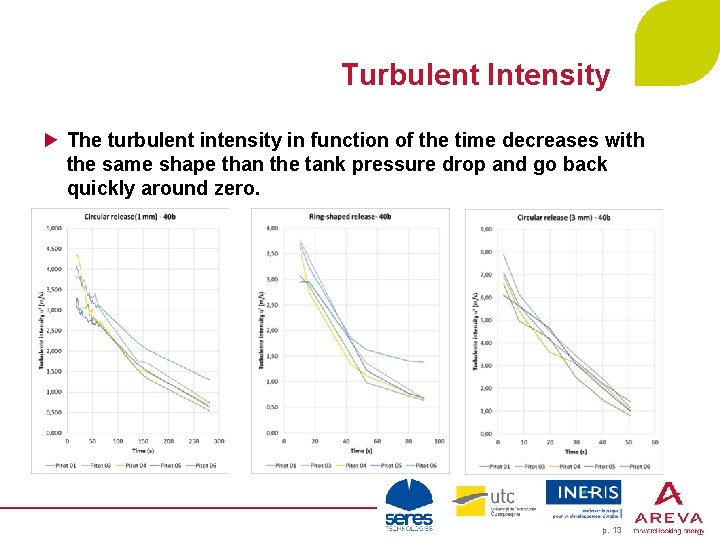
Turbulent Intensity The turbulent intensity in function of the time decreases with the same shape than the tank pressure drop and go back quickly around zero. p. 13
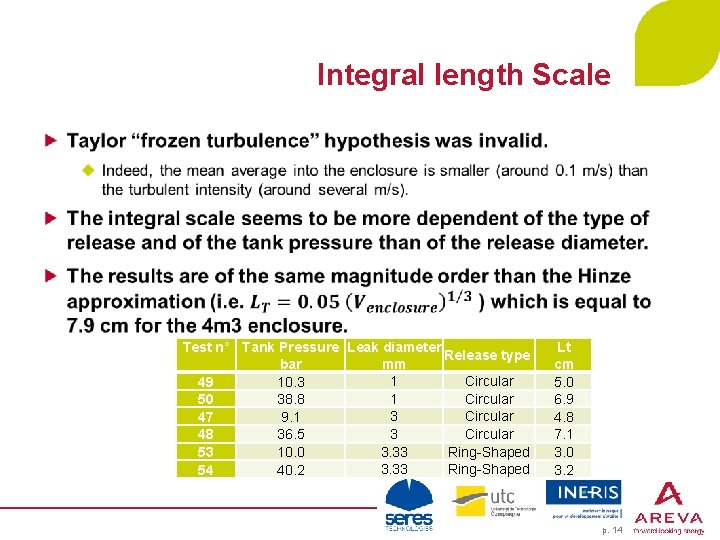
Integral length Scale Test n° Tank Pressure Leak diameter Release type mm bar 1 Circular 49 10. 3 1 Circular 50 38. 8 3 Circular 47 9. 1 3 Circular 48 36. 5 3. 33 Ring-Shaped 53 10. 0 3. 33 Ring-Shaped 54 40. 2 Lt cm 5. 0 6. 9 4. 8 7. 1 3. 0 3. 2 p. 14
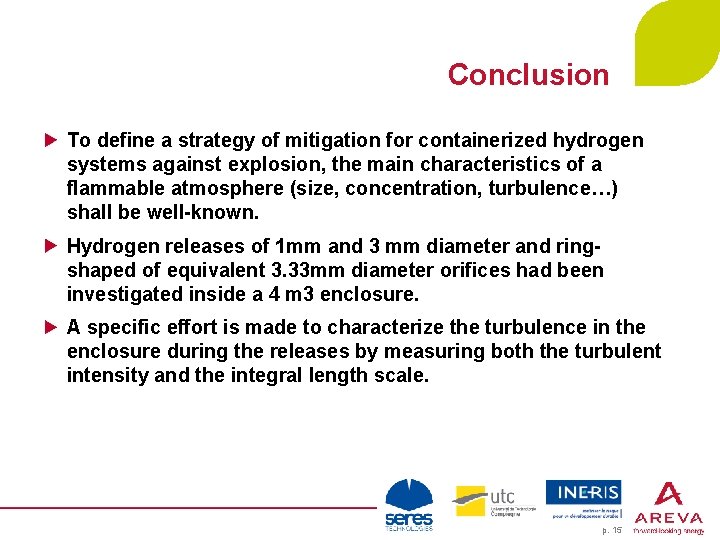
Conclusion To define a strategy of mitigation for containerized hydrogen systems against explosion, the main characteristics of a flammable atmosphere (size, concentration, turbulence…) shall be well-known. Hydrogen releases of 1 mm and 3 mm diameter and ringshaped of equivalent 3. 33 mm diameter orifices had been investigated inside a 4 m 3 enclosure. A specific effort is made to characterize the turbulence in the enclosure during the releases by measuring both the turbulent intensity and the integral length scale. p. 15
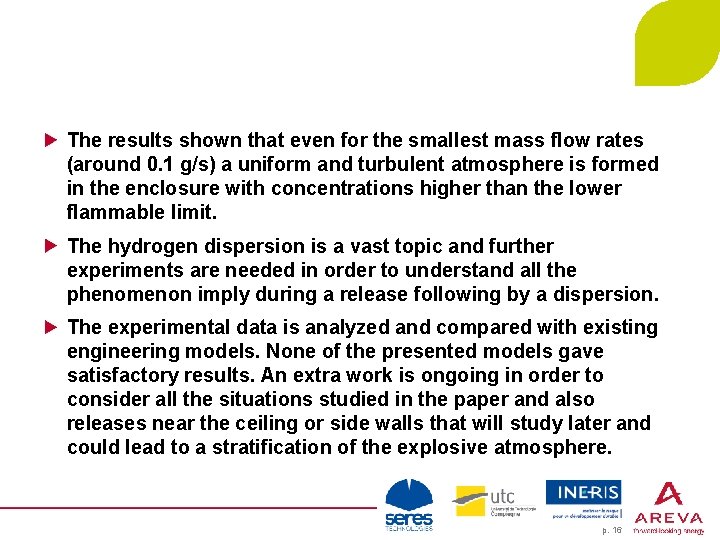
The results shown that even for the smallest mass flow rates (around 0. 1 g/s) a uniform and turbulent atmosphere is formed in the enclosure with concentrations higher than the lower flammable limit. The hydrogen dispersion is a vast topic and further experiments are needed in order to understand all the phenomenon imply during a release following by a dispersion. The experimental data is analyzed and compared with existing engineering models. None of the presented models gave satisfactory results. An extra work is ongoing in order to consider all the situations studied in the paper and also releases near the ceiling or side walls that will study later and could lead to a stratification of the explosive atmosphere. p. 16
Development of a Realistic Hydrogen Flammable Atmosphere Inside a 4 -m 3 Enclosure THANK YOU FOR YOUR ATTENTION Audrey DUCLOS, Ph. D Student Research engineer AREVA Energy Storage Audrey. duclos@areva. com p. 17
1 -mm circular bore release at 40 b 3, 33 -mm ring-shaped release at 10 b 3, 33 -mm ring-shaped release at 40 b p. 18
- Slides: 18