
Development of a Population Density and Land Use
- Slides: 55
Development of a Population Density and Land Use Based Regression Model to Calculate the Amount of Imperviousness Anna Chabaeva, Daniel L. Civco & Sandy Prisloe Department of Natural Resources Management & Engineering The University of Connecticut U-4087, Room 308, 1376 Storrs Road Storrs, CT 06269 -4087 May 26, 2004
Objectives Primary § Develop, assess, and refine a regression-based modeling technique to be used with National Land Cover Data (NLCD) and population density to predict percent imperviousness Secondary § Interpolate population density value for Connecticut watersheds § Estimate percent imperviousness for Connecticut Census tracts and watersheds 2
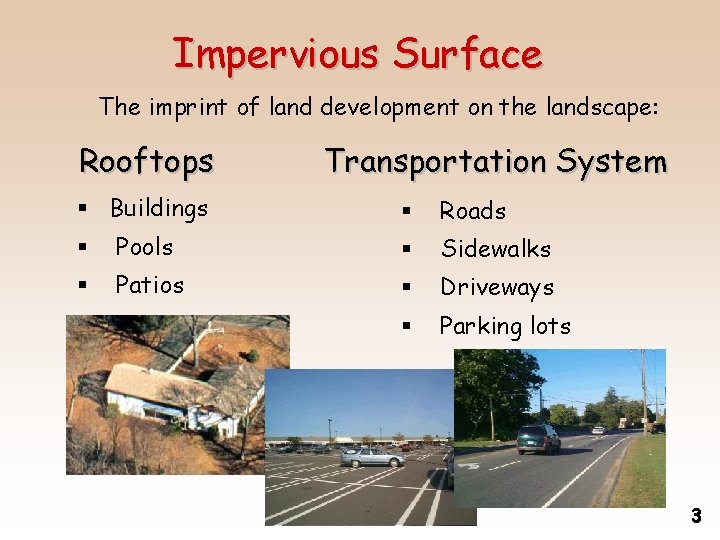
Impervious Surface The imprint of land development on the landscape: Rooftops Transportation System § Buildings § Roads § Pools § Sidewalks § Patios § Driveways § Parking lots 3
Impact of Imperviousness Limits the infiltration of water into soil and changes: § Flow dynamics – high flows low flows § Sedimentation load § Temperature regime § Pollution profile of storm water runoff § Stream biodiversity 4
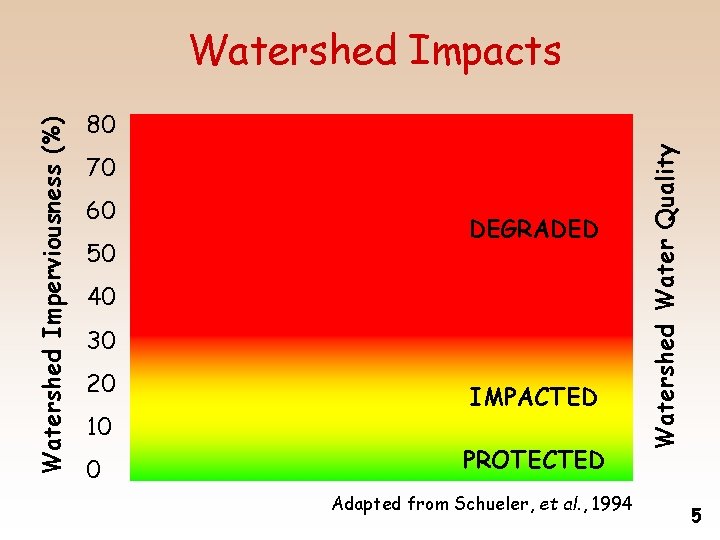
80 70 60 50 DEGRADED 40 30 20 10 0 IMPACTED PROTECTED Adapted from Schueler, et al. , 1994 Watershed Water Quality Watershed Imperviousness (%) Watershed Impacts 5
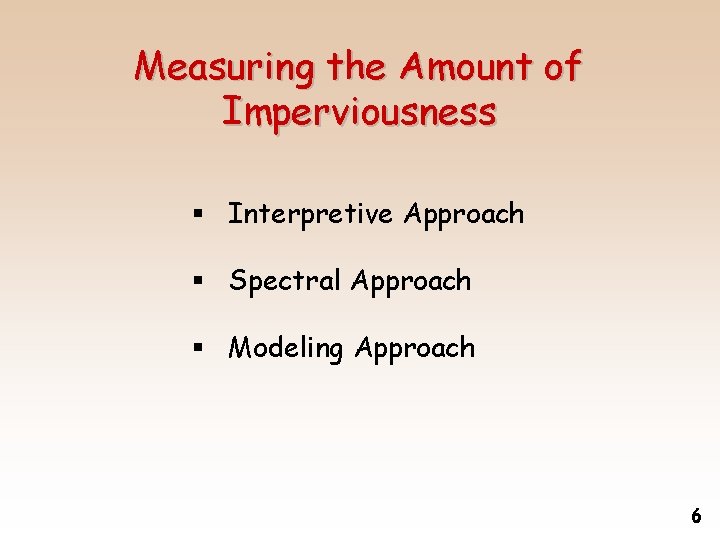
Measuring the Amount of Imperviousness § Interpretive Approach § Spectral Approach § Modeling Approach 6
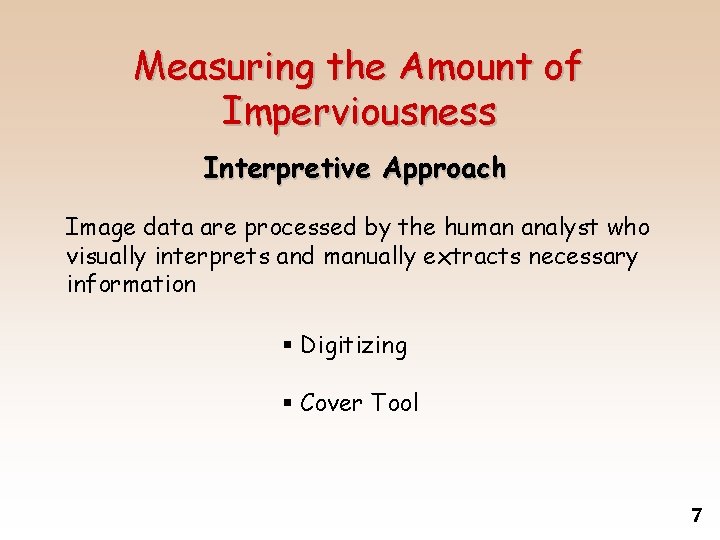
Measuring the Amount of Imperviousness Interpretive Approach Image data are processed by the human analyst who visually interprets and manually extracts necessary information § Digitizing § Cover Tool 7
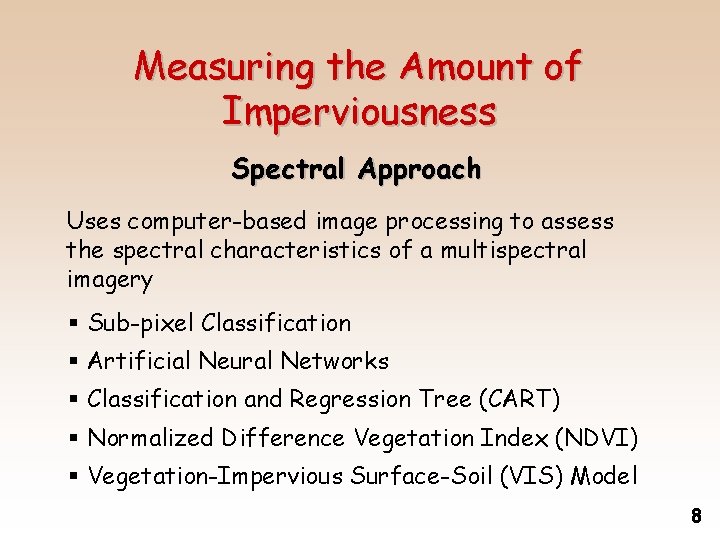
Measuring the Amount of Imperviousness Spectral Approach Uses computer-based image processing to assess the spectral characteristics of a multispectral imagery § Sub-pixel Classification § Artificial Neural Networks § Classification and Regression Tree (CART) § Normalized Difference Vegetation Index (NDVI) § Vegetation-Impervious Surface-Soil (VIS) Model 8
Measuring the Amount of Imperviousness Modeling Approach Employs numerical or statistical models to data derived from remote sensing imagery and/or ancillary spatial information § Population Density Based § Impervious Surface Analysis Tool (ISAT) § Regression Model 9
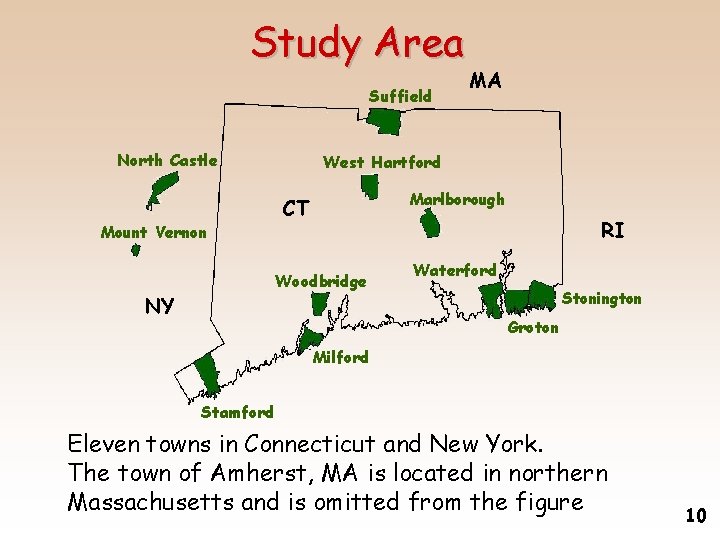
Study Area Suffield North Castle Mount Vernon West Hartford Marlborough CT RI Woodbridge NY MA Waterford Stonington Groton Milford Stamford Eleven towns in Connecticut and New York. The town of Amherst, MA is located in northern Massachusetts and is omitted from the figure 10
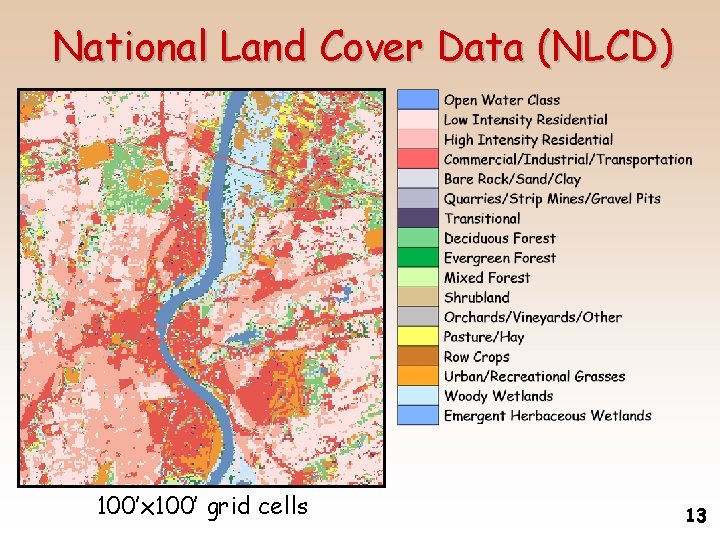
Data Requirements All datasets are in Connecticut State Plane feet, NAD 83 coordinates § Planimetric data § National Land Cover Data (NLCD) 1992 § Census tracts 1990 data § Census blocks 2000 data § CT watershed boundary data § Town boundary data 11
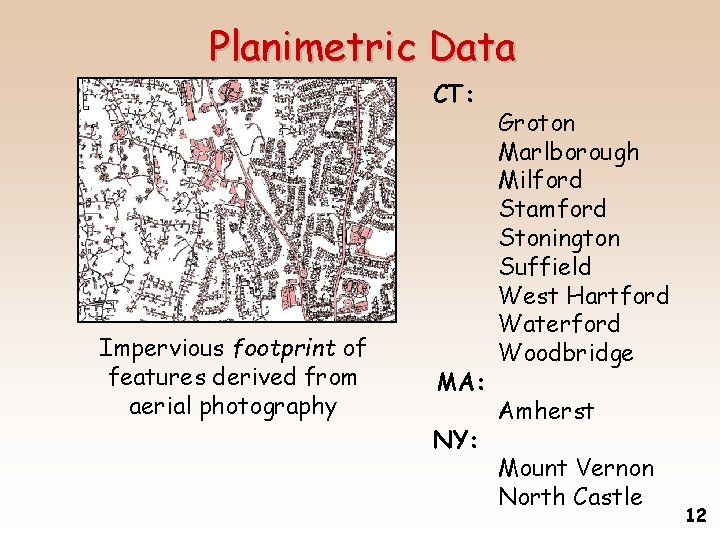
Planimetric Data CT: Impervious footprint of features derived from aerial photography MA: NY: Groton Marlborough Milford Stamford Stonington Suffield West Hartford Waterford Woodbridge Amherst Mount Vernon North Castle 12
National Land Cover Data (NLCD) 100’x 100’ grid cells 13
Accuracy Report for NLCD Classes Overall Accuracy – 0. 46; NR – not reported 14
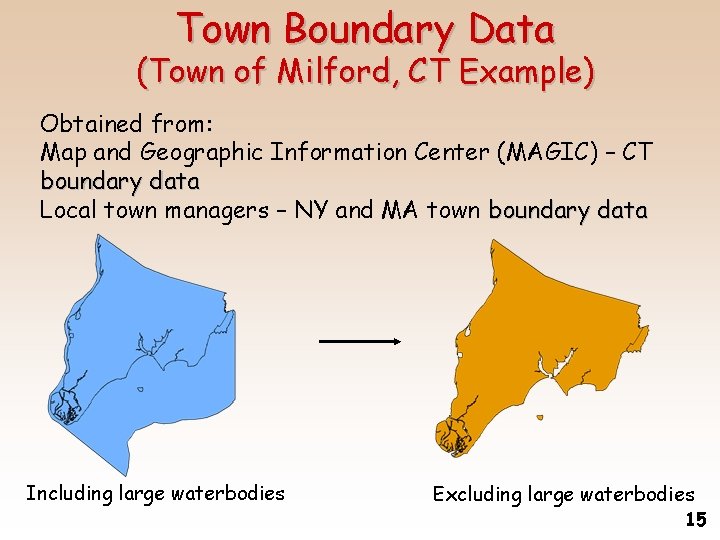
Town Boundary Data (Town of Milford, CT Example) Obtained from: Map and Geographic Information Center (MAGIC) – CT boundary data Local town managers – NY and MA town boundary data Including large waterbodies Excluding large waterbodies 15
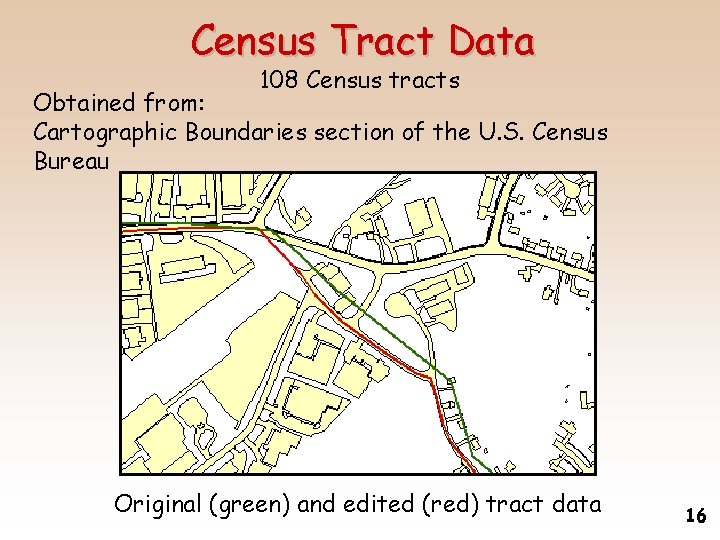
Census Tract Data 108 Census tracts Obtained from: Cartographic Boundaries section of the U. S. Census Bureau Original (green) and edited (red) tract data 16
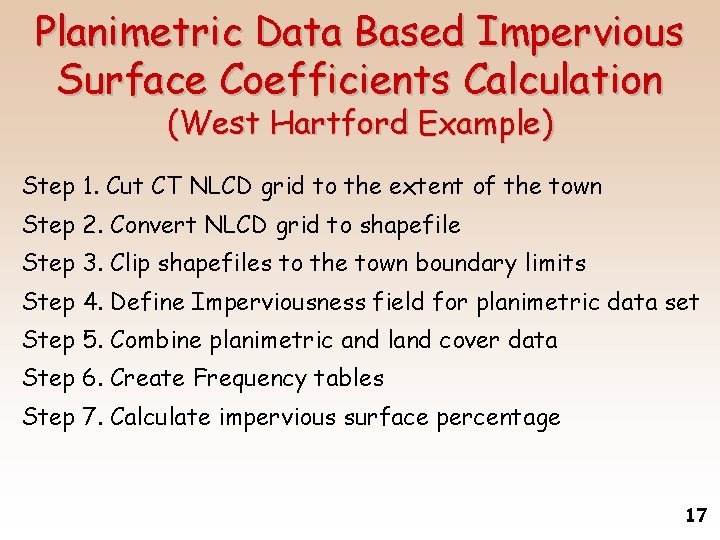
Planimetric Data Based Impervious Surface Coefficients Calculation (West Hartford Example) Step 1. Cut CT NLCD grid to the extent of the town Step 2. Convert NLCD grid to shapefile Step 3. Clip shapefiles to the town boundary limits Step 4. Define Imperviousness field for planimetric data set Step 5. Combine planimetric and land cover data Step 6. Create Frequency tables Step 7. Calculate impervious surface percentage 17
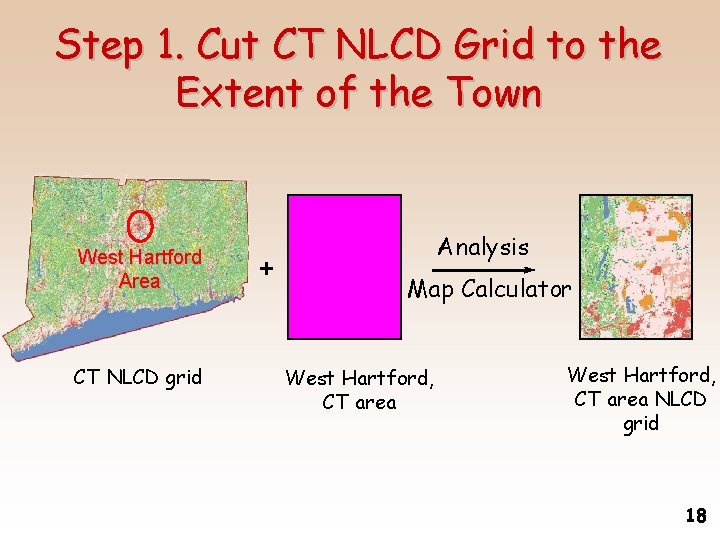
Step 1. Cut CT NLCD Grid to the Extent of the Town West Hartford Area CT NLCD grid + Analysis Map Calculator West Hartford, CT area NLCD grid 18
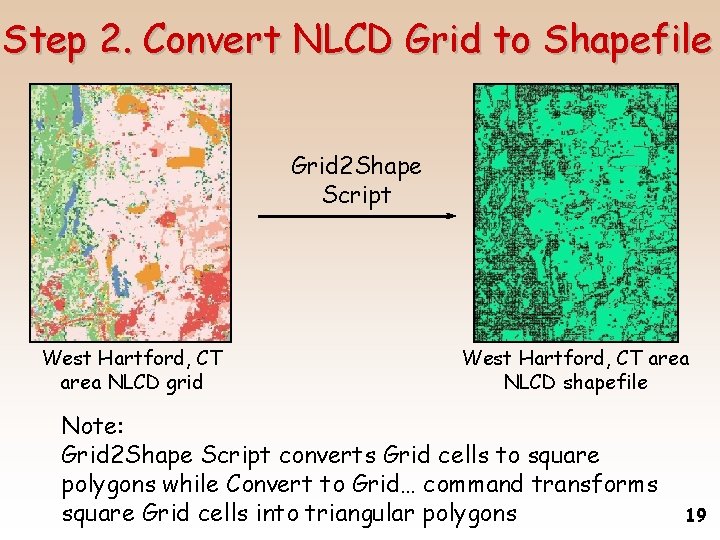
Step 2. Convert NLCD Grid to Shapefile Grid 2 Shape Script West Hartford, CT area NLCD grid West Hartford, CT area NLCD shapefile Note: Grid 2 Shape Script converts Grid cells to square polygons while Convert to Grid… command transforms square Grid cells into triangular polygons 19
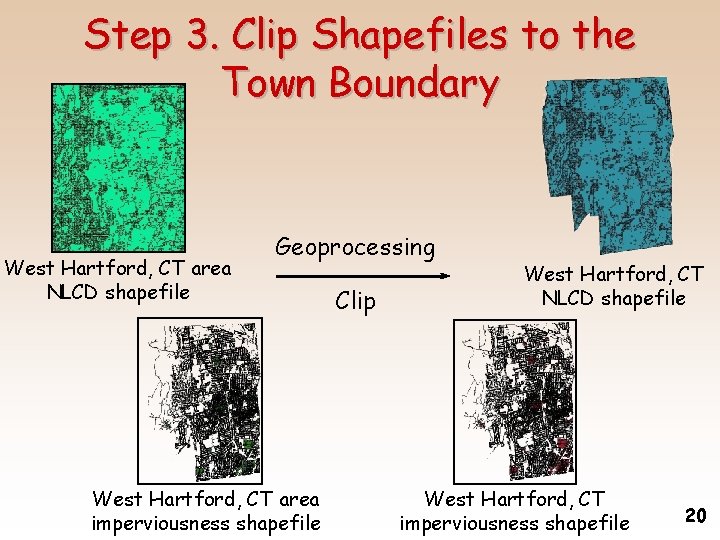
Step 3. Clip Shapefiles to the Town Boundary West Hartford, CT area NLCD shapefile Geoprocessing West Hartford, CT area imperviousness shapefile Clip West Hartford, CT NLCD shapefile West Hartford, CT imperviousness shapefile 20
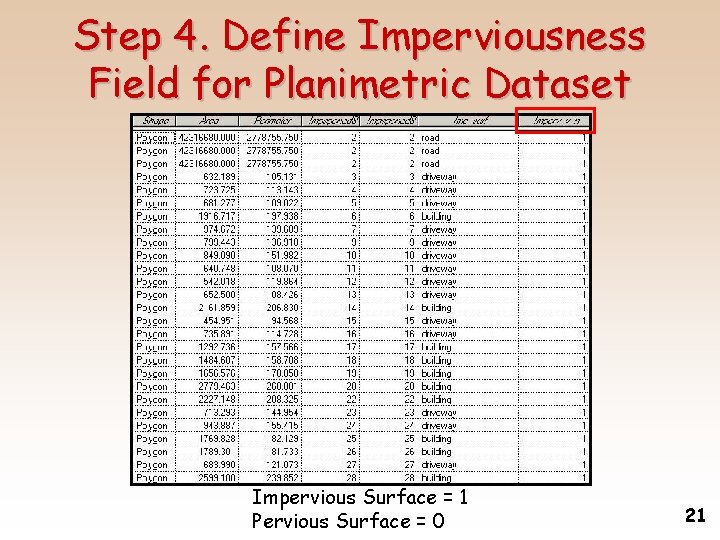
Step 4. Define Imperviousness Field for Planimetric Dataset Impervious Surface = 1 Pervious Surface = 0 21
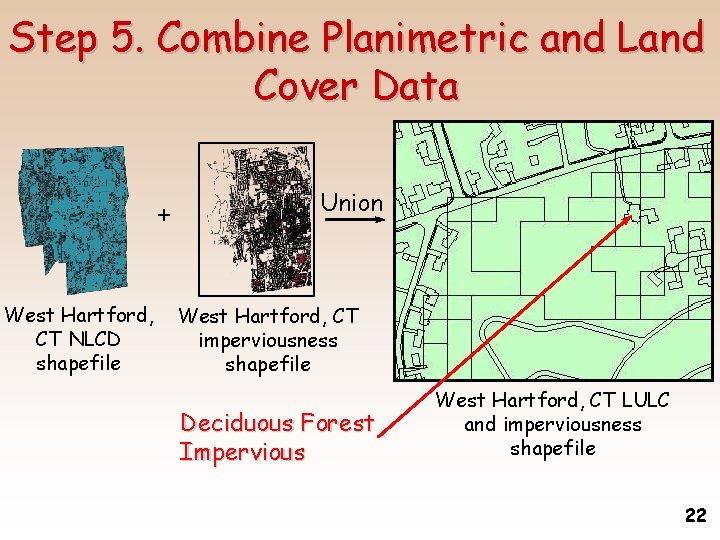
Step 5. Combine Planimetric and Land Cover Data + West Hartford, CT NLCD shapefile Union West Hartford, CT imperviousness shapefile Deciduous Forest Impervious West Hartford, CT LULC and imperviousness shapefile 22
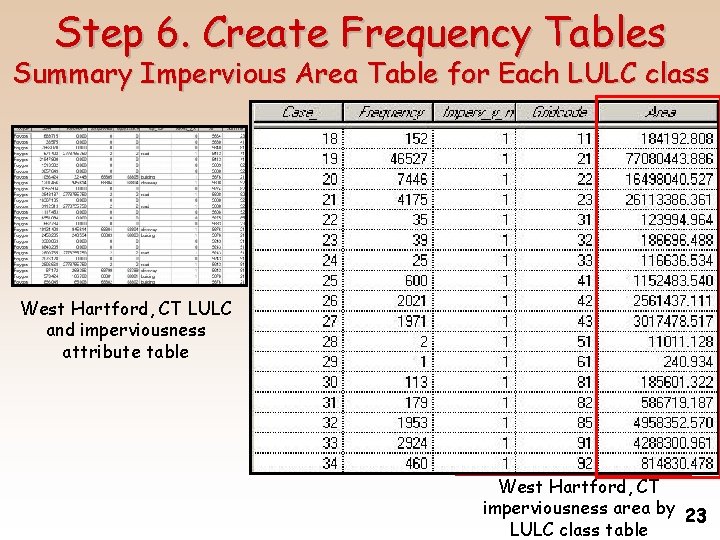
Step 6. Create Frequency Tables Summary Impervious Area Table for Each LULC class Xtools Extension Table Frequency West Hartford, CT LULC and imperviousness attribute table Frequency Fields: Gridcode Imperv_y_n Summary Field: Area West Hartford, CT imperviousness area by 23 LULC class table
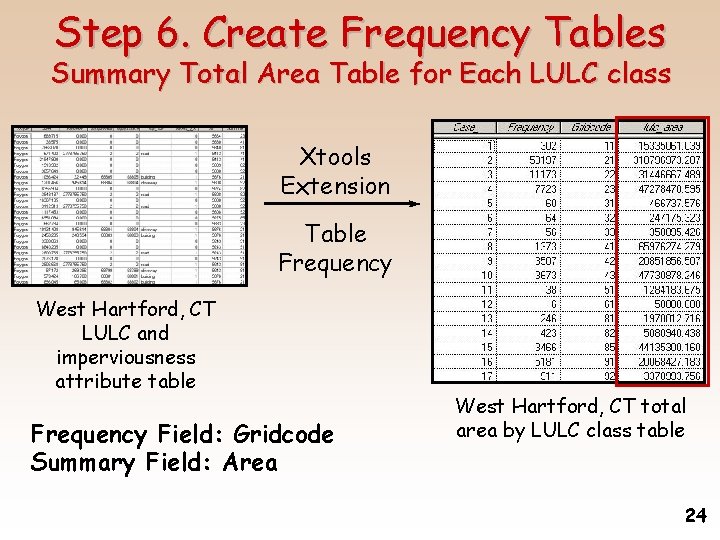
Step 6. Create Frequency Tables Summary Total Area Table for Each LULC class Xtools Extension Table Frequency West Hartford, CT LULC and imperviousness attribute table Frequency Field: Gridcode Summary Field: Area West Hartford, CT total area by LULC class table 24
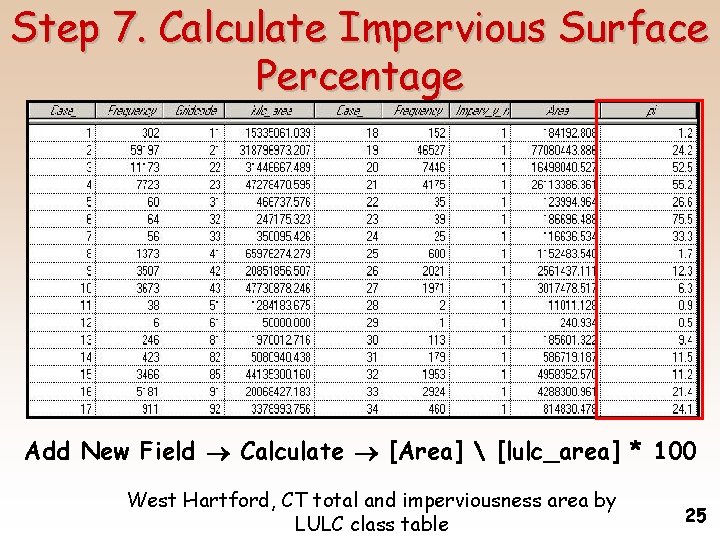
Step 7. Calculate Impervious Surface Percentage Join + West Hartford Total Area by LULC class Table West Hartford Imperviousness Area by LULC class Table Add New Field Calculate [Area] [lulc_area] * 100 West Hartford, CT total and imperviousness area by LULC class table 25
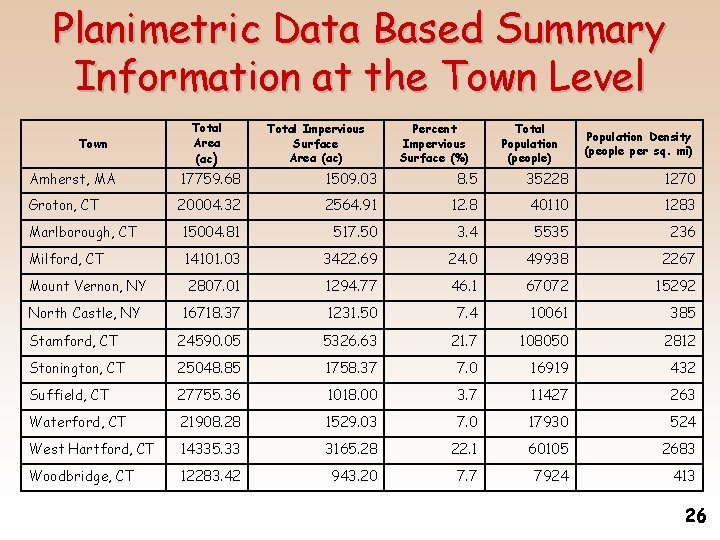
Planimetric Data Based Summary Information at the Town Level Town Total Area (ac) Total Impervious Surface Area (ac) Percent Impervious Surface (%) Total Population (people) Population Density (people per sq. mi) Amherst, MA 17759. 68 1509. 03 8. 5 35228 1270 Groton, CT 20004. 32 2564. 91 12. 8 40110 1283 Marlborough, CT 15004. 81 517. 50 3. 4 5535 236 Milford, CT 14101. 03 3422. 69 24. 0 49938 2267 Mount Vernon, NY 2807. 01 1294. 77 46. 1 67072 15292 North Castle, NY 16718. 37 1231. 50 7. 4 10061 385 Stamford, CT 24590. 05 5326. 63 21. 7 108050 2812 Stonington, CT 25048. 85 1758. 37 7. 0 16919 432 Suffield, CT 27755. 36 1018. 00 3. 7 11427 263 Waterford, CT 21908. 28 1529. 03 7. 0 17930 524 West Hartford, CT 14335. 33 3165. 28 22. 1 60105 2683 Woodbridge, CT 12283. 42 943. 20 7. 7 7924 413 26
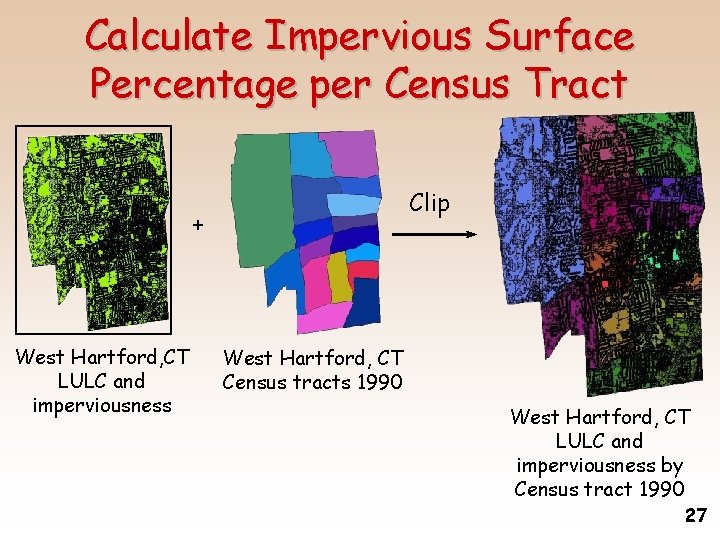
Calculate Impervious Surface Percentage per Census Tract Clip + West Hartford, CT LULC and imperviousness West Hartford, CT Census tracts 1990 West Hartford, CT LULC and imperviousness by Census tract 1990 27
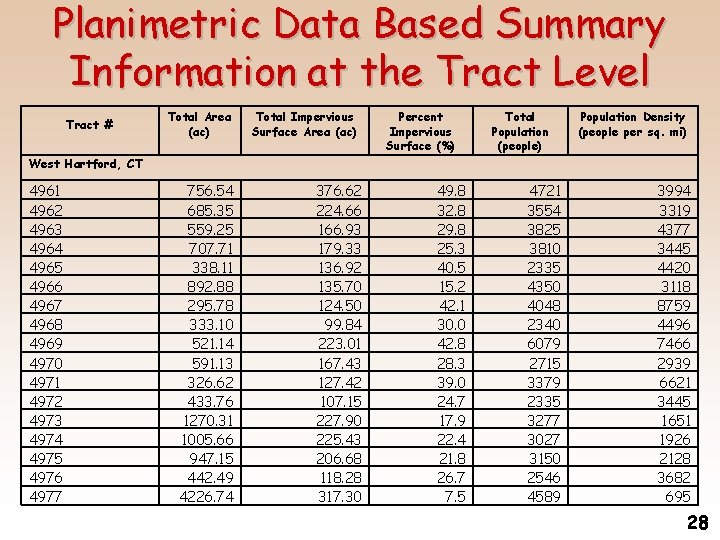
Planimetric Data Based Summary Information at the Tract Level Tract # Total Area (ac) Total Impervious Surface Area (ac) Percent Impervious Surface (%) Total Population (people) Population Density (people per sq. mi) West Hartford, CT 4961 4962 4963 4964 4965 4966 4967 4968 4969 4970 4971 4972 4973 4974 4975 4976 4977 756. 54 685. 35 559. 25 707. 71 338. 11 892. 88 295. 78 333. 10 521. 14 591. 13 326. 62 433. 76 1270. 31 1005. 66 947. 15 442. 49 4226. 74 376. 62 224. 66 166. 93 179. 33 136. 92 135. 70 124. 50 99. 84 223. 01 167. 43 127. 42 107. 15 227. 90 225. 43 206. 68 118. 28 317. 30 49. 8 32. 8 29. 8 25. 3 40. 5 15. 2 42. 1 30. 0 42. 8 28. 3 39. 0 24. 7 17. 9 22. 4 21. 8 26. 7 7. 5 4721 3554 3825 3810 2335 4350 4048 2340 6079 2715 3379 2335 3277 3027 3150 2546 4589 3994 3319 4377 3445 4420 3118 8759 4496 7466 2939 6621 3445 1651 1926 2128 3682 695 28
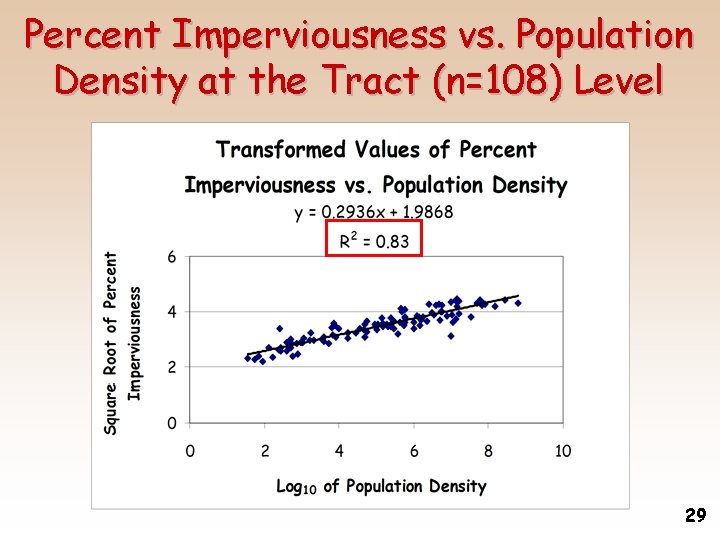
Percent Imperviousness vs. Population Density at the Tract (n=108) Level 29
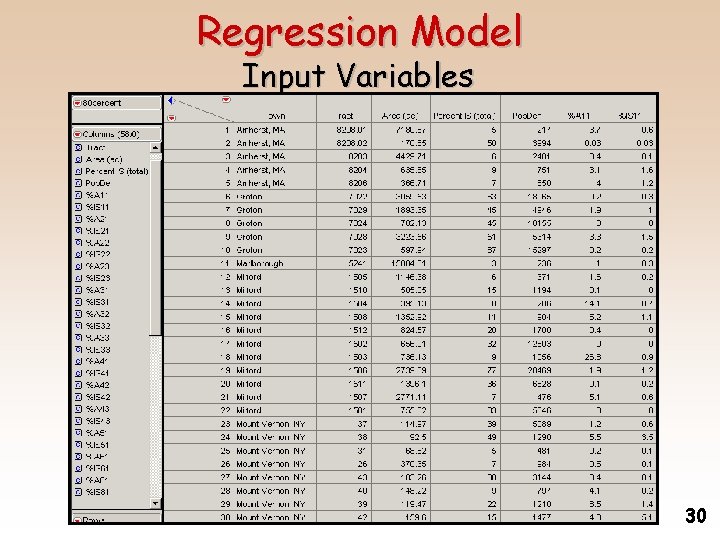
Regression Model Input Variables Total percent imperviousness based on planimetric data Population density % A 11 – percent of Open Water class area % A 21 – percent of Low Intensity Residential class area % A 22 – percent of High Intensity Residential class area % A 23 – percent of Commercial/Industrial/Transportation class area % A 31 – percent of Bare Rock/Sand/Clay class area % A 32 – percent of Quarries/Strip Mines/Gravel Pits class area % A 33 – percent of Transitional class area % A 41 – percent of Deciduous Forest class area % A 42 – percent of Coniferous Forest class area % A 43 – percent of Mixed Forest class area % A 51 – percent of Shrubland class area % A 61 – percent of Orchards/Vineyards/Other class area % A 81 – percent of Pasture/Hay class area % A 82 – percent of Row Crops class area % A 85 – percent of Urban/Recreational Grasses class area % A 91 – percent of Woody Wetlands class area % A 92 – percent of Emergent Herbaceous Wetlands class area 30
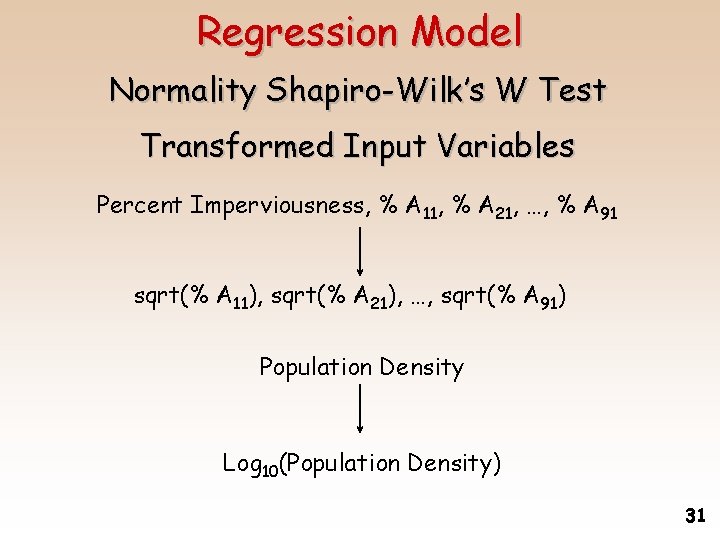
Regression Model Normality Shapiro-Wilk’s W Test Transformed Input Variables Percent Imperviousness, % A 11, % A 21, …, % A 91 sqrt(% A 11), sqrt(% A 21), …, sqrt(% A 91) Population Density Log 10(Population Density) 31
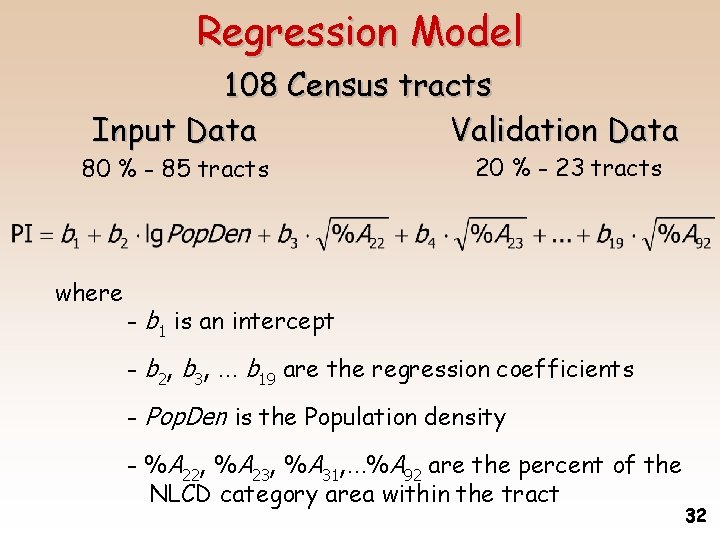
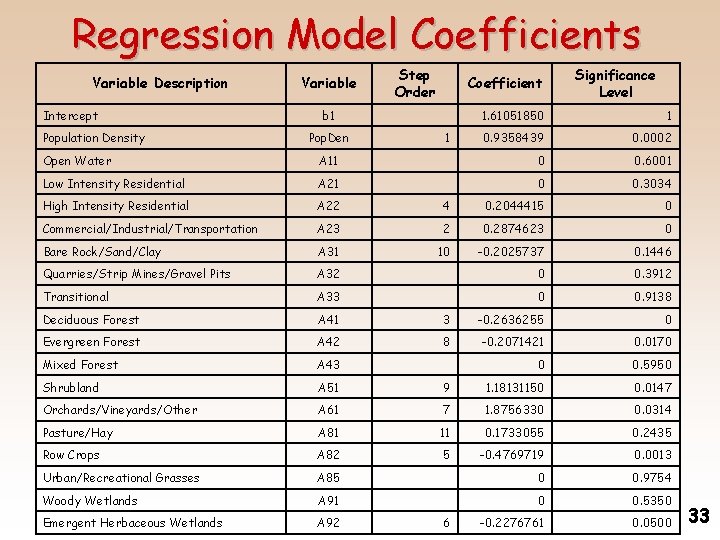
Regression Model 108 Census tracts Input Data Validation Data 80 % - 85 tracts where 20 % - 23 tracts - b 1 is an intercept - b 2, b 3, … b 19 are the regression coefficients - Pop. Den is the Population density - %A 22, %A 23, %A 31, …%A 92 are the percent of the NLCD category area within the tract 32
Regression Model Coefficients Variable Description Intercept Population Density Variable Step Order Coefficient b 1 Pop. Den 1 Significance Level 1. 61051850 1 0. 9358439 0. 0002 Open Water A 11 0 0. 6001 Low Intensity Residential A 21 0 0. 3034 High Intensity Residential A 22 4 0. 2044415 0 Commercial/Industrial/Transportation A 23 2 0. 2874623 0 Bare Rock/Sand/Clay A 31 10 -0. 2025737 0. 1446 Quarries/Strip Mines/Gravel Pits A 32 0 0. 3912 Transitional A 33 0 0. 9138 Deciduous Forest A 41 3 -0. 2636255 0 Evergreen Forest A 42 8 -0. 2071421 0. 0170 Mixed Forest A 43 0 0. 5950 Shrubland A 51 9 1. 18131150 0. 0147 Orchards/Vineyards/Other A 61 7 1. 8756330 0. 0314 Pasture/Hay A 81 11 0. 1733055 0. 2435 Row Crops A 82 5 -0. 4769719 0. 0013 Urban/Recreational Grasses A 85 0 0. 9754 Woody Wetlands A 91 0 0. 5350 Emergent Herbaceous Wetlands A 92 -0. 2276761 0. 0500 6 33
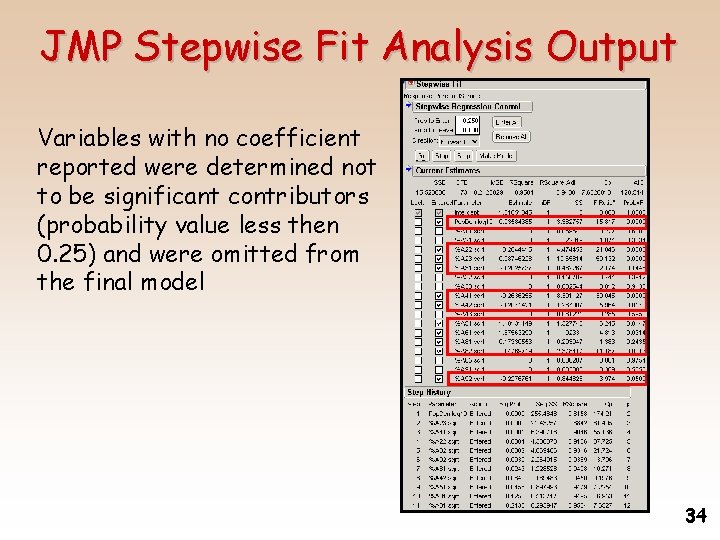
JMP Stepwise Fit Analysis Output Variables with no coefficient reported were determined not to be significant contributors (probability value less then 0. 25) and were omitted from the final model 34
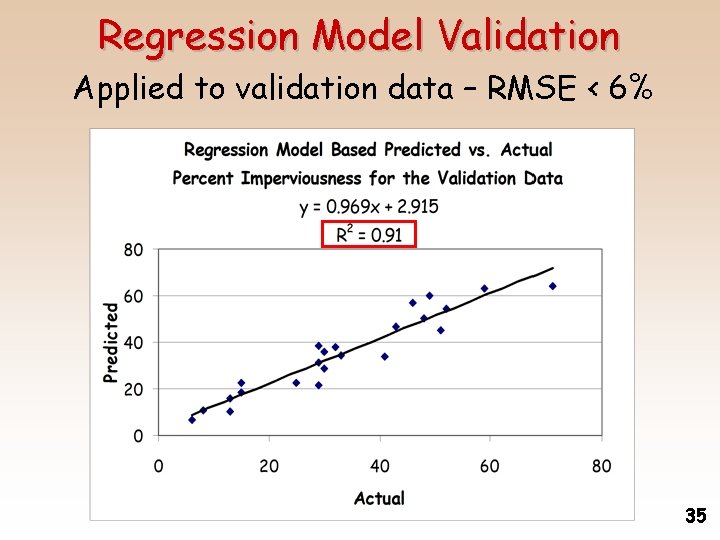
Regression Model Validation Applied to validation data – RMSE < 6% 35
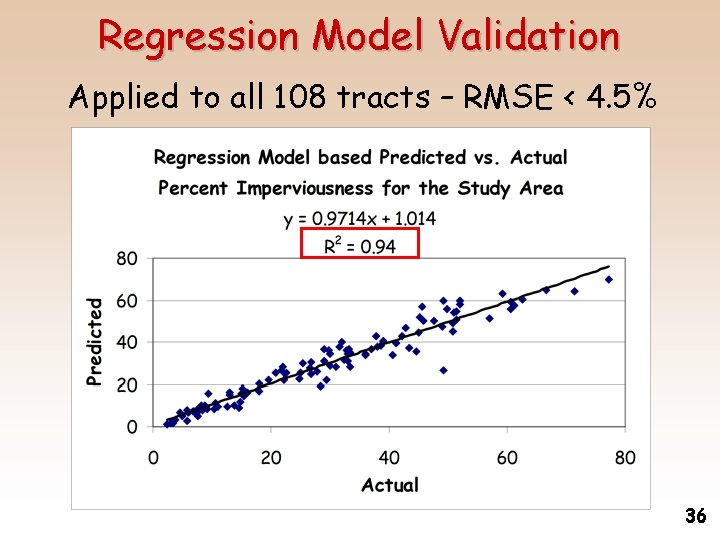
Regression Model Validation Applied to all 108 tracts – RMSE < 4. 5% 36
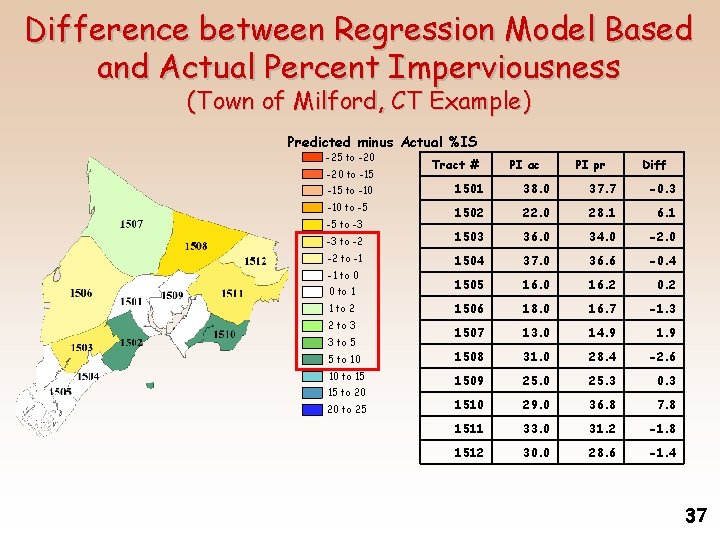
Difference between Regression Model Based and Actual Percent Imperviousness (Town of Milford, CT Example) Predicted minus Actual %IS -25 to -20 to -15 Tract # PI ac PI pr Diff -15 to -10 1501 38. 0 37. 7 -0. 3 -10 to -5 1502 22. 0 28. 1 6. 1 -3 to -2 1503 36. 0 34. 0 -2 to -1 1504 37. 0 36. 6 -0. 4 1505 16. 0 16. 2 0. 2 1506 18. 0 16. 7 -1. 3 1507 13. 0 14. 9 1. 9 5 to 10 1508 31. 0 28. 4 -2. 6 10 to 15 1509 25. 0 25. 3 0. 3 1510 29. 0 36. 8 7. 8 1511 33. 0 31. 2 -1. 8 1512 30. 0 28. 6 -1. 4 -5 to -3 -1 to 0 0 to 1 1 to 2 2 to 3 3 to 5 15 to 20 20 to 25 37
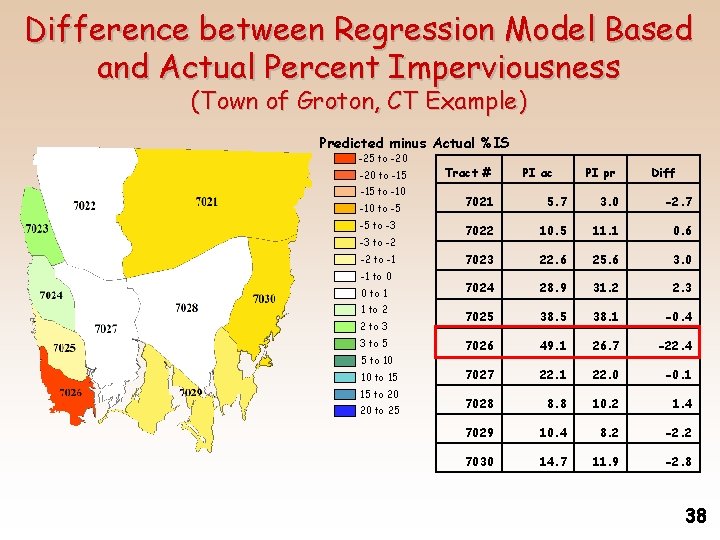
Difference between Regression Model Based and Actual Percent Imperviousness (Town of Groton, CT Example) Predicted minus Actual %IS -25 to -20 to -15 to -10 to -5 -5 to -3 -3 to -2 -2 to -1 -1 to 0 0 to 1 1 to 2 2 to 3 3 to 5 5 to 10 10 to 15 15 to 20 20 to 25 Tract # PI ac PI pr Diff 7021 5. 7 3. 0 -2. 7 7022 10. 5 11. 1 0. 6 7023 22. 6 25. 6 3. 0 7024 28. 9 31. 2 2. 3 7025 38. 1 -0. 4 7026 49. 1 26. 7 -22. 4 7027 22. 1 22. 0 -0. 1 7028 8. 8 10. 2 1. 4 7029 10. 4 8. 2 -2. 2 7030 14. 7 11. 9 -2. 8 38
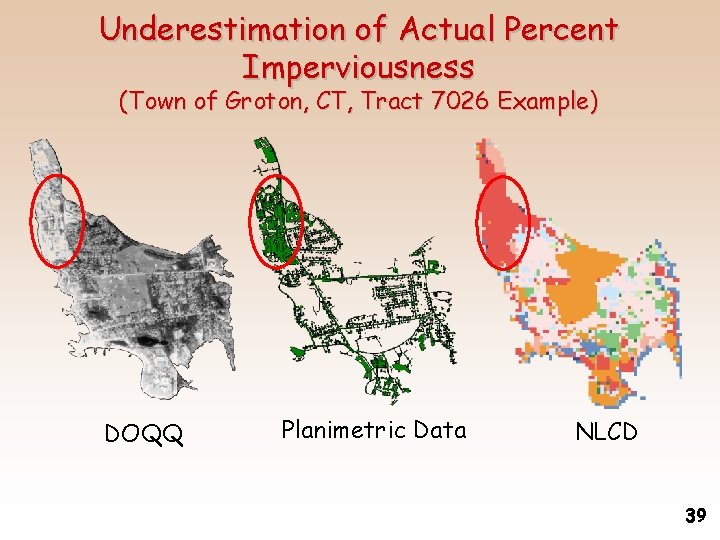
Underestimation of Actual Percent Imperviousness (Town of Groton, CT, Tract 7026 Example) DOQQ Planimetric Data NLCD 39
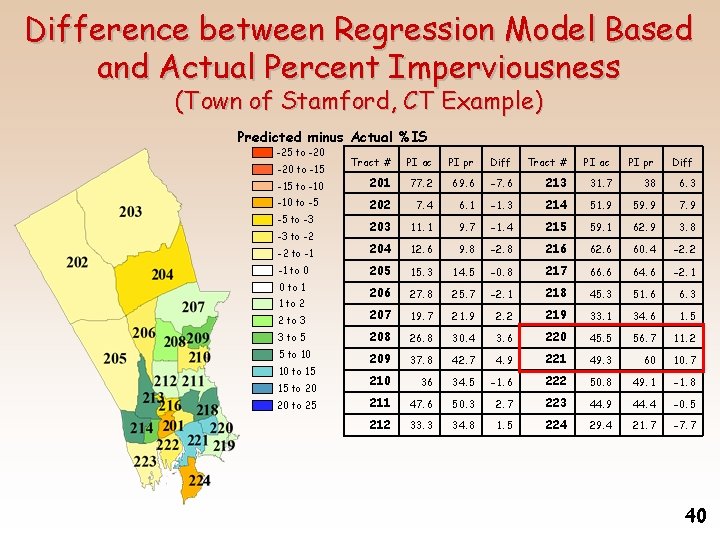
Difference between Regression Model Based and Actual Percent Imperviousness (Town of Stamford, CT Example) Predicted minus Actual %IS -25 to -20 Tract # PI ac PI pr Diff -15 to -10 201 77. 2 69. 6 -7. 6 213 31. 7 38 6. 3 -10 to -5 202 7. 4 6. 1 -1. 3 214 51. 9 59. 9 7. 9 203 11. 1 9. 7 -1. 4 215 59. 1 62. 9 3. 8 -2 to -1 204 12. 6 9. 8 -2. 8 216 62. 6 60. 4 -2. 2 -1 to 0 205 15. 3 14. 5 -0. 8 217 66. 6 64. 6 -2. 1 0 to 1 206 27. 8 25. 7 -2. 1 218 45. 3 51. 6 6. 3 2 to 3 207 19. 7 21. 9 2. 2 219 33. 1 34. 6 1. 5 3 to 5 208 26. 8 30. 4 3. 6 220 45. 5 56. 7 11. 2 5 to 10 209 37. 8 42. 7 4. 9 221 49. 3 60 10. 7 210 36 34. 5 -1. 6 222 50. 8 49. 1 -1. 8 211 47. 6 50. 3 2. 7 223 44. 9 44. 4 -0. 5 212 33. 3 34. 8 1. 5 224 29. 4 21. 7 -7. 7 -20 to -15 -5 to -3 -3 to -2 1 to 2 10 to 15 15 to 20 20 to 25 40
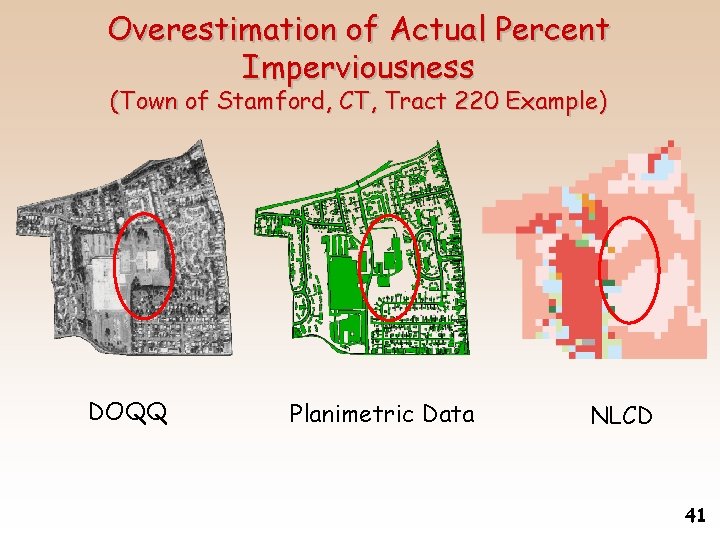
Overestimation of Actual Percent Imperviousness (Town of Stamford, CT, Tract 220 Example) DOQQ Planimetric Data NLCD 41
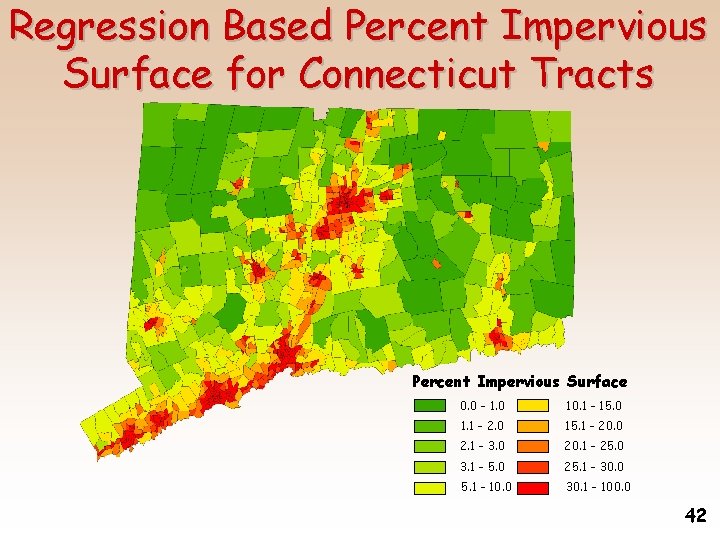
Regression Based Percent Impervious Surface for Connecticut Tracts Percent Impervious Surface 0. 0 - 1. 0 10. 1 - 15. 0 1. 1 - 2. 0 15. 1 - 20. 0 2. 1 - 3. 0 20. 1 - 25. 0 3. 1 - 5. 0 25. 1 - 30. 0 5. 1 - 10. 0 30. 1 - 100. 0 42
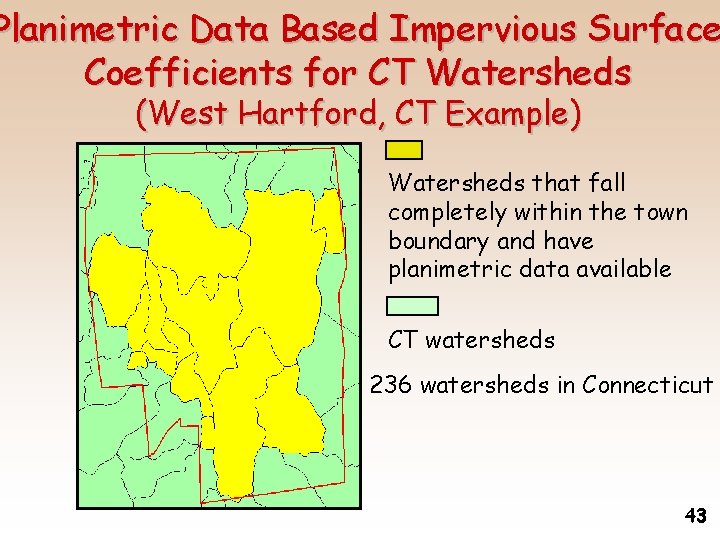
Planimetric Data Based Impervious Surface Coefficients for CT Watersheds (West Hartford, CT Example) Watersheds that fall completely within the town boundary and have planimetric data available CT watersheds 236 watersheds in Connecticut 43
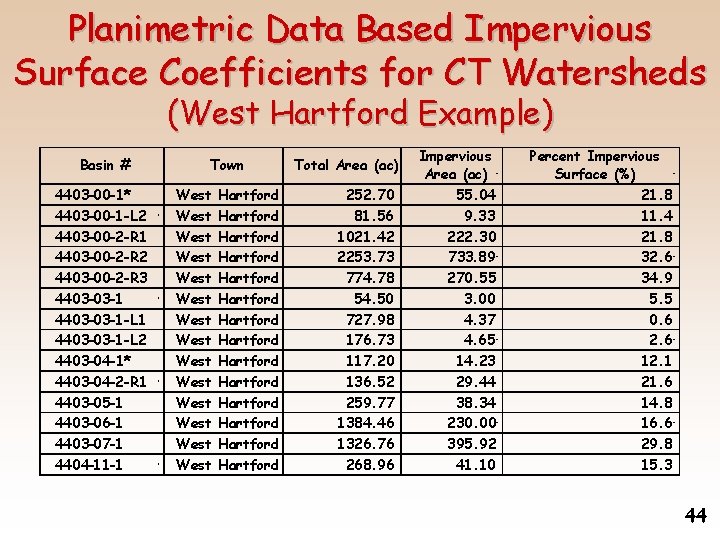
Planimetric Data Based Impervious Surface Coefficients for CT Watersheds (West Hartford Example) Basin # 4403 -00 -1* 4403 -00 -1 -L 2 4403 -00 -2 -R 1 4403 -00 -2 -R 2 4403 -00 -2 -R 3 4403 -03 -1 -L 1 4403 -03 -1 -L 2 4403 -04 -1* 4403 -04 -2 -R 1 4403 -05 -1 4403 -06 -1 4403 -07 -1 4404 -11 -1 Town West West West West Hartford Hartford Hartford Hartford Total Area (ac) 252. 70 81. 56 1021. 42 2253. 73 774. 78 54. 50 727. 98 176. 73 117. 20 136. 52 259. 77 1384. 46 1326. 76 268. 96 Impervious Area (ac) 55. 04 9. 33 222. 30 733. 89 270. 55 3. 00 4. 37 4. 65 14. 23 29. 44 38. 34 230. 00 395. 92 41. 10 Percent Impervious Surface (%) 21. 8 11. 4 21. 8 32. 6 34. 9 5. 5 0. 6 2. 6 12. 1 21. 6 14. 8 16. 6 29. 8 15. 3 44
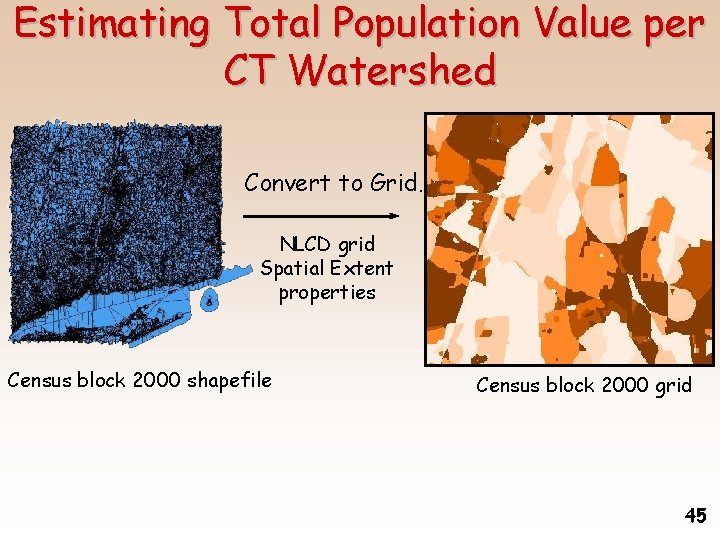
Estimating Total Population Value per CT Watershed Convert to Grid… NLCD grid Spatial Extent properties Census block 2000 shapefile Census block 2000 grid 45
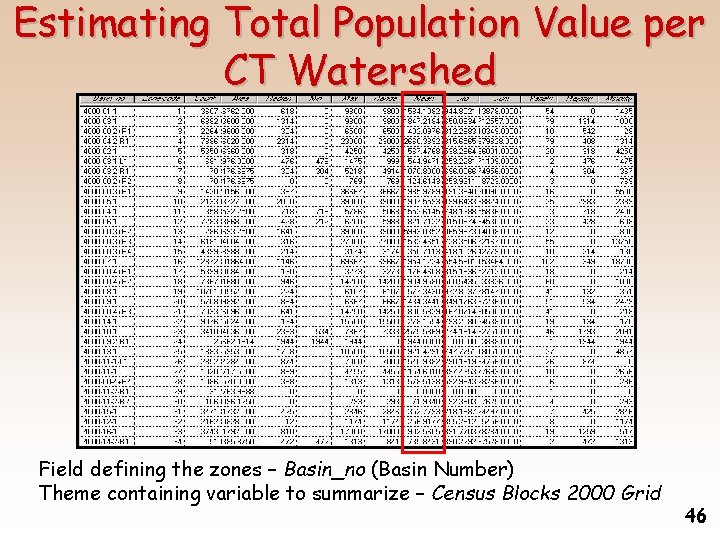
Estimating Total Population Value per CT Watershed Analysis Summarize Zones CT Watersheds Field defining the zones – Basin_no (Basin Number) Theme containing variable to summarize – Census Blocks 2000 Grid 46
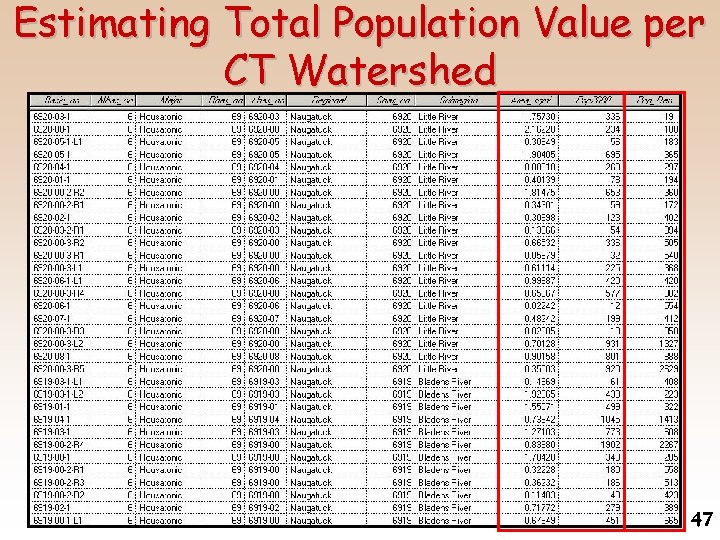
Estimating Total Population Value per CT Watershed Join Statistics Table for Population Value Attribute Table for CT Watersheds Shapefile 47
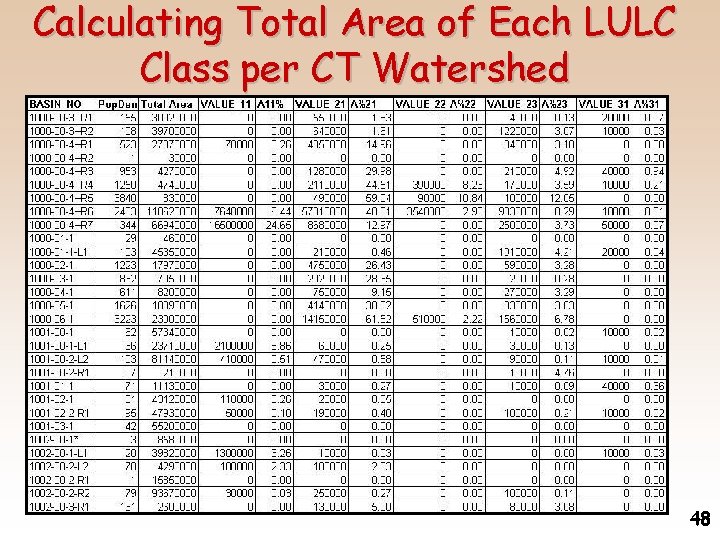
Calculating Total Area of Each LULC Class per CT Watersheds Row Theme NLCD Column Theme Analysis Tabulated Areas 48
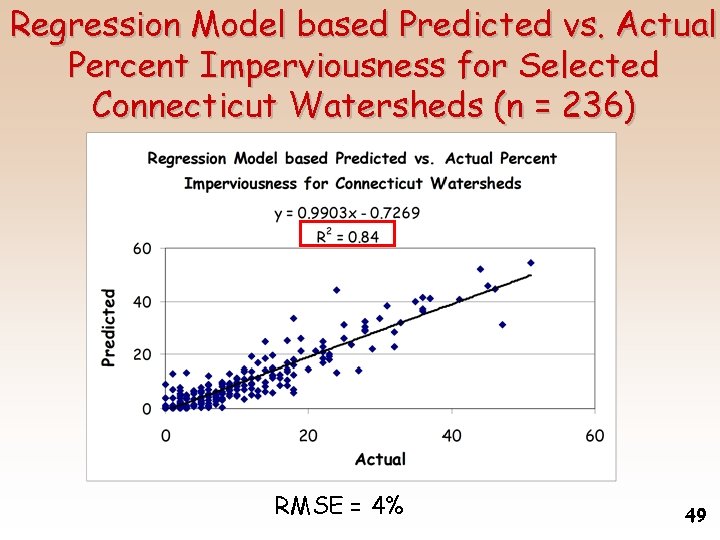
Regression Model based Predicted vs. Actual Percent Imperviousness for Selected Connecticut Watersheds (n = 236) RMSE = 4% 49
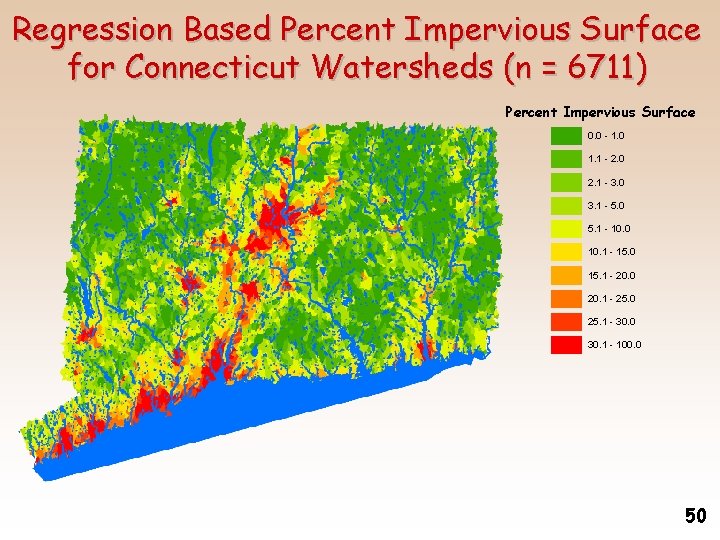
Regression Based Percent Impervious Surface for Connecticut Watersheds (n = 6711) Percent Impervious Surface 0. 0 - 1. 0 1. 1 - 2. 0 2. 1 - 3. 0 3. 1 - 5. 0 5. 1 - 10. 0 10. 1 - 15. 0 15. 1 - 20. 0 20. 1 - 25. 0 25. 1 - 30. 0 30. 1 - 100. 0 50
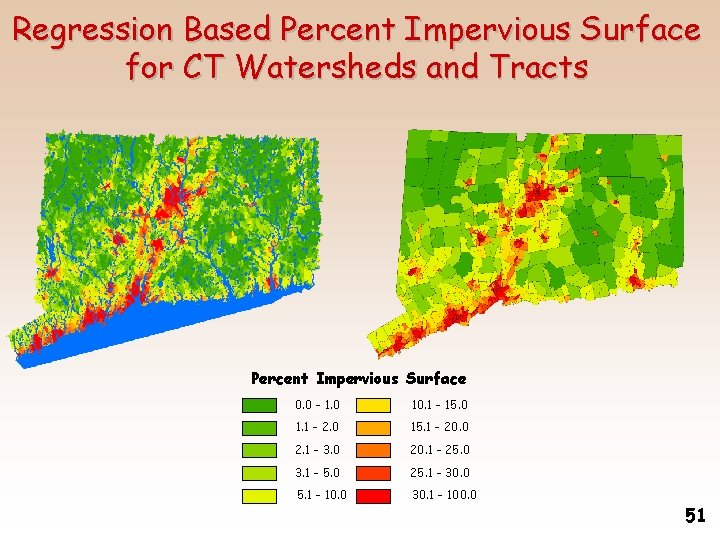
Regression Based Percent Impervious Surface for CT Watersheds and Tracts Percent Impervious Surface 0. 0 - 1. 0 10. 1 - 15. 0 1. 1 - 2. 0 15. 1 - 20. 0 2. 1 - 3. 0 20. 1 - 25. 0 3. 1 - 5. 0 25. 1 - 30. 0 5. 1 - 10. 0 30. 1 - 100. 0 51
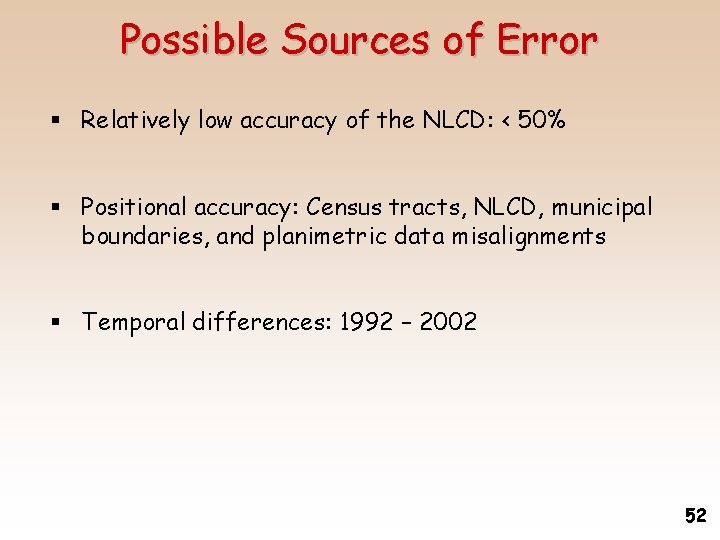
Possible Sources of Error § Relatively low accuracy of the NLCD: < 50% § Positional accuracy: Census tracts, NLCD, municipal boundaries, and planimetric data misalignments § Temporal differences: 1992 – 2002 52
Conclusions § Easy to use regression model to calculate imperviousness based on LULC data and population density was developed § Model was found to predict imperviousness on study area tracts and watersheds with acceptable accuracy § Model is less time consuming than other available methods 53
Conclusions § Does not require planimetric or satellite imagery data § Uses readily available NLCD and US Census Bureau population data (converted to population density) as inputs § Was not tested for geographic scale sensitivity § Need future research for applicability the model on the other geographic areas 54
Development of a Population Density and Land Use Based Regression Model to Calculate the Amount of Imperviousness Anna Chabaeva achabaev@canr. uconn. edu (860) 486 -4610 Department of Natural Resources Management & Engineering The University of Connecticut U-4087, Room 308, 1376 Storrs Road Storrs, CT 06269 -4087