
Development of a Pathway for Returning To Driving
- Slides: 2
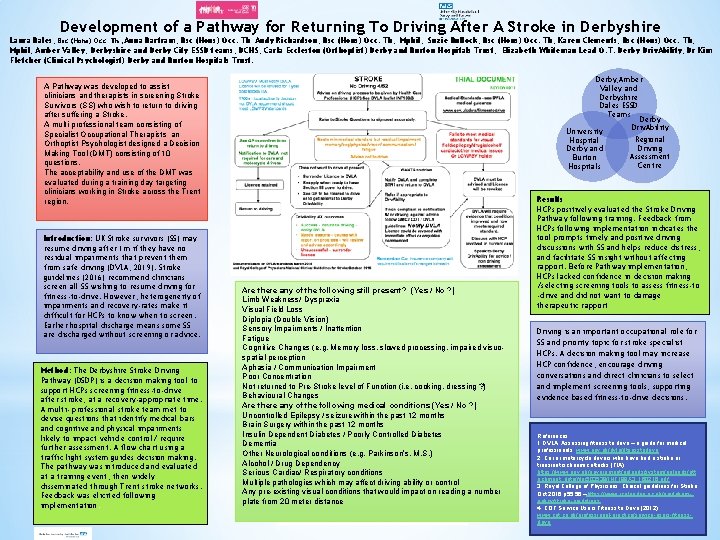
Development of a Pathway for Returning To Driving After A Stroke in Derbyshire Laura Bales, Bsc (Hons) Occ. Th , Anna Bartram, Bsc (Hons) Occ. Th Andy Richardson, Bsc (Hons) Occ. Th, Mphil, Suzie Bullock, Bsc (Hons) Occ. Th, Karen Clements, Bsc (Hons) Occ. Th, Mphil, Amber Valley, Derbyshire and Derby City ESSD teams, DCHS; Carla Eccleston (Orthoptist) Derby and Burton Hospitals Trust; Elizabeth Whiteman Lead O. T. Derby Driv. Ability, Dr Kim Fletcher (Clinical Psychologist) Derby and Burton Hospitals Trust. Derby, Amber Valley and Derbyshire Dales ESSD Teams Derby Driv. Ability University A Pathway was developed to assist clinicians and therapists in screening Stroke Survivors (SS) who wish to return to driving after suffering a Stroke. A multi-professional team consisting of Specialist Occupational Therapists an Orthoptist Psychologist designed a Decision Making Tool (DMT) consisting of 10 questions. The acceptability and use of the DMT was evaluated during a training day targeting clinicians working in Stroke across the Trent region. Introduction: UK Stroke survivors (SS) may resume driving after 1 m if they have no residual impairments that prevent them from safe driving (DVLA, 2019). Stroke guidelines (2016) recommend clinicians screen all SS wishing to resume driving for fitness-to-drive. However, heterogeneity of impairments and recovery-rates make it difficult for HCPs to know when to screen. Earlier hospital discharge means some SS are discharged without screening or advice. Method: The Derbyshire Stroke Driving Pathway (DSDP) is a decision making tool to support HCPs screening fitness-to-drive after stroke, at a recovery-appropriate time. A multi- professional stroke team met to devise questions that identify medical bars and cognitive and physical impairments likely to impact vehicle control/ require further assessment. A flow chart using a traffic light system guides decision making. The pathway was introduced and evaluated at a training event, then widely disseminated through Trent stroke networks. Feedback was elicited following implementation. Hospital Derby and Burton Hospitals Are there any of the following still present? (Yes / No ? ) Limb Weakness/ Dyspraxia Visual Field Loss Diplopia (Double Vision) Sensory Impairments / Inattention Fatigue Cognitive Changes (e. g. Memory loss, slowed processing, impaired visuospatial perception Aphasia / Communication Impairment Poor Concentration Not returned to Pre-Stroke level of Function (i. e. cooking, dressing ? ) Behavioural Changes Are there any of the following medical conditions (Yes / No ? ) Uncontrolled Epilepsy / seizure within the past 12 months Brain Surgery within the past 12 months Insulin Dependent Diabetes / Poorly Controlled Diabetes Dementia Other Neurological conditions (e. g. Parkinson’s, M. S. ) Alcohol / Drug Dependency Serious Cardiac/ Respiratory conditions Multiple pathologies which may affect driving ability or control Any pre-existing visual conditions that would impact on reading a number plate from 20 meter distance Regional Driving Assessment Centre Results HCPs positively evaluated the Stroke Driving Pathway following training. Feedback from HCPs following implementation indicates the tool prompts timely and positive driving discussions with SS and helps reduce distress, and facilitate SS insight without affecting rapport. Before Pathway implementation, HCPs lacked confidence in decision making /selecting screening tools to assess fitness-to -drive and did not want to damage therapeutic rapport Driving is an important occupational role for SS and priority topic for stroke specialist HCPs. A decision making tool may increase HCP confidence, encourage driving conversations and direct clinicians to select and implement screening tools, supporting evidence based fitness-to-drive decisions. References: 1. DVLA: Assessing fitness to drive – a guide for medical professionals. www. gov. uk/dvla/fitnesstodrive 2. Car or motorcycle drivers who have had a stroke or transient ischaemic attacks (TIA). https: //www. gov. uk/government/uploads/system/uploads/att achment_data/file/503539/INF 188 X 3_160216. pdf 3. Royal College of Physicians: Clinical guidelines for Stroke Oct 2016 p 55, 56 –https: //www. rcplondon. ac. uk/guidelinespolicy/stroke-guidelines 4. COT Service Users Fitness to Drive (2012) www. cot. co. uk/professional-practice/service-users-fitnessdrive
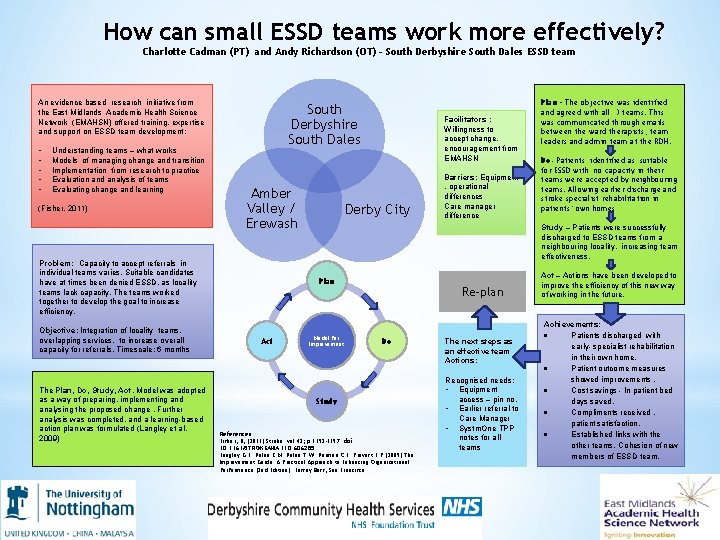
How can small ESSD teams work more effectively? Charlotte Cadman (PT) and Andy Richardson (OT) - South Derbyshire South Dales ESSD team An evidence based research initiative from the East Midlands Academic Health Science Network (EMAHSN) offered training, expertise and support on ESSD team development: • • • Understanding teams – what works Models of managing change and transition Implementation from research to practice Evaluation and analysis of teams Evaluating change and learning (Fisher, 2011) South Derbyshire South Dales Amber Valley / Erewash Problem: Capacity to accept referrals in individual teams varies. Suitable candidates have at times been denied ESSD, as locality teams lack capacity. The teams worked together to develop the goal to increase efficiency. Objective: Integration of locality teams, overlapping services, to increase overall capacity for referrals. Timescale: 6 months The Plan, Do, Study, Act, Model was adopted as a way of preparing, implementing and analysing the proposed change. Further analysis was completed, and a learning-based action plan was formulated (Langley et al, 2009) Facilitators : Willingness to accept change, encouragement from EMAHSN Derby City Do- Patients identified as suitable for ESSD with no capacity in their teams were accepted by neighbouring teams. Allowing earlier discharge and stroke specialist rehabilitation in patients’ own homes Study – Patients were successfully discharged to ESSD teams from a neighbouring locality, increasing team effectiveness. Plan Act Barriers: Equipment , operational differences Care manager difference Plan – The objective was identified and agreed with all 3 teams. This was communicated through emails between the ward therapists, team leaders and admin team at the RDH. Model for Improvement Re-plan Do Study References: Fisher, R, (2011) Stroke. vol 42; p 1392 -1397. doi: 10. 1161/STROKEAHA. 110. 606285 Langley G. L. Nolan K. M. Nolan T. W. Norman C. L. Provost L. P (2009) The Improvement Guide: A Practical Approach to Enhancing Organizational Performance (2 nd Edition). Jossey Bass, San Francisco. The next steps as an effective team Actions: Recognised needs: • Equipment access – pin no. • Earlier referral to Care Manager • Systm. One TPP notes for all teams Act – Actions have been developed to improve the efficiency of this new way of working in the future. Achievements: Patients discharged with early- specialist rehabilitation in their own home. Patient outcome measures showed improvements. Cost savings - In patient bed days saved. Compliments received , patient satisfaction. Established links with the other teams. Cohesion of new members of ESSD team.