
Development of a New Infrasound Microphone Technology Carrick

- Slides: 20
Development of a New Infrasound Microphone Technology Carrick L. Talmadge National Center for Physical Acoustics University of Mississippi, Oxford MS
Potential Applications of Infrasound Sensor • monitoring potential atmospheric nuclear tests (CTBT applications) • natural hazard detection of volcanos, tornados, tsunamis • monitoring natural phenomena such as hurricanes and bolides
Challenges of Atmospheric Infrasound • Noise associated with atmospheric turbulence (“wind noise”), especially at frequencies below 0. 1 Hz. Conventionally this is solved by adding large “wind-noise filters” to sensors. The cost of the filters typically far exceeds the cost of the infrasound sensor itself. • Environmental exposure is a hazard to current, rather delicate microphones, so vaults are constructed to stablize temperature and protect the instrument from environmental exposure.
Infrasound Pipe Array: State of the Art Wind Noise Sensor
Goals of This Instrument Development • Replace large pipe arrays with array of infrasound sensors. • Ruggedize sensors, and construct them to be insensitive to thermal fluctuates: Removes requirement for instrument vault. • Make them low-cost enough ($200 vs $5000+) to make practicable multiple arrays of sensors. • Low replacement cost also reduces risk associated with damaged or destroyed sensors.
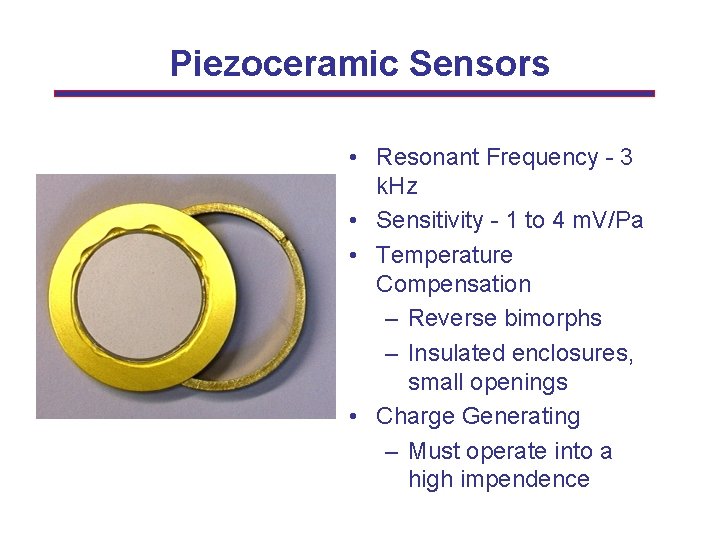
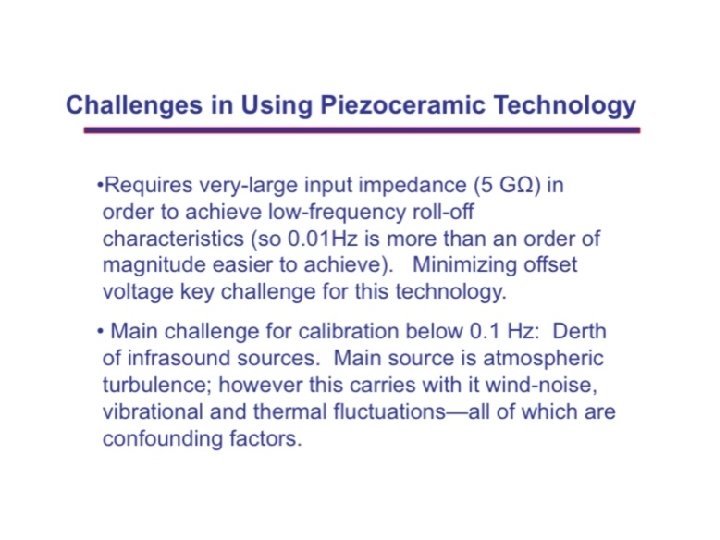
Piezoceramic Sensors • Resonant Frequency - 3 k. Hz • Sensitivity - 1 to 4 m. V/Pa • Temperature Compensation – Reverse bimorphs – Insulated enclosures, small openings • Charge Generating – Must operate into a high impendence
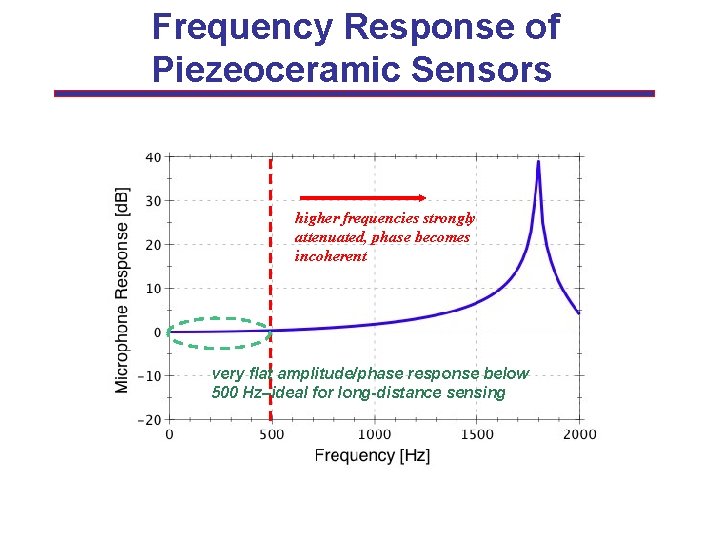
Frequency Response of Piezeoceramic Sensors higher frequencies strongly attenuated, phase becomes incoherent very flat amplitude/phase response below 500 Hz–ideal for long-distance sensing
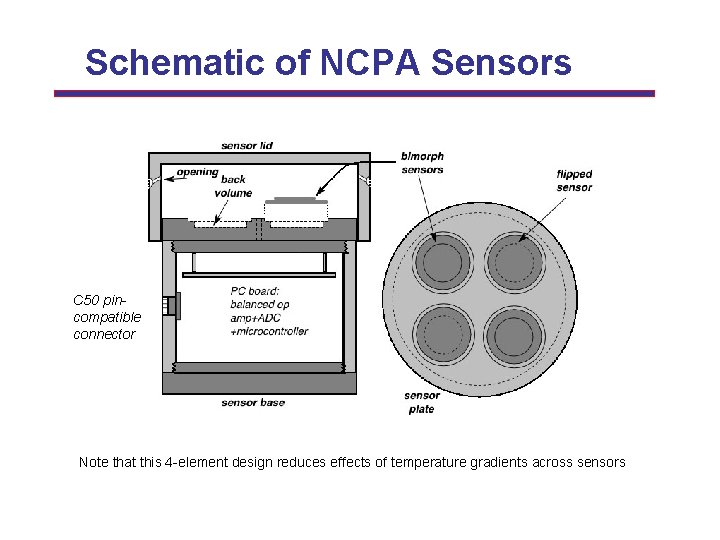
Schematic of NCPA Sensors C 50 pincompatible connector Note that this 4 -element design reduces effects of temperature gradients across sensors
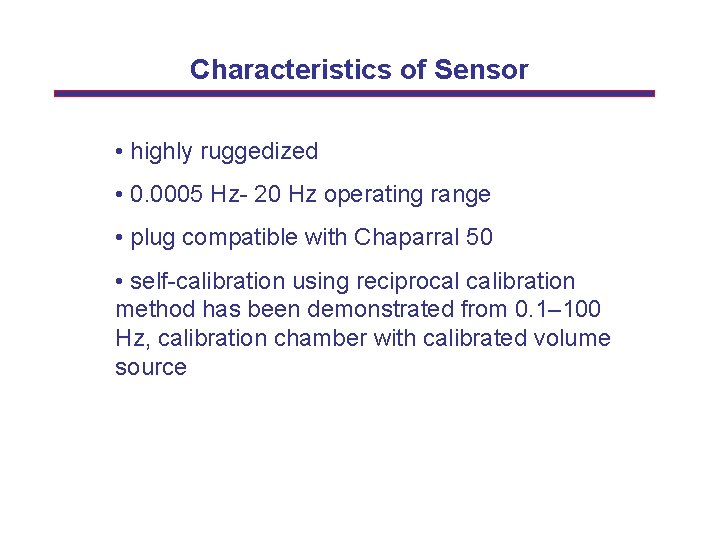
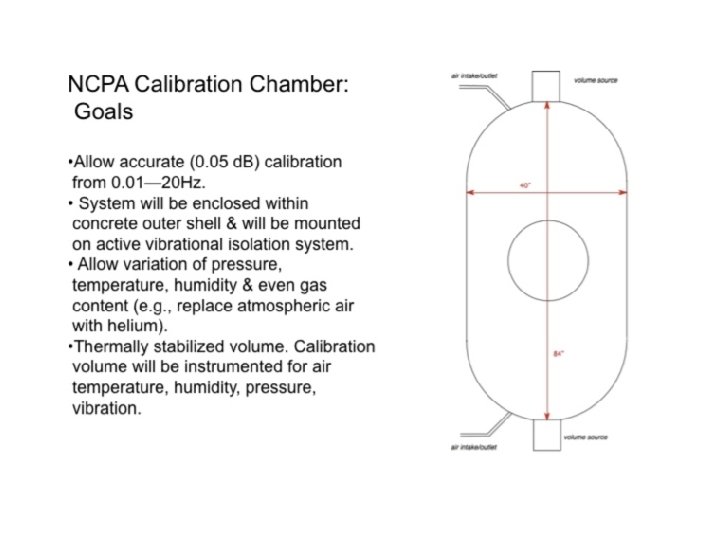
Characteristics of Sensor • highly ruggedized • 0. 0005 Hz- 20 Hz operating range • plug compatible with Chaparral 50 • self-calibration using reciprocal calibration method has been demonstrated from 0. 1– 100 Hz, calibration chamber with calibrated volume source
Single Sensor Comparison with C 50
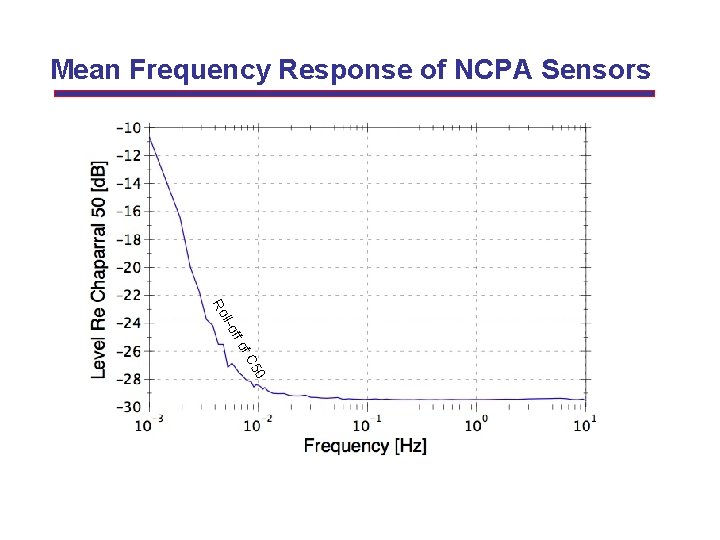
Mean Frequency Response of NCPA Sensors ff o ll-o Ro 50 f. C
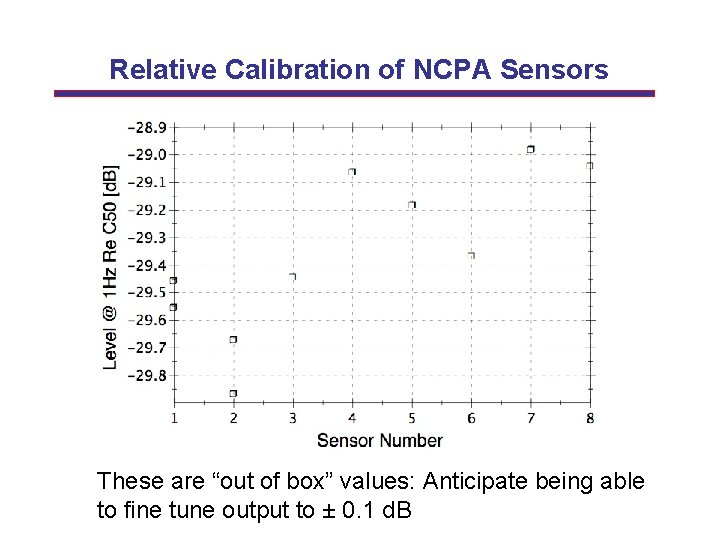
Relative Calibration of NCPA Sensors These are “out of box” values: Anticipate being able to fine tune output to ± 0. 1 d. B
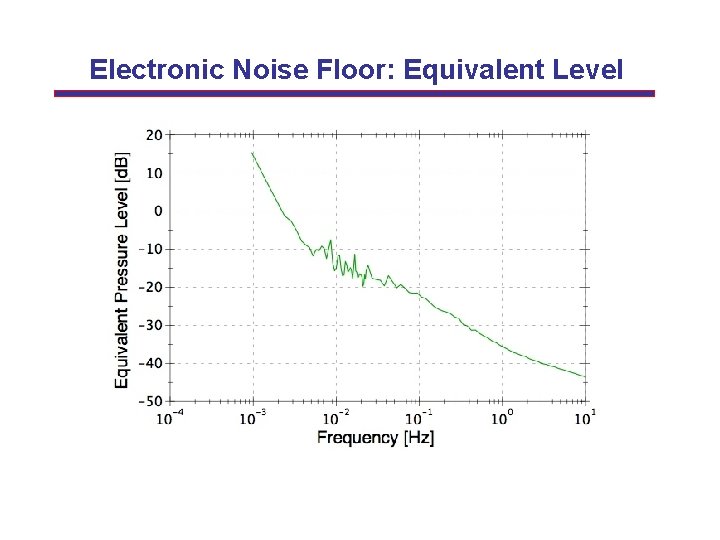
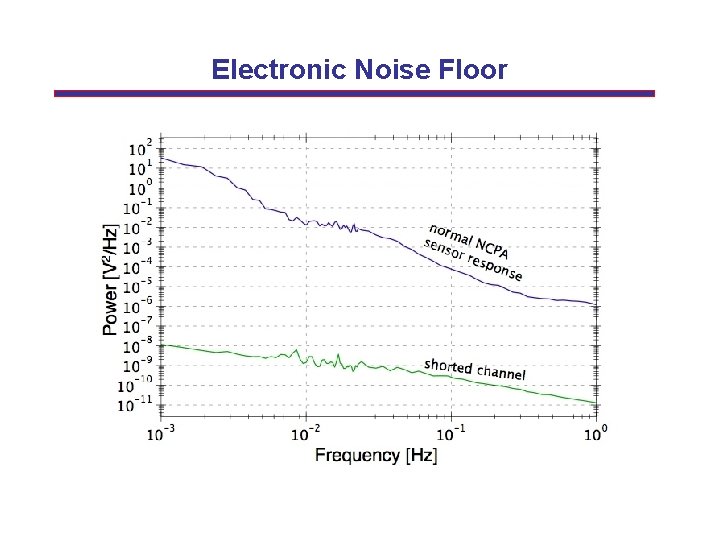
Electronic Noise Floor: Equivalent Level
Electronic Noise Floor
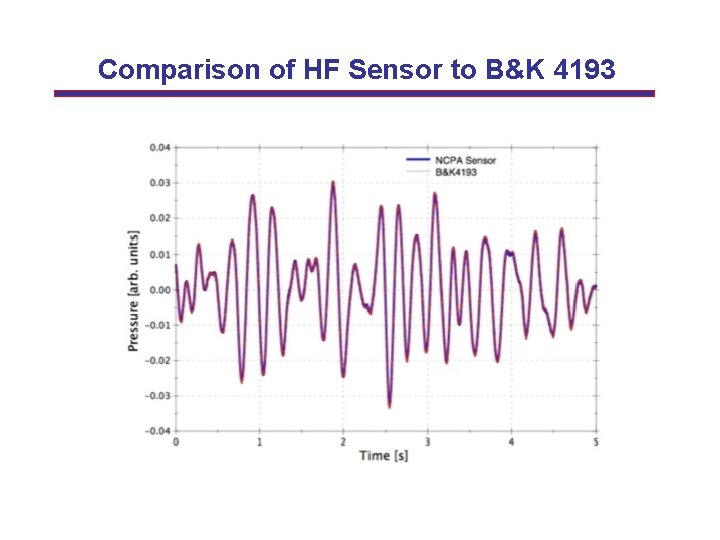
“High Frequency” Sensor • Allow use of microphone for low-frequency sound, long-range propagation experiments. • 0. 1 Hz- 1000 Hz operating range, configurable gain • Improved vibrational isolation (elevated sensor applications). • More compact sensor packaging.
Comparison of HF Sensor to B&K 4193
Work in Progress • Independent evaluation at Los Alamos facility • Final sensor body design: Improved coupling for senor lid, rectangular base enclosure for electronics, settle on weatherizing surface treatment for sensor plates. • Long term field test to evaluate ruggedness. • Develop calibration method for f < 0. 01 Hz
Conclusions • A new sensor technology incorporating piezoceramic sensors has been developed at the NCPA. • This technology allows the use of piezoceramics for very low (at least 0. 001 Hz) frequency detection. • Because the sensing elements are inherently rugge, a microphone based on these sensors has the capable of being used in much more rugged environments than is typically possible with current sensors.