
DEVELOPMENT OF A NEW BISTATIC DOPPLER MEASUREMENT SYSTEM

DEVELOPMENT OF A NEW BISTATIC DOPPLER MEASUREMENT SYSTEM AND ITS FIELD TEST IN OKINAWA Seiji Kawamura, Shigeo Sugitani, Hiroshi Hanado, and Katsuhiro Nakagawa National Institute of Information and Communications Technology, Japan National Institute of Information and Communications Technology
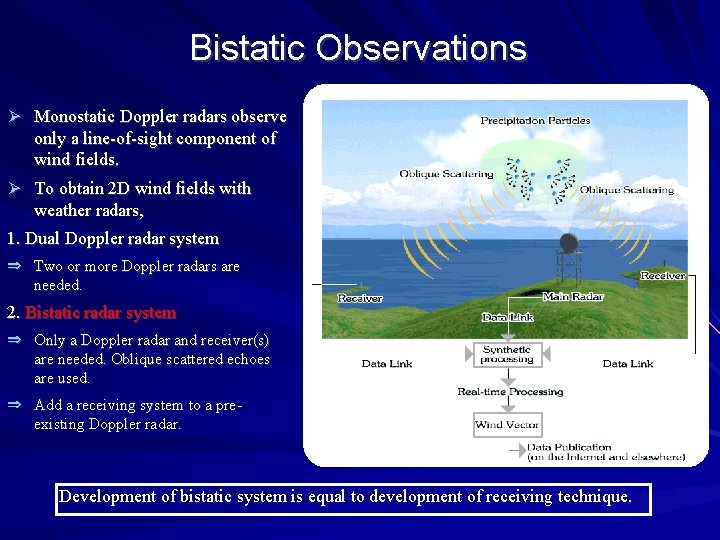
Bistatic Observations Ø Monostatic Doppler radars observe only a line-of-sight component of wind fields. Ø To obtain 2 D wind fields with weather radars, 1. Dual Doppler radar system ⇒ Two or more Doppler radars are needed. 2. Bistatic radar system ⇒ Only a Doppler radar and receiver(s) are needed. Oblique scattered echoes are used. ⇒ Add a receiving system to a pre- existing Doppler radar. Development of bistatic system is equal to development of receiving technique.
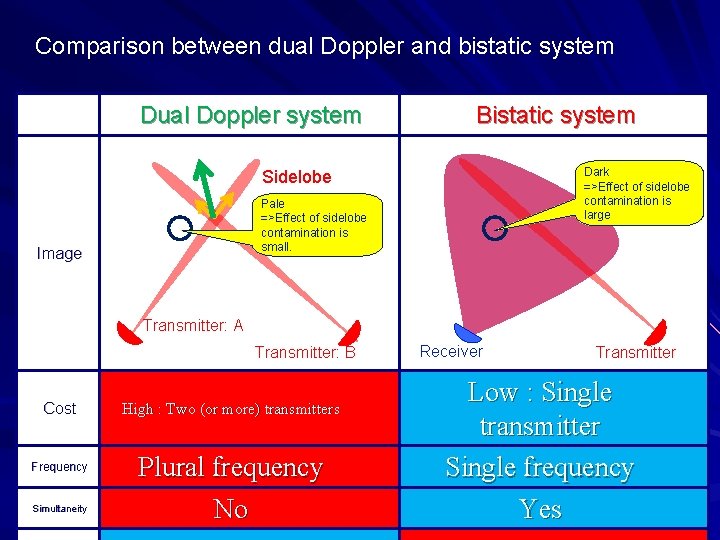
Comparison between dual Doppler and bistatic system Dual Doppler system Bistatic system Dark =>Effect of sidelobe contamination is large Sidelobe Pale =>Effect of sidelobe contamination is small. Image Transmitter: A Transmitter: B Cost Frequency Simultaneity High : Two (or more) transmitters Plural frequency No Receiver Transmitter Low : Single transmitter Single frequency Yes
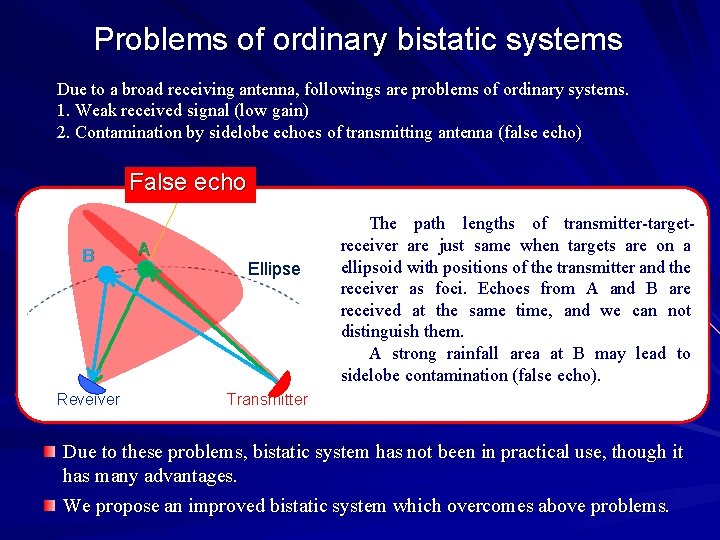
Problems of ordinary bistatic systems Due to a broad receiving antenna, followings are problems of ordinary systems. 1. Weak received signal (low gain) 2. Contamination by sidelobe echoes of transmitting antenna (false echo) False echo B Reveiver A Ellipse The path lengths of transmitter-targetreceiver are just same when targets are on a ellipsoid with positions of the transmitter and the receiver as foci. Echoes from A and B are received at the same time, and we can not distinguish them. A strong rainfall area at B may lead to sidelobe contamination (false echo). Transmitter Due to these problems, bistatic system has not been in practical use, though it has many advantages. We propose an improved bistatic system which overcomes above problems.
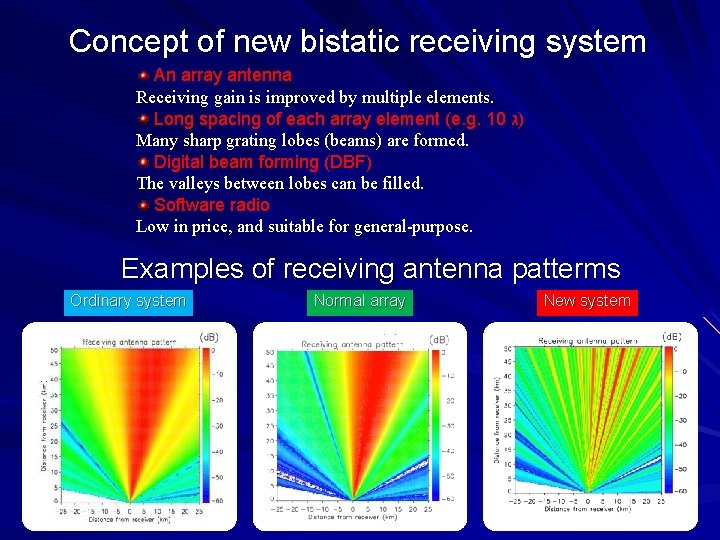
Concept of new bistatic receiving system An array antenna Receiving gain is improved by multiple elements. Long spacing of each array element (e. g. 10 )ג Many sharp grating lobes (beams) are formed. Digital beam forming (DBF) The valleys between lobes can be filled. Software radio Low in price, and suitable for general-purpose. Examples of receiving antenna patterms Ordinary system Normal array New system
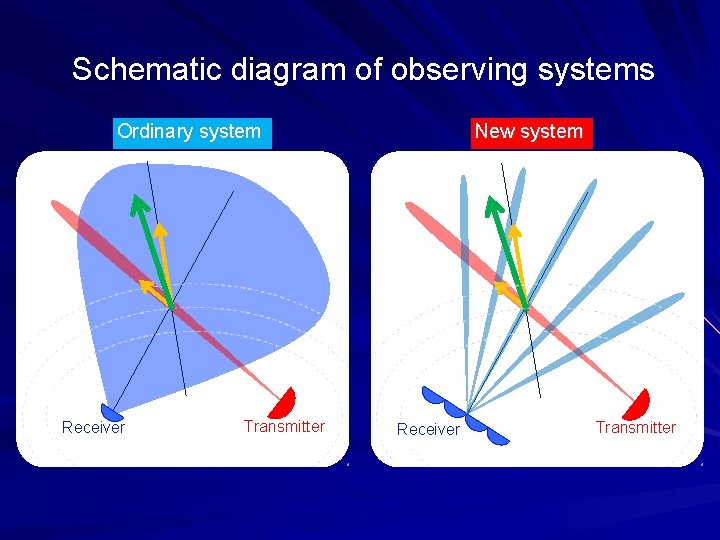
Schematic diagram of observing systems Ordinary system Receiver Transmitter New system Receiver Transmitter
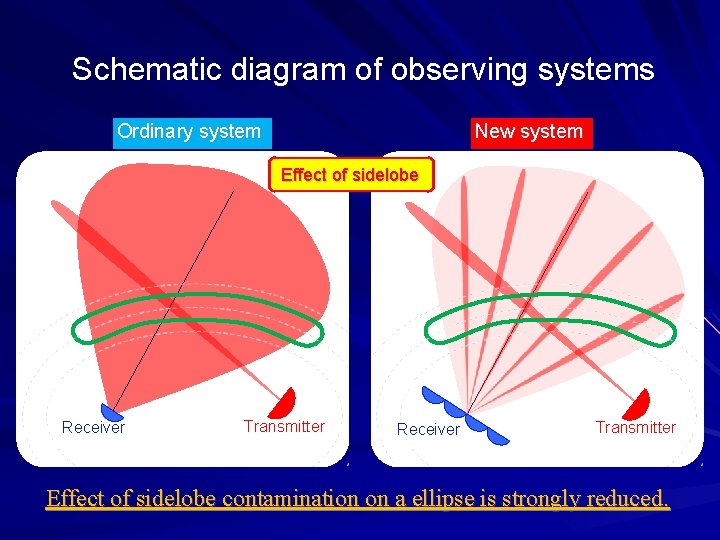
Schematic diagram of observing systems Ordinary system New system Effect of sidelobe Receiver Transmitter Effect of sidelobe contamination on a ellipse is strongly reduced.
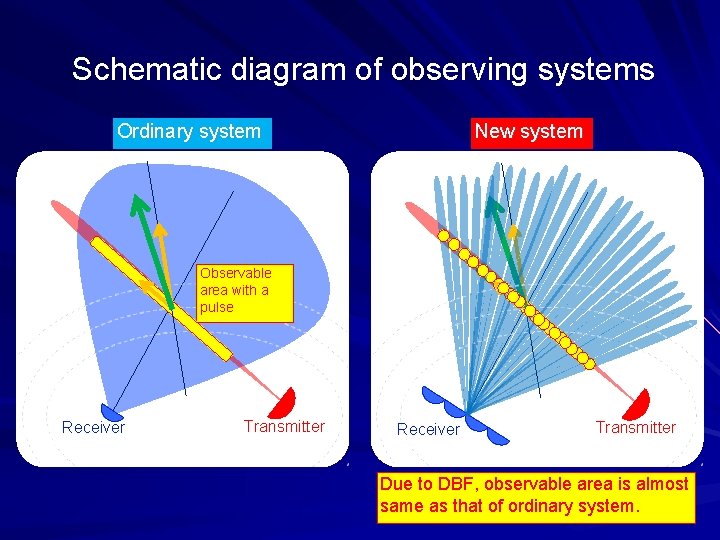
Schematic diagram of observing systems Ordinary system New system Observable area with a pulse Receiver Transmitter Due to DBF, observable area is almost same as that of ordinary system.
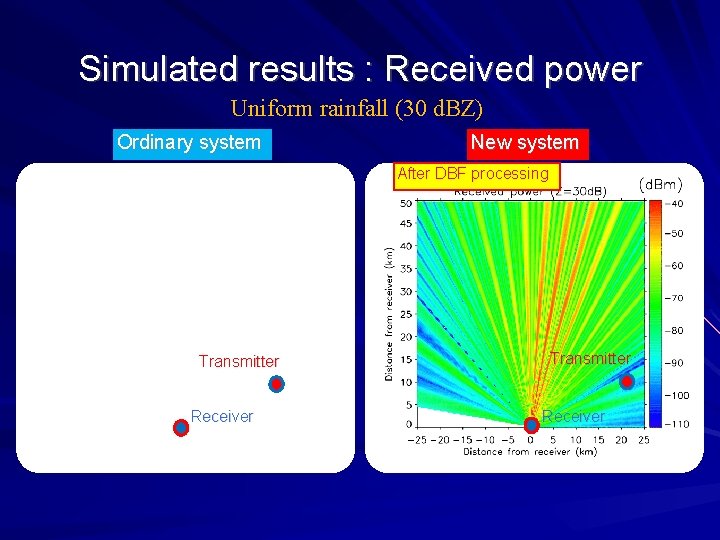
Simulated results : Received power Uniform rainfall (30 d. BZ) Ordinary system New system After DBF processing Transmitter Receiver
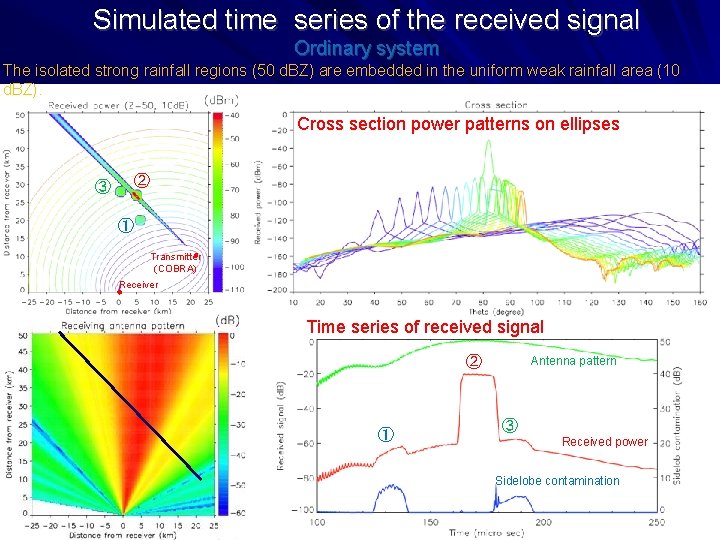
Simulated time series of the received signal Ordinary system The isolated strong rainfall regions (50 d. BZ) are embedded in the uniform weak rainfall area (10 d. BZ). Cross section power patterns on ellipses ② ③ ① Transmitter (COBRA) Receiver Time series of received signal ② ① Antenna pattern ③ Received power Sidelobe contamination
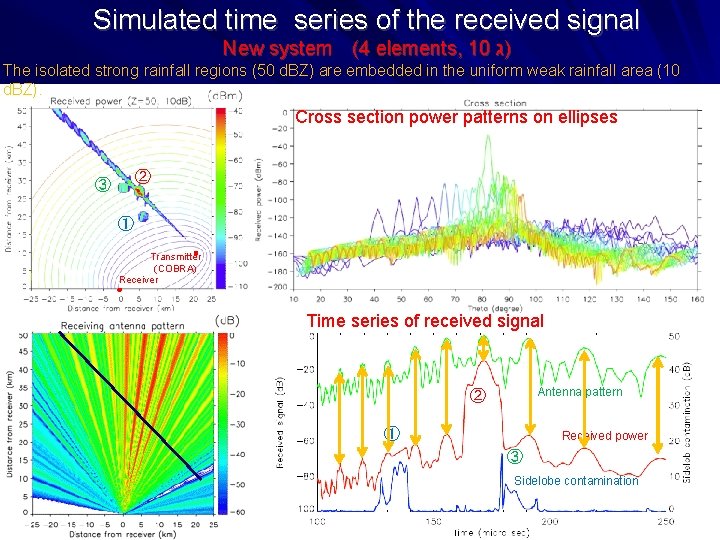
Simulated time series of the received signal New system (4 elements, 10 )ג The isolated strong rainfall regions (50 d. BZ) are embedded in the uniform weak rainfall area (10 d. BZ). Cross section power patterns on ellipses ② ③ ① Transmitter (COBRA) Receiver Time series of received signal Antenna pattern ② ① Received power ③ Sidelobe contamination
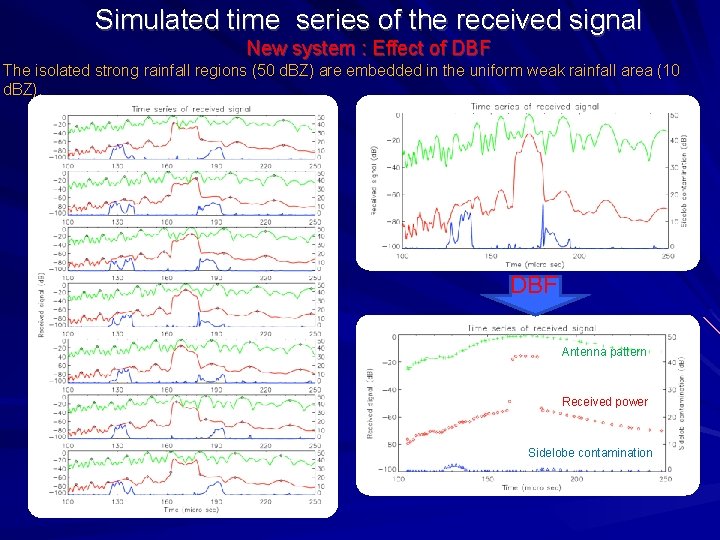
Simulated time series of the received signal New system : Effect of DBF The isolated strong rainfall regions (50 d. BZ) are embedded in the uniform weak rainfall area (10 d. BZ). DBF Antenna pattern Received power Sidelobe contamination
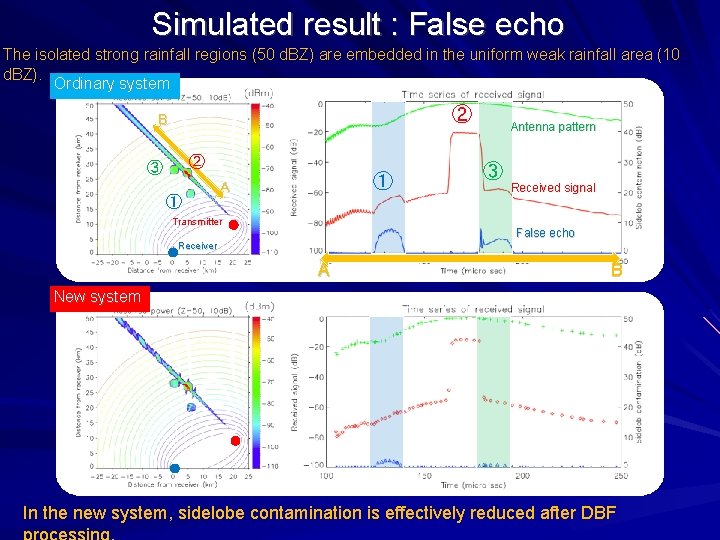
Simulated result : False echo The isolated strong rainfall regions (50 d. BZ) are embedded in the uniform weak rainfall area (10 d. BZ). Ordinary system ② B ② ③ ① ① A Transmitter Antenna pattern ③ Received signal False echo Receiver A B New system In the new system, sidelobe contamination is effectively reduced after DBF
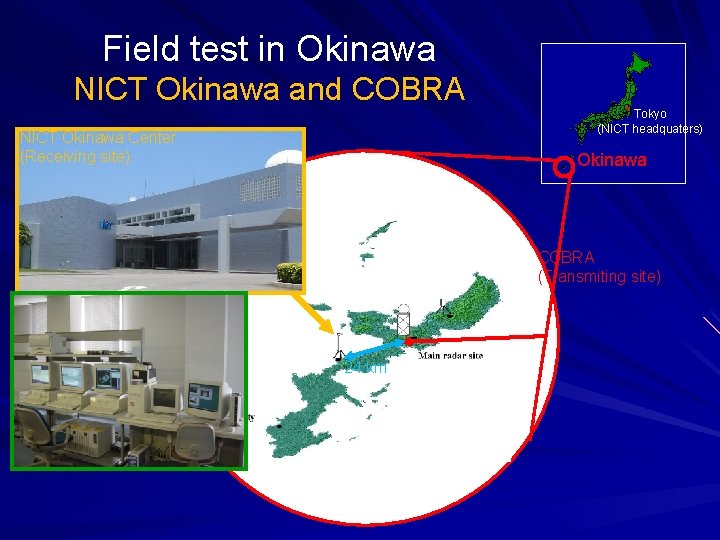
Field test in Okinawa NICT Okinawa and COBRA ・Tokyo (NICT headquaters) NICT Okinawa Center (Receiving site) Okinawa COBRA (Transmiting site) 24 km
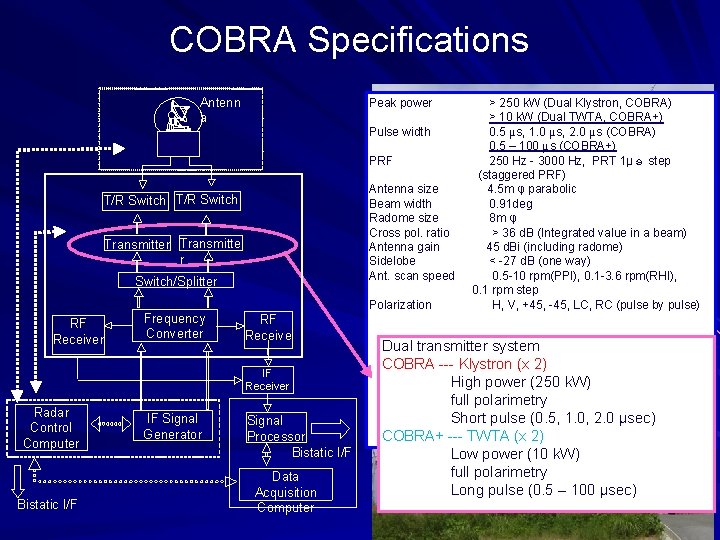
COBRA Specifications Antenn a Peak power > 250 k. W (Dual Klystron, COBRA) > 10 k. W (Dual TWTA, COBRA+) Pulse width 0. 5 μs, 1. 0 μs, 2. 0 μs (COBRA) 0. 5 – 100 μs (COBRA+) PRF 250 Hz - 3000 Hz, PRT 1μs step (staggered PRF) Antenna size 4. 5 m φ parabolic Beam width 0. 91 deg Radome size 8 m φ Cross pol. ratio > 36 d. B (Integrated value in a beam) Antenna gain 45 d. Bi (including radome) Sidelobe < -27 d. B (one way) Ant. scan speed 0. 5 -10 rpm(PPI), 0. 1 -3. 6 rpm(RHI), 0. 1 rpm step Polarization H, V, +45, -45, LC, RC (pulse by pulse) T/R Switch Transmitter Transmitte r Switch/Splitter RF Receiver Frequency Converter RF Receive r IF Receiver Radar Control Computer Bistatic I/F IF Signal Generator Signal Processor Bistatic I/F Data Acquisition Computer Dual transmitter system COBRA --- Klystron (x 2) High power (250 k. W) full polarimetry Short pulse (0. 5, 1. 0, 2. 0 μsec) COBRA+ --- TWTA (x 2) Low power (10 k. W) full polarimetry Long pulse (0. 5 – 100 μsec)
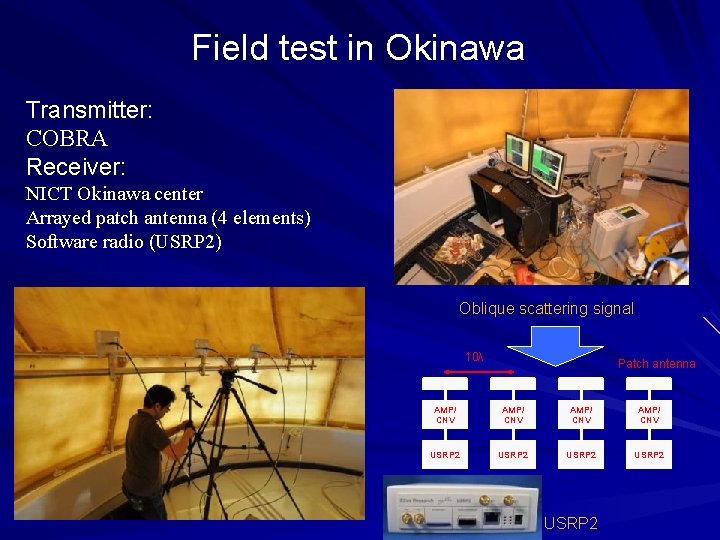
Field test in Okinawa Transmitter: COBRA Receiver: NICT Okinawa center Arrayed patch antenna (4 elements) Software radio (USRP 2) Oblique scattering signal 10λ Patch antenna AMP/ CNV USRP 2 USRP 2
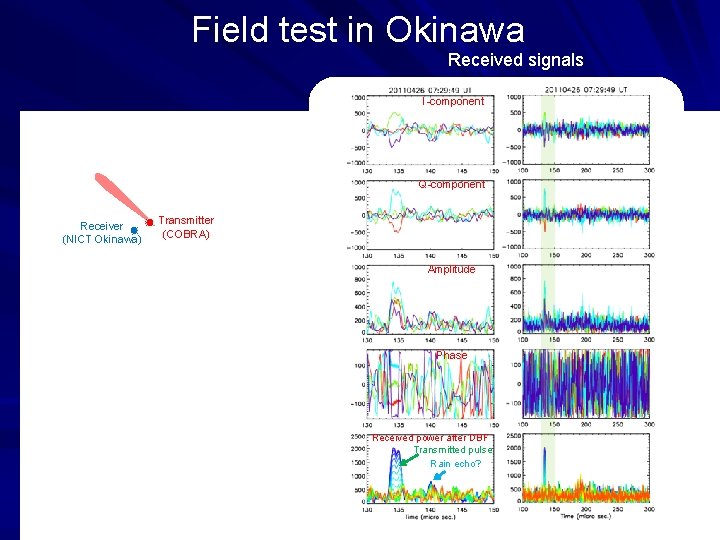
Field test in Okinawa Received signals I-component I Q-component Receiver (NICT Okinawa) Transmitter (COBRA) Q Amplitude COBRA (2011/4/26 07: 45 UT) Phase Received power after DBF Transmitted pulse Rain echo?
Summary ØA new bistatic measurement system is proposed. An array receiving antenna with long spacing (many sharp grating lobes are composed) Digital beam forming (DBF) processing ØIt can be expected that the received power in almost all area is increased and the sidelobe contamination effect can be effectively reduced. First actual experiment with the software radio as the receiver has performed in Okinawa (Antenna gain was not enough). An array antenna which has higher gain is now under construction.
- Slides: 18